Clinical Characteristics of Asthma Combined with COPD Feature
Hea Yon Lee, Ji Young Kang, Hyoung Kyu Yoon, Sook Young Lee, Soon Suk Kwon, Young Kyoon Kim, and Chin Kook Rhee
Division of Allergy and Pulmonary Medicine, Department of Internal Medicine, College of Medicine, The Catholic University of Korea, Seoul, Korea.
Received: July 31, 2013 Revised: November 28, 2013 Accepted: December 5, 2013
Corresponding author: Dr. Chin Kook Rhee, Division of Allergy and Pulmonary Medicine, Department of Internal Medicine,
Seoul St. Mary’s Hospital, College of Medicine, The Catholic University of Korea,
222 Banpo-daero, Seocho-gu, Seoul 137-701, Korea.
Tel: 82-2-2258-6369, Fax: 82-2-599-3589 E-mail: [email protected]
∙ The authors have no financial conflicts of interest.
© Copyright:
Yonsei University College of Medicine 2014 This is an Open Access article distributed under the terms of the Creative Commons Attribution Non- Commercial License (http://creativecommons.org/
licenses/by-nc/3.0) which permits unrestricted non- commercial use, distribution, and reproduction in any medium, provided the original work is properly cited.
Purpose: In clinical practice, some patients with asthma show incompletely re- versible airflow obstruction, resembling chronic obstructive pulmonary disease (COPD). The aim of this study was to analyze this overlap phenotype of asthma with COPD feature. Materials and Methods: A total of 256 patients, over the age of 40 years or more with a diagnosis of asthma, based on either 1) positive re- sponse to bronchodilator: >200 mL forced expiratory volume in 1 s (FEV1)and
>12% baseline or 2) positive methacholine or mannitol provocation test, were en- rolled. Among the asthma patients, we defined the overlap group with incomplete- ly reversible airflow obstruction [postbronchodilator FEV1/forced vital capacity (FVC) <70] at the initial time of admission and continuing airflow obstruction af- ter at least 3 months follow up. We evaluated clinical features, serum eosinophil counts, serum total immunoglobulin (Ig) E with allergy skin prick test, spirometry, methacholine or mannitol provocation challenges and bronchodilator responses, based on their retrospective medical record data. All of the tests mentioned above were performed within one week. Results: The study population was divided into two groups: asthma only (62%, n=159, postbronchodilator FEV1/FVC ≥70) and overlap group (38%, n=97, postbronchodilator FEV1/FVC <70). The overlap group was older, and contained more males and a higher percentage of current or ex-smokers than the asthma only group. Significantly lower FEV1 and higher total lung capacity, functional residual capacity, and residual volume were observed in the overlap group. Finally, significantly lower serum eosinophil count and higher IgE were seen in the overlap group. Conclusion: Our results showed that the over- lap phenotype was older, male asthmatic patients who have a higher lifetime smoking intensity, more atopy and generally worse lung function.
Key Words: Asthma, chronic obstructive pulmonary disease, overlap, airway hy- perresponsiveness
INTRODUCTION
Many older asthma patients have pathobiological and symptomatic features of the overlap phenotype of asthma and chronic obstructive pulmonary disease (COPD), necessitating a re-evaluation of the concept of both diseases as separate conditions.
From a clinical point of view, the overlap phenotype is composed of COPD pa-
pital, aged 41--79 years with a diagnosis of asthma in the set period. The identified cases were checked to ascertain wheth- er they met the following criteria of asthma: Physician’s di- agnosis of asthma by specialists in pulmonary and allergy departments with either 1) positive response to bronchodi- lator: >200 mL forced expiratory volume in 1 s (FEV1) and
>12% baseline and/or 2) positive methacholine or mannitol provocation test. All enrolled patients had at least one chronic persistent respiratory symptom consisting of cough, wheezing, dyspnea and chest tightness worsening at night or in the early morning for more than 3 months. Subjects who did not meet these criteria were excluded. Patients with the following diagnosis, based on history or tests, were excluded: COPD patients (defined by a post-bronchodilator FEV1/forced vital capacity (FVC) ratio of <0.70 due to GOLD criteria12) and with negative bronchodilator and/or bronchoprovocation response, bronchiectasis, tuberculosis destroyed lung, allergic bronchopulmonary aspergillosis, anthracofibrosis, interstitial lung disease, malignancy, and heart failure.
The enrolled study population was divided into two groups according to the presence of airflow obstruction. We de- fined overlap patients who had incompletely reversible air- flow obstruction (postbronchodilator FEV1/FVC <70) at the time of initial admission and continuing airflow obstruction after at least 3 months follow-up regardless of treatment.
Asthma only patients were defined as having postbronchodi- lator FEV1/FVC ≥70. Initial asthma patients with airflow ob- struction who recovered from obstruction (FEV1/FVC ≥70) in their follow-up pulmonary function tests (PFTs) were al- located in the asthma only group. Subjects who did not have follow up lung function results were excluded as they did not meet our definition. The baseline clinical data included demographic data, smoking history, body mass index, height, spirometry, lung volumes, diffusing capacity, methacholine and mannitol provocation challenges, bronchodilator re- sponses (BDRs), serum eosinophil percentage, serum eo- sinophil count, total serum immunoglobulin (Ig) E count and skin test results. All of the tests mentioned above were performed within one week.
Pulmonary function tests
PFTs were performed in all patients by three technicians ex- perienced in lung function testing following American Tho- racic Society (ATS)/European Respiratory Society (ERS) guidelines in a licensed laboratory.13,14 Spirometry and body plethysmography were performed according to current rec- tients with increased reversibility and/or of asthmatics with
fixed or incompletely reversible airflow obstruction. Its prevalence reports recently estimated that about 13--20% of subjects with COPD have the overlap phenotype, with an increasing trend in the elderly population.1-4 Physiological ageing of the lung is associated with a decrease in the static elastic recoil, a decrease in compliance of the chest wall, and a decrease in the strength of respiratory muscles. This can lead to decrease of lung function. Also senile emphysema can occur, contributing to the decrement in expiratory flow with ageing.5
Elderly asthmatics are known to have higher rates of air- way hyperresponsiveness, more severe asthma, and more difficult to control with corticosteroids.6,7 The Dutch Hypoth- esis quotes that asthma itself and airway hyperresponsiveness (AHR) predispose patients to develop COPD later in life.8
Patients with the overlap phenotype are known to have worse lung function, more respiratory symptoms, and a low- er health-related quality of life than either disease alone.9,10 Recently, the diagnostic criteria for the overlap phenotype has been established by the consensus of a group of ex- perts.11 However, this is limited to COPD patients, but not for the asthma with fixed airflow obstruction.
The aim of this study was to analyze clinical characteris- tics and lung function of the overlap phenotype of asthma with COPD feature, in the perspective of asthma patients.
Most of the previous studies were investigated from COPD perspective. The benefit of our study is that we tried to ap- proach overlap in the perspective of asthma as they may have different clinical and functional characteristics to COPD pa- tients with increased reversibility.
MATERIALS AND METHODS
The medical records of all consecutive patients who were di- agnosed with asthma at Seoul St. Mary’s Hospital, The Cath- olic University of Korea, South Korea, between September 2007 and March 2012 were retrospectively reviewed. The study was approved by the Institutional Review Board of the Seoul St. Mary’s Hospital, to evaluate and publish informa- tion from the patients’ records. The requirement for informed consent was waived because of the retrospective nature of the study.
Study subjects and baseline data
We identified all out- and inpatients at Seoul St. Mary’s Hos-
antihistamine for 3 days prior to testing.19 Furthermore, the increase of eosinophils, eosinophil count, and total IgE were analyzed between groups.
Data analysis
Continuous variables are presented as mean±standard error of mean and analyzed using two independent sample t-test.
Categorical variables are presented as frequency and per- centage and analyzed using Pearson’s chi-square tests or Fisher’s exact tests. All tests were two-sided, and p-value
<0.05 was considered statistically significant. All analyses were performed with the SPSS computer package, version 18.0 (SPSS Inc., Chicago, IL, USA).
RESULTS
During the study period, 1898 patients with a suspected di- agnosis of asthma were enrolled. After evaluation, a total of 566 (30%) eligible patients who had asthma according to the definition criteria were included: all relevant clinical data and initial spirometry results were available for these patients. Of these patients, we excluded 310 patients who did not follow up PFTs. Thus, a total of 256 asthma patients (13.4%) were enrolled in the study.
We divided the 256 asthma patients into two groups ac- cording to the presence of airflow obstruction. Finally, 159 (62%) patients were enrolled in the asthma only group and 97 (38%) patients in the overlap group.
Clinical characteristics of enrolled patients
The clinical characteristics of 256 asthma patients are shown in Table 1. The overlap group was older (63.0±0.9 vs. 57.6±
0.7, p<0.01) and had more males (37.1% vs. 18.2%, p<0.01) than the asthma only group. There was higher percentage of current or ex-smokers (46.2% vs. 14.9%, p<0.01) in the overlap group.
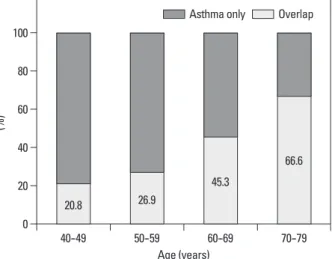
Percentage of patients with the overlap phenotype in dif- ferent age groups are shown in Fig. 1. Among subjects with asthma, the percentage of overlap was 20.8%, 26.9%, 45.3%, and 66.6% in the 40--49, 50--59, 60--69, and 70--79 years age groups, respectively (Fig. 1). The highest percentage was shown in the 70 s.
Allergic test findings
Allergic test results are shown in Table 1. Significantly lower serum eosinophil count (267.8±32.7 vs. 477.5±68.9, p=0.02) ommendations.13,14 The residual volume (RV), functional re-
sidual capacity (FRC) and total lung capacity (TLC) were determined by body plethysmograph. Diffusing capacity of the lung for carbon monoxide (DLCO) was measured in du- plicate by the single-breath method according to ATS/ERS guidelines.15 Post-bronchodilator (BD) FEV1 (ΔFEV1) was measured 15 min after the administration of 400 mcg salbuta- mol using a metered dose inhaler and a large volume spacer.
According to ATS guidelines, medications that can de- crease airway responsiveness were withheld before the test.16 Bronchoprovocation tests
Non-specific bronchial responsiveness was assessed by bron- chial challenge with methacholine chloride and mannitol.
Bronchoprovocation tests using methacholine were per- formed in accordance with ATS guidelines.16 The methacho- line challenge schedule started with an inhalation of saline, followed by increasing concentrations of methacholine up to a cumulative dose of 25 mg/mL. The test was stopped when either the maximum cumulative dose had been reached or FEV1 had fallen by 20% or more. Positive methacholine re- sults were defined as provocative concentration of methacho- line required to decrease FEV1 (PC20) by 20% less than or equal to 16 mg/mL.16
Dry powder mannitol (Aridol; Pharmaxis, Sydney, Aus- tralia) was administered according to the recommendations of the manufacturer, and FEV1 was recorded in line with current guidelines.17 The mannitol challenge schedule start- ed with an inhalation of 0 mg placebo, followed by increas- ing concentrations of mannitol up to a cumulative dose of 635 mg. The challenge was stopped when FEV1 decreased of 15% or more from baseline values or when the maxi- mum cumulative dose of 635 mg had been administered.
Positive mannitol results were defined as PD15 less than or equal to 635 mg.17,18 Patients with severe airflow limitation (FEV1 <50% predicted or <1.0 L) were contraindicated for bronchoprovocation tests. Medications that can decrease airway responsiveness were withheld before the test, ac- cording to ATS guidelines.16
Evaluation of allergy and atopy
Atopy was defined as either at least one positive specific IgE or one positive skin prick test to aeroallergens (cat, dog, house dust mite, grasses, and fungi). Skin prick test was considered positive when there was a 3 mm or larger wheal and/or erythema of 10 mm or more, greater than the nega- tive control. All patients were asked to discontinue using
posed, including positive BDR, eosinophilia in sputum, per- sonal history of asthma before age 40 years, high total IgE level, and a personal history of atopy.11 However, this was investigated from COPD perspective. From the perspective of asthma, overlap phenotype can be defined as asthmatics with fixed airflow obstruction.2 To investigate the overlap phenotype from the perspective of asthma, we excluded COPD patients without asthmatic components.
Previous studies showed that asthma is a risk factor for and higher IgE (332.1±74.0 vs. 199.8±33.4, p=0.03) were
seen in the overlap group. However, there was no significant difference in positive allergic skin test results in either group.
Pulmonary function test findings
Pulmonary function test findings at the time of presentation are shown in Table 2. The overlap group had lower FEV1 (58.0±1.2% vs. 69.4±1.2%, p<0.01), and higher TLC (111.1±2.2% vs. 101.6±1.6%, p<0.01), FRC (125.2±4.0%
vs. 101.9±2.3%, p<0.01), and RV (125.6±6.0% vs. 99.0±
3.9%, p<0.01). There was no significant difference in DLCO values in both groups.
There was no significant difference in AHR with either methacholine or mannitol and BDR in the two groups. How- ever, the mean PC20 (3.9 vs. 6.4, p<0.01), and PD15 (63.2 vs.
236.0, p<0.01) values were significantly lower in the overlap group, as shown in Table 2.
DISCUSSION
It is often difficult to clinically distinguish overlapping COPD and asthma, and there have been many studies to investi- gate the characteristics of such phenotype.1-4,6,20 Diagnostic criteria for this overlap phenotype in COPD have been pro- Table 1. Comparison between Overlap and Asthma Only Group
Overlap (n=97) Asthma only (n=159) p value
Age (yrs) 63.0±0.9 57.6±0.7 <0.01
Male (%) 36 (37.1) 29 (18.2) <0.01
Smoking history
Current or Ex (%) 31 (46.2)* 20 (14.9)† <0.01
Pack yrs 29.5±2.3 25.8±4.2 0.41
Height (cm) 163.0±0.9 159.3±0.6 <0.01
Weight (kg) 63.0±0.9 61.3±0.9 0.19
BMI (kg/m2) 23.7±0.3 24.1±0.3 0.36
Allergy test
Eosinophil (%) 4.1±0.4‡ 6.7±0.7§ <0.01
Eosinophil count 267.8±32.7‡ 477.5±68.9§ 0.02
Total IgE (U/mL) 332.1±74.0|| 199.8±33.4¶ 0.03
Skin test positive 18 (85.7)** 51 (73.9)†† 0.26
BMI, body mass index; SEM, standard error of mean.
Values are mean±SEM or number of patients (%).
*n=67.
†n=134.
‡n=42.
§n=98.
||n=22.
¶n=55.
**n=21.
††n=69.
Fig. 1. The percentage of patients diagnosed with overlap in different age groups. The values above each bar represent the percentage of patients diagnosed with overlap in each age groups.
Age (years) 0
20 40 60 80 100
(%)
40--49 50--59 60--69 70--79
20.8 26.9
45.3
66.6 Asthma only Overlap
also followed this trend. Age is a very important variable when assessing obstructive lung diseases, due to the known changes in lung function that occur with increased age.5 A combination of exercise intolerance, static or dynamic hy- perinflation and senile emphysema in the elderly patient can lead to a decrease in lung function.5 The annual de- crease in FEV1 is approximately 20 mL/year in subjects up to age 40 years and is approximately double that number when an individual’s age is greater than 65 years. The de- crease in FEV1 is slightly greater than that in FVC, particu- larly from 50 to 60 years of age, resulting in a decrease in the FEV1/FVC ratio in older individuals.5,25
Furthermore, there was significant increase of ex-smok- ers in the overlap group. It is known that asthmatics who smoke have more neutrophils in their airways, leading to steroid resistance.19,20 This in turn can lead to more severe symptoms and an accelerated decline in lung function.21,22
Total IgE was significantly increased in the overlap group compared to the asthma only group. Atopic persons often have increased plasma total IgE concentrations, and quanti- tative IgE antibodies may serve as a marker of asthma se- verity.26,27 It has been reported that AHR to methacholine is correlated with the level of total IgE in the serum, which has been observed not only in subjects with asthma and rhi- nitis, but also in asymptomatic subjects.28 Based on these findings, we conclude that more severe degree of atopy in the development of fixed airflow obstruction,8,21 while ciga-
rette smoking is the main risk factor for the development of persistent airflow obstruction in asthmatics.22 Asthmatics with a history of smoking, exhibit higher numbers of neu- trophils in bronchoalveolar lavage fluid and biopsies.23,24 In our present study, we defined the overlap group within our enrolled asthma patients, which is different from other stud- ies. In the diagnosis of asthma, we excluded physician’s di- agnosis of asthma without either positive BD or provoca- tion results because of the potential inaccuracy. To try and differentiate overlap, which shows persistent irreversible obstruction, from severe asthma with reversible airflow ob- struction, patients who recovered airflow obstruction at fol- low up PFTs (at least 3 months interval) were designated in the asthma group. Patients who did not have follow-up PFTs were excluded. Of the initial 566 asthma patients, we only enrolled 256 patients with follow up PFTs.
In our asthma clinic cohort, the prevalence of overlap was approximately half of that of asthma only (37.9% vs. 62.1%).
This finding is consistent with a previous study that the prev- alence of overlap is nearly half of that of asthma (24.3% vs.
52.9%), representing a significant proportion of patients with both phenotypes.6 In our cohort, the highest percent- age was observed in patients in their 70 s, and large popula- tion studies found that the prevalence of this overlap pheno- type increases with age.4,6 In our study, the age distribution Table 2. Comparison between Overlap and Asthma Only Group
Overlap (n=97) Asthma only (n=159) p value
Pulmonary function test
FEV1 (% pred) 58.0±1.2 69.4±1.2 <0.01
FVC (% pred) 82.4±1.4 80.8±1.1 0.38
Post BD FEV1/FVC 55.2±0.8 69.4±0.6 <0.01
TLC (% pred)* 111.1±2.2 101.6±1.6 <0.01
FRC (% pred)* 125.2±4.0 101.9±2.3 <0.01
RV (% pred)* 125.6±6.0 99.0±3.9 <0.01
DLCO (%)* 91.7±3.2 90.8±2.0 0.80
Positive BDR 90 (92.7%) 142 (89.3%) 0.37
Positive response to
Methacholine 62 (87.3%)† 93 (66.0%)‡ 0.36
Mannitol 5 (7.0%)† 35 (24.8%)‡ 0.36
PC20 (mg/mL) 4.0±0.5 6.4±0.6 <0.01
PD15 (mg) 63.2±12.9 236.0±30.6 <0.01
BDR, bronchodilator response; TLC, total lung capacity; FRC, functional residual capacity; RV, residual volume; BD, bronchodilator; SEM, standard error of mean; DLCO, difffusing capacity of the lung for carbon monoxide; FEV1, forced expiratory volume in 1 s; FVC, forced vital capacity.
Values are mean±SEM or number of patients (%).
Positive BDR: positive response to bronchodilator: >200 mL FEV1 and >12% baseline.
*Overlap (n=39), asthma only (n=66).
†n=71.
‡n=141.
mains unclear and needs to be studied further.
One limitation of this study is the possibility that selec- tion bias might have influenced the significance of our find- ings, given its retrospective nature. However, a strict diag- nostic criteria for asthma was applied to the patients during the enrolling process. As a result, only 13.4% (256 cases) of patients out of 1898 cases of suspected asthma, were en- rolled in the study. Thus, we are quite certain that our diag- nosis of asthma was reliable, as patients with only the phy- sician’s diagnosis of asthma have potential inaccuracy and they were excluded. In our study, we evaluated the differ- ences in lung functions and airway hyperresponsiveness in both groups, and therefore, initial and follow up PFTs were essential to our study. The patients without follow up PFT results were also excluded. Another limitation is the lack of evaluation in inflammatory markers, such as sputum eosin- ophil and neutrophil counts or exhaled NO. Comparison of these markers would have assisted in comparing the patho- logic differences in these two groups.
In conclusion, the overlap phenotype was found to be old- er, male asthmatic patients who had a higher lifetime smok- ing intensity and an increased total serum IgE. Lung func- tions in this group showed lower FEV1 and higher TLC, FRC and RV which suggests more air trapping. The causes of differences between the two groups may be due to the combination of aging, smoking and airway remodeling.
Further studies on this overlap phenotype are needed to es- tablish definite diagnostic criteria in asthmatic patients.
REFERENCES
1. Soriano JB, Davis KJ, Coleman B, Visick G, Mannino D, Pride NB. The proportional Venn diagram of obstructive lung disease:
two approximations from the United States and the United King- dom. Chest 2003;124:474-81.
2. Gibson PG, Simpson JL. The overlap syndrome of asthma and COPD: what are its features and how important is it? Thorax 2009;64:728-35.
3. Hardin M, Silverman EK, Barr RG, Hansel NN, Schroeder JD, Make BJ, et al. The clinical features of the overlap between COPD and asthma. Respir Res 2011;12:127.
4. de Marco R, Pesce G, Marcon A, Accordini S, Antonicelli L, Bu- giani M, et al. The coexistence of asthma and chronic obstructive pulmonary disease (COPD): prevalence and risk factors in young, middle-aged and elderly people from the general population.
PLoS One 2013;8:e62985.
5. Janssens JP, Pache JC, Nicod LP. Physiological changes in respi- ratory function associated with ageing. Eur Respir J 1999;13:197- 6. Zeki AA, Schivo M, Chan A, Albertson TE, Louie S. The Asthma-205.
asthma patients may lead to the development of mixed phe- notype.
In the present study, we compared pulmonary function between the two groups, and observed a lower FEV1 in the overlap group. This could be explained by the fact that the overlap group had more smokers than the asthma only group. Moreover, asthma itself is significantly associated with an increased risk for chronic bronchitis, emphysema and COPD compared to nonasthmatic subjects, and smok- ing significantly accelerates the decline in lung function in subjects with or without asthma.21,29 It is well known that cigarette smoking accelerates the loss of lung function by up to 50 mL per year.30 Its effect may be greater in asthmat- ic smokers, since they have more severe asthma symptoms, accelerated decline in FEV1, reduced response to corticoste- roids and increased neutrophilic airway inflammation.31-34
Previous studies have suggested that factors associated with accelerated lung function decline in asthma also in- clude more severe AHR, adult-onset asthma, frequent severe exacerbations, persistent symptoms, baseline airflow ob- struction and persistent elevation of exhaled nitric oxide (NO).35-37 In the present study, we found more severe AHR in the overlap group which could be an another contributing factor of lower pulmonary function and irreversible airway obstruction.
We evaluated lung volume in both groups (asthma only;
n=66, overlap; n=39). In the overlap group, TLC, FRC, and RV were significantly increased compared to the asthma only group, indicating that air trapping was more severe in the overlap group, in good agreement with a previous study that the overlap group had more gas trapping on expiratory chest CT scans compared to subjects with COPD alone.3 Un- fortunately, we were not able to evaluate CT imaging studies since this was a retrospective study. More imaging studies are needed to differentiate the two groups in the future.
The findings in the present study led us to suggest that the mechanisms behind the differences between the two groups involve the combination of aging, cigarette smoking and air- way remodeling. First, aging has an effect on decreased lung function, as seen previously.5,25 Second, cigarette smoking in asthmatic patients can significantly accelerate the decline in lung function and increase the risk of COPD.21,29 Third, asth- matic patients can develop airway remodeling as a conse- quence of persistent airway inflammation which can lead to fixed airflow obstruction. Therefore, these three factors may contribute to the manifestation of overlap syndrome. To what extent they individually contribute to the disease re-
22. Lee JH, Haselkorn T, Borish L, Rasouliyan L, Chipps BE, Wenzel SE. Risk factors associated with persistent airflow limitation in se- vere or difficult-to-treat asthma: insights from the TENOR study.
Chest 2007;132:1882-9.
23. Wenzel SE, Szefler SJ, Leung DY, Sloan SI, Rex MD, Martin RJ.
Bronchoscopic evaluation of severe asthma. Persistent inflamma- tion associated with high dose glucocorticoids. Am J Respir Crit Care Med 1997;156(3 Pt 1):737-43.
24. Louis R, Lau LC, Bron AO, Roldaan AC, Radermecker M, Djukanović R. The relationship between airways inflammation and asthma severity. Am J Respir Crit Care Med 2000;161:9-16.
25. Schmidt CD, Dickman ML, Gardner RM, Brough FK. Spiromet- ric standards for healthy elderly men and women. 532 subjects, ages 55 through 94 years. Am Rev Respir Dis 1973;108:933-9.
26. Gould HJ, Sutton BJ, Beavil AJ, Beavil RL, McCloskey N, Coker HA, et al. The biology of IGE and the basis of allergic disease.
Annu Rev Immunol 2003;21:579-628.
27. Wickman M. Experience with quantitative IgE antibody analysis in relation to allergic disease within the BAMSE birth cohort--to- wards an improved diagnostic process. Allergy 2004;59 Suppl 78:30-1.
28. Sears MR, Burrows B, Flannery EM, Herbison GP, Hewitt CJ, Holdaway MD. Relation between airway responsiveness and se- rum IgE in children with asthma and in apparently normal chil- dren. N Engl J Med 1991;325:1067-71.
29. Lange P, Parner J, Vestbo J, Schnohr P, Jensen G. A 15-year fol- low-up study of ventilatory function in adults with asthma. N Engl J Med 1998;339:1194-200.
30. Anthonisen NR, Connett JE, Murray RP. Smoking and lung func- tion of Lung Health Study participants after 11 years. Am J Respir Crit Care Med 2002;166:675-9.
31. Chaudhuri R, Livingston E, McMahon AD, Thomson L, Borland W, Thomson NC. Cigarette smoking impairs the therapeutic re- sponse to oral corticosteroids in chronic asthma. Am J Respir Crit Care Med 2003;168:1308-11.
32. Thomson NC, Chaudhuri R, Livingston E. Active cigarette smok- ing and asthma. Clin Exp Allergy 2003;33:1471-5.
33. Althuis MD, Sexton M, Prybylski D. Cigarette smoking and asth- ma symptom severity among adult asthmatics. J Asthma 1999;36:
257-64.
34. Siroux V, Pin I, Oryszczyn MP, Le Moual N, Kauffmann F. Rela- tionships of active smoking to asthma and asthma severity in the EGEA study. Epidemiological study on the Genetics and Environ- ment of Asthma. Eur Respir J 2000;15:470-7.
35. ten Brinke A, Zwinderman AH, Sterk PJ, Rabe KF, Bel EH. Fac- tors associated with persistent airflow limitation in severe asthma.
Am J Respir Crit Care Med 2001;164:744-8.
36. Bai TR, Vonk JM, Postma DS, Boezen HM. Severe exacerbations predict excess lung function decline in asthma. Eur Respir J 2007;
30:452-6.
37. van Veen IH, Ten Brinke A, Sterk PJ, Sont JK, Gauw SA, Rabe KF, et al. Exhaled nitric oxide predicts lung function decline in difficult-to-treat asthma. Eur Respir J 2008;32:344-9.
COPD Overlap Syndrome: A Common Clinical Problem in the Elderly. J Allergy (Cairo) 2011;2011:861926.
7. Enright PL. The diagnosis and management of asthma is much tougher in older patients. Curr Opin Allergy Clin Immunol 2002;2:
175-81.
8. Orie NG. The dutch hypothesis. Chest 2000;117(5 Suppl 1):299S.
9. Kauppi P, Kupiainen H, Lindqvist A, Tammilehto L, Kilpeläinen M, Kinnula VL, et al. Overlap syndrome of asthma and COPD predicts low quality of life. J Asthma 2011;48:279-85.
10. Miravitlles M, Soriano JB, Ancochea J, Muñoz L, Duran-Tauleria E, Sánchez G, et al. Characterisation of the overlap COPD-asthma phenotype. Focus on physical activity and health status. Respir Med 2013;107:1053-60.
11. Soler-Cataluña JJ, Cosío B, Izquierdo JL, López-Campos JL, Marín JM, Agüero R, et al. Consensus document on the overlap phenotype COPD-asthma in COPD. Arch Bronconeumol 2012;
48:331-7.
12. Vestbo J, Hurd SS, Agustí AG, Jones PW, Vogelmeier C, Anzueto A, et al. Global strategy for the diagnosis, management, and pre- vention of chronic obstructive pulmonary disease: GOLD execu- tive summary. Am J Respir Crit Care Med 2013;187:347-65.
13. Miller MR, Hankinson J, Brusasco V, Burgos F, Casaburi R, Coates A, et al. Standardisation of spirometry. Eur Respir J 2005;
26:319-38.
14. Wanger J, Clausen JL, Coates A, Pedersen OF, Brusasco V, Bur- gos F, et al. Standardisation of the measurement of lung volumes.
Eur Respir J 2005;26:511-22.
15. Macintyre N, Crapo RO, Viegi G, Johnson DC, van der Grinten CP, Brusasco V, et al. Standardisation of the single-breath determi- nation of carbon monoxide uptake in the lung. Eur Respir J 2005;
26:720-35.
16. Crapo RO, Casaburi R, Coates AL, Enright PL, Hankinson JL, Ir- vin CG, et al. Guidelines for methacholine and exercise challenge testing-1999. This official statement of the American Thoracic So- ciety was adopted by the ATS Board of Directors, July 1999. Am J Respir Crit Care Med 2000;161:309-29.
17. Brannan JD, Anderson SD, Perry CP, Freed-Martens R, Lassig AR, Charlton B, et al. The safety and efficacy of inhaled dry pow- der mannitol as a bronchial provocation test for airway hyperre- sponsiveness: a phase 3 comparison study with hypertonic (4.5%) saline. Respir Res 2005;6:144.
18. Anderson SD, Charlton B, Weiler JM, Nichols S, Spector SL, Pearlman DS, et al. Comparison of mannitol and methacholine to predict exercise-induced bronchoconstriction and a clinical diag- nosis of asthma. Respir Res 2009;10:4.
19. Bernstein IL, Li JT, Bernstein DI, Hamilton R, Spector SL, Tan R, et al. Allergy diagnostic testing: an updated practice parameter.
Ann Allergy Asthma Immunol 2008;100(3 Suppl 3):S1-148.
20. Kim TB, Oh YM, Chang YS, Cho YS, Jang AS, Cho SH, et al.
The reality of an intermediate type between asthma and COPD in practice. Respir Care 2012;57:1248-53.
21. Silva GE, Sherrill DL, Guerra S, Barbee RA. Asthma as a risk fac- tor for COPD in a longitudinal study. Chest 2004;126:59-65.