Ⓒ The Korean Society of Soil Science and Fertilizer. This is an Open Access article distributed under the terms of the Creative Commons Attribution Non- Commercial License (http://creativecommons.org/licenses/by-nc/4.0) which permits unrestricted non-commercial use, distribution, and reproduction in any medium, provided the original work is properly cited.
Korean J ournal of S oil S cience and F ertilizer
Article https://doi.org/10.7745/KJSSF.2020.53.4.614
pISSN : 0367-6315 eISSN : 2288-2162
Comparison of Pollution Indicies in Assessing the Heavy Metal(loid)s Pollution of Arable Soils Adjacent to Industrial Complex in Gyenggi-do
Seok Soon Jeong1, Hyuck Soo Kim2, Sang-Phil Lee3, Si Young Choi4, Ji Eun Lee4, Sung Chul Kim5, and Jae E. Yang6*
1Reasearcher, Dept. of Biological Environment, Kangwon National University, Chuncheon 24341, Korea
2Professor, Dept. of Biological Environment, Kangwon National University, Chuncheon 24341, Korea
3Post-Doct. Fellow, Dept. of Biological Environment, Kangwon National University, Chuncheon 24341, Korea
4Graduate Students, Dept. of Biological Environment, Kangwon National University, Chuncheon 24341, Korea
5Professor, Dept. of Bio-Environment Chem., Chungnam National University, Daejeon 34134, Korea
6Professor, Dept. of Biological Environment, Kangwon National University, Chuncheon 24341, Korea
*Corresponding author: [email protected]
A B S T R A C T Received: November 4, 2020
Revised: November 22, 2020 Accepted: November 23, 2020
ORCID Seok Soon Jeong
http://orcid.org/0000-0003-2311-8784
Soils adjacent to the industrial complexes are known to be vulnerable to pollution with the diverse pollutant sources. This research assessed pollution level in the arable soils located nearby industrial complexes using different pollution indices. Both surface (0 - 15 cm) and subsurface (15 - 30 cm) soil samples were taken from 150 agricultural fields located nearby 15 industrial complexes. Total concentrations of As, Cd, Cu, Ni, Pb, Zn, and Hg in soils were determined after extracting with aqua regia and mostly were lower than the pollution threshold criteria for the agricultural soil designated by the Korean Soil Environment Conservation Act. The calculated PI values for As indicated the unpolluted status but those for all other metals were in the ranges of low to moderately polluted. The Igeo values for Cd and Zn indicated soils were in the unpolluted to moderately polluted ranges, but those for other metals were unpolluted. The Igeo evaluated the pollution level lower than PI due to the geochemical correction factor. The average PINemerow values for surface soil and subsurface soils were 1.26 and 0.73, respectively, indicating a higher pollution in surface soil than subsurface soil. Ranges of PINemerow values showed a wide spectrum of pollution level from clean to heavy pollution, depending on soil sampling sites. All pollution indices indicate that levels of pollution for Cd were higher than other metals. Also four pollution indices exhibited different levels of pollution, even though they are equally based on the total concentrations of heavy metals in soil. This discrepancy might be derived from the fact whether a pollution index considers the geochemical background level, an individual metal or overall metals. The results suggest that a suitable pollution index for the pollution assessment cannot be specified based on the total concentrations of metal in the arable soil.
Keywords: Heavy metal(loid)s, Industrial complex, Single pollution index (PI), Geoaccumulation Index (Igeo), Nemerow Pollution Index (PINemerow)
(A) PI (B) Igeo (C) PINemerow
Pollution assessments of the arable soils using (A) single pollution index and (B) geoaccumulation index for each heavy metals, and (C) Nemerow pollution index for the integrated heavy metals in each industrial complex.
Introduction
중금속 (heavy metal)은 일반적으로 비중이 5 g cm-3 이상인 금속물질들을 말하며, 카드뮴 (Cd), 구리 (Cu), 납 (Pb) 및 아연 (Zn) 등이 있다. 비소 (As)의 경우 준금속(metalloid)이지만 화학적 특성과 환경 중에서 동태가 중금속과 유사 하여 중금속으로 분류되기도 한다 (Chen et al., 1999).
토양 중 중금속은 자연적인 요인과 인위적인 요인으로 발생한다. 자연적인 요인은 본래 모암이 함유하고 있는 중금 속이 풍화과정을 거쳐 발생하는 것이며 인위적인 요인은 채광, 제련, 도금 등 다양한 산업활동을 통해 발생하는 것을 말한다 (Nriagu, 1996; Li et al., 2009; Yang et al., 2018). 전 세계적으로 급격한 산업화가 일어나면서 인위적인 요인 으로 인한 중금속의 발생량이 더 많으며 과도한 양이 토양으로 유입되었을 때 토양의 질이 저하되고 결과적으로 토양 의 생산성이 감소하게 된다 (Li et al., 2009; Yang et al., 2018; Zwolak et al., 2019).
중금속으로 오염된 농경지에서 재배한 작물을 지속적으로 섭취할 경우 체내에 중금속이 축적되어 발암성, 신경독 성, 유전자 변이 등 다양한 건강 문제를 초래할 수 있다. 특히, 어린이나 임산부는 중금속에 의한 독성에 취약한 계층이 기 때문에 각별한 주의가 필요하다 (Wojciechowska-Mazurek et al., 2008; Shaheen et al., 2016).
우리나라는 1960년대 이후 본격적인 산업화가 이루어지면서 대규모 산업단지가 형성되었고 한국산업단지공단 (KICOX: www.kicox.or.kr)에 따르면 최근 5년간 50개, 34개, 31개, 18개, 13개 산업단지가 형성되어 증가폭은 감소 하였으나 지속적으로 산업단지가 형성되고 있다. 산업단지 인근에 위치한 농경지의 경우 오염에 노출될 가능성이 크 므로 이러한 취약농경지를 대상으로 환경부에서는 1999년부터 중금속 오염도 조사 및 평가를 실시해왔다 (Kim et al., 2018).
국내 선행연구 결과를 살펴보면 충청지역 15개 산업단지 인근 농경지 토양 중 중금속 함량분석 결과 As 2.99 mg kg-1, Cd 0.23 mg kg-1, Cu 9.35 mg kg-1, Ni 9.26 mg kg-1, Pb 10.18 mg kg-1 및 Zn 52.9 mg kg-1 으로 토양오염우려기 준 이하로 조사되었다 (Min et al., 2016). 경상지역의 경우 10개 산업단지 인근 농경지 토양 중 중금속 함량분석결과 As 9.8 mg kg-1, Cd 1.0 mg kg-1, Cu 25.4 mg kg-1, Ni 25.3 mg kg-1, Pb 29.8 mg kg-1 및Zn 89.1 mg kg-1으로 우려기준 을 초과하지 않았으나 우리나라 농경지 토양 중 평균 중금속 함량보다 높으며 농산물의 중금속 안정성을 높이기 위해 토양개량이 필요하다고 시사하였다 (Kim et al., 2018). Lee et al. (2019)은 강원, 충남, 전남, 경남지역 소재 산업단지 인근 취약농경지를 대상으로 대규모 중금속 오염도 조사 및 평가를 수행하였다. 취약농경지 이외에도 부산 공영 텃밭 에 대한 중금속 함량분석결과 As 3.87 mg kg-1, Cd 0.58 mg kg-1, Cu 32.0 mg kg-1, Ni 9.5 mg kg-1, Pb 29.1 mg kg-1, Zn 167.9 mg kg-1 및 Hg 0.08 mg kg-1으로 나타났으며 대부분은 토양오염우려기준 이하였으나 일부 지점에서 Pb와 Zn의 농도가 기준치를 초과한 것으로 나타나 산업단지 인근뿐만 아니라 도심지에서도 오염이 발생할 가능성이 있다 는 것을 시사하였다 (Kwag et al., 2019).
토양에 존재하는 중금속의 분석은 결과의 활용목적에 따라 유효태 (bioavailable) 와 총량 (total contents) 중금속 분석으로 구분할 수 있는 데 유효태 중금속은 식물에 의해 흡수될 수 있는 형태만을 분석하기 때문에 잠재적인 독성을 반영할 수 없어 총량 분석을 통한 오염도 평가가 널리 활용되고 있다.
토양 중금속 오염도 평가 방법은 크게 두 가지 방법이 있다. 첫 번째 방법은 중금속 총량을 분석하여 환경부 토양오 염우려기준과 대책기준과 같이 설정한 기준에 따라 오염여부를 평가하는 방법이다. 두 번째 방법은 지화학적 특성을 반영한 오염지표를 이용한 오염도 평가 방법이다 (Kim et al., 2018; Kowalska et al., 2018).
현재 우리나라에서 오염도 평가 방법은 첫 번째 방법인 중금속 총농도를 분석하는 방법을 채택하고 있다. 하지만
이러한 방법은 우리나라 토양의 지화학적 특성을 반영하지 못한다는 한계점이 있다. 반면에, 오염지표를 이용한 방법 은 토양의 지화학적 특성을 반영하기 때문에 보다 유연한 오염도 평가를 수행할 수 있다. 그 중 오염도를 평가하기 위 해 가장 널리 사용되고 있는 방법으로는 single pollution index (PI), geoaccumulation index (Igeo) 및 Nemerow pollution index (PINemerow)등이 있다 (Kowalska et al., 2018).
PI는 표토의 중금속별 오염정도를 평가하기 위해 제안된 방법으로 지화학적 중금속 배경농도와 토양 중 중금속 농 도의 비로 산출하기 때문에 편리하며 각 지역 실정에 맞는 배경농도를 도입할 수 있다는 장점이 있다 (Li and Yang, 2008; Varol, 2011; Ololade, 2014; Hu et al., 2017). 하지만 자연현상에 의한 다양한 변수를 고려하지 않고 중금속의 유효도를 설명하기에는 부족하다는 한계점이 있다. Igeo 또한 토양 중 중금속별 오염도 수준을 평가하기 위해 제안된 방법으로 지화학적 중금속 배경농도를 이용한다 (Abrahim and Parker, 2008; Begum et al., 2014; Chen et al., 2015;
Inengite et al., 2015). 다만, 중금속의 지질기원에 의한 변수를 보정하기 위한 계수를 이용하며 지수함수로 산출한다 는 점에서 PI와 차이가 있다. PI와 Igeo는 각 중금속별 오염도를 평가할 수 있으나 오염도를 통합적으로 파악하기에는 어려움이 있다. Nemerow pollution index (PINemerow)는 중금속에 대한 통합적인 평가를 하기 위하여 제안된 방법으로 PI의 평균값과 최대값을 기반으로하여 산출한다 (Inengite et al., 2015; Hu et al., 2017). 때문에, 분석 대상이 되는 중 금속에 의한 전체적인 오염도를 파악할 수 있지만 개별 중금속에 의한 오염을 특정하기에는 어려움이 있다.
앞서 설명한 오염지표에 대하여 어떠한 것을 사용하여야 하는지 정해진 바는 없으며 연구목적이나 지역 특이성 등 을 고려하여 적합한 오염도 평가방법을 선택할 수 있다. 그러나 동일한 총 함량 분석 농도에 대해 다양한 오염지표를 적용하였을 때 중금속 오염도가 어떻게 평가되는지 비교할 필요가 있다. 따라서 본 연구에서는 경기도 소재 산업단지 인근 농경지를 대상으로 중금속별 총 함량을 측정하고 이를 다양한 지수화 방법을 이용하여 오염도를 비교, 평가하고 자 하였다.
Materials and Methods
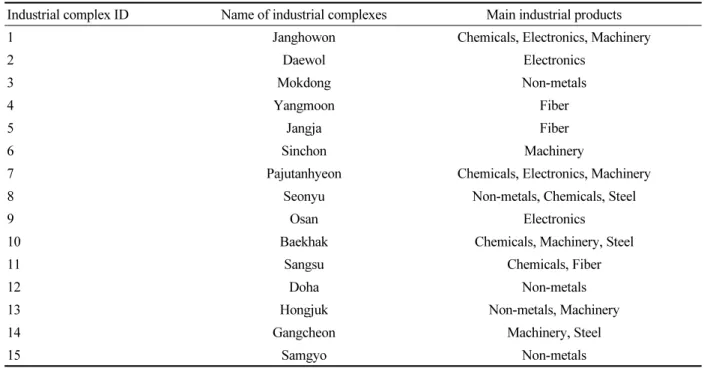
토양시료 채취 토양시료는 경기도 소재 15개 산업단지 인근의 농경지로부터 채취하였다 (Table 1). 산업단지를 중심으로 반경 1 km 이내에 임의의 10개 필지를 선정하여 표토 (0 - 15 cm)와 심토 (15 - 30 cm)를 각각 150점 (10개 필지 × 15개 산업단지) 채취하였다. 채취한 토양은 실험실로 운반 후 그늘에서 풍건하였고, 150 µm (100 mesh)로 체 거름하여 사용하였다.
비소 및 중금속 총함량 분석 토양 중 비소 및 중금속 총함량 분석은 토양오염공정시험법 (ES 07400.2c)에 준 하여 다음과 같이 수행하였다. 토양 3 g에 aqua regia (HCl 21 mL : HNO3 7 mL)를 가하여 흑연블럭상에서 가열, 분해 하였다. 분해가 완료되면 상온에서 냉각하여 HM No. 51 여과지로 여과하고 0.5 M HNO3로 100 mL 표선하여 분석 용액으로 사용하였고, As, Cd, Cu, Ni, Pb, Zn 및 Hg 함량은 각각 ICP-OES (iCAP 6300 Duo, Thermo Fisher Scientific, USA)와 mercury analyzer (Hydra II AA, Teledyne Leeman Labs, USA)로 정량하였다.
중금속 분석의 QA/QC 중금속 분석결과에 대한 신뢰성을 확보하기 위하여 표준인증물질 (BAM-U112a)을 위 와 동일한 방법으로 분석하여 회수율을 확인하였다. 분석결과 평균 회수율은 96.6%이었고 Ni을 제외하고 90% 이상 이었다 (Table 2).
Table 1. Lists of the industrial complexes located in Gyeeongi-do from where soil samples were taken.
Industrial complex ID Name of industrial complexes Main industrial products
1Janghowon Chemicals, Electronics, Machinery
2 Daewol Electronics
3 Mokdong Non-metals
4 Yangmoon Fiber
5 Jangja Fiber
6 Sinchon Machinery
7 Pajutanhyeon Chemicals, Electronics, Machinery
8 Seonyu Non-metals, Chemicals, Steel
9 Osan Electronics
10 Baekhak Chemicals, Machinery, Steel
11 Sangsu Chemicals, Fiber
12 Doha Non-metals
13 Hongjuk Non-metals, Machinery
14 Gangcheon Machinery, Steel
15 Samgyo Non-metals
Table 2. Recovery percentages of heavy metal concentrations in samples as compared to those in certified reference material (BAM-U112a).
Heavy metals
Certified values Measured values Recovery RSD†
Mass farction ± U‡ Mean ± SD§ Mean ± SD Mean ± SD
mg kg-1 mg kg-1 % %
As 10.3 ± 0.5 9.74 ± 0.78 93.1 ± 7.4 3.4 ± 1.6
Cd 4.12 ± 0.15 4.33 ± 0.12 104.9 ± 3.1 0.6 ± 0.3
Cu 75.5 ± 3.170.9 ± 2.4 94.0 ± 3.6 0.5 ± 0.2
Ni 10.1 ± 0.5 8.4 ± 0.3 83.4 ± 3.0 0.7 ± 0.5
Pb 198 ± 8 191.7 ± 6.6 96.3 ± 3.5 0.6 ± 0.3
Zn 198 ± 6 201.3 ± 12.7 100.9 ± 6.8 0.2 ± 0.1
Hg 16.3 ± 1.0 17.5 ± 0.5 103.7 ± 3.1 2.2 ± 0.6
†RSD: relative standard deviation.
‡U: uncertainty (level of confidence of applroximately 95%).
§SD: standard deviation.
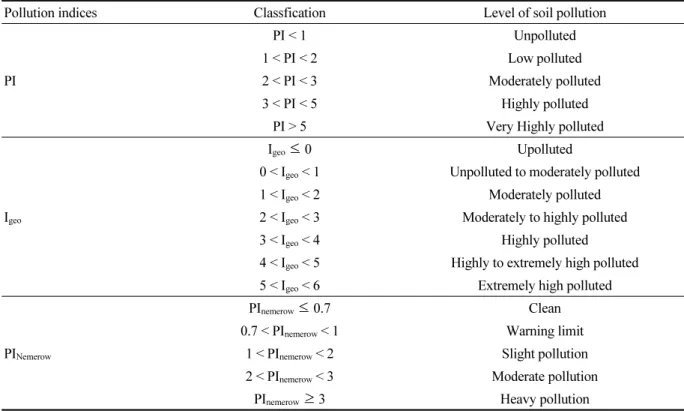
중금속 오염도평가 산업단지 인근 중금속별 오염도를 평가하기 위해 single pollution index (PI)와 geoaccumu- lation index (Igeo)를 산출하였다. PI는 토양 중 중금속의 배경농도를 이용하여 산출하며 식은 (Eq. 1)과 같다. 배경농 도는 2018년도 토양측정망 조사결과의 자연배경농도값을 이용하였으며 (ME, 2019) 산출된 PI 값에 따라 5개의 오염 등급으로 분류하였다 (Table 3).
Table 3. Indicies of PI, Igeo and PINemerow used to define the level of soil pollution.
Pollution indices Classfication Level of soil pollution
PI
PI < 1Unpolluted
1 < PI < 2 Low polluted
2 < PI < 3 Moderately polluted
3 < PI < 5 Highly polluted
PI > 5 Very Highly polluted
Igeo
Igeo ≤ 0 Upolluted
0 < Igeo < 1Unpolluted to moderately polluted 1 < Igeo < 2 Moderately polluted 2 < Igeo < 3 Moderately to highly polluted 3 < Igeo < 4 Highly polluted
4 < Igeo < 5 Highly to extremely high polluted 5 < Igeo < 6 Extremely high polluted
PINemerow
PInemerow ≤ 0.7 Clean
0.7 < PInemerow < 1Warning limit 1 < PInemerow < 2 Slight pollution 2 < PInemerow < 3 Moderate pollution
PInemerow ≥ 3 Heavy pollution
PI = (Eq. 1)
Igeo 또한 배경농도를 기반으로 하여 산출하며 식은 (Eq. 2)와 같다. 배경농도는 PI와 동일한 값을 적용하였으며 산 출식 분모의 1.5는 지질에 의한 영향을 보정하기 위한 계수이다. 산출된 Igeo 값에 따라 7개의 오염등급으로 분류하였 다 (Table 3).
Igeo = log (Eq. 2)
Nemerow pollution index (PINemerow)는 중금속별 산출된 PI를 활용하여 통합적인 오염도를 평가하는 방법으로 산 출식은 (Eq. 3)과 같다. 산출된 PINemerow 값에 따라 5개의 오염등급으로 분류하였다 (Table 3).
PINemerow =
∑
(Eq. 3)통계분석 SPSS (Ver. 24)를 이용하여 Levene 검정, t 검정 및 일원배치 분산분석 (One-way ANOVA)를 수행하 였으며 사후검증에는 Duncan을 적용하였다. 모든 분석은 P < 0.05 유의수준에서 수행하였다.
Table 4. Total concentrations of heavy metal(loid)s in arable soils adjacent to industrial complexes.
Soil As Cd Cu Ni Pb Zn Hg
Surface (n = 150)
Average 4.74 0.4120.5 17.2 24.3 128.3 0.06
Max 15.30 2.74 122.8 47.9 104.3 1168.4 0.77
Min 0.00 0.10 0.0 2.0 7.3 57.4 0.00
Sub (n = 150)
Average 4.98 0.38 19.0 17.7 24.5 120.9 0.07
Max 14.14 1.35 127.3 49.2 93.7 1202.4 1.85
Min 0.00 0.06 0.0 1.8 6.4 46.0 0.00
Total Average 4.86 0.39 19.7 17.4 24.4 124.6 0.06
Natural abundances† 5.38 0.13 17.57 16.47 18.53 72.47 0.04
†Soil monitoring network and soil pollution survey (ME, 2019).
Table 5. Statistical defferences of each metal concentration in between surface and subsurface soils by Levene and t-test.
Heavy metal Levene’s test† t-test
F‡ P§ t P
As 0.453 0.502 -0.695 0.487
Cd 0.499 0.4810.960 0.338
Cu 0.068 0.794 0.754 0.452
Ni 2.174 0.141 -0.367 0.714
Pb 0.111 0.739 -0.161 0.872
Zn 0.066 0.798 0.653 0.514
Hg 1.055 0.305 -0.339 0.735
†Statistical test for the assessing equality of variances of data.
‡F: F value.
§P: probability of significant differences.
Results
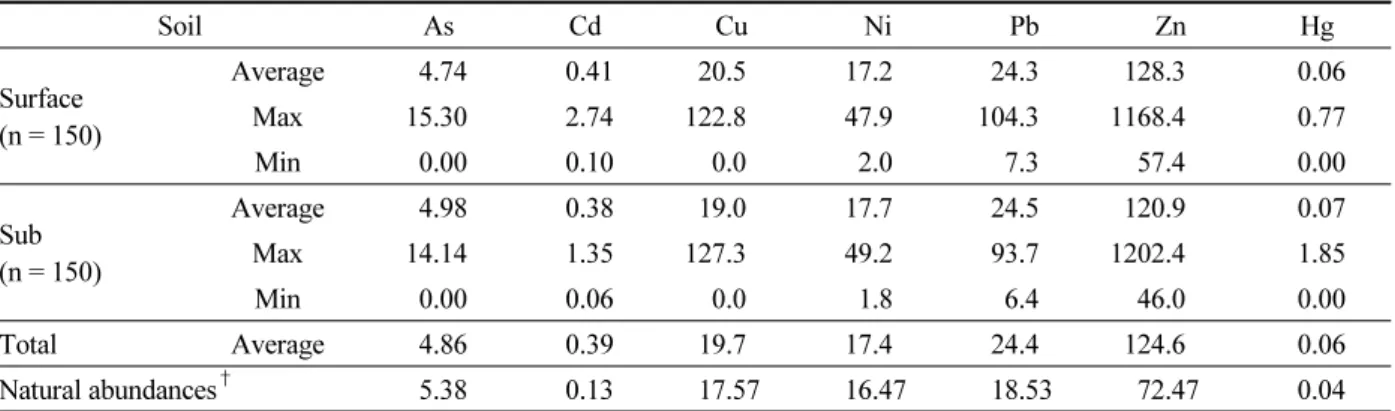
중금속 총함량 토양 중 중금속 총함량 분석결과 평균 농도로는 As 4.86 mg kg-1, Cd 0.39 mg kg-1, Cu 19.7 mg kg-1, Ni 17.4 mg kg-1, Pb 24.4 mg kg-1, Zn 124.6 mg kg-1 및 Hg 0.06 mg kg-1으로 Cd과 Zn 제외한 중금속은 2018년 도 토양측정망 자연배경농도 (ME, 2019)와 유사한 것으로 나타났다 (Table 4).
지점마다 표토와 심토간에 각 중금속별 농도 차이가 없는 것으로 나타났다 (Table 5). 이 분석치를 우리나라 토양환 경보전법 토양오염기준 1지역 (농경지)을 적용한 결과 Zn이 1개 지점에서 대책기준 (Zn: 900 mg kg-1)을 초과하였다.
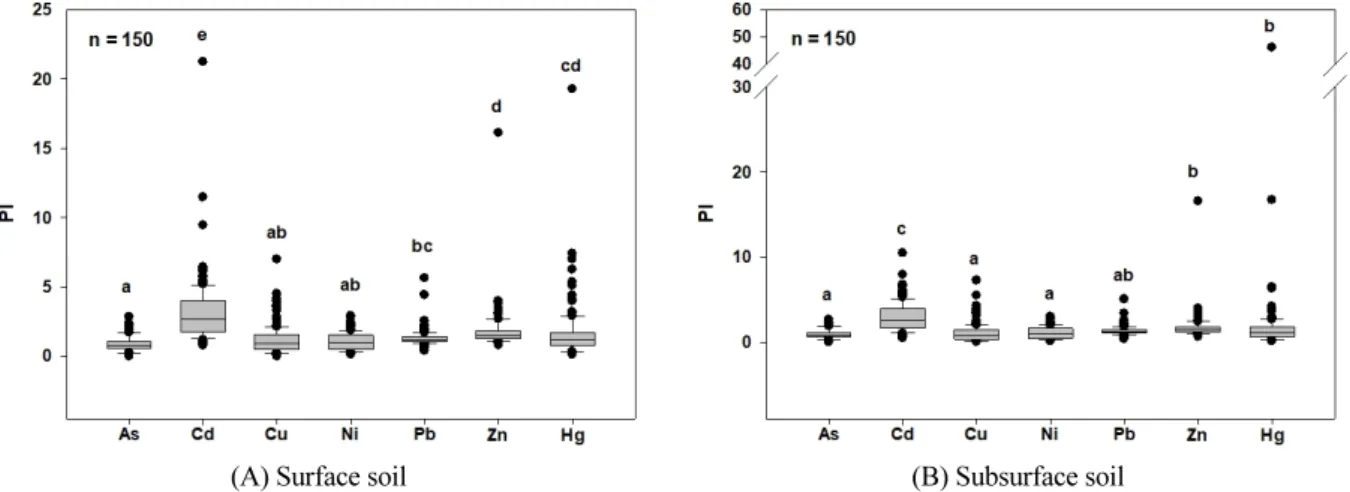
PI에 의한 중금속별 오염도 평가 PI는 지화학적 배경농도를 기반으로 외부환경에서 유입되어 나타나는 중금 속 오염도를 평가하기 위한 방법으로 1 이하는 비오염으로 구분한다. PI가 1 단위씩 증가할 때마다 오염도가 증가하 며 총 5단계로 구분한다. 총 중금속 분석치를 토대로 PI를 산출한 결과 As, Cd, Cu, Ni, Pb, Zn 및 Hg가 각각 평균 0.90, 3.04, 1.12, 1.06, 1.32, 1.72 및 1.63 이었다. 심도별로 살펴보면 표토와 심토 모두 Cd이 가장 높았으며 As가 가 장 낮은 것으로 나타났다 (Fig. 1). As는 PI가 1 이하로 오염되지 않았으며 Cu, Ni, Pb, Zn 및 Hg은 PI가 1에서 2사이로
(A) Surface soil (B) Subsurface soil
Fig. 1. Comparisons of the single pollution index (PI) values for each of metal(loid)s between (A) surface and (B) subsurface soil.
Table 6. Percentages of soil pollution by each metal(loid) classified by the single pollution index (PI).
Class As Cd Cu Ni Pb Zn Hg
Sur.† Sub.‡ Sur. Sub. Sur. Sub. Sur. Sub. Sur. Sub. Sur. Sub. Sur. Sub.
Unpolluted 70.7 68.0 2.7 7.3 51.3 55.3 16.0 50.7 6.0 14.0 38.0 7.3 52.0 46.7 Low polluted 23.3 24.0 29.3 25.3 36.7 34.7 80.0 38.7 76.7 80.7 44.7 75.3 40.7 33.3 Moderately polluted 6.0 8.0 22.7 23.3 6.0 4.0 2.7 10.7 8.7 3.3 8.7 12.0 7.3 14.0
Highly polluted - - 32.0 32.7 5.3 4.7 0.7 - 8.0 0.7 4.7 4.7 - 3.3
Very highly polluted - - 13.3 11.3 0.7 1.3 0.7 - 0.7 1.3 4.0 0.7 - 2.7
†Surface soil (n = 150).
‡Subsurface soil (n = 150).
오염도가 낮음 (low polluted) 수준이었다. Cd는 PI가 3을 초과하여 오염도가 높음 (highly polluted) 수준에 해당하여 타 중금속보다 오염도가 심한 것으로 평가되었다. 국내 선행연구를 살펴보면 Kim et al. (2018)은 경상도 지역 산업단 지 인근의 농경지를 대상으로 직접 산출한 배경농도를 토대로 오염도를 평가하였는데 As, Cd, Cu, Ni 및 Pb의 PI가 5.41, 6.13, 3.16, 4.24 및 3.39로 나타났다. 본 연구결과와 Kim et al. (2018)의 결과는 이용한 배경농도가 다르기 때문 에 직접적인 비교는 어려운 실정이다.
모든 지점 표토와 심토에 대하여 PI에 따른 오염도를 분류한 결과, Cd의 67.7%가 중간오염 (moderately polluted) 수준 이상인 반면에 나머지 중금속은 80% 이상이 낮음 (low polluted) 수준 이하로 주로 Cd에 의한 오염이 발생한 것 으로 평가되었다. 심도별로 살펴보면 Cd, Cu, Ni 및 Pb은 표토가 심토보다 오염지수가 높은 것으로 나타났다 (Table 6).
Igeo에 의한 중금속별 오염도 평가 Igeo는 PI와 마찬가지로 지화학적 배경농도를 기반으로 외부환경에서 유입 되어 나타나는 중금속 오염도를 평가하기 위한 방법으로 지수함수를 이용하기 때문에 PI와 달리 0 이하일 때를 비오 염 (unpolluted)으로 구분한다 (Table 3). Igeo 값이 1단위 씩 증가할때마다 오염도가 증가하며 PI보다 세분화되어 7단 계로 구분한다. 총 중금속 분석치를 토대로 Igeo를 산출한 결과 As, Cd, Cu, Ni, Pb, Zn 및 Hg가 각각 평균 -0.81, 0.78, -0.88, -0.83, -0.27, 0.04 및 -0.52 이었다. 심도별로 살펴보면 표토와 심토 공통적으로 Cd이 가장 높았으며 Cu가 가장
(A) Surface soil (B) Subsurface soil
Fig. 2. Comparisons of the geoaccumulation index (Igeo) values for each of metal(loid)s between (A) surface and (B) subsurface soil.
Table 7. Percentages of soil pollution by each metal(loid) classified by the geoaccumulation index (Igeo).
Class As Cd Cu Ni Pb Zn Hg
Sur.† Sub.‡ Sur. Sub. Sur. Sub. Sur. Sub. Sur. Sub. Sur. Sub. Sur. Sub.
Unpolluted 87.3 85.3 16.0 18.7 73.3 76.0 74.7 71.3 81.3 80.0 51.3 58.7 68.7 70.5 Unpolluted to moderately polluted 12.7 14.7 38.7 37.3 20.7 18.0 25.3 28.7 17.3 18.0 40.0 36.0 22.7 24.2
Moderately polluted - - 40.0 40.0 5.3 5.3 - - 1.3 2.0 8.0 4.7 6.0 3.4
Moderately to highly polluted - - 4.7 4.0 0.7 0.7 - - - 2.0 1.3
Highly polluted - - 0.7 - - - 0.7 0.7 0.7 0.7
Highly polluted to extremely high
polluted - - - 0.7
Extremely high polluted - - - -
†Surface soil (n = 150).
‡Subsurface soil (n = 150).
낮은것으로 나타났다 (Fig. 2). As, Cu, Ni, Pb 및 Hg는 Igeo가 음의 값으로 나타나 오염되지 않았으나 Cd과 Zn은 Igeo가 0.78, 0.04로 비오염에서 중간오염 (unpolluted to moderately polluted) 수준으로 평가되었다 (Fig. 2). 국내 선행연구 를 살펴보면 Kim et al. (2018)은 경상도 지역 산업단지 인근의 농경지를 대상으로 직접 산출한 배경농도를 토대로 오 염도를 평가하였는데 As, Cd, Cu, Ni 및 Pb의 Igeo가 1.66, 1.88, 0.95, 1.23 및 1.08로 나타났다. PI와 마찬가지로 본 연 구결과와 Kim et al. (2018)의 결과는 이용한 배경농도가 다르기 때문에 직접적인 비교는 어려운 실정이다.
모든 지점 표토와 심토에 대하여 Igeo에 따른 오염도를 분류한 결과, Cd의 44.7% 중간오염 (moderately polluted) 이 상인 반면에 나머지 중금속은 90% 이상 비오염에서 중간오염 (unpolluted to moderately polluted) 이하 수준으로 주 로 Cd에 의한 오염이 발생한 것으로 평가되었다. 심도별로 살펴보면 Cd, Cu, Zn 및 Hg은 표토가 심토보다 오염된 지 점이 더 많은 것으로 나타났다 (Table 7).
PI와 Igeo을 통해 중금속별 오염도를 평가한 결과 토양은 공통적으로 Cd이 오염되었고 나머지 중금속은 크게 오염 되지 않은 것으로 나타났다. Cd과 Cu가 표토에서 오염 지점이 더 많은 것으로 나타났는데 이러한 결과가 산업단지에 의한 인위적인 영향인지 자연적인 영향인지 파악하기 위해서는 지속적인 정점조사와 해당 지역의 모암에 대한 조사
(A) Surface soil (B) Subsurface soil
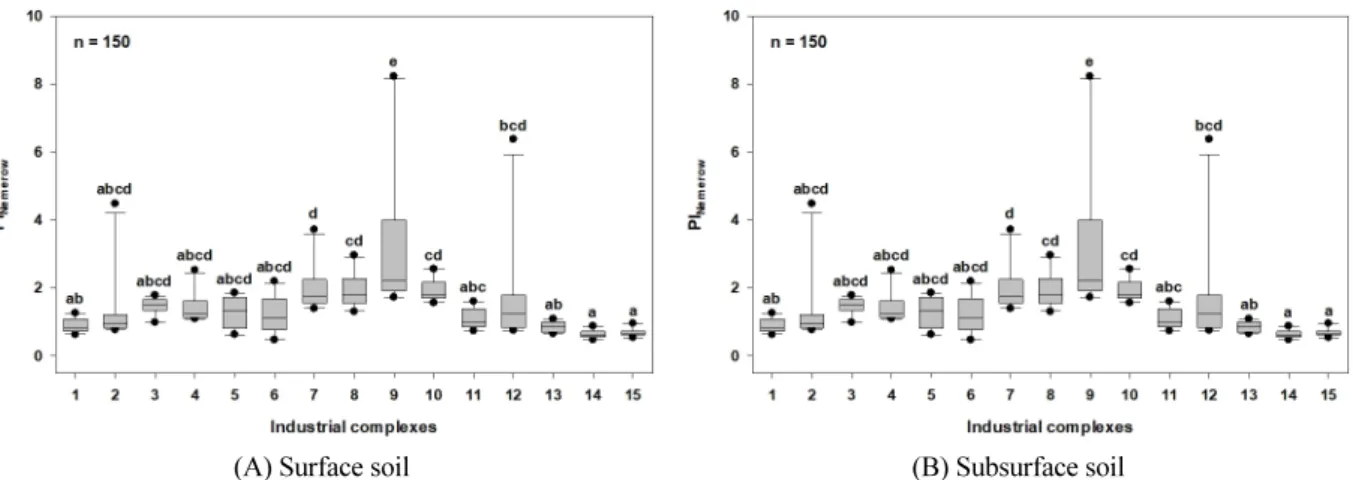
Fig. 3. Comparisons of the PINemerow values among industrial complexes for (A) surface and (B) subsurface soil.
등 추가적인 연구를 수행해야할 것으로 판단된다. 하지만 오염도가 다르게 평가되는 경향이 나타났는데 이는 Igeo 산 출과정에서 보정계수로 1.5가 작용하여 PI가 1.5 (low polluted)일 때 Igeo가 0 (unpolluted)으로 산출되어 PI보다 상대 적으로 오염도가 낮게 평가되는 것으로 판단된다. 또한, 배경농도를 2018년도 전국 자연배경농도 지점의 평균농도를 이용하였는데 각 산업단지별 인근 토양의 배경농도를 적용하면 다르게 평가될 수 있어 보다 정확한 오염도 평가를 위 해서는 적합한 배경농도 지점을 선정하는 것이 필요할 것으로 판단된다.
PINemerow 지수에 의한 통합적 중금속 오염도 평가 통합적 중금속 오염도 평가를 위해 PINemerow를 산출한 결
과 표토와 심토가 각각 1.26 (0.47 - 8.22), 0.73 (0.41 - 17.75)이었다. 각 지점별 표토와 심토를 평균하여 오염도를 분 류한 결과 clean 15.3%, warning limit 24.0%, slight pollution 43.3%, moderate pollution 13.3% 및 heavy pollution 4.0%으로 150개 지점 중 124개 (82.7%) 지점이 미미하게 오염 (slight pollution) 된 수준 이하인 것으로 평가되었다.
산업단지별 표토와 심토의 PINemerow를 살펴보면 공통적으로 14, 15번 산업단지 인근 농경지가 가장 낮았으며 9번 산 업단지 인근 농경지가 가장 높은 것으로 나타났다 (Fig. 3). 특히 9번 산업단지 인근 농경지의 평균 PINemerow가 3.57로 심하게 오염 (heavy pollution) 되어 타 산업단지 인근 농경지에 비해 오염도가 높은 것으로 평가되었다. 나머지 산업 단지 인근 농경지는 0.87 - 2.12로 미미하게 오염 (slight pollution) 되었거나 중간으로 오염 (moderate pollution) 된 것으로 평가되었다. 다만, 8번, 9번, 12번 산업단지의 일부 농경지에서 PINemerow가 높게 나타나 전체적인 오염도가 과 대평가 되었을 가능성이 있을 것으로 판단된다.
Overall Discussion and Conclusion
경기도 소재 산업단지 인근 농경지 토양에 대한 오염도 평가를 실시한 결과 대부분은 토양오염우려기준 (1 지역) 이하로 나타났으며 1개 지점에서 Zn이 대책기준을 초과하였다. PI와 Igeo로 중금속별 오염도를 평가한 결과 공통적으 로 Cd을 제외한 중금속들은 오염이 미미한 것으로 평가되었고, 오염정도에 차이가 있는 것으로 나타났다. 이는 오염 지수를 산출하는 과정에서 사용되는 correction factor값으로부터 기인한 것으로 판단된다. 따라서 배경농도가 명확 하게 선정되었을 경우에는 PI를, 그렇지 아니할 때는 Igeo를 이용하는 것이 적절할 것으로 판단된다. 산업단지별로 인 근 농경지의 PINemerow를 통해 통합적인 오염도를 평가한 결과 15개 산업단지 인근 농경지 중 13개 산업단지 인근 농경
지가 경고수준 (warning limit) 이상으로 평가되었으나 일부 지점에서 PINemerow가 높게 나타나 오염도가 과대평가되 는 경향이 있었다. 하지만 배경농도에 따라서 오염도 평가가 상이하게 나타날 수 있어 산업단지에 의한 영향을 확인하 기 어려우며 배경농도 지점 선정에 신중을 가할 필요가 있을 것으로 판단된다. 본 연구결과를 토대로 취약농경지에 대 한 지속적인 모니터링이 필요할 것으로 판단된다.
앞서 본문에서 언급하였듯이 중금속 분석에는 총량 이외에도 유효태 함량을 분석하는 방법이 있다. 유효태 함량을 분석하기 위해서는 중금속의 화학종 (species)을 정량해야 하는데 현재까지 그 방법은 없어 토양용액 중 이온강도 (ionic strength), 안정화상수 (stability constant) 등의 열역학적 상수를 모델링 프로그램인 GEOCHEM이나 MINTEQ 등에 입력하여 계산한다 (Holm et al., 1995; Schwab et al., 2008). 하지만 모델링 과정이 복잡하기 때문에, 유효태 중 금속은 Mehlich 3, DTPA, CaCl2, NaNO3, HCl 및 EDTA 등의 단일추출용액으로 추출하여 분석하거나 추출용액의 강도를 단계적으로 증가시켜 분획화 (fractionation)하는 방법으로 분석하여 식물체나 미생물 등에 흡수・이용되는 척 도를 평가한다 (Tessier et al., 1979; Wenzel, 2001; Feng et al., 2005; Arain et al., 2008; Nie et al., 2018).
중금속의 생물유효도, 분획은 각각의 농도로 표기되며, 그 농도의 높고, 낮음에 의해 유효도가 평가되기 때문에 특 별하게 오염지표 (pollution index)를 도입하여 오염도를 평가하는데 활용하지 않고 있다.
토양 중에 존재하는 중금속은 환경 조건의 변화에 따라 가역적-비가역적으로 유효태와 비유효태로 전환된다 (Ashraf et al., 2012). 중금속 총량분석은 유효태와 비유효태를 모두 포함하고 있어 오염도를 과대평가하게 될 가능성 이 있다 (Versantvoort et al., 2005). 따라서, 농경지 토양의 경우는 유효태 중금속을 활용한 오염도 평가방법에 대한 고려가 필요할 것으로 판단된다.
Acknowledgement
본 논문은 농촌진흥청 연구사업 (PJ01250524)의 지원에 의해 이루어진 것임. 그리고 중금속 오염도 평가 지수에 관한 일부 내용은 표토환경전략연구단 (2019002820004)의 지원에 의해 수행됨.
References
Abrahim, G.M.S. and R.J. Parker. 2008. Assessment of heavy metal enrichment factors and the degree of contamination in marine sedimetns from Tamaki Estuary, Auckland, New Zealand. Environ. Monit. Assess. 136:227-238.
Arain, M.B., T.G. Kazi, M.K. Jamali, N. Jalbani, H.I. Afridi, and J.A. Baig. 2008. Speciation of heavy metals in sediment by conventional, ultrasound and microwave assisted single extraction methods: a comparison with modified sequential extraction procedure. J. Hazard. Mater. 154:998-1006.
Ashraf, M.A., M.G. Maah, and I. Yusoff. 2012. Chemical speciation and potential mobility of heavy metals in the soil of former tin mining chatchment. Sco. World J. 12:1-11.
Begum, K., K.M. Mohiuddin, H.M. Zakir, M. Moshfiqur Rahman, and M. Nazmul Hasan. 2014. Heavy metal pollution and major nutrient elements assessment in the soil of Bogra City in Bangladesh. Can. Chem. Trans.
3:316-326.
Chen, H.H., C. Zheng, C. Tu, and Y. Zhu. 1999. Heavy metal pollution in soils in China: Status and countermeasures.
Ambio, 28(2):130-134.
Chen, H.Y., Y.G. Teng, S.J. Lu, Y.Y. Wang, and J.S. Wang. 2015. Contamination features and health risk of soil
heavy metals in China. Sci. Total Environ. 512-513:143-153.
Feng, M.H., X.Q. Shan, S. Zhang, and B. Wen. 2005. A comparison of the rhizosphere-basd method with DTPA, EDTA, CaCl2, and NaNO3 extraction methods for prediction of bioavailability of metals in soil to barely.
Environ. Pollut. 137:231-240.
Holm, P.E., S. Andersen, and T.H. Christensen. 1995. Speciation of dissolved cadmium: interpretation of dialysis, ion exchange and computer (GEOCHEM) methods. Wat. Res. 29(3):803-809.
Hu, B.F., X.L. Jia, J. Hu, D.Y. Xu, F. Xia, and Y. Li. 2017. Assessment of heavy metal pollution and health risks in the soil-plant-human system in the Yangtze river delta, China. Int. J. Environ. Res. Public Health 14(9):1-18.
Inengite, A.K., C.Y. Abasi, and C. Walter. 2015. Application of pollution indices for the assessment of heavy metal pollution in flood impacted soil. Int. Res. J. Pure. Appl. Chem. 8(3):175-189.
Kim, Y.G., H.H. L, H.J. Park, and C.O. Hong. 2018. Assessment of Heavy metal(lod)s pollution arable soils near industrial complex in gyeongsang provinces of South Korea. Korean J. Soil Sci. Fert. 51(2):128-141.
Kowalska, J.B., R. Mazurek, M. Gasiorek, and T. Zaleski. 2018. Pollution indices as usefil tools for the comprehensive evaluation of the degree of soil contamination – A rivew. Environ. Geochem. Health, 40:2395-2420.
Kwag, J.S., G.J. Cho, M.E. Jeong, K.Y. Ju, B.J. Song, and D.C. Ryou. 2019. Contamination indices and heavy metal concentrations in urban garden soil of Busan metropolis. Korean J. Soil Sci. Fert. 52(4):502-512.
Lee, T.G., M.S. Hong, E.J. Lee, H.I. Jung, Y.H. Kim, G.B. Jung, J.E. Yang, S.C. Kim, G.I. Kim, G.R. Kim, and M.J.
Chae. 2019. Assessment of heavy metal concentrations in the arable soils near industrial complexes in Gangwon, Chungnam, Jeonnam, and Gyeongnam provinces of South Korea. Korean J. Soil Sci. Fert. 52(4):541-550.
Li, J., M. He, W. Han, and Y. Gu. 2009. Analysis and assessment on heavy metal sources in the coastal soils developed from alluvial depostis using multivariate statistical methods. J. Hazard. Mater. 164:976-981.
Li, M.S. and S.X. Yang. 2008. Heavy metal contamination in soils and phytoaccumulation in a manganese mine wasteland, South China. Air Soil Water Res. 1:31-41.
ME (Ministry of Environment). 2019. Soil monitoring network and soil pollution survey. p. 8.
Min, K.J., Y.K. Hong, W.S. Choi, D.B. Kim, and S.C. Kim. 2016. Assessment of heavy metal (loid) pollution using pollution index in agricultural field adjacent to indsturial area. Korean J. Soil Sci. Fert. 49(6):768-775.
Nie, C., X. Yang, N.K. Niazi, X. Xu, Y. Wen, J. Rinklebe, Y.S. Ok, S. Xu, and H. Wang. 2018. Impact of sugarcane bagasse-derived biochar on heavy metal availability and microbial acitivity: A field study. Chemosphere.
200:274-282.
Nriagu, J.O. 1996. A history of global metal pollution. Science. 272(5259):223-224.
Ololade, I.A. 2014. An assessment of heavy-metal contamination in soils within auto-mechanic workshops using enrichment and contaminations factors with geoaccumulation indexes. J. Environ. Prot. 5:970-982.
Schwab, A.P., D.S. Zhu, and M.K. Banks. 2008. Influence of organic acids on the transport of heavy metals in soil.
Chemosphere. 72(6):986-994.
Shaheen, N., N.M. Irfan, I.N. Khan, S. Islam, M.S. Islam, and M.K. Ahmed. 2016. Presence of heavy metals in fruits and vegetables: health risk implications in Bangladesh. Chemosphere. 152:431-438.
Tessier, A., P.G.C. Campbell, and M. Bisson. 1979. Sequential extraction procedure for the speciation of particulate trace metals. Anal. Chem. 51(7):844-851.
Varol, M. 2011. Assessment of heavy metal contamination in sediments of the Tigris River (Turkey) using pollution indices and multivariate statistical techniques. J. Hazard. Mater. 195:355-364.
Versantvoort, C.H.M., A.G. Oomen, and E.V.D. Kamp. 2005. Applicability of an in vitro digestion model in assessing the bioaccessibility of mycotoxins from food. Food Chem. Toxicol. 43:31-40.
Wenzel, W.W., N. Kirchbaumer, T. Prohaska, G. Stingeder, E. Lombi, and D.C. Adriano. 2001. Arsenic fractionation
in soils using an improved sequential extraction procedure. Anal. Chim. Acta. 436:309-323.
Wojciechowska-Mazurek, M., K. Starska, E. Brulińska-Ostrowska, M. Plewa, U. Biernat, and K. Karłowski. 2008.
Monitoring of contamination of foodstuffs with elements noxious to human health. Part I. Whheat cereal products, vegetable porducts, confectionery and products for infants and children (2004year). Rocz. Panstw. Zakl. Hig.
59:251-266.
Yang, Q., Z. Li, X. L, Q. D, L. H, and J. Bi. 2018. A review of soil heavy metal pollution from industrial and agricultural regions in China: Pollution and risk assessment. Sci. Tot. Environ. 642:690-700.
Zwolak, A., M. Sarzyńska, E. Szpyrka, and K. Stawarczyk. 2019. Sources of soil pollution by heavy metals and their accumulation in vegetables: a Review. Water Air Soil Pollut. 230:164.