대불산업단지 도로먼지 내 중금속류 오염 특성:
입도와 자성에 따른 구분
정혜령*,**·최진영*·나공태*,**
한국해양과학기술원 해양환경연구센터*, 과학기술연합대학원대학교 한국해양과학기술원 스쿨 해양과학(해양학)**
Characteristics for Heavy Metal Pollution in Road Dust from Daebul Industrial Complex:
Classification by Particle Size and Magnetic Separation
Hyeryeong Jeong*,**·Jin Young Choi*·Kongtae Ra*,**
Marine Environmental Research Center, Korea Institute of Ocean Science & Technology (KIOST), Busan 49111, Korea*
Department of Ocean Science (Oceanography), KIOST School, University of Science & Technology (UST), Daejeon 34113, Korea **
요약 : 본 연구에서는 대불산업단지 내 14개 지점에서 채취한 도로먼지의 입도, 중금속 성분, 자기특성 등 물리 화학적 특성을 파악하고, 오염도 평가를 통해 주변 환경에 미치는 영향에 대한 고찰을 시행하였다. 도 로먼지 내 금속농도는 Fe>Zn>Cu>Pb>Cr>Ni>As>Cd>Hg 순이었으며, 중금속류 오염은 연구지역 의 주요 산업 및 교통 활동에 영향을 받은 것으로 나타났다. 도로먼지 내 중금속 원소와 입도와의 상관관계 분석결과는 Fe 및 모든 분석된 원소가 서로 유의한 상관관계를 가지며, 입자크기와는 유의한 음의 상관성 을 가짐을 보여주었다(p<0.05). 그러나 큰 금속 입자들의 노면 유입으로 인해 일부 금속의 경우 >1000 μm의 입자의 중금속류 농도가 가장 높았으며, 이 분율의 단위면적당 오염부하량이 다른 입도분율보다 높 았다. 도로먼지에서 자성입자의 분리 후 Cr, Ni, Cu, Zn, Cd, Pb의 농도 수준이 전체의 85(As)-22(Ni)%
로 감소함을 알 수 있었다. 연구지역 도로먼지의 평균 중금속 오염도는 3지역 토양환경 우려기준을 초과하 지 않아 우려할 수준은 아닌 것으로 나타났으나, 일부 지점의 경우 Zn 농도 기준을 초과해 재 비산이나 비 점오염유출 등을 통해 도로먼지가 주변 환경에 미치는 영향과 효과적 관리방법에 대한 더욱 자세한 연구가 필요한 것으로 판단된다.
주요어 : 도로먼지, 중금속, 조선업, 산업 활동, 교통 활동
Abstract: In this study, we investigated physical and chemical properties such as grain size, heavy metal pollution, magnetic properties, and their environmental impacts of road dusts (RD) collected from 14 sampling points in Daebul industrial Complex. Heavy metal concentrations in RD were in Research Paper
https://doi.org/10.14249/eia.2020.29.4.252
First Author:Hyeryeong Jeong, Tel: +82-51-664-3197, E-mail: [email protected], ORCID: 0000-0002-6280-9206 Corresponding Author:Kongtae Ra, Tel: +82-51-664-3184, E-mail: [email protected], ORCID: 0000-0003-1822-2886 Co-Author:Jin Young Choi, Tel: +82-664-3216, E-mail: [email protected], ORCID: 0000-0001-6439-4932 Received: 1 April, 2020. Revised: 4 August, 2020. Accepted: 5 August, 2020.
I. 서론
도로먼지는 주로 인근의 기반암과 토양 등의 풍 화와, 교통 및 산업활동 등의 인위적인 활동으로부터 발생하여 도로 노면에 쌓인 먼지로, 입자성 물질과 유·무기 오염물질이 결합되어있다(Aryal et al. 2010;
Jeong et al. 2019a; Lee et al. 2020a; Luo et al.
2011; Murakami et al 2008; Sun et al. 2010;
Zhang et al. 2012). 특히 산업도시의 도로먼지 내에 자연수준 보다 매우 높은 수준의 중금속이 존재는 것 이 알려지면서 이에 대한 관심이 증가했고, 자동차 나, 도로포장재, 건설 활동, 산업 원료, 산업시설 운 영이 도로먼지에 속한 중금속의 주요 오염원인 것으 로 밝혀졌다(Adachi and Tainosho 2004; Lee and Kim 2003; Oliva and Espinosa 2007; Zhang et al. 2008). 이러한 도로먼지의 주요 중금속 성분은 Cu, Pb, Zn, Ni, Cd, Cr 등 인데 이들 원소는 생물에 필수적인 원소이나(Faiz et al. 2009; Han et al.
2008; Lu et al. 2010; Wei and Yang 2010) 임계값 (threshold level)을 초과하는 농도의 노출은 생물에 단기 혹은 장기적인 독성영향을 준다(Nagajyoti et al. 2010; Singh et al. 2011). 또한 도로먼지에 주로 포함된 Cu, Zn, Fe, Ni, Cr 등의 중금속의 독성은 인
체건강과 밀접한 연관이 있으며(Kang et al. 2007;
Schlesinger et al. 2006) 비산을 통한 도로먼지의 인체노출은 체내 염증을 유발할 수 있다(Jalava et al.
2008; Happo et al. 2007). 이러한 이유로 세계 주요 도시들에서는 도로먼지로 인한 대기 및 수질 환경오 염을 효과적으로 제어하기 위한 많은 노력을 기울이 고 있다. 1970년대부터 도로청소는 도로먼지의 가장 효과적 방법 중의 하나로 인식되어왔으며(Jeong et al. 2011), 납과 같은 중금속은 도로청소를 통하여 50% 이상 제거가 가능하다(Kang et al. 2007). 그러 나 최근 20년간 도로먼지 미세입자 오염부하도가 매 우 높은데 반해 일반적 도로청소로는 제어가 어려운 것으로 밝혀져, 이를 개선하기 위해, 도로먼지 내 미 세입자의 특성에 관한 연구가 다양하게 수행되고 있 다(Vaze et al. 2002; Amato et al. 2009; Li et al.
2015; Lee et al. 2020a).
차량활동과 산업 등 인위적 활동에 의해 발생한 먼 지입자는 Fe의 함유량이 높아 도로먼지의 자성을 증 가시키며(Fialova et al. 2006; Jordanova et al.
2006; Querol et al. 1996, Gautam et al. 2005;
Goddu et al. 2004; Hoffmann et al. 1999; Kim et al. 2007), 물질의 자기민감도를 분석하는 환경 자기 방법은 화학적 분석보다 비파괴적이고 비용 효율적 the order of Fe>Zn>Cu>Pb>Cr>Ni>As>Cd>Hg, and this pollution pattern was related to major industries and traffic activities in this area. The results of the correlation analysis between heavy metal elements and particle size in RD showed that Fe and all of analyzed heavy metals had a significant correlation with each other and metal concentrations had a significantly negative correlation (p<0.05). However, due to the input of large metal particles some heavy metal concentrations in the particle fraction of >1000 μm were highest. Pollution load per unit area of this fraction was the highest among the grain size fractions. Cr, Ni, Cu, Zn, Cd, Pb levels in RD decreased and the levels of Cr, Ni, Cu, Zn, Cd, and Pb were reduced to 85 (As) -22 (Ni)% of the whole after removal of MFs fraction from RD. The mean heavy metal levels in the study area did not exceed the soil contamination guide value of Korea, indicating that heavy metal levels in RD were not a concern. However, at some sampling points, Zn concentrations were exceeded the soil contamination guide value for the 3rd areas of Korea and this result indicated that further studies of the impact of RD on the surrounding environment through re-suspension or non-point pollution, and of effective management methods are required.
Keywords: road dust (RD), heavy metals, shipbuilding industry, industrial activity, traffic activity
이다(Evans and Heller, 2003). 때문에 최근 거리먼 지의 자기특성분석이 환경오염 모니터링을 위한 효 과적 수단으로 사용되기도 한다(Wang et al. 2019;
Zhang et al. 2006).
우리나라의 수출특화산업인 조선업은(KIET 2012) 유해물질의 종류와 배출양상이 매우 복잡한 업종이다 (Kang et al. 2007; Kim 2013; Park 2016). 특히 원 료와 제조과정으로부터 배출되는 중금속이 함유된 입 자로 인한 환경오염은 국제적으로도 큰 문제가 되고 있다(OECD 2010; A′lvarez-Va′zquez et al. 2020).
대불산업단지는 국내 조선업의 배후공단이다(Seo 2011; Park 2016). 그러나 국내의 조선산업단지 인근 도로오염에 대한 연구는 매우 적으며(Lee and Kim 2003), 대불산업단지인근에 대한 연구는 다루어 진 적이 없다. 특히 대불산업단지는 영산강에 접해있 고 3 km 인근에는 인구 15만 명 이상의 도시가 있어 (Yeongam gun 2020) 산단의 도로먼지 내 중금속이 재비산과 비점으로 인해 주변 도시의 대기환경과 수 환경에 오염을 일으킬 우려가 있어 이에 관한 연구가 필요하다.
대상 도로먼지의 오염수준, 물리화학적 특성 및 오 염원 파악은 오염 제어를 위해 필수적인 정보이다.
따라서 본 연구에서는 대불산업단지 내 도로먼지의 입도, 중금속류 성분, 자기특성 등 물리화학적 특성 을 파악하고, 오염도 평가와 주변 환경에 미치는 영 향에 대한 고찰을 시행하였다.
II. 연구방법
1. 연구지역
연구지역인 대불산업단지는 전라남도 영암군에 삼 호읍에 위치하고 있으며, 1997년 조성 완료되어 지정 면적 총 20,887천 m2중 산업지역 10,734천 m2로 전 체 면적 중 48.5%가 산업시설 구역이며(Jeonnam industrial complex Data management system 2020), 공공시설구역(24.6%)과 녹지구역(20.2%) 등 의 토지이용형태로 구분되어 있다. 대불산업단지 내 도로연장은 66천 m, 도로면적은 전체 조성 면적 중 약 8.5%인 176만 5천 m2를 차지하고 있으며(Ministry of Construction 1990), 왕복8차선 도로연장이 약
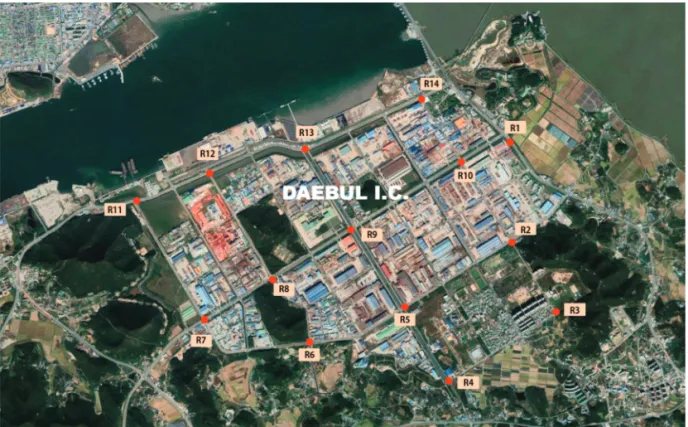
Figure 1. Map of sampling sites for road dust in Daebul industrial complex, Korea.
30천 m정도로 비교적 도로가 잘 정비되어 있다.
2014년에 총 339개의 업체가 입주하여 있었으며, 입 주업체의 구성은 조선업을 포함 한 운송장비 38.0%, 1차 금속을 포함한 조립금속 32.3%, 비금속 5.4%, 석 유화학 4.5% 등이 있다. 이들 입주업체중 약 70%가 조선업에 관련된 업체이다(Park 2016). 따라서 본 연 구에서는 대불산업단지 내 도로먼지의 물리화학적 특 성과 오염현황을 파악하기 위해서 도로먼지를 채취하 였다. 시료채취 지점은 Figure 1에 나타냈다. 연구지 역의 특성을 고르게 반영하기 위하여 14개 지점을 등 간격으로 선정하였으며, 주로 차량운행이 많은 왕복 8차선 도로와 비교를 위한 주거지와 녹지 인근의 지 점을 일부 선정하였다.
2. 도로먼지 시료채취
본 연구에서는 플라스틱 솔과 건식 진공청소시스 템(Dyson DC35, USA)을 활용하여 도로먼지를 채 취하였다. 건식진공청소법은 도로노면 위의 미세입 자까지 채취하기 위해 고안된 시료채취 방법으로, 연 구 분야의 다수의 연구자들이 보고한 방법이다 (Gunawardana et al. 2013; Hong et al. 2018; Lee et al. 2020a; Mahbub et al. 2011). 채취 과정 중 지 점별 교차오염과, 미세입자의 유실이 최소화 되도록 채취 과정 중에 사용되는 부품(플라스틱 솔, 먼지통, 미세먼지 필터)을 잘 털어서 사용하였으며, 청소기의 긴 호스는 사용되지 않았다. 도로의 설계 상 도로의 연석과 안쪽 15 cm에는 전체도로의 80%, 1 m 안쪽 으로는 95%가 축적된다고 보고되어 있다(Novotny and Chesters 1981). 따라서 본 연구에서는 각 지점 별로 도로연석의 0.25 m2내의 시료를 4회 이상 채취 하여 혼합하였으며, 시료채취는 2013년 12월 중에 교 통 혼잡 시간을 피해 새벽에 이루어졌다. 채취된 시 료는 40℃ 오븐에서 건조 후 플라스틱 백에 담아 분 석 전까지 실온에 보관하였다.
3. RDS 사이즈 및 자성분리
각 지점별 도로먼지 시료 중 일부 시료를 취하여 나 일론 체와 자동 체질기(Analysette 3, Fritsch Co.
Germany)를 이용하여 6개의 입자크기군(>1000
μm, 500-1000 μm, 250-500 μm, 125-250 μm, 63-125 μm, <63 μm)으로 분획하여 무게를 측정하 였다(Lee et al. 2020a). 도로먼지 시료 중 일부를 다 시 취하여 4000 gauss 세기의 네오디뮴 자석을 이용 하여 자성부분(magnetic fractions: MFs)과 비자성 부분(non-magnetic fractions: NMFs)으로 분리하 였다(Choi et al. 2014; Jeong et al. 2019a).
4. 중금속류 농도 및 입도 분석
지점별 시료와 입자크기군 및 자성을 기반으로 분리 된 도로먼지 시료는 각각 자동분쇄기(Pulverisette 6, Fritsch Co. Germany)로 분쇄, 균질화한 후 분석 전 까지 산세척 된 폴리에틸렌 병에 보관하였다. 분쇄된 시료 약 0.1 g을 테프론 재질의 산분해용기에 넣고 고 순도의 혼합산(불산, 과염소산, 질산)을 이용한 완전 산분해법(total digestion)으로 분해한 후 유도결합 플라즈마 질량분석기(ICP-MS; iCAP-Q, Thermo Scientific Co.)로 중금속을 분석하였다(Jeong et al.
2016). 수은(Hg)은 균질화 된 시료를 US EPA 7473 방법에 따라 자동수은분석기(Hydra-C, Teledyne Leeman Labs.)를 이용하여 분석하였다. 분석된 중 금속 자료를 2가지 종류의 해양퇴적물 표준시료 (MESS-4, BCR-667)로 정확도를 검증한 결과, 95.1 (Li)~103.8(Cu)%의 좋은 회수율을 나타냈다. 입도 분석은 2 mm 나일론 체로 큰 사이즈의 돌, 식물조각 등을 걸러내고 무기탄소와 유기물을 제거한 후 입도 분석기(Mastersizer 2000, Malvern Instruments Ltd.)로 분석을 실시하였다.
5. 중금속류의 오염도 평가
도로먼지 내 존재하는 분석된 개별 중금속류 원 소의 오염도평가를 위하여 농축계수(enrichment factor: EF)를 계산하였고(Taylor 1964), 계산식은 다음과 같다.
EF =
계산에 사용된 배경농도(background)는 Rudnick and Gao (2003) 지각평균농도를 사용하였다. 여기 서 (Metal/Li)sample은 시료에서의 중금속(metal)과 Li
(Metal / Li)sample (Metal / Li)background
의 농도 비 이며, (Metal/Li)background는 기존 문헌에 서 연구된 지각평균농도의 중금속과 Li의 비율이다.
계산된 값이 EF≤2 이면 deficiency to minimal enrichment, 2<EF≤5 이면 moderate enrichment, 5<EF≤20이면 significant enrichment, 20<EF
≤40이 면 very high enrichment), EF> 40이 면 extremely high enrichment으로 평가한다.
또한 도로먼지 내 존재하는 전체 원소에 대한 종합 적인 오염도를 평가 위하여 오염부하지수(pollution load index; PLI)를 계산하였으며(Tomlinson et al.
1980), 계산식은 다음과 같다.
CF = PLI =
여기서 CF값은 각 금속원소의 농도와 배경농도 의 비를 나타내며, Metalsample은 시료의 금속농도, Metalbackground는 배경농도의 금속농도이다. n은 계산 에 쓰인 중금속의 개수를 의미한다. PLI 계산에 사용 된 배경농도(background) 역시 Rudnick and Gao (2003)의 지각평균농도를 사용하였다. 계산된 PLI의 값이, PLI=0이면 background level, 0<PLI≤1 이면 Unpolluted, 1<PLI≤2이면 Moderately to unpolluted, 2<PLI≤3이면 Moderately polluted, 3<PLI≤4이면 Moderately to highly polluted, 4<PLI≤5이면 Highly polluted, PLI>5이면 Very highly polluted로 퇴적물의 오염도를 평가한다.
6. 통계분석
통계분석을 위하여 Microsoft office 16의 Excel과 PASW Statistics 18 프로그램이 사용되었다. 상관관 계 분석을 위해서 미리 데이터의 정규성 분포를 검정 하였으며, 정규분포를 가진 데이터는 Pearson 상관 관계 분석(Pearson’s correlation analysis)을, 정규 분포가 아닌 데이터는 Kendall의 tau방법(Kendall’s tau b method)을 이용하여 상관관계를 분석하였다.
통계적 유의수준은 0.05이하(p<0.05)인 것으로 판 단하였다.
III. 결과 및 고찰
1. 도로먼지의 중금속류 농도와 오염도 평가 Table 1에 본 연구에서 분석된 도로먼지 중금속류 농도의 기술통계요약(Table 1a)과 EF와 PLI을 이용 한 지점별 오염도 평가결과를 나타냈다(Table 1b).
도로먼지 내 중금속의 평균 농도는 Fe이 4.97%, Zn가 1168 mg/kg으로 가장 높았으며, Cu (92 mg/kg) > Pb (87 mg/kg) > Cr (85 mg/kg) > Ni (28 mg/kg) > As (7.1 mg/kg) > Cd (0.6 mg/kg) > Hg (0.01 mg/
kg) 순으로 나타났다. 분석된 지점의 중금속 농도 변 동성(coefficient of variation, CV)은 51.0(As)- 136(Zn)인 것으로 나타났다. 대불산업단지 도로먼지 내 중금속 대부분 금속이 반월·시화 산업단지에 비해 90%~50%정도 낮았으며(Jeong et al. 2019a), 오염 된 것으로 보고된 런던(Crosby et al. 2014), 상하이 (Shi et al. 2010) 도심의 도로먼지와 유사한 수준이 었다. 울산의 도심 도로먼지에 비해서는 Zn의 농도 는 낮았으나 Ni, Cu, Pb의 농도는 다소 높았다 (Doung et al. 2011).
연구지역의 EF값의 평균으로 본 금속별 인위적 농 축도는 Zn>Cd>Pb>Cu>Cr>Ni>Hg 순으로 낮 아졌고, Zn은 very high enrichment에 해당했으며, Cd, Pb, Cu는 significant enrichment에 해당했다.
Cr, Ni, Hg은 지각수준으로 자연기원인 것으로 나타 났다. 원소의 지점별 EF값의 차이를 보면, Zn의 경 우는 전 지점에서 significant enrichment 수준인 5이상의 값을 보여, 인위적 농축도가 전반적으로 높 았다. Cd, Pb, Cu의 경우는 EF값이 5를 넘는 지점이 79, 64, 43% 였다. Cr은 R6 한 지점에서만 EF값이 5.3으로 나타났고, 거의 모든 나머지 지점에서 지각 수준으로 나타나 오염되지 않은 것으로 나타났다. Ni 은 R6, R10의 두 지점이, As의 경우 9개의 지점이 moderate enrichment보여 minimal enrichment 수 준인 다른 대부분의 지점에 비해 높게 나타났다. 각 금속의 지점별 EF의 CV값은 48.2-127%였고, Zn, Cu, Ni, Cr, Cd의 경우 다른 금속들에 비해 평균농도 의 변동성이 크며 지점 간 인위적 오염도 차이가 큰 것으로 나타났다. 조선 산업의 환경 및 기후변화 문
n CF1× CF2× CF2…× CFn Metalsample Metalbackground
제에 대한 OECD(2010) 보고서에 의하면 Cd, Cr, Cu, Pb, Ni, Zn은 선박 본체의 기본물질, Cu, Cd, Cr, Pb, Zn은 선박의 표면에 쓰이는 물질, As, Cd, Cr, Pb, Ni 등은 연마 블라스팅 재료가 주 기원으로 조선업과 관련된 일반적인 오염물질이다(A′lvarez- Va′zquez et al. 2020). 또한 국내 선박 수리소 인근 은 연마작업에 의해 선박 표면에서 떨어진 물질로 인 해 Cu, Zn에 주로 오염되어 있다고 보고된 바 있다 (Choi et al. 2014). 반면 Zn, Cu, Pb은 국내 도로먼
지의 주요 오염 중금속이기도 하다(Lee et al. 2020a).
대불산업단지의 도로먼지의 평균 PLI값은 1.8 (Moderately to unpolluted)로 중금속류에 심각하게 오염되지는 않은 것으로 나타났으며, 지점별 변동성 은 65.2%였다. PLI로 본 지점별 오염평가 결과 R6 (4.7)이 Highly polluted로 가장 오염된 것으로 나타 났다. 이 지점은 Hg, Ni, As를 제외한 모든 원소들이 심각하게 농축되어 있는 지점(EF>5)으로 주변에는 철강업과, 선박용 철 의장품 및 조선기자재를 생산하 Table 1. a) Summary statistics of heavy metal concentrations of RD from 14 stations in Daebul industrial complex and
b) EF and PLI value for heavy metals a)
Fe Cr Ni Cu Zn As Cd Pb Hg
Unit. % mg/kg mg/kg mg/kg mg/kg mg/kg mg/kg mg/kg mg/kg
Mean 4.97 85 28 92 1168 9.1 0.6 87 0.01
S.D. 4.45 85 36 76 1587 4.6 0.5 55 0.01
Max. 18.6 336 138 242 6359 21 1.9 227 0.02
Min. 1.76 17 6.2 18 224 3.9 0.2 30 0.002
CV% 89.5 99.6 128 82.9 136 51.0 79.2 63.4 52.0
S.D.: standard deviation, Max.: maimum, Min.: minimum, CV%: coefficient of variation b)
Cr Ni Cu Zn As Cd Pb Hg PLI
R1 1.2 0.5 2.6 15.4 3.7 11.5 8.1 0.4 1.6
R2 1.2 0.6 7.1 32.8 6.7 10.1 11.3 0.5 2.4
R3 0.3 0.2 0.9 5.0 1.3 4.1 4.3 0.1 0.7
R4 0.4 0.3 1.4 6.5 1.9 6.2 3.6 0.2 0.9
R5 0.5 0.4 1.8 20.1 2.3 6.1 4.1 0.3 1.1
R6 5.3 4.3 12.0 137.9 3.0 30.7 19.4 0.5 4.9
R7 0.3 0.2 2.1 5.7 1.3 3.8 2.9 0.1 0.6
R8 0.6 0.3 1.4 15.1 1.8 3.8 3.9 0.1 0.8
R9 1.8 1.3 9.4 38.3 3.0 11.3 5.6 0.5 2.3
R10 3.1 2.5 6.8 45.6 3.3 22.1 10.8 0.5 3.0
R11 1.0 0.6 5.7 7.4 1.9 6.0 8.4 0.2 1.1
R12 2.2 0.9 14.7 20.5 4.3 14.5 13.7 0.4 2.4
R13 1.1 0.5 2.8 11.4 3.4 6.5 5.1 0.2 1.4
R14 1.4 0.6 4.8 15.4 4.1 8.2 12.6 0.4 1.8
Mean 1.5 0.9 5.3 26.9 3.0 10.3 8.1 0.3 1.8
SD 1.4 1.1 4.3 34.3 1.5 7.7 4.8 0.2 1.2
Max. 5.3 4.3 14.7 137.9 6.7 30.7 19.4 0.5 4.9
Min. 0.3 0.2 0.9 5.0 1.3 3.8 2.9 0.1 0.6
CV% 93.1 120 81.8 127 48.2 74.3 59.6 50.1 65.2
EF > 40; Extremely high enrichment 20 < EF < 40; Very high enrichment 5 < EF < 20; Significant enrichment 2 < EF < 5; Moderate enrichment EF < 2; Deficiency to minimal enrichment
는 중공업, 도장 관련 조선업체가 40개 이상이 모여 있는 지점이었다. 다음으로 오염도가 높은 R2, 9, 10, 12지점의 PLI값은 3.0으로 moderately polluted에 해당되는 오염도인데, 이 지점들은 Cu, As, Pb, Cd 의 EF값이 significant enrichment 수준으로 나타 난 곳으로 반경 500 m 이내에 조선 관련 업체들이 20 개 이상 모여 있는 지점이었다. PLI값이 2이하로 나 타나 종합적 오염도가 moderately to unpolluted, unpolluted인 것으로 나타난 지점은 주변 반경 500 m 이내에 절반이상이 유수지, 임야, 농지 등으로 둘 러싸여 있으며 입주 산업체의 수가 적은 지점이었다.
본 결과에 의하면 연구지역 내 도로먼지의 금속오 염 특성은 단지 내 업체들이 주로 차지하는 조선산업 에 관련되어 있으며, 지점 간 금속오염의 변동성은 채 취된 도로먼지 시료의 중금속 오염이 인근 업체의 직 접적 영향인 것으로 파악되었다.
2. 도로먼지의 입도 및 사이즈에 따른 중금속류 오염 특성
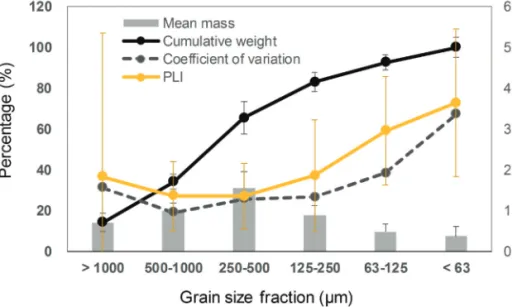
도로먼지의 입도분포와 입경분율의 오염도를 Figure 2에 나타냈다. 본 연구에서 채취한 도로먼지 의 평균입도(Dv50)는 346 μm(205-562 μm)이었다.
무게로는 250-500 μm 31.1%로 가장 많은 부분을 차 지하고 있었으며, 63 μm 미만의 입자가 7.4%를 차지
해 가장 작은 질량을 차지했다. 도심의 도로먼지의 경 우 더 세립한 크기인 150-250 μm의 질량이 가장 높 다고 보고되고 있으나(Zhao et al. 2010), 산업단지 도로먼지의 경우는 도심보다 상대적으로 큰 입자가 많다고 보고되고 있다(Khademi et al.2019; Lee et al. 2020a). 분리된 6개 입자크기군 내의 입자크기 변동성(CV)은 <63 μm > 63-125 μm > >1000 μm> 125-250 μm< 250-500 μm < 500-1000 μm순으로 나타났다. 이는 도심의 도로먼지에서 보고 된 중간정도의 크기(105-450 μm)의 도로먼지의 입 도 변동성이 그 이상이나 이하의 입경분율의 변동성 보다 낮은 것으로 나타난 결과와 유사하였으나, 조립 한 크기의 변동성이 그 이하크기의 입경분율보다 훨 씬 큰 변동성을 갖는 결과와는 큰 차이가 있었다 (Zhao et al. 2017).
도로먼지의 입자크기군 내의 각 중금속류의 농도 를 Table 2에 나타냈다. 입경분율별 인위적 중금속 농축도를 파악하기 위하여 각 중금속의 입경분율별 오염부하지수(PLI)와 EF값을 구하였다(Table 3).
PLI의 경우, >1000 μm는 1.8. 500-1000 μm는 1.4, 250-500 μm는 1.4, 125-250 μm는 1.9, 63-125 μm는 3.0, <63 μm는 3.6으로 나타나, >1000 μm 를 제외하고 도로먼지 입자의 크기가 줄어들수록 오 염부하가 높아지는 것으로 나타났다. Zn는 >1000
Figure 2. Grain size distribution, coefficient of variation and PLI of RD.
μm, 125 um 이하에서 very high enrichment, 나머 지 입자크기군에서는 significant enrichment의 오 염상태로 중금속 원소 중 가장 오염도가 높았다. Cd, Pb는 500 μm 미만, Cu는 125 μm 미만의 입자에서 significant enrichment에 해당되었다. Cr, Ni, Hg 은 모든 입자 크기에서 2 이하의 EF값을 보여 오염도 가 없는 것으로 나타났다.
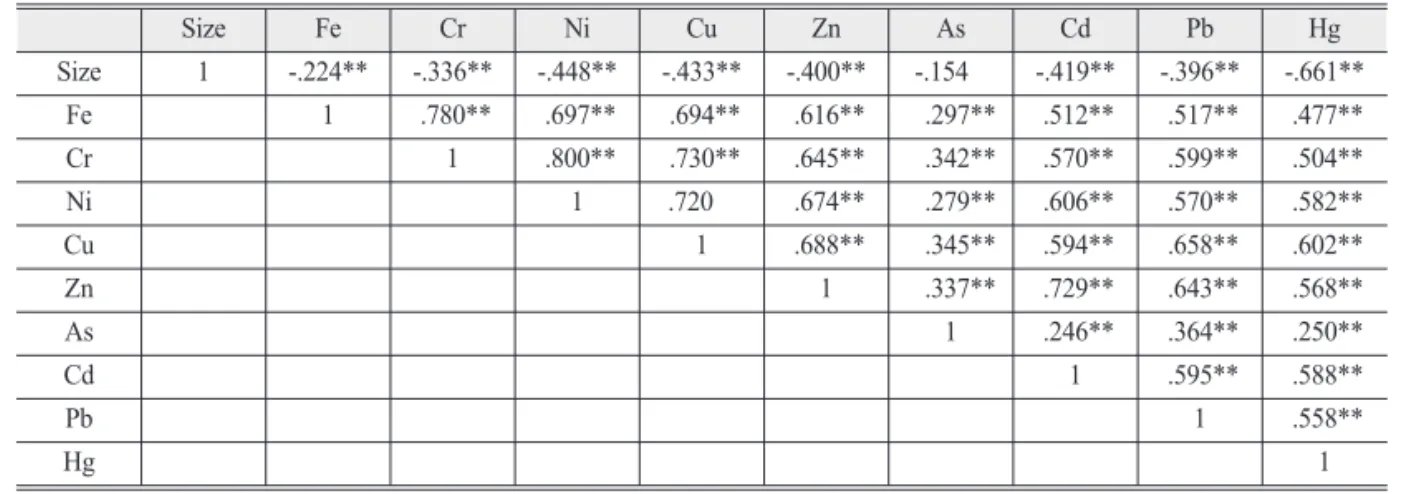
도로먼지의 입도와 중금속류의 농도에 대한 상관 관계 분석결과 As를 제외한 모든 원소의 농도가 입도
와 유의한 음의 상관관계를 보여(p<0.05, Kendall’s tau b method), 입자크기가 작아질수록 중금속 농도 가 증가함을 보여주었다(Table 4). 도로먼지는 차량 과 주변의 입자성 물질이 도로에 유입된 후, 차량운 행 등의 물리적 압력 및 환경에 의한 풍화를 거쳐 입 자의 크기가 줄어들고 입자에 오염물질이 축적된다.
때문에 일반적으로 도로먼지의 입자의 크기가 작을수 록 입자의 부피당 표면적이 커지고, 유기물 함량과 오 염물질의 함량이 높아진다(Roger et al. 1998; Zhao Table 2. Mean concentrations (mg/kg) of heavy metal in each RD size fraction of this study and other literature values
of Korea
(µm)Size Fe Cr Ni Cu Zn As Cd Pb Hg References
% mg/kg mg/kg mg/kg mg/kg mg/kg mg/kg mg/kg mg/kg
> 1000 7.3 132 43 115 2258 4.6 0.7 82 0.01
This study (industrial)
500-1000 5.6 81 18 69 576 9.7 0.4 66 0.01
250-500 4.3 70 16 51 651 8.3 0.4 70 0.01
125-250 4.9 95 28 95 1016 7.0 0.5 87 0.01
63-125 6.1 122 39 190 2046 6.9 0.9 125 0.02
< 63 6.3 125 41 246 2236 7.9 1.1 117 0.04
> 1000 154 35 120 633 8 0.5 130 0.02
Shihwa (industrial)a
500-1000 287 96 251 1797 20 0.8 283 0.02
250-500 539 145 484 1167 16 0.8 147 0.03
125-250 476 162 1949 2573 16 1.3 484 0.06
63-125 579 231 1997 3290 19 1.9 706 0.11
< 63 769 312 1810 3605 24 3.5 1438 0.24
Total – 18 119 136 – 1.4 82 0.08 Ulsan (urban)b
Total – – 57 214 – – 52 – Daejeon (urban)c
< 35 58 20 70 179 – 1.0 35 – Seoul (urban)d
a Lee et al. 2020a, b Duong and Lee 2011, c Kim et al. 1998, d Seo 2010
Table 3. Results of mean EF values in particle size, magnetic fractions (MFs), non-magnetic fractions (NMFs) of RD in the present study
Cr Ni Cu Zn As Cd Pb Hg
RDS by size (um)
>1000 1.2 0.7 3.5 24.0 1.0 6.2 4.1 0.1
500-1000 1.0 0.4 2.8 9.5 2.2 4.4 4.3 0.1
250-500 1.0 0.5 2.4 12.2 2.2 5.1 5.3 0.2
125-250 1.2 0.7 4.0 17.7 1.7 6.7 6.0 0.2
63-125 1.3 0.8 6.6 30.5 1.3 10.2 7.2 0.4
<63 1.0 0.7 7.0 25.8 1.3 9.8 5.3 0.6
RDS by M.S MFs 5.2 2.7 13.9 42.0 0.5 13.8 11.0 0.4
NMFs 0.0 0.2 2.4 10.7 1.8 3.8 4.6 0.2
EF > 40; Extremely high enrichment 20 < EF < 40; Very high enrichment 5 < EF < 20; Significant enrichment 2 < EF < 5; Moderate enrichment EF < 2; Deficiency to minimal enrichment
et al. 2009; German and Svensson 2002; Viklander 1998). 우리의 1000 μm이하 도로먼지의 중금속 오염 도 결과도 이와 같았다. 그러나 >1000 μm의 경우 Cr, Ni, Cu, Zn, Cd의 오염도가 500-1000 μm에 비 해 높았고, 오염도의 변동성(CV%)도 매우 컸다. 그 중 Cr, Ni, Zn의 경우는 EF값이 전체 평균 오염도보 다 107-120% 높게 나왔다. 가장 오염도가 높은 분율 인 <63 μm도 PLI의 지점별 차이가 크고 Cu, Zn, Cd의 오염도가 EF값이 전체 평균보다 129-139% 높 은 것으로 나타났다. 본 결과는 >1000 μm 및 <63 μm 크기의 도로먼지 입자의 기원이 다양하고, 주변 의 산업과 관련되었음을 보여주었다.
3. 도로먼지의 자기특성
다양한 연구를 통해 토양, 퇴적물, 도로먼지 입자 의 자기특성을 이용한 오염 모니터링과(Gautam et al. 2005; Zhang et al. 2006; Wang et al. 2005)
자력분리를 이용한 오염 저감기술이 효과적이며 효율 적인 방법임이 보고되었다(Yang et al. 2007; Wang and Qin 2006; Choi et al. 2014). 본 연구에서는 조 선산업이 발달한 산업단지 인근 도로먼지의 자기특성 과 중금속 분포와의 관계를 파악하기 위해 자성 (magnetic fractions: MFs)입자와 비자성(non- magnetic fractions: NMFs)의 중금속 농도를 비교 하여 Table 5에 나타냈고, 분석된 도로먼지 내 중금 속류 농도의 상관관계 분석결과를 Table 6에 표시하 였다.
MFs에서도 Zn의 평균농도가 Fe 다음으로 2395 mg/kg으로 가장 높았으며, NMFs에 비해 Cr 18.8배, Ni 17.7배, Cu 5.6배, Zn 3.7배, Cd 3.6배, Pb 2.3 배 농도가 높은 결과를 나타냈다. MFs와 NMFs 내 Fe의 평균농도는 각각 20.8%와 1.7%로 MFs가 12배 높은 특징을 보였다. 대불산업단지 도로먼지 내 MFs 중금속 농도는 도시지역에 비해 Cr 6.3배, Ni 4.2배, Table 4. Kendall’ tau b correlation coefficients among the concentrations of metals in RD
Size Fe Cr Ni Cu Zn As Cd Pb Hg
Size 1 -.224** -.336** -.448** -.433** -.400** -.154 -.419** -.396** -.661**
Fe 1 .780** .697** .694** .616** .297** .512** .517** .477**
Cr 1 .800** .730** .645** .342** .570** .599** .504**
Ni 1 .720 .674** .279** .606** .570** .582**
Cu 1 .688** .345** .594** .658** .602**
Zn 1 .337** .729** .643** .568**
As 1 .246** .364** .250**
Cd 1 .595** .588**
Pb 1 .558**
Hg 1
*, ** Correlation coefficients are significant at p < 0.05 and p < 0.01 (two-tailed), respectively.
Table 5. Heavy metal concentrations (mg/kg) in magnetic separations (MFs) and non-magnetic fractions (NMFs) in RD of this study and other literature values
M.S. Cr Ni Cu Zn As Cd Pb Hg References
MFs
441 112 330 2395 2.5 1.1 160 0.02 This study (industrial)
2709 890 4095 6319 13.6 3.8 1205 0.24 Shihwa (industrial, Jeong et al. 2019a) 64.1 25.8 58.4 314 – – 85.5 – Wuhan, China (urban park, Yang et al. 2011)
75.3 27.7 62.1 224 – – 103 Wuhan, China (urban, Yang et al. 2010)
NMFs
23.4 6.3 59.4 656 7.8 0.3 69 0.01 This study (industrial)
78 28 756 1443 16.7 1.0 526 0.05 Shihwa (industrial, Jeong et al. 2019a)
335 114 268 – – – – Xuanwei and Fuyuan, China (Urban, Tan et al. 2018)
Cu 5.5배, Zn 8.9배 높은 결과를 보였으나 시화산업 단지보다는 낮은 특징을 보였다(Table 5). 도로먼지 벌크입자 내 모든 원소는 Fe와 유의한 상관관계가 있 는 것으로 나타났고(Table 4), MFs의 경우 Fe, Cr, Ni, Cu, Zn, Cd, Pb이 서로 p<0.01 수준에서 양의 상관관계가 있는 것으로 나타나, 상자성을 가지는 입 자들은 Fe와 Cr, Ni, Cu, Zn, Cd, Pb 함께 입자 내 존재하는 합금형태임을 보여주었다. 이와 다르게 NMFs입자에서 원소들의 상관관계는 Cu, Zn, Cd와 만 p<0.01, Ni과는 p<0.05 수준에서 Fe와 유의한 상관관계를 가지며, 상관관계 계수도 MFs에 비해 낮 은 것으로 나타났다.
Fe은 판재나, 관, 형강 등으로 다양하게 가공할 수 있으므로, 선박, 기계, 건축물 등에 주요재료로 광범 위하게 사용되는데 Fe의 내마모성, 내부식성, 경량화 등 기능을 향상시키기 위하여 다양한 비철금속을 이
용한 합금이나(Grachev et al. 2020; Kainuma et al. 2019) 표면처리 기술을 사용한다(Krishna et al.
2019). 특히 선박을 위한 조선 강(shipbuilding steel) 에는 방 부식, 연성, 인장강도 등을 위해서 C, Si이외 에도 Cu, Ni, Fr, Al, Mn등의 중금속 성분이 첨가된 다(Cerik et al. 2019; Darch et al. 2013). 아연도금 (zinc plating)은 철강의 부식을 방지하는 목적으로 발달하였으며, 다양한 선박표면에 아연도금이 주로 사용되고 있다(Choi et al. 2014). 연구지역에는 선박 과 관련된 제조업체나 철강, 중공업 등 철강을 제조 하는 업체들이 다수 존재하며 아연도금제품 사용의 영향으로 대불산업단지 내 Zn 농도가 다른 금속에 비 해 높았다. 또한 선박도장업체가 주요하게 존재하는 R2, 6, 9, 10지점에서 농도가 상대적으로 다른 지점 보다 높았다(Table 1b). 이 외에도 Cd, Pb 역시 선박 의 표면에 쓰이는 물질이며(Rossmann and Barres, Table 6. Kendall’ tau b correlation coefficients among the concentrations of metals a) in MFs of RD, b) NMFs in RD a)
Fe Cr Ni Cu Zn As Cd Pb Hg
Fe 1.000 .641** .597** .884** .530** -.528** .354 .552** .321
Cr 1.000 .560** .692** .560** -.268** .582** .648** .405**
Ni 1.000 .648** .516** -.313** .538** .648** .429**
Cu 1.000 .560** -.514** .363** .648** .282**
Zn 1.000 -.223** .670** .560** .503**
As 1.000 .022** -.402** -.075
Cd 1.000 .538** .552**
Pb 1.000 .454**
Hg 1.000
*, ** Correlation coefficients are significant at p < 0.05 and p < 0.01 (two-tailed), respectively.
b)
Fe Cr Ni Cu Zn As Cd Pb Hg
Fe 1.000 .495** .593* .541* .518** .311 .433** .403 .222
Cr 1.000 .633* .516** .604* .429** .603* .516** .127
Ni 1.000 .522* .589* .433** .452** .478** .357
Cu 1.000 .516** .385 .536* .385 .466**
Zn 1.000 .429 .693* .473** .212
As 1.000 .492** .692* .495**
Cd 1.000 .626* .287
Pb 1.000 .297
Hg 1.000
*, ** Correlation coefficients are significant at p < 0.05 and p < 0.01 (two-tailed), respectively.
1992), As, Cd, Cr, Pb, Ni 등은 선박 표면의 블라스 팅 재료에(blasting, blast cleaning)(OECD 2010), Ni, Cr은 용접 등을 위한 오스테나이트계(austenite) 강재와 소모품에(Li et al. 2018)서 기인하며 조선 산 업단지 주변은 이러한 중금속으로 인한 오염이 환경 문제가 되고 있다. 특히 Fe, Cr, Ni, Pb, Cd, As는 독 성이 높고(Choi et al., 1998; Lee and Chon 2005;
Norton et al. 2014), Cd, Pb, As, Ni은 발암물질로 분류되어 있어 관리가 필요하다. 일반적으로 Al, Pb, Zn, Cu, Hg같은 이들 비철금속은 개별적으로는 자 성을 띄지 않거나 약하게 자석에 반발하며, Cr은 실 온에서 반강자성의 띄는 유일한 금속이다. 그러나 이 들이 철 합금으로 존재하는 경우 구성 성분과는 다른 다양한 형태의 자기 특성을 나타내며, 선박표면에서 분리된 입자, 도로먼지, 산업 및 도시 토양의 경우 다 량의 반자성 금속성분이 포함되어 있음에도 불구하고 자기 감수성을 가진다(Choi et al. 2014). 이는 토양 입자에 포함된 자철광이 자화율에 기여할 수 있기 때 문이다(Deering et al. 1999).
Figure 3는 전체 도로먼지 중 MFs와 NMFs의 상 대적 비율을 나타낸 것이다. 대불산업단지 전체 도로 먼지 중 MFs 차지하는 상대적인 비율은 Cr 80.1%, Ni 77.1%, Cu 52.5%, Zn 50.0%, Cd 45.9%, Pb 33.5%로 나타나, 도로먼지 전체에서 MFs를 분리할
경우 남은 NMFs 분율의 Cr, Ni, Cu, Zn, Cd, Pb의 농도수준이 전체의 85(As)-22(Ni)%임을 보여주었다 (Figure 3). MFs는 Cr, Cu, Cd, Pb가 significant enrichment, Zn는 extremely high enrichment 로 가장 미세한 입자크기군보다도 높은 EF 값을 보 였다. NMFs에서도 Cu, Zn, Cd, Pb의 금속원소가 moderately에서 significant enrichment의 오염상 태로 MFs보다는 낮았으나, 산업지역의 특성으로 인 하여 여전히 오염도가 높은 편이었다. MFs와 NMFs 의 PLI의 평균은 각각 3.5와 1.0으로 종합적인 오염 도의 경우 NMFs가 MFs에 비하여 낮아진 것으로 나 타났다.
본 연구결과로 대불산업단지의 도로먼지 내 중금 속들이 대부분 철과 결합된 형태로 존재하기 때문에, 금속농도가 높은 입자들이 400 Gauss 세기의 자석 으로 분리가 가능하며, MFs입자를 분리할 경우 남은 입자들의 Cr, Ni, Cu, Zn, Cd, Pb의 농도수준이 분 리해 내기 전보다 85(As)-22(Ni)%까지 감소할 수 있 는 것으로 나타났다.
4. 도로먼지 내 중금속류 오염도 평가 및 기원파악 도로먼지는 산업활동과 교통활동에 기인한 중금속 등 오염물질의 일시적인 저장고 역할을 하며, 바람, 차량활동 등에 의한 재부유와 강우시 지표면 유출수
Figure 3. Histogram of relative metals percentage (%) in magnetic fractions (MFs) and non- magnetic fractions (NMFs) of RD from Daebul industrial complex.
를 통해 대기와 수환경 등 주변환경에 오염원 혹은 운 반매개체의 역할을 한다(Brown and Peake 2006;
Jeong et al. 2019b; Lee et al. 2020b; Sansalone and Buchberger 1997; Sansalone and Ying 2008).
국내 토양환경기준은 토양환경보전법(토양환경보전 법 시행규칙(시행 2019. 12. 20. 환경부령 제833호, 2019. 12. 20. 타법개정)에 따라 사람의 건강과 재산, 동물과 식물의 생육에 지장을 줄 우려가 있는 토양 에 대하여 세운 우려기준(Soil contamination guide value)과 대책기준(Soil contamination clean-up value)이 있다. 도로먼지 내 중금속으로 인한 주변 환
경에 대한 영향을 파악하기 위하여, 도로먼지의 중금 속 농도를 토양환경기준과 비교하였다. 도로의 경우 3지역에 속하며, 토양환경기준 3지역의 중금속의 우 려기준과 대책기준은 Table 7과 같다.
대불산업단지 도로먼지에서 검출된 대부분 중금속 의 평균농도는 토양환경기준 3지역의 우려기준을 넘 지 않아, 대불산업단지의 도로오염은 전반적으로 우 려할만한 수준은 아닌 것으로 나타났다. 그러나 Zn 의 경우 R6 한 지점의 농도가 3지역의 우려기준 이상 으로 검출되었다. 이 지점은 PLI로 본 도로먼지의 지 점별 오염평가 결과에서도 가장 높았던 지점이며 다
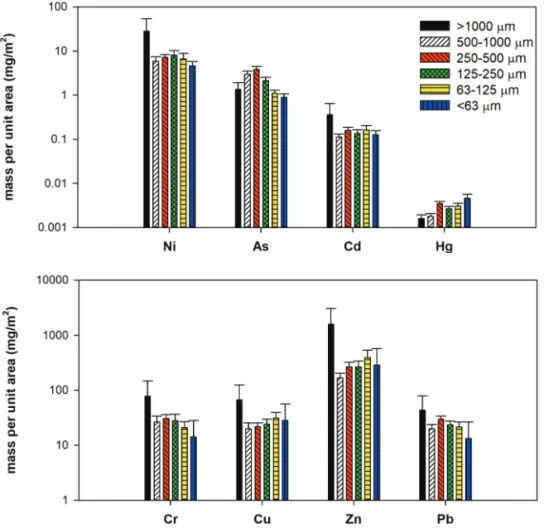
Figure 4. Mass per unit area (mg/m2) for heavy metals in each particle size of RD in this study.
Table 7. Korea soil quality standard of heavy metals for the 3rd area (unit. mg/kg)
Cd Cu As Hg Pb Zn Ni
Soil contamination guide value 60 2000 200 20 700 2000 500
Soil contamination clean-up value 180 6000 600 60 2100 5000 1500
른 지점에 비해 근방에 조선업관련 산업체수와 도장 업체가 가장 많아 이에 의한 Zn의 도로유입이 많은 것으로 파악된 지점이다. 그러므로 주변의 환경영향 을 고려하여 업체 주변의 도로먼지의 관리에 주의를 기울일 필요가 있다.
도로먼지의 배출량 제어 및 효과적인 오염관리 전 략 수립을 위해서는, 입자크기 및 도로먼지 양, 금속 농도, 하중에 대한 정량적 평가는 필수적이다(Zhao et al. 2017). 따라서 각 도로먼지 시료에서 분리한 입 경분율 별 단위면적당 도로먼지(g/m2)의 양에 각 금 속의 농도(mg/kg)를 곱하여 각 금속의 입경분율 별 단위면적당 부하량(mg/m2)을 계산하였으며 이 결과 를 Figure 4에 나타냈다. 도로먼지내 단위면적당 중 금속의 부하량(mg/m2)은 Zn이 입자크기에 따라 168~2574 mg/m2로 다른 원소에 비해 높았으며,
>1000 μm에서 상대적인 부하량이 높은 결과를 보 였다(Figure 4). 대부분 원소에서 >1000 μm의 입자 의 단위면적당 오염부하가 높아 도로먼지에 포함된 금속입자의 영향을 크게 받고 있음을 알 수 있었다.
많은 연구들에서 도시의 도로먼지의 경우 <250 μm 의 작은 입자의 중금속 부하량이 70% 이상이며, 63 μm보다 작은 입자에 오염물질의 부하량이 많아 미세 입자의 관리가 특히 중요하다고 보고되었다(Lee et al. 2020a; Zhao et al. 2010). 그러나 본 연구지역 의 경우 이와 달리 >1000 μm의 관리가 더 중요한 것 으로 나타났다.
도로먼지의 기원을 파악하기 위하여 Zn/Cu비율 을 도로먼지의 추적자로 이용하였다. Zn와 Cu는 일 반적으로 도로먼지에서 차량의 타이어와 브레이크 패드 등으로부터 방출되어 축적되는 주요 원소로 (Grigoratos and Martini, 2015; Hwang et al. 2016;
Mckenzie et al. 2009) 도로의 Zn/Cu의 농도비는 차량의 타이어와 브레이크의 도로먼지 기여율을 나타 낸다(Hwang et al. 2016). 차량활동이 많은 세계 주 요 도시의 도로먼지에서 Zn/Cu의 농도비는 미국의 경우(워싱턴 제외) 지난 수십 년간 2.6~5.1(Hwang et al. 2016) 범위로 나타났으며, 영국 런던에서는 3.4(Crosby et al. 2014), 국내 울산에서 1.1(Duong and Lee 2011), 시화에서는 1.8이었다(Jeong et al.
2019a). 그리고 일반적인 도심 도로먼지 중 <63 μm 인 미세입자의 경우 홍콩에서는 5.5(Ho 1990)-7.5 (Tanner et al. 2008), 타이완에서 9.8(Chang et al.
2009), 서울에서 2.6(Seo 2010)으로 나타났다. 그러 나 스페인과 대만에서 Zn 제련소가 위치하며 차량 이 외에 주요 산업기원 오염원이 존재하는 지역 도로먼 지의 Zn/Cu 농도비는 각각 26.7(Ordonez et al.
2003)과 9.8(Chang et al. 2009)로 차량운행이 많은 도시의 도로먼지에 비해 상당히 높았다. 본 연구에서 도로먼지의 입경분율 별 Zn/Cu 농도비는 평균적으 로 >1000 μm이 19.3, 500-1000 μm이 12.5, 250- 500 μm이 12.4, 125-250 μm이 11.2. 63-125 μm 이 10.7, <63 μm이 10.8이었으며, 상대적으로 큰 입 자에서 이들 농도비가 큰 특징을 보였고, 입자가 작 아질수록 도로에서 보고되는 비율에 가까워졌다.
이 결과는 대불산업단지의 경우 큰 사이즈의 도로 먼지 입자에는 철강, 중공업, 선박제조 등의 산업활 동에 기인한 입자들의 비율이 차량활동 기원보다 많 으며, 입자의 크기가 작아질수록 차량기원 입자가 늘 어났음을 보여주었다. 또한 산업시설이 주요 기원인 것으로 보이는 >1000 μm의 오염부하량이 높아, 산 업체 인근의 도로청소에 주의를 기울일 필요가 있는 것으로 나타났다. 국내에서는 전체 미세먼지 중 많은 부분을 차지하는 도로비산먼지 감소를 위해서 진공흡 입식 분진차량 도입 및 운영 횟수를 증가시키고 있다.
250 μm보다 큰 입자의 경우 일반적인 도로청소방법 도 효과적이며(Calabro 2010; Jeong et al. 2011), 본 연구결과에 의하면 도로청소의 효율성을 위해 자 력 분리방법 등의 물리적 분리방법의 적용도 고려할 수 있을 것으로 보인다.
IV. 결론
본 연구는 대불산업단지에 존재하는 도로먼지를 6 개의 입자크기 및 자성을 이용하여 분리한 후 각각에 대한 중금속류의 오염특성을 조사하였다. 도로먼지 의 중금속 농도는 Fe>Zn>Cu>Pb>Cr>Ni>
As>Cd>Hg 였고, EF로 본 인위적 농축도는 Zn>
Cd>Pb>Cu>Cr>Ni>Hg 순으로 나타나 연구지
역의 도로먼지의 중금속 오염은 대불산업단지의 주 력 업종인 조선업과 차량 활동과 관련이 큰 것으로 나타났다. 특히 대불산업단지는 Zn의 오염도가 다른 금속원소에 비해 매우 높은 특징을 보였다. PLI로 본 시료채취 지점별 오염도는 0.6-4.9의 범위로 지점 별 차이가 큰 편이었다. 선박관련 제조업 등의 산업체 가 밀집되어있는 지역에서 가장 높은 금속 오염도를 보였으며, 산업단지 외곽의 도로는 상대적으로 오염 도가 낮았다. 상관관계 분석 결과 도로먼지의 입자크 기와 중금속류의 농도는 음의 상관성을 보였다. 그러 나 일부 지점에서는 상대적으로 큰 입자에서 중금속 류의 농도가 높아, 산업활동을 통한 큰 금속입자가 도 로노면에 퇴적되어 있음을 알 수 있었다. 대불산업단 지에의 도로먼지 내 중금속들은 Fe과 함께 존재하며, 전체 도로먼지 중 자력으로 분리가 가능한 MFs 분율 에 함유된 비율이 Cr 80.1%, Ni 77.1%, Cu 52.5%, Zn 50.0%, Cd 45.9%, Pb 33.5%이었다. 도로먼지 전체에서 MFs를 분리할 경우 남은 NMFs 분율의 Cr, Ni, Cu, Zn, Cd, Pb의 농도 수준이 상당히 낮아 지는 것으로 나타났다. 도로먼지 내 금속농도와 Zn/Cu의 농도비를 추적자로 활용하여 큰 입자일수 록 산업단지의 기여도가, 작은 입자일수록 차량기원 의 기여도가 큰 것을 확인하였다. 대불산업단지 내 도로먼지의 평균 중금속류 오염도는 사람의 건강, 환 경에 우려할만한 수준은 아니었다. 그러나 일부 지점 의 경우 Zn이 토양오염 대책기준 이상으로 나와 즉 시 관리가 필요한 것으로 나타났다. 특히, 입경분율 의 상대적 비율을 고려한 중금속 오염부하도가 > 1000 μm에서 가장 높은 것으로 나타나 이 지역의 도 로청소에 주의를 필요가 있는 것으로 나타났다. 대불 산업단지 도로먼지의 입도와 자성특성으로 볼 때 도 로먼지의 중금속 저감을 위해 자력분리기술의 적용 이 가능할 것으로 판단되었다. 그러나 이에 대한 기 술적 적용성에 대한 연구와, 도로먼지로 인한 인근 해양환경, 주거환경에 대한 영향 파악을 위해서는 추 가적인 연구가 더 필요하다.
사사
본 연구는 한국해양과학기술원 연구비 지원(PE99 812)에 의해 수행되었습니다.
References
Adachi K, Tainosho Y. 2004. Characteristics of heavy metal particles embedded in tire dust. Environmental International, 30:
1009-1017.
Amato F, Pandolfi M, Escrig A, Querol X, Alastuey A, Pey J, Perez N, Hopke PK.
2009. Quantifying road dust resuspension in urban environment by multilinear engine: a comparison with PMF2.
Atmospheric Environment, 43: 2770-2780.
Álvarez-Vázquez MA, Álvarez-Iglesias P, De Uña- Álvarez E, Quintana B, Caetano M and Prego R. 2020. Industrial supply of trace elements during the “Anthropocene”: A record in estuarine sediments from the Ria of Ferrol (NW Iberian Peninsula). Marine Chemistry, 223: 103825.
Aryal R, Vigneswaran S, Kandasamy J, Naidu R.
2010. Urban stormwater quality and treatment. Korean Journal of Chemical Engineering, 27: 1343-1359.
Brown JN, Peake BM. 2006. Sources of heavy metals and polycyclic aromatic hydrocarbons in urban stormwater runoff. Science of the Total Environment, 359: 145-155.
Calabró PS. 2010. Impact of mechanical street cleaning and rainfall events on the quantity and heavy metals load of street sediments, Environmental Technology, 31(11): 1255- 1262.
Cerik BC, Park B, Park SJ, Choung J. 2019.
Modeling, testing and calibration of ductile
crack formation in grade DH36 ship plates. Marine Structures, 66: 27-43.
Chang SH, Wang KS, Chang HF, Ni WW, Wu BJ, Wong RH, Lee HS. 2009. Comparison of source identification of metals in road-dust and soil. Soil and Sediment contamination, 18: 669-683.
Choi DI, Choi SS, Choi PS, Lyu HI, Lee GC, Park GS, Lyu JS, Jung KH. 1998. Effects of Humic Acid on the Cadmium-Induced Fish Toxicity. Journal of environmental toxicology, 13: 11-17.
Choi JY, Hong GH, Ra K, Kim KT, Kim K.
2014. Magnetic characteristics of sediment grains concurrently contaminated with TBT and metals near a shipyard in Busan, Korea.
Marine Pollution Bulletin, 85: 679-685.
Crosby CJ, Fullen MA, Booth CA, Searle DE.
2014. A dynamic approach to urban road deposited sediment pollution monitoring (Marylebone Road, London, UK). Journal of Applied Geophysics, 105: 10-20.
Drach A, Tsukrov I, DeCew J, Aufrecht J, Grohbauer A, Hofmann U. 2013. Field studies of corrosion behaviour of copper alloys in natural seawater. Corrosion Science, 76: 453-464.
Duong T, Lee BK. 2011. Determining contamination level of heavy metals in road dust from busy traffic areas with different characteristics. Journal of Environmental Management, 95: 554-562.
Duong TTT, Lee BK. 2011. Determining contamination level of heavy metals in road dust from busy traffic areas with different characteristics. Journal of Environmental Management, 92: 554-562.
Dearing JA. 1999. Environmental Magnetic Susceptibility: Using the Bartington MS2
System. Chi Publishing, Kenilworth, UK, p. 54.
Evans ME, Heller F. 2003. Environmental Magnetism: Principles and Applications of Enviromagnetics. Academic Press, Google Scholar.
Faiz Y, Tufail M, Javed MT, Chaudhry MM, Siddique N. 2009. Road dust pollution of Cd, Cu, Ni, Pb and Zn along Islamabad Expressway, Pakistan. Microchemical Journal, 92: 186-192.
Fialova H, Maier G, Petrovsky E, Kapicka A, Boyko T, Scholger R, MAGPROX Team.
2006. Magnetic properties of soils from sites with different geological and environmental settings. Journal of Applied Geophysics, 59: 273-283.
Gautam P, Blaha U and Apple E. 2005. Magnetic susceptibility of dust-loaded leaves as a proxy of traffic-related heavy metal pollution in Kathmandu city, Nepal.
Atmospheric Environment, 39: 2201-2211.
German J and Svensson G. 2002. Metal content and particle size distribution of street sediments and street sweeping waste. Water Science and Technology, 46: 191-198.
Goddu SR, Appel E, Jordanova D, Wehland F.
2004. Magnetic properties of road dust from Visakhapatnam (India)-relationship to industrial pollution and road traffic.
Physics and Chemistry of the Earth, 29:
985-995.
Grachev VA, Rozen AE, Perelygin YP, Kireev YS, Los IS. 2020. Multilayer corrosion-resistant material based on iron-carbon alloys. Heliyon, 6(5): e04039.
Grigoratos T, Marini G. 2015. Brake wear particle emissions: a review. Environmental Science and Pollution Research, 22: 2491-2504.
Gunawardana C, Goonetilleke A, Egodawatta P.
2013. Adsorption of heavy metals by road deposited solids. Water Science and Technology, 67: 2622-2629.
Han YM, Cao JJ, Posmentier ES, Fung K, Tian H, An ZS. 2008. An particulate associated potentially harmful elements in urban road dusts in Xian, China. Applied Geochemistry, 23: 835-845.
Happo MS, Salonen RO, Halinen AI, Jalava PI, Pennanen AS, Kosma VM, Sillanpaa M, Hillamo R, runekreef BB, Katsouyanni K, Sunyer J, Hirvonen M-R. 2007. Dose and time dependency of inflammatory responses in the mouse lung to urban air coarse, fine, and ultrafine particles from six European cities. Inhalation Toxicology, 19(3): 227-246.
Ho YB. 1990. The effect of Pb reduction in petrol on the Pb content of curbside dust in Hong Kong. Science of the Total Environment, 93: 411-418.
Hong Ni, Zhu P, Liu A, Zhao X, Guan Y. 2018.
Using an innovative flag element ratio approach to tracking potential sources of heavy metals on urban road surfaces.
Environmental Pollution, 243(Part A):
410-417.
Hoffmann RM, Knab M, Apple E. 1999. Magnetic susceptibility napping of roadside pollution.
Journal of Geochemical Exploration, 99:
313-326.
Hwang HM, Fiala MJ, Park D, Wade TL. 2016.
Review of pollutants in urban road dust and stormwater runoff: part 1. Heavy metals released from vehicles. International Journal of Urban Sciences, 20: 334-360.
Jalava PI, Salonen RO, Pennanen AS, Happo MS, Penttinen P, Halinen AI, Sillanpaa M,
Hillamo R, Hirvonen M-R. 2008. Effects of solubility of urban air fine and coarse particles on cytotoxic and inflammatory responses in RAW 264.7 macrophage cell line. Toxicology and Applied Pharmacology, 229: 146-160.
Jeong H, Kim KT, Kim ES, Ra K, Lee SY. 2016.
Sediment quality assessment for heavy metals in stream around the Shihwa Lake.
Journal of the Korean Society for Marine Environments and Energy, 19: 25-36.
[Korean Literature]
Jeong H. Lee J, Kim KT, Kim ES, Ra K. 2019a.
Identification on metal pollution sources in road dust of industrial complex using magnetic property around Shihwa Lake Basin. Journal of Korean Society for Marine Environment and Energy, 22: 18-33.
[Korean Literature]
Jeong H, Lee J, Choi JY, Kim KT, Kim ES, Sun C, Park JK, Ra K. 2019b. Study on dissolved and particulate heavy metals in stream water and stormwater runoffs from Suyeong watershed in Busan special management area, Korea. Journal of Korean Society for Marine Environment and Energy, 22: 203-214. [Korean Literature]
Jeong K, Kang HM, Ko SO. 2011. Characteristics of Collected Sediments from Road Sweeping and Reduction in the Nonpoint Source Pollutants Loading. International journal of highway engineering, 13: 187- 193. [Korean Literature]
Jeonnam industrial complex Data management system http://industry.jeonnam.go.kr/ - accessed in 2020.
Jordanova D, Jordanova N, Hoffmann V. 2006.
Magnetic mineralogy and grain-size dependence of hysteresis parameters of
single spherules from industrial waste products. Physics of the Earth and Planetary Interiors, 154: 255-265.
Kainuma S, Yang M, Ishihara S, Kaneko A, Yamauchi T. 2019. Corrosion protection of steel members using an Al-Zn base sacrificial anode and fiber sheet in an atmospheric environment. Construction and Building Materials, 224: 880-893.
Kang YS, Sim SH, Lee SK, Bin SO, Choi ES, 2007. A Comparison Study on the Concentration of Total Welding Fume and Respirable Particulate Mass for Welding Workers of a Shipbuilding. Journal of environmental health sciences, 33(4): 276- 282. [Korean Literature]
KIET (Korea Institute for Industrial Economics
& Trade). 2012. Changes in trade specialization index by major industry (2000,2010), Industrial Statistics Analysis System(ISTANS). from http://www.istans.
or.kr/website/in/SubMain.jsp, accessed in 2012. [Korean Literature]
Khademi H, Gabarron M, Abbaspour A, Martinez-Martinez S, Faz A, Acosta JA.
2019. Environmental impact assessment of industrial activities on heavy metals distribution in street dust and soil.
Chemosphere, 217: 695-705.
Kim MY. 2013. Optimization of Industrial Protective Clothing to respond to Hazardous Working Environment of Shipbuilding Workshops - Focused on Welding Protective Clothing. Master Thesis, Changwon university, p.88. [Korean Literature]
Kim W, Doh SJ, Park YH, Yun ST. 2007. Two- year magnetic monitoring in conjunction with geochemical and electron microscopic
data of roadside dust in Seoul, Korea.
Atmospheric Environment, 41: 7627-7641.
Kim KW, Myung JH, Ahn JS, Chon HT. 1998.
Heavy metal contamination in dusts and stream sediments in the Taejeon area, Korea. Journal of Geochemical Exploration, 64: 409-419.
Krishna LR, Madhavi Y, Babu PS, Rao DS, Padmanabham G. 2019. Strategies for corrosion protection of non-ferrous metals and alloys through surface engineering.
Materials Today: Proceedings, 15(Part 1):
145-154.
Lee BG, Kim JK. 2003. Analysis of Heavy Metal Extracted from Road Dust under Acid Rain Condition in Ulsan. Korean Sciety for Atmospheric Environment, Proceeding of the 35th Meeting of KOSAE (May, 2003), 241-242. [Korean Literature]
Lee J, Jeong H, Ra K, Choi JY. 2020a.
Assessment of particle size distribution and pollution impact of heavy metals in road- deposited sediments (RDS) from Shihwa industrial complex. Journal of Environmental Impact Assessment, 29: 8-25. [Korean Literature]
Lee J, Jeong H, Choi JY, Ra K. 2020b.
Characteristics and assessment of metal pollution and their potential source in stormwaer runofff from Shihwa industrial complex, Korea. Korean Journal of Environment and Ecology, (in press).
[Korean Literature]
Lee JS, Chon HT. 2005. Risk Assessment of Arsenic by Human Exposure of Contaminated Soil, Groundwater and Rice Grain. Economic and environmental geology, 38: 535-545.
[Korean Literature]
Li D, Yang D, Zhang G, Chen X, Luo X. 2018.
Microstructure and mechanical properties of welding metal with high Cr-Ni austenite wire through Ar-He-N2 gas metal arc welding. Journal of Manufacturing Processes, 35: 190-196.
Li H, Shi A, Zhang X. 2015. Particle size distribution and characteristics of heavy metals in road- deposited sediments from Beijing Olympic Park. Journal of Environmental Sciences, 32: 228-237.
Lu XW, Wang LJ, Li LY, Lei K, Huang L, Kang D. 2010. Multivariate statistical analysis of heavy metals in street dust Baoji, NW China. Journal of Hazardous Materials, 173: 744-749.
Luo C, Liu C, Wang Y, Liu X, Li F, Zhang G, Li X. 2011. Heavy metal contamination in soils and vegetables near an e-waste processing site, south China. Journal of the Hazardous Materials, 186: 481-490.
Mahbub P, Goonetilleke A, Ayoko GA, Egodawatta P, Yigitcanlar T. 2011. Analysis of build-up of heavy metals and volatile organics on urban roads in gold coast, Australia. Water Science and Technology, 63: 2077-2085.
McKenzie ER, Money JE, Green PG, Young TM.
2009. Metals associated with stormwater- relevant brake and tire samples. Science of the Total Environment, 407: 5855-5860.
Ministry of Construction. 1990. Change of Development Basic Plan for Daebul Industrial complex (’89. 8. 5 basic plan notice) - from http://www.archives.go.kr.
[Korean Literature]
Murakami M, Sato N, Anegawa A, Nakada N, Harada A, Kamatsu T. 2008. Multiple evaluations of the removal of pollutants in road runoff by soil infiltration. Water Researches, 42(10-11): 2745-2755.
Nagajyoti P, Lee K, Sreekant: h T. 2010. Heavy metals, occurrence and toxicity for plants:
a review. Environmental Chemistry Letters, 8: 199-216.
Norton GJ, Williams PN, Adomako EE. 2014.
Lead in rice: analysis of baseline lead levels in market and field collected rice grains.
Science of the Total Environment, 485:
428-434.
Novotny V, Chesters G. 1981. Handbook of Nonpoint Pollution Sources and Management. Van Nostrand Reinhold Company, New York, p. 255.
OECD. 2010. Environmental and climate change issues in the shipbuilding industry OECD Council Working Party on Shipbuilding (WP6), https://www.oecd.org/sti/ind/
46370308.pdf (accessed 19.08.26)
Oliva SR, Espinosa AJF. 2007. Monitoring of heavy metals in topsoils, atmospheric particles and plant leaves to identify possible contamination sources. Microchemical Journal, 86(1): 131-139.
Ordonez A, Loredo J, De Miguel E, Charlesworth S. 2003. Distribution of heavy metals in the street dusts and soils of an industrial city in Northern Spain. Archives of Environmental Contamination and Toxicology, 44: 160-170.
Park JS. 2016. Structure and characteristics of employment of the block companies in Shipbuilding industry: Daebul Industrial Complex. Labor Brief, 10 51-64. [Korean Literature]
Querol X, Alastuey AS, Lopez-Soler A, Mantillai E, Plana F. 1996. Mineral composition of atmospheric particulates around a large coal-fired power station. Atmospheric Environment, 30: 3557-3572.
Roger S, Montrejaud-Vignoles M, Andral MC,
Herremans L, Fortune JP. 1998. Mineral, physical and chemical analysis of the solid matter carried by motorway runoff water.
Water Research, 32: 1119-1125.
Rossmann R, Barres JA. 1992. Contamination of green bay water with lead and cadmium by a 37-m long, 2-m draft research vessel.
Science of The Total Environment, 125:
405-415.
Rudnick RI, Gao S. 2003. Composition of the continental crust. In: Rudnick RL, editor.
The crust, Elsevier, pp. 1-64.
Sansalone JJ, Buchberger SG. 1997. Partitioning and first flush of metals in urban roadway storm water. Journal of Environmental Engineering, 123: 134-143.
Sansalone JJ, Ying G. 2008. Partitioning and granulometric distribution of metal leachate from urban traffic dry deposition particulate matter subject to acidic rainfall and runoff retention. Water Research, 42: 4146-4162.
Schlesinger RB, Kunzli N, Hindy GM, Gotschi T, Jerrett M. 2006. The Health Relevance of Ambient Particulate Matter Characteristics:
Coherence of Toxicological and Epidemiological Inferences. Inhalation Toxicology, 18(2):
95-125.
Seo HJ. 2011. A Studyon the Employment of Temporary and In-house Work Subcontract in Shipbuilding Industry-Focusing on the Temporary Workers Internally Subcontracted at Daebul Industrial Complex. Master Thesis, Daebul unuversity Graduate School of Business Administration, p. 101. [Korean Literature]
Seo YH. 2010. Development of road dust source profile by a detailed chemical composition analysis of road dust. Journal of Korean Society Environmental Administration, 16:
43-52. [Korean Literature]
Shi G, Chen Z, Bi C, Li Y, Teng J, Wang L, Xu S. 2010. Comprehensive assessment of toxic metals in urban and suburban street deposited sediments (SDSs) in the biggest metropolitan area of China. Environmental Pollution, 158: 694-703.
Singh R, Gautam N, Mishra A, Gupta R. 2011.
Heavy metals and living systems: an overview. Indian Journal of Pharmacology, 43: 246-253.
Sun Y, Zhou Q, Xie X, Liu R. 2010. Spatial, sources and risk assessment of heavy metal contamination of urban soils in typical regions of Shenyang, China. Journal of the Hazardous Materials, 174: 455-462.
Tan Z, Lu S, Zhao H, Kai X, Jiaxian P, Win MS, Yu S, Yonemochi S, Wang Q. 2018.
Magnetic, geochemical characteristics and health risk assessment of road dust in Xuanwei and Fuyuan, China. Environmental Geochemistry and Health, 40: 1541-1555.
Tanner PA, Ma HL, Yu PKN. 2008. Fingerprinting metals in urban street dust of Beijing, Shanghai and Hong Kong. Environmental Science Technology. 42: 7111-7117.
Taylor SR. 1964. Abundance of chemical elements in the continental crust: a new table. Geochimica Cosmochiica Acta, 28: 1273-1285.
Tomlinson DL, Wilson J, Harris CR, Jeffrey DW.
1980. Problems in assessment of heavy metals in estuaries and the formation of pollution load index. Helgoland Marine Research, 33: 566-575.
Vaze J, Chiew S. 2002. Experimental study of pollutant accumulation on an urban road surface, Urban Water, 4: 379-389.
Viklander M. 1998. Particle size distribution and metal content in street sediments. Journal of