This is an Open Access article distributed under the terms of the Creative Commons Attribution Non-Commercial License (http: //creativecommons.org/licenses/by- nc/4.0/) which permits unrestricted non-commercial use, distribution, and reproduction in any medium, provided the original work is properly cited.
Copyright: © 2019 Korean Journal of Agricultural Science
FOOD & CHEMISTRY
Heavy metals and pollution index of
agricultural soils around industrial complexes in the Jeon-Buk regions of Korea
Sorakon Suwanmanon, Ki In Kim
*Department of Horticultural Science, Mokpo National University, Muan 58554, Korea
*
Corresponding author: [email protected]
Abstract
The aim of this study was to evaluate heavy metal contamination and pollution index of agricultural soils around industrial complexes in the Jeon-Buk Regions of Korea. Soil samples near industrial complexes in 2017 were collected at two depths (0 - 15 and 15 - 30 cm) within a 500- and 1000-meter radius before planting. Eight heavy metals (Arsenic (As), cadmium (Cd), chromium (Cr), Cupper (Cu), nickel (Ni), lead (Pb), mercury (Hg) and zinc (Zn)) and the pollution index (PI), geoaccumulation index (Igeo) and soil pollution index (SPI) were evaluated based on soil contamination warning standard (SCWS). Overall, the heavy metal concentrations were below the SCWS. The PI ranged from 0.1 to 0.9 and categorized into Group 1 which is not polluted with any heavy metals. The average Igeo values of all the soil samples ranged from - 2.56 to 3.22. The Igeo values of Cd and Hg may not represent well the pollution index because the heavy metal concentrations in the soil is lower compared to the SCWS. In fact, based on the heavy metal concentrations, the Igeo for monitored soils should be categorized into Group 1, uncontaminated to moderately contaminated. However, the Igeo of Cd and Hg are classified into heavily contaminated. These results suggest that for calculating the Igeo, the heavy metal concentration and background concentration should be used very carefully if the heavy metal concentration in the soil is lower than the background concentration. SPI for all the soil samples ranged from 0.00 to 0.11 which indicates no heavy metal pollution was observed.
Keywords: geochemical index, heavy metal, industrial area, pollution index, soil pollution index
Introduction
Soil pollution is the most important agricultural issues for the food safety in worldwide (Kong, 2014). Monitoring and evaluating soil and other agricultural quality can help make environmental policy better (Kloke, 1979; Sutherland, 1999; Wu et al., 2010; Ahmadi et al., 2017). Many countries reported a comparison of the results of different methods for evaluating soil contamination. These researches were based on geochemistry mapping OPEN ACCESS
Accepted: September 30, 2019 Revised: September 27, 2019 Received: August 08, 2019 Citation: Suwanmanon S, Kim KI.
2019. Heavy metals and pollution index of agricultural soils around industrial complexes in the Jeon-Buk regions of Korea. Korean Journal of Agricultural Science 46:799-811. https://
doi.org/10.7744/kjoas.20190063
including enrichment factor (EF), geoaccumulation index (Igeo), and pollution index (PI), along with principal component analysis (PCA) and comparisons of indices derived from different soil contamination. Industry expansion may negatively influence on the environment that results in critical issues on soil, water, and air pollution. The common pollution issues in soils near industrial complexes is from either wastewater input or solid waste input from the industrial process (Chen et al., 2005).
Currently, Ministry of Environment (MOE) in Korea has set up the levels of Soil Contamination Warning Standard (SCWS) which is regulated by Soil Environment Conservation La (SECL). Heavy metal warning levels for cultivated lands (Region 1) are 25, 4, 150, 100, 200, and 300 mg kg
-1for As, Cd, Cu, Ni, Pb, and Zn, respectively. Heavy metal contaminations in soils are due to smoke, dust, sewage, and industrial wastewater (Kim et al., 1996; Kim et al., 2003; Jung et al., 2005; Lee et al., 2010). Major heavy metals found in soils are cadmium (Cd), chromium (Cr), copper (Cu), lead (Pb), nickel (Ni), and zinc (Zn). Some of the heavy metals are the most hazardous elements for human health such as arsenic (As) (Karaca et al., 2010). These heavy metals in soils can be accumulated and certain levels of these heavy metals can be negatively influenced on crop growth and quality. For example, Cd and mercury (Hg) can be absorbed in the plant tissue and caused indirect hazard for human and animal health if they were consumed (Holmgren et al., 1993; Kim, 1996; Vulava et al., 1997).
Kim et al. (2008) reported that human uptake levels of Cd and Pb concentrations in rice are 0.2 mg kg
-1each and heavy metal concentrations for As, Ni, and Zn at 2010 monitoring sites for paddy rice in South Korea tended to be increased, while Cd and Cu concentrations were decreased and Pb concentrations were similar. The effects of pollution in soils are highly related to the quality of agriculture products, food quality, and eventually human health (Jarup, 2003; Akoto et al., 2008; Cho et al., 2018; Kang et al., 2018; Kim et al., 2018). This paper will help us understand how much heavy metals in soils contain near industrial complexes in Jeon-Buk province.
Also, this research can provide some important information on food and soil safety issues based on heavy metal level and distribution. The objective of this study was to investigate heavy metal concentrations and to provide soil contamination index in agricultural soils around industrial complexes in Jeon-Buk province, Korea.
Materials and Methods
Site description
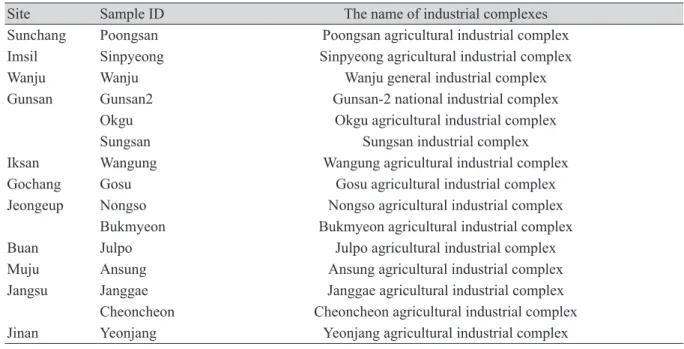
Soil sampling sites were selected at agricultural fields near 15 industrial complexes in 11 counties in Jeon-Buk Province (Table 1). Ten agricultural fields at each industrial complex were randomly selected with four directions (east, west, south, and north) in 2017. Five of ten agricultural fields was located at within 0 meter to 500 meter radius from the borderline of each agricultural industrial complex, while the other was located at within 500 meter to 1000 meter radius from the borderline of each industrial complex.
Soil sample
Soil samples for each site were collected at two soil depth (0 - 15 cm and 15 - 30 cm) before planting
from April through May in 2017. Ten soil cores were collected using soil auger (Eijelkamp one-piece soil
auger, Gempler �s, Giesbeek, Netherlands) and combined them. Detailed information on sample ID and site of agricultural complexes are listed in Table 1. The total number of soil samples collected were 300 soil samples (150 for 0 - 15 cm depth and 150 soil sample for 15 - 30 cm depth). Wet soils were sub sampled and remained soil samples were air dried, then sieved with a 2 mm sieve for further analysis (MOE, 2016). Soil samples for heavy metal analysis were milled with Zirconia balls by mill machine (Daihan, Korea) for 5 days at 10000 rpm.
Heavy metal analysis
Soil samples were analyzed based on National Institute of Agricultural Science and Technology (NIAST) method (NIAST, 1998). Soil moisture content was measured at 105℃ for 8 hours. Finely ground soil samples were wet digested for heavy metal analysis. In details, three grams of soils were weighed and mixed with 21 mL of hydrochloric acid (HCl) and 7 mL of nitric acid (HNO
3). Then the wet digested solution was heated for 2 hours at 120 ℃ and filtered through Whatman filter paper No. 2 (Whatman, UK). These digested solution was used for heavy metal analysis, such as As, Cd, Cr, Cu, Ni, Pb, Hg, and Zn (MOE, 2016). The heavy metal concentration was measured using an ICP-OES (Optima 7300DV, Perkin Elmer, USA).
Igeo and soil pollution index (SPI) analysis
Two evaluating methods, such as Igeo and SPI for the assessment of the soil contamination were performed.
For Igeo analysis, the contamination factor was calculated using the relation described (Hakanson, 1980).
PI = Cn/Bn (1)
Table 1. Monitored industrial complexes in Jeon-Buk province in 2017 in Korea.
Site Sample ID The name of industrial complexes
Sunchang Poongsan Poongsan agricultural industrial complex Imsil Sinpyeong Sinpyeong agricultural industrial complex
Wanju Wanju Wanju general industrial complex
Gunsan Gunsan2 Gunsan-2 national industrial complex
Okgu Okgu agricultural industrial complex
Sungsan Sungsan industrial complex
Iksan Wangung Wangung agricultural industrial complex
Gochang Gosu Gosu agricultural industrial complex
Jeongeup Nongso Nongso agricultural industrial complex
Bukmyeon Bukmyeon agricultural industrial complex
Buan Julpo Julpo agricultural industrial complex
Muju Ansung Ansung agricultural industrial complex
Jangsu Janggae Janggae agricultural industrial complex
Cheoncheon Cheoncheon agricultural industrial complex
Jinan Yeonjang Yeonjang agricultural industrial complex
(1) where Cn is the concentration of the examined element in the soil and Bn is the geochemical background value. The background values was used from Liao and Chao (2004). The constant 1.5 helps to analyze natural fluctuation between the content of a given substance in environment and very small anthropogenic influences.
The background values for this study were averaged values from 2070 paddy rice soil samples. The concentration of As, Cd, Cu, Ni, Pb, and Zn were 3.68, 0.22, 14.9, 14.1, 16.7, and 56.8 mg kg
-1, respectively.
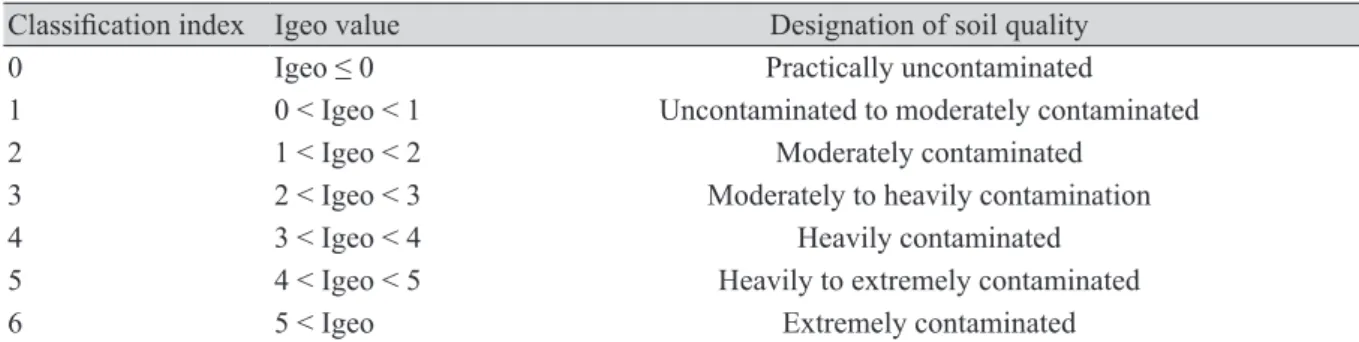
The contamination level of soil was evaluated using Igeo. Igeo values are classified into 6 classification index (Table 2). The Igeo were calculated using the modified formula based on Chester and Stoner (1973) and Hakanson (1980).
Igeo = log
2[Cn/1.5 × Bn] (2)
The PI and Igeo values were compared with the classification of soil contamination assessment degree index.
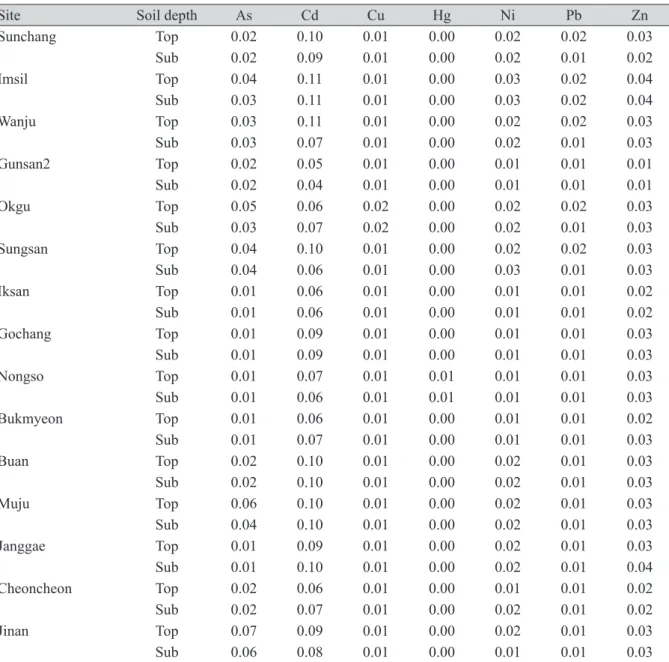
Four categories of PI and Igeo were defined Hakanson (1980) and Muller (1979) and Praveena et al. (2008). SPI was evaluated based on the levels of SCWS which is regulated by SECL. Warning levels for cultivated lands (Region 1) were 25, 4, 150, 100, 200, and 300 mg/kg for As, Cd, Cu, Ni, Pb, and Zn, respectively. Soil pollution index was calculated the equation below.
(3)
If SPI is greater than 1 each heavy metal concentration is higher than soil contamination warning standard, while SPI is less than 1 soil heavy metal concentration is within the levels of soil contamination warning standard.
Statistical analysis
All experiments data are expressed as means and standard deviation. The 0.05 p-value were considered a statistically significant using SPSS program (version 12.0, IBM, USA).
Table 2. Classification of different soil contamination assessment of geochemical index (Igeo).
Classification index Igeo value Designation of soil quality
0 Igeo ≤ 0 Practically uncontaminated
1 0 < Igeo < 1 Uncontaminated to moderately contaminated
2 1 < Igeo < 2 Moderately contaminated
3 2 < Igeo < 3 Moderately to heavily contamination
4 3 < Igeo < 4 Heavily contaminated
5 4 < Igeo < 5 Heavily to extremely contaminated
6 5 < Igeo Extremely contaminated
Results and Discussion
Summary statistics of heavy metals
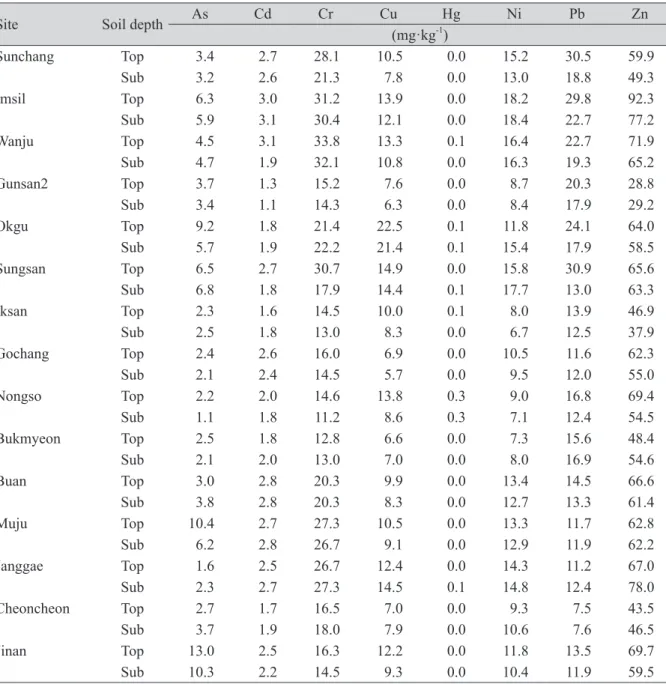
Statistical summary of heavy metal concentrations in soils near industrial complexes in Jeonbuk province in Korea are listed in Table 3. Average, minimum (Min.), maximum (Max.), standard deviation (stdev), coefficients of variation (C.V. (%)), kurtosis, and skewness were listed based on two soil depths (0 - 15 cm depth and 15 - 30 cm depth). Overall, eight heavy metals in the soil samples were found. Total averaged heavy metal concentrations for top and sub soils were 3.8, 3.4 mg kg
-1for As, 2.3, 2.2 mg kg
-1for Cd, 21.2, 19.5 mg kg
-1for Cr, 10.7, 9.1 mg kg
-1for Cu, 0.1, 0.1 mg kg
-1for Hg, 12.1, 11.3 mg kg
-1for Ni, 17.4, 14.2 mg kg
-1for Pb, and 58.9, and 53.5 mg kg
-1for Zn, respectively (Table 3). Yun et al. (2018) reported that the averaged heavy metal concentrations of general paddy rice soils (2110 soil samples) for As, Cu, Ni, Pb, and Zn were 3.68, 14.9, 14.0, 16.7, and 56.8 mg kg
-1, respectively. These heavy metal concentrations were below heavy metal warning levels for cultivated lands (Region 1) which were 25, 150, 100, 200, and 300 mg kg
-1for As, Cu, Ni, Pb, and Zn, respectively. Arsenic concentration was ranged from 0.0 to 24.9 mg kg
-1, Cd concentration was ranged from 0.0 to 3.9 mg kg
-1, Cr concentration was ranged from 0.0 to 83.7 mg kg
-1, Ni concentration was ranged from 0.0 to 34.8 mg kg
-1, Pb concentration was ranged from 0.0 to 58.9 mg kg
-1, Hg concentration was ranged from 0.0 to 2.7 mg kg
-1, and Zn concentration was ranged from 0.0 to 162.2 mg kg
-1. These results showed that all of heavy metal concentrations for 300 soil samples was lower than the levels of SCWS and did not exceed the level limits of SECL.
Standard deviations for the top and sub soils were 4.7, 3.9 for As, 0.9, 1.0 for Cd, 13.0, 11.9 for Cr, 7.9, 6.6 for Cu, 0.3, 0.3 for Hg, 6.5, 6.5 for Ni, 11.8, 7.3 for Pb, and 28.7, and 25.8 for Zn, respectively. The lowest Table 3. Descriptive statistics of selected heavy metals in agricultural soils near the industrial complexes in Jeon-Buk Province in Korea.
Parameter As Cd Cr Cu Hg Ni Pb Zn
(mg·kg
-1)
Soil depth Top Sub Top Sub Top Sub Top Sub Top Sub Top Sub Top Sub Top Sub Average 3.8 3.4 2.3 2.2 21.2 19.5 10.7 9.1 0.1 0.1 12.1 11.3 17.4 14.2 58.9 53.5 Min. 0.0 0.0 0.0 0.0 0.0 0.0 0.0 0.0 0.0 0.0 0.0 0.0 0.0 0.2 0.0 0.0 Max. 24.9 24.9 3.9 3.9 83.7 65.0 53.6 36.9 2.7 2.7 34.8 32.6 58.9 45.2 162 143 Stdev. 4.7 3.9 0.9 1.0 13.0 11.9 7.9 6.6 0.3 0.3 6.5 6.5 11.8 7.3 28.7 25.8
C.V. (%) 123 114 41 45 61 61 74 73 440 482 54 57 68 51 49 48
Kurtosis 7.8 8.6 - 0.3 - 0.4 3.8 1.1 7.1 3.2 64.0 64.2 0.4 - 0.1 2.9 2.6 2.0 0.7 Skweness 2.6 2.4 - 0.2 - 0.2 1.3 0.8 2.1 1.5 7.4 7.4 0.6 0.5 1.6 1.0 0.8 0.2
SCWS
zLimit 25 4 n/a 150 4 100 200 300
Number of
Below SCWS 0 0 0 0 0 0 0 0
Min., minimum; Max., maximum; Stdev., standard deviation; C.V., coefficients variations.
z