Monitering of Heavy Metal (loid)s Contamination of Arable Soils near Industrial Complexes in Gyeongnam Province of South Korea
Hye Jin Park, Hyun Ho Lee, and Chang Oh Hong*
Department of Life science & Environmental Biochemistry, Pusan National University 1268-50 Miryang 54063, Korea
(Received: October 20 2016, Revised: October 27 2016, Accepted: October 28 2016)
There are a number of industrial complexes which could be a source of heavy metal (loid)s contamination of arable soil in Gyeongnam province of South Korea. Heavy metal (loid)s accumulation of plant is more related to the concentration of plant available heavy metal (loid)s in arable soil than that of total heavy metal (loid)s.
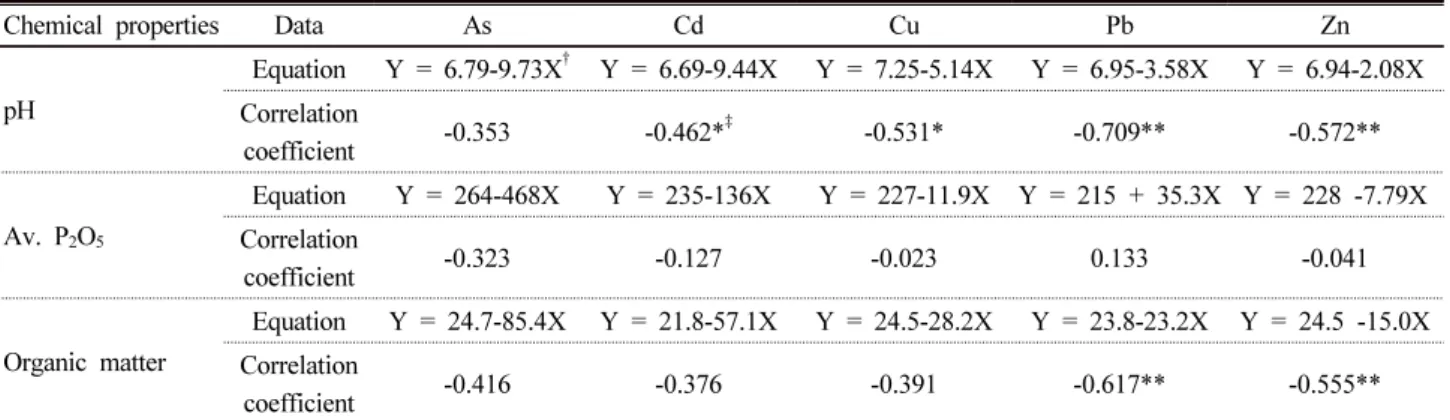
The objectives of this study were 1) to examine heavy metal concentrations in soils located near industrial complexes in Gyeongnam province and 2) to determine the relationship between concentration of plant available heavy metal (loid)s and chemical properties of soil. Soil samples were collected from 85 sites of arable lands nearby 7 industrial complexes in Gyeongnam province. Total heavy metal (loid)s concentration, available heavy metal (loid)s concentration, and chemical properties of collected soils were measured. The mean concentrations of arsenic (As), cadmium (Cd), copper (Cu), lead (Pb), and zinc (Zn) in the soils were 5.8 mg kg -1 , 1.3 mg kg -1 , 0.03 mg kg -1 , 51.5 mg kg -1 , and 68.7 mg kg -1 , respectively. Total concentration of Cd and Zn in arable soil located near ∇∇ industrial complex exceeded the warning criteria (4 mg kg -1 and 300 mg kg -1 for Cd and Zn, respectively) as described by in the soil environmental conservation Act of Korea. The concentration of plant available heavy metal (loid)s was negatively related to the soil pH and available Pb and Zn concentrations had relatively high correlation coefficient when compared with other heavy metal (loid)s.
The concentration of plant available Pb and Zn was negatively related to that of organic matter (OM). Based on the above results, it might be a good soil management to control pH and OM concentration with soil amendments such as lime and compost to reduce phytoavailability of heavy metal (loid)s in arable soil located near industrial complex.
Key words: Available heavy metal, Available phosphate, Industrial complexe, Organic Matter, pH
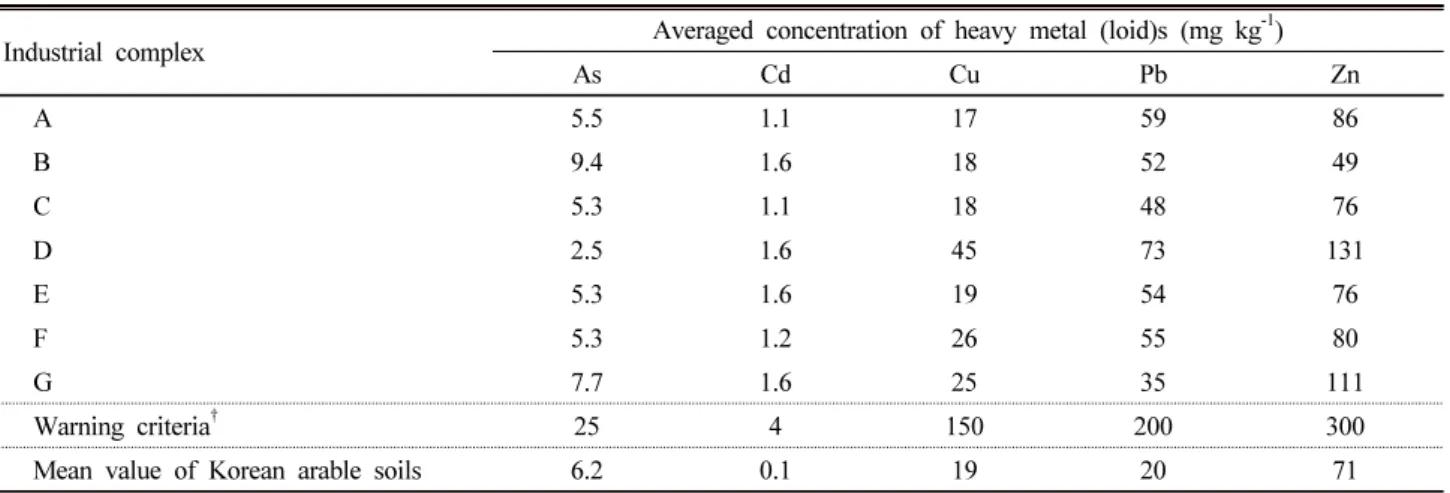
Averaged concentration of heavy metal (loid)s at 0-15 cm depth in arable soils located nearby each industrial complex.
Industrial complex Averaged concentration of heavy metal (loid)s (mg kg
-1)
As Cd Cu Pb Zn
A 5.5 1.1 17 59 86
B 9.4 1.6 18 52 49
C 5.3 1.1 18 48 76
D 2.5 1.6 45 73 131
E 5.3 1.6 19 54 76
F 5.3 1.2 26 55 80
G 7.7 1.6 25 35 111
Warning criteria
†25 4 150 200 300
Mean value of Korean arable soils 6.2 0.1 19 20 71
†
Warning criteria for arable soil established by the Soil Environmental Conservation Act of Korea.
1)
*Corresponding author: Phone: +82553505548, Fax: +82553505549, E-mail: [email protected]
§
Acknowledgement: This study was carried out with the support of “Research Program for Agricultural Science & Technology Development
(Project No. PJ009198332015)”, National Academy of Agricultural Science, Rural Development Administration, Republic of Korea.
Introduction
토양 내 중금속의 축적은 자연발생적인 경로 및 인간 활동 을 포함한 다양한 경로를 통해 발생될 수 있다. 토양으로 중 금속이 유입되는 경로를 크게 세 가지로 분류하여 보면 1) 화 산활동에 의한 지구표면의 토양으로 중금속의 유입; 2) 휴·
폐금속 광산의 광산폐기물로부터 인근 농경지 토양으로 중 금속의 유입; 3) 도색, 염색, 철강, 금속제련 등의 공업단지로 부터 중금속의 유입으로 열거할 수 있다. 국내에는 활동 중인 화산이 존재하지 않아 화산활동을 통한 농경지로의 중금속 유입은 거의 없으며 폐금속 광산과 공단 인근 농경지는 중금 속의 유입가능성이 높을 것으로 판단된다. 환경부의 조사결 과에 따르면 국내에는 638개의 폐금속 광산이 존재하며 이중 310개 (약 49%)의 폐금속 광산 인근 토양이 토양오염 우려기 준치를 초과하는 것으로 조사되었다 (ME, 2005). 이후 현재 까지 광해관리공단에서 폐금속 광산 인근 중금속 오염 토양 을 지속적으로 복원 및 관리 중에 있다. 그러나 국내 공단 인 근 농경지 토양에 대한 중금속 오염도에 대한 조사자료가 부 족한 실정이며 특정 공단 인근 농경지의 중금속 오염에 대한 조사가 실시되었으나 해당 농경지에 대한 개선책이 이루어 지고 있지 않은 실정이다.
산업단지 및 제련소에서 배출되는 비소 (As), 카드뮴 (Cd), 구리 (Cu), 납 (Pb), 아연 (Zn) 등과 같은 중금속은 수년에서 수십 년의 반감기를 가지면서 쉽게 분해되지 않고 축적되어 토양을 오염시킨다 (Massaro, 1990; Jung et al., 2010). 이 와 같은 중금속들이 공단 인근 농경지에 축적되면 해당 지역 에서 재배되는 농산물을 통해 인간에게 노출될 가능성이 크 다. As는 직접 접촉에 의해 피부염을, 만성중독에 의해 피부, 간, 방광, 신장, 폐의 암 발생 가능성이 높다 (O’Neil et al., 2001; WHO, 2004). Cd의 급성중독은 주로 Cd 염의 섭취로 일어나며 두통, 경련, 소화관 장애 등을 일으키며 만성중독 은 주로 빈혈, 신장손상에 의한 골연화증인 이타이이타이 병 을 유발한다 (Joshi et al., 1981). Pb의 급성중독은 어린아이 에게 흔하며 식욕부진, 구토, 경련, 영구 뇌손상 등을 일으키 며, 만성 중독은 체중 감소, 빈혈 등을 유발한다 (Niesink et al., 1996). Cu는 급성중독의 경우 구토, 고혈압, 빈혈, 위장관 장애를 일으키며, 만성중독은 간경변증 (Wilson’s disease), 부신기능의 저하, 정신질환 등을 유발한다 (P.G. Georgopoulos et al., 2001; D.M. Williams, 1982). Zn의 급성중독은 심와 부통증, 경련성 복통, 설사 등을 일으키며, 만성의 경우 호중 성 백혈구 감소증, 체내 HDL 함량 감소, 동부족혈증 등을 유 발한다 (G.J. Fosmire, 1990; R.R. Briefel et al., 2000).
토양 내 높은 중금속 함량은 재배되는 작물 내 중금속의 축적을 유발할 수 있다. 작물의 중금속 흡수는 토양의 총 중 금속 함량보다는 식물이 이용 가능한 형태의 중금속 함량에 의해 결정 되며 (Geebelen et al., 2002; Kim et al., 2012),
식물이 이용 가능한 중금속은 토양의 화학적 특성의 영향을 받는다 (Kim et al., 2007). 이전의 연구결과들에서 토양 내 중금속들의 용해도는 토양의 pH 변화, 유기물 함량, 인산 함 량의 영향을 받는다고 보고하였다 (Street et al., 1978;
McBride et al., 1997; Redman et al., 2002; Weng et al., 2002; Zwonitzer et al., 2003). 토양의 pH, 유기물 함량 및 인산 함량은 토양의 시비관리로 충분히 조절이 가능하므로 토양 화학성의 영향을 받는 식물이 이용 가능한 형태의 중금 속의 함량도 토양의 시비관리의 영향을 받게 된다.
부산, 울산을 포함한 경남지역에는 256개의 공업단지가 있고 도색, 염색, 금속가공, 화학품 제조 등의 중금속 유출가 능성이 있는 업종들이 많아 인근 농경지 토양의 중금속 오염 이 우려되는 실정이다. 따라서 본 연구의 목적은 1) 경남지역 에 분포하는 공업단지 인근 농경지 토양을 대상으로 토양 중 금속 오염정도를 파악하고 2) 중금속으로 오염된 농경지가 있는 공단 인근을 대상으로 정밀조사를 실시하여 토양의 화 학성과 유효태 중금속 함량의 관계를 구명하는 것이다. 본 연 구의 최종적 목표는 본 연구의 결과를 공단 인근 농경지 토양 의 개량을 위한 기초자료로 활용하고자 함이다.
Materials and Methods
공업단지 인근 토양 시료 채취 본 연구를 수행하기
위해 부산, 울산을 포함한 경남지역에 위치하는 공업단지 중 중금속 유출 가능성이 있는 업종을 포함한 7개 공업단지를 선정한 후 인근 농경지 (논, 밭) 76개 지점에서 토양시료를 채 취하였다 (Fig. 1). 각 공업단지의 주요 업종 및 시료 채취 위 치는 Table 1과 Figure1에 나타내었다. 공업단지 인근 농경지 토양시료들은 각 지점의 표층인 0~15 cm 깊이에서 hand auger (내부 직경 6.6 cm)를 이용하여 채취하였다. 한 필지의 농경지를 균등하게 3등분하여 각각의 시료를 채취한 후 혼합 하여 하나의 시료로 실험에 이용하였다. 토양시료채취 대상 농경지는 공업단지의 동서남북 방향으로 이격거리 1 km 이 내에 있는 곳으로 선정하였다. 토양 시료 채취는 2015년 4월 1일부터 2015년 5월 31일까지 수행하였다.
토양시료를 채취한 76개 지점 중 총 중금속 함량이 토양오 염 우려기준을 초과하는 농경지에 대하여 실시한 정밀조사 는 우려기준 초과 농경지와 초과 농경지를 둘러싼 인근농경 지 5곳을 선정하여 토양시료를 채취하였다. 토양시료는 각 지점에서 깊이 0~15 cm의 표층과 15~30 cm의 심토를 hand auger (내부 직경 6.6 cm)로 채취하였으며, 한 필지의 농경지 를 균등하게 3등분하여 각각의 시료를 채취한 후 혼합하여 하나의 시료로 실험에 이용하였다. 토양시료 채취는 2016년 4월 1일부터 2016년 5월 31일까지 수행하였다.
토양 중금속 함량 분석 채취한 토양시료는 풍건세토
Fig. 1. Location of 7 industrial complexes in Gyeongnam province and soil sampling point near G industrial complex.
Table 1. Selected industrial complexes located in Gyeongnam province for monitoring of heavy metal (loid)s contamination in arable soil.
Industrial complex Region Main industry Number of sampled arable soils
A Gimhae Machine, Metalworking 11
B Miryang Machine, Automobile parts 12
C Busan Machine, Metalworking 11
D Ulsan Metalworking, Chemical 10
E Jinju Machine, Chemical 10
F Changwon Telegraph pole 10
G Hamnan Machine, Chemical 12
후 2 mm체로 걸러내어 모든 분석에 이용하였다. 토양의 총 중금속 함량은 왕수 (염산:질산의 비 3:1, v/v)로 분해하여 As, Cd, Cu, Pb, Zn은 ICP-OES (Inductively coupled plasma optical emission spectrophotometer, Perkinelmer ICP optima 5300DV, United states)를 이용하여 측정하였다.
토양 내 중금속 중 식물이 이용 가능한 형태의 중금속 함 량을 조사하기 위하여 토양시료 3 g에 1 M NH
4OAc 용액 30ml를 50ml 플라스틱 튜브에 넣은 후 30분 동안 교반하였 으며, 교반 후 No.2 filter paper를 이용하여 침출하였다 (Symeonides and McRae 1977). As, Cd, Cu, Pb, Zn은 ICP-MS (Inductively coupled plasma emission and mass spectrometry, Thermo Scientific iCAP Q, Germany)로 함량 을 측정하였다.
토양 중금속 함량 회수율 검증 본 실험에서는 중금
속 분석법의 정확성을 평가하기 위하여 토양 내 중금속 함량 에 대한 표준인증물질 (BAM-U112a)을 상위에 제시한 방법 으로 분석하였다. 표준인증물질 (BAM-U112a)을 분석한 결 과, 평균 회수율이 As의 경우 96%, Cd은 104%, Cu는 96%, Pb와 Zn은 102%로 나타났다 (Table 2). 표준인증물질 내 중 금속 함량은 ICP-OES (Inductively coupled plasma optical emission spectrophotometer, Perkinelmer ICP optima 5300 DV, United states)를 이용하여 측정하였다.
토양의 화학적 특성분석 토양시료의 pH는 토양과 증
류수의 비를 1:5로 한시간 교반하여 pH meter (starter 3000,
Ohaus, USA)로 측정하였다. 유기물 함량은 Wakley and Black
Table 2. The results of certified reference materials for checking the analytical accuracy.
Reference material Heavy metal Analysis method
Certified value Observed value
(n=3) Recovery rate Mean±U
†(mg kg
-1)
AM± SD
‡(mg kg
-1)
AM±SD (%)
BAM-U112a
As Total 10.3±0.5 9.9±0.2 96.4±2.24
Cd Total 4.12±0.15 4.3±0.04 104.2±1.01
Cu Total 75.5±3.1 73±1.5 96.2±2.02
Pb Total 198±8 202±3 102.0±1.77
Zn Total 198±6 203±4 102.4±2.28
†
U: uncertainty (half-width of the 95% confidence interval)
‡
AM±SD: arithmetic mean±standard deviation
Table 3. Averaged concentration of heavy metal(loid)s at 0-15 cm depth in arable soils located nearby each industrial complex.
Industrial complex Averaged concentration of heavy metal (loid)s (mg kg
-1)
As Cd Cu Pb Zn
A 5.5 1.1 17 59 86
B 9.4 1.6 18 52 49
C 5.3 1.1 18 48 76
D 2.5 1.6 45 73 131
E 5.3 1.6 19 54 76
F 5.3 1.2 26 55 80
G 7.7 1.6 25 35 111
Warning criteria
†25 4 150 200 300
Mean value of Korean arable soils 6.2 0.1 19 20 71
†
Warning criteria for arable soil established by the Soil Environmental Conservation Act of Korea
방법 (Sparks, 1996)으로, 유효인산의 함량은 아래와 같은 Lancaster method (RDA, 1988)로 토양 5 g에 유효인산 침출 액 (0.33 M CH
3CHOOH, 0.15 M Lactic acid, 0.03 M NH
4F, 0.05 M (NH
4)
2SO
4을 혼합 한 후 0.2 M NaOH를 사용하여 pH 4.25 로 보정) 20ml로 침출하여 비색법으로 분석하였다.
통계적 처리 공단 인근 농경지 토양의 화학적 특성
(pH, OM, Av.P
2O
5)과 식물이 이용 가능한 형태의 중금속 함 량의 상관관계를 분석하기 위하여 Sigma plot (version 8.0) 을 이용하여 상관관계식을 구하였다. 상관관계식의 유의성 검정은 상관계수 (r)의 유의수준표를 이용하여 r 값의 유의수 준이 p < 0.05, p < 0.01 그리고 p < 0.001 일 때 *. **, ***로 나타내었다.
Results and Discussion
공단 인근 토양 중금속 함량 공업단지 인근 농경지
토양 내 중금속의 오염정도를 파악하기 위해 경남지역에 위 치하고 있는 7개의 공업단지를 대상으로 인근 농경지 토양 내 As, Cd, Cu, Pb, Zn의 총함량을 분석하였다. 각 공업단지
인근에서 채취된 토양시료 내 평균 중금속의 함량은 As, Cd, Cu, Pb, Zn 모두 토양오염 우려기준을 초과하지 않았다 (Table 3). 우리나라의 토양환경보전법에 따르면 농경지 토 양 내 중금속의 함량이 토양오염 우려기준치를 초과하는 경 우 해당 농경지에 대한 경작금지 및 복원처리가 수행되어야 한다 (ME, 2009). 비록 조사대상 공업단지 인근 농경지 토양 내 평균 중금속 함량이 토양오염 우려기준을 초과하지는 않 았으나 대부분이 우리나라 농경지 토양 내 중금속의 평균 함 량 보다 높은 것으로 나타났다. 조사대상이 되었던 공업단지 내 주요업종들은 기계, 금속가공, 자동차 부품 제조, 제련, 화학품 제조 등으로 금속을 재료로 하여 제조 및 가공을 하거 나 도색, 제련 등의 과정에서 발생되는 분진이나 폐수 등에 의해서 주변 토양환경으로 중금속이 유출될 가능성이 있다.
경북에 위치하고 있는 ∇∇제련소 인근 농경지 토양을 대상
으로 중금속 함량을 조사한 Hong et al. (2010)의 보고에 의
하면 제련소 인근 1 km 내에 위치하고 있는 농경지 토양 내
Cd와 Zn의 높은 함량은 제련소에서 발생되는 분진에 기인되
었다고 조사되었다. 또한, 방글라데시 수도인 다카의 하자리
바그는 방글라데시의 전체 피혁공장 90%가 밀집해있는 지역
으로 피혁공장에서 정화시설을 거치치 않고 방류되는 폐수
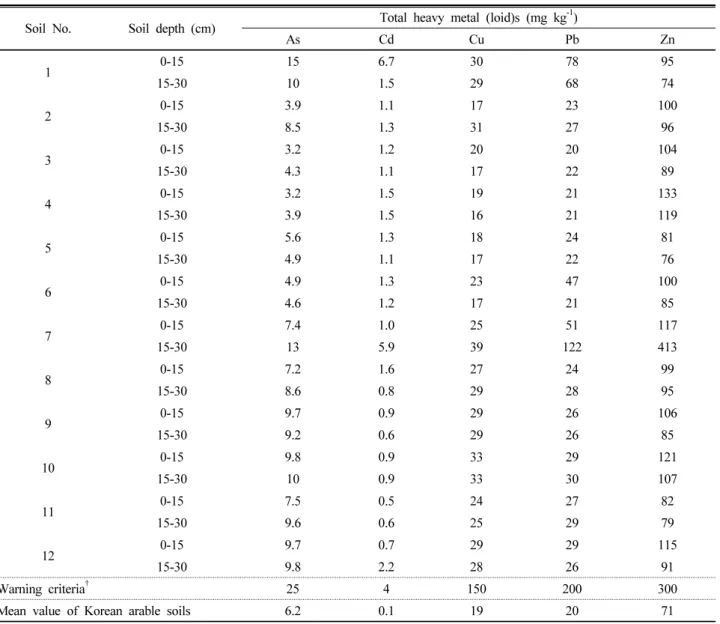
Table 4. Concentration of total heavy metal (loid)s in different depth of arable soils located nearby G industrial complex.
Soil No. Soil depth (cm) Total heavy metal (loid)s (mg kg
-1)
As Cd Cu Pb Zn
1 0-15 15 6.7 30 78 95
15-30 10 1.5 29 68 74
2 0-15 3.9 1.1 17 23 100
15-30 8.5 1.3 31 27 96
3 0-15 3.2 1.2 20 20 104
15-30 4.3 1.1 17 22 89
4 0-15 3.2 1.5 19 21 133
15-30 3.9 1.5 16 21 119
5 0-15 5.6 1.3 18 24 81
15-30 4.9 1.1 17 22 76
6 0-15 4.9 1.3 23 47 100
15-30 4.6 1.2 17 21 85
7 0-15 7.4 1.0 25 51 117
15-30 13 5.9 39 122 413
8 0-15 7.2 1.6 27 24 99
15-30 8.6 0.8 29 28 95
9 0-15 9.7 0.9 29 26 106
15-30 9.2 0.6 29 26 85
10 0-15 9.8 0.9 33 29 121
15-30 10 0.9 33 30 107
11 0-15 7.5 0.5 24 27 82
15-30 9.6 0.6 25 29 79
12 0-15 9.7 0.7 29 29 115
15-30 9.8 2.2 28 26 91
Warning criteria
†25 4 150 200 300
Mean value of Korean arable soils 6.2 0.1 19 20 71
†
Warning criteria for arable soil established by the soil environmental conservation Act of Korea
로 인하여 지역 하수 및 인근 농경지들이 Cr, Zn 등 중금속에 오염되어있다고 조사되었다 (Abul Kashem and Singh, 1998;
Kisku et al., 2000). 조사대상 공업단지 인근 농경지 토양 내 평균 중금속 함량이 현재까지 토양오염 우려기준치를 초과 하고 있지 않으나 대상 공업단지에서 산업활동이 활발히 진 행되고 있고 주변 토양으로 중금속이 지속적으로 유출될 가 능성이 있어 이들 지역 인근 농경지 토양 내 중금속 함량에 대해 향후 주기적인 조사가 이루어져야 할 것으로 판단한다.
조사대상 이었던 7개 공업단지 중 G 공단에서는 두 곳의 위치에서 Cd와 Zn의 함량이 토양오염 우려기준치를 초과하 여 해당지역에 대해 보다 자세한 조사를 실시하였다. G 공단 의 1번과 7번 위치의 토양 내 Cd의 함량은 Cd의 토양오염 우 려기준 (4 mg kg
-1)을 초과하는 6.7과 5.9 mg kg
-1이었다 (Table 4). 7번 위치의 토양 내 Zn의 함량은 Zn의 토양오염 우려기준 (300 mg kg
-1)을 초과하는 413 mg kg
-1로 나타났 다. 또한 G 공업단지 인근 농경지 12필지의 토양 내 중금속
함량은 대부분 우리나라 평균 농경지 토양 내 중금속 함량을 초과하는 것으로 조사되었다. 앞에서 언급한 바와 같이 G 공 단에서는 기계 및 화학품 제조가 주요 업종을 이루고 있어 주 변 토양으로 중금속 유입이 발생될 가능성이 있다. 공업단지 로부터 이격거리와 토양 내 각 중금속 함량의 상관관계계수 를 구한 결과 As: -0.277, Cd: -0.418, Cu: -0.382, Pb: -0.305, Zn: -0.484로 유의한 상관관계를 찾을 수 없었다. 이러한 결 과의 원인은 해당 공단의 면적은 3 km
2의 넓은 면적으로 분 포하고 있으며 토양 시료의 채취 위치는 공단의 중심위치로 부터 이격거리가 아니라 공단의 경계선으로부터의 이격거리 이므로 유의한 상관관계를 얻을 수 없었던 것으로 판단된다.
공업단지에서 발생되는 분진을 통해 인근 농경지 토양으로
중금속이 유입되었을 가능성을 조사하기 위해 각 토양시료
채취 위치에서 깊이 별 토양 내 중금속 함량을 조사하였다
(Table 4). 조사된 12 필지의 시료채취 위치에서 대부분 중금
속의 함량은 0-15 cm에서 채취된 토양에서 15-30 cm에서
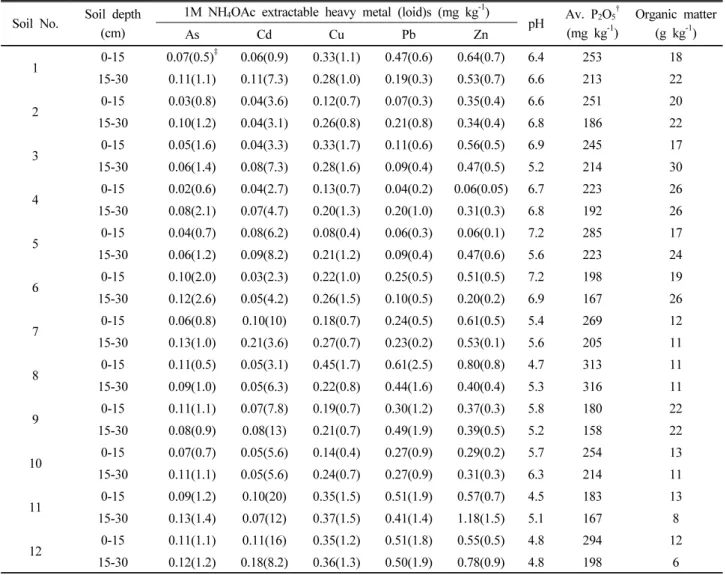
Table 5. Concentration of 1 M NH
4OAc extractable heavy metal(loid)s and chemical properties in different depth of arable soils located nearby G industrial complex.
Soil No. Soil depth (cm)
1M NH
4OAc extractable heavy metal (loid)s (mg kg
-1)
pH Av. P
2O
5†(mg kg
-1)
Organic matter (g kg
-1)
As Cd Cu Pb Zn
1 0-15 0.07(0.5)
‡0.06(0.9) 0.33(1.1) 0.47(0.6) 0.64(0.7) 6.4 253 18
15-30 0.11(1.1) 0.11(7.3) 0.28(1.0) 0.19(0.3) 0.53(0.7) 6.6 213 22
2 0-15 0.03(0.8) 0.04(3.6) 0.12(0.7) 0.07(0.3) 0.35(0.4) 6.6 251 20
15-30 0.10(1.2) 0.04(3.1) 0.26(0.8) 0.21(0.8) 0.34(0.4) 6.8 186 22
3 0-15 0.05(1.6) 0.04(3.3) 0.33(1.7) 0.11(0.6) 0.56(0.5) 6.9 245 17
15-30 0.06(1.4) 0.08(7.3) 0.28(1.6) 0.09(0.4) 0.47(0.5) 5.2 214 30
4 0-15 0.02(0.6) 0.04(2.7) 0.13(0.7) 0.04(0.2) 0.06(0.05) 6.7 223 26
15-30 0.08(2.1) 0.07(4.7) 0.20(1.3) 0.20(1.0) 0.31(0.3) 6.8 192 26
5 0-15 0.04(0.7) 0.08(6.2) 0.08(0.4) 0.06(0.3) 0.06(0.1) 7.2 285 17
15-30 0.06(1.2) 0.09(8.2) 0.21(1.2) 0.09(0.4) 0.47(0.6) 5.6 223 24
6 0-15 0.10(2.0) 0.03(2.3) 0.22(1.0) 0.25(0.5) 0.51(0.5) 7.2 198 19
15-30 0.12(2.6) 0.05(4.2) 0.26(1.5) 0.10(0.5) 0.20(0.2) 6.9 167 26
7 0-15 0.06(0.8) 0.10(10) 0.18(0.7) 0.24(0.5) 0.61(0.5) 5.4 269 12
15-30 0.13(1.0) 0.21(3.6) 0.27(0.7) 0.23(0.2) 0.53(0.1) 5.6 205 11
8 0-15 0.11(0.5) 0.05(3.1) 0.45(1.7) 0.61(2.5) 0.80(0.8) 4.7 313 11
15-30 0.09(1.0) 0.05(6.3) 0.22(0.8) 0.44(1.6) 0.40(0.4) 5.3 316 11
9 0-15 0.11(1.1) 0.07(7.8) 0.19(0.7) 0.30(1.2) 0.37(0.3) 5.8 180 22
15-30 0.08(0.9) 0.08(13) 0.21(0.7) 0.49(1.9) 0.39(0.5) 5.2 158 22
10 0-15 0.07(0.7) 0.05(5.6) 0.14(0.4) 0.27(0.9) 0.29(0.2) 5.7 254 13
15-30 0.11(1.1) 0.05(5.6) 0.24(0.7) 0.27(0.9) 0.31(0.3) 6.3 214 11
11 0-15 0.09(1.2) 0.10(20) 0.35(1.5) 0.51(1.9) 0.57(0.7) 4.5 183 13
15-30 0.13(1.4) 0.07(12) 0.37(1.5) 0.41(1.4) 1.18(1.5) 5.1 167 8
12 0-15 0.11(1.1) 0.11(16) 0.35(1.2) 0.51(1.8) 0.55(0.5) 4.8 294 12
15-30 0.12(1.2) 0.18(8.2) 0.36(1.3) 0.50(1.9) 0.78(0.9) 4.8 198 6
†
Av. P
2O
5: available phosphate.
‡
( ): percentage of ratio of concentration of plant available heavy metal(loid)s to concentration of total heavy metal (loid)s.
채취된 토양보다 높은 것으로 조사되었다. 일부 시료채취 위 치에서 As, Cd, Cu의 함량이 15-30 cm에서 채취한 토양이 0-15 cm에서 채취한 토양보다 더 높은 것으로 나타났다. 해 당 지역에서 조사대상이 되었던 농경지는 논 토양이었으며 토양시료의 채취는 5월 중순에 실시되어 토양시료채취 당시 경운이 실시된 상황이었다. 따라서 일부 농경지에서는 경운 에 의해 표토와 심토가 혼합되어 경우에 따라 일부 중금속의 함량이 15-30 cm 토양 깊이에서 다소 높게 나타난 것으로 판 단된다. 이전의 연구결과에 따르면 제련소 인근 농경지 토양 깊이 별 Cd와 Zn의 함량은 표토에서 심토 보다 높게 나타났 다 (Hong et al., 2007, 2008, 2010). 본 연구에서 조사대상이 었던 G 공단 인근 농경지 토양에 공업단지에서 배출되는 분 진을 통한 중금속이 유입되었을 가능성을 배제할 수는 없다.
해당 공업단지 인근 농경지로 중금속이 유입된 경로를 파악 하기 위해서는 추후 보다 자세한 연구가 필요할 것으로 판단 된다.
유효태 중금속과 토양화학성의 관계 식물이 이용
가능한 형태의 중금속 함량과 토양의 화학적 특성과의 관계 를 조사하기 위해 1 M NH
4OAc로 침출 가능한 중금속의 함량 과 토양의 pH, 유효인산 함량, 유기물의 함량을 조사하였다.
토양 내 식물이 이용 가능한 유효태 중금속의 함량을 침출하 는 방법에는 EDTA, CaCl
2, DPTA, NH
4NO
3(Rauret, 1998; Lu, 1999; Lindsay et al., 1978) 등의 침출액을 이용한 여러 방법 이 있으나 이 중 1 M NH
4OAc 침출액을 이용하여 유효태 중금 속을 분석하는 방법이 Cd와 Zn을 포함한 조사대상 중금속 분 석에 많이 이용되어 본 연구에서 유효태 중금속 분석방법으 로 채택하였다 (Hong et al., 2007, 2008, 2010; Narwal et al., 2008).
G 공업단지 인근 농경지 토양 내 유효태 중금속의 함량이
중금속의 총 함량에 대하여 차지하는 비율은 As의 경우
1.2%, Cd은 6.9%, Cu는 1%, Pb는 0.9%, Zn의 경우 0.5% 로
각 중금속의 총 함량에 비해 낮은 비율로 존재하였다 (Table
Table 6. The relationship between concentration of plant available heavy metal (loid)s and chemical properties of arable soils located nearby G industrial complex.
Chemical properties Data As Cd Cu Pb Zn
pH
Equation Y = 6.79-9.73X
†Y = 6.69-9.44X Y = 7.25-5.14X Y = 6.95-3.58X Y = 6.94-2.08X Correlation
coefficient -0.353 -0.462*
‡-0.531* -0.709** -0.572**
Av. P
2O
5Equation Y = 264-468X Y = 235-136X Y = 227-11.9X Y = 215 + 35.3X Y = 228 -7.79X Correlation
coefficient -0.323 -0.127 -0.023 0.133 -0.041
Organic matter
Equation Y = 24.7-85.4X Y = 21.8-57.1X Y = 24.5-28.2X Y = 23.8-23.2X Y = 24.5 -15.0X Correlation
coefficient -0.416 -0.376 -0.391 -0.617** -0.555**
†
In the equations, X is plant available heavy metal (loid)s concentration (mg kg
-1) and Y is chemical property.
‡