• 검색 결과가 없습니다.

Impact of Pulmonary Vascular Compliance on the Duration of Pleural Effusion Duration after Extracardiac Fontan Procedure

N/A
N/A
Protected

Academic year: 2021

Share "Impact of Pulmonary Vascular Compliance on the Duration of Pleural Effusion Duration after Extracardiac Fontan Procedure "

Copied!
9
0
0

로드 중.... (전체 텍스트 보기)

전체 글

(1)

Impact of Pulmonary Vascular Compliance on the Duration of Pleural Effusion Duration after Extracardiac Fontan Procedure

Tae-Jin Yun, M.D.*, Yu-Mi Im, M.S.*, Kwang-Jae Song*, Sung-Ho Jung, M.D.*, Jeong-Jun Park, M.D.*, Dong-Man Seo, M.D.*, Moo-Song Lee, M.D.**

Background: Preoperative risk analysis for Fontan candidates is still less than optimal in that patients with ap- parently low risks may have poor surgical outcome; prolonged pleural drainage, protein losing enteropathy, pul- monary thromboembolism and death. We hypothesized that low pulmonary vascular compliance (PVC) is a risk fac- tor for prolonged pleural effusion drainage after the Fontan operation. Material and Method: A retrospective review of 96 consecutive patients who underwent the Extracardiac Fontan procedures (median age: 3.9 years) was perfor- med. Fontan risk score (FRS) was calculated from 12 categorized preoperative anatomic and physiologic variables.

PVC (mm

2

/m

2

․mmHg) was defined as pulmonary artery index (mm

2

/m

2

) divided by total pulmonary resistance (W.U․m

2

) and pulmonary blood flow (L/min/m

2

), based on the electrical circuit analogue of the pulmonary cir- culation. Chest tube indwelling time was log-transformed (log indwelling time, LIT) to fit normal distribution, and the relationship between preoperative predictors and LIT was analyzed by multiple linear regression. Result: Preope- rative PVC, chest tube indwelling time and LIT ranged from 6 to 94.8 mm

2

/mmHg/m

2

(median: 24.8), 3 to 268 days (median: 20 days), and 1.1 to 5.6 (mean: 2.9, standard deviation: 0.8), respectively. FRS, PVC, cardiopulmo- nary bypass time (CPB) and central venous pressure at postoperative 12 hours were correlated with LIT by univa- riable analyses. By multiple linear regression, PVC (p=0.0018) and CPB (p=0.0024) independently predicted LIT, ex- plaining 21.7% of the variation. The regression equation was LIT=2.74-0.0158․PVC+0.00658․CPB. Conclu- sion: Low pulmonary vascular compliance is an important risk factor for prolonged pleural effusion drainage after the extracardiac Fontan procedure.

(Korean J Thorac Cardiovasc Surg 2006;39:579-587) ꠏꠏꠏꠏꠏꠏꠏꠏꠏꠏꠏꠏꠏꠏꠏꠏꠏꠏꠏꠏꠏꠏꠏꠏꠏꠏꠏꠏꠏꠏꠏꠏꠏꠏꠏꠏꠏꠏꠏꠏꠏꠏꠏꠏꠏꠏꠏꠏꠏꠏꠏꠏꠏꠏꠏꠏꠏꠏꠏꠏꠏꠏꠏꠏꠏꠏꠏꠏꠏꠏꠏꠏꠏꠏꠏꠏꠏꠏꠏꠏꠏꠏꠏꠏꠏꠏꠏꠏꠏꠏꠏꠏ Key words: 1. Fontan procedure

2. Pulmonary vascular compliance 3. Pleural effusion

*울산대학교 의과대학 서울아산병원 소아심장외과

Division of Pediatric Cardiac Surgery, Asan Medical Center, College of Medicien, University of Ulsan

**울산대학교 의과대학 예방의학교실

Department of Preventive Medicine, College of Medicine, University of Ulsan 논문접수일:2006년 3월 23일, 심사통과일:2006년 4월 18일

책임저자:윤태진 (138-736) 서울시 송파구 풍납동 388-1, 서울아산병원 소아심장외과 (Tel) 02-3010-3589, (Fax) 02-3010-6811, E-mail: [email protected]

본 논문의 저작권 및 전자매체의 지적소유권은 대한흉부외과학회에 있다.

수술 전 폐혈관 유순도가 심장 외 도관을 이용한 Fontan 수술 후 늑막 삼출 기간에 미치는 영향

윤태진*․임유미*․송광재*․정성호*․박정준*․서동만*․이무송**

(2)

서 론

1971년 프랑스의 Dr. Francis Fontan이 삼첨판막 폐쇄환 자에게 단심실 교정을 시도하여 성공한 이후[1], 우심실 바이패스의 개념으로 전신 정맥혈과 폐동맥을 직접 연결 하는 모든 변형 술식들은 개괄적으로 Fontan 술식이라고 하며 현재 양심실 교정이 어려운 기능적 단심증 환자에게 널리 적용되고 있다. 그동안 많은 임상 연구 및 기초 연구 를 통하여 단심실 교정의 단기 및 장기 성적에 영향을 줄 수 있는 요인들이 밝혀져 왔으며, 이러한 노력들에 힘입 어 Fontan 술식의 단기 및 장기 성적은 괄목할 만하게 호 전되었다. 하지만 아직까지도 수술 전에 수술 위험도가 낮다고 생각되는 환자들 중에서 수술 후 만족스럽지 못한 결과, 예를 들어 장기적인 늑막 삼출, 폐 색전증, 단백 소 모성 장질환 등으로 사망에 이르는 환자가 드물지 않다.

Fontan 수술 대상자의 수술 전 평가에 있어 가장 중요하다 고 생각되는 것은 폐혈관의 상태이며, 이를 위하여 폐동 맥의 크기, 압력, 저항, 형태학적 양상 등이 개별적으로 평 가된다. 그런데 폐혈관 저항은 특정 폐혈류에 대한 폐동 맥압을 나타내는 것으로 인체의 폐순환을 단독적으로 설 명하기에는 부족함이 있으며, 특히 우심실 없이 폐순환을 유지해야 하는 Fontan 순환을 이해하기 위해서는 폐혈관 저항 이외에도 추가로 폐동맥의 탄력성(elastance) 혹은 유 순도(compliance)의 개념을 추가로 필요로 하게 된다. 본 연구에서는 폐순환이 저항과 유순도로 구성된 전기회로 (windkessel model)에 적용될 수 있다는 전제하에 Fontan 수술을 받은 환자에서의 폐혈관 유순도(pulmonary vascu- lar compliance)를 이 전기 회로로부터 유추된 단순화한 방 법으로 측정하고, 수술 전 폐혈관 유순도와 수술 후 흉관 거치 기간과의 연관성을 알아봄으로써 본 연구에서와 같 이 단순화한 방법으로 측정된 폐혈관 유순도의 유효성을 입증하고자 하였다.

대상 및 방법

1) 대상 환자군

2002년 1월부터 2005년 5월까지 심장 외 도관을 이용한 단심실 교정을 받은 총 96명의 환자들의 기록을 후행적으 로 분석하였다. 동 기간 중 기존의 단심실 교정을 심장 외 도관으로 교체한 경우는 연구 대상에서 제외하였다. 환아 들의 남녀 성비, 심실의 형태, 동반 기형 등은 Table 1과

같다. 단심실 교정의 단계적 치료 전략의 측면에서 57명 의 환자가 1단계(적절한 폐혈류 확보를 위한 수술), 2단계 (양방향성 상공정맥 폐동맥 문합술)를 거쳐 3단계(Fontan 술식)를 받았으며, 30명의 환자는 단계 없이 2, 3단계만을 받았고 6명의 환자는 2단계 없이 1, 3단계만을 받았다. 한 편 3명의 환자는 1, 2단계 없이 직접 Fontan 술식을 받았 다.

2) 심장 외 도관을 이용한 Fontan 술식

연구 대상 환자들은 모두 심장 외 도관을 이용한 Fontan 술식을 받았다. 사용된 심장 외 도관은 모두 PTFE (poly- tetrafluoroethylene) 재질의 혈관 도관으로 그 크기는 직경 18 mm가 72명(75%)으로 가장 많았고, 직경 20 mm가 14 명, 직경 16 mm가 7명, 직경 22 mm가 3명의 순이었다. 도 관의 직경과 수술 당시 체중과의 비는 0.45∼1.61 mm/kg (중간값: 1.2)이었다. 대부분의 환자(71/96, 74%)에서 대동 맥 차단 없이 수술이 진행되었으며, 한 환자(1%)에서 심 장 외 도관 문합 후 심장 외 도관과 심방 사이의 연결(fe- nestration)이 설치되었다. 환자들은 중환자실 이송 후 가능 한 한 빨리 기관 내 삽관을 발관하는 것을 원칙으로 하였 고, 수술 당일은 흉관 배액량과 같은 양의 교질용액을 투 여하였다.

3) 지속적 흉관 거치의 위험 인자 분석을 위한 수술

전, 수술 관련 변수들

대부분(85/96, 88%)의 환자에서 수술 전 심도자술이 시 행되었고, 심도자술을 받지 않은 환자들은 심장 전산화

Table 1. Patient profile

ꠚꠚꠚꠚꠚꠚꠚꠚꠚꠚꠚꠚꠚꠚꠚꠚꠚꠚꠚꠚꠚꠚꠚꠚꠚꠚꠚꠚꠚꠚꠚꠚꠚꠚꠚꠚꠚꠚꠚꠚꠚꠚꠚꠚꠚꠚꠚꠚꠚꠚꠚꠚꠚꠚꠚ Sex ratio (male:female) 52:44

Age at Fontan operation (years) 2.43∼12.45 (median: 3.86) Ventricular morphology LV type: 33/96 (34.4%)

RV type: 38/96 (39.6%) Balanced ventricles:

25/96 (26%)

Associated anomalies Heterotaxy syndrome: 27 Cc-TGA: 16

Tricuspid atresia: 14 TAPVD: 14

ꠏꠏꠏꠏꠏꠏꠏꠏꠏꠏꠏꠏꠏꠏꠏꠏꠏꠏꠏꠏꠏꠏꠏꠏꠏꠏꠏꠏꠏꠏꠏꠏꠏꠏꠏꠏꠏꠏꠏꠏꠏꠏꠏꠏꠏꠏꠏꠏꠏꠏꠏꠏꠏꠏꠏ

LV=Left ventricular; RV=Right ventricular, Cc-TGA=Congeni-

tally corrected transposition of great arteries; TAPVD=Total ano-

malous pulmonary venous drainage.

(3)

Table 3. Fontan risk score

ꠚꠚꠚꠚꠚꠚꠚꠚꠚꠚꠚꠚꠚꠚꠚꠚꠚꠚꠚꠚꠚꠚꠚꠚꠚꠚꠚꠚꠚꠚꠚꠚꠚꠚꠚꠚꠚꠚꠚꠚꠚꠚꠚꠚꠚꠚꠚꠚꠚꠚꠚꠚꠚꠚꠚꠚꠚꠚꠚꠚꠚꠚꠚꠚꠚꠚꠚꠚꠚꠚꠚꠚꠚꠚꠚꠚꠚꠚꠚꠚꠚꠚꠚꠚꠚꠚꠚꠚꠚꠚꠚꠚꠚꠚꠚꠚꠚꠚꠚꠚꠚꠚꠚꠚꠚꠚꠚꠚꠚꠚꠚꠚꠚꠚꠚ

Risk factors 0 1 2 3

1. Age (months) >12 6∼12 <6

2. Ventricle LV RV

3. Systemic outflow obst. (+)

4. PV obst. (+)

5. PA hypoplasia (-) Mild Moderate Severe

McGoon ratio >2 1.8∼2 1.5∼1.8 <1.5

Nakata index >200 100∼200 50∼100 <50

Diameter (z) -2 to +2 -2 to -3 -3 to -4 <-4

6. Mean PAP <15 15∼20 20∼25 <20

7. PABS or distortion (-) Discrete, single Discrete, multiple Diffuse

8. Rp (wood unit․m

2

) <2 2∼3 3∼4 >4

9. AVV regurgitation (-) Mild Moderate Severe

10. V systolic dysfunction (-) Mild Moderate Severe

EF (%) >55 55∼45 45∼40 <40

SF (%) >32 31∼28 27∼24 <23

11. Vdiastolic dysfunction

VEDP (mmHg) <10 10∼12 12∼14 >14

12. V hypertrophy Nl Mild Moderate Severe

Mass (echo) -2 to +2 -2 to -3 -3 to -4 <-4

ꠏꠏꠏꠏꠏꠏꠏꠏꠏꠏꠏꠏꠏꠏꠏꠏꠏꠏꠏꠏꠏꠏꠏꠏꠏꠏꠏꠏꠏꠏꠏꠏꠏꠏꠏꠏꠏꠏꠏꠏꠏꠏꠏꠏꠏꠏꠏꠏꠏꠏꠏꠏꠏꠏꠏꠏꠏꠏꠏꠏꠏꠏꠏꠏꠏꠏꠏꠏꠏꠏꠏꠏꠏꠏꠏꠏꠏꠏꠏꠏꠏꠏꠏꠏꠏꠏꠏꠏꠏꠏꠏꠏꠏꠏꠏꠏꠏꠏꠏꠏꠏꠏꠏꠏꠏꠏꠏꠏꠏꠏꠏꠏꠏꠏꠏ Obst=Obstruction; PV=Pulmonary vein; PA=Pulmonary artery; PAP=Pulmonary artery pressure; PABS=Pulmonary artery branch stenosis;

Rp=Pulmonary vascular resistance; AVV=Atrioventricular valve; V=Ventricular; EF (%)=Ejection fraction; SF (%)=Shortening fraction;

VEDP=Ventricular end-diastolic pressure.

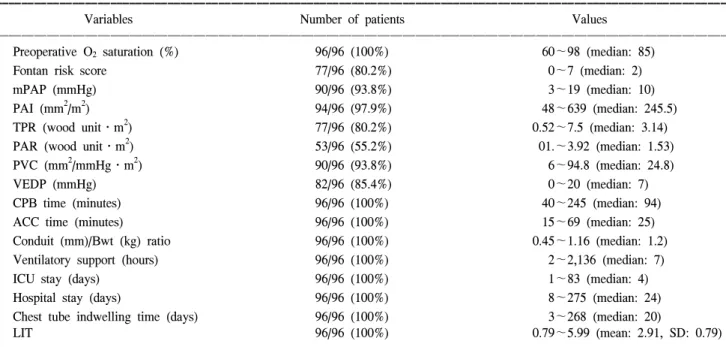
Table 2. Clinical and hemodynamic data

ꠚꠚꠚꠚꠚꠚꠚꠚꠚꠚꠚꠚꠚꠚꠚꠚꠚꠚꠚꠚꠚꠚꠚꠚꠚꠚꠚꠚꠚꠚꠚꠚꠚꠚꠚꠚꠚꠚꠚꠚꠚꠚꠚꠚꠚꠚꠚꠚꠚꠚꠚꠚꠚꠚꠚꠚꠚꠚꠚꠚꠚꠚꠚꠚꠚꠚꠚꠚꠚꠚꠚꠚꠚꠚꠚꠚꠚꠚꠚꠚꠚꠚꠚꠚꠚꠚꠚꠚꠚꠚꠚꠚꠚꠚꠚꠚꠚꠚꠚꠚꠚꠚꠚꠚꠚꠚꠚꠚꠚꠚꠚꠚꠚꠚꠚ

Variables Number of patients Values

ꠏꠏꠏꠏꠏꠏꠏꠏꠏꠏꠏꠏꠏꠏꠏꠏꠏꠏꠏꠏꠏꠏꠏꠏꠏꠏꠏꠏꠏꠏꠏꠏꠏꠏꠏꠏꠏꠏꠏꠏꠏꠏꠏꠏꠏꠏꠏꠏꠏꠏꠏꠏꠏꠏꠏꠏꠏꠏꠏꠏꠏꠏꠏꠏꠏꠏꠏꠏꠏꠏꠏꠏꠏꠏꠏꠏꠏꠏꠏꠏꠏꠏꠏꠏꠏꠏꠏꠏꠏꠏꠏꠏꠏꠏꠏꠏꠏꠏꠏꠏꠏꠏꠏꠏꠏꠏꠏꠏꠏꠏꠏꠏꠏꠏꠏ

Preoperative O

2

saturation (%) 96/96 (100%) 60∼98 (median: 85)

Fontan risk score 77/96 (80.2%) 0∼7 (median: 2)

mPAP (mmHg) 90/96 (93.8%) 3∼19 (median: 10)

PAI (mm

2

/m

2

) 94/96 (97.9%) 48∼639 (median: 245.5)

TPR (wood unit․m

2

) 77/96 (80.2%) 0.52∼7.5 (median: 3.14)

PAR (wood unit․m

2

) 53/96 (55.2%) 01.∼3.92 (median: 1.53)

PVC (mm

2

/mmHg․m

2

) 90/96 (93.8%) 6∼94.8 (median: 24.8)

VEDP (mmHg) 82/96 (85.4%) 0∼20 (median: 7)

CPB time (minutes) 96/96 (100%) 40∼245 (median: 94)

ACC time (minutes) 96/96 (100%) 15∼69 (median: 25)

Conduit (mm)/Bwt (kg) ratio 96/96 (100%) 0.45∼1.16 (median: 1.2)

Ventilatory support (hours) 96/96 (100%) 2∼2,136 (median: 7)

ICU stay (days) 96/96 (100%) 1∼83 (median: 4)

Hospital stay (days) 96/96 (100%) 8∼275 (median: 24)

Chest tube indwelling time (days) 96/96 (100%) 3∼268 (median: 20)

LIT 96/96 (100%) 0.79∼5.99 (mean: 2.91, SD: 0.79)

ꠏꠏꠏꠏꠏꠏꠏꠏꠏꠏꠏꠏꠏꠏꠏꠏꠏꠏꠏꠏꠏꠏꠏꠏꠏꠏꠏꠏꠏꠏꠏꠏꠏꠏꠏꠏꠏꠏꠏꠏꠏꠏꠏꠏꠏꠏꠏꠏꠏꠏꠏꠏꠏꠏꠏꠏꠏꠏꠏꠏꠏꠏꠏꠏꠏꠏꠏꠏꠏꠏꠏꠏꠏꠏꠏꠏꠏꠏꠏꠏꠏꠏꠏꠏꠏꠏꠏꠏꠏꠏꠏꠏꠏꠏꠏꠏꠏꠏꠏꠏꠏꠏꠏꠏꠏꠏꠏꠏꠏꠏꠏꠏꠏꠏꠏ

mPAP=Mean pulmonary artery pressure; PAI=Pulmonary artery index; TPR=Total pulmonary resistance; PAR=Pulmonary arterial resis-

tance; PVC=Pulmonary vascular compliance; VEDP=Ventricular end-diastolic pressure; CPB=Cardiopulmonary bypass; ACC=Aortic

cross-clamping; ICU=Intensive care unit; LIT=Log indwelling time; SD=Standard deviation.

(4)

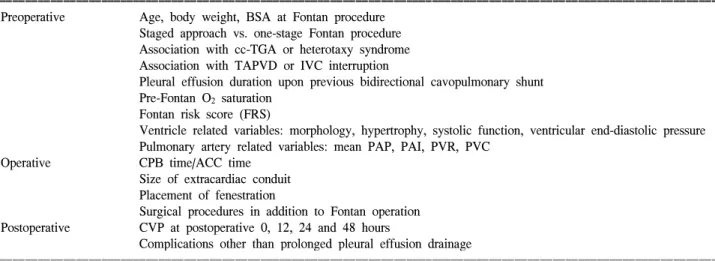
단층 촬영(cardiac computerized tomogram) 혹은 심장 자기 공명 영상법(cardiac magnetic resonance imaging)을 통한 형 태학적 평가와 수술장에서의 혈역학적 평가를 통하여 심 도자술로부터 얻어야 할 정보를 대치하였다(Table 2). 수술 후 늑막 삼출 기간의 위험 인자 분석에는 12가지 수술 전 위험인자들을 지수화한 Fontan risk score (FRS)[2](Table 3) 및 기타 다양한 수술 전, 수술 중 위험 인자들을 포함시켰 으며(Table 4), 본 연구를 위하여 전기 회로 analogue를 폐 순환에 적용하여 계산된 폐혈관 유순도(pulmonary vascular compliance, PVC, mm

2

/mmHg/m

2

)를 위험인자로 추가하였 다. 저항 및 유순도로 구성된 전기 회로 analogue (Fig. 1) 에 의하면 PVC는 폐동맥 지수(pulmonary artery index, mm

2

/m

2

)를 총폐저항(total pulmonary resistance, W.U․m

2

)

및 폐 혈류량(pulmonary blood flow, L/min/m

2

)으로 나눈 값 으로 정의되며(Fig. 2), 이는 폐동맥의 크기와 저항, 폐 혈 류량 등을 동시에 고려하는 변수라고 할 수 있다[3].

4) 통계 처리 방법

수치 자료는 빈도 혹은 중간값과 범주로 표시하였고, 자료가 정규분포를 이루는 경우에는 평균과 표준 편차로 표시하였다. 결과 변수인 흉관 거치 기간은 자연로그를 취해 정규 분포화하고 이를 log indwelling time (LIT)으로 정의하였으며, 수술 전 위험 인자들과 LIT의 관계를 다중

Fig. 1. Electrical circuit consisting of resistance and compliance.

V=Voltage; I=Current; R=Resistance; Q=Total charge in the cir- cuit; C=Compliance.

Table 4. Variables included for risk analysis of prolonged pleural effusion drainage

ꠚꠚꠚꠚꠚꠚꠚꠚꠚꠚꠚꠚꠚꠚꠚꠚꠚꠚꠚꠚꠚꠚꠚꠚꠚꠚꠚꠚꠚꠚꠚꠚꠚꠚꠚꠚꠚꠚꠚꠚꠚꠚꠚꠚꠚꠚꠚꠚꠚꠚꠚꠚꠚꠚꠚꠚꠚꠚꠚꠚꠚꠚꠚꠚꠚꠚꠚꠚꠚꠚꠚꠚꠚꠚꠚꠚꠚꠚꠚꠚꠚꠚꠚꠚꠚꠚꠚꠚꠚꠚꠚꠚꠚꠚꠚꠚꠚꠚꠚꠚꠚꠚꠚꠚꠚꠚꠚꠚꠚꠚꠚꠚꠚꠚꠚ Preoperative Age, body weight, BSA at Fontan procedure

Staged approach vs. one-stage Fontan procedure Association with cc-TGA or heterotaxy syndrome Association with TAPVD or IVC interruption

Pleural effusion duration upon previous bidirectional cavopulmonary shunt Pre-Fontan O

2

saturation

Fontan risk score (FRS)

Ventricle related variables: morphology, hypertrophy, systolic function, ventricular end-diastolic pressure Pulmonary artery related variables: mean PAP, PAI, PVR, PVC

Operative CPB time/ACC time

Size of extracardiac conduit Placement of fenestration

Surgical procedures in addition to Fontan operation Postoperative CVP at postoperative 0, 12, 24 and 48 hours

Complications other than prolonged pleural effusion drainage

ꠏꠏꠏꠏꠏꠏꠏꠏꠏꠏꠏꠏꠏꠏꠏꠏꠏꠏꠏꠏꠏꠏꠏꠏꠏꠏꠏꠏꠏꠏꠏꠏꠏꠏꠏꠏꠏꠏꠏꠏꠏꠏꠏꠏꠏꠏꠏꠏꠏꠏꠏꠏꠏꠏꠏꠏꠏꠏꠏꠏꠏꠏꠏꠏꠏꠏꠏꠏꠏꠏꠏꠏꠏꠏꠏꠏꠏꠏꠏꠏꠏꠏꠏꠏꠏꠏꠏꠏꠏꠏꠏꠏꠏꠏꠏꠏꠏꠏꠏꠏꠏꠏꠏꠏꠏꠏꠏꠏꠏꠏꠏꠏꠏꠏꠏ BSA=Body surface area; cc-TGA=Congenitally corrected transposition of great arteries; TAPVD=Total anomalous pulmonary venous drainage; IVC=Inferior vena cava; PAP=Pulmonary artery pressure; PAI=Pulmonary artery index; PVR=Pulmonary vascular resistance;

PVC=Pulmonary vascular compliance; CPB=Cardiopulmonary bypass; ACC=Aortic cross-clamping; CVP=Central venous pressure.

Fig. 2. Schematic illustration of the pulmonary circulation from

an electrical circuit analogue consisting of resistance and com-

pliance. mPAP=Mean pulmonary artery pressure; Qp=Pulmonary

blood flow; TPR=Total pulmonary resistance; PAI=Pulmonary

artery index; PVC=Pulmonary vascular compliance.

(5)

회귀 분석하였다. 수술 전 위험 인자 중 총폐저항(total pulmonary resistance)과 폐동맥 지수(pulmonary artery in- dex)를 근거로 한 층화 분석을 위해 총폐저항 3 Wood uni t․m

2

및 폐동맥 지수 250 mm

2

/m

2

를 기준으로 4군으로 나 누어 폐혈관 유순도의 LIT에 대한 예측력을 판정하였다.

통계 프로그램은 SPSS 12.0KO for windows가 사용되었으 며, p-value 0.05 이하를 통계적으로 유의하다고 간주하였 다.

결 과

수술 후 조기 사망은 없었고 만기 사망은 4명(4.2%)이 었다. 수술 전 PVC, 흉관 거치 기간, LIT는 각각 6∼94.8

mm

2

/mmHg/m

2

(중간값: 24.8), 3∼268일(중간값: 20일), 1.1∼

5.6 (평균: 2.9, 표준 편차: 0.8)이었다(Table 1). 단변수 분 석상 FRS, PVC, 체외 순환시간(CPB) 및 술 후 12시간째의 중심 정맥압 등이 LIT와 연관되었으나, 다변수 선형 회귀 분석상 PVC (p=0.0018, Fig. 3) 및 CPB (p=0.0024, Fig. 4) 만 이 독립적으로 LIT를 예측하였다. 두 변수는 LIT 변이에 대하여 21.7%의 설명력이 있었으며, 두 변수를 이용한 회 귀 분석식은 LIT=2.74-0.0158․PVC+0.00658․CPB였다.

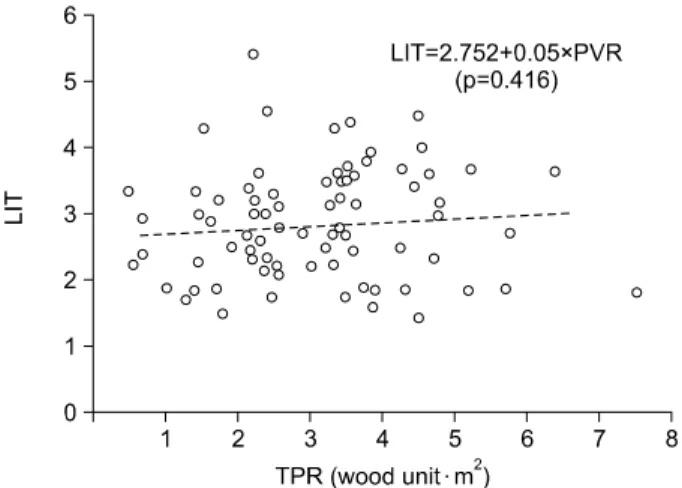
한편 폐동맥 지수(p=0.094, Fig. 5) 및 총폐저항(p=0.416, Fig. 6)은 LIT와 유의한 상관 관계가 없었으며, 두 변수 사 이에도 유의한 상관 관계가 없었다(p=0.937, Fig. 7). 총폐 저항 3 Wood unit․m

2

및 폐동맥 지수 250 mm

2

/m

2

를 기준 으로 4군으로 나누어 각 환자군에서의 폐혈관 유순도의

Fig. 4. Correlation between CPB and LIT. LIT=Log indwelling

time; CPB=Cardiopulmonary bypass time.

Fig. 3. Correlation between PVC and LIT. LIT=Log indwelling

time; PVC=Pulmonary vascular compliance.

Fig. 5. Correlation between PAI and LIT. LIT=Log indwelling time;

PAI=Pulmonary artery index.

Fig. 6. Correlation between TPR and LIT. LIT=Log indwelling
time; TPR=Total pulmonary resistance.

(6)

LIT 예측력을 분석한 결과 총폐저항이 낮고 폐동맥 지수 가 높거나(A) 총폐저항이 높고 폐동맥 지수가 낮은 군(C) 에서의 폐혈관 유순도의 LIT 예측력은 우수하였으나 (p=0.003), 두 가지 변수 모두 높거나 낮은 경우에는(B, C) 폐혈관 유순도의 LIT 설명력이 만족스럽지 못함을 알 수 있었다(p=0.241, Fig. 7).

고 찰

체외 순환에 의한 개심술이 시작된 지 반 세기가 흐르 는 동안 선천성 심기형의 수술적 치료는 거의 전 분야에 걸쳐 눈부신 발전을 보여왔지만, 그 중에서도 Fontan 수술 은 그 대상이 되는 심장기형의 다양함 및 세밀한 단계적 치료전략을 통한 환자 상태의 최적화, 잘 정리되고 계량 화된 수술 전 위험 인자 분석 등의 관점에서 볼 때 가히 선천성 심기형에 대한 수술적 치료 중의 백미라 할 만하 다. 그런데 Fontan 수술 대상자의 수술 전 평가에 있어 너 무 많은 변수들을 고려해야 한다는 점은 오히려 술 전 위 험 인자 분석에 어려움을 초래할 수 있다. 이러한 어려움 을 해결하기 위해 고안된 것이 여러 가지 변수를 점수화 하여 합산한 위험인자 지수 체계(risk factor scoring system) 이다. 하지만 합리적일 듯 보이는 이러한 지수 체계도 여 러 가지 문제점을 안고 있다. 본 연구에서 사용된 Fontan risk score[2]는 여러 가지 위험 인자들의 유무에 따른 점수

를 가산하여 수술 위험도를 분석한 것이지만 1) 연속, 비 연속 변수를 모두 범주형 변수(categorical variable)로 만들 어 점수화한 것이므로 그 자체가 비연속 변수이고, 2) 일 부 변수의 점수 산정 기준이 되는 수치들의 근거가 빈약 하고, 3) 이렇게 산출된 총 점수와 결과 변수와의 관계를 과학적으로 적절히 증명한 임상보고가 드물다는 점에서 그 한계를 보인다. 또한 각각의 위험인자들을 하나하나 살펴보아도 여러 가지 문제점이 발견된다. 예를 들어 폐 혈관 저항의 경우 폐혈류에 따라 그 측정치가 달라지는 문제점이 있다. 이는 폐동맥압이 폐혈류에 증가에 따라 직선관계가 아닌 기하 급수적으로 증가하는 양상을 보이 므로 낮은 폐혈류 상태에서는 폐혈관 저항이 낮게 계산되 기 때문이다. 이러한 문제점을 단적으로 보이는 예는 Fontan 수술 후 저심박출증이 생긴 환자들이 심장 이식술 을 받고 나서 폐혈관 저항이 상승한다는 보고이다[4]. 이 경우 심장 이식 후 폐혈관 저항이 상승했다기보다는 낮은 폐혈류에서의 폐동맥압으로 계산된 폐혈관 저항과 심장 이식술로 상승한 폐혈류량에 대한 폐동맥압으로 계산된 폐혈관 저항이 다름을 보여준다. 폐동맥의 크기 역시 논 란의 여지가 있는데, 폐동맥 크기는 Fontan 수술 성적을 예측하게 한다는 주장[5]과 폐동맥 크기와 Fontan 수술 성 적과는 무관하다는 주장[6,7]들이 서로 엇갈린다. 물론 이 러한 연구 결과들은 수술 사망을 결과 변수로 분석했다는 문제점 및 사망자와 생존자의 폐동맥 지수를 단순히 비교 하는 등의 통계 처리상의 문제점들을 가지고 있어 설득력 이 그리 높다고 할 수는 없다. 그렇다면 Fontan 수술 대상 자에 있어 상식적으로는 중요하다고 생각되는 폐동맥의 크기는 Fontan 수술의 결과에 어떤 영향을 줄 수 있는가?

폐순환을 저항과 유순도로 구성된 전기회로(Fig. 1)에 비 유할 때 폐동맥의 크기는 전체 전하량(Q)에 해당하며 총 폐저항, 폐혈관 유순도, 폐혈류량, 폐동맥압 등의 모든 요 인들로서 나타낼 수 있다는 것이 이 연구에서 인용한 가 설이다[2]. 이러한 가설이 맞고 틀림은 차치하고 이 가설 에 의해 정의된 폐혈관 유순도는 폐동맥의 크기와 폐혈관 저항을 동시에 고려한다는 점에서 매력적이라고 할 수 있 다. 폐혈관 유순도를 측정하는 고전적인 방법은 폐동맥압 곡선에서 dicrotic notch로부터 최저점까지의 시간(확장기 시간 상수, Diastolic time constant) 및 각각의 폐동맥압을 구한 뒤 혈관 저항과 함께 특정 공식에 대입함으로써 구 하는 ‘Reuben 공식'이다[8-10]. ‘Reuben 공식'은 폐순환을 탄력성(elastance)을 가진 하나의 방(chamber)으로 보고 우 심실로부터 구출된 혈류가 이 탄력적인 방(elastic cham-

Fig. 7. PAI and TPR. There was no correlation between PAI

and TPR (p=0.937). LIT predictability of PVC was significant only in patients with low TPR/large PA (group A) or high TPR/

small PA (group C). PAI=Pulmonary artery index; TPR=Total pulmonary resistance; PVC=Pulmonary vascular compliance;

LIT=Log indwelling time; PA=Pulmonary artery.

(7)

ber)을 확장시킬 때 최대로 확장된 상태에서 수축할 때까 지의 시간과 압력 변화를 분석하여 폐순환의 탄력성, 혹 은 유순도를 계산해내는 방법이다. 이때 최대 확장 압력 은 폐동맥 압력 곡선의 중복 맥박 패임(dicrotic notch) 압 력을 사용하며 기타 우심실 수축기말 압력[11]이나 폐동맥 평균압력[12]을 대신 사용할 수도 있다. 그런데 Fontan 순환 은 폐순환으로 혈액을 구출하는 펌프가 없는 ‘steady flow hemodynamics'이므로 정상 및 폐동맥 고혈압 환자에서 박 동성 혈류가 폐혈류로 유입될 때의 저항(input impedance) 를 고려해야 하는 것[13-15]과는 달리 ‘zero-frequency input impedance'만을 생각하면 된다는 점[16]에서 ‘Reuben의 공 식'을 적용하기에 적절하지 못하다. 따라서 수술장에서 폐 혈류량의 변화를 주면서 폐동맥압 변화의 추이를 관찰하 는 직접적인 방법[17,18]을 사용하지 않는다면, 본 연구에 서와 같은 방법으로 폐혈관 유순도를 측정하는 것이 차선 책이 될 수 있다. 다만 본 연구에서 측정된 폐혈관 유순도 는 총폐저항과 폐동맥 크기 중 어느 한 가지 위험인자만 을 가진 군에서는 흉관 거치 기간에 대한 설명력이 충분 하지 못하다는 제한점을 보였으며, 이는 후속 연구를 통 해 폐혈관 유순도를 보다 직접적으로 측정하는 방법을 개 발함으로써 개선될 것이라 생각한다.

본 연구에서는 결과 변수로서 흉관 거치 기간을 사용하 였으며, 연구 모델을 단순화하기 위하여 기타 결과 변수 는 고려하지 않았다. Fontan 수술 후 그 성적에 대한 평가 를 위한 결과 변수(outcome variable)로 분석되어 온 것들 은 본 연구에서와 같은 흉관 거치 기간(chest tube indwell- ing time)[19] 이외에도 부정맥과 같은 수술 후 합병증 여 부[20,21], 폐색전증(pulmonary throboembolism) 유무[22-27], 단백 소모성 장질환(protein loosing enteropathy) 여부, 심실 기능[28], 기타 장기 손상[29], 수술 사망[5-7] 등이 있다.

1980년대까지만 해도 Fontan 수술 후 수술 사망률 및 만기 사망률이 높았으므로 수술 후 사망이 유력한 결과 변수로 분석되었다. 하지만 수술 사망 및 만기 사망률이 현저히 감소된 점, 그리고 이에 반하여 상관 관계를 분석할 수술 전 위험인자들이 매우 많다는 점을 감안할 때 수술 사망 유무를 결과 변수로 사용하기에는 한계가 있다. 또한 수 술 후 나타나는 여러 가지 합병증들도 그 발생 빈도, 진단 의 정확성 및 증증도 산정 등에 있어 제한점을 가진다. 이 에 반하여 흉관 거치 기간(혹은 늑막 삼출 기간)은 조기 사망 환자를 제외한 모든 환자에서 정확히 측정할 수 있 고, 연속 변수로써 의미 있는 통계처리가 가능하므로 수 술 후 경과를 가장 잘 반영할 수 있는 결과 변수라고 할

수 있다. 본 연구에서는 폐혈관 유순도 이외에도 지속적 흉관 거치 기간의 위험인자로 장시간의 체외 순환도 관여 하는 것으로 밝혀졌다. 체외 순환 시간이 길다는 것은 그 만큼 복잡한 수술적 처치를 요하는 경우라고 생각하면 지 속적 흉관 거치의 다른 위험 인자들과 동반되었을 가능성 이 크다고 유추할 수도 있지만, 체외 순환 시간과 흉관 거 치 기간의 유의한 관계는 다변수 분석의 결과이므로 체외 순환 시간 자체가 독립적으로 흉관 거치 기간에 영향을 준다고 보는 것이 타당할 듯하다. 체외 순환으로 유발되 는 전신 염증 반응 및 폐혈관 반응성(pulmonary vascular reactivity)을 고려할 때 장시간의 체외 순환이 Fontan 수술 후의 혈역학에 나쁜 영향을 줄 것임은 쉽게 예상할 수 있 다. 흉관 거치 기간의 위험 인자를 분석한 다른 보고에서 도 체외 순환 시간은 중요한 변수로 기술되는 점을 고려 할 때[19], 체외 순환 시간을 최소한으로 하려는 노력이 필요하며 체외 순환 없이 Fontan 수술을 하려는 시도[30]

도 어느 정도 설득력이 있다고 할 수 있다.

결 론

저항과 유순도로 구성된 전기 회로에 폐순환을 적용하 여 계산되는 폐혈관 유순도는 심장 외 도관을 이용한 단 심실 교정 후의 흉관 거치 기간을 결정하는 중요한 예측 인자로서, 수술 전 위험 인자 분석에 유용하게 사용될 수 있다. 하지만 폐동맥 직경과 폐혈관 저항이 모두 크거나 모두 작은 환자군, 즉 두 변수 중 어느 한쪽만이 양호한 환자군에서는 본 연구에서 이용한 것과 같은 단순화한 계 산법에 의한 폐혈관 유순도의 흉관 거치 기간 예측력이 제한적이었으며, 이를 보완할 보다 정확하고 직접적인 폐 혈관 유순도 측정법에 대한 후속 연구가 필요할 것이라 생각한다.

참 고 문 헌

1. Fontan F, Baudet E. Surgical repair of tricuspid atresia.

Thorax 1971;26:240-8.

2. Fisher DJ, Geva T, Felters TF, et al. Lifelong management of patients with a single functional ventricle: a protocol. Tex Heart Inst J 1995;22:284-95.

3. Senzaki H, Isoda T, Ishzawa A, Hishi T. Reconsideration of

criteria for the fontan operation: influence of pulmonary ar-

tery size on postoperative hemodynamics of the Fontan ope-

ration. Circulation 1994;89:1196-202.

(8)

4. Mitchell MB, Campbell DN, Ivy D, et al. Evidence of pulmonary vascular disease after heart transplantation for Fontan circulation failure. J Thorac Cardiovasc Surg 2004;

128:693-702.

5. Fontan F, Fernandez G, Costa F, et al. The size of the pulmonary arteries and the results of the Fontan operation. J Thorac Cardiovasc Surg 1989;98:711-24.

6. Bridges ND, Farrell Jr PE, Pigott III JD, Norwood WI, Chin AJ. Pulmonary artery index: a nonpredictor of operative sur- vival in patients undergoing modified Fontan repair. Circula- tion 1989;80(suppl I):I216-21.

7. Girod DA, Rice MJ, Mair DD, Julsrud PR, Puga FJ, Daniel- son GK. Relationship of pulmonary artery size to mortality in patients undergoing the Fontan operation. Circulation 1985;(suppl II):II93-6.

8. Reuben SR. Compliance of the human pulmonary arterial system in disease. Circ Res 1971;29:40-50.

9. Senzaki H, Kato H, Akagi M, Hishi T. New criteria for the radical repair of congenital heart disease with pulmonary hypertension: in oder to avoid postoperative residual pulmo- nary hypertension. Jpn Hearrt H 1995;36:49-59.

10. Basnet NB, Awa S, Hishi T, Yanagisawa M. Pulmonary ar- terial compliance in children with atrial and ventricular sep- tal defect. Heart Vessels 2000;15:61-9.

11. Brown KA, Ditchey RV. Human right ventricular end-systo- lic pressure-volume relation defined by maximal elastance.

Circulation 1988;78:81-91.

12. Chemla D, Hebert JL, Coirault C, Salmeron S, Zamani K, Lecarpentier Y. Matching dicrotic notch and mean pulmona- ry artery pressures: implications for effective arterial ela- stance. Am J Physiol 1996:271:H1287-95.

13. Weinberg CE, Hertzberg JR, Ivy D, et al. Extraction of pul- monary vascular compliance, pulmonary vascular resistance, and right ventricular work from single-pressure and Doppler flow measurement in children with pulmonary hypertension:

a new method for evaluating reactivity-in vitro and clinical studies. Circulation 2004;110:2609-17.

14. Deswysen B, Charlier AA, Gevers M. Quantitative evalua- tion of the systemic arterial bed by parameter estimation of a simple model. Med & Biol Eng 1980;18:153-66.

15. Huez S, Brimioulle S, Naeije R, Vachiery JL. Feasibility of routine pulmonary arterial impedance measurements in pul- monary hypertension. Chest 2004;125:1211-28.

16. De Zelicourt DA, Pekkan K, Willis L, et al. In vitro flow analysis of a patient-specific intraatrial total cavopulmonary connection. Ann Thorac Surg 2005;79:2094-102.

17. Reddy VM, Petrossian E, McElhinney DB, Moore P, Teitel DF, Hanley FL. One-stage complete unifocalization in in-

fancts: when should the ventricular septal defect be closed? J Thorac Cardiovasc Surg 1997;113:858-68.

18. Kitagawa T, Hori T, Chikugo F, et al. Direct intraoperative measurements of aortic and pulmonary blood flows in patients with severe pulmonary artery hypertension. J Car- diovasc Surg 2000;41:683-9.

19. Gupta A, Dagger C, Behera S, Ferraro M, Wells W, Starnes V. Risk factors for persistent pleural effusions after the ex- tracardiac Fontan procedure. J Thorac Cardiovasc Surg 2004; 127:1664-9.

20. Chowdhury UK, Airan B, Kothari SS, et al. Specific issues after extracardiac Fontan operation: ventricular function, growth potential, arrhythmia, and thromboembolism. Ann Thorac Surg 2005;80:665-72.

21. Ovroutski S, Alexi-Meskishvili V, Ewert P, Nurnberg JH, Hetzer R, Lange PE. Early and medium-term results after modified Fontan operation in adults. Eur J Cardiothorac Surg 2003;23:311-6.

22. Jacobs ML. The Fontan operation, thromboembolism and an- ticoagulation: a reappraisal of the single bullet theory. J Thorac Cardiovasc Surg 2005;129:491-5.

23. Jacobs ML, Pourmoghadam KK, Geary EM, et al. Fontan's operation: is aspirin enough? is coumadin too much? Ann Thorac Surg 2002; 73:64-8.

24. Kaulitz R, Ziemer G, Rauch R, et al. Prophylaxis of throm- boembolic complications after the Fontan operation (total cavopulmonary anastomosis). J Thorac Cardiovasc Surg 2005;

29:569-75.

25. Kavarana MN, Pegni S, Recto MR, et al. Seven-year clinical experience with the extracaridac pedicled pericardial Fontan operation. Ann Thorac Surg 2005;80:37-43.

26. Mahnke CB, Boyle GJ, Janosky JE, Siewers RD, Pigula FA.

Anticoagulation and incidence of late cerebrovascular acci- dents following the Fontan procedure. Pediatr Cardiol 2005;

26:56-61.

27. Monagle P, Karl TR. Thromboembolic problems after the Fontan operation. Semin Thorac Cardiovasc Surg Pediatr Card Surg Annu 2002;5:36-47.

28. Uemura H, Yagihara T, Kawashima Y, et al. What factors affect ventricular performance after Fontan-type operation? J Thorac Cardiovasc Surg 1995;110:405-15.

29. Ghaferi AA, Hutchins GM. Progression of liver pathology in patients undergoing the Fontan procedure: chronic passive congestion, cardiac cirrhosis, hepatic adenoma, and hepatocel- lular carcinoma. J Thorac Cardiovasc Surg 2005;129: 1348-2.

30. Shuichi S, Uemura H, Kagisaki K, Koh M, Yagihara T, Ki-

tamura S. The off-pump procedure by simply cross-clamping

the inferior caval vein. Ann Thorac Surg 2005;79:2083-8.

(9)

=국문 초록=

배경 : 단심실 교정을 시행함에 있어 수술 전 위험 인자가 많지 않다고 판단되는 경우에도 수술 후 장 기간의 흉관 배액, 단백 소모성 장질환, 폐혈관 색전증, 사망 등의 불량한 결과를 얻을 수 있다. 이러 한 측면에서, 단심실 교정에 대한 기존의 위험 인자 분석은 수술 결과를 예측함에 있어 미흡한 점이 있다고 할 수 있다. 저자 등은 폐혈관 유순도를 새로이 정의하고, 낮은 폐혈관 유순도가 수술 후 흉관 배액 기간을 길게 한다는 가설을 세워 이를 증명하고자 하였다. 대상 및 방법: 2002년 1월부터 2005 년 5월까지 심장 외 도관을 이용한 단심실 교정을 받은 총 96명의 환자들의 기록을 후행적으로 분석 하였다. 동 기간 중 기존의 단심실 교정을 심장 외 도관으로 교체한 경우는 연구 대상에서 제외하였 다. 수술 후 늑막 삼출 기간의 위험 인자 분석에는 12가지 수술 전 위험인자들을 지수화한 Fontan risk score (FRS) 및 기타 다양한 수술 전, 수술 중 위험 인자들을 포함시켰으며, 본 연구를 위하여 전기 회 로 analogue를 폐순환에 적용하여 계산된 폐혈관 유순도(pulmonary vascular compliance, PVC, mm

2

/ mmHg/m

2

)를 위험인자로 추가하였다. 전기 회로 analogue에 의하면 PVC는 폐동맥 지수(pulmonary artery index, mm

2

/m

2

)를 총폐저항(total pulmonary resistance, Wood Unit․m

2

) 및 폐 혈류량(pulmonary blood flow, L/min/m

2

)으로 나눈 값으로 정의되며, 이는 폐혈관의 크기와 저항, 폐 혈류량 등을 동시에 고려하는 변수라고 할 수 있다. 결과 변수인 흉관 거치 기간은 자연로그를 취해 정규 분포화하고 이 를 log indwelling time (LIT)으로 정의하였으며, 분석 대상 위험 인자들과 LIT의 관계에 대한 다중 선 형 회귀분석을 시행하였다. 결과: 조기 사망은 없었고 만기 사망은 4명(4.2%)이었으며, 단심실 교정 시 fenestration이 추가된 경우는 1예 있었다(1%). 수술 전 PVC, 흉관 거치 기간, LIT는 각각 6∼94.8 mm

2

/mmHg/m

2

(중간값:24.8), 3∼268일(중간값: 20일), 1.1∼5.6 (평균: 2.9, 표준 편차: 0.8)이었다. 단변 수 분석상 FRS, PVC, 체외 순환시간(CPB) 및 술 후 12시간째의 중심 정맥압 등이 LIT와 연관되었으 나, 다변수 분석상 PVC (p=0.0018) 및 CPB (p=0.0024)만이 독립적으로 LIT를 예측하였다. 두 변수는 LIT 변이에 대하여 21.7%의 설명력이 있었으며, 두 변수를 이용한 회귀 분석식은 다음과 같았다.

LIT=2.74-0.0158․PVC+0.00658․CPB. 결론: 새로이 정의된 폐혈관 유순도는 심장 외 도관을 이용 한 단심실 교정 후의 흉관 거치 기간을 결정하는 중요한 예측 인자로서, 수술 전 위험 인자 분석에 유용하게 사용될 수 있다.

중심 단어:1. Fontan 술식

2. 폐혈관 유순도

3. 늑막 삼출

수치

Table 3. Fontan risk score
Table 4. Variables included for risk analysis of prolonged pleural effusion drainage
Fig. 6. Correlation between TPR and LIT. LIT=Log indwelling  time; TPR=Total pulmonary resistance.
참조

관련 문서

7. Identification [pursuant to Family relation registration procedure No. certification of an ID is required if the reporters sign the application form

Histogram shows the difference of pleural effusion volume depending on the experimental conditions in freshwater group... Youn Shin

(3.1-6) is the discrete-time Wiener-Hopf equation. It is the basis for the derivation of the Wiener filter. Then the impulse response ) has a finite duration, and this

Objective :::: The neovascularization is an essential a factor for the growth of solid organ cancer, and especially vascular endothelial growth factor (VEGF)

The purpose of this study was to examine the effects of 8 weeks of Zumba dance exercise for obese middle-aged women on blood lipid index and vascular aging.. The subjects of

For example, the public’s sentiments of risk regarding nuclear power plants exceeds the risk felt by an expert in the area, and therefore the public sentiment is a negative

Department of Naval Architecture and Ocean Engineering Department of Naval Architecture and Ocean Engineering Department of Naval Architecture and Ocean Engineering, Department

Department of Naval Architecture and Ocean Engineering Department of Naval Architecture and Ocean Engineering Department of Naval Architecture and Ocean Engineering, Department