324
©The Korean Society of Food Science and Technology
유산균 발효에 따른 무 발효물의 휘발성 향기 성분 변화
김보람
1,*·조연정
1·김문석
1·허병석
1·백형희
21샘표식품 주식회사, 2단국대학교 식품공학과
Changes in volatile flavor compounds of radish fermented by
lactic acid bacteria
Boram Kim1,*, Youn-Jeung Cho1, Moonseok Kim1, Byungserk Hurh1, and Hyung-Hee Baek2
1Sempio Fermentation Research Center 2Department of Food Engineering, Dankook University
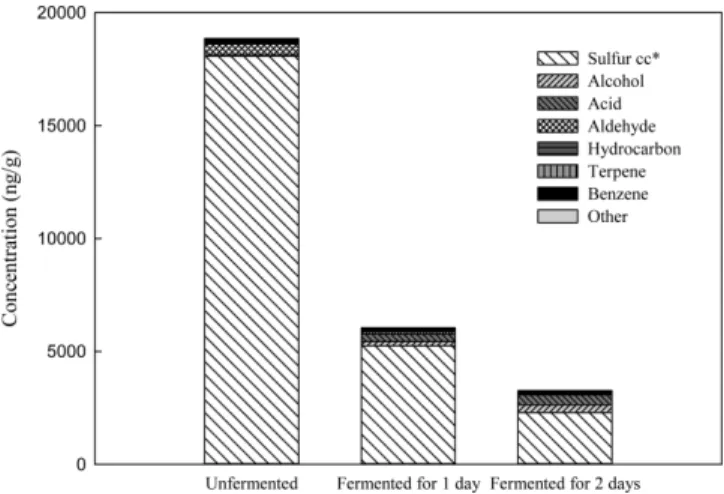
Abstract Volatile flavor compounds of radish fermented by lactic acid bacteria were extracted using solid-phase microextraction (SPME) and analyzed by gas chromatography-mass spectrometry (GC-MS). A total of 45 volatile flavor compounds were identified. The volatile flavor compounds in unfermented radish mostly consisted of sulfur-containing compounds (95.85%) and aldehydes (2.61%). While the composition ratio of volatile flavor compounds in radish fermented for two days changed to sulfur-containing compounds (75.53%) and acids (11.12%). As the fermentation period was increased, the contents of dimethyl disulfide, dimethyl trisulfide, diallyl sulfide, diallyl disulfide, and diallyl trisulfide, which have unique garlic and scallion flavor, decreased, and acetic acid and 1-hexanol, which have a sour and fruity flavor, increased. These changes in volatile flavor compounds seemed to have affected the flavor characteristics of fermented radish.
Keywords: radish, flavor, volatile compound, lactic acid bacteria, fermentation
서
론
무(Raparus sativus L.)는 겨자과(Crecifer family) 또는 배추과 (Brassicaceae family)에 속하는 작물로 세계적으로 널리 재배되며, 국내에서는 배추와 함께 김치의 주재료로 사용되는 채소 중 하 나이다(Lee 등, 2017). 무를 이용한 대표적인 발효 식품인 동치미 는 무, 마늘, 파와 소금물을 넣어 발효시킨 김치로 특유의 신선 한 신맛으로 기호도가 높다(Lee와 Kim, 2009). 국내에서는 동치 미 국물을 이용한 냉면 육수 등 소스류의 다양한 제품 개발 및 상품화가 이루어지고 있다. 무에 대한 연구로는 무의 품종 별 이화학 특성에 대한 연구 (Kim 등, 2007) 및 무 뿌리에 대한 연구(Blažević과 Mastelić, 2009)가 보고되었다. 무 발효에 관한 연구로는 동치미에서 분리 한 유산균의 생리활성에 대한 연구(Choi 등, 2015), 동치미의 관 능 특성에 대한 연구(Lee와 Kim, 2009) 및 동치미의 묘사분석에 대한 연구(Cho 등, 2015) 등이 보고되었으며, 무의 휘발성 향기 성분에 대한 연구로는 발효기간에 따른 감동젓무 김치의 휘발성 성분에 대한 연구가 있으며(Yoon 등, 2008), 함황화합물인 trans-4-(methylthio)-3-butenyl isothiocyanate와 trans-4-(methylthio)butyl isothiocyanate가 무의 특징적 향을 나타내는 성분이라 보고된 바 있다(McGorrin, 2011). 무에 함유되어 있는 휘발성 함황화합물은 무의 특징적 향미와 이취에 중요한 역할을 한다. 화학적으로 불안정한 특성과 낮은 역치를 가져 낮은 농도에서는 식품에서 적절한 향미 특성을 나 타내지만 높은 농도에서는 그 향이 불쾌하게 인식된다. 예를 들 어 dimethyl sulfide는 높은 농도에서는 양배추향을 나타내지만, 낮은 농도에서는 통조림 옥수수의 풍미를 나타낸다. 휘발성 함황 화합물은 빵, 팝콘, 견과류 및 와인 등의 향에 중요한 역할을 하 며 체다치즈, 초콜릿 및 열대 과일의 미묘한 향미 특성에도 기여 한다(McGorrin, 2011). 유산균은 수 천 년 동안 발효식품을 만드는 데에 이용되어 왔 고, 발효식품에서 높은 품질 및 재현성 있는 제품을 만들기 위한 스타터로 이용되고 있다. 유산균은 그람 양성균이며 병원성이 없 는 균으로, 유산구균(Lactococci)과 유산간균(Lactobacilli)으로 나 뉜다. 또한 유산균은 안전한 미생물인 GRAS (generally recognized as safe)에 속하며 유산간균의 특정 균주들이 사람의 건강을 증진 시킨다는 프로바이오틱 효과와 관련된 수 많은 연구가 이루어 지 고 있다(Gilliland, 1990). 한국의 전통 발효식품인 김치의 발효에 관여하는 유산균으로는 Leuconostoc과 Lactobacillus 등이 있다(Lee 등, 2015). 발효 초기에는 Leuconostoc 속이 우세하게 증식하며 발효 후기에는 Lactobacillus 속이 증식하는 것으로 알려져 있다 (Stamer 등, 1971). Lactobacillus 속은 당을 이용하여 젖산과 초산 등의 유기산을 생성하여 김치에 신맛과 풍미를 부여하고, pH를 낮춰 오염을 억제하는 역할을 한다(Lee 등, 1998). 무를 유산균으 로 발효한 무 발효물은 관능적으로 새콤한 동치미의 향미와 신 선한 향미를 부여하여 냉면 육수, 미네스트로네 수프와 같이 동 양 및 서양 요리에 모두 적용 가능할 것으로 생각된다. *Corresponding author: Boram Kim, Sempio Fermentation
Research Center, Cheongju, Chungbuk 28156, Korea Tel: +82-43-249-6359
Fax: +82-43-238-8575 E-mail: [email protected]
Received May 31, 2019; revised August 5, 2019; accepted August 5, 2019
동치미의 휘발성 향기성분에 대한 연구는 이전에 이루어진 적 이 있으나(Hwang과 Jang, 2003), 무 발효물의 휘발성 향기성분에 관한 연구는 미흡한 실정이다. 무 발효물을 이용한 동치미 향미 제품의 품질을 개선하고 품질지표 성분을 확립하기 위해서는 무 발효물의 향 특성을 이해하는 것이 중요하다. 따라서 본 연구에 서는 무를 유산균으로 발효시킨 무 발효물의 발효 기간에 따른 휘발성 향기성분을 고체상 미량 추출(solid-phase microextraction, SPME)로 추출하고 GC-MS로 분석하여, 이를 통해 무 발효물의 향미 특성을 확인하고자 하였다.
재료 및 방법
무 발효물의 제조 본 연구에서 사용된 무 발효물은 국내산 갈은 무 및 찐 양파 와 중국산 다진 마늘을 제이팜스(Gongju, Chungnam, Korea)로부 터 제공받아 94:3:3의 중량비율로 혼합 후 김치에서 신규 분리 및 동정된 유산균(Lactobacillus brevis SMB091, KCCM11556P)을 3.7×10⁷ CFU/mL 수준으로 접종하여 적정산도가 0.6%로 상승할 때까지 30oC에서 2일간 발효하였다. 향기성분 분석을 위한 무 발 효물은 여과지로 여과한 여액을 −20oC에 보관하면서 실험에 사 용하였다.고체상 미량추출(solid-phase microextraction, SPME)을 이용 한 휘발성 향기성분 추출
각 시료 6 g과 내부표준물질로 ethyl benzoate 6 µg을 20 mL headspace vial (Thermo Fisher Scientific, Waltham, MA, USA)에 넣고 magnectic cap (Thermo Fisher Scientific, Waltham, MA, USA)으로 밀봉하여 30oC에서 250 rpm으로 25분 동안 평형상태 를 유지시킨 후 SPME fiber 1 cm를 노출시켜 10분 동안 휘발성 성분을 흡착시켰다. SPME fiber는 divinylbenzene/carboxen/poly-dimethylsiloxane (DVB/CAR/PDMS, 50/30µm) fiber (Supelco, Bellefonte, PA, USA)를 사용하였다(Jang 등, 2015).
GC-MS를 이용한 휘발성 향기성분의 정성 및 정량분석 SPME를 사용하여 추출한 무 발효물의 휘발성 향기성분은 기 체크로마토그래피(gas chrmotography, GC)의 주입구(250oC)에서 5
분 동안 탈착시켜 휘발성 향기성분들을 분리한 후 GC에 연결된 ISQ LT 질량분석기(TRACE 1310, Thermo Fisher Scientific, Waltham, MA, USA)로 분석하였다. GC 컬럼은 DB-WAX (30 m ×0.25 mm×0.25 µm, J&W Scientific, Folsom, CA, USA)를 사용 하였다. 오븐의 온도는 40oC 에서 5분 동안 유지시키고 4oC/min
의 가열속도로 200oC까지 상승시켜 5분 동안 유지하였다. 주입구
와 Ion source 온도는 250oC였으며 이동상 기체(고순도 He)는 1.0
mL/min의 유속을 유지하고, 비분할(splitless) 모드로 분석하였다. 분석할 분자량 범위는 29-550 a.m.u.였으며, 이온화 전압은 70 eV 로 전자이온화(electron ionization, EI) 방식에 의해 얻어졌다. 모 든 분석은 삼반복으로 실시하였다. 휘발성 향기성분의 동정은 머 무름 지수(retention index, RI)와 mass spectral database (NIST MS Search 2.2 Library)를 이용하였다. 머무름 지수는 외부 표준 물질로 C8-C20 alkane류들의 머무름 시간과 비교하여 계산하였고, 문헌상의 RI와 스펙트럼을 비교하여 확인하였다. SPME로 추출 한 휘발성 향기성분의 정량은 추출 시 내부 표준물질로 사용한 ethyl benzoate의 피크면적과 동정된 휘발성 향기성분의 피크면적 비를 이용하여 산출하였다. 이 때 피크면적비와 함량비의 상관계 수는 1이라고 가정하였다(Seo 등, 2015; Yoon 등, 2008). 농도(ng/g)= 피크면적비×ethyl benzoate의 양(ng) 시료(g) 통계적 분석
분석 결과는 Minitab 18 (Minitab Inc., State College, PA, USA)를 이용하였고, 분산분석(ANOVA)을 실시하여 통계적 유의 성(p<0.05)은 Fisher’s multiple comparison test로 검증하였다.
결과 및 고찰
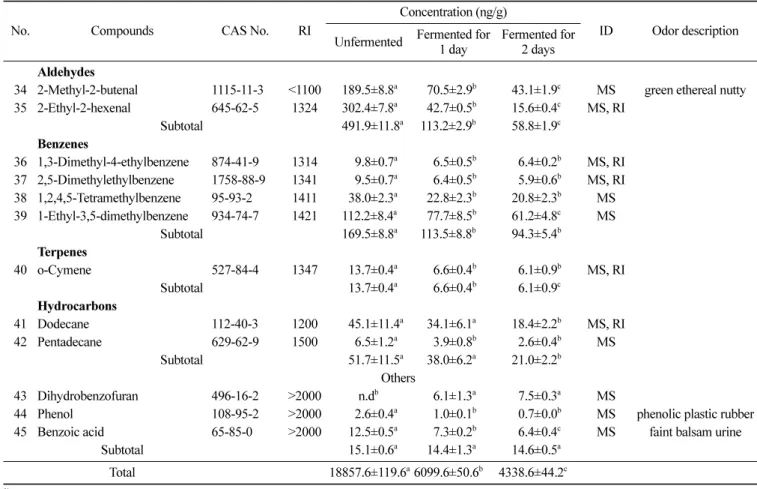
무 발효물의 휘발성 향기성분 무 발효물의 발효 기간에 따른 휘발성 향기성분을 SPME로 추 출한 후 GC-MS로 분석하여 얻어진 결과는 Table 1에 나타냈다. 무 발효물에서는 함황화합물 25종, 알코올 7종, 산 1종, 알데하이 드 2종, 벤젠 4종, 탄화수소 2종, 터펜 1종과 기타 3종 등 총 45 종의 휘발성 향기성분들이 확인되었다. 발효 기간에 따른 휘발성 향기성분의 종류는 크게 차이가 나지 않았으며, 함황화합물의 함 량이 가장 높았다. 한편 전체적인 휘발성 향기성분의 함량 변화 가 발효 기간에 따라 나타났다. 발효 0일차의 휘발성 향기성분의 조성 비율을 보면 함황화합물(95.85%), 알데하이드(2.61%)가 대 부분을 차지했고, 발효 2일차의 휘발성 향기성분의 조성 비율은 함황화합물(75.53%), 산(11.12%), 알코올(8.44%) 및 알데하이드 (1.48%)으로 조성 비율의 변화를 확인할 수 있었다. 발효 기간에 따른 무 발효물의 휘발성 향기성분 발효 기간이 증가함에 따라 무 발효물의 휘발성 향기성분의 총 함량이 감소하였는데, 그 중 함황화합물의 함량이 18,074.7 ng/g 에서 2,996.2 ng/g으로 가장 크게 감소하였고, 다음으로 알데하이 드가 491.9 ng/g에서 58.8 ng/g으로 감소하였다. 반면 산은 0 ng/g 에서 441.0 ng/g으로 증가하였고, 알코올은 41.1 ng/g에서 334.9 ng/ g으로 증가하였다(Fig. 1과 Table 1). 발효 0일차 무 발효물에서 는 함황화합물 중 diallyl disulfide, allyl methyl disulfide와 allyl methyl trisulfide의 함량이 가장 높았는데, 이 성분들은 무 발효물 의 원재료인 무, 양파와 마늘 등에서 유래된 것으로 보인다(Cha 등, 1998). Allium 속 식물인 마늘, 파 등에서 유래된 sulfide 류 는 각각 전구물질의 차이로 인하여, 마늘에서 유래되는 allyl 기 를 가지는 sulfide류와 propenyl, methyl 및 propyl기를 가지는 sulfide류가 있다(Block과 Calvey, 1994; Lee 등, 2003). DiallylFig. 1. Concentrations of volatile flavor compounds of fermented radish (*Sulfur cc: sulfur-containing compound).
disulfide는 다진 마늘에서, propenyl propyl disulfide는 익힌 양파 에서 나타나는 주요 휘발성 향기성분이다. 발효 기간이 증가할수록 함황화합물의 함량이 크게 감소하였 는데 이러한 사실은 함황화합물의 농도가 높으면 무 발효물이 무, 마늘, 양파 등 재료 고유의 향 특성을 나타내는데 반해 발효가 진행되면서 함황화합물의 농도가 낮아지면 무 발효물의 향 특성 이 동치미 향미 및 마일드한 향미를 나타내어서 무 발효물의 향 미에 긍정적인 영향을 줄 것으로 생각된다. 함황화합물의 함량이 크게 감소하는 이유는 함황화합물들이 발효기간 동안 cysteine sulfoxide lyase의 효소반응에 의해 생성된 후 알코올과 상호 반 응하여 다른 성분들로 전환되기 때문인 것으로 알려져 있다(Grosch, 1993). 또한 양파의 불쾌취 성분으로 알려져 있는 dimethyl disul-fide와 dimethyl trisulfide의 함량은 각각 발효 전 1,528.9 ng/g과 1,108.1 ng/g에서 발효 후 각각 431.8 ng/g과 196.2 ng/g으로 크게 감소하였다(Fig. 2).
무의 조직이 파괴되면서 조직 속에 있던 glucosinolate가 가수 분해효소인 thioglucosidase의 작용을 받아 생성되는 것으로 알려 져 있는 isothiocyanate류의 성분들인 3-(methylthio)propyl isothio-Table 1. Volatile flavor compounds identified from fermented radish
No. Compounds CAS No. RI1)
Concentration (ng/g)
ID2) Odor description3) Unfermented Fermented for
1 day
Fermented for 2 days Sulfur-containing compounds
1 Allyl methyl sulfide 10152-76-8 <1100 00139.2±7.34),a 0137.8±10.9a,5) 0120.9±9.1a MS alliaceous garlic onion 2 Dimethyl disulfide 624-92-0 <1100 01528.9±33.4a 0553.6±17.0b 0431.8±1.6c MS cabbage onion 3 Diallyl sulfide 592-88-1 1139 00177.9±4.8a 0154.6±5.7b 0137.2±6.5c MS, RI sulfurous onion garlic 4 Propyl thioacetate 2307-10-0 1172 n.d6),b n.db 0014.0±0.4a MS, RI
5 (E)-Allyl 1-propenyl sulfide 104324-36-9 1180 00007.1±0.7a 0005.7±0.4b 0004.6±0.3c MS
6 Methyl propyl disulfide 2179-60-4 1122 00083.5±1.1a 0020.7±0.7b 0013.2±2.2c MS, RI onion radish mustard 7 Methyl (E)-1-propenyl disulfide 23838-19-9 1253 00083.0±1.6a 0022.6±0.3b 0009.3±0.3c MS, RI
8 Allyl methyl disulfide 2179-58-0 1271 03280.3±52.0a 0712.6±7.0b 0446.4±10.0c MS, RI alliaceous garlic onion 9 Methyl (Z)-1-propenyl disulfide 23838-18-8 1277 00742.3±6.0a 0226.6±6.7b 0112.0±4.2c MS, RI
10 Dimethyl trisulfide 3658-80-8 1365 01108.1±35.4a 0313.5±9.2b 0196.2±7.6c MS, RI sulfurous onion meaty 11 1-Allyl-2-isopropyl disulfide 67421-85-6 1419 00102.0±0.5a 0044.6±1.1b 0020.7±1.7c MS
12 (E)-1-Propenyl propyl disulfide 23838-21-3 1426 00023.8±1.3a 0014.2±0.4b 0007.3±0.3c MS, RI 13 Allyl (E)-1-propenyl disulfide 122156-02-9 1455 00380.1±6.2a 0134.7±4.2b 0056.1±3.3c MS
14 Diallyl disulfide 2179-57-9 1472 03608.6±54.5a 1385.2±26.8b 0687.5±25.1c MS, RI onion garlic metallic 15 Allyl (Z)-1-propenyl disulfide 122156-03-0 1477 01286.6±10.2a 0530.8±20.9b 0211.9±13.3c MS, RI
16 1,2-Dithiole 288-26-6 1511 00700.0±39.1a 0051.4±2.3b 0023.8±1.5c MS, RI sulfurous meaty 17 Allyl methyl trisulfide 34135-85-8 1580 02916.6±61.8a 0574.6±20.7b 0338.0±9.8c MS, RI creamy garlic onion 18 Allyl propyl trisulfide 33922-73-5 1719 00083.4±4.0a 0021.6±1.1b 0011.8±3.8c MS, RI alliaceous garlic onion 19 3-Vinyl-1,2-dithi-4-ene 62488-52-2 1723 00267.0±6.2a 0033.8±1.7b 0007.5±1.3c MS
20 Diallyl trisulfide 2050-87-5 1780 00966.9±7.7a 0146.6±7.6b 0077.4±6.4c MS, RI garlic onion metallic 21 Allyl (Z)-1-propenyl trisulfide 382161-75-3 1790 00269.4±12.1a 0082.5±5.9b 0031.4±3.3c MS
22 2-Vinyl-4H-1,3-dithiine 80028-57-5 1832 00244.4±3.6a 0053.3±2.8b 0023.4±2.8c MS, RI 23 3-Methylthiopropyl isothiocyanate 505-79-3 >2000 00007.4±0.4 a 0003.3±1.1b 0003.0±0.2b MS sulfurous horseradish 24 4-(Methylthio)butyl isothiocyanate (erucin) 4430-36-8 >2000 00048.4±3.9 a 0014.0±0.6b 0008.3±0.7c MS cabbage radish 25 (E)-4-Methylthio-3-butenyl isothiocyanate 13028-50-7 >2000 00019.9±0.9 a 0004.9±0.3b 0002.7±1.1c MS Subtotal 18074.7±118.1a5243.3±48.3b 2996.2±36.1c Alcohols
26 Ethanol 64-17-5 <1100 n.dc 0040.1±9.7b 0141.6±4.9a MS strong alcoholic 27 3-Methyl-1-butanol 123-51-3 1210 00008.7±1.5a 0006.3±0.7b 0006.0±0.4b MS, RI whiskey fruity banana 28 3-Methyl-2-butenol 556-82-1 1320 00007.8±0.8c 0011.1±0.6b 0020.2±1.0a MS, RI fruity green lavender 29 1-Hexanol 111-27-3 1353 00020.5±1.3c 0109.0±1.9b 0139.3±1.2a MS, RI oily fruity alcoholic 30 2-Hexenol 2305-21-7 1405 n.db 0001.1±0.2a 0001.0±0.1a MS, RI fruity green leafy 31 2-Ethyl-1-hexanol 104-76-7 1491 00004.1±0.1a 0001.8±0.0b 0002.0±0.1b MS, RI citrus fresh floral 32 2-Ethyl-2-hexen-1-ol 50639-00-4 1572 n.dc 0017.7±0.3b 0024.8±1.1a MS
Subtotal 00041.1±2.1c 0187.2±9.9b 0334.9±5.3a Acids
33 Acetic acid 64-19-7 1444 n.dc 0332.4±1.9b 0441.0±22.7a MS, RI sharp sour vinegar Subtotal n.dc 0332.4±1.9b 0441.0±22.7a
cyanate, 4-(methylthio)butyl isothiocyanate와 (E)-4-(methylthio)-3-butenyl isothiocyanate 등의 성분들도 검출되었다. 이 성분들 또한
발효 기간이 증가될수록 감소되는 경향을 나타냈다. 이 중 4-(methylthio)butyl isothiocyanate은 erucin이라 불리며 무 뿌리의 주 요 성분으로 알려져 있다(Blažević과 Mastelić, 2009).
마늘에서 유래된 것으로 보이는 3-vinyl-1,2-dithi-4-ene과 2-vinyl-4H-1,3-dithiine 성분들도 발효 기간이 증가함에 따라 함량이 감소 하는 경향을 보였다. 마늘의 주요 성분인 alliin은 마늘을 으깨거 나 잘랐을 때 alliinase의 작용에 의해 2-propenesulfenic acid 및 thioacrolein으로 분해된다. 이 때, thioacrolein은 Diels-Alder 반응 에 따라 축합하여 2-vinyl-4H-1,3-dithiine 등의 마늘 고유의 냄새 를 내는데 기여한다. 또한 disulfide류는 분해되어 양파와 마늘의 특유의 냄새에 기여하는 thiophene 등의 저분자 함황화합물을 생 성한다(Ahn, 2005). 특히 diallyl disulfide는 다진 마늘에서 유래된 성분으로 역치(odor threshold)가 0.22 ng/g으로 낮으며(Nagata, 2019), 발효 후 농도가 크게 감소하여(687.5 ng/g) 무 발효물에서 마늘 특유의 자극적인 향이 감소하는데 영향을 미쳤을 것으로 사 료된다.
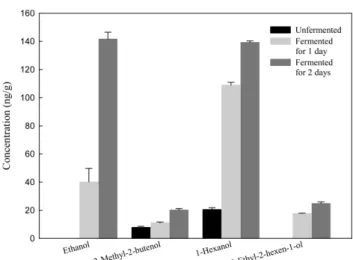
산 및 알코올 화합물은 발효 기간이 증가할수록 함량도 증가 하는 경향을 나타냈는데, 이는 유산균이 pentose phosphate path-way와 TCA cycle을 통해 당을 분해하여 유기산, 이산화탄소 및 에탄올로 전환시켜 탄산 맛을 부여하는데 영향을 미친다(Lim 등, 2017). 톡 쏘는 신 향을 나타내는 acetic acid는 발효 후 441.0 ng/ Table 1. Continued
No. Compounds CAS No. RI
Concentration (ng/g)
ID Odor description Unfermented Fermented for
1 day
Fermented for 2 days Aldehydes
34 2-Methyl-2-butenal 1115-11-3 <1100 00189.5±8.8a 0070.5±2.9b 0043.1±1.9c MS green ethereal nutty 35 2-Ethyl-2-hexenal 645-62-5 1324 00302.4±7.8a 0042.7±0.5b 0015.6±0.4c MS, RI Subtotal 00491.9±11.8a 0113.2±2.9b 0058.8±1.9c Benzenes 36 1,3-Dimethyl-4-ethylbenzene 874-41-9 1314 00009.8±0.7a 0006.5±0.5b 0006.4±0.2b MS, RI 37 2,5-Dimethylethylbenzene 1758-88-9 1341 00009.5±0.7a 0006.4±0.5b 0005.9±0.6b MS, RI 38 1,2,4,5-Tetramethylbenzene 95-93-2 1411 00038.0±2.3a 0022.8±2.3b 0020.8±2.3b MS 39 1-Ethyl-3,5-dimethylbenzene 934-74-7 1421 00112.2±8.4a 0077.7±8.5b 0061.2±4.8c MS Subtotal 00169.5±8.8a 0113.5±8.8b 0094.3±5.4b Terpenes 40 o-Cymene 527-84-4 1347 00013.7±0.4a 0006.6±0.4b 0006.1±0.9b MS, RI Subtotal 00013.7±0.4a 0006.6±0.4b 0006.1±0.9c Hydrocarbons 41 Dodecane 112-40-3 1200 00045.1±11.4a 0034.1±6.1a 0018.4±2.2b MS, RI 42 Pentadecane 629-62-9 1500 00006.5±1.2a 0003.9±0.8b 0002.6±0.4b MS Subtotal 00051.7±11.5a 0038.0±6.2a 0021.0±2.2b Others 43 Dihydrobenzofuran 496-16-2 >2000 n.db 0006.1±1.3a 0007.5±0.3a MS
44 Phenol 108-95-2 >2000 00002.6±0.4a 0001.0±0.1b 0000.7±0.0b MS phenolic plastic rubber 45 Benzoic acid 65-85-0 >2000 00012.5±0.5a 0007.3±0.2b 0006.4±0.4c MS faint balsam urine
Subtotal 00015.1±0.6a 0014.4±1.3a 0014.6±0.5a Total 18857.6±119.6a6099.6±50.6b 4338.6±44.2c 1)Retention indexes were determined using n-alkanes of C
8 to C20 as external standards
2)Identification was performed as follows: MS, mass spectrum was consistent with that NIST mass spectrum database, RI, retention index was consistent with that of the literatures (http://webbook.nist.gov/chemistry/name-ser/)
3)http://www.thegoodscentscompany.com/search2.html 4)All values are the mean±standard deviation
5)Values in the same row with different superscripts (a-c) are significantly different (Fisher test, p<0.05). 6)Not detected
Fig. 2. Changes in the contents of representative sulfur-containing compounds during fermentation.
g으로 증가 하여 무 발효물의 향미 특성에 영향을 주었을 것으 로 생각되며, 알코올 화합물 중 3-methyl-butenol, 1-hexanol과 2-ethyl-2-hexen-1-ol은 발효 기간이 경과함에 따라 증가하는 경향을 나타냈다(Fig. 3). 이러한 알코올 화합물은 carbonyl의 환원반응 또는 미생물의 대사활동에 의해 생성된다고 보고된 바 있다(Park 등, 1997). 특히 oily, fruity와 alcoholic 향미특성을 가진 1-hex-anol은 역치가 낮으며(6 ng/g)(Nagata, 2019), 발효 후 함량이 증가 하여(139.3 ng/g) 무 발효물의 향미특성에 영향을 미친 성분으로 사료 된다. 알데하이드 성분인 2-methyl-2-butenal는 발효 0일차 189.5 ng/g 에서 발효 2일차에는 43.1 ng/g으로 2-ethyl-2-hexenal은 302.4 ng/ g에서 15.6 ng/g으로 함량이 크게 감소하였으며, 1,3-dimethyl-4-ethylbenzene과 1-ethyl-3,5-ethylbenzene 등의 benzene 화합물도 발 효 기간이 증가함에 따라 함량이 감소하였다.
요
약
무 발효물의 발효기간에 따른 휘발성 향기성분을 SPME를 이 용하여 추출하고 GC-MS로 분석하였다. 총 46종의 휘발성 향기 성분이 검출되었으며, 이들 중 함황화합물의 함량이 가장 높았다. 발효 전(발효 0일차) 휘발성 향기성분의 조성 비율을 보면 함황 화합물(95.85%)과 알데하이드(2.61%)가 대부분을 차지했고, 발효 후(발효 2일차) 휘발성 향기성분의 조성 비율은 함황화합물 (75.53%), 산(11.12%), 알코올(8.44%) 및 알데하이드(1.48%)으로 구성되어 변화가 큼을 알 수 있었다. 발효 후 함황화합물의 총 함량은 18,074.7 ng/g에서 2,996.2 ng/g으로 가장 크게 감소하였고, 이 성분 중 원재료의 주 성분으로 알려져 있는 dimethyl disulfide, dimethyl trisulfide, diallyl sulfide, diallyl disulfide와 diallyl trisul-fide의 함량이 발효 기간이 증가함에 따라 크게 감소하는 경향을 보였다. 또한 이 성분들은 자극적인 함황화합물 특유의 마늘향과 파향을 나타내는 휘발성 화합물로 발효 후 함량이 크게 감소하 여 무 발효물의 발효 전후 향미특성에 크게 영향을 줄 것으로 생 각된다. 반면 acetic acid는 발효 전 0 ng/g에서 발효 후 441.0 ng/ g으로 크게 증가하였고, 알코올은 41.1 ng/g에서 334.9 ng/g으로 발 효 기간이 경과함에 따라 크게 증가하는 것을 확인할 수 있었다. 발효 2일차에 증가된 acetic acid (441.0 ng/g)와 1-hexanol (139.3 ng/g)은 각각 톡 쏘는 신향, 과일향과 알코올향을 나타내 발효 전 후 무 발효물의 향미특성에 영향을 미칠 것으로 생각된다.감사의 글
본 연구는 2018년 국가식품클러스터 기업공동기술개발사업의 지원을 받아 수행한 연구임(국내에서 주로 이용하는 채소의 푸드 페어링 및 주요 향미성분 분석).References
Ahn SY. Food Chemistry. Gyomoon Publishers. Paju. Korea. pp. 196-197 (2005)
Blažević I, Mastelić J. Glucosinolate degradation products and other bound and free volatiles in the leaves and roots of radish (Rapha-nus Sativus L.). Food Chem. 113: 96-102 (2009)
Block E, Calvey EM. Facts and artifacts in allium chemistry. ACS Symp. 564: 66-79 (1994)
Cha YJ, Kim H, Cadwallader KR. Aroma-active compounds in kim-chi during fermentation. J. Agr. Food Chem. 46: 1944-1953 (1998)
Cho JH, Lee SJ, Choi JJ, Chung CH. Chemical and sensory profiles of dongchimi (Korean watery radish kimchi) liquids based on descriptive and chemical analyses. Food Sci. Biotechnol. 24: 497-506 (2015)
Choi MS, Kim DM, Oh KH. Studies on the enhanced physiological activities of mixed lactic acid bacteria isolated from fermented watery kimchi, dongchimi. KSBB J. 30: 245-252 (2015)
Gilliland SE. Health and nutritional benefits from lactic acid bacteria. FEMS Microbiol. Lett. 87: 175-188 (1990)
Grosch W. Detection of potent odorants in foods by aroma extract dilution analysis. Trends Food Sci. Technol. 4: 68-73 (1993) Hwang JH, Jang MS. Free sugar, free amino acid, non-volatile
organic acid and volatile compounds of dongchimi added with jasoja (Perillaesemen). Korean J. Food Cook. Sci. 19: 1-10 (2003)
Jang GJ, Kim DW, Gu EJ, Song SH, Lee JI, Lee SB, Kim JH, Ham KS, Kim HJ. GC/MS-based metabolomic analysis of the radish water kimchi, Dongchimi, with different salts. Food Sci. Biotech-nol. 24: 1967-1972 (2015)
Kim HR, Lee JH, Kim YS, Kim KM. Chemical characteristics and enzyme activities of icheon ge-geol radish, gangwha turnip, and korean radish. Korean J. Food Sci. Technol. 39: 255-59 (2007) Lee ME, Jang JY, Lee JH, Park HW, Choi HJ, Kim TW. Starter
cul-tures for kimchi fermentation. J. Microbiol. Biotechnol. 25: 559-568 (2015)
Lee SH, Kim JH. Effect of ingredients on the sensory characteristics of dongchimi. Korean J. Food Sci. Technol. 41: 162-166 (2009) Lee JH, Kong JH, Min DB. Optimization of solid-phase
microextrac-tion for the analysis of the headspace volatile compounds in kim-chi, a traditional korean fermented vegetable product. J. Food Sci. 68: 844-848 (2003)
Lee JG, Lim SY, Kim JK, Lee EJ. The mechanism of deterioration of the glucosinolate-myrosynase system in radish roots during cold storage after harvest. Food Chem. 233: 60-68 (2017)
Lee KS, Shin YS, Lee CH. Acid tolerance of lactobacillus brevis isolated from kimchi. Korean J. Food Sci. Technol. 30: 1399-1403 (1998)
Lim ES, Kim YM, Lee EW. Functional evaluation of sourdough con-taining lactic acid bacteria isolated from sliced radish kimchi. Korean J. Microbiol. 53: 180-192 (2017)
McGorrin RJ. The significance of volatile sulfur compounds in food flavors. ACS Symp. 1068: 3-31 (2011)
Nagata Y. Measurement of odor threshold by triangle odor bag method. Available from: http://www.env.go.jp/en/air/odor/measure/ 02_3_2.pdf. Accessed May 21, 2019.
Park HK, Sohn KH, Park OJ. Analysis of significant factor in the flavor of traditional Korean soy sauce (iii)-aroma compound anal-ysis. J. Korean Soc. Food Cult. 12: 173-182 (1997)
Seo WH, Kim YK, Jang SH, Baek HH. Aroma characterization of roasted bulgogi reaction flavor manufactured by a high-tempera-ture reaction apparatus. Korean J. Food Sci. Technol. 47: 176-183 (2015)
Stamer JR, Stoyla BO, Dunckel BA. Growth rates and fermentation patterns of lactic acid bacteria associated with the sauerkraut fer-mentation. J. Milk Food Technol. 34: 521-525 (1971)
Yoon MK, Kwon MJ, Lee SM, Kim JW, Cho MS, Lee JM, Kim
YS. Characterization of volatile components according to fermen-tation periods in gamdongchotmoo kimchi. Korean J. Food Sci. Technol. 40: 497-502 (2008)