INTRODUCTION
Negative public attitude toward epilepsy is a common phe- nomenon all over the world (1-10), and is the major factor causing serious social discrimination against people with epilepsy. In general, those with epilepsy have considerable limitations in their interaction with and adaptation to their surroundings; some of them find social attitudes toward them more devastating than the disorder itself (11).
Lennox suggested that public health workers needed to be acquainted with the public perception on a given illness, to be aware of changes in this thinking, and to recognize the factors influencing such change (12). Most physicians who manage epileptic persons, however, have not been enthusiastic in treating the social stigma of the patients, e.g., in changing negative attitudes toward epilepsy.
Informational campaigns are often very helpful in chang- ing the knowledge of and the public attitudes toward epilep- sy (1). Some unfavorable public perceptions toward epilepsy in a certain society are mainly due to or can be induced from false beliefs about epilepsy (11). Therefore, thorough under- standing of the quantification and qualification of the false beliefs about epilepsy among community individuals would
be essential before practicing public information campaigns to modify the negative attitudes. However, little has been published in Korea on this subject, although the authors believe that social discrimination against people with epilepsy is very serious in this country (3, 4). Furthermore, trials to indicate the trends in public attitudes toward epilepsy have been rare in the world to our knowledge.
We present here public attitudes toward epilepsy in rural area in Korea, and a positive trend of the attitudes after the schedule of public education campaigns on epilepsy over the same area.
MATERIALS AND METHODS Surveys and questionnaire
A survey conducted in Kwangju, Korea demonstrated that negative attitudes toward epilepsy were closely correlated to the level of education or age of the respondents, e.g., the less educated or older they were, the more negative were their attitudes toward epilepsy (3). Therefore, for the purpose of retrieving the optimal results in Korea, several small typical
Myeong-Kyu Kim, In-Kyu Kim, Byeong-Chae Kim, Ki-Hyun Cho, Sei-Jong Kim, Jai-Dong Moon*
Department of Neurology and *Occupation &
Enviornmental Medicine, Medical Research Institute, Chonnam National University Medical School, Gwangju, Korea
Address for correspondence Myeong-Kyu Kim, M.D.
Department of Neurology, Chonnam University Hospital, Hak-1-dong, Dong-gu, Gwangju 501-190, Korea
Tel : +82.62-220-6161, Fax : +82.62-228-3461 E-mail : [email protected]
*The author wishes to acknowledge the financial support of Chonnam National University for this research in the program year of 1998.
*The Korean version of this article was published in J Korean Neurol Assoc 2002; 20: 486-96.
248
Positive Trends of Public Attitudes Toward Epilepsy after Public Education Campaign Among Rural Korean Residents
To assess trends of public attitudes toward epilepsy in Korea, two surveys were performed in the same village using a common questionnaire before and after the schedule of public education on epilepsy. Cross-sectional studies were conduct- ed by means of a door-to-door interview, in which all residents over 19 yr of age living in the survey area were targeted. Vehicles for the educational campaign took the form of lectures and small group discussions. The understanding of epilep- sy among Korean respondents appeared to be not only based more on super- natural or superstitious thinking, but was also less comparable to that of other studies. The attitudes toward epilepsy also were far more negative in Korean rural areas than in other countries. The false belief that “epilepsy can not be treated”
was the factor that contributed most to negative attitudes. Although a positive trend was obvious not only in understanding the cause of epilepsy but also in attitudes toward epilepsy, the majority of respondents still remain unchanged in their mis- understanding of and negative attitudes toward epilepsy. To ameliorate the social stigma against epilepsy in Korea, continuous and repetitive educational efforts as well as the sympathy of the lay societies regarding epilepsy would be needed.
Key Words : Education; Prejudice; Attitude; Epilepsy; Korea
Received : 6 September 2002 Accepted : 29 November 2002
farming villages in Chonnam Province, Korea, were chosen as the investigating areas because the residents in that area were usually less educated and older on average than those in urban area (13). Other reasons the researchers selected the particular areas were for the convenience of the survey and information campaign, and the expectation of minimizing difference in parameters of respondents, e.g., occupation or level of income.
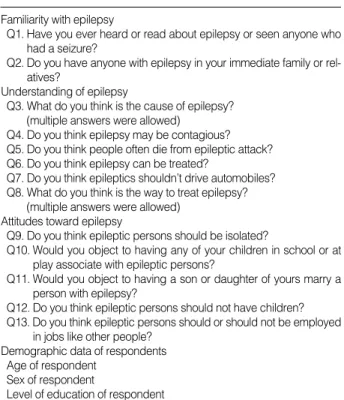
Two cross-sectional surveys were conducted in the same village using a common questionnaire before and after the schedule of public education on epilepsy. The first survey was performed in 1995, and 931 subjects were contacted. The second was performed in 1999, and 730 subjects were con- tacted. The questionnaire used in our survey consisted of 4 categories, concerning 1) familiarity with epilepsy 2) under- standing of epilepsy 3) attitudes toward epilepsy and 4) demo- graphic data of respondents. Each category contained several questions (2 to 6) to obtain information about the issue (Table 1). Some questions were designed to ask the respondents to select one among “Yes”, “No”, or “I don’t know”, and others were allowed multiple answers. The majority of these ques- tions were from a previous Gallup Poll of public attitudes toward epilepsy (14).
Interview method
Each survey was conducted by means of a door-to-door interview. All residents over 19 yr of age living in the survey area were targeted. The interviewers (medical students and
doctors) had undergone a one-week orientation on the ques- tionnaire. Since not all respondents could understand the exact meaning of the questions, the interviewers were allowed to read and explain the questions to all respondents. No attempt was made to prompt the respondents by suggesting answers directly.
Public education campaign for epilepsy
Vehicles for the educational campaign were directed at the respondents interviewed. It was demonstrated during the first survey that most of the rural residents thought that medical information about epilepsy was not worthwhile to learn about health. Furthermore, mass media such as local radios, televi- sion programs, or newspapers did not seem to be an effective vehicle in the campaign in such rural areas because the resi- dents usually had to work in the field until late in the evening.
Accordingly, the authors chose special meetings with the residents as an educational channel. These meetings took the form of lectures and small group discussions. Lectures contained descriptive knowledge about epilepsy only to cor- rect false beliefs proven during the first survey to affect neg- ative public attitudes toward epilepsy; much attention was paid in not including direct descriptions about the prejudice in the lectures for a precise assessment of the efficacy of the campaign. Lectures were held in each township office of 3 different districts once a year for 2 yr, and it took about one and a half hour per lecture. In order to increase the efficacy of the campaign, the schedule of the lecture was included in the agricultural education program that was obligatory on all residents of the district to appear at. The number of atten- dants in the lecture was 132 in average. The small group discussion was designed to cover the residents who did not attend the lecture and was held at least three times a year for same village. About 20 persons in average were present at the meeting.
Data Analyses
Data from a total of 820 respondents gathered during the first survey was included in the analysis. Of 931 subjects contacted, 50 were excluded from all the analysis because they could not understand the exact meaning of questions or complete the questionnaire appropriately. Sixty-one answered
“not familiar with epilepsy” and were also excluded from the analysis. A chi-square test was used to estimate the relation- ships between the responses and their age, sex, and level of education, and their knowledge about epilepsy and attitudes toward epilepsy or people with epilepsy. Data from a total of 715 respondents gathered during the second survey was compared to those from the first survey to estimate the trend in changing attitudes over 4 yr. To indicate the effect of the campaign on the trend, data from the second survey was divided into two groups according to whether the respon-
Familiarity with epilepsy
Q1. Have you ever heard or read about epilepsy or seen anyone who had a seizure?
Q2. Do you have anyone with epilepsy in your immediate family or rel- atives?
Understanding of epilepsy
Q3. What do you think is the cause of epilepsy?
(multiple answers were allowed) Q4. Do you think epilepsy may be contagious?
Q5. Do you think people often die from epileptic attack?
Q6. Do you think epilepsy can be treated?
Q7. Do you think epileptics shouldn’t drive automobiles?
Q8. What do you think is the way to treat epilepsy?
(multiple answers were allowed) Attitudes toward epilepsy
Q9. Do you think epileptic persons should be isolated?
Q10. Would you object to having any of your children in school or at play associate with epileptic persons?
Q11. Would you object to having a son or daughter of yours marry a person with epilepsy?
Q12. Do you think epileptic persons should not have children?
Q13. Do you think epileptic persons should or should not be employed in jobs like other people?
Demographic data of respondents Age of respondent
Sex of respondent
Level of education of respondent
Table 1.Composition of the questionnaire
dent attended the campaign (n=418) or not (n=297), and then both groups were compared to one another. A logistic regression test was used in those analyses and age, gender and level of education were adjusted in comparing data from the two surveys, if necessary. Non-committal answers, such as “I have no idea,” or “not sure,” were excluded from the analyses. The level p<0.05 was considered as the cut-off value for significance.
RESULTS
Internal consistency reliability of the questionnaire
Cronbach’s alpha coefficient for the questionnaire was 0.64.
The correlation between some similar questions in the ques- tionnaire, for example, “epileptic persons should be isolated”
versus “epilepsy may be contagious,” or “epilepsy is a mental illness” versus “the way to treat epilepsy is psychotherapy”
and so on, was statistically significant (p<0.05, correlation analysis; data not shown).
Demographic features of respondents
The distribution of age, gender and level of education of respondents was not even. The majority of respondents was less educated (elementary school or below; 83%) and was more than 50 yr of age (87%). Sixty percent were female.
Females and the elderly were directly related to being less educated (p<0.05).
Familiarity with epilepsy
Of 881 persons who completed the questionnaire appro- priately in the first survey, 93% of respondents were familiar with epilepsy; 55% had seen someone who had a seizure and 38%, although they had not seen a seizure directly, had heard or read about epilepsy. Of a total of 820 respondents who answered they were familiar with epilepsy and completed the questionnaire appropriately, 8.5% had an epileptic person amongst their family or relatives.
Understanding of epilepsy
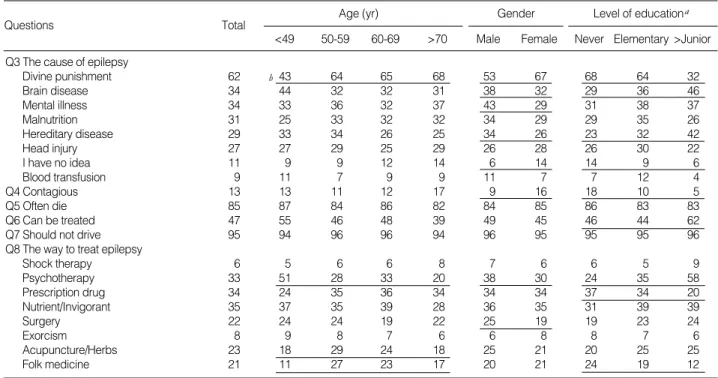
The responses of 820 respondents to the survey questions about understanding of epilepsy are shown in Table 2. Sixty- two percent of respondents answered the question, “What do you think is the cause of epilepsy?” as “divine punish- ment”, and this false belief was directly associated with being older, female, and less educated (p<0.01). Thirty-four percent answered, “brain or nervous system disease” or “mental ill- ness”, and these answers were directly associated with being more educated or male, respectively (p<0.01). Thirty-one percent believed that epilepsy was caused by “malnutrition”.
Twenty-nine percent answered, “hereditary or inherited dis- ease”, and this answer was directly associated with being more
Q3 The cause of epilepsy
Divine punishment 62 43 64 65 68 53 67 68 64 32
Brain disease 34 44 32 32 31 38 32 29 36 46
Mental illness 34 33 36 32 37 43 29 31 38 37
Malnutrition 31 25 33 32 32 34 29 29 35 26
Hereditary disease 29 33 34 26 25 34 26 23 32 42
Head injury 27 27 29 25 29 26 28 26 30 22
I have no idea 11 9 9 12 14 6 14 14 9 6
Blood transfusion 9 11 7 9 9 11 7 7 12 4
Q4 Contagious 13 13 11 12 17 9 16 18 10 5
Q5 Often die 85 87 84 86 82 84 85 86 83 83
Q6 Can be treated 47 55 46 48 39 49 45 46 44 62
Q7 Should not drive 95 94 96 96 94 96 95 95 95 96
Q8 The way to treat epilepsy
Shock therapy 6 5 6 6 8 7 6 6 5 9
Psychotherapy 33 51 28 33 20 38 30 24 35 58
Prescription drug 34 24 35 36 34 34 34 37 34 20
Nutrient/Invigorant 35 37 35 39 28 36 35 31 39 39
Surgery 22 24 24 19 22 25 19 19 23 24
Exorcism 8 9 8 7 6 6 8 8 7 6
Acupuncture/Herbs 23 18 29 24 18 25 21 20 25 25
Folk medicine 21 11 27 23 17 20 21 24 19 12
Table 2.Understanding of epilepsy; Responses to Q3 through Q8 in Table 1 (n=820)
Figures represent % of positive responses. Multiple answers were allowed in Q3 and Q8. aNever; never went to school, Grade; grade school,
>Junior; junior high school or above. bp<0.01 by chi-square test (for all underlined).
Age (yr) Gender Level of educationa
<49 50-59 60-69 >70 Male Female Never Elementary >Junior
Questions Total
b
educated and male (p<0.01). About 11% answered they did not know the cause of epilepsy; this answer was directly associated with being female and less educated (Table 2).
Thirteen percent believed that epilepsy might be conta- gious, and 53% believed that epilepsy could not be treated.
These responses were observed more frequently among the less educated (p<0.01). Eighty-five percent thought that people often died from an epileptic attack and 95% objected to epileptic persons driving automobiles. These responses appeared to be universal (Table 2).
As for the way to treat epilepsy, 22% responded that they had no idea, 35% recommended nutritional support or invigo- rants, prescription drugs (34%), psychotherapy (33%), and acupuncture or herbal medicine (23%), and surgery as the way to treat epilepsy (22%). Surprisingly, 21% preferred folk medicine practiced without a sound theoretical basis, such as eating the organs of animals or humans, or soup boiled with the branches of a tree struck by lightening, or with a rope used in a suicidal hanging. These superstitious thoughts appeared more frequently among the less educated and the elderly (Table 2).
Attitudes toward epilepsy
Ninety-four percent of respondents objected to having their children marry an epileptic person, and 43% believed that epileptic persons should be isolated; these negative attitudes were directly associated with lower education (p<0.05). Fifty percent objected to having their children associate with epilep-
tic persons in school or at play, and 46% believed that epilep- tic persons should not have children; these answers appeared to be universal among all respondents. Fifty-two percent thought that epileptic persons should not be employed in jobs like other people; this response was related to being male and the level of education (p<0.05) (Table 3).
Relationship between knowledge of and attitudes toward epilepsy
For the purpose of elucidating major false beliefs about epilepsy that have contributed to negative attitudes toward epilepsy, the relationship between knowledge of and attitudes toward epilepsy of the respondents in the first survey was ana- lyzed. Five items of knowledge of epilepsy that were thought to be obviously wrong were selected for correlation study with 5 prejudices about epilepsy (Table 4). The most proba- ble contributive factors in forming negative attitudes toward epilepsy in rural areas in Korean were the false beliefs that
“epilepsy can not be treated” and “people often die from an epileptic attack.” Each of them was strongly associated with 4 items of 5 selected prejudices (p<0.05 by correlation anal- ysis). Those were followed by the beliefs that “epilepsy may be contagious” and “epilepsy is caused by mental illness.”
The false belief that “epilepsy is derived from divine punish- ment” was directly associated with none of the selected 5 nega- tive attitudes. Instead, the false belief was strongly associated with another false belief that “epilepsy can not be treated”
(p<0.05 by correlation analysis) (Table 4).
Q9 Should be isolated 43 41 38 44 49 40 46 b49 39 36
Q10 Object to association 50 57 46 51 49 50 50 48 55 46
Q11 Object to marriage 94 97 92 96 98 95 94 92 95 99
Q12 Should not have children 46 45 41 46 51 41 49 48 47 36
Q13 Should not be employed 52 48 51 54 52 57 48 48 58 45
Table 3.Attitudes toward epilepsy; Responses to Q9 through Q13 in Table 1 (n=820)
Figures represent % of positive responses. aNever; never went to school, Grade; grade school, >Junior; junior high school or above. bp<0.05 by Chi- square test (for all underlined).
Age (yr) Gender Level of educationa
<49 50-59 60-69 >70 Male Female Never Grade >Junior
Questions Total
Should be isolated 49 39 NS 49 40 * 67 35 * 47 25 * 43 44 NS
Object to association 51 50 NS 55 49 NS 66 46 * 54 34 * 55 41 *
Object to marriage 96 93 NS 95 95 NS 94 95 NS 96 92 NS 97 91 *
Should not have children 46 45 NS 39 49 * 65 41 * 47 34 * 53 35 *
Should not be employed 53 49 NS 54 51 NS 51 52 NS 52 54 * 59 41 *
Table 4.Relationship between knowledge of and negative attitudes toward epilepsy in The First Survey (n=820)
Figures represent % of positive responses to questions about attitudes. Yes; a group of respondents who believe the knowledge of epilepsy ques- tioned is true. No; a group of respondents who believe the knowledge of epilepsy questioned is not true. ap value by correlation analysis. *: p<0.05, NS: not significant. bThey are strongly associated with one another (p<0.05 by correlation analysis).
Divine punishmentb Mental illness Contagious Often die Can not be treatedb
Attitudes Yes No pa Yes No p Yes No p Yes No p Yes No p
Knowledge
Trends between the first and the second survey
Of the total of 730 persons contacted in the second survey, 715 (98%) were familiar with epilepsy and were included in the analysis. Two hundred and thirteen persons of 715 were enrolled both the first and the second survey and they did not show any significant difference in demographic features and knowledge of and attitudes toward epilepsy comparing with the rest (data not shown). Demographic features of the respon- dents who have attended the epilepsy education campaign (n=418) were not significantly far from those of the respon- dents who have never attended the campaign (n=297).
An increase in the percentage of respondents who had an epileptic person among in their family or relatives (from 8.5%
to 12%, p<0.05) was observed. The changes in understand-
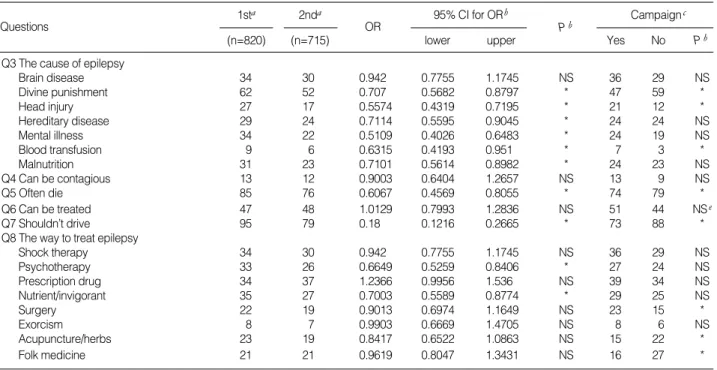
ing of and attitude toward epilepsy, as reflected in surveys conducted in 1995 and 1999, are indicated in Table 5 and 6.
Also the putative effects of the campaign for epilepsy on the changes are shown in the tables.
The false beliefs, considering “divine punishment,” “mental illness,” “malnutrition,” or “blood transfusion” as causes of epilepsy, were significantly reduced (p<0.05). There remained, however, that 52% of respondents still believed that epilepsy is caused by “divine punishment.” Furthermore, all the results were not correlated with the campaign. The number of respon- dents who believed that epileptic persons often died from a seizure attack or that epileptic persons should not drive auto- mobiles was markedly reduced, and these results were well correlated with the campaign (p<0.05). Even though strong emphasis was placed on the facts that “epilepsy can be treat-
Q9 Should be isolated 43 28 0.524 0.4109 0.6682 * 29 31 NS
Q10 Object to association 50 40 0.6304 0.5048 0.7871 * 57 63 NS
Q11 Object to marriage 94 89 0.4952 0.3332 0.7359 * 6 15 *
Q12 Should not have children 46 33 0.5882 0.4628 0.7475 * 29 25 NS
Q13 Should not be employed 52 51 0.9951 0.7942 1.247 NS 48 55 NS
Table 6.The changes in attitudes toward epilepsy or epileptic persons and putative effect of the campaign on the changes
aFigures represent % of positive responses in the first or the second survey, respectively. bStatistical significance in the changes between the first and second surveys. cFigures represent % of positive responses in the groups educated (Yes; n=418) or not (No; n=297). dp value by binary regres- sion logistic test with 95% confidence interval (CI) for odds ratio (OR). * : p<0.05, NS: not significant.
1sta 2nda 95% CI for ORb Campaignc
(n=820) (n=715) lower upper Yes No Pb
Questions OR Pb
Q3 The cause of epilepsy
Brain disease 34 30 0.942 0.7755 1.1745 NS 36 29 NS
Divine punishment 62 52 0.707 0.5682 0.8797 * 47 59 *
Head injury 27 17 0.5574 0.4319 0.7195 * 21 12 *
Hereditary disease 29 24 0.7114 0.5595 0.9045 * 24 24 NS
Mental illness 34 22 0.5109 0.4026 0.6483 * 24 19 NS
Blood transfusion 9 6 0.6315 0.4193 0.951 * 7 3 *
Malnutrition 31 23 0.7101 0.5614 0.8982 * 24 23 NS
Q4 Can be contagious 13 12 0.9003 0.6404 1.2657 NS 13 9 NS
Q5 Often die 85 76 0.6067 0.4569 0.8055 * 74 79 *
Q6 Can be treated 47 48 1.0129 0.7993 1.2836 NS 51 44 NSe
Q7 Shouldn’t drive 95 79 0.18 0.1216 0.2665 * 73 88 *
Q8 The way to treat epilepsy
Shock therapy 34 30 0.942 0.7755 1.1745 NS 36 29 NS
Psychotherapy 33 26 0.6649 0.5259 0.8406 * 27 24 NS
Prescription drug 34 37 1.2366 0.9956 1.536 NS 39 34 NS
Nutrient/invigorant 35 27 0.7003 0.5589 0.8774 * 29 25 NS
Surgery 22 19 0.9013 0.6974 1.1649 NS 23 15 *
Exorcism 8 7 0.9903 0.6669 1.4705 NS 8 6 NS
Acupuncture/herbs 23 19 0.8417 0.6522 1.0863 NS 15 22 *
Folk medicine 21 21 0.9619 0.8047 1.3431 NS 16 27 *
Table 5.The changes in understanding of epilepsy and putative effect of the campaign on the changes
aFigures represent % of positive responses in the first or the second survey, respectively. bStatistical significance in the changes between the first and second surveys. cFigures represent % of positive responses in the groups educated (Yes; n=418) or not (No; n=297). dp value by regression logistic test with 95% confidence interval (CI) for odds ratio (OR). ep=0.0504; * : p<0.05; NS: not significant.
1sta 2nda 95% CI for ORb Campaignc
(n=820) (n=715) lower upper Yes No Pb
Questions OR Pb
ed,” or “epilepsy is not contagious” in the education cam- paigns, no significant interval change was evident in the ratio of respondents who replied that “epilepsy can not be treated”
or “epilepsy may be contagious.” However, even if it was statistically not significant, there was an obvious tendency of reduction in the ratio of respondents who replied that “epilepsy can not be treated” after the campaign (p=0.0504) (Table 5).
As for the way to treat epilepsy, the ratio of respondents who considered psychotherapy, nutrients, or invigorants as the means to treat epilepsy was significantly reduced (p<0.05).
Although no interval change was observed in the trend of answering with surgery, acupuncture or herbs, or folk medicine as the means to treat epilepsy, it was evident that the educa- tion campaign had contributed to an increasing positive atti- tude toward surgery, and a negative attitude toward acupunc- ture, herbs, or folk medicine (Table 5).
It was clear that the interval changes in attitudes toward epilepsy or epileptic persons were quite remarkable; the ratio of respondents who believe that “epileptics should be isolated”
or “epileptics should not have children” and who “object to having their children marry or associate with epileptic per- son” was significantly reduced (p<0.05). However, the posi- tive trend in changing attitudes seemed not to be affected by the education campaigns except for the attitude toward one’s children marrying an epileptic person. The attitude toward the employment of epileptic persons also appeared unchanged (Table 6).
DISCUSSION
Although the distribution of age, gender or level of edu- cation of respondents enrolled in the current study might not be the representative of the entire Korean population, it reflects the current situation of rural areas in Korea in itself.
In addition, the authors intended to obtain the lowest atti- tudes toward epilepsy in Korea and to elucidate the most contributive factors to these attitudes. Therefore, the eccen- tric distribution of the parameters of respondents does not seem to be a major factor of disturbance in interpreting the data from this study.
As in other countries, epilepsy is a well-known disease in rural societies in Korea. Ninety-three percent of respondents replied that they were aware of epilepsy directly or indirectly in this survey from Korea, as compared with 93% in China (2), 95% in the United States (1), and 90% in Finland (5).
The understanding of epilepsy among the Korean respon- dents appeared to be not only based more on the supernatural or superstitious perception but was also less comparable to that of other studies. Surprisingly, the majority of respondents (62%) believed that epilepsy was caused by divine punish- ment. The response was much higher than that in other countries; in a Tanzanian survey (6), 7.3% of respondents mentioned witchcraft as a cause of epilepsy and, in an Arabian
survey (7), 13.8% mentioned evil spirits. Moreover, as a way to treat epilepsy, 21% preferred incantatory folk medicine practiced without a sound theoretical basis in the current study, as compared with 15% in China. Those supernatural or superstitious ideas have not been demonstrated yet in surveys conducted in western countries because the ques- tionnaire used in their surveys was devoid of the particular question. However, considering that the word “epilepsy”
derives from a Greek word meaning “to seize” and it implies
“being seized by demon” (15), those ideas are supposed to be more widespread in the world than expected, even in west- ern countries. The percentages of respondents who believed that “epilepsy is a mental illness” and that “epilepsy is a pri- marily hereditary disease” were 34% and 29% in Korea, as compared with 17% and 17% in China, 16% and 15% in the United Arab Emirates, and 2% and 9% in the United States. In addition to those differences among countries, the great majority of the Korean respondents had a tendency to consider epilepsy as a far more dangerous disease than what it was, e.g., they believed that epileptic persons should not drive automobiles (95%) and that people often die from epilep- tic attacks (85%). Although it is difficult to demonstrate the exact reason the negative understanding of epilepsy prevails more significantly in Korea, the authors believe that it may be attributed to the difference in demographic distribution of the survey population or to the cultural background among countries. In general, it is well known that youth, higher levels of education, and more westernized urban residents are likely to give answers that are more favorable concerning epilepsy (1-3, 10). In contrast to the surveys conducted in other countries, the current study was confined to only one rural area where a traditional Korean value system prevails.
Therefore, the great majority of the residents were less edu- cated, over 50 yr in age and less westernized.
The attitudes toward epilepsy in rural societies in Korea also were far more negative than those in other countries, but were consistent with those in China. The percentage of respon- dents who “objected to association,” and “objected to employ- ment,” were 50, and 52% in this Korean study; 57, and 53%
in China. In contrast, the numbers were 6, and 9% in the United states; 11, and 15% in Italy (8); and 18, and 31% in Taiwan (9). Furthermore, as many as 94% of the respondents in the current study and 87% in China objected to having their sons or daughters marry a person with epilepsy, as com- pared with 72% in Taiwan; and 18% in the United States.
Considering the Korean population shares common value systems such as Confucianism and Buddhism with the Chi- nese rather than western society, it can be suggested that such differences in attitudes between western and Asian countries derive from the different cultural background among the countries. Evidence of the cultural similarity between Kore- ans and the Chinese is that the respondents of both coun- tries commonly chose superstitious folk medicine (21 and 15%, respectively) and acupuncture or herbs (23 and 27%,
respectively) as the way to treat epilepsy.
The false belief about epilepsy, “epilepsy can not be treated,”
was the most contributive factor to the negative attitudes in rural areas in Korea. Because the incantatory or superstitious understanding of epilepsy was a unique feature among Korean respondents, and the attitudes toward epilepsy were far more negative in Korea than in other countries, a strong correla- tion between misunderstanding and negative attitudes was expected. In contrast to the possible assumption, however, the belief that “epilepsy derives from divine punishment” was absolutely associated with the belief that “epilepsy cannot be treated” rather than negative attitudes such as “object to association,” “object to marriage,” “object to employment,”
and so on. Therefore, a hypothesis that superstitious think- ing might not be a cause of the negative attitudes, but be a result of misunderstandings about epilepsy was deduced from these results. This deduction is partially supported by the fact that superstitious thinking is directly associated with the elderly whose experience is derived from a time when medi- cal treatment of epilepsy was seriously lacking.
The positive trend in attitudes toward epilepsy was evi- dent over the past four years in rural areas in Korea. Even though it was not remarkable, such trend was obvious not only in understanding the cause of epilepsy but also in atti- tudes toward epilepsy. Considering that the content of the education campaigns about epilepsy has been confined only to knowledge to improve respondents’ understanding of epilepsy, the positive changes in attitude must be enlight- ened ones. However, it is not sure whether the changes were entirely attributed to the campaigns because the respondents who attended the campaign failed to make a definite differ- ence in their attitude toward epilepsy comparing with the respondents who did not attend. The information campaign in the current study seemed to be effective in ameliorating superstitious thinking about epilepsy, but it proved not useful to attenuate effectively the deep-rooted prejudices against epilepsy or epileptic persons in Korean rural society. There- fore, the effect of several possible contributive factors on the positive trend such as the survey itself that is believed to evoke a fresh interest in epilepsy or epileptic persons, some advance in control of seizures, and/or unintended mass media programs about epilepsy, should not be excluded.
It is important to recognize the fact that the majority of respondents still remain unchanged in their misunderstand- ing of and negative attitudes toward epilepsy regardless of the positive trend; there still remained 89% who would object to having their children marry an epileptic person, and 40%
would not permit their children to associate with epileptic persons. In addition, 33% still believed that epileptic persons should not have children. Though the results from the cur- rent study seem to be at the extreme end of understanding of and attitudes toward epilepsy of the Korean people, it is
clear that such negative attitudes do prevail in Korea. This is supported by the results from a previous survey conducted in a city in Korea (3). Therefore, in order to ameliorate the prejudices against epilepsy and allow epileptic persons to interact with and adapt to their surroundings properly, con- tinuous and repetitive educational efforts and the sympathy of professional and lay societies regarding epilepsy would be needed.
REFERENCES
1. Caveness WF, Gallup GH Jr. A survey of public attitudes toward epilepsy in 1979 with an indication of trends over the past thirty years. Epilepsia 1980; 21: 509-18.
2. Lai CW, Huang X, Lai YHC, Zhang Z, Liu G, Yang MZ. Survey of public awareness, understanding, and attitudes toward epilepsy in Henan province, China. Epilepsia 1990; 31: 182-7.
3. Kim MK, Cho KH, Shin JIS, Kim SJ. A study of public attitude toward epilepsy in Kwang-ju area. J Korean Neurol Assoc 1994;
12: 410-27.
4. Oh SW, Yoo KJ. Sociopsychiatric study on epilepsy. J Korean Neu- ropsychiat Assoc 1971; 10: 1-18.
5. Iivanainen M, Uutela A, Vilkkumaa J. Public awareness and atti- tudes toward epilepsy in Finland. Epilepsia 1980; 21: 413-23.
6. Rwiza HT, Matuja WBP, Kilonzo GP, Haule J, Mbena P, Mwang’
ombola R, Jilek-Aall L. Knowledge, attitudes, and practice toward epilepsy among rural Tanzanian residents. Epilepsia 1993; 34:
1017-23.
7. Bener A, al-Marzooqi FH, Sztriha L. Public awareness and atti- tudes towards epilepsy in the United Arab Emirates. Seizure 1998;
7: 219-22.
8. Canger R, Cornaggia C. Public attitudes toward epilepsy in Italy:
Result of a survey and comparison with U.S.A. and West German data. Epilepsia 1985; 26: 221-6.
9. Chung MY, Chang Y, Lai YHC, Lai CW. Survey of public aware- ness, understanding, and attitudes toward epilepsy in Taiwan. Epilep- sia 1995; 36: 488-93.
10. Jensen R, Dam M. Public attitudes toward epilepsy in Denmark.
Epilepsia 1992; 33: 459-63.
11. Wright GN. Rehabilitation and the problem of epilepsy. In: Wright GN, ed. Epilepsy rehabilitation. Boston: Little Brown, 1975: 1-7.
12. Sands H, Zalkind SS. Effects of an educational campaign to change employer attitudes toward hiring epileptics. Epilepsia (Amst.) 1972;
13: 87-96.
13. National Statistical Office, Republic of Korea. 1995 Population and Housing Census Report. Volume II: Region (15 provinces).
14. Cohn, Wolfe. A Gallup survey - attitudes toward epilepsy. The Gallup Organization, Inc. 1987: 56-63.
15. Engel J Jr. Terminology and classifications, and perspectives. In:
Engel J Jr, ed. Seizures and epilepsy. Philadelphia: F.A. Davis Com- pany, 1989: 3-36.