Volume 32. No. 2, 319 - 330, August 2018
중심단어 : 흡연, 신체활동, 대사증후군Influence of Physical Activity on Metabolic Syndrome according to Smoking Intensity *
Ra, Jin Suk
**․Kim, Hye Sun
**** This study was funded by a National Research Foundation of Korea (NRF) grant funded by the Korean government, Ministry of Science, ICT and Future Planning (grant number 2017R1C1B1003762).
** Associate professor, College of Nursing, Chungnam National University, Daejeon, South Korea
*** Doctoral student, College of Nursing, Chungnam National University, Daejeon, South Korea (교신저자 E-mail: [email protected])
∙Received: 20 March 2018 ∙Revised: 6 August 2018 ∙Accepted: 19 August 2018
∙Address reprint requests to: Kim, Hye Sun
College of Nursing, Chungnam National University, 266 Munhwaro, Jung-gu, Daejeon, 35015, Korea.
Tel: 82-42-538-8333 Fax: 82-42-580-8309 E-mail: [email protected]
I. Introduction
Metabolic syndrome (MetS) is a clustering of elevated glucose and blood pressure, abdominal obesity, increased levels of triglyceride (TG), and reduced high-density lipoprotein (HDL) (Reaven, 1988). As a global health problem, the National Health and Nutrition Examination Survey showed that 34.7% American adults aged over 20 years had MetS in 2011-2012 (Aguilar, Bhuket, Torres, Liu, & Wong, 2015).
Among Korean adults aged over 30 years, 32.1% also had MetS in 2014 (Korean Society of Lipidology and Atherosclerosis, 2015).
Although the current prevalence of MetS among Koreans is lower than that in the western countries, it is expected to rise with the increasing number of older individuals and the adoption of a westernized lifestyle (Park, Choi,
& Lee, 2013). MetS is considered a major risk factor for cerebral-cardiovascular disease, type 2 diabetes mellitus (T2DM), and mortality from complications due to MetS (Ford, 2005; Ra &
Kim, 2015). Thus, interventions should be applied for high-risk MetS population to decrease its development and associated complications.
The development of MetS is associated with an unhealthy lifestyle, such as smoking, excessive alcohol consumption, insufficient physical activity, and high fat and high-calorie diets (Grundy et al., 2005). In particular, increased obesity prevalence among people has been associated with insufficient physical activity, which in turn has resulted in an increased prevalence of MetS (Kim et al., 2014; Lee, 2014). In the same vein, physical activity is effective for weight loss, reduced visceral adiposity and
insulin resistance, and decreased severity of components of MetS (e. g., hypertension, reduced HDL) (Chu & Moy, 2014; Grundy et al., 2005;
Ha, Ha, & So, 2012). According to Chu and Moy (2014), physical activity also lowers the risk of MetS by up to 1.85 times. Thus, increased physical activity is emphasized to decrease the development of this syndrome (Guinhouya, Samouda, Zitouni, Vilhelm, &
Hubert, 2011).
Meanwhile, smoking increases dyslipidemia, and insulin resistance has been associated with the development of MetS and its associated complications (U.S. Department of Health and Human Services, 2014). In particular, an increase in smoking intensity has been associated with an increased risk of MetS (Sun, Liu, & Ning, 2012). According to a meta-analysis, heavy smokers are at a 1.42 times higher risk of MetS compared to non-smokers (Sun, Liu, & Ning, 2012). Thus, smokers need more intensive interventions, such as vigorous physical activity, to lower the risk of MetS. However, studies examining the effects of physical activity on the prevention of this syndrome among smokers are limited. Thus, the effects of physical activity on MetS among smokers need to be investigated.
Moreover, this should be studied in terms of smoking intensity. Thus, this study aimed to determine effective physical activity levels for the prevention of MetS, by taking into account the smoking intensity of smoking men, who comprise the majority of the smoking population in Korea, by performing a secondary data analysis.
Ⅱ. Methods
1. Study design and participants
Our study used a cross-sectional design for the secondary analysis of the 2010-2015 Korean National Health and Nutrition Examination Survey (KNHANES). The KNHANES is a nationwide survey that evaluates the health and nutritional status of the Korean population.
In all, 48,482 people selected by stratified sampling method participated in this survey. In our study, the sample for the data analysis was selected according to the following inclusion criteria for the 48,482 participants: (1) smoking men over 19 years of age (2) men without physical or mental health problems diagnosed by a medical specialist, which could affect their physical activity. and (3) those who completed the questionnaire that assessed their health and nutritional status in terms of smoking intensity, physical activity, and the biological and social factors associated development of MetS, as well as underwent a physical examination for the evaluation of the components of MetS.
To verify the statistical power of our sample, a minimum of 150 participants were required to achieve an odds ratio of 1.81 (Lallukka, Rahkonen, Lahelma, & Lahti, 2015). This calculation was based on the sample size from a previous study, an α of .05, and a logistic regression power of .80 (G*Power, version 3.1) (Faul, Erdfelder, Buchner, & Lang, 2009). Our study included data from 3,027 men for the statistical analysis.
2. Ethical consideration
As this study involved a secondary data analysis, it was exempt from approval by the Institutional Review Board of the research institute at which the study was conducted (IRB No. 2-1046881-A-N-01-201701-HR-001-09).
3. Measures
1) MetS
MetS was defined based on the criteria for the clinical diagnosis of MetS developed by the American Heart Association and the National Heart, Lung, and Blood Institute (Aguilar, Bhuket, Torres, Liu, & Wong, 2015). For waist circumference, the criteria developed by the Korean Society for the Study of Obesity were used (Kim et al., 2014).
Individuals with three or more of the following five symptoms were diagnosed with the development of MetS: (i) waist circumference
≥ 90 cm in men; (ii) blood pressure ≥ 130/85 mmHg or taking medication for hypertension;
(iii) HDL cholesterol level < 40 mg/dl in men or being on medication for reduced HDL; (iv) triglyceride level ≥ 150 mg/dl or taking medication for increased triglycerides; and (v) fasting glucose level ≥ 100 mg/dl or taking medication for hyperglycemia.
2) Smoking intensity
Smoking intensity was assessed by the average number of cigarettes smoked per day.
According to the criteria proposed by Wakabayashi (2014), smoking less than 20 cigarettes a day was classified as light smoking, and smoking more than 21 was classified as heavy smoking.
3) Physical activity
Physical activity was assessed by the Metabolic Equivalent Task (MET)-minutes of International Physical Activity Questionnaire (IPAQ Research Committee, 2005). Physical activity, including the activities during work and at leisure, was calculated as the sum of walking, moderate, and vigorous MET-minutes in a week. The formula for calculating walking,
moderate, and vigorous MET-minutes is described below.
- Walking MET-minutes in a week = 3.3 × minutes walked per walking day × walking days in a week
- Moderate MET-minutes in a week = 4.0 × moderate-intensity activity minutes per moderate-intensity day × moderate-intensity days in a week
- Vigorous MET-minutes in a week = 8.0 × vigorous-intensity activity minutes per vigorous-intensity day × vigorous-intensity days in a week
The level of physical activity was classified as vigorous, moderate, and light. More than 3,000 MET-min in a week was classified as vigorous physical activity; more than 600 MET -min and less than 3,000 MET-min in a week was classified as moderate physical activity;
less than 600 MET-min in a week was classified as light physical activity.
4) Covariates
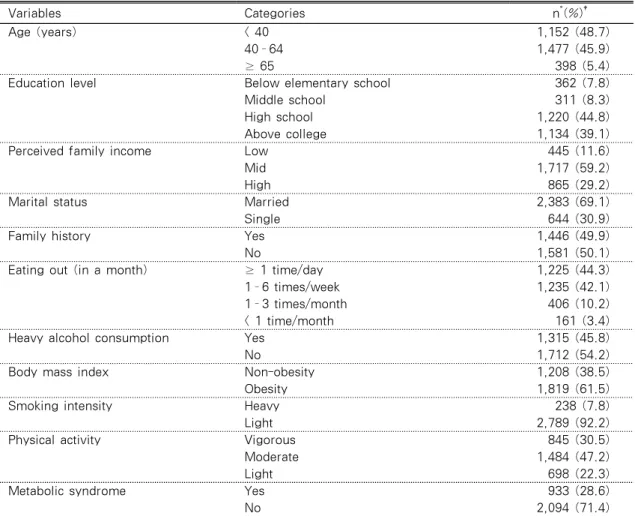
The variables associated with the development of MetS were assessed to adjust for the covariates, which included the following: (i) biological factors (age; obesity; family history of hypertension, dyslipidemia, T2DM, or cerebral -cardiovascular disease in immediate family members such as parents and siblings), (ii) social factors (educational level, marital status, and perceived family income), and (iii) individual health-related behavioral factors including heavy alcohol consumption (more than seven glasses of alcohol per day for more than one day in a week regardless of the type of alcohol) and eating out. Each of the covariates and their categories are shown in Table 1.
Table 1. Characteristics of Samples regarding Metabolic Syndrome, Smoking Intensity, Physical Activity, and Covariates related to the Development of Metabolic Syndrome in
Participants (N=3,027)
Variables Categories n*(%)†
Age (years) < 40 1,152 (48.7)
40–64 1,477 (45.9)
≥ 65 398 (5.4)
Education level Below elementary school 362 (7.8)
Middle school 311 (8.3)
High school 1,220 (44.8)
Above college 1,134 (39.1)
Perceived family income Low 445 (11.6)
Mid 1,717 (59.2)
High 865 (29.2)
Marital status Married 2,383 (69.1)
Single 644 (30.9)
Family history Yes 1,446 (49.9)
No 1,581 (50.1)
Eating out (in a month) ≥ 1 time/day 1,225 (44.3)
1–6 times/week 1,235 (42.1)
1–3 times/month 406 (10.2)
< 1 time/month 161 (3.4)
Heavy alcohol consumption Yes 1,315 (45.8)
No 1,712 (54.2)
Body mass index Non-obesity 1,208 (38.5)
Obesity 1,819 (61.5)
Smoking intensity Heavy 238 (7.8)
Light 2,789 (92.2)
Physical activity Vigorous 845 (30.5)
Moderate 1,484 (47.2)
Light 698 (22.3)
Metabolic syndrome Yes 933 (28.6)
No 2,094 (71.4)
*Underweighted, †Weighted.
4. Statistical analysis
Analyses were performed using SPSS version 22.0 for Windows (IBM, Armonk, NY, USA).
Since the KNHANES uses stratified, clustered, and systematic sampling methods, sampling weight with complex samples procedures were needed to adjust for the unequal probabilities of the selection of their estimates and to decrease the bias associated with no-response and non-coverage of the population. The characteristics of the participants including smoking intensity,
physical activity, MetS, and covariates were analyzed by descriptive statistics such as frequencies and percentages. Chi-square test was performed to identify the differences in the prevalence of MetS by smoking intensity and physical activity. To confirm significant covariates on the development of MetS, a Chi-square test was also performed. Significant covariates were analyzed by logistic regression analysis to adjust for the confounding effects of covariates.
Logistic regression analysis was performed on weighted data using a complex sample
procedure to identify the influence of physical activity on the development of MetS by adjusting for covariates, such as age, education level, marital status, heavy alcohol consumption, family history of metabolic syndrome, body mass index, according to the smoking intensity.
P values less than 0.05 were regarded as statistically significant.
Ⅲ. Results
1. Characteristics of the participants with respect to MetS, smoking intensity, physical activity, and covariates related to the development of MetS
We put weight on the percentage of variables, but the prevalence of variables followed the guideline for statistical analysis of the KNHANES. Table 1 presents the prevalence of MetS, smoking intensity, physical activity, and covariates including biological, social, and health-related behavioral factors related to the development of MetS. Among the samples, 28.6% of men had MetS. Most of smoking men were light smokers (92.2%). Men with vigorous (30.5%) or moderate (47.2%) physical activity level constituted 77.7% of the samples.
2. Differences in the prevalence of MetS by smoking intensity and physical activity level
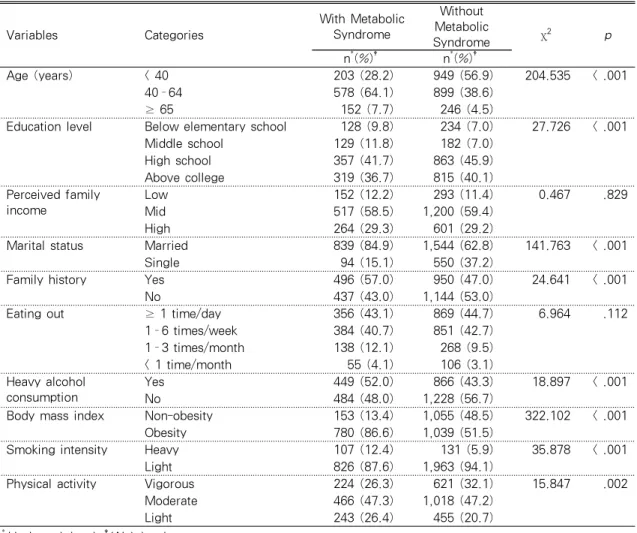
Table 2 presents the differences in the prevalence of MetS by smoking intensity and physical activity level. Among participants with MetS, heavy smoking was more prominent than it was in participants without MetS (χ2= 35.878, p<.001). Furthermore, vigorous physical activity was more prominent in participants
without MetS than those with MetS (χ2= 15.847, p=.002).
3. Effects of smoking intensity and physical activity on the development of MetS
Compared to participants in the light smoking group, those in the heavy smoking group were more likely to develop MetS (Adjusted odds ratio [AOR]: 1.481, 95% Confidence interval [CI]: 1.061-2.066, p=.021, Table 3). Compared to light physical activity, vigorous physical activity was significantly associated with a decreased likelihood of the development of MetS (AOR: 0.644, 95% CI: 0.491-0.843, p=.001, Table 3).
4. Effects of physical activity on the development of MetS according to smoking intensity
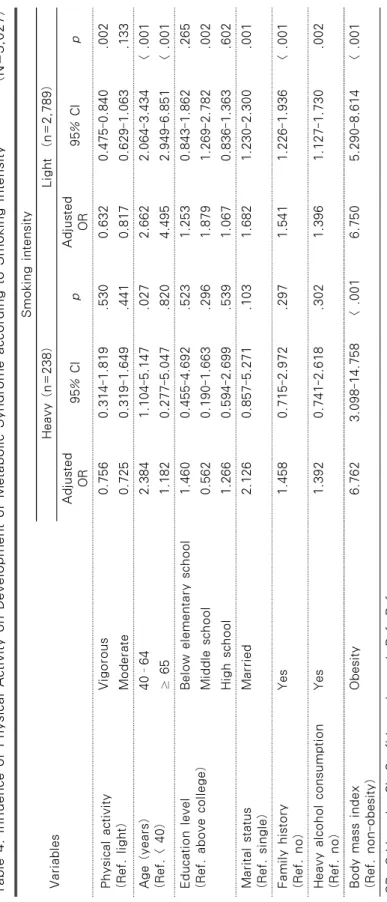
Light smokers who engaged in vigorous physical activity were less likely to develop MetS compared to light smokers who engaged in light physical activity (AOR: 0.632, 95% CI:
0.475-0.840, p=.002). Meanwhile, for heavy smokers, physical activity regardless of the intensity level did not have an effect on the development of MetS (Table 4).
Ⅳ. Discussion
This study adds to our understanding of the effect of physical activity levels on the prevention of MetS with respect to the smoking intensity of Korean smoking men over 19 years of age.
According to our results, heavy smoking resulted in an increased risk of MetS than did light smoking. According to Lee et al. (2016),
Table 2. Difference of Prevalence of Metabolic Syndrome by Smoking Intensity and Physical Activity Level (N=3,027)
Variables Categories
With Metabolic Syndrome
Without Metabolic
Syndrome χ
2 p
n*(%)† n*(%)†
Age (years) < 40 203 (28.2) 949 (56.9) 204.535 < .001
40–64 578 (64.1) 899 (38.6)
≥ 65 152 (7.7) 246 (4.5)
Education level Below elementary school 128 (9.8) 234 (7.0) 27.726 < .001
Middle school 129 (11.8) 182 (7.0)
High school 357 (41.7) 863 (45.9)
Above college 319 (36.7) 815 (40.1)
Perceived family income
Low 152 (12.2) 293 (11.4) 0.467 .829
Mid 517 (58.5) 1,200 (59.4)
High 264 (29.3) 601 (29.2)
Marital status Married 839 (84.9) 1,544 (62.8) 141.763 < .001
Single 94 (15.1) 550 (37.2)
Family history Yes 496 (57.0) 950 (47.0) 24.641 < .001
No 437 (43.0) 1,144 (53.0)
Eating out ≥ 1 time/day 356 (43.1) 869 (44.7) 6.964 .112
1–6 times/week 384 (40.7) 851 (42.7)
1–3 times/month 138 (12.1) 268 (9.5)
< 1 time/month 55 (4.1) 106 (3.1)
Heavy alcohol consumption
Yes 449 (52.0) 866 (43.3) 18.897 < .001
No 484 (48.0) 1,228 (56.7)
Body mass index Non-obesity 153 (13.4) 1,055 (48.5) 322.102 < .001
Obesity 780 (86.6) 1,039 (51.5)
Smoking intensity Heavy 107 (12.4) 131 (5.9) 35.878 < .001
Light 826 (87.6) 1,963 (94.1)
Physical activity Vigorous 224 (26.3) 621 (32.1) 15.847 .002
Moderate 466 (47.3) 1,018 (47.2)
Light 243 (26.4) 455 (20.7)
*Underweighted, †Weighted.
Table 3. Influence of Smoking Intensity and Physical Activity on Development Metabolic Syndrome (N=3,027)
Variables Categories Adjusted OR 95% CI p
Smoking intensity (Ref. light) Heavy 1.481 1.061-2.066 .021
Physical activity (Ref. light) Vigorous 0.644 0.491-0.843 .001
Moderate 0.808 0.633-1.033 .089
Age (years) (Ref. < 40) 40–64 2.618 2.058-3.331 < .001
≥ 65 4.150 2.755-6.252 < .001
Education level (Ref. above college) Below elementary school 1.276 0.878-1.855 .200
Middle school 1.626 1.121-2.359 .010
High school 1.090 0.862-1.377 .472
Marital status (Ref. single) Married 1.731 1.275-2.352 < .001
Family history (Ref. no) Yes 1.518 1.217-1.894 < .001
Heavy alcohol consumption (Ref. no) Yes 1.383 1.133-1.690 .001
Body mass index (Ref. non-obesity) Obesity 6.738 5.333-8.514 < .001 OR: Odds ratio, CI: Confidence interval, Ref: Reference
Table 4. Influence of Physical Activity on Development of Metabolic Syndrome according to Smoking Intensity(N=3,027) Variables
Smoking intensity Heavy (n=238)Light (n=2,789) Adjusted OR95% CIpAdjusted OR95% CIp Physical activity (Ref. light)
Vigorous0.7560.314-1.819.5300.6320.475-0.840.002 Moderate0.7250.319-1.649.4410.8170.629-1.063.133 Age (years) (Ref. < 40)40–642.3841.104-5.147.0272.6622.064-3.434< .001 ≥ 651.1820.277-5.047.8204.4952.949-6.851< .001 Education level (Ref. above college)Below elementary school1.4600.455-4.692.5231.2530.843-1.862.265 Middle school0.5620.190-1.663.2961.8791.269-2.782.002 High school1.2660.594-2.699.5391.0670.836-1.363.602 Marital status (Ref. single)Married2.1260.857-5.271.1031.6821.230-2.300.001 Family history (Ref. no) Yes1.4580.715-2.972.2971.5411.226-1.936< .001 Heavy alcohol consumption (Ref. no)Yes1.3920.741-2.618.3021.3961.127-1.730.002 Body mass index (Ref. non-obesity)Obesity6.7623.098-14.758< .0016.7505.290-8.614< .001 OR: Odds ratio, CI: Confidence interval, Ref: Reference
current smoking Korean men are at 4.38 times increased risk of MetS than are non-smokers.
Furthermore, an increase in smoking intensity increases the risk of MetS (Slagter et al., 2013). In the same vein, Sun, Liu, and Ning (2012) reported that heavy smokers were at 1.42 times increased risk of MetS than were light smokers. Slagter et al. (2013) proposed that smoking leads to altered lipid and glucose metabolism due to stimulation of the sympathetic nerve activity and increased insulin resistance with elevated cortisol concentration. In addition, smoking leads to the accumulation of visceral adiposity with sex steroid hormones such as estrogen and androgens. Finally, as endothelial dysfunction and prothrombotic effects are related to pro-inflammatory cytokine, the risk of thrombosis is increased (U.S. Department of Health and Human Services, 2014). Thus, smoking cessation and decreasing smoking intensity would be necessary for preventing MetS.
Meanwhile, our study showed that physical activity had protective effects on the development of MetS. In a previous study, physical activity was also considered a health promotion behavior to prevent MetS and its associated complications (Kim, 2008). It contributes to increased adiponectin that inhibits the cohesion of platelet. This response from the adiponectin leads to decreased inflammatory response, TG level, and insulin resistance (Kato et al., 2006;
Yamauchi et al., 2002). Furthermore, increased physical activity level has more protective effects on the development of MetS (Swain &
Franklin, 2006; Xiao et al., 2016). In particular, vigorous physical activity is more effective for reducing the risk of MetS than is light physical activity (Hidalgo-Santamaria et al., 2017).
Thus, vigorous physical activity is recommended
to prevent the development and complications of MetS (Swain & Franklin, 2006; Xiao et al., 2016).
However, our study showed that for heavy smokers, physical activity did not have a protective effect on the development of MetS.
However, among light smokers, those who indulged in vigorous physical activities were less likely to develop MetS. In a study by Huang et al. (2015), physical activity had no significant protective effects for smokers on the development of MetS. Similarly, Lallukka et al.
(2015) reported that physical activity had an insufficient effect to compensate for the negative effects of heavy smoking. Physical activity had limited beneficial effects for decreasing risk of MetS only in individuals without major cardiovascular risk factors (Lee, Sesso, Oguma, & Paffenbarger Jr, 2004). Among individuals who are overweight, a high-risk group for MetS, vigorous physical activity also had protective effects on the development of MetS than did moderate physical activity (Zhu, St-Onge, Heshka, & Heymsfield, 2004). Moreover, among individuals with light alcohol consumption, vigorous physical activity decreased the risk of MetS, while it did not for individuals with heavy alcohol consumption (Kim, Kim, Choi, Won, & Kim, 2014). Further, Kim et al. (2014) proposed that physical activity might not compensate for the high-risk factors for the development of MetS. Thus, the preventive effect of physical activity might be significant for people with low-risk factors for MetS.
Moreover, for heavy smokers, physical activity did not reduce the risk of MetS. Thus, lowering smoking intensity and smoking cessation are more required to prevent the development of MetS than promoting physical activity among heavy smokers.
Ⅴ. Conclusion
In conclusion, only vigorous physical activity had protective effects for the development of MetS among low-intensity smokers. For high -intensity smokers, lowering smoking intensity and smoking cessation are also required to prevent the development of MetS. Thus, physical activity would be a secondary and limited intervention to prevent the development of MetS among smokers. For smokers, smoking cessation program should primarily be provided.
However, this study has some limitations.
First, this study was a cross-sectional study, and therefore, inferring the causality between physical activity and the development of MetS is limited. Thus, a longitudinal cohort study should be conducted to confirm the causality between the variables. Second, our study was conducted only on smoking men. Further studies are needed to examine the risk of MetS in other high-risk groups, such as post -menopause women.
References
Aguilar, M., Bhuket, T., Torres, S., Liu, B., &
Wong, R. J. (2015). Prevalence of the metabolic syndrome in the United States, 2003~2012. The Journal of the American Medical Associaion, 313(19), 1973-1974.
http://dx.doi.org/10.1001/jama.2015.4260 Chu, A. H., & Moy, F. M. (2014). Association
between physical activity and metabolic syndrome among Malay adults in a developing country, Malaysia. Journal of Science and Medicine in Sport, 17(2), 195-200. http://dx.doi.org/10.1016/j.jsams.
2013.04.003
Faul, F., Erdfelder, E., Buchner, A., & Lang,
A. G. (2009). Statistical power analyses using G* Power 3.1: Tests for correlation and regression analyses. Behavior Research Methods, 41(4), 1149-1160. http://dx.doi.org/
10.3758/BRM.41.4.1149
Ford, E. S. (2005). Risks for all-cause mortality, cardiovascular disease, and diabetes associated with the metabolic syndrome a summary of the evidence. Diabetes Care, 28(7), 1769-1778. http://dx.doi.org/10.2337/
diacare.28.7.1769
Grundy, S. M., Cleeman, J. I., Daniels, S. R., Donato, K. A., Eckel, R. H., Franklin, B.
A., ... & Spertus, J. A. (2005). Diagnosis and management of the metabolic syndrome.
Circulation, 112(17), 2735-2752. http://dx.doi.org/
10.1161/CIRCULATIONAHA.105.169404 Guinhouya, B. C., Samouda, H., Zitouni, D.,
Vilhelm, C., & Hubert, H. (2011). Evidence of the influence of physical activity on the metabolic syndrome and/or on insulin resistance in pediatric populations: a systematic review. Pediatric Obesity, 6(5-6), 361-388. http://dx.doi.org/10.3109/
17477166.2011.605896
Ha, C. H., Ha, S., & So, W. Y. (2012). Effects of a 12 week combined exercise training program on the body composition, physical fitness levels, and metabolic syndrome profiles of obese women. Journal of Korean Public Health Nursing, 26, 417-427.
http://dx.doi.org/10.5932/JKPHN.2012.26.
3.417
Hidalgo-Santamaria, M., Fernandez-Montero, A., Martinez-Gonzalez, M. A., Moreno-Galarraga, L., Sanchez-Villegas, A., Barrio-Lopez, M.
T., & Bes-Rastrollo, M. (2017). Exercise intensity and incidence of metabolic syndrome:
the SUN Project. American Journal of Preventive Medicine, 52(4), e95-e101.
http://dx.doi.org/10.1016/j.amepre.2016.11 .021
Huang, J. H., Li, R. H., Huang, S. L., Sia, H.
K., Chen, Y. L., & Tang, F. C. (2015).
Lifestyle factors and metabolic syndrome among workers: the role of interactions between smoking and alcohol to nutrition and exercise. International Journal of Environmental Research and Public Health, 12, 15967-15978. http://dx.doi.org/10.3390/
ijerph121215035
IPAQ Research Committee. (2005, November).
Guidelines for the data processing and analysis of the International Physical Activity Questionnaire. Retrieved May 23, 2016, from https://sites.google.com/site/
theipaq/scoring-protocol
Kato, H., Kashiwagi, H., Shiraga, M., Tadokoro, S., Kamae, T., Ujiie, H., ... & Maeda, N.
(2006). Adiponectin acts as an endogenous antithrombotic factor. Arteriosclerosis, Thrombosis, and Vascular Biology, 26(1), 224-230. http://dx.doi.org/10.1161/01.ATV.
0000194076.84568.81
Kim, B. S., Kim, M. J., Choi, H. R., Won, C.
W., & Kim, S. Y. (2014). Relationship between physical activity level, amount of alcohol consumption and metabolic syndrome in Korean male drinkers. The Korean Journal of Sports Medicine, 32(2), 97-104. http://dx.doi.org/10.5763/kjsm.2014.
32.2.97
Kim, M. K., Lee, W. Y., Kang, J. H., Kang, J.
H., Kim, B. T., Kim, S. M., ... & Lee, K.
Y. (2014). 2014 clinical practice guidelines for overweight and obesity in Korea.
Endocrinology and Metabolism, 29(4), 405-409. http://dx.doi.org/10.3803/EnM.
2014.29.4.405
Kim, Y. H. (2008). Effect of the physical
activity promotion program on physical function and quality of life in elderly.
Journal of Korean Biological Nursing Science, 10(1), 11-18. Retrieved October 3, 2015, from http://www.koreascience.or.kr/
article/ArticleFullRecord.jsp?cn=GCJOBO_2 008_v10n1_11
Korean Society of Lipidology and Atherosclerosis.
(2015). Dyslipidemia fact sheet in korea 2015 [Fact sheet]. Retrieved August 23, 2015, from http://www.lipid.or.kr/file/Dysli pidemia%20fact%20sheet_kor_Final.pdf Lallukka, T., Rahkonen, O., Lahelma, E., &
Lahti, J. (2015). Joint associations of smoking and physical activity with disability retirement: a register-linked cohort study.
British Medical Journal Open, 5, e006988.
http://dx.doi.org/10.1136/bmjopen-2014-00 6988
Lee, H. (2014). The effects of lifestyle factors on metabolic syndrome among adolescents.
Journal of Korean Public Health Nursing, 28, 270-284. http://dx.doi.org/10.5932/
JKPHN.2014.28.2.270
Lee, I. M., Sesso, H. D., Oguma, Y., &
Paffenbarger Jr, R. S. (2004). The “weekend warrior” and risk of mortality. American Journal of Epidemiology, 160(7), 636-641.
http://dx.doi.org/10.1093/aje/kwh274 Lee, J. A., Cha, Y. H., Kim, S. H., Pa가, H. S.
(2016). Impact of combined lifestyle factors on metabolic syndrome in Korean men.
Journal of Public Health, 39, 82-89.
http://dx.doi.org/10.1093/pubmed/fdv208 Park, E., Choi, S. J., & Lee, H. Y. (2013). The
prevalence of metabolic syndrome and related risk factor based on the KNHANES V 2010. Journal of Agricultural Medicine and Community Health, 38(1), 1-13.
http://dx.doi.org/10.5393/JAMCH.2013.38.
1.001
Ra, J. S., & Kim, H. S. (2015). Combined influence of obesity and metabolic syndrome on ischemic heart disease in Korean middle aged and older adults. Journal of Korean Public Health Nursing, 29, 540-550.
http://dx.doi.org/10.5932/JKPHN.2015.29.
3.540
Reaven, G. M. (1988). Role of insulin resistance in human disease. Diabetes, 37(12), 1595 –1607. http://dx.doi.org/10.2337/diab.37.
12.1595
Slagter, S. N., van Vliet-Ostaptchouk, J. V., Vonk, J. M., Boezen, H. M., Dullaart, R.
P., Kobold, A. C. M., ... & Wolffenbuttel, B.
H. (2013). Associations between smoking, components of metabolic syndrome and lipoprotein particle size. BMC Medicine, 11(1), 195. http://dx.doi.org/10.1186/1741 -7015-11-195
Sun, K., Liu, J., & Ning, G. (2012). Active smoking and risk of metabolic syndrome: a meta-analysis of prospective studies. PLoS One, 7(10), e47791. http://dx.doi.org/10.
1371/journal.pone.0047791
Swain, D. P., & Franklin, B. A. (2006).
Comparison of cardioprotective benefits of vigorous versus moderate intensity aerobic exercise. The American journal of Cardiology, 97(1), 141-147. http://dx.doi.org/10.1016/
j.amjcard.2005.07.130
U.S. Department of Health and Human Services.
(2014, January). The health consequences of smoking-50 years of progress: a report of
the Surgeon General. Atlanta, GA: US Department of Health and Human Services, Centers for Disease Control and Prevention, National Center for Chronic Disease Prevention and Health Promotion, Office on Smoking and Health. Retrieved August 23, 2015, from https://www.surgeongeneral.
gov/library/reports/50-years-of-progress/full -report.pdf
Wakabayashi, I. (2014). Relationship between smoking and metabolic syndrome in men with diabetes mellitus. Metabolic Syndrome
& Related Disorders, 12(1), 70-78.
http://dx.doi.org/10.1089/met.2013.0110 Xiao, J., Shen, C., Chu, M. J., Gao, Y. X., Xu,
G. F., Huang, J. P., ... & Cai, H. (2016).
Physical activity and sedentary behavior associated with components of metabolic syndrome among people in rural china. PloS One, 11(1), e0147062. http://dx.doi.org/10.
1371/journal.pone.0147062
Yamauchi, T., Kamon, J., Minokoshi, Y. A., Ito, Y., Waki, H., Uchida, S., ... & Eto, K (2002). Adiponectin stimulates glucose utilization and fatty-acid oxidation by activating AMP-activated protein kinase.
Nature Medicine, 8(11), 1288-1295.
http://dx.doi.org/10.1038/nm788
Zhu, S., St-Onge, M. P., Heshka, S., &
Heymsfield, S. B. (2004). Lifestyle behaviors associated with lower risk of having the metabolic syndrome. Metabolism, 53(11), 1503-1511. http://dx.doi.org/10.1016/j.metabol.
2004.04.017
ABSTRACT
Influence of Physical Activity on Metabolic Syndrome according to Smoking Intensity
*Ra, Jin Suk (Associate Professor, College of Nursing, Chungnam National University, Daejeon, South Korea) Kim, Hye Sun (Doctoral Student, College of Nursing, Chungnam National University, Daejeon, South Korea)
Purpose: This study was conducted to determine if physical activity levels relieve the risk of development of metabolic syndrome (Mets) according to smoking intensity among smoking men. Methods: Secondary data from the 2010-2015 Korea National Health and Nutrition Examination Survey were used for this cross sectional study. A total of 3,027 men over the age of 19 were included for data analysis. Complex samples logistic regression was used to analyze the combined effects of smoking and physical activity on Mets. Smoking intensity was categorized as light (≤ 20 cigarettes/day) or heavy (> 20 cigarettes/day), while physical activity was categorized as light (< 600 metabolic equivalent [MET]-min/week), moderate (600-3,000 MET-min/week), and vigorous (≥ 3,000 MET-min/week). Results:
Mets was less prevalent among light smokers with vigorous physical activity (Adjusted Odds Ratio [AOR]: 0.632, 95% Confidence Interval [CI]: 0.475-0.840) compared to those with light physical activity. Among heavy smokers, physical activity level was not significantly associated with Mets. Conclusion: Only vigorous physical activity exerted protective effects against development of Mets among low intensity smokers. For high intensity smokers, lowering smoking intensity and smoking cessation are also necessary to prevent development of Mets.
Key words : Smoking, Physical activity, Metabolic syndrome X