RESEARCH ARTICLE
Received: February 10, 2020, Revised: February 27, 2020, Accepted: March 3, 2020 eISSN 2233-7679
†Correspondence to: Sun-Jung Shin, https://orcid.org/0000-0003-0229-9635
Department of Dental Hygiene, College of Dentistry, Gangneung-Wonju National University, 7 Jukheon-gil, Gangneung 25457, Korea Tel: +82-33-640-2469, Fax: +82-33-642-6410, E-mail: [email protected]
Copyright © The Korean Society of Dental Hygiene Science.
Status and Opinions of Public Health Centers and
Industrial Dental Offices on the Oral Health Promotion of Korean Adult Workers
Sue-Hyang Lee
1, Soo-Myoung Bae
1,2, Bo-Mi Shin
1,2, and Sun-Jung Shin
1,2,†1
Department of Dental Hygiene, College of Dentistry, Gangneung-Wonju National University, Gangneung 25457,
2
Research Institute of Oral Science, Gangneung-Wonju National University, Gangneung 25457, Korea
Background: This study investigated the status of oral health promotion activities for adult workers in public health centers and
industrial dental offices and provided basic data for the model development of oral health promotion program for adult workers in Korea.
Methods: A questionnaire was developed separately according to the person who in charge of the oral health promotion activities
in public health centers nationwide and dental hygienists working in 20 industrial dental offices. This survey was conducted through postal survey and consisted of 29 items and 35 items respectively, including 19 common items for general information, oral health promotion program status and opinion. Statistical analysis was performed using the IBM SPSS ver. 23.0.
Results: We analyzed the data of 147 public health centers (57.9%) and 9 industrial dental offices (45.0%). A workforce with a lack
of practice was the biggest barrier to oral health promotion activities for adult workers. However, both groups showed high intention for the practice of adult worker’s oral health promotion activities. Also, they showed willingness to work together in an organic partnership to perform their roles (94.4% and 77.8%, respectively). Regarding the scope of cooperation in the implementation of the industrial oral health promotion activity linked to the public health center, dental hygienists of industrial dental offices responded that they could coordinate necessary matters and schedule management.
Conclusion: The development of an oral health promotion program aided by the relationship between public health centers and
industrial dental offices is essential for the oral health promotion of adult workers. The possibility of cooperation between the abovementioned centers was confirmed through this study. In a long-term perspective, it would be necessary to identify a method to institutionalize industrial dental hygienists for the provision of continuous oral health care in workplaces.
Key Words: Adult, Dental hygienists, Oral health, Workplace
Introduction
Korean adults aged between 19 and 65 years constitute 66.7% of the total Korean population
1)and are mostly employed
2). Workers play an essential role in various aspects of society; however, they often lack the time and finances to fully care for their health
3). In 2017, the Korea Outpatient Clinical Disease Ranking Survey showed that the number of patients with gingivitis and periodontal disease surpassed 15 million, making these diseases the
second most prevalent diseases in Korea
4). Periodontal diseases are the main cause of adult tooth loss
5). Such losses can in turn lead to economic losses, which may exacerbate oral health problems in old age and personal economic burdens
6).
Public health centers in Korea were established in 1945
to contribute to the overall improvement of national
health. An oral health program was first developed in
1980s and oral health programs spanning every develop-
mental stage have been implemented to further prevent
Table 1. General Status of Public Health Centers
Section Variable Content Value
Total number of facilities investigated
147 (100.0)
Personnel information
License Dental
hygienist
132 (91.0)
Nurse 5 (3.5) Dentist 1 (0.7) Other 7 (4.8) Number of dental
hygienists in charge of oral health program in each public health center
2.5±1.5
Program target
Oral health program by developmental stage and condition (in 2016)
aInfant/child 27.3 Teenager 23.7
Adult 9.9
Elderly 23.6
Pregnant women
6.1
Disabled person
8.5
Other 1.1
Values are presented as n (%) or mean±standard deviation or percentage only.
Frequency analysis excluding non-responses for each question.
a
Results of responses as of 2016. Note that the data for oral health programs conducted in public health centers were averaged according to developmental stage so that the sum would be 100.
oral diseases and promote oral health in the 2000s
7). Typical oral health programs for adults include a continuing dental care program for specific groups such as smokers and pregnant women, or workplace dental hygiene programs. In 2013, the government began implementing integrated health promotion programs by converting individual state-run programs into health promotion programs
8). In particular, unlike children or the elderly, adults are perceived as being able to manage their own health, which means they tend to be given a lower priority in public health initiatives. Therefore, their access to particular services such as oral health services is limited
9). Industrial oral health was developed as a part of industrial health in the 1990s for improving and maintaining the oral health of those engaged in the industry. However, it has tended to focus on specific oral examinations since the need for occupational dentistry services was identified
10). In addition, the oral health examination rate is less than half of the general health examination rate
11). Because oral diseases do not directly threaten workers’ lives, these individuals often avoid early treatment even when aware of the disease
12,13).
Currently, there is a global trend toward balancing the role of public and private health care
14). Many developed countries are constantly seeking to improve the workers’
oral health by considering industrial health services when establishing general health policies. For instance, in the UK and US, since the early 20th century, it has become common for business sites to have dental clinics for improving workers’ oral health
2). Therefore, this study investigated the status of oral health promotion activities in public health centers and industrial dental offices by surveying the opinions of people in charge of oral health promotion activities to provide basic data for the further development of oral health promotion models for Korean adult workers.
Materials and Methods
This study was conducted as part of the master’s thesis of Lee
15).
1. Data collection
To investigate the status of oral health promotion activities at public health centers and industrial dental offices and survey the opinions of individuals in charge of oral health promotion therein, we contacted the oral health managers of 254 public health centers and dental hygienists at 20 industrial dental offices (excluding those in universities and correctional facilities).
We investigated the facilities’ general characteristics
and the details of their oral health promotion programs
using the items adapted and supplemented from the study
by Park et al.
16). The opinion survey was developed by
referring to the opinions of persons in charge of oral health
promotion in the study by Jung et al.
17). To determine the
validity of the questionnaire, we conducted a preliminary
survey with six people. The Cronbach's of the total
questionnaire was 0.825.
Table 2. General Status of Industrial Dental Offices
Section Variable Content Value
Total number of facilities investigated
9 (100.0)
General characteristics Common patient type
aWorkers 7 (81.8)
Family member of worker 1 (9.1)
Other 1 (9.1)
Business size (workers) 300 to less than 1,000 2 (22.2)
More than 1,000 7 (77.8)
Primary role of person in charge within industrial dental office
Employee welfare services 9 (100.0) Workers’ oral examination 0 (0.0)
Oral health program 0 (0.0)
Average number of patients per day Less than 20 5 (55.6)
21 to 40 3 (33.3)
More than 41 1 (11.1)
Average number of dental care patients per day
b8.0±7.2
Person in charge Health manager None 5 (55.6)
Doctor 1 (11.1)
Nurse 3 (33.3)
Oral health care type Preventive management Not performed 2 (22.2)
Scaling 1∼2 times a year
c5 (55.6) Incremental oral health care
d2 (22.2) Values are presented as n (%) or mean±standard deviation.
a
Multiple responses were made in one of the industrial dental offices.
bThe number of the patients who regularly visited and received oral care at regular intervals.
cProvides patients with scaling 1∼2 times per year.
dPrevention-focused care involving appropriate cycles of scaling depending on the patient’s oral condition.
We mailed the questionnaires to the person in charge of oral health promotion at each facility and encouraged their participation in this study by telephone to increase the recovery rate. The survey was conducted from July 10, 2017 to August 11, 2017. We confirmed that the questionnaire could not be returned by nine industrial dental offices because of the internal regulations of their companies.
2. Statistical analysis
A frequency analysis was conducted to describe the general characteristics, oral health promotion program characteristics, and number of non-responses. It is notable that this frequency analysis accounted for the fact that multiple responses were allowed for several sections of the questionnaire. All statistical analyses were performed using IBM SPSS ver. 23.0 (IBM Corp., Armonk, NY, USA).
Results
A total of 147 of the 254 public health centers and 9 of the 20 industrial dental clinics returned completed questio- nnaires (response rates of 57.9% and 45.0%, respectively).
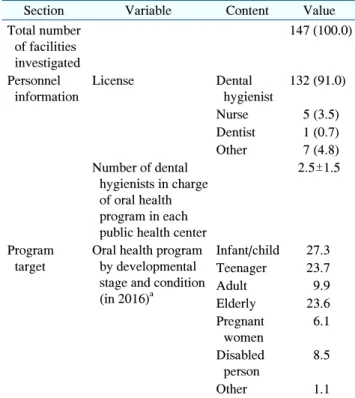
1. General status of public health centers The majority of the public health centers (n=132, 91.0%) had licensed dental hygienists as persons in charge of oral health promotion. When examining the participants in the oral health program conducted in 2016 in the developmental stage, we found that only 9.9% were adults (Table 1).
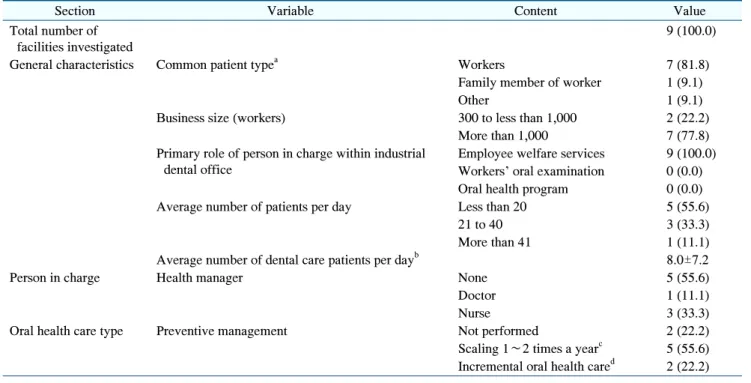
2. General status of industrial dental offices In industrial dental offices, the patients were primarily workers (81.8%) and employee welfare services played the major roles (100.0%). Health care managers were appointed in only 44.4% of the industrial dental offices.
Additionally, 77.8% of industrial dental offices conducted
Table 3. Status of Oral Health Activities for Adult Workers
Program Execution status Public health
center
Industrial
dental office Total
Number of facilities investigated 147 (100.0) 8 (100.0) 155 (100.0)
Customized 1-to-1 oral health education Currently 75 (53.2) 8 (100.0) 83 (55.7)
In the past but not currently 10 (7.1) 0 (0.0) 10 (6.7)
Never done 43 (30.5) 0 (0.0) 43 (28.9)
Plan to do in the future 13 (9.2) 0 (0.0) 13 (8.7)
Group oral health education Currently 99 (69.2) 1 (12.5) 100 (66.2)
In the past but not currently 16 (11.2) 2 (25.0) 18 (11.9)
Never done 18 (12.6) 5 (62.5) 23 (15.2)
Plan to do in the future 10 (7.0) 0 (0.0) 10 (4.3)
Oral health campaign
aCurrently 114 (79.7) 0 (0.0) 114 (75.5)
In the past but not currently 8 (5.6) 1 (12.5) 9 (6.0)
Never done 16 (11.2) 6 (75.0) 22 (14.6)
Plan to do in the future 5 (3.5) 1 (12.5) 6 (4.0) Environmental changes for oral health care
bCurrently 56 (41.5) 2 (25.0) 58 (40.6)
In the past but not currently 15 (11.1) 0 (0.0) 15 (10.5)
Never done 48 (35.6) 5 (62.5) 53 (37.1)
Plan to do in the future 16 (11.9) 1 (12.5) 17 (11.9) Connected to other departments at public health center
cCurrently 112 (78.3) 0 (0.0) 112 (74.2) In the past but not currently 7 (4.9) 0 (0.0) 7 (4.6)
Never done 22 (15.4) 7 (87.5) 29 (19.2)
Plan to do in the future 2 (1.4) 1 (12.5) 3 (2.0)
Oral examination for workers Currently 53 (37.3) 3 (37.5) 56 (37.3)
In the past but not currently 14 (9.9) 0 (0.0) 14 (9.3)
Never done 71 (50.0) 5 (62.5) 76 (50.7)
Plan to do in the future 4 (2.8) 0 (0.0) 4 (2.7) Oral examination for workers exposed to acids Currently 10 (7.4) 1 (12.5) 11 (7.7) In the past but not currently 3 (2.2) 0 (0.0) 3 (2.1)
Never done 122 (90.4) 6 (75.0) 128 (89.5)
Plan to do in the future 0 (0.0) 1 (12.5) 1 (0.7) Values are presented as n (%).
a
Publicity activities, oral health promotion information booth operation, etc.
bImprovement of underdeveloped facilities, regulation of sales of beverages containing sugar, placement of toothpaste in bathrooms, health culture development, etc.
cPrograms linked to departments dealing with nutrition, smoking, exercise, and chronic disease.
preventive oral health care of adult workers. Further, it is notable that 55.6% of the industrial dental offices conducted regular scaling and 22.2% of the industrial dental offices decided the appropriate frequency for patient’s oral health condition (Table 2).
3. Status of oral health activities for adult workers
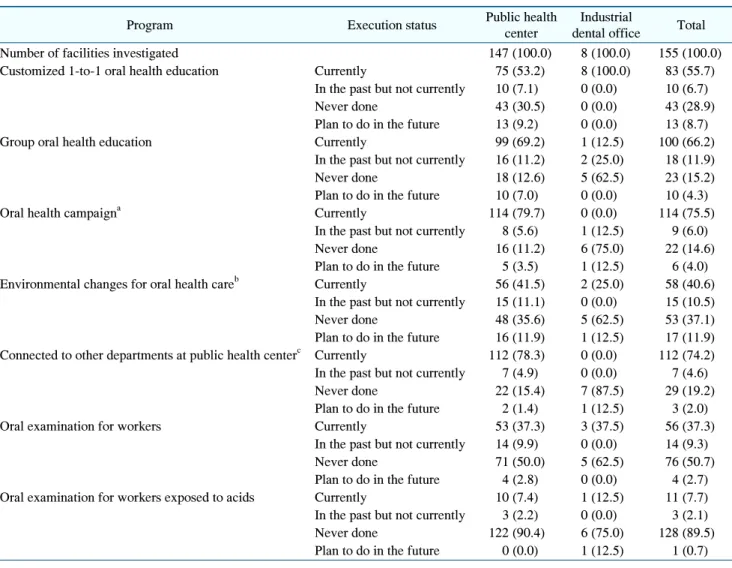
Regarding the oral health promotion activities for adult workers, “Customized 1-to-1 oral health education” was performed by 53.2% of the public health centers and 100.0% of the industrial dental offices. “Oral health
campaigns” were performed at 79.7% of public health centers; however, approximately 75.0% of industrial dental offices did not conduct such campaigns. Approximately 78.3% of public health centers reported having connections to other departments at public health centers. However, most (87.5%) industrial dental offices were not connected to other departments (Table 3).
4. Problems with the oral health activities among adult workers
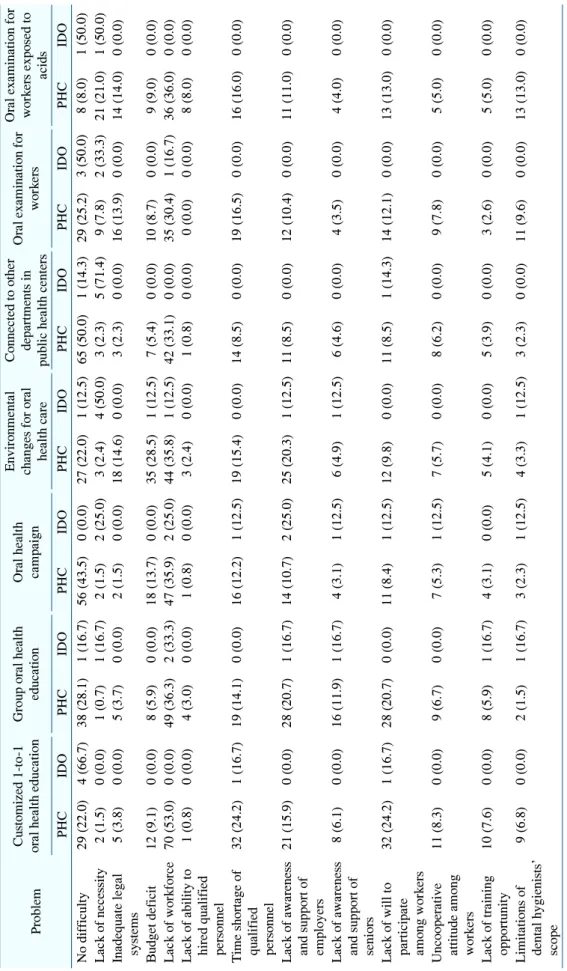
The difficulties or reasons for not carrying out oral
health promotion activities for adult workers are shown in
Table 4. Problems with Oral Health Activities for Adult Workers
Problem Custom iz ed 1 -to -1 oral he alth ed uca tion G rou p or al h ealth educ ation O ral health ca m paign En vir onm en tal changes for ora l health care Con nec ted to othe r dep ar tm ents in public hea lth ce nters O ra l e xa m inatio n for wo rk er s
O ra l exa m inatio n f or w orkers exposed to ac id s PH C IDO PH C IDO PH C IDO PH C ID O PH C IDO PH C IDO PH C IDO No di ffi cul ty 29 (2 2. 0) 4 (66 .7 ) 38 (2 8. 1) 1 (16 .7 ) 56 (4 3. 5) 0 (0.0 ) 27 (2 2.0) 1 ( 12 .5) 65 ( 50.0 ) 1 (1 4.3) 29 (2 5.2) 3 ( 50 .0) 8 ( 8.0) 1 ( 50.0 ) Lac k of ne cessity 2 (1 .5) 0 (0 .0) 1 (0 .7) 1 (1 6.7) 2 (1 .5) 2 (2 5.0) 3 ( 2.4 ) 4 ( 50 .0) 3 (2 .3) 5 (7 1.4) 9 ( 7.8 ) 2 ( 33 .3) 21 (2 1.0 )1 ( 50 .0 ) Inadequate le gal system s 5 (3 .8) 0 (0 .0) 5 (3 .7) 0 (0 .0) 2 (1 .5) 0 (0 .0) 18 (1 4.6) 0 (0.0 ) 3 (2 .3) 0 (0 .0) 16 (1 3.9) 0 ( 0.0 ) 14 (1 4.0) 0 ( 0.0 ) Bu dge t def icit 12 ( 9.1) 0 (0 .0) 8 (5 .9) 0 (0 .0) 18 ( 13.7 ) 0 (0 .0) 35 (2 8.5) 1 (12 .5) 7 (5 .4) 0 (0 .0) 10 (8 .7) 0 (0.0 ) 9 (9.0 ) 0 (0.0 ) Lac k of w or kf or ce 70 ( 53.0 ) 0 (0 .0) 49 ( 36.3 ) 2 (3 3.3) 47 ( 35.9 ) 2 (2 5.0) 44 (3 5.8) 1 ( 12 .5) 42 ( 33.1 ) 0 (0 .0) 35 (3 0.4) 1 ( 16 .7) 36 (3 6.0) 0 ( 0.0 ) Lac k of ab ility to hire d qu alif ied pers on ne l
1 (0 .8) 0 (0 .0) 4 (3 .0) 0 (0 .0) 1 (0 .8) 0 (0 .0) 3 (2.4 ) 0 (0.0 ) 1 (0 .8) 0 (0 .0) 0 (0.0 ) 0 (0.0 ) 8 (8.0 ) 0 (0.0 ) Tim e shorta ge of qu alified pers on ne l
32 ( 24.2 ) 1 (1 6.7) 19 ( 14.1 ) 0 (0 .0) 16 ( 12.2 ) 1 (1 2.5) 19 (1 5.4) 0 ( 0.0 ) 14 ( 8.5) 0 (0 .0) 19 (1 6.5) 0 ( 0.0 ) 16 (1 6.0) 0 ( 0.0 ) L ack o f awar en es s and sup por t of em ploy er s 21 ( 15.9 ) 0 (0 .0) 28 ( 20.7 ) 1 (1 6.7) 14 ( 10.7 ) 2 (2 5.0) 25 (2 0.3) 1 ( 12 .5) 11 ( 8.5) 0 (0 .0) 12 (1 0.4) 0 ( 0.0 ) 11 (1 1.0) 0 ( 0.0 ) L ack o f awar en es s and sup por t of seniors
8 (6 .1) 0 (0 .0) 16 ( 11.9 ) 1 (1 6.7) 4 (3 .1) 1 (1 2.5) 6 ( 4.9 ) 1 ( 12 .5) 6 (4 .6) 0 (0 .0) 4 (3.5 ) 0 (0.0 ) 4 (4.0 ) 0 (0.0 ) Lac k of w ill to participa te am ong w or ker s 32 (2 4. 2) 1 (1 6. 7) 28 (2 0. 7) 0 (0 .0 ) 11 (8 .4 ) 1 (12 .5 ) 12 (9 .8 ) 0 (0 .0 ) 11 ( 8.5) 1 (1 4.3) 14 (1 2.1) 0 ( 0.0 ) 13 (1 3.0) 0 ( 0.0 ) U nc ooperative attitude am on g wor ke rs
11 (8.3) 0 (0 .0) 9 (6 .7) 0 (0 .0) 7 (5 .3) 1 (1 2.5) 7 (5.7 ) 0 (0.0 ) 8 (6 .2) 0 (0 .0) 9 (7.8 ) 0 (0.0 ) 5 (5.0 ) 0 (0.0 ) Lac k of training oppo rtu nity 10 (7.6) 0 (0 .0) 8 (5 .9) 1 (1 6.7) 4 (3 .1) 0 (0 .0) 5 (4.1 ) 0 (0.0 ) 5 (3 .9) 0 (0 .0) 3 (2.6 ) 0 (0.0 ) 5 (5.0 ) 0 (0.0 ) Lim itatio ns of de nta l hyg ienists’ scope
9 (6 .8) 0 (0 .0) 2 (1 .5) 1 (1 6.7) 3 (2 .3) 1 (1 2.5) 4 (3.3 ) 1 (1 2.5 ) 3 ( 2.3 ) 0 (0 .0 ) 11 (9 .6 ) 0 (0 .0) 13 ( 13 .0 ) 0 (0 .0) Valu es ar e p resen ted as n (%). Mu ltiple respo nses are po ssible fo r e ach que stio n. PH C: pu blic h ealth cen ter, ido: in dustrial de ntal o ffice s.
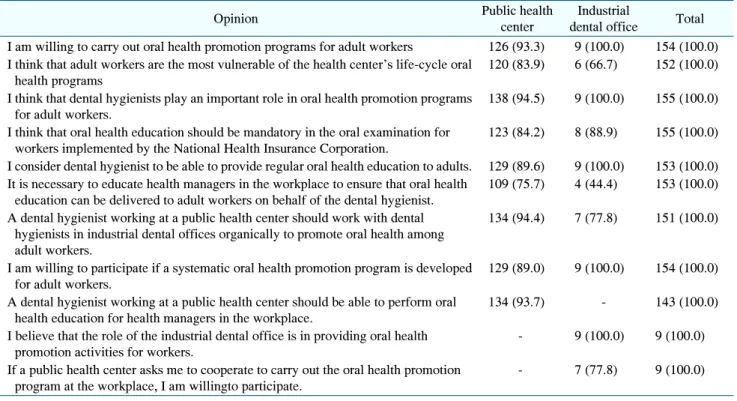
Table 5. Needs and Opinions Survey on the Implementation of Oral Health Programs for Adult Workers