A Study on the Influence of Choice Properties of Food Carving Decoration Lecture on Recommended Intention and Revisiting Intention
Myung Sug Kwag MBA, Kyung Hee University
Jin Soo Kim*
MBA, Kyung Hee University
ABSTRACT
This paper examines the effect of the choice properties of food carving decoration lectures on the recommendation and revisiting intention. As the culinary industry grows, consumers seek not only the value of satiety through food but also the value of aesthetics. They perceived satisfaction from the taste and appearance of the food as well as the interior of the restaurant and the service. Food carving is an important means of fulfilling consumer satisfaction value which is ever-changing. This study attempts to analyze the relationship between the choice properties of food carving lectures and the course recommendation and revisiting intention.
This study hypothesis was formulated and the survey was conducted on 125 respondents who had experienced food carving lectures. The reliability and validity of measurement items were verified through Cronbach’s Alpha and factor analysis. As a result, all measurement items showed no abnormality. The results of the analyses are as follows.
The education satisfaction, education commitment, and brand image, the choice properties of food carving decoration lecture, were found to have a positive effect on the recommendation intention. The results also showed that the education commitment and brand image of food carving decoration lectures were positively associated with revisiting intention. Lastly, the implications of these findings were suggested and for future research were discussed.
Keywords education satisfaction, education commitment, psychological security, brand image, recommendation intention, revisiting intention
1)
*Corresponding author: [email protected]
1. Introduction
The restaurant industry has been changing in the consciousness and lifestyle of leisure time as the income level increases due to economic growth. In addition, consumers in the restaurant industry are seeking more value as the consumption structure for food has changed from homemade meals to restaurants. Through dining out, consumers not only solve their physiological needs, but also seek satisfaction with the atmosphere, service, etc. In other words, it seeks more value than simply satisfying physiological needs through the ingestion of food. As such, consumers are more satisfied with their dining out by being provided with delicious food and a proper service beautiful space.
In particular, the aesthetic element of the dining space has an important effect on consumers' satisfaction. Just as eating something with someone is important, aesthetic elements such as interior design, decoration, and food carving play an important role. Here, food carving means carving food ingredients such as vegetables and fruits to make sculptures. Prior researches on visual factors such as food carving are as follows.
Seo and Ham (2015) studied the impact on customer sentiment and revisit intention on the production of food space in hotel restaurants. They examined that food designs such as food colors, food decorations, utensils, food designs, and spatial designs such as background music and light have a positive impact on customer sentiment, affecting the willingness to revisit. Shin (2018) studied the influence of the production factors of food carving on the psychological response and affection of customers. She showed that space production, table production, and food production among the production elements of food carving had a significant impact on customers' psychological response. Kim and Byun (2010) studied the impact of carving decoration recognition and purchase intention on price acceptability. The results of the study show that: More than 20 percent of restaurant consumers were aware of food carving on TV. In addition, consumers with high awareness of carving decoration showed high intention of purchase and high price acceptability. On the other hand, consumers with low recognition of carving decoration showed low price acceptability even if they were willing to buy.
As we reviewed earlier, most of the prior literature studied the relationship between aesthetic elements of the dining space, such as interior, decoration, food carving, and consumer loyalty.
However, no research has been conducted on the influence of choice properties of food carving decoration lecture on recommendation intention and revisiting intention. Therefore, this study examined the effect of the choice property of the food carving decoration lecture on the recommendation intention and the revisit intention.
2. Literature Review 2.1. Food Carving
Food carving refers to the use of a technology to express the original characteristics of food ingredients to express the completeness of food and the beauty of space (Ko and Lee, 2019; Kim and Jin, 2016). Food carving allows the proper carving and production of food ingredients according to the purpose of the food space. Food carving decoration uses subdivisions of the names of food pieces, vegetable carving, watermelon carving, flower carving, and fruit carving.
Food Carving not only provides customers with simple visual satisfaction but also forms emotional satisfaction and consensus through proper directing of the purpose of the dining space and food culture. Through food carving decoration, food quality can be improved and luxurious atmosphere can be created, and seasonal feeling can be made by utilizing seasonal ingredients.
Kim and Jin (2016) conducted a study on concentration and job confidence according to the level of food carving decoration education. The results showed that the level of carving skill and attention and confidence in employment had a positive correlation. especially, it found that attention and confidence in employment were high among those who obtained food carving advanced skill certificates. Ko and Lee (2019) studied the relationship between the educational immersion of food carving decoration and psychological healing, love mark, and loyalty. The results showed that both the immersion in participation in food carving decoration education positively affect psychological healing and love mark. Kim and Byun (2010) analyzed the relationship between consumers' perception of food carving decoration, intention of purchase, and price acceptability in Daegu. According to the results, consumers with high awareness of food carving decoration were more willing to buy and more receptive to prices.
2.2. Education Satisfaction
Satisfaction defined as a customer's overall evaluation after experiencing a product or service, and if consumers experienced more than their expectations, they would be satisfied (Johnson, Anderson, and Fornell 1995; Oliver, 1980). This study focuses on educational satisfaction. Astin (1993) defined educational satisfaction as the learner's interest in subjective responses to the educational experience. Eliot and Shin (2002) defined educational satisfaction as a subjective experience to educational outcomes. Byun (2010) defined educational satisfaction to the extent that it is satisfied with education contents, instructors, facilities, and other educational-related environments.
Min (2019) studied the relationship between the brand authenticity of the franchise, brand identity, educational satisfaction, brand trust, intention to renew contract and recommendation
intention in the pharmacy industry. The result found that brand trust can be enhanced through brand promise, employee sincerity, originality, product excellence, brand reputation, brand identity, and educational satisfaction in pharmacy franchise. Lee (2020) found in insurance planners that educational satisfaction and job satisfaction have a positive effect on self-efficacy.
Min and Kim (2016) analyzed the impact of Meister High School graduates' satisfaction on job skills and job satisfaction. The educational satisfaction of Meister High School graduates shows a correlation between job satisfaction and quantity. In addition, job competency mediated between educational satisfaction and work satisfaction.
2.3. Educational Commitment
Woosley (2003) defined educational commitment as a student’s belief that there are no barriers to their completion of a degree or meeting immediate educational goals. Cho (2014) showed that STEAM education, which defines problems in education programs and designs/produces them on their own, has a positive impact on elementary school students' creativity and commitment to learning. Cho (2019) examined the mediated effects of learning commitment in the effects of digital literacy on learning satisfaction and academic achievement when using smart devices in elementary school math classes. Jang and Park (2016) analyzed the structural relationship between learners' interaction, learning commitment, learning satisfaction, and perceived learning performance in classes using SNS. Park (2017) showed that self-leadership and positive psychological capital have positively affected learning commitment and learning satisfaction. Lee (2018) examined the impact of the teaching type of the academy on elementary school students' academic self-efficacy, learning commitment, learning attitude, and learning satisfaction.
2.4. Psychological Security
The concept of psychological security has been used by scholars in many areas of study. Kahn (1990) defined it as psychological security to express freely his or her own image, career, etc. in an organization without expecting a negative response to his or her own actions when he or she presents a new idea. According to Edmondson (1999), psychological security is a subjective perception that employees are stable in expressing their opinions without difficulty within the organization. Rhonades and Eisenberger (2002) showed that psychological security would affect a favorable attitude toward leaders and organizations that employees receive through the trust of leaders and can lead to positive results such as reduced job stress.
Min (2018) used knowledge sharing and psychological security as a mediating effect to determine the impact of the leader's use of humor on creative job commitment in an organization.
Seo (2018) examined that inclusive leadership has a positive influence on psychological stability, job zeal, and job performance. Cho (2018) investigated the relationship between inclusive leadership of social entrepreneurs and the organizational commitment and psychological security of the members. As a result, the inclusive leadership of social entrepreneurs has had a positive influence on the members' psychological security, and psychological security has been shown to have a positive influence on organizational commitment.
2.5. Brand Image
Brand image is a concept that combines a brand that means a differentiating role from a similar product or service through its unique characteristics, attributes, etc. with an image that means subjective impression, perception, and belief in a particular target (Kang, 2020). Kim (2018) studied how consumers in the 30s and 40s perceived brand image, brand trust, and purchase intention according to the advertising models. Lee (2020) examined the negative brand image and the impact of service failures on negative word-of-mouth and brand switching intentions. As a result, negative brand image and service failure have been shown to have a significant effect on brand hatred, negative brand attitude, and conversion intention. Wang (2018) investigated the impact of brand image, brand relationship, and brand experience on purchase intention in Chinese consumers. The result has shown that the brand image and brand experience has a positive influence on brand trust and brand attachment.
2.6. Recommendation Intention
The recommendation refers to the intention of a person who has experience in a product or service to convey the positive or negative feelings of it to his or her family, friends, etc (Im, 2011;
Jung, 2018). Jung (2018) examined the impact of online SNS-based performance art PR on consumer awareness, satisfaction, purchase intention, and recommendation intentions. The study found that the latest interoperability and information suitability among the characteristics of Instagram have positive effects on the recommendation intentions. In addition, consumer favorability had a positive effect on recommendation intentions. Lim (2011) investigated the relationship between the influencing factors, the intent of use and the intention of recommendation through a research model that combines external factors that reflect the characteristics of social commerce with a technology acceptance model (TAM). As a result. the perceived usefulness and perceived playfulness of social commerce had a positive influence on both the intention of use and the recommendation. Kwon (2011) used the IPA matrix to verify the variables that affect the satisfaction, reuse, and recommendation of the quality of
each branch. As a result, overall satisfaction has had a positive influence on reuse and recommendation intention.
2.7. Recommendation Intention
Revisiting intention refers to a condition in which there is a high possibility of revisiting the place based on positive evaluation (Lee, 2009). Oliver (1997) defined the revisiting intention as a sub-area that constitutes loyalty to the customer, defining it as a willingness to continue to purchase preferred goods or services. Brady and Cronin (2001) defined the customer's satisfaction with the services they used as a means of revisiting that they are more likely to purchase those services in the future.
Park (2020) examined the determinants of the museum shop's intention to revisit. As a result, the perceived value of the museum shop consists of utility value and social value, these positively affected the intention of a revisit of the museum shop. Jeon (2018) investigated the impact of the bookstore's experience on visitors' emotional reactions, satisfaction, and intention to revisit. It has been confirmed that both positive and negative reactions of visitors to bookstores that function as cultural spaces positively affect satisfaction and intention to revisit. Kim (2017) examined the relationship between service quality, customer satisfaction, revisiting intention, and recommendation intentions in a shared economy environment, focusing on accommodation sharing services. As a result, the quality of accommodation-sharing services had a positive effect on customer satisfaction, revisiting intention, and recommendation intentions.
3. Hypothesis
Based on prior research, this study consisted of educational satisfaction, learning immersion, psychological stability, brand image as the choice factors of food carving decoration lecture. This study hypothesized as follows to shed light on the relationship between choice factors of food carving decoration lecture, recommendation intention, and revisiting intention.
H1: The educational satisfaction of the food carving decoration lecture will have a positive effect on the recommendation intention.
H2: The educational commitment of the food carving decoration lecture will have a positive effect on the recommendation intention.
H3: The psychological security of the food carving decoration lecture will have a positive effect on the recommendation intention.
H4: The brand image of the food carving decoration lecture will have a positive effect on the recommendation intention.
H5: The educational satisfaction of the food carving decoration lecture will have a positive effect on the revisiting intention.
H6: The educational commitment of the food carving decoration lecture will have a positive effect on the revisiting intention.
H7: The psychological security of the food carving decoration lecture will have a positive effect on the revisiting intention.
H8: The brand image of the food carving decoration lecture will have a positive effect on the revisiting intention.
4. Results 4.1. Sample
In order to verify the proposed hypothesis, this study surveyed 125 customers who had experience in food carving decoration education. The demographic characteristics are as follows.
Respondents were 53 males (42.4%) and 72 females (57.6%). Respondents were aged between 10 and 19 years with 5.6%, between 20 and 29 years with 55.2%, between 30 and 39 years with 2.4%, between 40 and 49 years with 12.8%, between 50 and 59 years with 16.8%, above 60 years with 7.2%. Respondents’ occupation were housewife 19.2%, students 43.2%, service provider 8.8%, office worker 4.0%, professions 12.8%, etc 12.0%. The education level of respondents was high school 25.6%, college 44.0%, university 23.2%, and above graduate school 7.2%. The monthly income of respondents was below $1,000 47.2%, between $1,000 and $2,000 24.0%, between $2,000 and $3,000 11.2%, between $3,000 and $4,000 8.8%, between $4,000 and $5,000 3.2%, between
$5,000 and $6,000 2.4%, between $6,000 and $7,000 0.8%, above $8,000 2.4%. Table 1 presents the sample demographics.
Measure Frequency Percent
Sex Male
Female
53 72
42.4 57.6
Age
10s 20s 30s 40s 50s 60s+
7 69
3 16 21 9
5.6 55.2
2.4 12.8 16.8 7.2 Table 1 Demographics of the survey respondents
4.2. Measurement Item
The measurement item on the choice propertied of the food carving decoration lecture were restrcutured to fit the purpose of this study by Kim (2015), Bae (2008), Park (2006), Hien et al.
(2020), Lien et al. (2015), and Roberts (2006). The recommendation intention were restructured to fit the purpose of this study by referring to Lee and Lee (2004), Jang (2010), Bagozzi and Yi (1991), and Oliver (1997). The revisiting intention were restructured to fit the purpose of this study by referring to Lee and Song (2018). The questionnaire used the Likert scale of 5 points interval from
“strongly disagree” to “strongly agree”
4.3. Reliability and Validity
To test reliabilities of the constructs, Cronbach’s Alpha statistics were calculated. As shown in Table 2, Cronbach’s Alpha value for all factors was over 0.9, indicating a sound reliability level.
Next, we carried out a factor analysis of each construct, using principle component analysis via the VARIMAX method, as the orthogonal rotation. As shown in Table 3-5, all items for factor loadings was above 0.3. This indicated that they generally satisfied validity evaluation standards.
Measure Frequency Percent
Occupation
Housewife Student Service provider
Office worker Professions
Etc
24 54 11 5 16 15
19.2 43.2 8.8 4.0 12.8
12
Education
High school College University Graduate+
32 55 129
9
25.6 44.0 23.2 7.2
Income
below $1,000
$1,000~2,000
$2,000~3,000
$3,000~4,000
$4,000~5,000
$5,000~6,000
$6,000~7,000
$7,000~8,000 above $8,000
59 30 14 11 4 3 1 0 3
47.2 24.0 11.2 8.8 3.2 2.4 0.8 0.0 2.4
Construct Items Cronbach`s ⍺
Choice Properties
Education Satisfaction 7 .93
Education Commitment 5 .90
Psychological Security 5 .93
Brand Image 6 .94
Recommendation Intention 4 .92
Revisiting Intention 4 .94
Table 2 Reliability analysis
Measurement Item Factor
Loading
Eigen
Value Variance
Education Satisfaction
I am satisfied with the service provided by food
carving education. .751
5.468 .238
I'm satisfied that I took a food carving education. .670 The cost of food carving education is reasonable. .417 I am satisfied with the way of education for food
carving education. .688
I am satisfied with the interest and consideration of
the staff of food carving education. .746 Food carving trainers have sufficient knowledge to
answer customer questions. .773
Food carving trainers have the ability to cope with
customer complaints. .857
Education Commitment
I'm thinking of continuing to study the field of food
carving. .664
4.851 .211
We exchange information with people who learn food
carving. .809
I learned to actively participate in related events while
learning food carving. .778
I tend to pay attention to food carving when it comes
out in the mass media. .525
I often talk to people about food carving. .772
Brand Image
Food carving feels intimate. .585
3.685 .160
I have a good sense of food carving. .678 There is a belief in the field of food carving. .566 It has a good image of food carving. .450 The cost of food carving is not a waste. .422 I think food carving is interesting. .619 Table 3 Results of factor analysis (choice properties)
Measurement Item Factor Loading
Eigen
Value Variance
Recommendation Intention
It will promote food carving to people. .793
3.058 .764
I'm willing to tell people good things about food
carving. .883
If you ask for advice on food carving, I'll recommend it. .893 I will tell my friends about food carving. .922
KMO = 0.835, d.f.=2, χ²=7.030, p<.05
Table 4 Results of factor analysis (recommendation intention)
Measurement Item Factor
Loading
Eigen
Value Variance
Revisiting Intention
I will continue to learn food carving. .869
3.142 .785
Even if the cost of education goes up, we will continue
to receive food carving education. .895
Even if you experience problems with food carving
education, you will continue to be educated. .911 Next time, I will participate in food carving training. .868
KMO = 0.835, d.f.=2, χ²=7.030, p<.05
Table 5 Results of factor analysis (revisiting intention)
4.4. Descriptive Statistics and Correlations
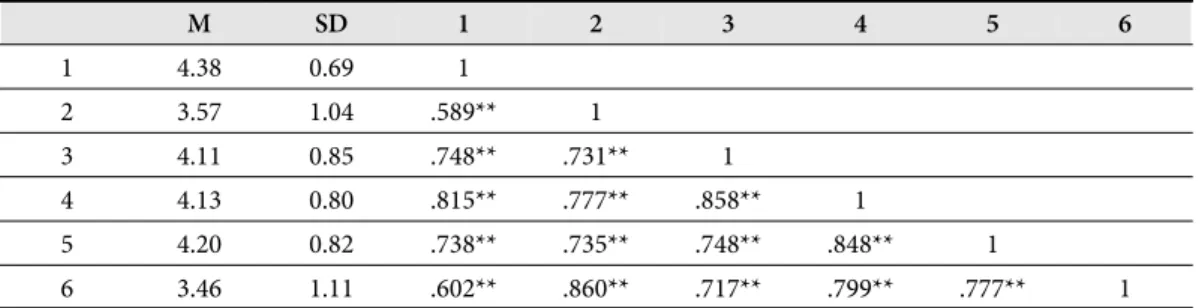
Descriptive statistics related to variables and the correlations between the six factors are shown in Table 6. The analysis of the correlation results showed that there was a significant relation all variables at the 0.01 level.
Measurement Item Factor
Loading
Eigen
Value Variance
Psychological Security
Food carving gives me a feeling of peace. .621
3.148 .137
Food carving makes you emotionally comfortable. .841 Food carving makes you psychologically stable. .779 After the food carving education, I came to think
positively. .420
I think there will be a good change for me while doing
food carving. .321
KMO = 0.940, d.f.=167, χ²=323.77, p<.001
M SD 1 2 3 4 5 6
1 4.38 0.69 1
2 3.57 1.04 .589** 1
3 4.11 0.85 .748** .731** 1
4 4.13 0.80 .815** .777** .858** 1
5 4.20 0.82 .738** .735** .748** .848** 1
6 3.46 1.11 .602** .860** .717** .799** .777** 1
*p < .05. **p < .01
1 = Education satisfaction, 2 = Education commitment, 3 = Brand image, 4 = Psychological Security, 5 = Recommendation intention, 6 = Revisiting intention
Table 6 Means, standard deviations and correlations of scales
4.5. Hypotheses Test
To test the hypotheses 1-4, we performed a regression analysis with the choice properties of food carving decoration lecture as the independent variable and recommendation intention as the dependent variable. In this case, the R2 = .744, and F(2, 122) = 86.950, p < .01. As a result of the analysis, education satisfaction (β = .201, t(122) = 2.049, p < .05), education commitment (β = .166, t(122) = 2.778, p < .01), and brand image (β = .566, t(122) = 4.736, p < .01) positively affected recommendation intention. However, psychological security did not affect recommendation intention (β = -.001, t(122) = -.075, p > .10). Therefore, H1, H2, H4 were supported.
Next, to test the hypotheses 5-8, we performed a regression analysis with the choice properties of food carving decoration lecture as the independent variable and revisiting intention as the dependent variable. In this case, the R2 = .784, and F(2, 122) = 109.000, p < .01. As a result of the analysis, education commitment (β = .638, t(122) = 8.604, p < .01) and brand image (β = .550, t(122) = 3.713, p < .01) positively affected revisiting intention. However, education satisfaction (β = -.107, t(122) = -.878, p > .10) and psychological security (β = -.017, t(122) = -.157, p > .10) did not affect revisiting intention. Therefore, H6, H8 were supported.
β SE std. β t-value p F R2
Constant .416 .246 1.690 .094
86.950** .744
Education Satisfaction .201 .098 .168 2.049 .043
Education Commitment .166 .060 .211 2.778 .006
Psychological Security -.001 .090 -.007 -.075 .941
Brand Image .566 .119 .553 4.736 .000
*p < .05. **p < .01
Table 7 Regression analysis on recommendation intention
The result of the regression analysis is summarized in Table 7-8.
β SE std. β t-value p F R2
Constant -.553 .305 -1.814 .072
109.00** 0.784
Education Satisfaction -.107 .121 -.066 -.878 .382
Education Commitment .638 .074 .600 8.604 .000
Psychological Security -.017 .112 -.013 -.157 .876
Brand Image .550 .148 .398 3.713 .000
*p < .05. **p < .01
Table 8 Regression analysis on revisiting intention
5. Conclusions and future research
This research explored the effect of the choice properties of the food carving decoration lecture on the recommendation intention and revisiting intention. This study confirmed that the choice properties of educational satisfaction, education commitment, and brand image has a significant influence on the recommended intention of food carving decoration education. It was also confirmed that education commitment and brand image had a significant impact on the revisiting intention of the food carving decoration education.
The result of this study has two implications. First, most of the existing studies were about how visual factors such as food carving affect customer satisfaction. However, this research has a theoretical contribution that what factors are consisted of the choice properties of food carving lectures. Also, this study did shed light on the relationship between choice properties of food carving lecture, recommendation intention, and revisiting intention.
Second, this study analyzed the factors influencing customer loyalty of food carving decoration education by dividing them into recommendation intention and revisiting intention through empirical analysis. The findings of this study provided useful information on the factors for customer management in the field of food carving decoration lectures that will grow together in accordance with the development of the restaurant industry.
Third, According to the results of this study, the brand image has the greatest influence on the recommendation intention of a food carving lecture. Therefore, companies preparing for food carving lectures need to make efforts to build a positive brand image in order to enhance the word-of-mouth of food carving lectures, which calls for active use of SNS such as Facebook, Instagram and blogs.
Fourth, Education commitment has the greatest influence on the revisiting intention of a food carving lecture. For increasing the revisiting intention of food carving lectures, therefore, efforts should be made to induce active participation in order to increase the commitment of existing students in education.
Notwithstanding our study’s usefulness for theory and practice, the research has some limitations. First, Food Carving is a curriculum conducted at specialized high schools, universities' culinary departments, and specialized technical institutes, and there were lots of samples in the 10s and 20s. Although housewives and students are economically inactive, they were also the main target of the survey. Future studies need to make efforts to collect more samples to ensure the external validity. Second, this study surveyed people who had taken food carving decoration lectures. According to the structural limitations of setting up samples, no investigation had been conducted on potential consumers who want to take food carving training. Therefore, further research will have to be performed to solve these limitations.
Received 21. June. 2020, Revised 2. July. 2020, Accepted 3. July. 2020
REFERENCES
Astin, A. W. (1993). What matters in college?: Four critical years revisited. San Francisco:
Jossey-Bass.
Bae, Byung-Chul (2008). The relation between engrossing behavior and satisfactory leisure of par- ticipants at in-line skating. master dissertation, Kyunggi University.
Bagozzi, R. P. and Yi, Y. (1991). Assessing construct validity in organizational research.
Administrative Science Quarterly, 36(3).
Brady, M. K. and Cronin, J. J. (2001). Some new thoughts on conceptualizing perceived service quality: A hierarchical approach. Journal of Marketing, 65(3), 34–49
Byun, Ju-Sung (2010). Structural Analysis of Factors Influencing Learning Outcomes in Ceramic Education Programs at Lifelong Educational Institutes. Journal of Art Education, 28, 81-108.
Cho, Bo-Ram (2014). The Effects of Creativity and Flow on Learning through the STEAM Education on Elementary School Contexts. Master dissertation, Ewhawomans University.
Cho, Young-Bohk, Lee, Na-Young, and Park, Kwang-Hwi (2018). The Effect of Inclusive Leadership on Organizational Commitment: The Mediating effect of Psychological safety.
Social Enterprise Studies, 10(2), 231-259.
Edmondson, A. (1999). Psychological safety and learning behavior in work teams. Administrative Science Quarterly, 44(2), 350-383.
Elliott, K. M. and Shin, D. (2002). Student satisfaction: An alternative approach to assessing this
important concept. Journal of Higher Education policy and Management, 24(2), 197-209.
Hien, N., Phuong, N., Tran, T. and Thang, L. (2020). The effect of country-of-origin image on pur- chase intention: The mediating role of brand image and brand evaluation. Management Science Letters, 10(6), 1205-1212.
Jang Jae-hong and Park, Inn-woo (2017). Analysis of the Structural Relationship among Learner Interaction, Learning flow, Learning Satisfaction, and Perceived Learning Outcomes in SNS based Instruction. The Education Assignment Institute, 30(3): 1-26.
Jang, Yong-Jun (2010). A study on eco-friendly marketing of food service industry effecting pur- chase intention of consumers and impact of word of mouth marketing. Master dissertation, Kyunggi University.
Jeon, Na-Rae (2018). The effects of experiential factors of bookstore functioning as cultural space on emotional response, satisfaction and revisit intention. Doctoral dissertation, Sungkyunkwan University.
Johnson, M. D., Anderson, E. W. and Fornell, C. (1995). Rational and adaptive performance ex- pectations in a customer satisfaction framework. Journal of Consumer Research, 21(4), 695-707.
Jung, Eun-Hee (2018). Performing arts PR's infiuence on consumer awareness, satisfaction meas- urement, and purchased intention, as well as recommended intention through instagram.
Doctoral dissertation, Sungkyunkwan University.
Kahn, W. A. (1990). Psychological conditions of personal engagement and disengagement at work.
Academy of Management Journal, 33(4), 692-724.
Kang, Ra-Mi (2020). A Research on the physical and social servicescape of cosmetics brand shops for improved brand image. Doctoral dissertation. Hongik University.
Kim, Gi-jin and Jin, Yang-ho (2016). A Study on Concentration and Confidence in Job-seeking based on Level of Food-carving Decoration Education: Focusing on high school and uni- versity students. Journal of Foodservice Management, 19(6), 27-47.
Kim, Gi-Jin and Byun, Gwang-In (2010). The Effect of the Recognition of Carving Decoration Purchase Intention on Acceptable Price Range: Focused on Daegu Area. Culinary Science &
Hospitality Research, 16(4), 28-42.
Kim, Hyun-Ju (2012). The effects of tourists's usage features of social network service on the com- mitment and travel purchasing intention: Focused on the influences of commitment and purchasing intention & the moderating effects of perceived value. Doctoral dissertation, Kyunggi University.
Kim, Ji-Choul (2018). Investigation the impacts of model's areas of expertise on brand image, brand trust and buying intention in golf wear. Doctoral dissertation, Sungkyunkwan University.
Kim, Seung-Jeong (2015). The Relationship among Culture and Arts Education Program Components, Education Flow and Effect. Master dissertation. Honam University.
Kim, Tae-Youn (2017). The effect of service quality of sharing economy on guest satisfaction, re-
visit and recommendation intention: Focused on accommodation sharing service.
Doctoral dissertation, Hanyang University.
Ko, Yun-Hee and Lee, Soo-Bum (2019). A study on the effect of educational immersion in food carving decoration on psychological healing, love mark, and loyalty. International Journal of Tourism and Hospitality Research, 33(8), 107-121.
Kwon, Dong-Keug (2011). Effects of Reusing and the Recommendation Depending on the Satisfaction Rate of Coffee Shop Service Quality. Journal of the Korea Contents Association, 11(5), 449-465.
Lee, Ae-Jun (2020). The effect of educational satisfaction and job satisfaction on self-efficacy:
Focus on 'H' company's insurance planners. Doctoral dissertation, Hanyang University.
Lee, Ju-Ho (2009). A Study on the Relationship of Place Image, Experiential Value, and Intention to (Re)Visit. Doctoral dissertation, Kangwon National University.
Lee, Jung-Hwa (2018). The effect of leadership style of academy teachers on elementary student’s academic self-efficacy, flow on learning, learning attitude, and learning satisfaction. Master dissertation, Yonsei University.
Lee, Seung-Chul and Song, Ki-Ok (2018). Effect of Food Involvement, HMR Selection Attributes and Repurchase Intention: Focused on female consumers. Journal of Tourism and Leisure Research, 30(3), 157-175.
Lee, Soo-Jin and Han, Jin-Soo (2020). The effect of hotel servicescape on the customer satisfaction and revisit intention: Focused on the mediated effect ofbrand Image. Korean Journal of Hospitality & Tourism, 29(2), 109-124.
Lee, Ye-Joo (2020). A Study on the effect of negative brand image and service failure to negative WOM and intent to brand wwitch: Mediating effect of brand hate. Doctoral dissertation, Kyunghee University.
Li, Ki-Hwan (2003). A study on learner's motive of participation and satisfying degree in the pro- gram for lifeling education: With lifelong education by government and public offices in the center. Doctoral dissertation, Daegu University.
Lien, C. H., Wen, M. J., Huang, L. C. and Wu, K. L. (2015), Online hotel booking, the effects of brand image, price, trust and value on purchase intentions, Asia Pacific Management Review, 20(4), 210-218
Lim, Bo-Ram (2011). Factors affecting on users' intention in using social commerce: Based on technology acceptance model. Doctoral dissertation, Hanyang University.
Lim, Hee-Jin and Lim, Keun-Uk (2018). The effects of airline service quality on customer sat- isfaction and repurchase intention : Focusing on Qatar Airways. International Journal of Tourism and Hospitality Research, 32(5), 131-144.
Min, Byeong-Seok, Park, Woojin and Bae, byung-Yun (2019). A Study on the Relationship Among Brand Authenticity, Brand Identification, Educational Satisfaction, Brand Trust, Recommendation andRe-Contract Intention in the Pharmacy Franchisee. Asia-Pacific Journal of Business Venturing and Entrepreneurship, 14(4), 143-160.
Min, Sang-Ki and Kim, Jong-Woo (2016). The Causal Relationship among Educational Satisfaction, Competency and Job Satisfaction of Meister School Graduates. The Journal of Vocational Education Research, 35(2), 17-36.
Min, Yoon-Hyung and Choi, Suk-Bong (2018). The Effect of Leaders Use of Humor on Involvement in Creative Work: The Mediating Effect of Knowledge Sharingand Psychological Safety. Journal of Vocational Rehabilitation, 40(2), 23-53.
Oliver, C. (1997). Sustainable competitive advantage: combining institutional and resource‐based views. Strategic Management Journal, 18(9), 697-713.
Oliver, R. L. (1980). A cognitive model of the antecedents and consequences of satisfaction decisions. Journal of Marketing Research, 17(4), 460-469.
Park, Hye-Rin (2020). A study on determinants of the revisit intention and the word of mouth in- tention of museum shop. Doctoral dissertation, Sungkyunkwan University.
Park, Hyun-Jung (2006). What are the psychological stabilizing affects of a weekend dance pro- gram on adolescent participants? Master dissertation, Chungang University.
Park, Ji-Yoon (2017). Prediction of Students’ Self-leadership on Learning Satisfaction : Focused on Mediating Effects of Positive Psychological Capital and Learning Flow. Master dissertation, Ewhawomans University.
Park, Jong-Chul and Choi, Hyun-Jung (2019). The effects of the brand image based on con- sumption values of hotel enterprise on customer’s social value andpurchase intention.
Korean Journal of Hospitality & Tourism, 28(7), 57-70.
Rhoades, L. and Eisenberger, R. (2002). Perceived organizational support: a review of the literature.
Roberts, K. (2006). Lovemarks Effect: Winning in the consumer revolution. Sydney: Murdoch Books.
Seo, Hyun-Ju and Hahm, Sung-Pil (2015). Study on the affect of Customer feeling for Food space design in hotel Restaurant on Customer satisfaction andRevisit intention. Journal of Tourism and Leisure Research, 27(2), 427-445.
Seo, Ko-Oun (2018). The effect of inclusive leadership on psychological stability and job engage- ment and job performance: Focused on the hotel. Doctoral dissertation, Kyunghee University.
Shin, So-Young (2018). Decoration effect of food piece on psychological response and loyalty of customer. Master dissertation, Kyunggi University.
Yi, You-jae and Lee, Ji-young (2004). Relationships among Brand Identification Brand Affect, and Brand Loyalty: Utilitarian Products vs. Hedonic Products. Advertising Research, 1(65), 101-125.