Retrospect and Prospect of Economic Geography in Korea
Wonho Lee* ‧ Sung-Cheol Lee ‧ Yangmi Koo***
한국 경제지리학의 회고와 전망
이원호*·이승철**·구양미***
Abstract : The main aim of the paper is to identify the position or status of Korean economic geography in changing global economic geography by reviewing papers published in Korean geographical journals since the mid-1950s. Since the late 20th century as economic geography has developed significantly with the introduction of new research issues, methodologies, and theory and concepts, economic geography in Korea also has gone through rapid development in terms of both quantitative and qualitative perspectives.
The paper attempts to analyze trends in Korean economic geography by reviewing agricultural, industrial, commercial geographies, and others since the mid-1950s. The review of economic geography in Korea would be based on four periods classified by research issues and approaches; foundation (~1950s), positioning (1960s and 1970s), jump and rush (1980s and mid-1990s), and transitional period (late 1990s~). Agricultural geography in Korea has decreased due to increases of the interests in industrial geography since the 1980s. In particular, since the late 1990s industrial geography has undergone a significant transition in accordance with the emergence of new theories of institutional perspectives, centering around issues on value chains, innovative cluster, cooperative and competitive networks, foreign direct investment, flexible specialization and venture ecology. Along with this, there has been changes in the interest of commercial geography in Korea from researches on periodical markets, the structure of store formats, and distributions by commodity, to researches on producer services and retailer’s locational behaviors and commercial supremacy according to the emergence of new store formats. Since the late 1990s, many researches and discussions associated with the new economic geography began to emerge in Korea. Various research issues are focused on analyzing changes of local, regional and global economic spaces and their processes in relation to institutional perspectives, knowledge and innovation, production chain and innovative networks, industrial clusters and RIS, and geographies of service. Although economic geography in Korea has developed significantly both in quantitative and qualitative perspectives, we pointed out that it has still limited in some specific scope and issues. Therefore, it is likely to imply that its scope and issues should be diversified with new perspectives and approaches.
Key Words : economic geography in Korea, agricultural geography, industrial geography, commercial geography, new economic geography
요약 :본 연구는 1950년대 중반 이후 나타난 한국 경제지리학의 연구 성과와 과제를 검토하여 한국 경제지리
학의 지향점과 연구 과제를 제시하는데 주안점을 두었다. 20세기 후반 이후 경제지리학은 새로운 이슈, 이론, 방법론 등의 도입과 함께 크게 발전하였다. 이에 따라 한국 경제지리학도 지난 반세기 동안 연구의 양적인 면 과 질적인 면에서 크게 발전하였다. 본 논문은 1950년대 중반 이후 한국의 농업지리학, 공업지리학, 상업지리 학 등의 문헌을 검토함으로써 한국 경제지리학의 동향을 분석하고자 하였다. 한국 경제지리학은 연구의 주제
* Associate professor, Department of Geography, Sungshin Women’s University, [email protected]
** Associate professor, Department of Geography Education, Dongguk University (Seoul Campus), [email protected]
*** Assistant professor, Department of Geography, Seoul National University, [email protected]
1. Introduction
Economic geography has developed significantly with the introduction of new research issues, research methodologies, and theory and concepts since the late 20th century. Since the 1960s economic geography in Korea also has gone through rapid development in terms of both quantitative and qualitative perspectives.
In terms of the development of economic geography in Korea, it is important to concern with its the starting point as a barometer of future economic geography in Korea.
The terminology of ‘economic geography’ has been used since Japanese colonial era, as there was economic geography as one of curriculums in adminstration examinations during the era under Japanese occupa- tion (Hyong, 2008). After independence from Japan, economic geography in Korea turned out the first MA dissertation (Lee, 1956). It is regarded as the starting point of economic geography in Korea (Hyong, 1976a;
Han, 2007). Also, the first economic geography book
was published in 1959 (Hyong, 1976a). Since then, as Korean economic geography has developed rapidly with the great participation of numbers of geographers into this field, there has been great transition in the position or status of economic geography in Korea.
Therefore, the main aim of the paper is to identify the position or status of Korean economic geography in changing global economic geography by reviewing pa- pers published in Korean geographical journals since the mid-1950s. The review of economic geography in Korea would be based on four periods classified by research issues and approaches - foundation, position- ing, jump and rush, and transitional period.
To this end, the paper is fallen into three sections.
Firstly, the paper attempts to analyze the character- istics, issues and approaches of Korean economic ge- ography through classifying the history of economic geography into four periods; foundation, positioning, jump and rush, and transitional period. Secondly, the paper attempts to explain the emergence and develop- ment of new economic geography in Korea in response to rapid changes in theories, approaches and method- 와 접근방법을 기반으로 네 개 시기- 요람기(1950년대), 정립기(1960~1970년대), 도약기(1980~1990년대 중 반), 전환기(1990년대 후기 이후) -로 구분할 수 있다. 1980년대 한국 경제지리학의 연구 관심이 공업지리학으 로 옮겨지면서 농업지리학은 크게 쇠퇴하였다. 특히, 1990년대 후반 이후 가치사슬, 혁신 클러스터, 협력과 경 쟁 네트워크, 해외직접투자, 유연적 전문화, 벤처 생태계 등과 같은 주요 이슈를 중심으로 새로운 제도적 관점 의 이론이 도입되면서 공업지리학은 크게 성장하였다. 상업지리학에서는 1980년대까지 정기시장, 상품 유통, 상가 구조 등에 관한 연구가 주로 이루어졌으나, 1990년대 이후에는 생산자 서비스를 중심으로 한 서비스 산업 과 새로운 양식의 출현에 따른 소비 입지 형태와 상권에 관한 연구들이 많이 이루어졌다. 이와 더불어 1990년 대 후반 이후 신경제지리학과 관련된 많은 연구와 담론들이 출현하기 시작하였다. 특히, 제도적 관점, 지식과 혁신, 생산 사슬과 혁신 네트워크, 산업 클러스터와 지역혁신체제 등을 중심으로 다양한 경제공간의 변화에 대 한 연구가 활발히 이루어졌다. 한국 경제지리학은 1990년대 이후 급격한 양적·질적 성장을 이루었지만, 여전 히 대부분의 연구가 몇몇 특정 공간과 이슈에 집중되어 있는 한계를 가지고 있다. 따라서 경제지리학 전반에서 볼 때, 새로운 이론적 및 방법론적 관점과 접근 방식을 보다 적극적으로 도입하여 연구 주제를 다양화 시켜야 할 뿐만 아니라 연구의 공간 범위도 다층화하는 것이 앞으로 중점으로 지향해야 할 주요 연구 과제이다. 있다.
주요어 : 한국 경제지리학, 농업지리학, 공업지리학, 상업지리학, 신경제지리학
ologies helped to explain changes in spatial economies since the late 1990s. Finally, based on the review of economic geography in Korea, we attempt to provide retrospect and prospect of economic geography in Ko- rea.
2. Development of Economic Geography in Korea
1) Foundation of Korean economic geography:
In mid-1950s
Economic geography in Korea was newly intro- duced in the 1950s, which was mainly based on inter- activism based on a methodology developed by B. Di- etrich(1927) and economic zones divided by industrial structure and income degree based on from Japanese economic geography (Han, 2007). Also, American economic geography was introduced by the translation of <Economic Geography> written by C.F. Jones and G.G. Darkenwald (Hyong, 1976a).
The remarkable performance of economic geog- raphy in Korea in this period was the publication of Journal ‘Geography’, which was including economic geography and field survey reports, published by students in Seoul National University. Although its academic level was relatively low, it was worthy enough as the first geographical journal in Korea (Hyong, 1976a). Also, economic geography in Korea turned out the first MA dissertation (Lee, 1956). It is regarded as the starting point of economic geography in Korea (Hyong, 1976a; Han, 2007). Even though there were few researchers in economic geography in the 1950s, some researches on agricultural region, industrial locations, land plans and development, and issues on resources began to emerge.
2) Positioning of Korean economic geography:
Between 1960s and 70s
The first positioning of economic geography in Ko- rea could be set up in the first publication of “Journal of the Korean Geographical Society” published by the “Ko�
rean Geography Society” in 1963 (Han, 2007). During the 1960s and 70s there was significant growth in agri- cultural geography, and some expansions of industrial geography related to industrial locations and stages of industrial development. In particular, there had been rapid increase in researches in search of spatial model- ing developed by positive and quantitative analysis stemmed from F.K. Schaefer’s work1).
During this period, there had been a significant changes in agricultural geography from researches focused on regional differentiation in rural areas, to researches on cultural analysis for the structure of agri- cultural regions and the conceptualization of agricul- tural regions through a number of quantitative meth- ods (Hyong, 1977; Park, 1996). For example, while Seo(1974; 1976) attempted to reinterpret agricultural regions in the perspective of positivism, Kim(1969) explored Korean agricultural regions by investigating agricultural regions in the early of Yi Dynasty in the perspective of culture and economic history.
The main interest of industrial geography in Ko- rea during this period was placed on the structure of industrial regions, the differentiation of industrial regions, and changes in industrial locations in ac- cordance with rapid industrialization (Hyong, 1975;
1976b). In particular, the researches focused on changes in locational structure and regional structure (Hyong, 1976b). However, researches in this period had some limits on the lack of understanding problems with the application of quantitative methods into the analysis of the locational structures of industrial re- gions, and the principles of locational theories (Park, 1983; 1992). Nevertheless, it was worthy that some
researches attempted to regarded economic spaces as dynamic spaces, rather than static spaces, through empirical works on changes in industrial locations and theoretical works on changes in industrial agglomera- tion (Park, 2002a).
3) Jump and rush of Korean economic geography: Between 1980s and mid-90s
Between the 1980s and mid-90s Korean economic geography had been driven by a number of research- ers who had degree from abroad, and new issues and approaches in economic geography had introduced (Han, 2007). A number of paradigms such as be- haviorism, structuralism, and political economic ap- proaches based on marxism as alternatives of positiv- ism were introduced and explored during this period.
The main stream of Korean agriculture geography in jump and rush period was intensified changes in rural and agricultural spaces along with industrializa- tion and urbanization in Korea. The main feature of agriculture geography in Korea during this period was to identify the processes of changes in the activities and spaces of agriculture in social-economic perspec- tives (Sohn, 2007). For example, main works were the regional differentiation of part-time farming (Seo, 1992), changes in Korean agriculture spaces analyzed by a quantitative method (Kim, 1991), etc. In particu- lar, Hyong(1992) made great contribution on agricul- tural geography in Korea by developing its theories and cases through the classification of agricultural spaces into heritage, patterns and functions.
New issues of industrial geography emerged in this period are mainly placed on changes in firm organiza- tion and firm locations, changes in the production system and industrial restructuring, patterns of foreign direct investment(FDI), and high-technology indus- try and building technopolis in Korea (Hyong, 2008;
Park, 1996). In terms of firm organization and firm
locations, main interests were laid on the relationships between firm’s organization and spatial structure by analyzing the implications of national industry poli- cies for changes in the business activities and organiza- tions of large firms (Hwang, 1983; Park and Wheeler, 1984; Park, 1986a; 1986b; 1990). Also, researches drew attention on the transition of production system from the mass production to the flexible production system in Korea (Lee, 1993a; 1993b; Lee, 1993c; Park and Kim, 1994; Choo, 1994a; 1994b). Most of Korean firms had introduced flexible production strategies for industrial restructuring to enhance firm’s competitive- ness (Park and Kim, 1994). In particular, the flexibility of production processes was emphasized in the subcon- tracting relations of the automobile industry in Korea (Ryu, 1989; 1990). However, Choo(1994a) pointed out that the introduction of the flexible production system or flexible specialization in Korea is likely to be differentiated by the size and technology levels of firms, arguing that the introduction of new technology and labour flexiblization is driven by large firms, but just in time procurement of raw and subsidiary materi- als is driven by small and medium firms in Korea. In addition, along with the growth in the role of MNCs in the global economy, researches on Korean FDI had increased since the 1980s. For example, Choo(1986) classified the pattern of inward FDI in Korea by coun- try. What is more, researches on high-tech industrial parks were drawn attention by emphasizing needs on the stimulation of the high-tech industry (Hyong, 1986; Park, 1994).
3. Transition in Korean economic geography: since late 1990s
Since the late 1990s Korean economic geography has gone through significant transformation with the
emergence of new issues on innovation, informatiza- tion, cluster, networks and their participation on na- tional policies. In particular, since issues on regional innovation systems and industrial clusters emphasized from since the late 1990s has been used in regional even development policies, economic geography has emerged as a key discipline related to strategies for regional development. Along with the qualitative de- velopment of economic geography in Korea, there has been a increase in the number of economic geography paper in Korea since the late 1990s. For example, the proportion of Korean economic geography papers published between 2001 and 2010 accounted for 44% of geography papers published in Korea since 19562)(Han, 2011). One of the main reasons for this that researches on economic geography in Korea has significantly developed with the establishment of the
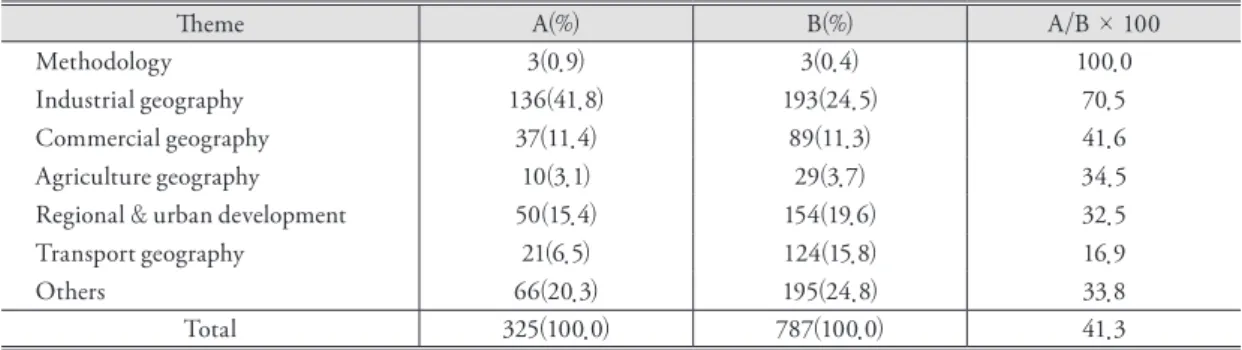
“Economic Geographical Society of Korea” (hereafter EGSK) in 1997, leading to the significant increase of papers published in the EGSK since 1998. The number of papers published in the “Journal of the Economic Geographical Society of Korea” between 2001 and 2011 was 3253), which is accounting for 41.3% of economic geographical papers published in geography journals in Korea (Table 1).
The main interests of economic geography in Korea has been industrial geography, accounting for 24.5%
of papers published in geographical journals in Ko- rea, and 41.8% of papers published in the society4). It shows the great transformation of trends in Korean economic geography in response to economic restruc- turing towards the knowledge and high technology based industry due to the Korean economic crisis in 1997. Also, the area of regional and urban develop- ment has contributed significantly on the growth of Korean economic geography, accounting for 19.6%
of papers published in Korean geographical journals.
It should be resulted from the increase of interests centering around numbers of policies for even regional development and building the regional innovation sys- tems driven by the government since the early 2000s.
In addition, commercial and transport geography has played a relatively important role for the growth of Korean economic geography. The number of papers in commercial and transport geography accounts for 11.3% and 15.8% respectively of papers published in Korean geographical journals, thanks to the emer- gence of new store formats and distributors, dramatic increases in the new types of specialized business ser- vice, and the rapid development of transport technol- ogy and infrastructure since the late 1990s. However, the proportion of papers between 2001 and 2011 in Korean agriculture geography accounts for only 3.7%, due to the transition of interests into industrial
Table 1. Number of Korean economic geography papers published by theme, 2001-2011
Theme A(%) B(%) A/B × 100
Methodology 3(0.9) 3(0.4) 100.0
Industrial geography 136(41.8) 193(24.5) 70.5
Commercial geography 37(11.4) 89(11.3) 41.6
Agriculture geography 10(3.1) 29(3.7) 34.5
Regional & urban development 50(15.4) 154(19.6) 32.5
Transport geography 21(6.5) 124(15.8) 16.9
Others 66(20.3) 195(24.8) 33.8
Total 325(100.0) 787(100.0) 41.3
Note: ‘A’ means the number of papers published in the EGSK.
‘B’ means the number of economic geography papers published in all geographical journals in Korea.
geography. This section would review general trends of Korean economic geography in transitional period between 2001 and 2010, centering around industrial, commercial and agricultural geographies which have been major interests in Korean economic geography.
1) Agricultural geography
According Han(2011), until 1980 Korean economic geography was mainly focused on agriculture geog- raphy. However, since the late 1990s there has been a significant decrease in the number of papers in agri- cultural geography in Korea, accounting only 3.7%
between 2001 and 2011 (Table 1). It seems to show the main transition of economic geography in Korea from agricultural to industrial geography in response to the emergence of new theories of institutional perspec- tives, centering around issues on value chains, innova- tive cluster, cooperative and competitive networks, FDI, flexible specialization and venture ecology.
Nevertheless, it is worthy to notice that issues on agricultural geography has been diversified since the late 1990s, showing a remarkable increase in inter- disciplinary approaches with tourism, finance, civil participation and so on. For example, Choo(1999) attempts to show changes in the structure of Korean agriculture regions along with the development of information and communication technology. Cho et al.(2002) attempted to identify agriculture regions in Korea as a new space by investigating the structure and implications of agricultural amenity. Choi et al.(2004) analyzed the role of national agricultural cooperative federation in the financial markets of agriculture re- gions in Korea. More recently, Ahn(2007) argued the importance of civil participation in building tourist villages in agriculture regions. More recently, Hyun and Lee(2011) analyzed the spatial diffusion patterns of organic farms increasing rapidly with the growth in the agricultural product market.
2) Industrial geography
Since the late 1990s the global and local economy has become focus on knowledge and technology based industries, as they has played a critical role for national economic development. Along with this trends, there has been also a transition of industrial geography in Korea. More specifically, it has developed in accor- dance with the economic globalization and emergence of new theories related to industrial restructuring, networks, value chains, innovative clusters and the re- gional innovation systems(RIS), FDI, venture ecology, etc.
Research topics about industrial location and re- gional economic change were still a lot studied in this period (Lee, 1999; Kim, 1999b; Lee, 2002a; Beak, 2003; Moon, 2004). Industrial restructuring and their spatial effects has been one of the key issues in economic geography since the 1980s and until in the 1990s and 2000s (Park, 1983; 1996; Woo, 2005; Kim, 2007). In terms of strategies for industrial restructur- ing since the late 1990s in Korea, what is the most important is the formation of the international and local networks among firms, government, university and research institute, which is based on the innova- tion system. In particular, the role of the region for the innovation systems has been emphasized in researches on the formation of networks, as innovation is en- hanced through learning by interacting and the tran- sition of tacit knowledge based on spatial proximity (Kim, 1997; 2001; Park, 2000; 2001; 2008a; Jung and Kim, 2005; Koo, 2008b).
Also, there have been numbers of researches on in- novative clusters as a main regional development tool and a major momentum for the formation of the RIS in Korea (Nahm, 2001; 2003; 2005; Lee, 2003c). In particular, Nahm(2004) suggested some policy im- plications for Korean clusters and regional innovation strategies through lessons from the worst practices by
pointing out conceptual vagueness of cluster and mo- notonous policy options. Also, Cho(1999) emphasized innovative environments have important implications for technology innovation and regional economic de- velopment.
In addition, there has been the qualitative develop- ment of research issues and methodologies on inward and outward FDI since the late 1990s in Korea. It has transferred from the location patterns and spatial distribution of Korean firms to MNCs’ networks and their locational changes in accordance with the emer- gence of trade protectionism. Lee(2000c) analyzed the spatial pattern of international trade based on increas- es in the FDI proportion of MNCs. Jung(1999; 2001) identified the characteristics of Korean MNCs FDI in the EU, which is defensive-oriented FDI in respond to changes in trade restriction from the EU. Lee(2000a;
2001a) investigated the spatial characteristics and net- works of foreign business service firms and their em- beddedness in Korea. Also, there has been researches on the impact of institutional changes for Korean FDI, and their networks and value chain in transitional economies such as China and Vietnam in institutional perspective (Lee et al., 2003; Lee and Jung, 2004; Suh, 2004; Lee, 2007d; Kim and Lee, 2009a; Kim and Lee, 2009c; Lee and Kim, 2010).
3) Commercial geography
There has been changes in the interest of commer- cial geography in Korea from researches on periodical markets, the structure of store formats, and distribu- tions by commodity until the late 1980s (Han, 1990), to researches on producer services and retailer’s loca- tional behaviors and commercial supremacy according to the emergence of new store formats (Ahn, 2002;
Lee, 2004). Since the late 1990s the Korean retailing industry has developed in accordance with changes in social and economic environment, such as changes
in purchasing power, the structure of population and technology innovation, related to retailing and con- sumption activities. More specifically, it has developed with new store formats: supermarket, convenient store, discount store, and super-supermarket5) (Chung, 2011). This section attempts to identify recent research trends in commercial geography in Korea since 1997 by investigating researches on retail, consumption and logistics activities.
Researches on the Korean retailing industry has been focused on changes in retailer’s locational be- haviors and commercial supremacy according to the emergence of new store formats. The emergence of convenient store has resulted in some conflicts against existing small and medium sized supermarket and coner shop, and changes in their location (Ryu, 2004a;
Shin, 1993). Also, along with the growth of discount store in Korea since the 1990s, researches has focused on the relationships between their spatial expansion and distribution in response to changes in the pat- tern of consumer purchasing activities (Kang, 2004).
Lee(2000b) concerned with the role of discount store as a niche of department store and traditional market, developing the model of quantitative growth and spatial expansion. The scope of research interests has expanded into the locational characteristics and com- mercial supremacy of discount store by region (Lee and Kim, 2000), and the process of its spatial expan- sion by comparing it with department store (Ryu, 2004b).
More recently, there has been methodological devel- opment in research on the location of discounts store.
Lee and Yuh(2010) classified its location in accordance with regional scale, land use, etc, and analyzed its turnover by the classification of location to identify its locational characteristics. Tae and Lhim(2010) has developed a model of its locational determinants by using probability model developed by Huff in 1963.
Kim(2010) provided the idealogical location of retail
store through the introduction of GIS and field survey for big discount stores located in Incheon, concerning with population, transport conveniency, land use, and the degree of competition with neighbor stores. What is more, some researches has considered the impact of super-supermarket on other retail stores (Shin and Moon, 2010). They analyzed the commercial suprem- acy of super-supermarkets located in a specific district, which is called ‘dong’ in Seoul, arguing the supremacy of a super-supermarket is almost 14 times of a normal- sized supermarket.
As we have pointed out above, the main research trends of Korean commercial geography since 1998, has still focused on locational behaviors, spatial expan- sion and commercial supremacy by store formats, even though new research technique has been introduced in this field. It is likely to show that its scope and issues should be diversified with new perspectives and ap- proaches.
4) Other research fields in economic geography
Apart from industrial and commercial geography, researches on transport geography has stimulated sig- nificantly in Korea since the late 1990s. In particular, traffic networks has been emerged as an important is- sue. For example, Kim(1995) analyzed problems with traffic plans in metropolitan areas, Yoon et al.(1998) developed a model for building environment-friendly urban traffic system. Also, a new methodological tech- nique, which is geographical information system(GIS), was used newly to analyze proximity to the system of traffic networks (Lee and Lee, 1997). More recently, there has been a number of literatures related to traffic networks, patterns, and their network structures in the metropolitan Seoul (Hyun and Lee, 2011; Lee et al., 2007; Lee and Park, 2006; Park and Lee, 2007; 2008;
2011; Noh and Joh, 2011). Also, there has been a rapid increase in new approaches and techniques in trans-
port geography. For example, Joh(2009) investigated daily travel pattern in Seoul by using a multi-dimen- sional motif search. Also, Joh(2011) analyzed the trip chain of freight travel through sequence alignment methods to set the starting framework of decision- making principle in freight travel. However, although there has been a growth in both quantitative and quali- tative perspectives in Korean transport geography, it shows still some weakness in researches on efficient and effective transport policies to deal with serious traffic problems in Korea, implications of transport facilities for regional socio-economies, and the analysis for transport systems in the international level.
In addition to transport geography in Korea, there has been great increases in the interests of labour ge- ography in Korea since the late 1990s. Lee(2000d) identify the relationships between the regional growth in employment and the pattern of spatial economies by investigating the uneven development of regional economies in China. Also, Lee(2002b) investigated the wage determination process of regional labor mar- kets in order to understand the regional dimension of labor market processes in Korean metropolitan cities.
It provides an insight into why labor market policy as a regional policy needs to be redefined and it can be much enhanced by geographical investigation on re- gional market.
4. Emergence and development of New Economic
Geography in Korea
Since the 1990s, the rediscovery of economic ge- ography has been discussed actively worldwide both in the field of economics and economic geography.
The most determined attempt to introduce space and location into mainstream economic theory has been
related to the rise of this ‘New Economic Geography (NEG)’ (Martin, 2011). In economic geography, new methodologies and theoretical frameworks were ex- plored, which are based on the institutional and evolu- tionary approaches following a broad trend of ‘cultural turn’ (Park, 2008b). The key words concerning this trend are cultural turn, social interactions, networks, embeddedness, transformation process, etc. Many researches and discussions associated with the NEG began to emerge especially after the late 1990s in Ko- rea. Various research issues are focused on analyzing changes in local, regional and global economic spaces and their processes in relation to institutional perspec- tives, knowledge and innovation, production chain and innovative network, industrial clusters and RIS, and geographies of service.
Knowledge has become one of the most important driving forces of economic growth and the competi- tiveness of regions. Therefore, knowledge creation and the innovation systems have been emphasized as new industrial development strategies in the knowledge- based economy (Park, 2008b). In the late 1990s, the Korean government has made explicitly a great deal of efforts to help attract and create high-tech new start- ups and venture ecology. Some studies have investi- gated the locational characteristics and institutional milieu of venture businesses (Kim, 2002; Choi and Yoon, 2004; Lee and Lee, 2004). After the 2000s, the importance of innovation and knowledge creation in the regional development and competitiveness has been more emphasized, and there were some empiri- cal analysis on the knowledge production. Lee and Kim(2006) demonstrated the spatial-temporal pat- terns of knowledge production activities based on a data set of patents using spatial statistical methods and GIS in Korea. Jeong(2007) also analyzed spatial de- terminants of innovative activities using spatial econo- metric techniques. Koo(2008b) analyzed the network formation process of personal actors applied to a
knowledge creation model, that is socialization, ex- ternalization, combination and internalization. More recently, the triple helix model has been introduced as a new regional and national innovation model (Lee et al., 2009; Lee et al., 2010). It seeks to understand the innovation process centered upon the university- industry-government interactions.
After the 1990s, research on industrial clusters and RIS has increased explosively in the world despite their conceptual vagueness. Lee and Lee(2008) pointed out the ambiguity of terms and concepts of industrial ag- glomeration and cluster. Nevertheless, after about the early 2000s, there has been a number of discussions and case studies on the spatial and regional agglom- eration of industries based on the theory of industrial district, collective learning, industrial clusters and RIS in Korea. In particular, national balanced develop- ment and RIS have been one of the most important industrial and regional policies under the President Roh’s administration (2003.2-2008.2). The key policy objective was to build competitive RIS and innova- tive clusters in the regions. Many studies attempted to investigate policies of innovative clusters and RIS and their effect on the region (Nahm, 2004; Lee, 2007a).
Therefore, successful clusters have been analyzed by economic geographers, for example, software and IT cluster in Gangnam area (Hwang, 2000; Nahm, 2003;
Park, 2008a), fashion cluster in Dongdaemun Market (Nahm, 2003; Kim and Lee, 2009b), IT and research cluster in Daeduk (Lee, 2003c; Hwang, 2004; Kim, 2009a), automobile cluster in Ulsan (Lee, 2007b), electronics cluster in Gumi (Park and Chung, 2012), and metal and machinery cluster in South-East Region (Kwon, 2006; 2010). In addition, some traditional clusters such as fermented soy products industry in Sunchang (Lee, 2011) and emerging clusters such as the photonics industry in Gwangju (Lim and Park, 2006) and biotechnology clusters (Kim, 2009b) have been also explored.
These clusters’ critical success factors are mainly based on the institutional perspectives and untraded interdependences, for example, physical agglomera- tions of firms and organizations, developed local and global networking, embeddedness and institutional thickness, and regional policy supports. Hwang(2000) examined that Gangnam area has been well equipped with localization, embeddedness, institutional thick- ness and collective learning, however, less developed in networking. Park and Chung(2012) reviewed the evolutionary process of Gumi electronics cluster from the industrial park of branch plants to the innovative cluster and revealed the role of government policies for local industrial dynamics. There were also some re- searches to explore the spatial patterns and structure of the industrial agglomeration and cluster using spatial econometric techniques, which is different from the existing qualitative methods (Jeong and Kim, 2005;
Jeong and Pak, 2007).
In the above cluster literatures and case studies, local and global network of firms, organizations and regions are one of the important factors of their competitive- ness (Park, 2002b). The more firms interact through regional networks, the more generate greater agglom- eration advantages, and such networks and agglom- eration process promotes regional industrial clusters.
Thus, networks can be regarded as a firm’s strategy to make efficient use of other firms’ resources in the form of cooperative subcontract relationship, R&D coop- eration, joint project, outsourcing, and sales network alliance, etc. (Kim, 1998). In other words, networks in the social and institutional perspectives have become important for understanding spatial organization of economic activities (Koo and Park, 2012).
Production systems with subcontracting linkage and network of Korean large firms were examined with the case of LG Electronics (Lee, 2001b), Samsung Heavy Industry (Woo, 2003) and Samsung Electron- ics (Kang, 2005). In addition to the network with
supplier and customer firms, innovation networks with other organizations such as competitors, research institutes, universities and government also have be- come important in innovation and knowledge creation (Park, 2002b; Lee, 2003c; Beak, 2006; Kim et al., 2008). Choi(2005) analyzed cooperative networks of service industries in the technological innovation and revealed the structural difference by region. Kim et al.(2008) demonstrated that R&D networks focused on government research institutes geographically are concentrated in the Capital region and Daedeok by R&D policies promoted by the Korean government.
These kinds of social and institutional perspectives of networks, so-called the ‘network governance ap- proach’ focusing on the network contents, have been main topics of clusters and other researches since the 1990s (Koo and Park, 2012). However, according to the prevalence of the evolutionary approach in eco- nomic geography in the 2000s, network analysis is widely adopted to analyze the network structure of individual actors (Koo, 2008a; 2010).
More recently, value chain, commodity chain and networks were studied in relation with the concept of FDI, spatial division of labor, innovative clus- ters and the impact on regional economy (Lee and Kim, 2005; Lee, 2007d; Han, 2009; Jang and Han, 2009). With the progress of globalization, economic geography studies related to commodity chain and production network were expanded to the global commodity chains(GCCs) and global production networks(GPNs). Lee and Kim(2005) examined the characteristics of industrial transformations in East Asia from the perspective of GPNs and investi- gated changes in production networks in East Asia through analyzing trade data of industries. Jang and Han(2009) clarified the GCCs of the grafted cactus of Umseong region and revealed the spatial division of labor from semi-periphery to core regions.
With the advent of the knowledge and service
economy since the 1990s, the number of researches on the knowledge-based and technology-intensive service industries and their spatial characteristics in- creased rapidly. In Korea, knowledge-based industries have been highly concentrated in the Capital region, especially in Seoul (Kim et al., 2003). Many studies demonstrate that Seoul has been the center of producer and business services, information and technology services, software and the Internet-related industries, and cultural industries, which reinforced the role and function of Seoul (Kim, 1999a; Lee, 2003a; Choi, 2003; Lee and Lee, 2005; Choo, 2006; Hong, 2008).
Within Seoul, in addition to CBD area, the growth of Gangnam area is prominent which is benefiting from the agglomeration of a variety of firms, favorable social and physical infrastructure (Lee, 2003d; Ryu, 2005;
Koo, 2010). There also have been some researches on the geography of finance (Choi, 1999; Lee, 2004; Park, 2008c).
5. Conclusion: Retrospect and prospect
This paper attempts to review historical and the- matic trends in Korean economic geography based on four periods; foundation, positioning, jump and rush, and transition. The research framework of Korean economic geography has changed from the regional structure theory in jump and rush period to the spatial system of economies and network theory in transi- tion period (Han, 2007). Since the late 20th century, economic geography in Korea has gone through rapid development in terms of both quantitative and qualita- tive perspectives. There are newly widely used terms such as ‘institutional turn’ and ‘relational turn’ in economic geography with the advent of the so-called NEG since the 1990s. Therefore, new methodologies
and theoretical frameworks were explored, which is based on institutional and evolutionary approaches.
Various research issues are focused on analyzing changes of local, regional and global economic spaces and their processes in relation to institutional perspec- tives, knowledge and innovation, production chain and innovative network, industrial clusters and RIS, and geographies of services.
Although economic geography in Korea has devel- oped significantly both in quantitative and qualitative perspectives, we pointed out that it has still limited in some specific scope and issues. Therefore, it is likely to imply that its scope and issues should be diversified with new perspectives and approaches. In addition to the traditional topics of interest, diverse new themes such as culture, environment, services, and policy should be studied in relation to economic geography in Korea. Methodologies such as mathematical model, GIS-based econometric techniques, network analysis and so on will expand the possibilities of researches in economic geography. It is expected that new theories and methodologies for understanding and analyzing new economic spaces can be established through active interactions with other disciplines. Korean economic geographers should interact and cooperate not only with other fields of geographers such as urban, cultural and social, and even physical geographer, but also oth- er social scientists such as regional science, economics, sociology, etc.
Notes
1) His main work could be found in “Exceptionalism in geog- raphy: a methodological introduction” published in Annals of the Association of American Geographers in 1953.
2) According to Han(2011), up to 2010 the number of eco- nomic geography paper published since 1956 is 1,621.
Among those papers, 713 papers were published between
2001 and 2010.
3) The total number of research paper published in the “Jour- nal of the Economic Geographical Society of Korea” from 1998 to June 2012 is 358, including research notes.
4) In particular, the number of industrial geography papers published in the EGSK up to 2010 is 136, which is account- ing for 70.5% of all industrial geographical papers pub- lished in Korean geography journals (Table 1). It is likely to implicate that the EGSK has a critical role on the develop- ment of industrial geography in Korea.
5) The super-supermarket is a similar store to the discount store in that both have specific logistic centers and distri- bution systems based on scale economies. According to Chung(2011), however, the commodity turnover of super- supermarkets is much higher than discount stores, due to relatively their small floor spaces compared to big discount stores.
Reference
Ahn, J.-H., 2007, Rural tourism village building with residents’ participation: In the case of Jinmok vil-’ participation: In the case of Jinmok vil-participation: In the case of Jinmok vil-: In the case of Jinmok vil-In the case of Jinmok vil- lage in Jangheung county, Journal of the Economic Geographical Society of Korea, 10(2), 197-210. (in Korean)
Ahn, Y.-J., 2002, A review on the urban-economic geologi-, Y.-J., 2002, A review on the urban-economic geologi-Y.-J., 2002, A review on the urban-economic geologi-.-J., 2002, A review on the urban-economic geologi-J., 2002, A review on the urban-economic geologi-., 2002, A review on the urban-economic geologi-2002, A review on the urban-economic geologi-, A review on the urban-economic geologi-A review on the urban-economic geologi--economic geologi-economic geologi- cal research of office locations, Journal of the Eco�
nomic Geographical Society of Korea, 5(2), 229-248.
(in Korean)
Beak, Y. K., 2003, On the location and development of in-, Y. K., 2003, On the location and development of in-Y. K., 2003, On the location and development of in-. K., 2003, On the location and development of in-K., 2003, On the location and development of in-., 2003, On the location and development of in-2003, On the location and development of in-, On the location and development of in-On the location and development of in- dustrial complexes in Chonbuk province, Journal of the Economic Geographical Society of Korea, 6(2), 307-326. (in Korean)
Beak, Y. K., 2006, Competition, collaboration and innova-, Y. K., 2006, Competition, collaboration and innova-Y. K., 2006, Competition, collaboration and innova-. K., 2006, Competition, collaboration and innova-K., 2006, Competition, collaboration and innova-., 2006, Competition, collaboration and innova-2006, Competition, collaboration and innova-, Competition, collaboration and innova-Competition, collaboration and innova-, collaboration and innova-collaboration and innova- tion networks in regional economic developmentL The case of Chonbuk, Journal of the Economic Geographical Society of Korea, 9(3), 459-472. (in Korean)
Cho, H.-Y., 1999, Characteristics and industrial linkages of science parks: A case study of the United King-: A case study of the United King-A case study of the United King- dom, Journal of the Korean Regional Science Asso�
ciation, 15(1), 45-61. (in Korean)
Choi, H-B. and Yoon, S.-M., 2004, An empirical study on the regional characteristics of venture business, Journal of the Economic Geographical Society of Ko�
rea, 7(1), 29-43. (in Korean)
Choi, J.-B., Kim, T.-H. and Min, J.-H., 2004, The role of national agricultural cooperative federation in the Pusan and Kyungnam regional financial mar- kets: An empirical study, Journal of the Economic Geographical Society of Korea, 7(3), 433-460. (in Korean)
Choi, J.-H., 1999, Financial restructuring and its spatial implications in Korea, Journal of the Korean Geo�
graphical Society, 34(3), 265-279. (in Korean) Choi, J.-S., 2003, Spatial distribution of the operators of
public business-to-business electronic market--to-business electronic market-to-business electronic market--business electronic market-business electronic market- places in Korea, Journal of the Korean Geographical Society, 38(3), 426-443.
Choi, J.-S., 2005, Analysis on the technological innovation and cooperative networks of service industries by region, Journal of the Korean Geographical Society, 40(1), 63-77.
Choo, S., 1986, Locational patterns and characteristics of foreign-invested manufacturing firms in Korea, Journal of Geography, 13, 69-89. (in Korean) Choo, S., 1994a, Production system changes in the Korean
consumer electronics sector, Growth & Change, 25, 165-182.
Choo, S., 1994b, Company size and production system changes, Journal of Geography, 24, 19-32. (in Ko-24, 19-32. (in Ko-, 19-32. (in Ko-19-32. (in Ko--32. (in Ko-32. (in Ko-. (in Ko-in Ko- rean)
Choo, S., 1999, Prospects of territorial changes result-, S., 1999, Prospects of territorial changes result-S., 1999, Prospects of territorial changes result-., 1999, Prospects of territorial changes result-1999, Prospects of territorial changes result-, Prospects of territorial changes result-Prospects of territorial changes result- ing from informatization processes: Results of a survey to professionals, Journal of the Economic Geographical Society of Korea, 2(1․2), 169-182. (in Korean)
Choo, S., 2006, Development of the Korean film industry and its spatial characteristics: Gangnam Region of Seoul as a new cluster in a new Renaissance?, Jour�
nal of the Korean Geographical Society, 41(3), 245- 266. (in Korean)
Chung, S.-Y., 2011, Korean geographies of retailing and
consumption, Journal of the Economic Geographi�
cal Society of Korea, 14(3), 394-406. (in Korean) Han, J.-S., 1990, Review and perspectives on the study of
geography of commerce & distribution, Journal of the Korean Geographical Society, 42, 49-65. (in Korean)
Han, J.-S., 2007, The history of Korean economic geog-, J.-S., 2007, The history of Korean economic geog-J.-S., 2007, The history of Korean economic geog-.-S., 2007, The history of Korean economic geog-S., 2007, The history of Korean economic geog-., 2007, The history of Korean economic geog-2007, The history of Korean economic geog-, The history of Korean economic geog-The history of Korean economic geog- raphy framework during fifty years (1956-2005), Journal of the Economic Geographical Society of Ko�
rea, 10(4), 355-376. (in Korean)
Han, J.-S., 2009, Prospects and problems in the study of geography related to the concept of commodity, transport, and supply chains, Journal of the Korean Geographer Society, 44(6), 723-744. (in Korean) Han, J.-S., 2011, Research results and preparation of the
future economic geography in Korea, Journal of the Economic Geographical Society of Korea, 14(3), 241-262. (in Korean)
Hong, I., 2008, The spatial change of agglomerated loca-, I., 2008, The spatial change of agglomerated loca-I., 2008, The spatial change of agglomerated loca-., 2008, The spatial change of agglomerated loca-2008, The spatial change of agglomerated loca-, The spatial change of agglomerated loca-The spatial change of agglomerated loca- tion and the characteristics of firm movement in Korean software industry, Journal of the Economic Geographical Society of Korea, 11(2), 175-191. (in Korean)
Huff, D., 1963, A probabilistic analysis of shopping center trade areas, Land Economy, 39, 81-90.
Hwang, J.-S., 2000, Locational trend of software indus-, J.-S., 2000, Locational trend of software indus-J.-S., 2000, Locational trend of software indus-.-S., 2000, Locational trend of software indus-S., 2000, Locational trend of software indus-., 2000, Locational trend of software indus-2000, Locational trend of software indus-, Locational trend of software indus-Locational trend of software indus- try and the formation of an industrial district in Seoul, Journal of the Korean Geographical Society, 35(1), 121-139. (in Korean)
Hwang, J.-S., 2004, IT cluster evolved from research park:
Taeduk Valley in Korea, Journal of the Economic Geographical Society of Korea, 7(3), 359-384. (in Korean)
Hwang, M.-I., 1983, Locational implications of the struc-, M.-I., 1983, Locational implications of the struc-M.-I., 1983, Locational implications of the struc-.-I., 1983, Locational implications of the struc-I., 1983, Locational implications of the struc-., 1983, Locational implications of the struc-1983, Locational implications of the struc-, Locational implications of the struc-Locational implications of the struc- tural change in the mobile home manufacturing industry in the United States, Journal of the Korean Geographical Society, 28, 35-45. (in Korean) Hyong, K.-J., 1975, A study on the localization processes
of manufacturing industries in Korea, 1910~1945:
Methodology and colonial industrialization, Jour�
nal of the Korean Geographical Society, 12, 27-51.
(in Korean)
Hyong, K.-J., 1976a, Economic geography, Journal of the Korean Geographical Society, 13, 28-35. (in Ko-13, 28-35. (in Ko-, 28-35. (in Ko-28-35. (in Ko--35. (in Ko-35. (in Ko-. (in Ko-in Ko- rean)
Hyong, K.-J., 1976b, A Study on the localization processes of manufacturing industries in Korea, 1910~1945:
A dynamic pivot of regional structure in manufac- turing industries, Journal of the Korean Geographi�
cal Society, 14, 9-39. (in Korean)
Hyong, K.-J., 1977, Some trends in the studies of economic geography in Korea since 1945, The Geographical Journal of Korea, 3, 43-54. (in Korean)
Hyong, K.-J., 1986, Technopolis in France, Urban Affairs, 21(4), Public Officials Benefit Association, 58-70.
(in Korean)
Hyong, K.-J., 1992, Agricultural geography, Bobmunsa. (in Korean)
Hyong, K.-J., 2008, Fifty years of the Korean economic geography and ten years since the EGSK’s founda-’s founda-s founda- tion: Retrospect and prospect, Journal of the Eco�
nomic Geographical Society of Korea, 11(1), 1-7. (in Korean)
Hyun, K. and Lee, K., 2004, The location patterns of retail services and the consumer behaviors in Jeju island, Journal of the Economic Geographical Society of Ko�
rea, 7(10), 97-115. (in Korean)
Hyun, K., and Lee, K., 2011, Spatial diffusion patterns of the organic farms in Korea and the geographical characteristics, Journal of the Economic Geographi�
cal Society of Korea, 14(3), 377-393. (in Korean) Jang, M.-W. and Han, J.-S., 2009, Global commodity
chain of grafting cactus in Umseong county of Chungcheongbuk-do(province), Korea, Journal of the Korean Geographer Society, 44(1), 56-76. (in Korean)
Jeong, B.-S. and Pak, R.-H., 2007, An empirical study on the industrial cluster in Korea, Journal of the Eco�
nomic Geographical Society of Korea, 10(1), 19-43.
(in Korean)
Jeong, J. H., 2006, Path dependence and regional develop-, J. H., 2006, Path dependence and regional develop-J. H., 2006, Path dependence and regional develop-. H., 2006, Path dependence and regional develop-H., 2006, Path dependence and regional develop-., 2006, Path dependence and regional develop-2006, Path dependence and regional develop-, Path dependence and regional develop-Path dependence and regional develop- ment paths: The case of Ansan, Journal of the Eco�
nomic Geographical Society of Korea, 9(3), 410-430.
(in Korean)
Jeong, J. H., 2007, An analysis of spatial determinants of innovative activities in Korea, Journal of the Eco�
nomic Geographical Society of Korea, 10(4), 394- 413. (in Korean)
Jeong, J. H. and Kim, S.-B., 2005, The spatial pattern and structure of industrial agglomerations in Korea:
Towards a regional innovation system, Journal of the Economic Geographical Society of Korea, 8(1), 17-30. (in Korean)
Joh, C.-H., 2009, Daily travel pattern using public trans-, C.-H., 2009, Daily travel pattern using public trans-C.-H., 2009, Daily travel pattern using public trans-.-H., 2009, Daily travel pattern using public trans-H., 2009, Daily travel pattern using public trans-., 2009, Daily travel pattern using public trans-2009, Daily travel pattern using public trans-, Daily travel pattern using public trans-Daily travel pattern using public trans- port model in Seoul: An analysis using a multi- dimensional motif search, Journal of the Korean Geographer Society, 44(2), 176-186.
Joh, C.-H., 2011, An analysis of trip chain of freight travel using sequence alignment methods, Journal of the Economic Geographical Society of Korea, 14(4), 540-552. (in Korean)
Joh, Y.-K., Park, C.-S. and Jeon, Y.-O., 2002, An investiga-, Y.-K., Park, C.-S. and Jeon, Y.-O., 2002, An investiga-Y.-K., Park, C.-S. and Jeon, Y.-O., 2002, An investiga-.-K., Park, C.-S. and Jeon, Y.-O., 2002, An investiga-K., Park, C.-S. and Jeon, Y.-O., 2002, An investiga-., Park, C.-S. and Jeon, Y.-O., 2002, An investiga-Park, C.-S. and Jeon, Y.-O., 2002, An investiga-, C.-S. and Jeon, Y.-O., 2002, An investiga-C.-S. and Jeon, Y.-O., 2002, An investiga-.-S. and Jeon, Y.-O., 2002, An investiga-S. and Jeon, Y.-O., 2002, An investiga-. and Jeon, Y.-O., 2002, An investiga-and Jeon, Y.-O., 2002, An investiga-, Y.-O., 2002, An investiga-Y.-O., 2002, An investiga-.-O., 2002, An investiga-O., 2002, An investiga-., 2002, An investiga-2002, An investiga-, An investiga-An investiga- tion of structure and meaning of rural amenity, Journal of the Economic Geographical Society of Ko�
rea, 5(2), 157-174. (in Korean)
Jung, S.-H., 1999, Entries and exits: Case studies of the foreign direct investment of Korean consumer electronics chaebols in the European Union, Jour�
nal of the Economic Geographical Society of Korea, 2(1․2), 145-167.
Jung, S.-H., 2002, Global fi rms, global regions and incen-, S.-H., 2002, Global fi rms, global regions and incen-S.-H., 2002, Global fi rms, global regions and incen-.-H., 2002, Global fi rms, global regions and incen-H., 2002, Global fi rms, global regions and incen-., 2002, Global fi rms, global regions and incen-2002, Global fi rms, global regions and incen-, Global fi rms, global regions and incen-Global firms, global regions and incen-, global regions and incen-global regions and incen- tive package for foreign investors: Korean foreign direct investment in EU objective 1, 2 regions, Journal of the Economic Geographical Society of Ko�
rea, 5(2), 209-228. (in Korean)
Kang, H. 2005, Collaborative relationship and spatial features on the large firm based production link- ages: The case of the Samsung Electronics and its subcontracting firms, Journal of the Economic Geo�
graphical Society of Korea, 8(2), 217-236.
Kang, J.-G., 2004, The benefits and challenges of opening distribution service market� Restructuring the Ko�� Restructuring the Ko�Restructuring the Ko�
rean retail market, Research reports 04-03, Korea Institute for International Economic Policy. (in Korean)
Kim, B.-H. and Lee, S.-C., 2009a, Innovative networks
of foreign capital and spatial identity in the post- socialist system transformations: The case of Korean FDI firms in Shanghai, China, Journal of the Economic Geographical Society of Korea, 12(4), 421-437.
Kim, D.-Y., 2000, Th e locational characteristics of agglom-, D.-Y., 2000, Th e locational characteristics of agglom-D.-Y., 2000, Th e locational characteristics of agglom-.-Y., 2000, Th e locational characteristics of agglom-Y., 2000, Th e locational characteristics of agglom-., 2000, Th e locational characteristics of agglom-2000, Th e locational characteristics of agglom-, Th e locational characteristics of agglom-The locational characteristics of agglom- eration areas of advanced producer services in Seoul: advertising-related industry, Journal of the Korean Geographical Society, 35(5), 731-744.
Kim, D.-Y., 2010, The location analysis and optimum location choice for large-scale discount store us--scale discount store us-scale discount store us- ing GIS, The Geographical Journal of Korea, 44(4), 661-670. (in Korean)
Kim, H.-K., 2002, Locational characteristics of venture industry in the Chungbuk Region, Journal of the Economic Geographical Society of Korea, 5(1), 49- 68. (in Korean)
Kim, H. and Lee, J. H., 2009b, Multi-scalar dynamics of cluster development: the role of policies in three Korean clusters, Journal of the Korean Geographical Society, 44(5), 634-646.
Kim, H., Lee, J. H. and Sohn, D.-W., 2008, Governmet policies, R&D networks and space: The case of Korean national R&D projects, Journal of the Economic Geographical Society of Korea, 11(3), 319- 333. (in Korean)
Kim, H. Y., 2009a, The making of a science town: the case of Daedeok, Korea, Journal of the Economic Geo�
graphical Society of Korea, 12(1), 83-95.
Kim, K.-H., 1991, A Study on the changes of regional struc�
ture of agriculture in Korea, Unpublished Ph.D dis-Unpublished Ph.D dis-.D dis-D dis- sertation, Seoul National University. (in Korean) Kim, K.-S., 1995, An investigation of problems and policy
directions in the process of transportation plan- ning for construction of the five new towns in the capital region, Journal of the Korea Planners Asso�
ciation, 30(1), 169-197. (in Korean)
Kim, K., Choo, S., and Nahm, K.-B., 2003, Spatial de-, K., Choo, S., and Nahm, K.-B., 2003, Spatial de-K., Choo, S., and Nahm, K.-B., 2003, Spatial de-., Choo, S., and Nahm, K.-B., 2003, Spatial de-Choo, S., and Nahm, K.-B., 2003, Spatial de-, S., and Nahm, K.-B., 2003, Spatial de-S., and Nahm, K.-B., 2003, Spatial de-., and Nahm, K.-B., 2003, Spatial de-and Nahm, K.-B., 2003, Spatial de-, K.-B., 2003, Spatial de-K.-B., 2003, Spatial de-.-B., 2003, Spatial de-B., 2003, Spatial de-., 2003, Spatial de-2003, Spatial de-, Spatial de-Spatial de- mand estimation for the knowledge-based indus--based indus-based indus- tries in the Capital Region of Korea, Journal of the Korean Geographical Society, 38(3), 363-374.
Kim, M.-S. and Lee, S.-C., 2009c, Impact of institutional
changes on foreign direct investment: The case of Korean textile and clothing foreign direct invest- ment in China, The Geographical Journal of Korea, 43(4), 663-673.
Kim, S.-B., 1997, Spatial characteristics of the inter-firm networks in the industrial clusters in Seoul: Focus on computer industry, Journal of the Korean Re�
gional Science Association, 13, 55-74. (in Korean) Kim, S.-B., 1998, The formation and its factors of inter-
firm networks: Focus on computer industry in Korea, Journal of the Korean Geographical Society, 33(2), 309-324. (in Korean)
Kim, S.-B., 2001, Building an innovation system for indus-, S.-B., 2001, Building an innovation system for indus-S.-B., 2001, Building an innovation system for indus-.-B., 2001, Building an innovation system for indus-B., 2001, Building an innovation system for indus-., 2001, Building an innovation system for indus-2001, Building an innovation system for indus-, Building an innovation system for indus-Building an innovation system for indus- trial development in a knowledge based economy, Journal of the Economic Geographical Society of Ko�
rea, 4(1), 61-76. (in Korean)
Kim, S.-H., 1969, Research on a paddy field agriculture in the early of Yi Dynasty, Ministry of Education.
Kim, S.-J., 2009b, Vacillating between a neoliberal state and a developmental state: The case of develop- developmental state: The case of develop-developmental state: The case of develop-: The case of develop-The case of develop- ment of biotechnology clusters in South Korea, Journal of the Economic Geographical Society of Ko�
rea, 12(3), 235-247.
Kim, T., 1999a, Geographical development of the ad-, T., 1999a, Geographical development of the ad-T., 1999a, Geographical development of the ad-., 1999a, Geographical development of the ad-1999a, Geographical development of the ad-, Geographical development of the ad-Geographical development of the ad- vanced information services industry, Journal of the Korean Geographical Society, 34(5), 531-542.
Kim, T., 1999b, Effects of industrial location policies on the locational changes of individual firms, Jour�
nal of the Economic Geographical Society of Korea, 2(1/2), 47-61. (in Korean)
Kim, T.-W., 2007, The spatial restructuring and change of locational pattern of auto parts industry in Korea, Journal of the Korean Geographical Society, 42(3), 434-452. (in Korean)
Kim, Y.-M. and Lee, K., 2001, Th e locational characteris-, Y.-M. and Lee, K., 2001, Th e locational characteris-Y.-M. and Lee, K., 2001, Th e locational characteris-.-M. and Lee, K., 2001, Th e locational characteris-M. and Lee, K., 2001, Th e locational characteris-. and Lee, K., 2001, Th e locational characteris-and Lee, K., 2001, Th e locational characteris-, K., 2001, Th e locational characteris-K., 2001, Th e locational characteris-., 2001, Th e locational characteris-2001, Th e locational characteris-, Th e locational characteris-The locational characteris- tics of cultural industries, Journal of the Economic Geographical Society of Korea, 4(1), 37-60. (in Ko-4(1), 37-60. (in Ko-(1), 37-60. (in Ko-1), 37-60. (in Ko-), 37-60. (in Ko-37-60. (in Ko--60. (in Ko-60. (in Ko-. (in Ko-in Ko- rean)
Koo, Y., 2008a, The structural and spatial characteristics of the actor networks of the industries for the elderly: Based on the social network analysis, Jour�
nal of the Korean Geographical Society, 43(4), 526-
543. (in Korean)
Koo, Y., 2008b, A spatial study on the network formation process of personal actors: The case of institutional building networks in industries for the elderly, Journal of the Economic Geographical Society of Ko�
rea, 11(3), 334-349. (in Korean)
Koo, Y., 2010, Agglomeration patterns of advertising industries and spatial networks of advertisement production, Journal of the Korean Geographical So�
ciety, 45(2), 256-274. (in Korean)
Koo, Y. and Park, S. O., 2012, Structural and spatial char-, Y. and Park, S. O., 2012, Structural and spatial char-Y. and Park, S. O., 2012, Structural and spatial char-. and Park, S. O., 2012, Structural and spatial char-and Park, S. O., 2012, Structural and spatial char-, S. O., 2012, Structural and spatial char-S. O., 2012, Structural and spatial char-. O., 2012, Structural and spatial char-O., 2012, Structural and spatial char-., 2012, Structural and spatial char-2012, Structural and spatial char-, Structural and spatial char-Structural and spatial char- acteristics of personal actor networks: The case of industries for the elderly in Korea, Papers in Re�
gional Science, 91(1), 43-65.
Kwon, O., 2006, The strategies for forming governance system to raise industrial competitiveness of metal and machinery industrial clusters in South-East Region, Korea, Journal of the Economic Geographi�
cal Society of Korea, 9(3), 297-317. (in Korean) Kwon, O., 2010, A study on the development process and
structure of the machine and material industrial cluster in Yeongnam Region, Journal of the Eco�
nomic Geographical Society of Korea, 13(2), 196- 218. (in Korean)
Lee, B., 2000a, Characteristics of foreign firm’s corporate networks in Korea: Th e case study of business ser-: Th e case study of business ser-The case study of business ser- vices, Journal of the Economic Geographical Society of Korea, 3(2), 43-61. (in Korean)
Lee, B., 2001a, Th e embeddedness of foreign fi rms in Ko-, B., 2001a, Th e embeddedness of foreign fi rms in Ko-B., 2001a, Th e embeddedness of foreign fi rms in Ko-., 2001a, Th e embeddedness of foreign fi rms in Ko-2001a, Th e embeddedness of foreign fi rms in Ko-, Th e embeddedness of foreign fi rms in Ko-The embeddedness of foreign firms in Ko- rea: The case of business service activities, Journal of the Korean Geographical Society, 36(4), 402-417.
(in Korean)
Lee, C.-W., 2001b, Spatial features and implications of subcontracting networks by a large firm: The case of the display division of LG Electronics in Kumi, Korea, Journal of the Economic Geographical Society of Korea, 4(1), 19-35. (in Korean)
Lee, C.-W., 2007a, The evaluation of regional innovation and innovative cluster policies in Korea, Journal of the Economic Geographical Society of Korea, 10(4), 377-393. (in Korean)
Lee, C.-W. and Lee, J.-H., 2004, Institutional milieu of
high-tech venture business cluster in an Metro--tech venture business cluster in an Metro-tech venture business cluster in an Metro- politan Area: The case of Daegu City in Korea, Journal of the Economic Geographical Society of Ko�
rea, 7(1), 1-27. (in Korean)
Lee, C.-W., Lee, J.-H. and Park, K.-S., 2010, An inquiry into the triple helix as a new regional innovation model, Journal of the Economic Geographical Soci�
ety of Korea, 13(3), 335-354. (in Korean)
Lee, D.-A., 1993a, Flexible specialization: A new para-, D.-A., 1993a, Flexible specialization: A new para-D.-A., 1993a, Flexible specialization: A new para-.-A., 1993a, Flexible specialization: A new para-A., 1993a, Flexible specialization: A new para-., 1993a, Flexible specialization: A new para-1993a, Flexible specialization: A new para-, Flexible specialization: A new para-Flexible specialization: A new para-: A new para-A new para- digm for modern industrial society?, Journal of the Korean Geographical Society, 28(2), 148-162. (in Korean)
Lee, D.-A., 1993b, Chaebol, government and Korean in-, D.-A., 1993b, Chaebol, government and Korean in-D.-A., 1993b, Chaebol, government and Korean in-.-A., 1993b, Chaebol, government and Korean in-A., 1993b, Chaebol, government and Korean in-., 1993b, Chaebol, government and Korean in-1993b, Chaebol, government and Korean in-, Chaebol, government and Korean in-Chaebol, government and Korean in-, government and Korean in-government and Korean in- dustrial location, Journal of the Korean Regional Science Association, 9(1), 79-100. (in Korean) Lee, H., 2004, Spatial analysis of bank’s ATMs in Korea,
Journal of the Korean Geographical Society, 39(5), 755-767.
Lee, H. Y., 2003a, Spatial analysis of the Internet industry in Korea, Journal of the Korean Geographical Soci�
ety, 38(6), 863-886.
Lee, H. Y. and Kim, H. J., 2006, The spatial analysis of knowledge production activities based on Korean patent data, Journal of the Economic Geographical Society of Korea, 9(3), 318-340. (in Korean) Lee, H.-Y. and Kim, J-.Y., 2000, A Study on the locational
characteristics and the trade area of large-scale discount stores, Journal of the Korea Planners As�
sociation, 35(6), 61-80. (in Korean)
Lee, H.-Y. and Lee, J.-Y., 1997, A study on the analysis of the integrated accessibility for transportation New York system: The case of Kangnam-gu, Seoul, Journal of the Korea Planners Association, 32(2), 119-182. (in Korean)
Lee, H.-Y., 2000b, A study on the growth and spatial dif-, H.-Y., 2000b, A study on the growth and spatial dif-H.-Y., 2000b, A study on the growth and spatial dif-.-Y., 2000b, A study on the growth and spatial dif-Y., 2000b, A study on the growth and spatial dif-., 2000b, A study on the growth and spatial dif-2000b, A study on the growth and spatial dif-, A study on the growth and spatial dif-A study on the growth and spatial dif- fusion of large-scale discount stores, Journal of the Korean Regional Science Association, 16(2), 47-66.
(in Korean)
Lee, H. Y. and Lee, N. K., 2005, The distribution structure of the Internet movie and spatial clustering of the Internet movie industry, Journal of the Economic Geographical Society of Korea, 8(1), 107-130. (in
Korean)
Lee, J. H., 2007b, Formation and evolution of Ulsan auto-, J. H., 2007b, Formation and evolution of Ulsan auto-J. H., 2007b, Formation and evolution of Ulsan auto-. H., 2007b, Formation and evolution of Ulsan auto-H., 2007b, Formation and evolution of Ulsan auto-., 2007b, Formation and evolution of Ulsan auto-2007b, Formation and evolution of Ulsan auto-, Formation and evolution of Ulsan auto-Formation and evolution of Ulsan auto- mobile cluster, Journal of the Economic Geographi�
cal Society of Korea, 10(1), 1-18. (in Korean) Lee, J. H. and Kim, H., 2005, Innovation clusters in
changing global production networks of East Asia, Journal of the Economic Geographical Society of Ko�
rea, 8(3), 383-404. (in Korean)
Lee, J.-H. and Lee, C.-W., 2008, Reconsidering the con-, J.-H. and Lee, C.-W., 2008, Reconsidering the con-J.-H. and Lee, C.-W., 2008, Reconsidering the con-.-H. and Lee, C.-W., 2008, Reconsidering the con-H. and Lee, C.-W., 2008, Reconsidering the con-. and Lee, C.-W., 2008, Reconsidering the con-and Lee, C.-W., 2008, Reconsidering the con-, C.-W., 2008, Reconsidering the con-C.-W., 2008, Reconsidering the con-.-W., 2008, Reconsidering the con-W., 2008, Reconsidering the con-., 2008, Reconsidering the con-2008, Reconsidering the con-, Reconsidering the con-Reconsidering the con- cept, typology and theories of agglomeration and cluster in economic geography, Journal of the Economic Geographical Society of Korea, 11(3), 302- 318. (in Korean)
Lee, J.-H. and Yuh, H.-K., 2010, Analysis on the locational characteristics of large-scale discount store per type, The Geographical Journal of Korea, 44(4), 683-695. (in Korean)
Lee, J.-H., 1993c, Intensification of subcontracting and changes of location and labor composition in the apparel industry in Seoul, Journal of Geography, 31, 35-51. (in Korean)
Lee, J.-H., 2003b, Enhancing regional innovation system potential: The dimension of firm practices, Journal of the Economic Geographical Society of Korea, 6(1), 61-77.
Lee, J.-H., 2007c, Reconceptualizing the dynamic evolu-, J.-H., 2007c, Reconceptualizing the dynamic evolu-J.-H., 2007c, Reconceptualizing the dynamic evolu-.-H., 2007c, Reconceptualizing the dynamic evolu-H., 2007c, Reconceptualizing the dynamic evolu-., 2007c, Reconceptualizing the dynamic evolu-2007c, Reconceptualizing the dynamic evolu-, Reconceptualizing the dynamic evolu-Reconceptualizing the dynamic evolu- tion of the firm: On learning and adaptation in restructuring, Journal of the Korean Association of Regional Geographers, 13(6), 623-638.
Lee, J.-H., Kim, T.-Y. and Lee, C.-W., 2009, The triple helix system of innovation in Øresund food clus- ter, Journal of the Economic Geographical Society of Korea, 12(4), 388-405. (in Korean)
Lee, J.-M., 1956, Geographical consideration of vegetables and fuel in Seoul, Unpublished MA dissertation, Seoul National University.
Lee, J.-R., 2002a, Regional change and location of indus-, J.-R., 2002a, Regional change and location of indus-J.-R., 2002a, Regional change and location of indus-.-R., 2002a, Regional change and location of indus-R., 2002a, Regional change and location of indus-., 2002a, Regional change and location of indus-2002a, Regional change and location of indus-, Regional change and location of indus-Regional change and location of indus- trial complex: A case of Yeochon national indus-: A case of Yeochon national indus-A case of Yeochon national indus- trial complex of Korea, Journal of the Economic Geographical Society of Korea, 5(2), 137-155. (in Korean)
Lee, K. and Park, J. S., 2006, Travel patterns of transit