ISSN: 2233-601X (Print) ISSN: 2093-6516 (Online)
Department of Thoracic and Cardiovascular Surgery, Samsung Medical Center, Sungkyunkwan University School of Medicine Received: September 5, 2014, Revised: November 7, 2014, Accepted: November 8, 2014, Published online: June 5, 2015
Corresponding author: Young Mog Shim, Department of Thoracic and Cardiovascular Surgery, Samsung Medical Center, Sungkyunkwan University School of Medicine, 81 Irwon-ro, Gangnam-gu, Seoul 135-710, Korea
(Tel) 82-2-3410-3022 (Fax) 82-2-3410-6986 (E-mail) [email protected]
C
The Korean Society for Thoracic and Cardiovascular Surgery. 2015. All right reserved.
CC
This is an open access article distributed under the terms of the Creative Commons Attribution Non-Commercial License (http://creative- commons.org/licenses/by-nc/4.0) which permits unrestricted non-commercial use, distribution, and reproduction in any medium, provided the original work is properly cited.
Surgical Treatment for Non-Small Cell Lung Cancer in Patients on Hemodialysis due to Chronic Kidney Disease: Clinical Outcome
and Intermediate-Term Results
Byung Jo Park, M.D., Sumin Shin, M.D., Hong Kwan Kim, M.D., Yong Soo Choi, M.D., Jhingook Kim, M.D., Young Mog Shim, M.D.
Background: Patients on dialysis undergoing surgery belong to a high-risk group. Only a few studies have eval- uated the outcome of major thoracic surgical procedures in dialysis patients. We evaluated the outcomes of pulmo- nary resection for non-small cell lung cancer (NSCLC) in patients on hemodialysis (HD). Methods: Between 2008 and 2013, seven patients on HD underwent pulmonary resection for NSCLC at our institution. We retrospectively reviewed their surgical outcomes and prognoses. Results: The median duration of HD before surgery was 55.0 months. Five patients underwent lobectomy and two patients underwent wedge resection. Postoperative morbidity occurred in three patients, including pulmonary edema combined with pneumonia, cerebral infarction, and delirium.
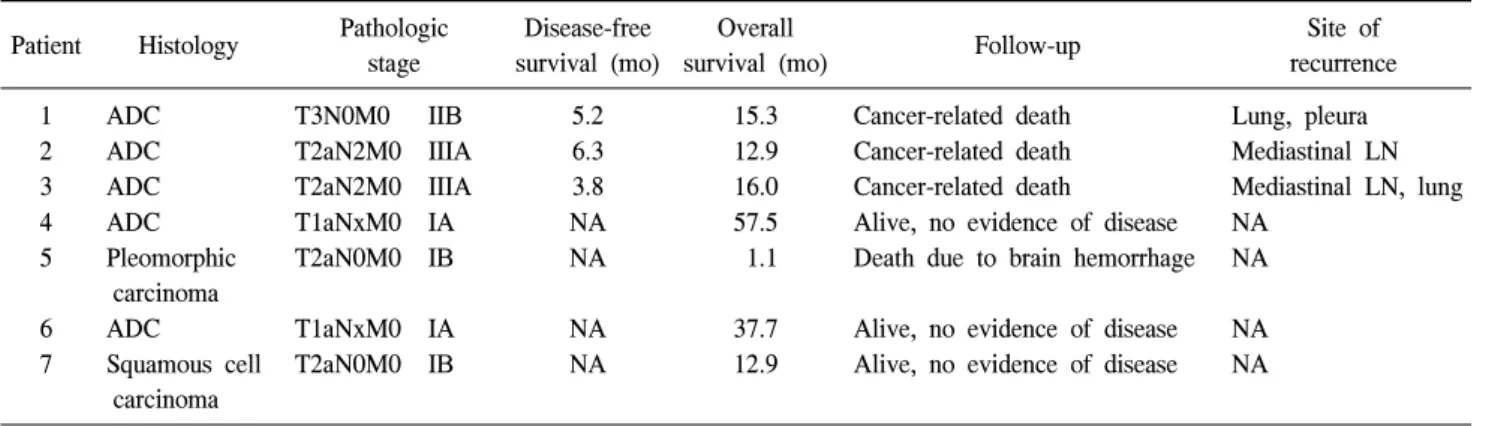
There were no instances of in-hospital mortality, although one patient died of intracranial bleeding 15 days after discharge. During follow-up, three patients (one patient with pathologic stage IIB NSCLC and two patients with pathologic stage IIIA NSCLC) experienced recurrence and died as a result of the progression of the cancer, while the remaining three patients (with pathologic stage I NSCLC) are alive with no evidence of disease. Conclusion:
Surgery for NSCLC in HD patients can be performed with acceptable perioperative morbidity. Good medium-term survival in patients with pathologic stage I NSCLC can also be expected. Pulmonary resection seems to be the proper treatment option for dialysis patients with stage I NSCLC.
Key words: 1. Dialysis 2. Renal dialysis
3. Pulmonary surgical procedures 4. Thoracic surgery
5. Lung neoplasms
INTRODUCTION
Due to advances in dialysis techniques, the number of pa- tients on long-term dialysis has been increasing [1].
Moreover, a tendency for lung cancer to be detected earlier in dialysis patients has been reported, since these patients un-
dergo more extensive follow-up and are monitored more closely by their doctors [2]. Therefore, it is reasonable to an- ticipate an increasing number of dialysis patients with lung cancer who require surgery.
Patients on dialysis undergoing surgery are a high-risk
group, requiring careful perioperative management [3]. Due to
http://dx.doi.org/10.5090/kjtcs.2015.48.3.193
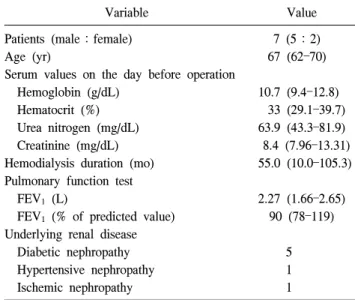
Table 1. Preoperative profiles
Variable Value
Patients (male:female) 7 (5:2)
Age (yr) 67 (62–70)
Serum values on the day before operation
Hemoglobin (g/dL) 10.7 (9.4–12.8)
Hematocrit (%) 33 (29.1–39.7)
Urea nitrogen (mg/dL) 63.9 (43.3–81.9)
Creatinine (mg/dL) 8.4 (7.96–13.31)
Hemodialysis duration (mo) 55.0 (10.0–105.3) Pulmonary function test
FEV
1(L) 2.27 (1.66–2.65)
FEV
1(% of predicted value) 90 (78–119) Underlying renal disease
Diabetic nephropathy 5
Hypertensive nephropathy 1
Ischemic nephropathy 1
Values are presented as number or median (range).
FEV
1, forced expiratory volume in one second.
their increased risk of perioperative complications associated with electrolyte imbalance, bleeding, infection, and hemody- namic instability, patients on dialysis are often not considered suitable for major surgical procedures. For this reason, only a few studies have evaluated the outcomes of major thoracic surgical procedures in patients who are on dialysis due to chronic kidney disease (CKD) [1,4,5]. The aim of this study was to evaluate the postoperative outcomes, in terms of com- plications and survival, of pulmonary resection for non-small cell lung cancer (NSCLC) in patients who are on hemodial- ysis (HD) due to CKD.
METHODS
We performed a retrospective chart review on all patients who underwent pulmonary resection for NSCLC with curative intent at Samsung Medical Center between January 2008 and December 2013 (n=4,793). Of these patients, we retrospectively reviewed the data of seven patients (five male, two female) who had been receiving HD for CKD at the time of surgery.
The routine preoperative workup included pulmonary func- tion tests, computed tomography (CT) scans of the chest and upper abdomen, F-18-flurodeoxyglucose-positron emission to- mography (PET)/CT scans, flexible bronchoscopy, and brain magnetic resonance imaging.
Pulmonary resections were performed via posterolateral thoracotomy in three patients and via video-assisted thoracic surgery in four patients. Lobectomy with systematic lymph node dissection was the preferred procedure. Limited re- section without mediastinal lymph node dissection was per- formed in two patients with peripherally-located clinical T1aN0M0 NSCLC.
All patients were evaluated by nephrologists before the op- eration, and the dialysis schedule was discussed. Most pa- tients underwent HD on the day before surgery. Intravenous antibiotics were routinely administered intraoperatively and postoperatively, with consideration of the glomerular filtration rate and dialysis schedule. Postoperatively, patients were re-evaluated by nephrologists and usually underwent HD the day after surgery. Conventional or continuous renal replace- ment therapy (CRRT) was chosen based on the hemodynamic stability and fluid and electrolyte balance of each patient.
In order to prevent bleeding, we administered a dose of desmopressin every six hours from the day of the operation until the third postoperative day. We sought to maintain pre- operative hemoglobin levels >10 g/dL by injecting 2,000 U of erythropoietin subcutaneously twice a week. Additionally, red blood cell transfusion was performed during preoperative dialysis in patients whose hemoglobin level was <10 g/dL.
The decision to use adjuvant treatment was made by a multi- disciplinary team based on the pathologic stage of the cancer, the general condition of the patient, and the presence of comorbidities.
Patients were evaluated with CT scans every three to four months for the first two years after surgery and every six months thereafter, and were also annually evaluated with PET/CT scans. When recurrence was suspected, we attempted to obtain unequivocal histological or radiological proof. In cases where follow-up was not performed, a telephone inter- view was conducted to determine outcomes.
RESULTS
There were five men and two women in our study, with a
median age of 67 years (range, 62 to 70 years). The pre-
operative profiles of the patients are presented in Table 1.
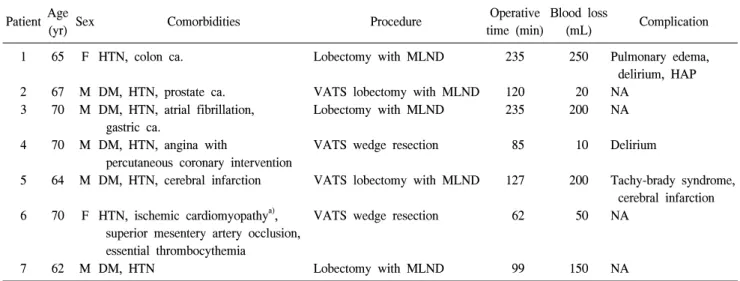
Table 3. Comorbidities and operative outcomes Patient Age
(yr) Sex Comorbidities Procedure Operative
time (min)
Blood loss
(mL) Complication
1 65 F HTN, colon ca. Lobectomy with MLND 235 250 Pulmonary edema,
delirium, HAP
2 67 M DM, HTN, prostate ca. VATS lobectomy with MLND 120 20 NA
3 70 M DM, HTN, atrial fibrillation, gastric ca.
Lobectomy with MLND 235 200 NA
4 70 M DM, HTN, angina with
percutaneous coronary intervention
VATS wedge resection 85 10 Delirium
5 64 M DM, HTN, cerebral infarction VATS lobectomy with MLND 127 200 Tachy-brady syndrome, cerebral infarction 6 70 F HTN, ischemic cardiomyopathy
a),
superior mesentery artery occlusion, essential thrombocythemia
VATS wedge resection 62 50 NA
7 62 M DM, HTN Lobectomy with MLND 99 150 NA
HTN, hypertension; ca., cancer; MLND, mediastinal lymph node dissection; HAP, hospital-acquired pneumonia; DM, diabetes melli- tus; VATS, video-assisted thoracic surgery; NA, not applicable.
a)