An Early Stage Evaluation of the Supporting Program for Obstetric Care Underserved Areas in Korea
“The Supporting Program for Obstetric Care Underserved Areas (SPOU)” provides financial aids to rural community (or district) hospitals to reopen prenatal care and delivery services for regions without obstetrics and gynecology clinics or hospitals. The purpose of this study was to evaluate the early stage effect of the SPOU program. The proportion of the number of birth through SPOU was calculated by each region. Also survey was conducted to investigate the extent of overall satisfaction, elements of dissatisfaction, and suggestions for improvement of the program; 209 subjects participated from 7 to 12 December, 2012.
Overall, 20% of pregnant women in Youngdong (71 cases) and Gangjin (106 cases) used their community (or district) hospitals through the SPOU whereas Yecheon (23 cases) was 8%; their satisfaction rates were high. Short distance and easy accessibility was the main reason among women choosing community (or district) hospital whereas the reasons of not selecting the community (or district) hospital were favor of the outside hospital’s facility, system, and trust in the medical staffs. The SPOU seems to be currently effective at an early stage. However, to successfully implement this program, the government should make continuous efforts to recruit highly qualified medical staffs and improve medical facility and equipment.
Keywords: Medically Underserved Area; Prenatal Care; Delivery, Obstetric; Hospitals, Community; Financing, Government
Baeg Ju Na,1 Hyun Joo Kim,2 and Jin Yong Lee3
1Department of Preventive Medicine, College of Medicine, 2Department of Public Health, The Graduate School, Konyang University, Daejeon;
3Public Health Medical Service, Seoul National University Boramae Medical Center, Seoul, Korea Received: 15 March 2014
Accepted: 10 April 2014 Address for Correspondence:
Jin Yong Lee, MD
Public Health Medical Service, Seoul National University Boramae Medical Center, 20 Boramae-ro 5-gil, Dongjak-gu, Seoul 156-707, Korea
Tel: +82.2-870-2165, Fax: +82.2-831-0714 E-mail: [email protected]
This study was supported by the Ministry of Health and Welfare in Korea (2012; 091-2700-2743-304-260).
http://dx.doi.org/10.3346/jkms.2014.29.6.764 • J Korean Med Sci 2014; 29: 764-770
INTRODUCTION
It is important for pregnant women to get prenatal care and de- livery services in their community. If care is available in their community, check-ups would be available on a regular basis for pregnant women; and in case of an emergency situation, quick response would be on hand (1-4). Nevertheless, as of June 2011, there were 54 administrative districts in Korea which had no obstetrics and gynecology (OBGY) clinics or hospitals providing prenatal care and delivery services (5). The more serious prob- lem is that these regions were mostly rural areas therefore moth- ers have to travel outside their community to receive care (6-7).
The number of healthcare institutions which provide deliv- ery service reduced from 1,311 in 2004 to 808 in 2010 (5). This was because of decreasing number of birth and the situation has been more worsening especially in rural areas (6-7). Insuf- ficient prenatal care can increase the possibility of stillbirth, perinatal mortality, low birth weight, premature babies and can also raise obstetric complications and maternal mortality (4, 8-15). Therefore it is important for pregnant women to be able to receive prenatal care and delivery services in their commu- nity. This problem is being confronted not only in Korea, but also in Western countries such as Canada and the US. To deal with this problem, health authorities of these countries set up a
policy to support healthcare institutions in rural areas and also training family medicine doctors and general practitioners to give prenatal care and delivery services (16).
The Korean Government recognized the seriousness of this problem; and in July 2011, “The Supporting Program for Ob- stetric Care Underserved Areas” (SPOU) was launched in three administrative districts including Youngdong, Yecheon, and Gangjin. The SPOU is a demonstration program which sup- ports healthcare institutions in areas with no OBGY clinics or hospitals by the means of giving financial aids to restart or new- ly provide prenatal care and delivery services (5). Therefore, in theory, pregnant women do not need to go outside the district to receive prenatal care and delivery services. Also, additional costs such as time and transportation costs do not need to pay.
The SPOU’s most significant feature is that the aids are not only used for medical equipment and facility but they are also fur- ther used for operational costs as well as personnel expenses for medical doctors and registered nurses (5). From the govern- ment’s point of view, if the SPOU is successfully settled, they can apply this policy to reduce the number of obstetrically un- derserved areas. Even though, the implementing period of the SPOU has only been over a year as of December 2012, early stage evaluation for this program is important in order to deter- mine whether the program is operating well or if there are any Medicine General & Social Medicine
problems.
The purpose of this study was to investigate how many preg- nant women gave birth in their district through the program, the elements of their satisfaction and dissatisfaction, sugges- tions for improvement of the program, and reasons why some pregnant women still went out of their district for prenatal care and delivery services.
MATERIAL AND METHODS Study population
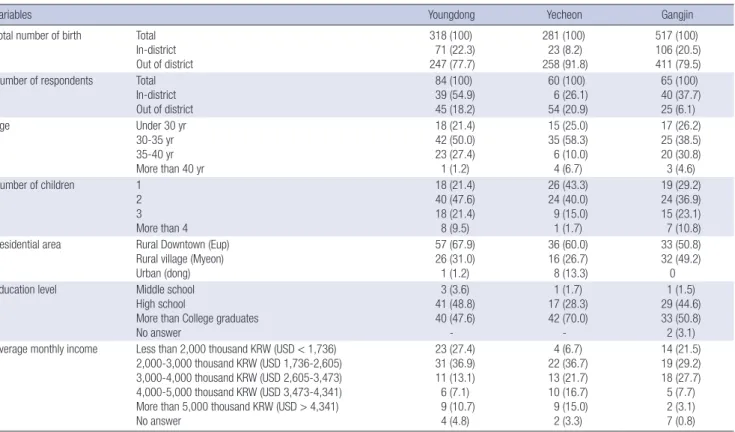
For a year, from August 1 2011 to July 31 2012, there were 318 women living in Youngdong who gave birth, 281 in Yecheon, and 517 in Gangjin. The officers working in each district office phone called to ask if each subject had the intention to give con- sent to participate in this study. Finally, 209 subjects took part in this study; 84 (Youngdong), 60 (Yecheon), and 65 (Gangjin).
The survey was conducted by Gallup Korea, a specialized poll- ing company, from December 7 to 12 2012 for 6 days using a structured questionnaire.
Questionnaire
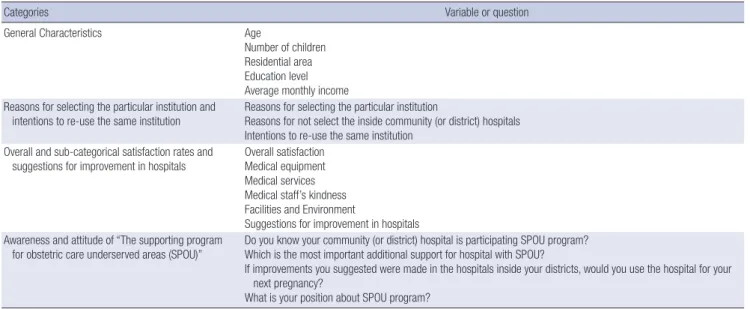
The authors developed a questionnaire based on four catego- ries. The first category included the item regarding general char- acteristics, second category was reasons for participating and not participating for SPOU, third category contained elements of satisfaction and dissatisfaction, and last category was aware- ness of SPOU. Table 1 shows the detailed information of the ques- tionnaire (Table 1).
Statistical analysis
Using SPSS Win 18.0K program (IBM, Chicago, IL, USA), fre- quencies and their percentages were calculated by each ques-
tionnaire. Currency was presented not only Korean won (KRW) but also the United States dollar (USD), with an exchange rate of 1 USD equal to 1,151.8 KRW (average annual rate in 2011).
Ethics approval
The institutional review board of Konyang University Hospital (IRB No. 13-26) approved this study.
RESULTS
General Characteristics of Study Participants
In Youngdong, there were 318 women who gave birth in total;
71 (22.3%) women gave birth in the district and 247 (77.7%) women gave birth outside the district. Of the 71 women who gave birth in the district, 39 (54.9%) women answered to the questionnaire; Of the 247 women who gave birth outside the district, 45 (18.2%) women answered to the questionnaire. The average age were 30-35 yr (50.0%), and mostly were giving birth to their second child (47.6%). They mostly lived downtown (67.9%), the average education of these women were high school (48.8%), and the average monthly income was 200-300 thousand KRW (USD 1,736-2,605) (36.9%).
In Yecheon, there were 218 women who gave birth in total;
23 (8.2%) women gave birth in the district and 258 (91.8%) wom- en gave birth outside the district. Of the 23 women who gave birth in the district, 6 (26.1%) women answered to the question- naire; from the 258 women who gave birth outside the district, 54 (20.9%) women answered to the questionnaire. The average age were 30-35 yr (58.3%), and mostly were giving birth to their first child (43.3%). Most of them lived downtown (60.0%); the average education of these women were university (70.0%), and the average monthly income was 200-300 thousand KRW (USD 1,736-2,605) (36.7%).
Table 1. The summary of the questionnaire
Categories Variable or question
General Characteristics Age
Number of children Residential area Education level Average monthly income Reasons for selecting the particular institution and
intentions to re-use the same institution
Reasons for selecting the particular institution
Reasons for not select the inside community (or district) hospitals Intentions to re-use the same institution
Overall and sub-categorical satisfaction rates and suggestions for improvement in hospitals
Overall satisfaction Medical equipment Medical services Medical staff’s kindness Facilities and Environment
Suggestions for improvement in hospitals Awareness and attitude of “The supporting program
for obstetric care underserved areas (SPOU)”
Do you know your community (or district) hospital is participating SPOU program?
Which is the most important additional support for hospital with SPOU?
If improvements you suggested were made in the hospitals inside your districts, would you use the hospital for your next pregnancy?
What is your position about SPOU program?
In Gangjin, there were 517 women who gave birth in total;
106 (20.5%) women gave birth in the district and 411 (79.5%) women gave birth outside the district. From the 106 women who gave birth in the district, 40 (37.7%) women answered to the questionnaire; from the 411 women who gave birth outside the district, 25 (6.1%) women answered to the questionnaire.
The average age were 30-35 yr (38.5%), and mostly were giving birth to their second child (36.9%). They mostly lived downtown (50.8%); the average education of these women were higher than university (50.8%), and the average monthly income was 200-300 thousand KRW (29.2%) (USD 1,736-2,605) (Table 2).
Reasons for selecting the particular institution and intentions to re-use the same institution
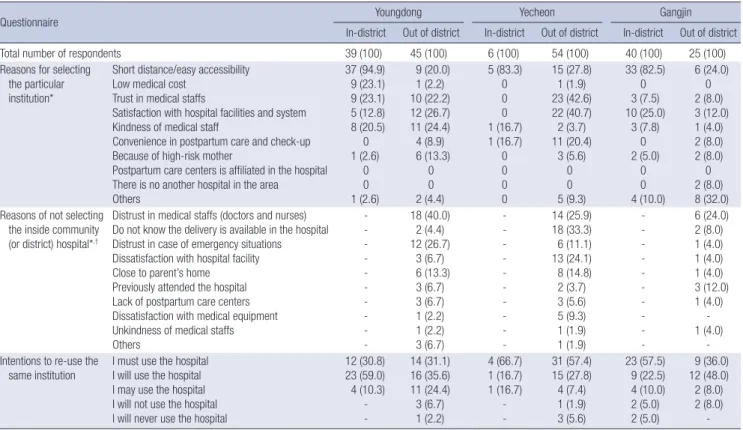
We asked participants why they selected the particular institu- tion for giving birth. For those whom gave birth in their district, the most common reason was because of the short distance and easy accessibility (Youngdong 94.9%; Yecheon 83.3%; and Gangjin 82.5%). For those whom gave birth outside their dis- trict, the most common reason was quite different by each area;
Youngdong, good facility and familiar system in the outside hos- pital (26.7%); Yecheon, confidence in medical doctors (42.6%);
and Gangjin, the short distance and easy accessibility (24.0%).
For only women whom went outside the district, we asked the reasons why they did not select the inside community (or dis- trict) hospital; women in Youngdong (40.0%) and Gangjin (24.0%)
answered they were unable to trust the medical staffs (doctors and nurses) while women in Yecheon (33.3%) answered that they did not realize the presence of SPOU program in their area.
For women whom gave birth in their district, the majority an- swered that they would re-use the same hospital if they got preg- nant again, and the results were the same for women who gave birth outside their district (Table 3).
Overall and sub-categorical satisfaction rates and suggestions for improvement in hospitals
For those who utilized hospitals in their district, the overall sat- isfaction rates (the sum of response from very satisfied + satis- fied) were high; Youngdong 92.3%, Yecheon 100%, and Gangjin 87.5%. The satisfaction for sub-categories including medical equipment, medical services, and medical staff’s kindness were also highly rated. We further asked their opinions on improve- ment of the community (or district) hospital. Women in Young- dong suggested the need for improvement in medical facility and medical equipment such as ultrasonography (25.6%) where- as women in Gangjin picked up the need for improvement in medical facility (35.0%) (Table 4).
Awareness of and attitude to “The supporting program for obstetric care underserved areas”
Women were asked if they knew that the hospital they gave birth in was being supported by “The supporting program for obstet-
Table 2. General characteristics of study participants Unit: persons (%)
Variables Youngdong Yecheon Gangjin
Total number of birth Total In-district Out of district
318 (100) 71 (22.3) 247 (77.7)
281 (100) 23 (8.2) 258 (91.8)
517 (100) 106 (20.5) 411 (79.5) Number of respondents Total
In-district Out of district
84 (100) 39 (54.9) 45 (18.2)
60 (100) 6 (26.1) 54 (20.9)
65 (100) 40 (37.7) 25 (6.1)
Age Under 30 yr
30-35 yr 35-40 yr More than 40 yr
18 (21.4) 42 (50.0) 23 (27.4) 1 (1.2)
15 (25.0) 35 (58.3) 6 (10.0) 4 (6.7)
17 (26.2) 25 (38.5) 20 (30.8) 3 (4.6)
Number of children 1
2 3 More than 4
18 (21.4) 40 (47.6) 18 (21.4) 8 (9.5)
26 (43.3) 24 (40.0) 9 (15.0) 1 (1.7)
19 (29.2) 24 (36.9) 15 (23.1) 7 (10.8) Residential area Rural Downtown (Eup)
Rural village (Myeon) Urban (dong)
57 (67.9) 26 (31.0) 1 (1.2)
36 (60.0) 16 (26.7) 8 (13.3)
33 (50.8) 32 (49.2)
0
Education level Middle school
High school
More than College graduates No answer
3 (3.6) 41 (48.8) 40 (47.6)
-
1 (1.7) 17 (28.3) 42 (70.0)
-
1 (1.5) 29 (44.6) 33 (50.8) 2 (3.1) Average monthly income Less than 2,000 thousand KRW (USD < 1,736)
2,000-3,000 thousand KRW (USD 1,736-2,605) 3,000-4,000 thousand KRW (USD 2,605-3,473) 4,000-5,000 thousand KRW (USD 3,473-4,341) More than 5,000 thousand KRW (USD > 4,341) No answer
23 (27.4) 31 (36.9) 11 (13.1) 6 (7.1) 9 (10.7) 4 (4.8)
4 (6.7) 22 (36.7) 13 (21.7) 10 (16.7) 9 (15.0) 2 (3.3)
14 (21.5) 19 (29.2) 18 (27.7) 5 (7.7) 2 (3.1) 7 (0.8) 1 USD = 1,151.8 KRW (Korean Won).
Table 3. Reasons for selecting the particular institution and intentions to re-use the same institution Unit: persons (%)
Questionnaire Youngdong Yecheon Gangjin
In-district Out of district In-district Out of district In-district Out of district
Total number of respondents 39 (100) 45 (100) 6 (100) 54 (100) 40 (100) 25 (100)
Reasons for selecting the particular institution*
Short distance/easy accessibility Low medical cost
Trust in medical staffs
Satisfaction with hospital facilities and system Kindness of medical staff
Convenience in postpartum care and check-up Because of high-risk mother
Postpartum care centers is affiliated in the hospital There is no another hospital in the area Others
37 (94.9) 9 (23.1) 9 (23.1) 5 (12.8) 8 (20.5)
0 1 (2.6)
0 0 1 (2.6)
9 (20.0) 1 (2.2) 10 (22.2) 12 (26.7) 11 (24.4) 4 (8.9) 6 (13.3)
0 0 2 (4.4)
5 (83.3) 0 0 0 1 (16.7) 1 (16.7)
0 0 0 0
15 (27.8) 1 (1.9) 23 (42.6) 22 (40.7) 2 (3.7) 11 (20.4)
3 (5.6) 0 0 5 (9.3)
33 (82.5) 0 3 (7.5) 10 (25.0)
3 (7.8) 0 2 (5.0)
0 0 4 (10.0)
6 (24.0) 0 2 (8.0) 3 (12.0) 1 (4.0) 2 (8.0) 2 (8.0) 0 2 (8.0) 8 (32.0) Reasons of not selecting
the inside community (or district) hospital*,†
Distrust in medical staffs (doctors and nurses) Do not know the delivery is available in the hospital Distrust in case of emergency situations Dissatisfaction with hospital facility Close to parent’s home
Previously attended the hospital Lack of postpartum care centers Dissatisfaction with medical equipment Unkindness of medical staffs Others
- - - - - - - - - -
18 (40.0) 2 (4.4) 12 (26.7)
3 (6.7) 6 (13.3) 3 (6.7) 3 (6.7) 1 (2.2) 1 (2.2) 3 (6.7)
- - - - - - - - - -
14 (25.9) 18 (33.3) 6 (11.1) 13 (24.1) 8 (14.8) 2 (3.7) 3 (5.6) 5 (9.3) 1 (1.9) 1 (1.9)
- - - - - - - - - -
6 (24.0) 2 (8.0) 1 (4.0) 1 (4.0) 1 (4.0) 3 (12.0) 1 (4.0)
- 1 (4.0)
- Intentions to re-use the
same institution
I must use the hospital I will use the hospital I may use the hospital I will not use the hospital I will never use the hospital
12 (30.8) 23 (59.0) 4 (10.3)
- -
14 (31.1) 16 (35.6) 11 (24.4) 3 (6.7) 1 (2.2)
4 (66.7) 1 (16.7) 1 (16.7)
- -
31 (57.4) 15 (27.8) 4 (7.4) 1 (1.9) 3 (5.6)
23 (57.5) 9 (22.5) 4 (10.0) 2 (5.0) 2 (5.0)
9 (36.0) 12 (48.0) 2 (8.0) 2 (8.0) -
*Multiple responses to this question were allowed; †This question is only for women who gave birth out of district.
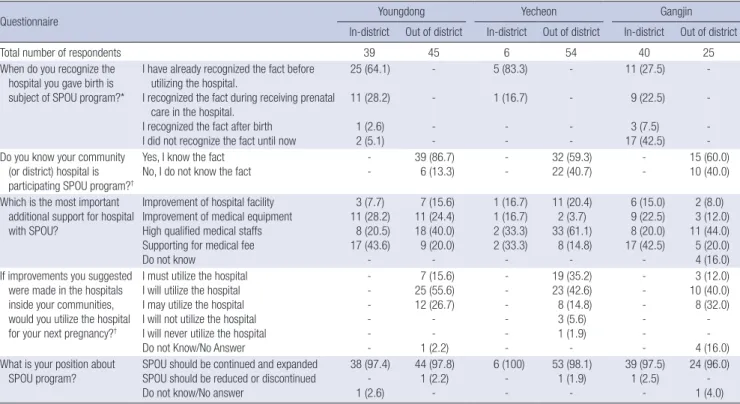
ric care underserved areas” from the Korean government. From the women who gave birth in the hospital in Youngdong, 94.9%
answered they knew about the program. 86.7% of women who gave birth outside their districts knew about the program how- ever they still chose to give birth in hospitals outside their who gave birth outside their district. In Yecheon, 40.7% of women who gave birth outside their who gave birth outside their district did not know about the program, and in Gangjin, for those who gave birth in or outside their who gave birth outside their dis- trict, about 40% of women did not know about the program. We asked what kind of additional support was needed for hospitals with the SPOU program. The results varied by each area. The majority wanted hiring of qualified medical doctors and sup- port for medical fees. We asked women who went outside their districts to give birth, “If improvements you suggested were made in the hospitals inside your districts, would you use the hospital for your next pregnancy?” All women in the three areas answered with the majority saying they would use the hospitals in their communities for their next pregnancy. It was found that, regard- less of the birth place, more than 95% of women strongly agreed the SPOU program to be continued and expanded (Table 5).
DISCUSSION
The purpose of this study was to evaluate the policy of “The Sup- porting Program for Obstetric Care Underserved Areas” in three
designated areas. Even though this program is in the just begin- ning stages, the authors believe that an early evaluation was necessary. For the successful implementation of this early pro- gram, problems should be found in the early stages for finding modifications and improvement. Overall, 20% of pregnant wo- men in Youngdong and Gangjin used hospitals in their districts as a result of the SPOU policy whereas Yecheon was 8%. For those who used these hospitals, their satisfaction rates were high and the reasons for women going to hospitals outside their districts in Youngdong and Gangjin was the lack of confidence in medi- cal staffs whereas in Yecheon, many women did not recognize the hospital were providing the prenatal care and delivery ser- vice. Women who gave birth outside their districts answered that if improvements were made such as hiring qualified medi- cal doctors and expanding the support for medical fees was to take place, they would give birth in the community (or district) hospital for their next pregnancy.
Prenatal care is essential for both mother and baby as based on regular check-ups, early detection can be found and appro- priate response can be given (15) and if possible this should be done in their districts. However as noted above, there are many obstetrically underserved areas which are mainly located in ru- ral regions. Therefore pregnant women living in rural areas must commute outside their districts which could make complica- tions for mother and baby and also in emergency situations prob- lems could arise if rapid response is unavailable (1-4, 7, 17-19).
Table 4. Overall and sub-categorical satisfaction rates and suggestions for improvement in hospitals Unit: persons (%)
Questionnaire Youngdong Yecheon Gangjin
In-district Out of district In-district Out of district In-district Out of district
Total number of respondents 39 (100) 45 (100) 6 (100) 54 (100) 40 (100) 25(100)
Overall satisfaction Strongly satisfied Satisfied Usually Dissatisfied Strongly dissatisfied
16 (41.0) 20 (51.3) 2 (5.1) 1 (2.6) -
16 (35.6) 22 (48.9) 5 (11.1) 2 (4.4)
-
4 (66.7) 2 (33.3)
- - -
22 (40.7) 26 (48.1) 6 (11.1)
- -
14 (35.0) 21 (52.5) 3 (7.5) 1 (2.5) 1 (2.5)
9 (36.0) 14 (56.0) 2 (8.0)
- - Medical equipment Strongly satisfied
Satisfied Usually Dissatisfied Strongly dissatisfied Do not know / No answer
12 (30.8) 18 (46.2) 8 (20.5) 1 (2.6)
-
13 (28.9) 30 (66.7) 2 (4.4)
- -
5 (83.3) 1 (16.7)
- - -
24 (44.4) 25 (46.3) 5 (9.3)
- -
15 (37.5) 18 (45.0) 5 (12.5) 1 (2.5) 1 (2.5)
8 (32.0) 14 (56.0) 2 (8.0)
- - 1 (4.0) Medical services Strongly satisfied
Satisfied Usually Dissatisfied Strongly dissatisfied
26 (66.7) 11 (28.2) 2 (5.1)
- -
20 (44.4) 20 (44.4) 2 (4.4) 3 (6.7) -
5 (83.3) 1 (16.7)
- - -
31 (57.4) 18 (33.3) 4 (7.4) 1 (1.9) -
25 (62.5) 11 (27.5) 3 (7.5)
- 1 (2.5)
11 (44.0) 13 (52.0) 1 (4.0)
- - Kindness of medical
staffs Strongly satisfied Satisfied Usually Dissatisfied Strongly dissatisfied
30 (76.9) 7 (17.9) 2 (5.1)
- -
20 (44.4) 19 (42.2) 2 (4.4) 3 (6.7) 1 (2.2)
5 (83.3) 1 (16.7)
- - -
31 (57.4) 19 (35.2) 3 (5.6) 1 (1.9) -
25 (62.5) 13 (32.5) 1 (2.5)
- 1 (2.5)
13 (52.0) 9 (36.0) 3 (12.0)
- - Hospital facility Strongly satisfied
Satisfied Usually Dissatisfied Strongly dissatisfied
16 (41.0) 17 (43.6) 5 (12.8) 1 (2.6)
-
17 (37.8) 20 (44.4) 7 (15.6) 1 (2.2)
-
5 (83.3) 1 (16.7)
- - -
19 (35.2) 26 (48.1) 9 (16.7)
- -
16 (40.0) 15 (37.5) 6 (15.0) 3 (7.5)
-
10 (40.0) 12 (48.0) 3 (12.0)
- - Suggestions for
improvement of the community (or district) hospitals*,†
Expansion or improvement of hospital facility Improvement on medical equipment such as ultrasound Expansion of additional services
Improvement of the level of medical services Improving kindness of medical staffs Additional support of medical fee Do not know / No answer Nothing
Others
10 (25.6) 10 (25.6) 7 (17.9) 4 (10.3) 2 (5.1) 1 (2.6) 4 (10.3) 8 (20.5) 3 (7.7)
- - - - - - - - -
1 (16.7) - 1 (16.7) 1 (16.7)
- - 1 (16.7) 2 (33.3)
-
- - - - - - - - -
14 (35.0) 4 (10.0) 7 (17.5) 1 (2.5) 2 (5.0) 2 (5.0) 10 (25.0)
4 (10.0) 1 (2.5)
- - - - - - - - -
*Multiple responses to this question were allowed; †This question is only for women who gave birth in community (or district) hospital.
It is meaningful that about 20% of pregnant women are using hospitals in their district, except Yecheon. This result is signifi- cant as women selecting hospitals to give birth is not as simple as choosing one for other diseases. Women will need to wholly put their trust in the hospital for ten months with regard to both mother and baby’s health and to entrust a hospital, the mother will consider many aspects such as medical staff, equipment and hospital reputation. If there were no trust in these it would be impossible for mothers to go to these hospitals. It is not an exaggeration to pinpoint that the effect of the SPOU policy is proving to be positive as 20% is not a low number despite the fact that the implementation has only been a year. Yecheon was relatively low compared to the other two regions as they were at 8.2%. Therefore, the Korean government should investigate which factors are affecting women in Yecheon preventing them from going to hospitals in their communities.
According to our results, distance and accessibility were the main reasons women were utilizing hospitals in their districts.
This result shows that the policy’s intention is being correspond- ed well. On the other hand, we have to listen to the voice of preg- nant women who are going outside of their districts in two as- pects. That is, why they chose the outside community (or dis- trict) hospital and the reasons of not selecting the inside com- munity (or district) hospital. Our results showed that they are in favor of the outside hospital’s facility, system, and had trust in the medical staffs. To reverse flow of women to utilize inside community (or district) hospital, there needs to be an effort to satisfy all the needs of pregnant women. Moreover, even though the majority of women giving birth in their districts were satis- fied with the hospital, we need to pay more attention to their suggestions of improvement in the inside community (or dis- trict) hospital including the improvement of medical facility and medical equipment. Regardless of the place of women giv- ing birth, they showed tremendous support in the SPOU pro- gram continuing and being expanded. However we must focus on the elements that must be prepared for further improvement
Table 5. Awareness and attitude of “The supporting program for obstetric care underserved areas (SPOU)” units: persons (%)
Questionnaire Youngdong Yecheon Gangjin
In-district Out of district In-district Out of district In-district Out of district
Total number of respondents 39 45 6 54 40 25
When do you recognize the hospital you gave birth is subject of SPOU program?*
I have already recognized the fact before utilizing the hospital.
I recognized the fact during receiving prenatal care in the hospital.
I recognized the fact after birth I did not recognize the fact until now
25 (64.1) 11 (28.2) 1 (2.6) 2 (5.1)
- - - -
5 (83.3) 1 (16.7)
- -
- - - -
11 (27.5) 9 (22.5) 3 (7.5) 17 (42.5)
- - - - Do you know your community
(or district) hospital is participating SPOU program?†
Yes, I know the fact
No, I do not know the fact -
- 39 (86.7)
6 (13.3) -
- 32 (59.3)
22 (40.7) -
- 15 (60.0)
10 (40.0) Which is the most important
additional support for hospital with SPOU?
Improvement of hospital facility Improvement of medical equipment High qualified medical staffs Supporting for medical fee Do not know
3 (7.7) 11 (28.2)
8 (20.5) 17 (43.6)
-
7 (15.6) 11 (24.4) 18 (40.0) 9 (20.0)
-
1 (16.7) 1 (16.7) 2 (33.3) 2 (33.3)
-
11 (20.4) 2 (3.7) 33 (61.1)
8 (14.8) -
6 (15.0) 9 (22.5) 8 (20.0) 17 (42.5)
-
2 (8.0) 3 (12.0) 11 (44.0) 5 (20.0) 4 (16.0) If improvements you suggested
were made in the hospitals inside your communities, would you utilize the hospital for your next pregnancy?†
I must utilize the hospital I will utilize the hospital I may utilize the hospital I will not utilize the hospital I will never utilize the hospital Do not Know/No Answer
- - - - - -
7 (15.6) 25 (55.6) 12 (26.7)
- - 1 (2.2)
- - - - - -
19 (35.2) 23 (42.6) 8 (14.8) 3 (5.6) 1 (1.9) -
- - - - - -
3 (12.0) 10 (40.0) 8 (32.0)
- - 4 (16.0) What is your position about
SPOU program? SPOU should be continued and expanded SPOU should be reduced or discontinued Do not know/No answer
38 (97.4) - 1 (2.6)
44 (97.8) 1 (2.2)
-
6 (100) - -
53 (98.1) 1 (1.9)
-
39 (97.5) 1 (2.5)
-
24 (96.0) - 1 (4.0)
*This question is only for women who gave birth in community (or district) hospital; †This question is only for women who gave birth in out of community (or district).
of the SPOU program. Many women requested for the hire of qualified doctors and more support in medical fees and if this was implemented, many women using outside community (or district) hospital showed interest in utilizing the community (or district) hospital for their next pregnancy. Additionally, there is an affect from the quality of healthcare facilities and equipments need to be of high quality to encourage women to utilize com- munity (or district) hospital.
About 40% of women in Yecheon (40.7%) and Gangjin (40.0%) using hospitals outside their districts did not know about the SPOU policy whereas women in Youngdong were 13.3%. This is a very important finding for policymakers because low aware- ness rate of a certain policy can result in low participation rate.
However, it is not denied the fact that the government has main- ly focused on how to reopen or restart obstetrical services and has relatively overlooked how to promote and encourage preg- nant women to participate on the SPOU. Therefore, current strat- egy of promotion and advertisement for SPOU should be re- checked.
We acknowledge the fact that the government is making an effort to support rural community (or district) hospitals with fi- nancial aid however in reality this amount is currently insuffi- cient. For example, under the current policy, the hospitals can receive a total amount of 1.25 billion KRW (USD = 1,085,258), including investing in facility and equipment with 1.0 billion KRW (USD = 868,206) and the rest 0.25 billion KRW (USD = 217,052) can be used for OBGY operating costs for every 6 months.
However in reality these costs are insufficient with the total amo- unt of 0.25 billion KRW (USD = 217,052) to operate 2 OBGY spe- cialists, 1 pediatrician and 8 nurses for 6 months. Besides, the costs for doctors in these areas are higher because of the loca- tion and it is more difficult to employ nurses as most would want to work in a city. Even if they were employed, fair wages must be given in order for nurses to work in these conditions.
The amounts are not enough to cover OBGY specialist’s night shift pay and in reality 3 OBGY specialists can be needed for ro- tation in the delivery room. In short, additional financial sup- port reflecting reality should be given to rural community (or district) hospitals (20).
There are some limitations in this study. First, selection bias may occur due to low response rate (Youngdong: 84 respon- dents out of 318 total number of birth; Yecheon: 60 out of 281;
and Gangjin; 65 out of 517). Therefore, the results should be carefully interpreted. Second, the evaluation was based on the results of participant’s survey. In general, to evaluate a program, policymakers considers 3 aspects; structure, process, and out- come of the project. However in this study we only dealt with the outcome, focusing only on participants. Even so, this study is meaningful because the SPOU policy was evaluated at an ear- ly stage and we were able to gather precious information from real subjects, pregnant women currently living in rural areas.
The policy, “The Supporting Program for Obstetric Care Un- derserved Areas”, is to give financial aid to community (or dis- trict) hospitals in rural areas to reopen prenatal care and deliv-
ery services for pregnant women. Our results showed that the policy is currently effective even though it is still at an early stage.
However, to successfully implement this policy, the government needs to consider recruiting highly qualified medical staffs and improve medical facility and equipment. Furthermore, activity in promotion is needed to make women aware of this program.
Lastly, there needs to be a continuous evaluation and monitor- ing to successfully implement and disseminate the project.
DISCLOSURE
The authors have no conflicts of interest to disclose.
ORCID
Baeg Ju Na http://orcid.org/0000-0002-3742-6035 Hyun Joo Kim http://orcid.org/0000-0001-5784-3576 Jin Yong Lee http://orcid.org/0000-0002-7752-2697
REFERENCES
1. Getahun D, Ananth CV, Kinzler WL. Risk factors for antepartum and intrapartum stillbirth: a population-based study. Am J Obstet Gynecol 2007; 196: 499-507.
2. Fisher ES, LoGerfo JP, Daling JR. Prenatal care and pregnancy outcomes during the recession: the Washington State experience. Am J Public Health 1985; 75: 866-9.
3. Nesbitt TS, Connell FA, Hart LG, Rosenblatt RA. Access to obstetric care in rural areas: effect on birth outcomes. Am J Public Health 1990; 80:
814-8.
4. Nesbitt TS, Larson EH, Rosenblatt RA, Hart LG. Access to maternity care in rural Washington: its effect on neonatal outcomes and resource use.
Am J Public Health 1997; 87: 85-90.
5. Ministry of Health and Welfare and Konyang University. The evaluation study of supporting policy for underserved area of obstetric care. Seoul:
MOHW, 2012. Available at http://www.prism.go.kr/homepage/research- Common/retrieveResearchDetailPopup.do?research_id=1351000-2013 00012 [accessed on 23 April 2014].
6. Ministry of Health and Welfare. The guidance of government supporting project for underserved area in obstetric care. Seoul: MOHW, 2013. Avail- able at http://www.google.co.kr/url?sa=t&rct=j&q=&esrc=s&source=we b&cd=2&ved=0CCkQFjAB&url=http%3A%2F%2Fdownload.mw.go.kr%- 2Ffront_new%2Fmodules%2Fdownload.jsp%3FBOARD_ID%3D110%- 26CONT_SEQ%3D291233%26FILE_SEQ%3D139614&ei=0HRXU7L_
BYOj8AXpxIH4Bw&usg=AFQjCNHTDNNitijUvbcDf6pU9kEvXcCe3w&
bvm=bv.65177938,d.dGc&cad=rjt [accessed on 23 April 2014].
7. Ministry of Health and Welfare. The second basic plan for low fertility and aging society <medical support for obstetric care underserved areas
>. 2013. Available at http://www.mw.go.kr/front_new/jb/sjb030301vw.
jsp?PAR_MENU_ID=03&MENU_ID=031601&page=1&CONT_SEQ=
286292 [accessed on 23 April 2014].
8. Showstack JA, Budetti PP, Minkler D. Factors associated with birthweight:
an exploration of the roles of prenatal care and length of gestation. Am J Public Health 1984; 74: 1003-8.
9. Vintzileos AM, Ananth CV, Smulian JC, Scorza WE, Knuppel RA. Pre- natal care and black-white fetal death disparity in the United States:
heterogeneity by high-risk conditions. Obstet Gynecol 2002; 99: 483-9.
10. Stephansson O, Dickman PW, Johansson AL, Cnattingius S. The influ- ence of socioeconomic status on stillbirth risk in Sweden. Int J Epidemiol 2001; 30: 1296-301.
11. Alessandri LM, Stanley FJ, Newnham J, Walters BN. The epidemiologi- cal characteristics of unexplained antepartum stillbirths. Early Hum Dev 1992; 30: 147-61.
12. Conde-Agudelo A, Belizán JM, Díaz-Rossello JL. Epidemiology of fetal death in Latin America. Acta Obstet Gynecol Scand 2000; 79: 371-8.
13. Lowery C, Bronstein J, McGhee J, Ott R, Reece EA, Mays GP. ANGELS and University of Arkansas for Medical Sciences paradigm for distant obstetrical care delivery. Am J Obstet Gynecol 2007; 196: 534.e1-9.
14. Reece EA, Leguizamon G, Silva J, Whiteman V, Smith D. Intensive inter- ventional maternity care reduces infant morbidity and hospital costs. J Matern Fetal Neonatal Med 2002; 11: 204-10.
15. Brown SS. Can low birth weight be prevented? Fam Plann Perspect 1985;
17: 112-8.
16. Craig M, Nichols A, Price D. Education for the management of obstetric conditions in rural general practice: a curriculum statement for a major in obstetric studies in the Rural Training Programme of the Faculty of Rural Medicine, Royal Australian College of General Practitioners. Aust N Z J Obstet Gynaecol 1993; 33: 230-9.
17. Song SY. No OBGY clinic for pregnant women: Korea healthlog. Avail- able at http://www.koreahealthlog.com/news/newsview.php?newscd=
2009102300009 [accessed on 2 March 2014].
18. Yu SH, Jung, SH, Cheon BY, Shn TY, Oh HJ. Geographical distribution of physician manpower by specialty and care level. Korean J Prev Med 1993;
26: 661-71.
19. Gortmaker SL. The effects of prenatal care upon the health of the new- born. Am J Public Health 1979; 69: 653-60.
20. Son YS. Community hospitals participating SPOU “worsening financial difficulties” rapportian. Available at http://www.rapportian.com/n_news/
news/view.html?no=4689 [accessed on 2 March 2014].