
Printed in the Republic of Korea https://doi.org/10.5012/jkcs.2018.62.2.113
Polymerization and Physical Property Assessment of Optical Lens Materials Containing Amide Group
Min-Jae Lee and A-Young Sung*
Department of Optometry & Vision Science, Catholic University of Daegu, Gyeongsan 38430, Korea.
*E-mail: [email protected]
(Received August 22, 2017; Accepted January 16, 2018)
ABSTRACT. The basic hydrogel lens with addition of N,N-dimethylacrylamide (DMA) and N-methyl-N-vinylacetamide (NMV) were manufactured. The optical and physical characteristics of ophthalmic lens were evaluated by measuring water content, oxygen permeability (Dk), refractive index and optical transmittance. The water content & oxygen permeability (Dk) of sample containing Ref., DMA group and NMV group was in the average of 34.48%, 35.54~49.19% & 13.003~18.468 × 10⁻¹¹ (cm2/sec)(mlO2/ml×mmHg) and 36.28~44.95% & 12.270~16.883 × 10⁻¹¹ (cm2/sec) (mlO2/ml×mmHg), respectively. And also, refractive index of the sample containing Ref., DMA group and NMV group was in the average of 1.4350, 1.4330~1.4131 and 1.4335~1.4195, respectively. Standard hydrogel monomer containing DMA and NMV was expected to be used usefully as a material for fabricating hydrophilic functional ophthalmic lens.
Key words: Water content, Oxygen permeability, N,N-dimethylacrylamide, N-methyl-N-vinylacetamide
INTRODUCTION
Various studies have been carried out of late on high water content polymers for medical use. The physical characteristics of ophthalmic lenses, which have been attracting extraordinary public attention lately, include a feeling of comfort that directly affects the lenses’ use comfort, as well as wettability and oxygen permeability (Dk), which have a significant effect on ocular diseases and their associated side effects. Countless studies have been conducted on lens materials using additives like PVP, 1,4-butanediol, and glycerin in an attempt to increase the wettability of lenses. Researches on silicone hydrogel lenses made with silicone synthetic monomers are actively under way to increase the oxygen permeability of lenses.1−3 In the case of silicone hydrogel monomers in particular, the studies are focused on increasing the oxygen permeability by using N,N-dimethylacrylamide (DMA), a water-soluble and biocompatible material. It has also been demonstrated that DMA can be used as the material for drug delivery silicone hydrogel lenses made with silicone monomers. DMA-based polymers are also suitable for many practical applications, such as drug delivery, polypeptide synthesis, and coagulant and polymer synthesis for catalysis, and can be used in various fields thanks to their applicability to various organic solvents due to their strong polarity and high solubility.4−7 Oxygen permeability is a unique characteristic of polymeric materials and is not affected by the thickness and shape. The methods of measuring the oxygen permeability
of ophthalmic lenses are mainly classified into the coulometric and polarographic methods. In the polarographic method, which was adopted in this study, a sample is placed on the surface of a sensor composed of an anode and a cathode before measuring the current generated by the chemical reaction between the two electrodes. The measurement range is limited, but the method can be applied to various curvature, hardness, and ductility conditions, thereby making it the most popular method for measuring the oxygen permeability of ophthalmic lenses.8−10 N-methyl- N-vinylacetamide (NMV) is used as a monomer to improve the surface hydrophilicity of materials like polyethylene films. A polar monomer with a blood-compatible hydrophilic surface, NMV has excellent biocompatibility. It has also been reported that hydrophilic monomers like NMV can increase the electric conductivity at 37.1 °C.11−13 In this study, a medical-use lens was fabricated using 2-hydroxyethyl methacrylate (HEMA) as the basic material. Other additives that were used into the basic mix include DMA, a hydrophilic monomer mainly used with silicon monomers, and NMV, which is known to have high electric conductivity. The changes in the optical and physical properties of the lens, such as the refractive index, water content, optical transmittance, and oxygen permeability, were measured and analyzed.
EXPERIMENTAL Polymerization
HEMA, ethyleneglycol dimethacrylate (EGDMA, a
that was used as the initiator, were both manufactured by JUNSEI, whereas the EGDMA, DMA, and NMV were manufactured by Sigma-Aldrich. The refractive index, water content, optical transmittance, and oxygen transmissibility of each lens sample were measured after the sample was hydrated in 0.9% saline solution for 24 hours. The lens samples that were polymerized by adding DMA at a ratio of 1-20% to Ref., which was a combination of basic lens materials, were named “DMA1”, “DMA5”, “DMA10”,
“DMA15”, and “DMA20”, respectively, according to their respective addition ratios. Another set of lens samples were polymerized by adding NMV at a ratio of 1-20%, and the samples were named “NMV1”, “NMV5”, “NMV10”,
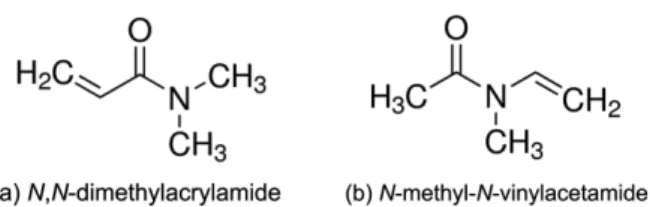
“NMV15”, and “NMV20”, respectively, according to their addition ratios. The optical and physical properties were measured using the average of the five samples for each combination. The mixing ratios for each sample are shown in Table 1. The molecular structures of DMA and NMV, the additives that were used in the experiment, are shown in Fig. 1.
Analysis of the Optical and Physical Characteristics All the samples that were used in the experiments were stored in a standard saline solution 24 hours before the start of the test, and were maintained at the test temperature for at least 2 hours to achieve equilibrium. The water contents of the prepared lens samples were measured using the gravimetric method, and the refractive indices were measured using a DR-A1. The ABBE refractometer manufactured by ATAGO Co., Ltd. was used to measure the water contents
and refractive indices of the lens samples in a hydrated state.
The optical transmittance of each lens sample was measured using a Cary 60 UV-vis spectrophotometer equipped with an Agilent C-60 microscope near the 280-380 nm UV range and the 380-800 nm visible-light range. The thickness measurement required for calculating the oxygen permeability of the lens samples was conducted using OTG-137 of Bristol, Inc., which uses a non-contact measurement method. Oxygen permeability and oxygen transmissibility (Dk/t) measurements were also conducted using the polarographic method, in accordance with ISO 18369-4: 2006. The instrument that was used in this study was a Rehder single-chamber system- O2 permeometer (Rehder, USA), while a thermo-hygrostat WL1000S was used to maintain a constant temperature and humidity. The overall system maintained a constant temperature of 35±0.5 °C, and the humidity was maintained at 97±5%. In each experiment, the measurement results were determined by calculating the average value of the five samples for each combination to ensure reliability.
RESULTS AND DISCUSSION
Lens Manufacturing and Optical Transmittance HEMA, EGDMA as a crosslinking agent, and DMA and NMV as additives were polymerized to obtain a colorless transparent hydrogel lens. In addition, all the combinations of lenses that were hydrated in a standard saline solution
Table 1. Percent compositions of samples (Unit: wt %)
Sample HEMA EGDMA AIBN DMA NMV Total
Ref. 99.40 0.50 0.10 - - 100.00
DMA1 98.42 0.49 0.10 0.99 - 100.00
DMA5 94.67 0.47 0.09 4.76 - 100.00
DMA10 90.37 0.45 0.09 9.09 - 100.00
DMA15 86.44 0.43 0.09 13.04 - 100.00
DMA20 82.84 0.41 0.08 16.67 - 100.00
NMV1 98.42 0.49 0.10 - 0.99 100.00
NMV5 94.67 0.47 0.09 - 4.76 100.00
NMV10 90.37 0.45 0.09 - 9.09 100.00
NMV15 86.44 0.43 0.09 - 13.04 100.00
NMV20 82.84 0.41 0.08 - 16.67 100.00
Figure 1. Structures of additives [(a): DMA, (b): NMV].
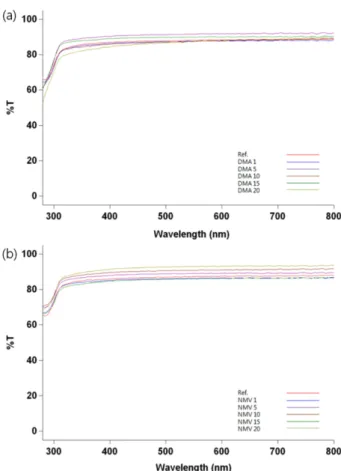
for 24 hours demonstrated flexible and soft characteristics, as shown in Fig. 2. The results of the measurement of the optical transmittance of each sample are shown in Fig. 3.
Optical and Physical Properties
The refractive indices of the prepared lens samples were determined to be 1.4350 for Ref., 1.4330−1.4131 for NMV, and 1.4335−1.4195 for DMA, respectively, confirming that both combinations tended to show a decreasing refractive index compared to Ref. The measurement results are summarized in Fig. 4 and Table 2. Even though the refractive index of the lens is decreased, it is considered that the increase of the water content of the hydrogel lens does not significantly affect the reduction of the Dk value depending on the thickness. Because it shows the effect of improving the oxygen permeability.
The water content of Ref. measured using the gravimetric method was 34.48%, which is the water content of a typical hydrogel lens. In the DMA combinations by ratio, Figure 2. Hydrogel ophthalmic lens samples (Ref., DMA20 and
NMV20).
Figure 3. Spectral transmittance of samples [(a): DMA, (b): NMV].
Figure 4. Refractive indices of samples (DMA and NMV).
Table 2. Optical & physical properties of ophthalmic lens samples
Sample Refractive Index Water Content* Dk/t** Dk*** Transmittance (near-UV)* Transmittance (Visible)*
Ref. 1.4350 34.48 2.424 11.783 81.95 88.49
DMA1 1.4330 35.54 2.555 13.003 80.67 87.78
DMA5 1.4296 37.83 2.587 13.183 85.46 91.56
DMA10 1.4247 41.62 2.939 14.984 86.49 92.28
DMA15 1.4194 45.12 3.244 15.947 85.18 91.15
DMA20 1.4131 49.19 3.505 18.468 80.97 90.20
NMV1 1.4335 36.28 2.235 12.270 82.91 88.81
NMV5 1.4319 37.59 2.619 13.113 83.98 89.73
NMV10 1.4290 39.16 2.758 14.324 84.50 90.42
NMV15 1.4248 41.64 2.945 15.525 82.03 88.27
NMV20 1.4195 44.95 3.112 16.883 84.61 92.15
*Unit of Water Content, transmittance (near-UV, Visible) : Percent (%).
**Unit of Dk/t : ×10−9(cm/sec)(mlO2/ml × mmHg)
***Unit of Dk : ×10−11(cm2/sec)(mlO2/ml × mmHg)
for NMV15, and 44.95% for NMV20. Both combinations showed an overall increase in water content. When the addition ratios of DMA and NMV were over 5%, the marginal increase ratio of the water content of DMA was larger. This result is considered to be influenced by the refractive index. In case of DMA sample with low refractive index, the optical density is low, which is interpreted as a result of increasing the water content of the lens polymer. Therefore, the water content of the lens was different due to the difference of the optical structure of the two materials. In addition, the current value and center thickness of each lens sample were measured and then calculated to determine the oxygen permeability of the fabricated lens. The center thickness of each combination was found to be in the range of 0.48274− 0.54904 µm, which is slightly thicker than a regular hydrogel lens, suggesting that the manufactured lens did not undergo a cutting process designed to provide refractive index. The Dk/t of each sample was determined to be 2.424×10⁻⁹ (cm/sec) (mlO2/ml × mmHg) in the Ref. sample, 2.555− 3.505×10⁻⁹ (cm2/sec) (mlO2/ml × mmHg) when DMA was added by ratio, and 2.235−3.112×10⁻⁹ (cm2/sec) (mlO2/ml
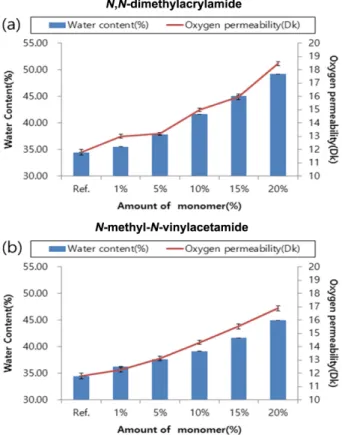
× mmHg) when NMV was added by ratio, somewhat lower than that of the general hydrogel lenses, suggesting that the relatively low oxygen transmissibility of the fabricated lens is due to the fact that the lens was made thick. The oxygen permeability, a characteristic of the material, was determined to be 11.783 × 10⁻¹¹ (cm2/sec) (mlO2/ml × mmHg) for Ref., somewhat similar to the oxygen permeability of a typical hydrogel lens. Also, in the combination in which DMA was added by ratio, DMA1 was 13.003; DMA5, 13.183; DMA10, 14.984; DMA15, 15.947; and DMA20, 18.846x10⁻¹¹ (cm2/sec) (mlO2/ml mmHg), respectively. In the combinations made by adding NMV by ratio, NMV1 was determined to be 12.270; NMV5, 13.113; NMV10, 14.324; NMV15, 15.525; and NMV20, 16.883, respectively, suggesting that the oxygen transmissibility and permeability both increased when DMA or NMV was added. Based on the results of the experiment that was performed in this study, the oxygen permeability increases with increasing water content, similar to the study result obtained by Maldonado-Codina et al.5 The relationship between the water content and oxygen permeability of each combination as well as the current graph transferred to the polarographic cells are shown in Fig. 5-6, respectively. The graph in
Fig. 5 shows that the increase of the water content of DMA is larger than that of NMV, and that the rate of increase of the resulting oxygen permeability is also larger in the former.
In addition, Eeckman et al.13 reported that as the hydrophilic- monomer addition ratio increases, the water content increases as well, hence pushing up the electric conductivity, a phenomenon that is believed to be closely associated with the fact that the oxygen permeability increases in proportion to the increase in water content in the general hydrogel lenses.
Table 2 summarizes the results of the refractive index, optical transmissibility, water content, oxygen transmissibility, and oxygen permeability of each lens combination.
CONCLUSION
This study was conducted to evaluate the optical and physical properties of the lens samples that were made through the copolymerization of HEMA, widely used as a general hydrogel lens material; NMV, a hydrophilic monomer known as a functional material with high electrical conductivity;
and DMA, an amide group with a similar structure, and to examine their applicability as optical lens materials. The Figure 5. Water content and oxygen permeability of samples [(a): DMA, (b): NMV].
results showed that a hydrophilic hydrogel lens with a high water content and high oxygen permeability could be prepared by adding a polar monomer such as DMA and
NMV, and could be used as a highly functional ophthalmic medical material. The results also showed that DMA is highly compatible with the silicone hydrogel lens material, and that NMV, which has the same amide group, is also expected to be useful as a functional medical material with high gas permeability.
Acknowledgments. Publication cost of this paper was supported by the Korean Chemical Society.
REFERENCES
1. Lee, M. J.; Sung, A. Y.; Kim, T. H. J. Korean Ophthalmic Opt. Soc. 2014, 19, 43.
2. Cho, S. A.; Park, S. Y.; Kim, T. H.; Sung, A. Y. Korean J. Vis. Sci. 2012, 14, 69.
3. Lee, M. J.; Sung, A. Y. J. Nanosci. Nanotechnol. 2017, 17, 5505.
4. Ribeiro, A. M.; Figueiras, A.; Veiga, F. J. Pharm. Pharm.
Sci. 2015, 18, 683.
5. Maldonado-Codina, C.; Efron, N. Opt. Prac. 2003, 4, 101.
6. Fang, C.; Jing, Y.; Zong, Y.; Lin, Z. Int. J. Adh. Adh. 2016, 71, 105.
7. Kim, T. H.; Sung, A. Y. J. Korean Chem. Soc. 2010, 54, 761.
8. Hamano, H.; Kawabe, H.; Mitsunaga, S. Eye Contact Lens 1985, 11, 221.
9. Fatt, I. Optician 1985, 190, 25.
10. Brennan, N. A.; Eforn, N.; Holden, B. A. Clin. Exp. Optom.
1986, 69, 82.
11. Ikram, S.; Kumari, M.; Gupta, B. Radiat. Phys. Chem. 2011, 80, 50.
12. Chen, G.; van der Dose, L.; Bantjes, A. J. App. Pol. Sci.
1992, 45, 853.
13. Eeckman, F.; Moës, A. J.; Amighi, K. Eur. Polym. J. 2004, 40, 873.
Figure 6. Probe current and temperature versus time in optical zone [(a) Ref., (b) DMA20, (c) NMV20].
![Figure 6. Probe current and temperature versus time in optical zone [(a) Ref., (b) DMA20, (c) NMV20].](https://thumb-ap.123doks.com/thumbv2/123dokinfo/5298419.153941/5.892.85.428.150.679/figure-probe-current-temperature-versus-time-optical-zone.webp)
