https://doi.org/10.4174/astr.2020.99.2.97 Annals of Surgical Treatment and Research
Oncologic effects of adjuvant chemotherapy in patients with ypT0–2N0 rectal cancer after neoadjuvant
chemoradiotherapy and curative surgery: a meta-analysis
Gi Won Ha, Min Ro Lee
Research Institute of Clinical Medicine of Jeonbuk National University-Biomedical Research Institute of Jeonbuk National University Hospital, Jeonju, Korea
INTRODUCTION
For patients with locally advanced rectal cancer, neoadjuvant chemoradiotherapy (nCRT) followed by radical surgery is the standard treatment. Although nCRT has been shown to increase the control of local disease while reducing toxicity associated with treatment, it has not been shown to improve overall survival (OS) [1,2]. As distant recurrence occurs in roughly 30% of patients [2-5], adjuvant chemotherapy has been used to
stop or destroy circulating tumor cells and micro-metastases in order to decrease distant recurrence. Although adjuvant chemotherapy is recommended for patients who undergo nCRT and radical surgery, the use of adjuvant chemotherapy for patients with rectal cancer following nCRT and radical surgery has not demonstrated a clear benefit, especially for patients that respond well to nCRT, such as ypT0–2N0 [4-6]. Some studies have suggested that adjuvant chemotherapy should be used selectively, as patients treated with nCRT and radical surgery
Received January 20, 2020, Revised May 13, 2020, Accepted May 23, 2020 Corresponding Author: Min Ro Lee
Research Institute of Clinical Medicine of Jeonbuk National University- Biomedical Research Institute of Jeonbuk National University Hospital, 20 Geonji-ro, Deokjin-gu, Jeonju 54907, Korea
Tel: +82-63-250-1570, Fax: +82-63-271-6197 E-mail: [email protected]
ORCID: https://orcid.org/0000-0001-9838-8071
Copyright ⓒ 2020, the Korean Surgical Society
cc Annals of Surgical Treatment and Research is an Open Access Journal. All articles are distributed under the terms of the Creative Commons Attribution Non- Commercial License (http://creativecommons.org/licenses/by-nc/4.0/) which permits unrestricted non-commercial use, distribution, and reproduction in any medium, provided the original work is properly cited.
Purpose: The role of adjuvant chemotherapy for patients with ypT0–2N0 rectal cancer following neoadjuvant chemoradiotherapy (nCRT) and curative surgery is uncertain. We performed a meta-analysis using selected studies to compare adjuvant chemotherapy with observation for this cohort of patients.
Methods: PubMed, Embase, and the Cochrane Library were searched. Data were pooled, and overall effect size was calculated using random effect models. Outcome measures were 5-year overall survival (OS), disease-free survival (DFS), local, and distant recurrence.
Results: We included 17 nonrandomized studies for qualitative analysis and 16 nonrandomized studies that examined 4,747 patients for the meta-analysis. In analysis of patients with ypT0N0 rectal cancer, adjuvant chemotherapy had no significant effect on OS (odds ratio [OR], 1.53; 95% confidence interval [CI], 0.86–2.72; I2 = 27%), DFS (OR, 1.22; 95% CI, 0.61–2.42; I2 = 5%), local recurrence (OR, 0.78; 95% CI, 0.08–7.37; I2 = 0%), and distant recurrence (OR, 1.04; 95% CI, 0.41–2.62; I2 = 0%).
In analysis of patients with ypT1–2N0 rectal cancer, adjuvant chemotherapy also had no significant effect on OS (OR, 2.15;
95% CI, 0.59–7.80; I2 = 26%), DFS (OR, 1.66; 95% CI, 0.35–7.85; I2 = 44%), local recurrence (OR, 2.56; 95% CI, 0.72–9.13; I2 = 0%), and distant recurrence (OR, 1.15; 95% CI, 0.23–5.87; I2 = 0%).
Conclusion: Adjuvant chemotherapy may have no oncologic benefits in patients with ypT0–2N0 rectal cancer after nCRT and radical surgery. Routine use of adjuvant chemotherapy for those patients may be avoided.
[Ann Surg Treat Res 2020;99(2):97-109]
Key Words: Adjuvant chemotherapy, Chemoradiotherapy, Prognosis, Rectal neoplasms
that achieve stage ypT0–2N0 already have a favorable oncologic outcome, so they may not benefit from adjuvant chemotherapy following nCRT and surgery [7-9].
Although there is one previous meta-analysis about adjuvant chemotherapy following nCRT and radical surgery for rectal cancer [10], it did not focus on patients with ypT0–2N0 rectal cancer. Since there were no random trials with a subgroup of ypT0–2 patients excluding N positive, no previous random trial on this subject can be a part of a meta-analysis that focuses solely on ypT0–2N0 patients. Consequently, the hypothesis that adjuvant chemotherapy is beneficial for ypT0–2N0 rectal cancer patients needs stronger evidence for confirmation. Therefore, we performed a meta-analysis to assess the oncologic efficacy of adjuvant chemotherapy for patients with ypT0–2N0 rectal cancer who were treated with nCRT and radical surgery.
METHODS
This meta-analysis followed the recommendations of the Preferred Reporting Items for Systematic Reviews and Meta- Analyses (PRISMA) statement [11]. Multiple comprehensive databases were searched for studies that assessed the oncologic effects of adjuvant chemotherapy compared with observation for patients with ypT0–2N0 rectal cancer after nCRT and radical resection surgery. The study protocol used Cochrane Review Methods [12]. This study was approved exempt from Institutional Review Board of Jeonbuk National University Hospital (No. CUH202001021-HE001).
Data and literature sources
Studies were identified from PubMed (January 1, 1976 to December 13, 2018), Embase (January 1, 1985 to December 13, 2018), and the Cochrane Central Register of Controlled Trials (CENTRAL; January 1, 1987 to December 13, 2018). There were no restrictions regarding the year of publication, and articles in any language were permitted for review. The search terms were
“rectal cancer,” “neoadjuvant chemoradiotherapy,” “adjuvant chemotherapy,” “recurrence,” “prognosis,” and “survival.” After the preliminary electronic search, further articles were searched for manually to retrieve additional studies. Finally, all articles were assessed individually for inclusion.
Study selection and data extraction
Article titles and abstracts were screened and full texts were independently reviewed by 2 reviewers according to the selection criteria. Any differences in judgment regarding inclusion were resolved through discussion between the reviewers.
The included studies assessed survival outcomes, including OS, disease-free survival (DFS), cancer-specific survival (CSS), local recurrence, and distant recurrence, for patients with ypT0–
2N0 rectal cancer after nCRT and radical surgery. Studies were excluded if they: (1) assessed patients with stage IV or recurrent rectal cancer; (2) assessed patients who received neoadjuvant radiotherapy alone without chemotherapy; (3) examined rectal cancer patients who did not receive total mesorectal excision after completion of nCRT; (4) examined rectal cancer patients who had observation after completion of nCRT; (5) had no extractable data and authors were unavailable to provide additional information (e.g., only an abstract was available); or (6) were case series with fewer than 10 patients.
All eligible studies were reviewed and all relevant data were extracted by the 2 reviewers independently using a data extraction form designed before the review. The variables recorded were: (1) standard publication information, including year of publication, name of the first author, and number of patients; (2) clinical and demographic characteristics of all patients; and (3) outcomes (5-year OS, DFS, CSS, local recurrence, and distant recurrence).
Assessment of methodological quality
The methodological quality of the studies included in the meta-analysis was assessed using the Newcastle-Ottawa quality assessment scale (NOS), which attributes a maximum of 9 points to each study and categorizes a study with a score of 6 or more as “high quality” [13]. The quality of the included studies was analyzed using 3 metrics: study group comparability, patient selection, and outcome assessment.
6,593 of records excluded
17 of full-text articles excluded,
with reasons 6,627 of records after
duplicates removed 8,036 of records
potentially relevant identified
6,627 of records screened
34 of full-text articles assessed
for eligibility
17 of studies included in qualitative synthesis
16 of studies included in quantitative synthesis
(meta-analysis)
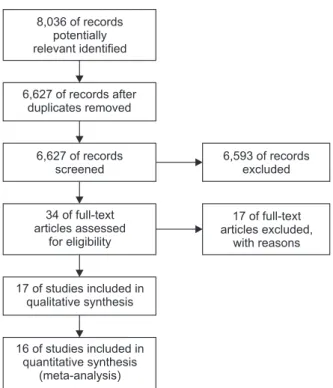
Fig. 1. PRISMA flow diagram.
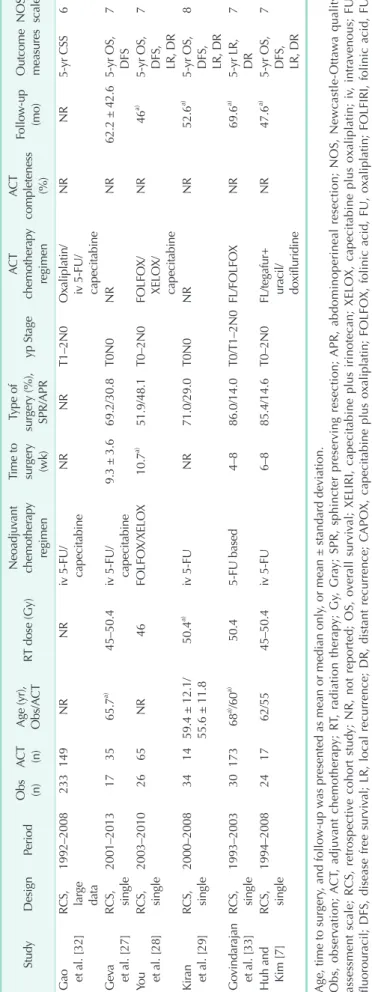
Table 1. Characteristics of the included studies StudyDesignPeriodObs (n)ACT (n)Age (yr), Obs/ACTRT dose (Gy)Neoadjuvant chemotherapy regimen Time to surgery (wk) Type of surgery (%), SPR/APR yp StageACT chemotherapy regimen ACT completeness (%)
Follow-up (mo)Outcome measuresNOS scale Dossa et al. [20]RCS, large data
2006–20121,77568059.545–54NRNRNRT0N0NRNR36.9a)5-yr OS7 Galata et al. [21]RCS, single1999–20125054 62 ± 10.750.4a) Capecitabine/ XELIRI ± cetuximab/ XELOX/iv 5-FU/ panitumumab NR79.8/20.2T0/T1-2N0Capecitabine/ XELOX/ iv 5-FU 83.068 ± 33.73-yr OS, DFS, LR, DR
7 Lu et al. [22]RCS, single2005–2014515852a) 42–50Capecitabine/ CAPOX7.7a) 36.7/63.3T0/T1–2N0Capecitabine/ CAPOX/ FOLFOX/ oxaliplatin +S1
53.250a) 5-yr OS, LR, DR8 Peng et al. [23]RCS, single2008–2014228352.9 ± 11.830–46 (36.2%) 50 (63.8%)XELOX6–869.5/30.5T0N0XELOX74.749a)3-yr OS, DFS7 Gamaleldin et al. [24]RCS, single2000–2012834758.9 ± 11.850.4a)iv 5-FUNRNRT0N0NRNR68.4 ± 38.45-yr OS, DFS, LR, DR
8 Lichthardt et al. [25]RCS, single1992–2013323565a) NRNRNRNRT0/T1–2N0iv 5-FU/ Capecitabine /FOLFOX/ FOLFIRI
NRNR5-yr OS7 Tay et al. [26]PCS, multi2003–20143097NR50a) FluoropyrimidineNRNRT0N0iv 5-FU/ FOLFOX/ capecitabine 71.045.5a) 5-yr OS, RR7 Zhou et al. [30]PCS, single2005–20132119 54 ± 12.650CapeOX/ FOLFOX/ capecitabine
7a)70.0/30.0T0N0CapeOX/ FOLFOX/ capecitabine
NR57a)5-yr DFS, LR, DR8 Jung et al. [31]RCS, single2006–2011810764a)/54a)44a)iv 5-FU/ capecitabine8a)90.0/10.0T1–2N05-FU based10047.8a)5-yr DFS7 Lee et al. [8]RCS, single1999–20091232NR50.4Capecitabine6–886.6/13.4T0/Tis–2N0UFT/ doxifluridine/ capecitabine
NR60.5a) 5-yr OS, DFS, LR7 Park et al. [9]RCS, multi2004–200910691065a) /58a) 50.4a) iv 5-FU/ capecitabine/ irinotecan/ oxaliplatin/oral fluoropyrimidine/ cetuximab
4–1283.6/16.4T0–1/T2N0Capecitabine/ oxaliplatin/ irinotecan NR58a) 5-yr LR, DR7
Table 1. Continued StudyDesignPeriodObs (n)ACT (n)Age (yr), Obs/ACTRT dose (Gy)Neoadjuvant chemotherapy regimen Time to surgery (wk) Type of surgery (%), SPR/APR yp StageACT chemotherapy regimen ACT completeness (%)
Follow-up (mo)Outcome measuresNOS scale Gao et al. [32]RCS, large data
1992–2008233149NRNRiv 5-FU/ capecitabineNRNRT1–2N0Oxaliplatin/ iv 5-FU/ capecitabine
NRNR5-yr CSS6 Geva et al. [27]RCS, single2001–2013173565.7a) 45–50.4iv 5-FU/ capecitabine9.3 ± 3.669.2/30.8T0N0NRNR62.2 ± 42.65-yr OS, DFS7 You et al. [28]RCS, single2003–20102665NR46FOLFOX/XELOX10.7a)51.9/48.1T0–2N0FOLFOX/ XELOX/ capecitabine NR46a)5-yr OS, DFS, LR, DR
7 Kiran et al. [29]RCS, single2000–2008341459.4 ± 12.1/ 55.6 ± 11.850.4a)iv 5-FUNR71.0/29.0T0N0NRNR52.6a)5-yr OS, DFS, LR, DR
8 Govindarajan et al. [33]RCS, single1993–20033017368a) /60a) 50.45-FU based4–886.0/14.0T0/T1–2N0FL/FOLFOXNR69.6a) 5-yr LR, DR7 Huh and Kim [7]RCS, single1994–2008241762/5545–50.4iv 5-FU6–885.4/14.6T0–2N0FL/tegafur+ uracil/ doxifluridine
NR47.6a) 5-yr OS, DFS, LR, DR
7 Age, time to surgery, and follow-up was presented as mean or median only, or mean ± standard deviation. Obs, observation; ACT, adjuvant chemotherapy; RT, radiation therapy; Gy, Gray; SPR, sphincter preserving resection; APR, abdominoperineal resection; NOS, Newcastle-Ottawa quality assessment scale; RCS, retrospective cohort study; NR, not reported; OS, overall survival; XELIRI, capecitabine plus irinotecan; XELOX, capecitabine plus oxaliplatin; iv, intravenous; FU, fluorouracil; DFS, disease free survival; LR, local recurrence; DR, distant recurrence; CAPOX, capecitabine plus oxaliplatin; FOLFOX, folinic acid, FU, oxaliplatin; FOLFIRI, folinic acid, FU, irinotecan; PCS, prospective cohort study; RR, recurrence rate; CapeOX, capecitabine plus oxaliplatin; UFT, tegafur/uracil; CSS, cancer specific survival; FL, FU, folinic acid. a) Median.
Statistical analysis
Odds ratio (OR), variance, and 95% confidence interval (CI) were determined in the meta-analysis. Heterogeneity, including its presence and extent, were assessed using the Q test and I2 index, respectively; a P-value less than 0.1 was considered statistically significant [14]. The DerSimonian- Laird random effects model was used to pool data in light of cross-study heterogeneity [15]. When sufficient data were available, subgroup analyses were performed. For this analysis, patients treated with nCRT and radical surgery were separately categorized as patients with ypT0N0 rectal cancer and patients
with ypT1–2N0 rectal cancer. Sensitivity analyses were also performed to assess the robustness of the meta-analysis findings [16,17]. Sensitivity analysis of the data was determined with the trim-and-fill method and an alternative effects size, and were performed to exclude any studies with large outlying effects. Assessment of publication bias was done using the Egger weighted linear regression test, along with visual inspection of funnel plots showing outcomes [18,19]. Data analyses were performed using Review Manager software (ver.
5.3; Cochrane Collaboration) and Comprehensive Meta-Analysis software (ver. 3; Biostat, Englewood, NJ, USA).
Study or subgroup
Observation
Adjuvant chemotherapy
Dossa et al.
Galata et al.
Gamaleldin et al.
Geva et al.
Huh and Kim Kiran et al.
Lee et al.
Lichthardt et al.
Lu et al.
Peng et al.
Tay et al.
You et al.
Total events
Heterogeneity: Tau = 0.22; chi = 16.22, df = 11 (P = 0.13); I = 32%
Test for overall effect: Z = 2.08 (P = 0.04) Total (95% CI)
2 2 2
209 6 11 1 4 2 0 5 7 3 2 4
254 Events Total
1,775 50 83 17 24 34 38 32 51 22 30 26 2,182
Weight 26.4%
4.7%
11.3%
4.5%
6.2%
3.7%
2.8%
4.5%
11.2%
7.8%
8.2%
8.6%
100.0%
34 1 4 5 2 1 8 1 5 4 17 4
86 680
54 47 35 17 14 87 35 58 83 97 65 1,272 Events Total
2.54 [1.74, 3.69]
7.23 [0.84, 62.32]
1.64 [0.49, 5.48]
0.38 [0.04, 3.49]
1.50 [0.24, 9.30]
0.81 [0.07, 9.76]
0.12 [0.01, 2.16]
6.30 [0.69, 57.15]
1.69 [0.50, 5.69]
3.12 [0.64, 15.12]
0.34 [0.07, 1.55]
2.77 [0.64, 12.05]
1.71 [1.03, 2.85]
OR
M H, random, 95% CI
Favours [observation]
Favours [adjuvant chemotherapy]
OR
M H, random, 95% CI
100
0.01 0.1 1 10
Study or subgroup
Observation
Adjuvant chemotherapy
Galata et al.
Gamaleldin et al.
Geva et al.
Huh and Kim Jung et al.
Kiran et al.
Lee et al.
Peng et al.
You et al.
Zhou et al.
Total events
Heterogeneity: Tau = 0.08; chi = 10.12, df = 9 (P = 0.43); I = 11%
Test for overall effect: Z = 1.57 (P = 0.12) Total (95% CI)
2 2 2
7 12 1 6 2 4 0 3 7 5
47
Events Total
50 83 17 24 8 34 38 22 26 21 323
Weight 11.8%
15.7%
5.4%
10.0%
8.5%
9.0%
3.2%
11.0%
17.5%
7.9%
100.0%
3 4 7 3 14 3 9 6 9 2
60 54 47 35 17 107 14 87 83 65 19 528 Events Total
2.77 [0.67, 11.36]
1.82 [0.55, 5.99]
0.25 [0.03, 2.22]
1.56 [0.33, 7.34]
2.21 [0.41, 12.07]
0.49 [0.09, 2.54]
0.11 [0.01, 1.89]
2.03 [0.46, 8.85]
2.29 [0.75, 7.00]
2.66 [0.45, 15.69]
1.52 [0.90, 2.55]
OR
M H, random, 95% CI
Favours [observation]
Favours [adjuvant chemotherapy]
OR
M H, random, 95% CI
100
0.01 0.1 1 10
A
B
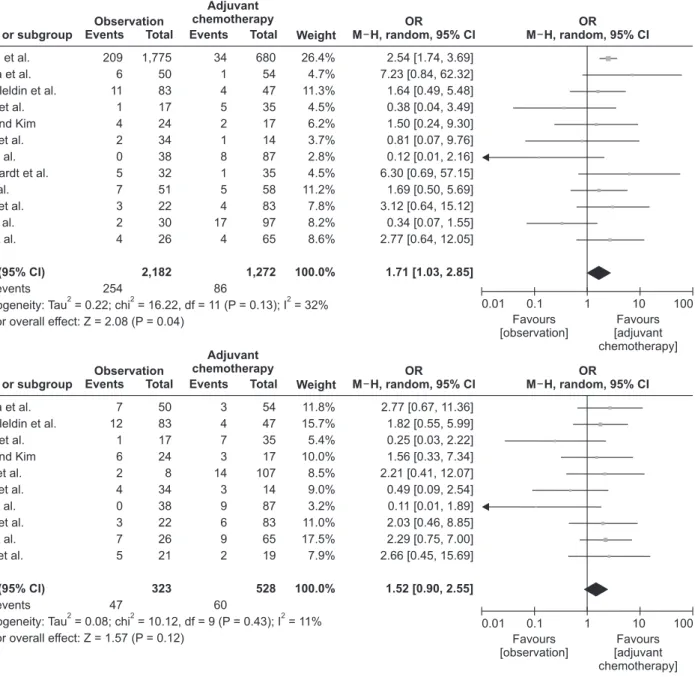
Fig. 2. Meta-analysis of the effects of adjuvant chemotherapy. (A) On overall survival (OS) in patients with ypT0–2N0 rectal cancer after neoadjuvant chemoradiotherapy (nCRT) and radical surgery. (B) On disease-free survival (DFS) in patients with ypT0–2N0 rectal cancer after nCRT and radical surgery. (C) On local and distant recurrence in patients with ypT0–2N0 rectal cancer after nCRT and radical surgery. OR, odds ratio; CI, confidence interval; df, degree of freedom.
RESULTS
Description of studies
The predefined search strategy and manual searching identified 8,036 potentially relevant articles. We excluded 1,409 articles because they were duplicates, and 6,593 articles because their titles and abstracts did not fulfill the selection criteria. After full text review of the remaining 34 articles, we excluded 17 articles because of the exclusion criteria of this study. Therefore, we included 17 nonrandomized studies for qualitative analysis and 16 nonrandomized studies that examined 4,747 patients for the meta-analysis (Fig. 1). Twelve studies evaluated OS [7,8,20-29], 10 studies evaluated DFS [7,8,21,23,24,27-31], one study evaluated CSS [32], 10 studies evaluated local recurrence [7-9,21,22,24,28-30,33], and 8 studies evaluated distant recurrence [7,9,21,22,24,28,30,33].
Eight studies examined patients with ypT0–2N0 rectal cancer
[7,9,21,22,25,28,29,33]; among these, 5 studies separately analyzed patients with ypT0N0 and ypT1–2N0 rectal cancer [8,21,22,25,33]. Seven studies examined patients with ypT0N0 rectal cancer alone [20,23,24,26,27,29,30], and 2 studies examined patients with ypT1–2N0 rectal cancer alone [31,32].
Evaluation of methodological quality showed all studies scored high (≥6) on the NOS. Table 1 summarizes the characteristics of included studies.
Oncologic outcomes of adjuvant chemotherapy in patients with ypT0–2N0
Analysis of oncologic effects of adjuvant chemotherapy in patients with ypT0–2N0 indicated that 12 studies (3,454 patients) reported data on OS; patients who received adjuvant chemotherapy had better survival than patients who were not (OR, 1.71; 95% CI, 1.03–2.85; I2 = 32%) (Fig. 2A). Ten studies (851 patients) reported data on DFS; there were no significant
Study or subgroup
Observation
Adjuvant chemotherapy
2.1.1 Local recurrence
Subtotal (95% CI)
2.1.2 Distant recurrence
Subtotal (95% CI) Galata et al.
Gamaleldin et al.
Covindarajan et al.
Huh and Kim Kiran et al.
Lee et al.
Lu et al.
Park et al.
You et al.
Zhou et al.
Total events
Heterogeneity: Tau = 0.00; chi = 4.47, df = 7 (P = 0.72); I = 0%
Test for overall effect: Z = 1.88 (P = 0.06)
Galata et al.
Gamaleldin et al.
Govindarajan et al.
Huh and Kim Lu et al.
Park et al.
You et al.
Zhou et al.
Total events
Heterogeneity: Tau = 0.00; chi = 3.37, df = 7 (P = 0.85); I = 0%
Test for overall effect: Z = 1.76 (P = 0.08)
Test for subgroup differences: chi = 0.33, df = 1 (P = 0.57); I = 0%
2 2 2
2 2 2
2 2
1 0 3 1 1 0 2 5 2 0
15
5 4 1 4 10 11 3 3
41
Events Total
50 83 30 24 34 38 51 106 26 21
50 83 30 24 51 106 26 21 463
391
Weight
4.2%
18.0%
5.3%
4.1%
4.8%
4.6%
44.2%
14.8%
8.9%
8.3%
4.5%
3.8%
20.1%
43.3%
5.7%
5.4%
100.0%
100.0%
0 0 4 1 0 3 0 23 5 0
36
3 3 10 1 9 63 2 2
93 54 47 173 17 14 87 58 910 65 19
54 47 173 17 58 910 65 19 1,444
1,343 Events Total
3.30 [0.13, 82.97]
Not estimable 4.69 [1.00, 22.14]
0.70 [0.04, 11.96]
1.30 [0.05, 33.80]
0.31 [0.02, 6.22]
5.91 [0.28, 126.01]
1.91 [0.71, 5.13]
1.00 [0.18, 5.51]
Not estimable
1.89 [0.43, 8.35]
0.74 [0.16, 3.47]
0.56 [0.07, 4.56]
3.20 [0.32, 31.53]
1.33 [0.49, 3.58]
1.56 [0.79, 3.06]
4.11 [0.64, 26.18]
1.42 [0.21, 9.55]
1.88 [0.97, 3.62]
1.49 [0.96, 2.32]
OR
M H, random, 95% CI
OR
M H, random, 95% CI
Favours [observation]
Favours [adjuvant chemotherapy]
100
0.01 0.1 1 10
C
Fig. 2. Continued.
survival differences between the observation and adjuvant chemotherapy groups (OR, 1.52; 95% CI, 0.90–2.55; I2 = 11%) (Fig. 2B). Ten studies (1,907 patients) reported data on local recurrence; there were no significant survival differences between the observation and adjuvant chemotherapy groups (OR, 1.88; 95% CI, 0.97–3.62; I2 = 0%) (Fig. 2C). Eight studies (1,734 patients) reported data on distant recurrence; there were
no significant survival differences between the observation and adjuvant chemotherapy groups (OR, 1.49; 95% CI, 0.96–2.32; I2 = 0%) (Fig. 2C). On the other hand, there was only one study that reported data on CSS; therefore, we could not perform a meta- analysis on this outcome metric.
Sensitivity analyses using predefined methods indicated that the results of these meta-analyses were robust except for data
Study or subgroup
Observation
Adjuvant chemotherapy
3.1.1 ypT0N0 OS
Subtotal (95% CI)
3.1.2 ypT0N0 DFS
Subtotal (95% CI)
3.1.3 ypT0N0 local recurrence
Subtotal (95% CI) Dossa et al.
Galata et al.
Gamaleldin et al.
Geva et al.
Kiran et al.
Lee et al.
Lichthardt et al.
Lu et al.
Peng et al.
Tay et al.
Total events
Heterogeneity: Tau = 0.20; chi = 12.30, df = 9 (P = 0.20); I = 27%
Test for overall effect: Z = 1.44 (P = 0.15)
Galata et al.
Gamaleldin et al.
Geva et al.
Kiran et al.
Lee et al.
Peng et al.
Zhou et al.
Total events
Heterogeneity: Tau = 0.00; chi = 3.37, df = 7 (P = 0.85); I = 0%
Test for overall effect: Z = 1.76 (P = 0.08)
Gamaleldin et al.
Govindarajan et al.
Huh and Kim Kiran et al.
Lee et al.
Zhou et al.
Total events
Heterogeneity: Tau = 0.00; chi = 0.18, df = 1 (P = 0.67); I = 0%
Test for overall effect: Z = 0.22 (P = 0.83)
2 2 2
2 2 2
2 2 2
209 2 11 1 2 0 4 3 3 2
237
2 12 1 4 0 3 5
27
0 0 0 1 0 0
1 Events Total
1,775 20 83 17 34 12 15 29 22 30
20 83 17 34 12 22 21
83 9 10 34 12 21 2,037
209
169
Weight
36.2%
3.2%
14.9%
5.8%
4.8%
3.3%
3.3%
7.7%
10.2%
10.7%
4.8%
29.6%
9.6%
16.4%
5.2%
20.2%
14.2%
47.6%
52.4%
100.0%
100.0%
100.0%
34 0 4 5 1 3 0 2 4 17
70
0 4 7 3 4 6 2
26
0 0 0 0 2 0
2 680
12 47 35 14 32 9 22 83 97
12 47 35 14 32 83 19
47 64 17 14 32 19 1,031
242
193 Events Total
2.54 [1.74, 3.69]
3.38 [0.15, 76.51]
1.64 [0.49, 5.48]
0.38 [0.04, 3.49]
0.81 [0.07, 9.76]
0.34 [0.02, 7.02]
7.43 [0.35, 156.28]
1.15 [0.18, 7.58]
3.12 [0.64, 15.12]
0.34 [0.07, 1.55]
3.38 [0.15, 76.51]
1.82 [0.55, 5.99]
0.25 [0.03, 2.22]
0.49 [0.09, 2.54]
0.25 [0.01, 5.07]
2.03 [0.46, 8.85]
2.66 [0.45, 15.69]
Not estimable Not estimable Not estimable 1.30 [0.05, 33.80]
0.49 [0.02, 10.91]
Not estimable 1.53 [0.86, 2.72]
1.22 [0.61, 2.42]
0.78 [0.08, 7.37]
OR
M H, random, 95% CI
OR
M H, random, 95% CI
Favours [observation]
Favours [adjuvant chemotherapy]
100
0.01 0.1 0 10
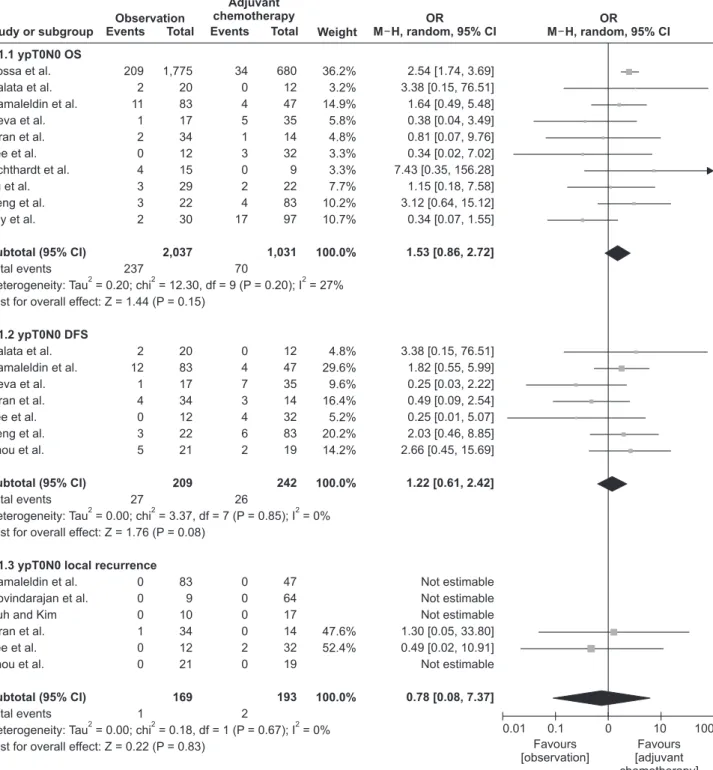
Fig. 3. Subgroup analysis of oncologic effects of adjuvant chemotherapy in patients with ypT0N0 rectal cancer. OR, odds ratio;
CI, confidence interval; df, degree of freedom; OS, overall survival; DFS, disease-free survival.
on OS. Excluding one study with a large outlying effect [20], OS between the observation and adjuvant chemotherapy groups was not significantly different (OR, 1.48; 95% CI, 0.80–2.75; I2 = 27%).
Subgroup analysis of ypT0N0 rectal cancer patients
The oncologic effects of adjuvant chemotherapy were determined in 2 subgroups, according to the final pathologic stage. They were separately determined in patients with ypT0N0 and ypT1–2N0 rectal cancer who were treated with nCRT and radical surgery.
The first subgroup consisted of patients with ypT0N0 rectal cancer. The results show that adjuvant chemotherapy had no significant effect on OS (OR, 1.53; 95% CI, 0.86–2.72; I2 = 27%), DFS (OR, 1.22; 95% CI, 0.61–2.42; I2 = 5%), local recurrence (OR, 0.78; 95% CI, 0.08–7.37; I2 = 0%), and distant recurrence (OR, 1.04; 95% CI, 0.41–2.62; I2 = 0%) (Fig. 3).
Subgroup analysis of ypT1–2N0 rectal cancer patients
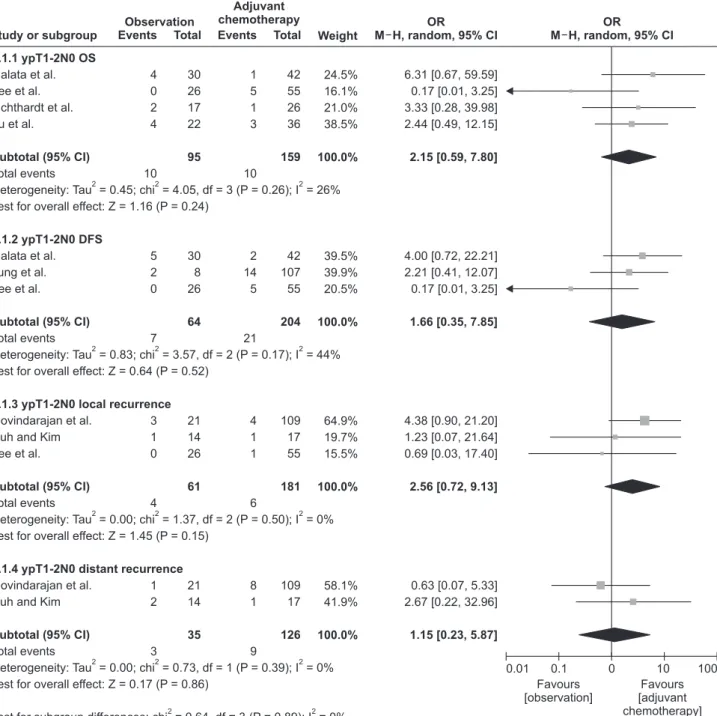
A second subgroup consisted of patients with ypT1–2N0 rectal cancer. The results show that adjuvant chemotherapy had no significant effect on OS (OR, 2.15; 95% CI, 0.59–7.80; I2 = 26%), DFS (OR, 1.66; 95% CI, 0.35–7.85; I2 = 44%), local recurrence (OR, 2.56; 95% CI, 0.72–9.13; I2 = 0%), and distant recurrence (OR, 1.15; 95% CI, 0.23–5.87; I2 = 0%) (Fig. 4).
Publication bias
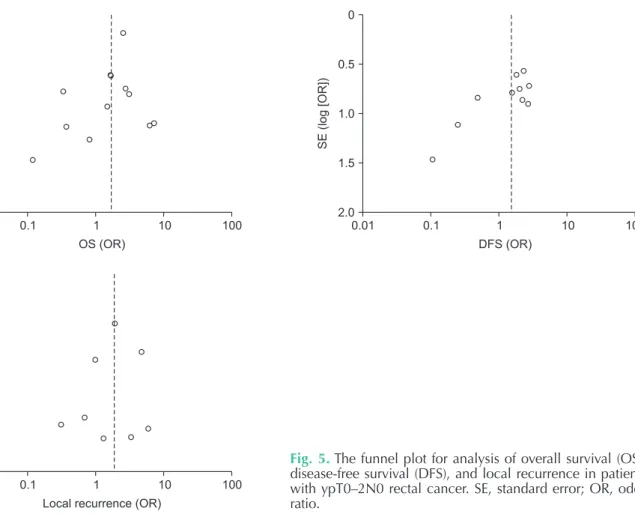
Publication bias was analyzed using the Egger weighted linear regression test, which assesses the asymmetry of funnel plots, and visual inspection of funnel plots (Fig. 5). The funnel plot for analysis of OS (P = 0.075) and DFS (P = 0.007) in patients with ypT0–2N0 was found to be asymmetrical, indicating the presence of publication bias. However, the funnel plots for
analysis of local recurrence (P = 0.31) in patients with ypT0–
2N0 indicated no publication bias.
DISCUSSION
For patients with locally advanced rectal cancer who were treated with nCRT, transabdominal resection can be performed.
According to the guidelines of National Comprehensive Cancer Networ, adjuvant chemotherapy is recommended to improve survival rates in these patients, regardless of their pathologic stage after surgery. The treatment strategy to use adjuvant chemotherapy has been guided by studies on colon cancer [34-36], and has also been guided by the thesis that tumor downstaging after nCRT may suggest a favorable tumor biology that can be correlated with further responsivity to additional chemotherapy. The theory further suggests that patients with a proven responsivity to treatment may benefit from adjuvant chemotherapy insofar as potentially eliminating residual micrometastatic disease [37,38]. Further, a recent meta-analysis demonstrated improved OS with adjuvant chemotherapy in patients with a downstaged tumor following nCRT and radical surgery [10].
However, in clinical practice, patients’ compliance with adjuvant chemotherapy is poor, with only about half to two- thirds of patients continuing with it [39,40]. Further, adjuvant chemotherapy after local treatment is usually not well tolerated and often cannot be completed by older patients and those with comorbidities. In addition, patients with a positive response to nCRT are expected to have improved outcomes, and adjuvant chemotherapy may not be needed for them [9,29].
Some studies showed that patients with ypT3–4 or ypN+ rectal cancer that were treated with nCRT and radical surgery had worse oncological outcomes where adjuvant chemotherapy was required; whereas patients with a positive response to
Study or subgroup
Observation
Adjuvant chemotherapy
3.1.4 ypT0N0 distant recurrence
Subtotal (95% CI) Gamaleldin et al.
Govindarajan et al.
Huh and Kim Kiran et al.
Zhou et al.
Total events
Heterogeneity: Tau = 0.00; chi = 2.13, df = 4 (P = 0.71); I = 0%
Test for overall effect: Z = 0.09 (P = 0.93)
Test for subgroup differences: chi = 0.75, df = 3 (P = 0.86); I = 0%
2 2 2
2 2
4 0 2 3 3
12
Events Total
83 9 14 34 21 161
Weight
35.8%
8.8%
8.7%
23.3%
23.4%
100.0%
3 2 0 2 2
9 47 64 17 14 19 161 Events Total
0.74 [0.16, 3.47]
1.32 [0.06, 29.56]
7.00 [0.31, 158.83]
0.58 [0.09, 3.92]
1.42 [0.21, 9.55]
1.04 [0.41, 2.62]
OR
M H, random, 95% CI
OR
M H, random, 95% CI
Favours [observation]
Favours [adjuvant chemotherapy]
100
0.01 0.1 0 10
Fig. 3. Continued.
nCRT, such as ypT0–2N0 rectal cancer, were expected to have improved survival outcomes and may not need adjuvant chemotherapy [9,29]. Therefore, the hypothesis that adjuvant chemotherapy is beneficial for ypT0–2 rectal cancer patients needs better evidence for confirmation. However, the only previous meta-analysis on this topic did not focus on patients with ypT0–2N0 rectal cancer, so we performed the present meta-analysis. To our knowledge, the present study is the first meta-analysis evaluating the effect of adjuvant chemotherapy in patients with ypT0–2N0 rectal cancer after nCRT and radical
surgery.
Our primary analysis of ypT0–2N0 rectal cancer patients indicated that adjuvant chemotherapy was associated with better OS, but there were no associations between adjuvant chemotherapy and DFS, local recurrence, and distant recurrence.
However, the studies included in patients with ypT0–2N0 were heterogeneous in terms of groups of participants. To account for this affect, it was necessary to perform sensitivity analysis for confirmation of robustness in this meta-analysis. As a result, although there was a survival difference in the analysis of OS,
Study or subgroup
Observation
Adjuvant chemotherapy
4.1.1 ypT1-2N0 OS
Subtotal (95% CI)
4.1.2 ypT1-2N0 DFS
Subtotal (95% CI)
4.1.3 ypT1-2N0 local recurrence
Subtotal (95% CI)
4.1.4 ypT1-2N0 distant recurrence
Subtotal (95% CI) Galata et al.
Lee et al.
Lichthardt et al.
Lu et al.
Total events
Heterogeneity: Tau = 0.45; chi = 4.05, df = 3 (P = 0.26); I = 26%
Test for overall effect: Z = 1.16 (P = 0.24)
Galata et al.
Jung et al.
Lee et al.
Total events
Heterogeneity: Tau = 0.83; chi = 3.57, df = 2 (P = 0.17); I = 44%
Test for overall effect: Z = 0.64 (P = 0.52)
Govindarajan et al.
Huh and Kim Lee et al.
Total events
Heterogeneity: Tau = 0.00; chi = 1.37, df = 2 (P = 0.50); I = 0%
Test for overall effect: Z = 1.45 (P = 0.15)
Govindarajan et al.
Huh and Kim
Total events
Heterogeneity: Tau = 0.00; chi = 0.73, df = 1 (P = 0.39); I = 0%
Test for overall effect: Z = 0.17 (P = 0.86)
Test for subgroup differences: chi = 0.64, df = 3 (P = 0.89); I = 0%
2 2 2
2 2 2
2 2 2
2 2 2
2 2
4 0 2 4
10
5 2 0
7
3 1 0
4
1 2
3 Events Total
30 26 17 22
30 8 26
21 14 26
21 14 95
64
61
35
Weight
24.5%
16.1%
21.0%
38.5%
39.5%
39.9%
20.5%
64.9%
19.7%
15.5%
58.1%
41.9%
100.0%
100.0%
100.0%
100.0%
1 5 1 3
10
2 14 5
21
4 1 1
6
8 1
9 42 55 26 36
42 107 55
109 17 55
109 17 159
204
181
126 Events Total
6.31 [0.67, 59.59]
0.17 [0.01, 3.25]
3.33 [0.28, 39.98]
2.44 [0.49, 12.15]
4.00 [0.72, 22.21]
2.21 [0.41, 12.07]
0.17 [0.01, 3.25]
4.38 [0.90, 21.20]
1.23 [0.07, 21.64]
0.69 [0.03, 17.40]
0.63 [0.07, 5.33]
2.67 [0.22, 32.96]
2.15 [0.59, 7.80]
1.66 [0.35, 7.85]
2.56 [0.72, 9.13]
1.15 [0.23, 5.87]
OR
M H, random, 95% CI
OR
M H, random, 95% CI
Favours [observation]
Favours [adjuvant chemotherapy]
100
0.01 0.1 0 10
Fig. 4. Subgroup analysis of oncologic effects of adjuvant chemotherapy in patients with ypT1–2N0 rectal cancer. OR, odds ratio; CI, confidence interval; df, degree of freedom; OS, overall survival; DFS, disease-free survival.
adjuvant chemotherapy was not associated with better OS after excluding one study in a sensitivity analysis. In that case, the primary result for OS was modified by excluding a study that assessed a large number of patients with ypT0N0 disease only, as inclusion of such a large study with ypT0N0 patients would inaccurately distort the results [20]. Eventually, we found that subgroup analysis separating into ypT0N0 and ypT1–2N0 patients provided a more robust analysis.
Subgroup analyses, in terms of OS, DFS, and local and distant recurrence, determined no oncologic effects of adjuvant chemotherapy, both for patients with ypT0N0 and ypT1–2N0.
Although patients with ypT0–2N0 rectal cancer are regarded as responding well to nCRT, there was a need to explore patients with ypT0N0 and ypT1–2N0 separately. There were 2 studies reporting ypT stage as a prognostic predictor [8,33]
and another reporting ypN stage as an independent prognostic factor influencing oncological outcomes [41]. These studies may suggest that final TNM staging could help predict oncological outcomes [38,42]. Tumor response to nCRT can range from no response to a complete pathological response (pCR), where no tumor is seen in the specimen subsequent to rectal resection.
This response may also help predict overall prognosis, as patients with pCR (ypT0N0) appear to have improved survival prognosis in general [43,44]. In addition, a study reported that
dividing patients between ypT1–2N0 and ypT0N0 showed that response to nCRT in ypT1–2N0 patients treated with adjuvant chemotherapy had a significantly longer recurrence- free time [45]. Therefore, separating into 2 subgroups was more reasonable to determine oncologic effects of adjuvant chemotherapy.
According to the results of this meta-analysis, adjuvant chemotherapy may be an overtreatment for patients with ypT0N0 and ypT1–2N0 rectal cancer after nCRT and radical surgery, as it may lead to a lack of benefit regarding oncologic outcomes along with the adverse effects of the therapy itself.
Such chemotherapy may delay recovery from the surgery and delay closure of ileostomy. Nevertheless, this meta-analysis has several limitations. First, it was based on an analysis of nonrandomized studies. Second, there could be a potential heterogeneity across the included studies, even though subgroup and sensitivity analyses were performed. For example, there were clinical differences regarding radiation dose and chemotherapeutic agents during nCRT. In addition, the regimen of adjuvant chemotherapy and duration of its use also varied among the included studies. Third, although 5-year survival rates and recurrence rates were outcome measures, there were differences in the median follow-up period among the included studies, which may affect oncologic outcomes.
0.01 100
SE(log[OR])
OS (OR) 0
0.5
1.0
1.5
2.0
0.1 1 10 0.01 100
SE(log[OR])
DFS (OR) 0
0.5
1.0
1.5
2.0
0.1 1 10
0.01 100
SE(log[OR])
Local recurrence (OR) 0
0.5
1.0
1.5
2.0
0.1 1 10
Fig. 5. The funnel plot for analysis of overall survival (OS), disease-free survival (DFS), and local recurrence in patients with ypT0–2N0 rectal cancer. SE, standard error; OR, odds ratio.
In conclusion, based on this meta-analysis, patients with ypT0–2N0 rectal cancer after nCRT and radical surgery may not benefit from adjuvant chemotherapy with respect to long term oncologic outcomes, including OS, DFS, and local and distant recurrence. Therefore, routine use of adjuvant chemotherapy for those patients may be avoided but selective use of adjuvant chemotherapy is recommended. As this is a meta-analysis of non-randomly controlled studies, a random controlled trial would provide a higher degree of evidence to confirm this result.
ACKNOWLEDGEMENTS
The authors wish to thank Professor Jong Hun Kim for some very helpful discussion.
An abstract of this paper was presented at the 52th Annual Meeting of the Korean Society of Coloproctology, Jeju, South Korea, April 5–7, 2019, where it received an award for best
poster.
Conflicts of Interest
No potential conflict of interest relevant to this article was reported.
ORCID iD
Gi Won Ha: https://orcid.org/0000-0001-9401-1760 Min Ro Lee: https://orcid.org/0000-0001-9838-8071
Author Contribution
Conceptualization: MRL Formal Analysis: GWH Investigation: GWH, MRL Methodology: GWH
Project Administration: GWH, MRL Writing – Original Draft: GWH, MRL Writing – Review & Editing: GWH, MRL
REFERENCES
1. Scott NA, Susnerwala S, Gollins S, Myint AS, Levine E. Preoperative neo- adjuvant therapy for curable rectal cancer:
reaching a consensus 2008. Colorectal Dis 2009;11:245-8.
2. Sauer R, Liersch T, Merkel S, Fietkau R, Hohenberger W, Hess C, et al. Preoperative versus postoperative chemoradiotherapy for locally advanced rectal cancer:
results of the German CAO/ARO/AIO- 94 randomized phase III trial after a median follow-up of 11 years. J Clin Oncol 2012;30:1926-33.
3. van Gijn W, Marijnen CA, Nagtegaal ID, Kranenbarg EM, Putter H, Wiggers T, et al.
Preoperative radiotherapy combined with total mesorectal excision for resectable rectal cancer: 12-year follow-up of the multicentre, randomized controlled TME trial. Lancet Oncol 2011;12:575-82.
4. Bosset JF, Calais G, Mineur L, Maingon P, Stojanovic-Rundic S, Bensadoun RJ, et al.
Fluorouracil-based adjuvant chemotherapy after preoperative chemoradiotherapy in rectal cancer: long-term results of the EORTC 22921 randomised study. Lancet Oncol 2014;15:184-90.
5. Breugom AJ, van Gijn W, Muller EW, Berglund Å, van den Broek CB, Fokstuen T, et al. Adjuvant chemotherapy for rectal cancer patients treated with preoperative (chemo)radiotherapy and total mesorectal excision: a Dutch Colorectal Cancer Group (DCCG) randomized phase III trial. Ann Oncol 2015;26:696-701.
6. Glynne-Jones R, Counsell N, Quirke P, Mortensen N, Maraveyas A, Meadows HM, et al. Chronicle: results of a randomised phase III trial in locally advanced rectal cancer after neoadjuvant chemoradiation randomising postoperative adjuvant capecitabine plus oxaliplatin (XELOX) versus control. Ann Oncol 2014;25:1356- 62.
7. Hu h J W, K i m H R . Po st op er at ive chemot herapy af ter neoadjuvant chemoradiation and surgery for rectal cancer: is it essential for patients with ypT0-2N0? J Surg Oncol 2009;100:387-91.
8. Lee KH, Kim JC, Kim JY, Kim JS. Oncologic results and prognostic predictors of patients with locally advanced rectal cancer showing ypN0 after radical surgery following neoadjuvant
chemoradiotherapy. Int J Colorectal Dis 2015;30:1041-50.
9. Park IJ, Kim DY, Kim HC, Kim NK, Kim HR, Kang SB, et al. Role of adjuvant chemotherapy in ypT0-2N0 patients treated with preoperative chemoradiation therapy and radical resection for rectal cancer. Int J Radiat Oncol Biol Phys 2015;92:540-7.
10. Petrelli F, Coinu A, Lonati V, Barni S. A systematic review and meta-analysis of adjuvant chemotherapy after neoadjuvant treatment and surgery for rectal cancer.
Int J Colorectal Dis 2015;30:447-57.
11. Moher D, Liberati A, Tetzlaff J, Altman DG; PRISMA Group. Preferred reporting items for systematic reviews and meta- analyses: the PRISMA statement. Ann Intern Med 2009;151:264-9, W64.
12. Higgins JPT, Green S, editors. Cochrane handbook for systematic reviews of interventions, version 5.1.0. Chichester:
Wiley; 2011.
13. Wells GA, Shea B, O'Connell D, Peterson J, Welch V, Losos M, et al. The Newcastle- Ottawa scale (NOS) for assessing the quality of nonrandomized studies in