서 론
미꾸리과(Cobitidae) 어류는 잉어목(Cypriniformes), 미꾸리 상과(Cobitoidea)에 속하며 유라시아(Eurasia)의 강과 하천에 넓게 서식하는 저서성 소형어류로 21속 171종이 보고되었다 (Kottelat, 2012; Nelson et al., 2016). 우리나라에는 5속 16종이 서식하는데, 이 중 3속 13종이 한국 고유속, 고유종으로 알려 져 있고, 연구종이 속한 참종개속 Iksookimia은 6종이 지리적 으로 나뉘어 서식하고 있다(Kim, 1997, 2009; Vasil’eva et al., 2016). 동방종개 Iksookimia yongdokensis는 1997년 Kim and Park에 의해 왕종개 I. longicorpa와 구별되는 신종으로 보고되 었으며 지리적으로 우리나라의 동남부 지역인 형산강과 영덕
오십천, 축산천, 송천 일대에만 서식한다(Kim and Park, 1997).
동방종개는 핵형분석(Kim et al., 1999)을 통해 4배체 생물로 확인되어 주목받았고, 그 밖에 난막구조(Park and Kim, 2001), 분자계통학적 연구(Šlechtová et al., 2008; Kwan, 2015; Per
dices et al., 2016) 등이 수행되었다. 또한 2011년 한국의 멸종 위기 야생동·식물 적색자료집(어류)에서는 최근 하천공사로 서식지가 교란되고 있어 관심대상종(LC)으로 평가된 바 있으 며(NIBR, 2011), 근래에는 생태학적 연구를 통해 서식지와 연 령, 산란기 특징이 보고되었다(Ko et al., 2016). 그러나 아직까 지 이들의 행동주기 및 섭식생태에 대해서는 연구된 바 없다.
우리나라 미꾸리과 어류의 섭식 생태학적 연구는 Uchida (1939)에 의해 처음 진행된 후 많은 종들에서 이루어졌는데, 주로 동물성 먹이와 크기가 작은 조류(Algae)를 함께 섭식하 기 때문에 종에 따라 분석방법에 차이가 있어 왔다. 참종개
—27 — http://www.fishkorea.or.kr
한국고유종 동방종개 Iksookimia yongdokensis (Pisces: Cobitidae)의 활동주기 및 섭식생태
고명훈1·김효진2·명라연1·원용진1,2,
*
1이화여자대학교 에코과학부, 2에코크리에티브협동과정
The Activity Period and Feeding Ecology of the Korean Eastern Spined Loach, Iksookimia yongdokensis (Pisces: Cobitidae) by Myeong-Hun Ko1, Hyo-Jin Kim2, Ra-Yeon Myung1 and Yong-Jin Won1,2,* (1Division of EcoScience and 2Interdisciplinary Program of EcoCreative, Ewha Womans University, Seoul 03760, Republic of Korea)
ABSTRACT The activity period and feeding ecology of the Iksookimia yongdokensis were investigated to obtain baseline data for its ecological characteristics in the Chuksan Stream and Gokgang Stream, Gyeongsangbuk-do, Korea from 2015 to 2016. I. yongdokensis were active on cobble, pebble and sand bottom from March to November when the water temperature exceeded 10°C, but tended to overwinter in cobble and pebble during the winter months(December~February) when the water temperature was lower than 10°C. During the day from 9 am to 15 pm, individuals of I. yongdokensis were highly active with a high rate of food consumption. I. yongdokensis activley fed on the surface of stone, pebble and sand as a filter feeder. Their main food sources analyzed with an index of relative importance(IRI) include Chironomidae(54.7%), Branchiopoda(10.1%), Rotatoria(8.7%), Arcellidae(8.6%), Chlorophyceae(6.5%) and Bacillariophyceae(5.1%). Juveniles of I.
yongdokensis(total length 20~39mm) fed on small-sized preys such as Rotatoria, Branchiopoda and Arcellidae, but they exhibited a transition in their prey-size markedly dominated by large-sized preys such as Chironomidae and Ephemeroptera as they grow.
Key words: Iksookimia yongdokensis, spined loach, feeding ecology, activity period
* Corresponding author: YongJin Won Tel: 82232774630, Fax: 82232772385, Email: [email protected]
ISSN: 1225-8598(Print), 2288-3371(Online)
Accepted: March 23, 2018
I. koreensis(Kim, 1978)와 부안종개 I. pumila(Kim and Lee, 1984), 새코미꾸리 Koreocobitis rotundicaudata(Byeon, 2007), 수수미꾸리 Kichulchoia multifasciata(Chong, 1986), 남방종 개 I. hugowolfeldi(Choi, 2003), 북방종개 I. pacifica(Choi and Byeon, 2009) 등은 먹이 수로만 분석되었고, 왕종개(Kim and Ko, 2005)와 줄종개 Cobitis tetralineata(Kim et al., 2006), 참종개, 점줄종개 C. nalbanti(Ko et al., 2009), 기름종개 C.
hankugensis(Ko, 2009), 남방종개(Park, 2016)는 먹이 개체 수와 부피로 나누어 계산되었으며, 좀수수치 K. brevifasciata (Kim et al., 2011a)와 얼룩새코미꾸리 K. naktongensis(Hong, 2012), 미호종개 C. choii(ME, 2011), 북방종개(Ko, 2015) 등 은 먹이 수와 부피, 출현빈도를 통한 상대중요성지수(index of relative importance, IRI)로 연구되었다. 또한 종에 따라 연 과 일 활동주기(Kim and Ko, 2005; Kim et al., 2006; Ko et al., 2009), 섭식행동 및 섭식장소(Kim and Ko, 2005; Kim et al., 2006; Park, 2016), 성장에 따른 먹이 구성 및 크기 변화(Kim and Ko, 2005; Kim et al., 2006, 2011a; Ko et al., 2009; ME, 2011; Ko, 2015) 등의 연구가 진행되었다.
따라서 본 연구에서는 아직까지 연구되지 않은 4배체 한국 고유종 동방종개의 연과 일간 행동주기와 상대중요성지수를 통한 섭식내용물 분석, 성장에 따른 먹이 구성과 크기 변화 등 을 조사하여 생태적 특징을 밝히고 유연종과 비교·논의하고 자 한다.
재료 및 방법
동방종개 Iksookimia yongdokensis의 연 활동주기 및 섭식내 용물 분석은 서식이 안정화된 경상북도 영덕군 축산면 상원리 일대의 축산천에서 2015년 3월부터 2016년 2월까지 실시하였 다(Fig. 1). 매달 14~16일 사이에 기온과 수온, 활동여부 등을 조사하였고, 채집은 족대(망목 4×4, 1×1mm)를 이용하였다.
매달 채집된 개체 중 만 3년생 이상(전장 100mm 이상)의 성 어 7개체 이상을 10% 포르말린 수용액으로 고정한 후 섭식량 을 0.01g까지 측정하였고 섭식개체율(섭식개체/총개체×100) 을 계산하였다.
일 활동주기는 동방종개의 서식개체수가 많고 물이 맑아 수 중관찰이 가능한 경상북도 포항시 북구 신광면 사정리의 곡 강천에서 2016년 8월 22~23일에 실시하였다. 정확한 활동성 을 확인하기 위해 수중관찰과 직접포획 조사를 병행하였는 데, 수중관찰은 소(pool) 지역에 10m×40m의 조사지역(수심 0.4~1.4m, 면적 400m2)을 선정한 후 수중관찰(스킨다이빙, 30분 관찰)로 3시간 간격으로 만 24시간 동안 활동개체수와 동소출현종을 조사하였다. 직접포획 조사는 수중관찰 지역에 서 15m 이상 떨어진 곳에 일각망(날개 길이 10m, 망목 4×4
mm)을 상류 방향으로 2개를 설치하여 같은 시간대별로 그물 에 들어온 개체수 및 동소출현종을 계수하였다. 또한 각각의 시간대별로 기온과 수온을 측정하였으며, 섭식량 변화를 파악 하기 위해 시간대별로 족대를 사용하여 전장 100mm 이상의 성어 5개체씩을 채집하여 10% 포르말린 수용액에 고정한 후 섭식량을 0.01g까지 측정하였다. 채집된 어류의 동정은 Kim and Park(2007), Kim et al.(2005)에 따라 분류·동정하였다.
섭식내용물 분석은 미꾸리과 어류의 섭식이 왕성한 5월 (Kim and Ko, 2005; Kim et al., 2006; Ko et al., 2009)에 채집 하여 10% 포르말린 수용액에 고정한 후 Ko et al.(2016)에 따 라 연령별로 구분하여 최소 5개체씩을 분석하였다. 섭식내용 물은 실험실에서 해부현미경(Olympus SZX9, Japan)과 광학 현미경(Olympus BX50, Japan)을 이용하여 분석하였는데, 수 서곤충은 Yoon(1995)과 Won et al.(2005), 동물성플랑크톤은 Jo(1993), 조류는 Jeong(1993) 등을 참고하여 분류·동정하여 계수하고 부피를 계산하였다. 먹이생물은 개체수(%N)와 부 피(%W), 출현빈도(%F)를 이용하여 상대중요성지수(index of relative importance, IRI)를 Pinkas et al.(1971)의 방법으로 계 산(IRI=(%N+%W)×%F)한 후 백분율로 환산하여(% IRI) 비교하였다. 그리고 연령별로 상대중요성지수를 계산하여 성 장에 따른 먹이 변화를 조사하였으며, 먹이 크기는 개체크기 가 크고 상대중요성지수가 높은 곤충강(Insecta)의 깔다구과 (Chironomidae)와 하루살이목(Ephemeroptera)의 크기를 측정 하여 연령별 변화양상을 비교하였다.
Fig. 1. Study stations of Iksookimia yongdokensis in the Chuksan Stream(A) and Gokgang Stream(B), Korea.
결 과
1. 연 활동주기
연 활동주기를 알아보기 위하여 1년간 월별 기온과 수온, 섭 식량, 섭식개체율을 조사하였다(Fig. 2). 3월은 수온 9.3°C로 섭식량은 0.02±0.01g, 섭식개체율은 25.0%로 낮았으나 이후 수온이 상승하면서 점점 증가하였는데, 4월은 섭식량 0.04±
0.01g, 섭식개체율은 40.0%였고 5월은 섭식량 0.09±0.04g, 섭식개체율은 80.0%로 첫 번째 정점을 보였다. 이후 6월과 7 월의 섭식량은 거의 동일하게 0.04±0.02g으로 나타났고, 섭 식개체율은 각각 71.4%, 50.0%로 점점 감소하는 경향을 보였
다. 하지만 8월부터 다시 증가하는 경향을 보여 8월의 섭식량 은 0.08±0.03g, 섭식개체율은 71.4%, 9월의 섭식량은 0.09±
0.07g, 섭식개체율은 100%로 두 번째 정점을 보였고, 10월도 섭식량 0.08±0.06g, 섭식개체율 87.5%로 비교적 높게 나타 났다. 이후 11월은 감소하여 섭식량은 0.07±0.04g, 섭식개체 율 62.5%를 보였으며, 12월부터 2월까지는 수온이 10°C 이하 로 내려가면서 모든 개체가 섭식을 하지 않았다. 따라서 동방 종개의 연 활동기는 수온이 약 10°C 이상 되는 3월부터 11월 까지로, 월동기는 12월부터 2월까지로 나타났다.
2. 일 활동주기
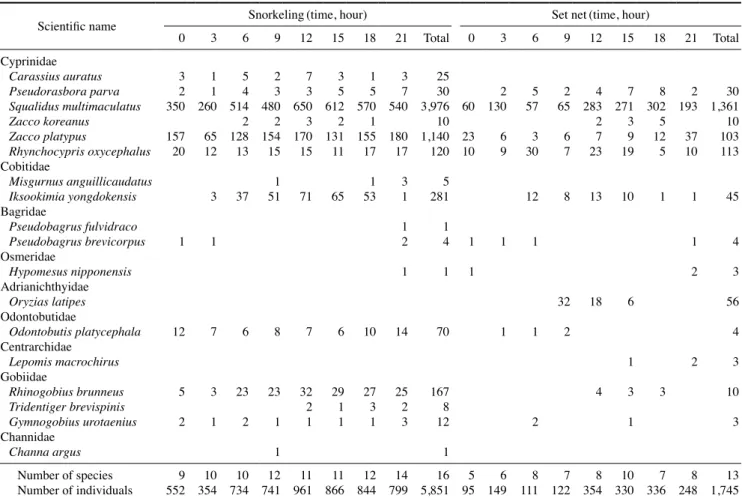
일 활동주기를 밝히기 위해 시간대별 섭식량과 수중관찰, 일각망을 통한 활동개체수를 조사하였다(Fig. 3, Table 1). 조
Fig. 2. Monthly changes of temperature(A), prey weight(B) and feeding individuals rate(C) of Iksookimia yongdokensis in the Chuk
san Stream, Korea, during March 2015 to February 2016.
(A)
(B)
(C)
Fig. 3. Changes of temperature(A), prey weight(B) and number of ac
tive individuals(C) of Iksookimia yongdokensis in the Gokgang Stream, Korea, observed at threehour intervals on August 22~23, 2016.
(A)
(B)
(C)
사 시 기온은 24.2~30.3°C, 수온은 22.2~25.2°C 범위였으며, 날씨는 맑았다. 일출(05:50) 후 06시에는 섭식량이 0.02±0.01 g으로 최저치를 보였으며, 활동개체수는 수중관찰에서는 37개 체가 관찰되고, 일각망에서는 12개체가 채집되었다. 이후 09 시부터 15시까지는 섭식량과 활동개체수가 높게 나타났는데, 섭식량은 15시에 0.08±0.06g이었고, 수중관찰에서는 12시에 71개체가 확인되었으며, 일각망에서도 12시에 13개체로 채집 되어 최대 개체수를 보였다. 이후 일몰(18:50)이 가까운 18시 에는 섭식량이 0.05±0.03g으로 다소 감소하였고, 활동개체수 는 수중관찰에서 53개체로 감소하였고, 일각망에서는 1개체만 이 채집되었다. 야간인 21~03시까지는 섭식량이 0.02~0.03g 으로 낮았고, 수중관찰 조사에서 0~3개체가 확인되었으며, 일 각망에서는 0~1개체가 채집되어 대부분의 개체들은 활동을 하지 않고 모래와 자갈, 돌무더기 밑에 은신하였다. 따라서 동 방종개는 섭식량 및 활동개체수 변화로 볼 때 낮에 바닥 속에 서 나와 활동과 섭식을 하고 야간에서는 모래와 자갈, 돌무더 기 속에서 은신하는 주행성 어류로 나타났다.
본 조사에서 확인된 동소출현종은 수중관찰에서 7과 16종, 일각망에는 8과 13종으로 모두 9과 18종이 확인되었다(Table
1). 공통적으로 우점종은 점몰개 Squalidus multimaculatus였 고, 아우점종은 수중관찰에서 피라미 Zacco platypus, 일각망 에서 버들치 Rhynchocypris oxycephalus였으며, 그 다음은 동 방종개, 밀어 Rhinogobius brunneus, 참붕어 Pseudorasbora parva 순으로 우세하였다. 출현종 중 낮 시간대에 많이 관찰되 고 활동성이 높았던 어류는 점몰개와 피라미, 송사리 Oryzias latipes, 참갈겨니 Z. koreanus, 버들치, 밀어 등이었으며, 주로 밤 시간대에 관찰되고 활동성이 높았던 어류는 꼬치동자개 Pseudobagrus brevicorpus, 동사리 Odontobutis platycephala, 꾹저구 Gymnogobius urotaenius, 동자개 P. fulvidraco 등이었 다.
3. 섭식활동 및 소화관 내용물
1) 섭식활동
동방종개는 일출 후 08시부터 17시까지 왕성한 섭식행동 을 보였다. 섭식은 주로 모래 표층과 돌 위, 돌틈 등에서 이루 어졌으며, 앞으로 전진하면서 지속적으로 유기물 층을 입으로 빨아들인 후 먹이를 걸러 먹는 여과섭식을 하였다.
Table 1. List of fish species and the number of fish observed by the methods of snorkeling and set net in the Gokgang Stream, Korea, on August 22~23, 2016
Scientific name Snorkeling(time, hour) Set net(time, hour)
0 3 6 9 12 15 18 21 Total 0 3 6 9 12 15 18 21 Total
Cyprinidae
Carassius auratus 3 1 5 2 7 3 1 3 25
Pseudorasbora parva 2 1 4 3 3 5 5 7 30 2 5 2 4 7 8 2 30
Squalidus multimaculatus 350 260 514 480 650 612 570 540 3,976 60 130 57 65 283 271 302 193 1,361
Zacco koreanus 2 2 3 2 1 10 2 3 5 10
Zacco platypus 157 65 128 154 170 131 155 180 1,140 23 6 3 6 7 9 12 37 103
Rhynchocypris oxycephalus 20 12 13 15 15 11 17 17 120 10 9 30 7 23 19 5 10 113
Cobitidae
Misgurnus anguillicaudatus 1 1 3 5
Iksookimia yongdokensis 3 37 51 71 65 53 1 281 12 8 13 10 1 1 45
Bagridae
Pseudobagrus fulvidraco 1 1
Pseudobagrus brevicorpus 1 1 2 4 1 1 1 1 4
Osmeridae
Hypomesus nipponensis 1 1 1 2 3
Adrianichthyidae
Oryzias latipes 32 18 6 56
Odontobutidae
Odontobutis platycephala 12 7 6 8 7 6 10 14 70 1 1 2 4
Centrarchidae
Lepomis macrochirus 1 2 3
Gobiidae
Rhinogobius brunneus 5 3 23 23 32 29 27 25 167 4 3 3 10
Tridentiger brevispinis 2 1 3 2 8
Gymnogobius urotaenius 2 1 2 1 1 1 1 3 12 2 1 3
Channidae
Channa argus 1 1
Number of species 9 10 10 12 11 11 12 14 16 5 6 8 7 8 10 7 8 13
Number of individuals 552 354 734 741 961 866 844 799 5,851 95 149 111 122 354 330 336 248 1,745
2) 소화관 내용물
동방종개의 식성을 알아보기 위하여 연령별로 소화관 내용 물을 조사한 결과 Table 2와 같았다. 먹이생물은 크게 동물성 (Zooplankton)과 식물성(Phytoplankton)으로 나누어졌으며 구 성비율은 상대중요성지수(IRI)로 계산하였을 때 각각 88.4%, 11.6%로 나타나 동물성 먹이가 월등히 많았다.
동물성 먹이는 절지동물문(Arthropoda)의 비율이 가장 높 았는데, 이 중 곤충강(Insecta, 58.3%)의 파리목(Diptera)은 깔다구과(Chironomidae)가 54.7%로 매우 높았고, 하루살이
목(Ephemeroptera, 3.6%)은 강하루살이과(Potamanthidae) 가 1.7%, 미동정이 1.9%였다. 같은 문의 갑각강(Crustacea, 11.8%)의 새각목(Branchiopoda, 10.1%)은 코끼리물벼룩과 (Bosminidae) 7.3%, 물벼룩과(Daphniidae) 2.5%, 둥굴레물벼 룩과(Chydoridae) 0.2%, 털보물벼룩과(Macrothricidae) 0.1%
의 순으로 비율이 높았고, 요각목(Copepoda)은 1.7%를 차 지하였다. 윤형동물문(Trochelminthes), 윤충강(Rotatoria)의 유영목(Ploima, 8.7%)에서는 주머니윤충과(Asplanchnidae) 6.6%, 쥐꼬리윤충과(Trichocercidae) 1.8%, 방패윤충과 Table 2. Composition of the intestine contents of Iksookimia yongdokensis(n=20) by the ratio of number, volume, occurrence and index of rel
ative importance(IRI) in the Chuksan Stream, Korea, May 2015 Prey organisms
Age(total length, mm)
Total Number
(%) Volum
(%) Occurrence
(%) IRI IRI
0+ (%)
(20~39) 1+
(40~65) 2+
(66~99) 3+≤ (100~130) Zooplankton
Phylum Sarcomastigophora Class Rhizopodea
Family Arcellidae 400 284 148 44 876 14.9 0.3 100.0 1517.3 8.6
Phylum Trochelminthes Class Rotatoria
Order Bdelloidea
Family Philodidae 2 12 12 4 30 0.5 + 20.0 10.3 0.1
Order Ploima
Family Trichocercidae 140 52 20 16 228 3.9 + 80.0 312.9 1.8
Family Asplanchnidae 336 180 120 44 680 11.5 0.1 100.0 1166.3 6.6
Family Brachionidae 12 16 10 4 42 0.7 + 50.0 36.0 0.2
Family Euchlannidae 8 5 8 8 29 0.5 + 35.0 17.4 0.1
Phylum Tardigrada 7 40 38 34 119 2.0 0.5 70.0 175.1 1.0
Phylum Arthropoda Class Crustacea
Order Branchiopoda
Family Daphniidae 136 44 42 10 232 3.9 0.9 90.0 439.0 2.5
Family Bosminidae 208 258 112 38 616 10.5 2.5 100.0 1295.0 7.3
Family Chydoridae 16 12 12 4 44 0.7 0.2 40.0 37.0 0.2
Family Macrothricidae 12 12 6 4 34 0.6 0.1 30.0 21.4 0.1
Order Copepoda 32 24 98 32 186 3.2 0.6 80.0 302.5 1.7
Class Insecta Order Diptera
Family Chironomidae 208 320 308 452 1288 21.9 75.1 100.0 9693.2 54.7
Order Ephemeroptera
Family Potamanthidae 16 4 20 0.3 15.1 20.0 308.4 1.7
Unidentified spp. 4 46 43 93 1.6 4.5 55.0 332.4 1.9
Phytoplankton
Class Bacillariophyceae
Navicula spp. 12 10 8 8 38 0.6 + 50.0 32.3 0.2
Cymbella spp. 27 8 24 9 68 1.2 + 70.0 80.9 0.5
Synedra spp. 24 36 122 25 207 3.5 + 80.0 281.7 1.6
Fragilaris spp. 8 2 4 14 0.2 + 20.0 4.8 0.0
Melosira spp. 72 40 72 94 278 4.7 + 100.0 475.9 2.7
Nitzschia spp. 8 12 8 14 42 0.7 + 35.0 25.0 0.1
Class Chlorophyceae
Cosmarium sp. 2 2 + 5.0 0.2 +
Peridinium spp. 28 4 4 4 40 0.7 + 40.0 27.2 0.2
Gonatozygon spp. 28 18 4 50 0.8 + 50.0 42.5 0.2
Closterium spp. 224 172 168 68 632 10.7 + 100.0 1077.6 6.1
+: less than 0.1%
(Brachionidae) 0.2%, 장삼윤충과(Euchlannidae) 0.1% 등 의 순으로, 윤충목(Bdelloidea)의 거머리윤충과(Philodidae) 는 0.1%였다. 육질편모충문(Sarcomastigophora)의 근족충강 (Rhizopodea)은 8.6%였고, 완보동물문(Tardigrada)은 1.0%였 다.
식물성 먹이는 조류(algae)로 녹조강(Chlorophyceae, 6.5%) 은 Closterium spp. 6.1%, Gonatozygo spp. 0.2%, Peridinium spp. 0.2% 등의 순으로, 규조강(Bacillariophyceae, 5.1%)은 Melosira spp. 2.7%, Synedra spp. 1.6%, Cymbella spp. 0.5%, Nabicula spp. 0.2%, Nitzschia spp. 0.1% 등의 순으로 높았다.
3) 성장에 따른 먹이 크기 및 구성 변화
성장에 따른 먹이 구성을 상대중요성지수(IRI)로 비교한 결 과(Fig. 4), 당년생 치어(전장 20~39mm)의 먹이에서는 새 각목이 32.3%로 가장 비율이 높았고 그 다음은 깔다구과 (28.9%), 윤충강(14.4%), 꽃병벌레과(12.5%), 조류(11.0%) 등 의 순이었다. 1년생(40~65mm)은 깔다구과가 급격히 증가 하여 49.6%였고, 그 다음은 새각목(19.1%), 조류(10.3%), 꽃 병벌레과(9.9%), 윤충강(8.9%) 등의 순이였다. 2년생(66~99 mm)은 깔다구과(36.2%)가 감소하고 하루살이과(24.6%) 가 급격히 증가하였으며 그 다음은 조류(15.1%), 윤충강 (6.0%) 등의 순이었다. 3년생 이상(100~130mm)은 깔다구과 가 68.7%로 가장 높았고 그 다음은 조류(11.8%), 하루살이목 (6.8%), 윤충강(3.9%) 순이었다. 따라서 연령이 낮을 때에는 비교적 먹이 크기가 작은 새각목과 윤충강, 꽃병벌레과 등을 주로 섭식하다가 성장하면서 비교적 크기가 큰 깔다구과와 하 루살이과로 먹이전환이 일어났다.
동방종개의 가장 중요한 먹이로 나타난 깔다구과와 하루살 이목의 크기는 연령에 따라 큰 차이를 보였다(Fig. 5). 당년생 치어에서 먹이 크기는 1.53±0.45mm로 작았으나 이후 1년생 1.84±0.94mm, 2년생 2.90±2.16mm, 3년생 이상 5.17±2.81 mm로 나타나 연령이 높아지면서 먹이 크기도 급격히 커지는 경향을 보였다.
고 찰
온대 지역의 담수어류는 급격한 계절적 온도 변화에 따 라 연 활동주기가 활동기와 월동기로 나누어지며, 월동기에 는 어류에 따라 섭식량이 급격히 감소하거나 섭식을 하지 않 는 것으로 보고되었다(Byeon et al., 1995; Choi et al., 2001, 2004; Kim and Ko, 2005; Ko et al., 2009). 지금까지 조사 된 미꾸리과(Cobitidae) 어류에 대한 연 활동주기 연구는 왕 종개 Iksookimia longicorpa(Kim and Ko, 2005)와 줄종개 Cobitis tetralineata(Kim et al., 2006), 점줄종개 C. nalbanti (Ko et al., 2009), 참종개 I. koreensis(Ko et al., 2009), 북방 종개 I. pacifica(Ko, 2015) 등이 있는데, 공통적으로 수온 약 10~13°C 이상 되는 3월부터 10월까지는 활동기로 하상 밖으 로 나와 활동과 섭식행동 등을 하지만 수온이 약 13°C 이하가 되는 11월부터 2월까지는 월동기로 하상의 기질 속으로 은신 하며 먹이 섭식을 하지 않는 것으로 보고되어, 3월부터 11월까 지 활동하는 본 연구종인 동방종개와 비교적 유사하였다. 동 방종개가 11월까지도 활동하는 것으로 나타난 결과는 조사년 도(2015)의 11월 수온이 12.2°C로 다른 종의 조사년도 11월 Fig. 5. Ontogenetic changes in the size of prey organisms(Insecta) of Iksookimia yongdokensis in the Chuksan Stream, Korea, May 2015.
Circles and bars represent the mean and range of the size.
Fig. 4. Ontogenetic changes in the composition of intestine contents by the index of relative importance(IRI) of Iksookimia yongdokensis (n=20) in the Chuksan Stream, Korea, March 2015.
IRI(%)
100 90 80 70 60 50 40 30 20 10
0 20~39 40~65 66~99 100~130
Branchioda Chironomidae Ploima Arcellidae Ephemeroptera Algae Others
Total length(mm)
수온 8~10°C보다 높았기 때문에 활동기가 늘어난 것으로 판 단되었다(Kim and Ko, 2005; Kim et al., 2006; Ko et al., 2009;
Ko, 2015). 섭식개체율과 섭식량 변화양상은 5월과 9월에 높 게 나타나고 6월과 7월에 낮게 나타나는 경향을 보여 왕종개 (Kim and Ko, 2005)와 줄종개(Kim et al., 2006), 점줄종개(Ko et al., 2009), 참종개(Ko et al., 2009), 북방종개(Ko, 2015) 등 과 비교적 유사하였는데, 5월과 9월은 산란과 월동 준비 때문 으로 높게 나타나고, 6월과 7월은 산란 및 장마의 영향으로 낮 아지는 것으로 추정되었다.
어류는 일 중 활동시간대에 따라 주행성과 야행성으로 나 누어지는데, 많은 어류가 주행성으로 알려져 있지만(Yoon et al., 2011) 잉어과(Cyprinidae)의 흰수마자 Gobiobotia naktongensis와 꾸구리 G. macrocephala, 돌상어 G. brevi
barba(MLTM, 2010) 등과 메기과(Siluridae)와 퉁가리과 (Amblycipitidae), 동자개과(Bagridae) 등의 어류는 야행성으 로 알려져 있다(Kim, 1997; ME, 2006; Kim and Park, 2007).
미꾸리과 어류 중에서 왕종개(Kim and Ko, 2005)와 줄종개 (Kim et al., 2006), 점줄종개(Ko et al., 2009), 참종개(Ko et al., 2009)는 시간대별 활동개체수와 섭식개체수 조사 결과 주 행성 어류로 보고되어 본 연구종과 동일하였다. 하지만 북방 종개는 시간대별 활동개체수 및 섭식량 분석 결과 12시부터 24시까지 활동하는 것으로 나타나 약간 차이를 보였고(Ko, 2015), 얼룩새코미꾸리 Koreocobitis naktongensis는 일몰 이 후부터 일출 전까지 돌 밖으로 나와 활동하는 야행성으로 보 고되어 차이를 보였다(Hong, 2012). 본 조사에서 출현한 동 소종 중 점몰개 Squalidus multimaculatus와 피라미 Zacco platypus, 송사리 Oryzias latipes, 참갈겨니 Z. koreanus, 버들 치 Rhynchocypris oxycephalus, 밀어 Rhinogobius brunneus 등은 동방종개와 유사한 주행성으로 나타났다. 그러나 꼬치 동자개 Pseudobagrus brevicorpus, 동자개 P. fulvidraco, 동사 리 Odontobutis platycephala, 꾹저구 Gymnogobius urotaenius 등은 야행성으로 추정되어 본 종과 차이를 보였다. 피라미와 동자개, 꼬치동자개의 활동성은 이전 보고(Kim, 1997; ME, 2006; Yoon et al., 2011)와 유사하였고, 나머지 종들의 활동성 에 대한 연구는 찾아볼 수 없었다. 본 출현종 중 특이하게 낙 동강 수계에만 서식하는 천연기념물 제455호 및 환경부지정 멸종위기야생생물 I급으로 지정된 꼬치동자개가 채집되었다.
포항 일대의 저수지에는 꼬치동자개의 인위적인 방류로 서식 이 알려져 있는데(Yoo et al., 2008; Kim et al., 2011b), 본 연구 수역 인근의 용연지에도 방류기록과 채집기록이 확인되어 인 위적 도입으로 서식하게 된 개체들로 판단되었다.
동방종개의 소화관 내용물을 상대중요성지수(IRI)로 분석 한 결과 깔다구과(Chironomidae)가 54.7%로 가장 높았고 그 다음은 새각목(Branchiopoda) 10.1%, 윤충강(Rotatoria) 8.7%, 꽃병벌레과(Arcellidae) 8.6%, 녹조강(Chlorophyceae) 6.3%,
규조강(Bacillariophyceae) 5.1% 등의 순이었다. 미꾸리과 어 류 중 줄종개(Kim et al., 2006)와 점줄종개(Ko et al., 2009), 미호종개(ME, 2011), 북방종개(Ko, 2015)의 먹이 비중은 깔 다구과가 가장 높은 것으로 보고되어 본 종과 유사한 결과였 지만, 같은 속에 속하는 왕종개와 참종개는 부피와 수에서 하 루살이목과 깔다구과가, 남방종개는 수에서 요각목과 깔다구 과가 높게 나타나 약간의 차이를 보였다. 미꾸리과 어류의 식 성은 서식지와 연관되어 있는데, 왕종개(Kim and Ko, 2005)와 참종개(Ko et al., 2009)는 유속이 비교적 빠르고(10~30cm/
sec) 자갈과 돌이 많은 하천에 서식하기 때문에 이러한 지역에 많이 서식하는 하루살이목을 많이 섭식한 것으로 추정된 반 면, 동방종개는 자갈과 돌, 모래 바닥에 고루 서식하고 유속이 느린 곳(4~7cm/sec)에 서식하기 때문에(Ko et al., 2016) 하 루살이목보다는 깔다구과를 많이 섭식한 것으로 판단되었다. 또한 동방종개는 조류(Algae)의 비율(IRI)이 11.6%로 나타 나 왕종개(Kim and Ko, 2005)와 줄종개(Kim et al., 2006), 참 종개(Ko et al., 2009), 점줄종개(Ko et al., 2009)와 유사하였으 나 조류를 거의 섭식하지 않은 북방종개(Ko, 2015)와 미호종 개(ME, 2011)와는 차이를 보였다. 당년생 치어는 크기가 작은 윤충강과 새각목 등을 주로 섭식하나 연령이 높아지면서 이들 의 비율은 작아지고 크기가 큰 깔다구과와 하루살이목의 비율 이 증가하여 기존에 보고된 왕종개(Kim and Ko, 2005)와 참 종개(Ko et al., 2009), 줄종개(Kim et al., 2006), 점줄종개(Ko et al., 2009), 미호종개(ME, 2011)와 비교적 유사하였다.
요 약
한국고유종 동방종개 Iksookimia yongdokensis의 행동주기 와 섭식생태를 밝히기 위해 2015년부터 2016년까지 경상북 도 축산천과 곡강천에서 조사를 실시하였다. 동방종개는 수 온이 10°C 이상 되는 3월부터 11월까지 돌과 자갈, 모래 바 닥에서 나와 활동하였지만, 10°C 이하가 되는 12월부터 이듬 해 2월까지는 기질 속으로 파고 들어가 월동하였다. 하루 중 에는 오전 9시부터 오후 15시까지 활발한 활동과 높은 섭식 량을 보였다. 동방종개는 주로 돌 표면이나 돌 틈, 모래 표층 에서 여과섭식을 하였다. 소화관 내용물을 상대중요성지수 (IRI)로 분석한 결과, 깔다구과(Chironomidae, 54.7%)와 새각 목(Branchiopoda, 10.1%), 윤충강(Rotatoria, 8.7%), 꽃병벌레 과(Arcellidae, 8.6%), 녹조강(Chlorophyceae, 6.5%), 규조강 (Bacillariophyceae, 5.1%) 등의 순서로 높게 나타났다. 당년생 치어는 먹이 크기가 작은 윤충강과 새각목, 꽃병벌레과 등을 많이 섭식하였으나 성장하면서 먹이 크기가 큰 깔다구과와 하 루살이목(Ephemeroptera)을 주로 섭식하여 먹이전환을 보였 다.
사 사
이 논문은 2015년도 정부(미래창조과학부)의 재원으로 한 국연구재단의 지원을 받아 수행된 기초연구사업임(과제번호:
2015R1A2A2A01007117).
REFERENCES
Byeon, H.K. 2007. Ecology of Koreocobitis rotundicaudata(Cobit
idae) in the Naerin Stream, Korea. Korean J. Ichthyol., 19:
299305.(in Korean)
Byeon, H.K., H.S. Sim, J.S. Choi, Y.M. Son, J.K. Choi and S.R.
Jeon. 1995. Feeding habit of the river sculpin, Cottus poe- cilopus from the stream at Mt. Chiak, Korea. Korean J.
Ichthyol., 7: 160170.(in Korean)
Choi, E.K. 2003. Biology of the southern spined loach, Iksookimia hugowolfeldi(Pisces, Cobitidae). Master Thesis, Chonbuk National University, Jeonju, 42pp.(in Korean)
Choi, J.K. and H.K. Byeon. 2009. Ecological characteristics of Co- bitis pacifica(Cobitidae) in the Yeongok Stream. Korean J.
Limnol., 42: 2631.(in Korean)
Choi, J.S., O.K. Kwan, J.H. Park and H.K. Byeon. 2001. Feeding habit of Gobibotia brevibarba(Cyprinidae) from the Hong
cheon River, Korea. Korean J. Ichthyol., 13: 230236.(in Korean)
Choi, J.S., Y.S. Jang, K.Y. Lee and O.K. Kwon. 2004. Feeding habit Gobiobotia macrocephala(Cyprinidae) from the Namhan River, Korea. Korean J. Ichthyol., 16: 165172.(in Korean) Chong, D.S. 1986. Morphological and bionomical studies of Ni-
waella multifasciata(Wakiya et Mori). Master Thesis, Chonbuk National University, 37pp.(in Korean)
Hong, Y.K. 2012. Studies on the habitat, feeding habit and reprodu
tive biology of an endangered freshwater fish, Koreocobitis naktongensis(Cobitidae). Master Thesis, Soonchunhyang University, Asan, 34pp.(in Korean)
Jeong, J. 1993. Illustration of the Freshwater Algae of Korea. Acad
emy Publishing Company, Seoul, 496pp.(in Korean) Jo, K.S. 1993. Illustration of the Freshwater Zooplankton of Korea.
Academy Publishing Company, Seoul, 387pp.(in Korean) Kim, E.J., I.S. Kim and N. Onikura. 2011a. Sizerelated changes in
food of dwarf loach, Kichulchoia brevifasciata Kim & Lee, 1995. Folia Zool., 60: 295301.
Kim, I.S. 1978. Ecological studies of cobitid fish, Cobitis koreensis in Jeonjucheon Creek, Jeonrabugdo province, Korea. Ko
rean J. Ecol., 2: 914.(in Korean)
Kim, I.S. 1997. Illustrated Encyclopedia of Fauna & Flora of Korea, Vol. 37, Freshwater Fishes. Ministry of Education, Yeongi, 518pp.(in Korean)
Kim, I.S. 2009. A review of the spined loaches, family Cobitidae (Cypriniformes) in Korea. Korean J. Ichthyol., 21(supple
ment): 728.
Kim, I.S. and J.Y. Park. 1997. Iksookimia yongdokensis, a new co
bitid fish(Pisces: Cobitidae) from Korea with a key to the species of Iksookimia. Ichthyol. Res., 44: 249256.
Kim, I.S. and J.Y. Park. 2007 Freshwater Fishes of Korea. Kyohak Publishing, Seoul, 467pp.(in Korean)
Kim, I.S. and M.H. Ko. 2005. Ecology of Iksookimia longicorpa (Cobitidae) in the Seomjin River, Korea. Korean J. Icthyol., 17: 112122.(in Korean)
Kim, I.S., M.H. Ko and J.Y. Park. 2006. Population ecology of Ko
rean sand loach Cobitis tetralineata(Pisces; Cobitidae) in the Seomjin River, Korea. J. Ecol. Field Biol., 29: 277286.
(in Korean)
Kim, I.S. and W.O. Lee. 1984. Morphological and ecological as
pects on the population of Cobitis koreensis Kim(Pisces:
Cobitidae) in the Begchon Stream, Puangun, Cholla
bugdo, Korea. Korean J. Ecology, 7: 1020.(in Korean) Kim, I.S., Y. Choi, C.L. Lee, Y.J. Lee, B.J. Kim and J.H. Kim. 2005.
Illustrated Book of Korean Fishes. Kyohak Publishing, Seoul, 615p.(in Korean)
Kim S.K., Y.H. Kang, G.B. Hong, D.U. Yoo, H.Y. Suk. B.S. Chae, H.S. Kim and U.W. Hwang. 2011b. Ichthyofauna and com
munity structure from 21 Lakes in the Yeongnam area in
cluding Gyeongsangbukdo and Gyeongsangnamdo prov
inces, Korea. Korean J. Ichthyol., 23: 288289.(in Korean) Kim, S.Y., J.Y. Park and I.S. Kim. 1999. Chromosome of spined
loach, Iksookimia yongdokensis(Pisces: Cobitidae) form Korea. Korean J. Ichthyol., 11: 172176.
Ko, M.H. 2009. Reproductive mechanisms of the unisexual dip
loidtriploid hybrid complex between the spined loach Cobitis hankugensis and Iksookimia longicorpa(Teleostei, Cobitidae) in Korea. Doctoral Thesis, Chonbuk National University, Jeonju, 160pp.(in Korean)
Ko, M.H. 2015. Habitat characteristics and feeding ecology of the Korean endemic species, Iksookimia pacifica(Pisces: Cobit
idae) in the Bukcheon(stream), Korea. Korean J. Ichthyol., 27: 275283.(in Korean)
Ko, M.H., J.Y. Park and S.H. Kim. 2009. Habitat enviornment and feeding habitat of Iksookimia koreensis and Cobitis lutheri (Pisces: Cobitidae) in the Mangyeong River, Korea. Korean J. Ichthyol., 21: 253261.(in Korean)
Ko, M.H., Y.S. Jeon and Y.J. Won. 2016. The habitat, age and spawning characteristics of the Korean eastern spined loach, Iksookimia yongdokensis(Pisces: Cobitidae) in the Chuksancheon(stream), Korea. Korean J. Ichthyol., 28:
239248.(in Korean)
Kottelat, M. 2012. Conspectus Cobitidum: An inventory of the loaches of the World(Teleostei: Cypriniformes: Cobitoidei).
Raffles Bull. Zool., Suppl. 26: 1-199.
Kwan, Y.S. 2015. Molecular phylogenetic and population genetic studies of the freshwater fish Family Cobitidae(Teleostei:
Cypriniformes) in Korea. Doctoral Thesis, Ewha Womans University, Seoul, 143pp.
ME(Ministry of environment). 2006. Species Conservation, Resto
ration and Cuture Technology of Endangered Korena En
demic Fish Species. Kunsan University, Gunsan, 537pp.(in Korean)
ME(Ministry of environment). 2011. Development of Culture Tech
niques and Construction of Monitoring System for Released Seed of an Endangered Fish Koreocobitis naktongensis.
Soonchunhyang University, Asan, 250pp.(in Korean) MLTM(Ministry of Land, Transport and Maritime Affairs). 2010.
Culture and Restoration of Endangered Species in the Major Four River Drainages, Soonchunhyang University, Asan, 489pp.(in Korean)
Nelson, J.S., T.C. Grande and M.V.H. Wilson. 2016. Fishs of the World(Fifth edition). John Wiley & Sons, Hoboken, New Jersey, p. 190.
NIBR(National Institute of Biological Resources). 2011. Red Data Book of Endangered Fishes in Korea. Ministry of Environ
ment, Incheon, 202pp.(in Korean)
Park, C.W. 2016. Ecology of the endemic Korean southern king spine loach, Iksookimia hugowolfeldi. Master Thesis, Chon
buk National University, Jeonju, 56pp.(in Korean)
Park, J.Y. and I.S. Kim. 2001. Fine structures of oocyte envelopes of three related cobitid species in the genus Iksookimia(Co
bitidae). Ichthyol. Res., 48: 7175.
Perdices, A., J. Bohlen, V. Šlechtová and I. Doadrio. 2016. Molec
ular evidence for multiple origins of the European spined loaches(Teleostei, Cobitidae). Plos One, 11: e0144628.
doi:10.1371.
Pinkas, L., M.S. Oliphant and I.K.K. Ivrson. 1971. Food habits of albacore, bluefin tuna, and bonito in California water. Fish.
Bull., 152: 1105.
Šlechtová, V., J. Bohlen and A. Perdices. 2008. Molecular phyloge
ny of the freshwater fish family Cobitidae(Cypriniformes:
Teleostei): Delimitation of genera, mitochondrial introgres
sion and evolution of sexual dimorphism. Mol. Phylogenet.
Evol., 47: 812831.
Uchida, K. 1939. The Fishes of Tyosen. Part I. Numatognathi, Eventognathi. Bull. Fish Exp. Sta. Gov. Gener. Tyôsen, pp.
400458.(in Japanese)
Vasil’eva, E.D., D. Kim, V.P. Vasil’ev, M.H. Ko and Y.J. Won.
2016: Cobitis nalbanti, a new species of spined loach from South Korea, and redescription of Cobitis lutheri(Teleostei:
Cobitidae). Zootaxa, 4208: 577591.
Won, D.H., S.J. Kwon and Y.C. Jeon. 2005. Aquatic Insects of Ko
rea. Korean Ecosystem Service, Seoul, 360pp.(in Korean) Yoo, D.J., K.H. Han, S.H. Lee, J.S. Yim, J.H. Hwang, J.H. Lee and
K.W. Kang. 2008. Ichthyolfauna collected from reservoirs in Pohangsi, Gyeongsangbukdo. Korean J. Fish. Soc., 41:
363370.(in Korean)
Yoon, I.B. 1995. Aquatic Insects of Korea. Jeonghaeng Publishing Company, Seoul, 262pp.(in Korean)
Yoon, J.D., J.H. Kim, G.J. Joo, J. Seo, H. Pak and M.H. Jang. 2011.
Freshwater fish utilization of fishway installed in the Jang
heung Dam. Korean J. Limnol., 44: 264271.(in Korean)