—89—
서 론
미꾸리과(Cobitidae) 어류는 잉어목(Cypriniformes)에 속 하고 유라시아와 아프리카 북부에 널리 서식하는 담수어류 로 26속 177종이 보고되었으며(Nelson, 2006), 우리나라에 는 5속 16종이 서식하는 것으로 알려졌다(Kim, 2009). 이 중 Kichulchoia 속은 우리나라 고유속으로 골질반(laminar circularis)이 없으며 체측반문 및 체형에 독특한 특징을 가 지며 좀수수치 Kichulchoia brevifasciata와 수수미꾸리 K.
multifaciata 2종이 포함된다(Kim, 2009). 이중 좀수수치는 Kim and Lee (1995a)에 의해 신종으로 보고된 한국고유종으
로 전장 70 mm 이하의 매우 작은 소형 어류이며 전남 고흥 반도와 인근 도서인 거금도와 금오도 등의 작은 하천에 제 한적으로 서식하여 생물지리학적, 진화학적으로 주목받아 왔 다(Kim and Lee, 1995a; 김, 1997; 김과 박, 2007; Kim, 2008;
2009; Kim et al., 2013). 또한 좁은 서식범위와 환경오염, 각 종 개발 등의 위험 요소로 인하여 1998년 환경부 보호종으 로 지정되었으며, 이후 2005년 환경부 멸종위기 야생동∙
식물 목록에 제외되었으나 다시 2012년 개정으로 환경부지 정 멸종위기 야생생물 II급으로 지정되어 법적 보호를 받고 있다(환경부, 2005; 2012). 또한 우리나라 어류의 적색목록 에서도 제한적인 분포범위 및 개발압, 수질오염 등의 위험 요인 등으로 멸종위협 등급인 위기종(EN B2ab(i,ii,iii,iv))으 로 선정된 바 있다(국립생물자원관, 2011). 좀수수치에 관한 연구는 분포와 서식지 특징(김과 박, 2012; Kim et al., 2012)
멸종위기종 좀수수치 Kichulchoia brevifasciata의 산란기 특징 및 초기생활사
고명훈∙방인철*
순천향대학교 생명시스템학과
Spawning Character and Early Life History of the Endangered Korean Dwarf Loach, Kichulchoia brevi- fasciata (Teleostei: Cobitidae)by Myeong-Hun Ko and In-Chul Bang* (Department of Life Science and Biotechnology, Soonchunhyang University, Asan 336-745, Korea)
ABSTRACT Eggs development and early life history of the endangered Korean dwarf loach, Kichul- choia brevifasciata (Teleostei: Cobitidae) was investigated to provide basic information regarding bio- logical characteristics and restoration. Adult fish specimens were sampled using a spoon net at Geurn- san-myeon, Goheung-gun, Jeollanam-do, Korea from June to July 2011. Since, spawning characteris- tics were analyzed, and females were induced to spawn by injecting Ovaprim (0.5 mL/kg) and their eggs were artificially fertilized with sperms by the dry method in the laboratory. Total length of mature female were 46~~76 mm with GSI 9.6±±3.77%, and total length of mature male was 42~~52 mm with GSI 3.5±± 1.04%. Sex ratio (��/♀♀) was 0.10, and there were no secondary sexual characteristics. The number of mature eggs was averaged 60±±28.7 per female. The lemon yellow eggs were slightly adhesive 1.46±± 0.07 mm in diameter. The embryo hatched approximately 66 h after fertilization at 25��C, and the hatched larvae were averaged 5.5±±0.07 mm in total length (TL). At 6 days after hatching, the larvae averaged 9.0±±0.29 mm (TL) and their yolk sac was completely absorbed. At 17 days after hatching, they entered the juvenile stage and reached 12.6±±0.24 mm (TL). At 80 days after hatching, the band patterns and external form of the juveniles were similar to those of adults, and they averaged 33.0±±2.19 mm (TL).
Key words : Kichulchoia brevifasciata, egg development, early life history, endangered species
*Corresponding author: In-Chul Bang Tel: 82-41-530-1286 Fax: 82-41-530-1638, E-mail: [email protected]
http://www.fishkorea.or.kr
과 섭식변화(Kim et al., 2011), 채색 페턴과 형태적 특징 (Kim and Mochioka, 2012), 난막구조(Park and Kim, 2001), 핵형(Kim and Kim, 2008), 유전학적 비교(Kim et al., 2000;
ˇSlechtová et al., 2008) 및 개체군 분석(Kim et al., 2013) 등 의 다양한 연구가 이루어진 바 있으나 아직까지 초기생활 사 및 보전학적 연구에 대해서는 미비하다.
한편 어류의 초기생활사 연구는 종의 산란 장소의 선택 및 난 발생과 자치어 발달 등의 특유의 생식전략을 분석하 는 학문으로 종의 특징을 규명하고 유사종과의 분류학적 유 연관계를 밝히는데 적용되어 왔으며(Tanaka, 1973; Balon, 1985), 우리나라에서는 자원증강 및 멸종위기종의 복원을 위한 인공증식 기술 확립의 중요한 기초연구로 폭넓게 연 구되고 있다(환경부, 2009; 2011; 국토해양부, 2010; Ko et al., 2013). 미꾸리과의 초기생활사에 관한 연구는 우리나라 와 일본에서 주로 연구되었는데, Uchida (1939)에 의해 미 꾸리 Misgurnus anguillicaudatus와 Cobitis taenia (현재 C.
hankugensis)가 처음 보고되었고 이후 C. biwae (Okada, 1959
~1960; Saitoh and Hosoya, 1988), Niwaella delicata (Suzuki, 1966), 미꾸라지 M. mizolepis (Kim et al., 1987), 수수미꾸리 Kichulchoia multifasciata (Kim and Lee, 1995b), C. takatsuen- sis (Shimizu et al., 1998), 미호종개 Cobitis choii (Song et al., 2008), 왕종개 Iksookimia longicorpa (Ko et al., 2009), 얼룩 새코미꾸리 Koreocobitis naktongensis (Song et al., 2009), 북 방종개 C. pacifica (Lee et al., 2011), 참종개 I. koreensis (Ko et al., 2012), 기름종개 C. hankugensis (Ko and Park, 2012) 부안종개 I. pumila (Ko et al., 2013) 등이 연구되었다.
따라서 본 연구에서는 멸종위기어류 좀수수치의 초기생 활사 및 산란기 특징을 조사하여 생물학적 특징을 밝히고 다른 미꾸리과 어류들과의 유연관계를 비교∙논의하며 보 전학적 기초자료를 확보하고자 하였다.
재료 및 방법
1. 채집 및 산란기 특징
좀수수치 Kichulchoia brevifasciata는 멸종위기종으로 선 정되기 전인 2011년 6월 27일과 7월 2일에 전남 고흥군 금 산면에서 족대(망목 1×1 mm)를 이용하여 채집하였다. 채집 된 개체는 대부분 현장에서 마취제 MS-222 (Syndel, Canada) 를 이용하여 마취한 후 치어와 성어(암컷과 수컷)로 나누어 전장을 측정하고 일부 개체를 제외하고 모두 방류하였다.
채집된 곳의 서식지 환경은 하폭과 유폭, 수심, 하상구조, 유 속 등을 분석하였는데, 하폭과 유폭, 수심은 줄자와 자를 이 용하여 측정하였고, 유속은 유속계 (FP101, Grlobal Water 800-876-1172, USA)를 사용하여 측정하였다. 또한 일부 성 숙한 개체는 실험실로 옮겨 산란유도 및 생식소 분석에 사
용하였다. 생식소 분석은 일부 개체를 10% 포르말린에 고 정하여 전장과 체중, 생식소 무게, 포란수 등을 측정하였다.
체중과 생식소 무게를 이용하여 생식소성숙도(GSI, gonado- somatic index (%)==gonado weight/body weight×100)를 계 산하였고, 포란수는 전체를 개수하였다. 난경은 인공배란된 30개의 난을 무작위로 선정하여 0.01 mm까지 측정하였다.
2. 산란유도 및 초기생활사
성숙한 암컷과 수컷은 채집즉시 실험실로 옮겨 1 kg당 0.5 mL의 Ovaprim (Syndel, Canada)을 주사하였고, 12시간 경과 후에 암컷을 복부압박법으로 채란하고 여기에 수컷으 로부터 얻은 정액을 생리식염수에 100배 희석시켜 건식법 으로 수정시켰다. 수정란은 패트리디쉬(지름 15 cm)에 분산 하여 수용하여 난발생과 전기자어기를 관찰하였으며, 이후 수조(20, 50 L)에 순차적으로 옮겨 후기자어기와 치어기를 사육하였다. 난황 흡수가 끝난 후기자어부터 부화 후 30일 까지는 알테미아(brine shrimp) 유생을, 31일 이후부터는 알 테미아 유생과 배합사료를 병행하여 순차적으로 공급하며 사육하였다. 사육용수는 매일 1/2 환수하였으며, 사육수온은 25±1�C로 관리하였다. 난과 자∙치어의 발달 과정은 Charles et al. (1995)와 김(1997)에 따라 구분하였으며, 해부현미경 (Olympus SZX9, Japan) 하에서 8~57배의 배율에서 관찰하 고 디지털카메라(Olympus DP72, Japan)로 촬영하였다. 자
∙치어 발달과정은 부화 직후부터 부화 후 100일까지 각 단계별 무작위로 10개체를 선별한 후 MS-222로 마취하여 관찰 및 전장을 측정하였다.
결 과
1. 산란기 특징
1) 서식장소
좀수수치 Kichulchoia brevifasciata의 서식지는 유폭이 1~5 m이고 여울과 소가 짧게 반복적으로 나타나는 물이 맑은 곳이었는데, 여울은 수심이 0.1~0.2 m이고 유속이 5~20 cm/s, 하상은 주로 자갈과 돌로 이루어져 있었고, 소 는 대체로 유속이 0~5 cm/s로 느리고 수심은 0.5~1.0 m, 하상은 대부분 모래와 자갈로 이루어져 있었다. 산란기 좀 수수치 치어와 암컷은 주로 소에 10~30개체/m2로 비교적 많이 서식하고 있었지만 일부 여울에서도 5~10개체/m2로 채집되었다. 하지만 수컷은 여울에서만 소수 채집되었을 뿐 소에서는 채집되지 않아 암컷과 서식지 차이를 보였다.
2) 전장분포와 생식소 성숙
조사기간 동안 채집된 좀수수치는 모두 152개체였고, 치 어 25개체, 암컷 115개체, 수컷 12개체로 구성되었다. 이들
중 전장 24~35 mm의 개체는 생식소가 거의 발달하지 않 은 치어였으며, 전장 36 mm 이상의 개체는 생식소가 발달한 암컷과 수컷이었다. 암컷은 전장범위는 36~76 mm로 나타 났는데, 이중 36~45 mm는 생식소가 미성숙하여 미성숙란 만 관찰되었으며, 전장 46~76 mm의 개체들은 GSI가 9.6±
3.77 (4.3~16.9)% (n==27)로 성숙란과 일부 미성숙란이 함 께 관찰되었다. 수컷은 42~52 mm로 복부를 누르면 정액이 나왔으며 GSI는 3.5±1.04 (2.1~4.5)% (n==5)였다. 암컷과 수컷은 특별한 2차 성징을 보이지 않았으나 암컷은 성숙란 이 밖으로 비쳐져 구별되었으며(Fig. 1), 수컷은 암컷에 비 해 전장 15~20 mm가 작았고 개체수도 적어 성비(�/♀) 는 0.1이었다(Fig. 2).
3) 성숙란의 특징
포란수는 Fig. 3과 같이 69±35.3 (18~160)개(n==27)로 전 장이 커짐에 따라 추세선 y==4.0818x-163.83 (R2==0.6681)
로 급격히 증가하는 경향을 보였다. Ovaprim 주사로 얻어진 성숙란은 약한 점착성을 가진 짙은 담황색의 분리침성란으 로 난경 1.46±0.07 mm (n==30)이었다.
2. 초기생활사
1) 난발생 과정
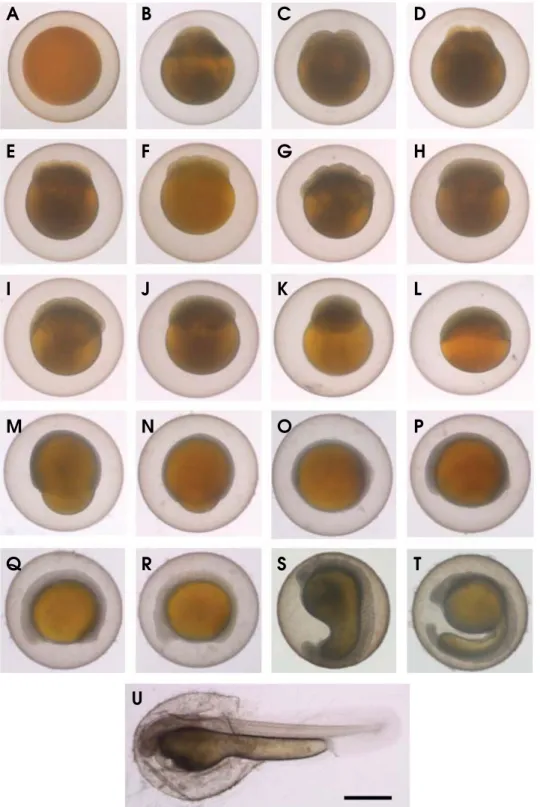
좀수수치의 수정난은 수정 후 20분에 물을 흡수하여 2.25
±0.03 mm (n==20)로 팽창하였다(Fig. 4A). 수정 1시간 후에 세포질이 동물극 (animal pole) 쪽으로 끌려 배반 (blasto- disc, 1세포기)이 형성되었으며(Fig. 4B), 2세포기는 1시간 20 분 후에 배반에 난할(위할)이 일어나 형성되었다(Fig. 4C).
4세포기는 1시간 40분 후에 경할을 통하여 형성되었고(Fig.
4D), 8세포기는 2시간 후에 난할을 통하여(Fig. 4E), 16세포 기는 2시간 20분 후에 경할을 통하여 형성되었다(Fig. 4F).
32세포기는 2시간 45분 후에(Fig. 4G), 64세포기는 3시간 05분 후에(Fig. 4H), 128세포기는 3시간 25분 후에 형성되 었으며(Fig. 4I), 상실기(morula, 256 세포기)는 3시간 45분 후에 형성되었고(Fig. 4J), 이후 난할을 계속하여 4시간 30 분 후에는 포배기(blastula)를 형성하였다(Fig. 4K). 10시간 후에는 낭배기(gastrula)가 형성되어 세포층이 동물극에서 식물극(vegetal pole) 쪽으로 덮기 시작하였으며(Fig. 4L), 이 후 12시간 30분 후에 낭배 중기에(Fig. 4M), 14시간 20분 후에는 90% 이상을 덮어 낭배 말기에 도달하였다(Fig. 4N).
16시간 후에는 원구(blastopore)가 폐쇄되고 배체(embryo) 의 윤곽이 뚜렷해졌으며(Fig. 4O), 19시간 후에는 근절(myo- tomes)이 3~4개가 생기고 안포(optic vesicle)가 형성되었 다(Fig. 4P). 21시간 30분 후에는 9~10개의 근절이 형성되 었으며(Fig. 4Q), 23시간 30분 후에는 근절이 16~18개이 Fig. 1. A matured male and female of Kichulchoia brevifasciata in
the Sinpyeong Stream, Geumsan-myeon, Goheung-gun, Jeollanam- do, Korea from June 2011. Bars indicate 1 cm.
Number of individuals
15
10
5
0
5
10
0 10 20 30 40 50 60 70 80
n==152
Female
Male
Total length (mm) Juvenile
Fig. 2.Frequency distribution of total length of Kichulchoia brevi- fasciata in the Sinpyeong Stream, Geumsan-myeon, Goheung-gun, Jeollanam-do, Korea from 27 June to 2 July 2011.
Fecundity
180 160 140 120 100 80 60 40 20 0
40 50 60 70 80
Total length (mm) n==27
y==4.0818x-163.83 R2==0.6681
Fig. 3.Relationship between the number of spawned eggs and total length of Kichulchoia brevifasciata (n==27) in the Sinpyeong Stream, Geumsan-myeon, Goheung-gun, Jeollanam-do, Korea from 27 June to 2 July 2011.
Female Male
고 이포(auditory vesicle)와 Kupper’s vesicle이 형성되었다 (Fig. 4R). 이후 꼬리가 난황에서 분리되면서 움직이기 시작 하였고, 26시간 후에는 28~30 근절이 생기고 눈의 렌즈가 형성되며 뇌가 분화하기 시작하였으며 Kupper’s vesicle이
사라졌다(Fig. 4S). 30시간 후에는 심장이 형성되어 뛰기 시 작하였다(Fig. 4T). 60시간부터 꼬리를 이용하여 난막(chori- on)을 뚫고 부화하는 개체가 관찰되었고, 66시간 후에 50%
가 부화하였으며(Fig. 4U), 72시간 이내에 모두 부화하였다.
Fig. 4.Egg development of Kichulchoia brevifasciata at water temperature 25�C. Time required for each developmental stage is shown in Table 1. The bar indicate 1 mm.
A B C D
E F G H
I J K L
M N O P
Q R S T
U
2) 자어와 치어의 발달
부화 후 발달 과정(Fig. 5)은 전기자어기와 후기자어기, 치 어기로 구분하였으며 성장은 Fig. 6과 같았다.
(1) 전기자어기
부화 직후의 자어는 전장 5.5±0.07 (5.4~5.6) mm (n==10) 로 몸이 약간 휘어져 있었고 가슴지느러미가 형성되기 시 작하였다. 몸은 무색으로 입과 항문은 열리지 않았고 앞쪽 에 구형의 난황이 있으며 몸의 중앙과 뒤쪽에 막지느러미 가 형성되었다(Fig. 5A). 부화 후 1일째의 자어는 전장 6.4
±0.10 mm (n==10)로 몸이 곧게 펴지고 외새가 1쌍이 나타 났으며 눈은 검게 착색되었다(Fig. 5B). 부화 후 2일째에는 전장 7.2±0.16 mm (n==10)로 난황이 1/2 이상 흡수되고 외 새가 5쌍이 관찰되었다. 또한 수염 1쌍이 나타나고 두부와 체측상부에 흑색포가 침착되었다(Fig. 5C). 부화 후 3일째에 는 전장 7.7±0.10 mm (n==10)로 온 몸에 보다 많은 흑색포 가 침적되었고 수염이 길어졌다(Fig. 5D). 부화 후 4일째에 는 전장 8.1±0.24 mm (n==10)로 입과 항문이 열렸으며 등 지느러미 원기가 관찰되었다(Fig. 5E). 부화 후 5일째에는 전장 8.6±0.09 mm (n==10)로 난황이 대부분 흡수되었고 뒷 지느러미 원기가 나타나기 시작하였다. 처음으로 먹이(알테 미아 유생)를 섭식하였으며 외새가 짧아져 아가미 뚜껑 속
으로 들어갔다(Fig. 5F).
(2) 후기 자어기
부화 후 6일째에는 전장 9.0±0.29 mm (n==10)로 난황을 모두 흡수하여 후기자어로 이행하였고 수염이 3쌍이 관찰 되었다(Fig. 5G). 부화 후 10일째에는 전장 11.4±0.04 mm (n==10)로 등지느러미 기조는 5~6개, 꼬리지느러미 기조는 12~15개가 관찰되었다(Fig. 5H). 부화 후 13일째에는 전장 12.9±0.29 mm (n==10)로 등지느러미 기조가 7개, 뒷지느러 미 기조가 3~4개 관찰되었으나 뚜렷이 구분되지는 않았다.
(3) 치어기
부화 후 17일째에는 전장 14.9±0.28 mm (n==10)로 뒷지 느러미 기조가 정수(6~7)가 되면서 치어기로 이행하였다 (Fig. 5I). 부화 후 20일째에는 전장 16.4±0.52 mm (n==10) 로 체측 중앙에 검은 반점 8~10개가 나타났으며 막지느러 미는 등지느러미와 뒷지느러미 뒤쪽으로 축소되었다(Fig.
5J). 부화 후 30일째에는 전장 21.1±0.94 mm (n==10)로 체 측 상부에 반문이 형성되기 시작하였으며(Fig. 5K), 부화 후 50일째에는 전장 26.8±1.50 mm (n==10)로 반문이 보다 뚜렷해지고 등지느러미에 1줄, 꼬리지느러미에 2줄의 반문 이 나타나기 시작하였다(Fig. 5L). 부화 후 80일째에는 전 Table 1.Egg development of Kichulchoia brevifasciata at water temperature 25�C
Stage Elapsed time Characters Fig. 4
Zygote period
Insemination 00 min Sperm and egg are inseminated -
Swelling 20 min Inseminated egg is swelling A
1 cell (blastodisc) 1 h 00 min Blastodisc B
Cell cleavage period
2 cells 1 h 20 min 2 blastodisc is cleavage C
4 cells 1 h 40 min 2-2 array of blastomeres D
8 cells 2 h 00 min 2-4 array of blastomeres E
16 cells 2 h 20 min 4-4 array of blastomeres F
32 cells 2 h 45 min 4-8 array of blastomeres G
64 cells 3 h 05 min 8-8 array of blastomeres H
Blastula period
128 cells 3 h 25 min 8-16 array of blastomeres I
Morula (256 cells) 3 h 45 min 16 regular tiers of blastomeres J
Blastula 4 h 30 min Flattening produces an elliptical shape K
Gastrula period
Early gastrulation 10 h 00 min Early gastrulation (50%) L
Middle gastrulation 12 h 30 min Middle gastrulation (75%) M
Late gastrulation 14 h 20 min Late gastrulation (90%) N
Embryoric period
Formation of the embryo 16 h 00 min Formation of the embryo O
3-4 myotomes 19 h 00 min 3-4 myotomes furrow, formation of optic vesicles P
9-10 myotomes 21 h 30 min 9-10 myotomes furrow Q
16-18 myotomes 23 h 30 min 16-18 myotomes furrow, formation of auditory
vesicles and Kupffer’s vesicles R
28-30 myotomes 26 h 00 min 28-30 myotomes furrow, disappear Kupffer’s
vesicles, specialization of brain S
Formation of heart 30 h 00 min Formation of heart T
Hatching 66 h 00 min 50% of hatching U
Fig. 5.Larva and juvenile development of Kichulchoia brevifasciata at water temperature 25�C. The bar indicates 1 mm. A: 0 day, 5.5±0.07 mm (TL); B: 1 day, 6.4±0.10 mm; C: 2 days, 7.2±0.16 mm; D: 3 days, 7.7±0.10 mm; E: 4 days, 8.1±0.24 mm; F: 5 days, 8.6±0.09mm; G: 6 days, 9.0±0.29 mm; H: 10 days, 11.4±0.04 mm; I: 17 days, 14.9±0.28 mm; J: 20 days, 16.4±0.52 mm; K: 30 days, 21.1±0.94 mm; L: 50 days, 26.8
±1.50 mm; M: 80 days, 33.0±2.19 mm.
A F-2
B G
C H
D-1 I
D-2 J
E K
F-1 L
M
장 33.0±2.19 mm (n==10)로 체측상부 및 체측 중앙에 16
~20개의 반문이 뚜렷하게 나타나고 등지느러미와 꼬리지 느러미에 3개, 뒷지느러미에 2개의 줄무늬가 나타났으며 배 쪽은 은백색을 띄어 성어의 체형과 반문과 비교적 유사하 였다(Fig. 5M).
고 찰
좀수수치 Kichulchoia brevifasciata는 자갈과 모래가 깔 려 있는 소하천에 주로 서식하는 것으로 알려졌고 산란기 는 7월로 추정된 바 있다(Kim and Lee, 1995a; Kim, 2008).
본 연구에서도 6월 말부터 7월 초에 생식소가 성숙한 개체 들이 다수 채집되어 7월이 산란시기로 추정되었다. 수컷과 암컷은 보통 자갈과 모래가 깔린 웅덩이에 같이 서식하는 것으로 보고되었으나(Kim, 2008), 본 조사에서는 자갈과 모 래가 깔린 웅덩이에서는 암컷과 치어만이 집단으로 서식하 고 있을 뿐 수컷은 채집되지 않았고, 수컷은 수심이 0.1~
0.2 m, 유속 5~20 cm/s이고 하상이 자갈과 돌이 깔린 여울 부에서만 채집되어 차이를 보였다. 미꾸리과 어류 중 유럽 에 서식하는 Cobitis taenia는 산란기에 수컷이 수초지로 먼 저 이동한 후 산란하는 것으로 보고되었고(Bohlen, 2003), 일본의 C. striata 집단도 산란기에 집단별로 구별된 산란장 소로 이동하여 산란하는 것으로 보고되었으며(Saitoh, 1990), 우리나라의 얼룩새코미꾸리는 산란기에 산란장으로 이동을 하며 성비의 불균형을 유발할 수 있다고 보고하였다(Hong et al., 2011). 또한 박(1996)은 우리나라 미꾸리과 어류의 난 막구조를 분석하여 난막구조는 서식지 및 산란장소와 매우 밀접한 관련이 있는 것으로 보고하였는데, 좀수수치는 소구 형(hillock-shaped form)으로 나타나 산란지역이 자갈바닥과
매우 관련이 있는 형태로 보고하였다. 따라서 암수 서식지 차이는 산란장소와 매우 밀접한 관련이 있는 것으로 추정되 는데, 수컷이 산란을 위하여 여울지역으로 먼저 이동한 것 으로 추정된다. 또한 성비(�/♀)도 0.10으로 나타나 연중 조사된 Kim (2008)의 0.49와 큰 차이를 보이고 있는데, 이 러한 원인도 수컷의 이동과 관련이 있는 것으로 추정된다.
전장분포는 치어 24~35 mm와 수컷 42~52 mm, 암컷 36~76 mm로 구분되었으며, 이중 암컷의 성숙난이 관찰된 성어의 전장범위는 46~76 mm로 나타났다. 우리나라 미꾸 리과 어류(김, 1978; 김과 이, 1984; 김과 고, 2005; 변, 2007;
최와 변, 2009; 고와 박, 2011; Ko et al., 2013)와 비교하여 볼 때 암컷이 수컷보다 10~20 mm가 큰 것은 비교적 유사 한 경향이었으나 산란가능한 개체크기는 가장 작았다.
좀수수치의 난경은 평균 1.46±0.07 mm로 Kim (2008)의 1.45±0.16와 유사하게 나타났으며, 유연종과 비교하면 Niwaella delicata (2.7 mm; Suauki, 1966), 수수미꾸리 K.
multifasciata (1.8 mm; Kim and Lee, 1995b)보다는 작으나 왕종개 Iksookimia longicorpa (Ko et al., 2009)와 Cobitis takatsuensis (Shimizu et al., 1998)와 비슷하였고 참종개 I.
koreensis (Ko et al., 2012)와 C. biwae (Saitoh and Hosoya, 1988), 기름종개 C. hankugensis (Ko and Park, 2012), 미호종 개 C. choii (Song et al., 2008), 미꾸리 Misgurnus anguilli- caudatus (Uchida, 1939), 미꾸라지 M. mizolepis (Kim et al., 1987), 얼룩새코미꾸리 Koreocobitis naktongensis (Song et al., 2009) 보다는 큰 편이었다(Table 2). 그러나 생식소성숙 도(GSI)는 다른 미꾸리과 어류(김, 1978; 김과 이, 1984; 김 과 고, 2005; 김 등, 2006; 변, 2007; 최와 변, 2009; 고와 박, 2011, Hong et al., 2011)의 15~25%보다 적은 9.6%였으며, 산란량도 평균 69 (18~160)개로 N. delicata (60~120개, Suauki, 1966)와 C. takatsuensis (86~144개, Shimizu et al., 1998)와 함께 가장 적은 편에 속하였다(Table 2).
부화시간은 산란기의 수온에 따라 달라지는 경향을 보이 는데, 미꾸리과 어류 중 Misgurnus와 Iksookimia, Cobitis 속 에 해당되는 종들은 대부분 6~7월에(김, 1978; 김과 이, 1984; 김 등, 2006; 김과 박, 2007; 최와 변, 2009; 고와 박, 2011), Koreocobitis의 어류들은 5~6월에(변, 2007; Hong et al., 2011), N. delicata와 수수미꾸리는 낮은 수온인 겨울 또 는 이른 봄에 산란을 하는 것으로 알려져 있다(Suzuki, 1966; Kim and Lee, 1995b; Kawanabe et al., 2005). 좀수수치 는 7월이 산란시기로 판단되며 Misgurnus와 Iksookimia, Cobitis 속과 비교적 유사하였다. 또한 부화시간을 유연종들 과 비교하여 보면 25�C에서 66시간 만에 부화하여 비슷한 수온에서 실험한 왕종개와 유사하였으나 참종개(Ko et al., 2012)와 북방종개(Lee et al., 2011), C. biwae (Okada, 1959
~1960; Saitoh and Hosoya, 1988), 기름종개(Ko and Park, 2012), 미호종개(Song et al., 2008)보다는 느렸다.
Total length(mm)
40 35 30 25 20 15 10 5 0
0 10 20 30 40 50 60 70 80 90 100 110
Age (day)
Fig. 6. Relationship between age and total length of Kichulchoia brevifasciata after hatching at water temperature 25�C. Vertical lines show standard deviation.
y==-0.0027x2++0.5618x++5.8658 R2==0.9987
부화 직후의 자어 크기는 난의 크기와 상관관계를 가지는 데, 좀수수치는 5.5 mm로 나타나 N. delicata 7.5 mm (Suzuki, 1966)보다는 작았지만 난경이 유사한 수수미꾸리와 왕종개, C. takatsuensis와는 비교적 유사하였고, 참종개 (Ko et al., 2012)와 C. biwae (Saitoh and Hosoya, 1988), 기름종개(Ko and Park, 2012), 미호종개(Song et al., 2008), 미꾸리(Uchida, 1939), 미꾸라지(Kim et al., 1987), 얼룩새코미꾸리(Song et al., 2009)보다는 컸다.
미꾸리과 어류는 발생과정에서 외새(outernal gill)가 나타 나는 것으로 알려졌는데, 좀수수치에서도 부화 후 1일에 1쌍 이, 2일 5쌍이 길게 밖으로 나왔으나 이후 5일째에는 급격 히 짧아져 아가미 뚜껑 속으로 들어가 Iksookimia와 Cobitis 속 어류들과 유사하였다. 미꾸리과에서 외새가 나타나지 않 는 어류는 일본에 서식하는 N. delicata만이 보고되고 있다 (Suzuki, 1966).
후기자어기로의 이행시기는 부화 후 6일로 나타나 비교 적 참종개(Ko et al., 2012)와 북방종개(Lee et al., 2011), C.
biwae (Okada, 1959~1960; Saitoh and Hosoya, 1988), 얼룩 새코미꾸리(Song et al., 2009)와 유사하였으며, 치어기로의 이행시기는 부화 후 17일로 나타나 참종개(Ko et al., 2012) 와 유사하였으나 다른 미꾸리과 어류들 보다는 빨랐다.
따라서 좀수수치의 난발생 및 초기생활사 특징을 정리하 여 보면, 난경은 1.46 mm로 미꾸리과 어류에서 비교적 컸으 나 산란양은 60개로 가장 적은 편이었다. 같은 속에 속하는 수수미꾸리는 부화 직후 자어 크기만 유사하였을 뿐 부화 시간과 난경, 후기자어 및 치어기로의 이행시기에 있어 큰 차이를 보였다. 오히려 Iksookimia와 Cobitis 속 어류들과 난 경 및 부화시간, 부화 직후 크기, 후기자어로의 이행시기에 서 비교적 유사하였다. 그리고 치어기로의 이행시기는 참종 개를 제외한 다른 어류들 보다 빠른 특징을 보였다.
요 약
좀수수치 Kichulchoia brevifasciata의 산란기 특징 및 초 기생활사 연구는 생물학적 특성 및 복원학적 기초자료를 확 보하기 위하여 실시하였다. 산란기인 2011년 6월부터 7월까 지 전라북도 고훙군 금산면에서 족대를 이용하여 채집한 후 산란기 특징을 분석하였고, 초기생활사는 성숙한 개체에 Ovaprim을 0.5 mL/kg 주사하여 성숙란을 얻은 후 건식법으 로 인공수정 시켜 진행하였다. 성숙한 암컷은 전장은 46~
76 mm이고 GSI는 9.6±3.77%였고, 수컷은 전장 42~52 mm 이고 GSI는 3.5±1.04%였다. 성비는 0.1로 수컷이 매우 적 었으며, 특별한 이차성징은 관찰되지 않았다. 포란수는 69±
35.3개였으며, 산란된 성숙란은 담황색의 분리침성란으로 난경 1.46±0.07 mm였다. 수정난은 수온 25�C에서 66시간 Table 2.Comparisons of early development among cobitid species in Korea and Japan Species Egg size(mm)FecundityTime of hatchingHatchingOuter gillDays untilDays until References (average)(water temp.)size(mm)filamentpostlarvajuvenile Kichulchoia brevifasciata1.25-1.55(1.46)28-138(60)66h(25�C)5.4-5.6(5.5)Present617Present study K. multifasciata1.5-1.9(1.8)798-901(861)6days(10-14�C)5.1-5.9(5.4)Present⁄1685Kim and Lee, 1995b Iksookimia koreensis1.3-1.5(1.4)1,339-2,635(2,020)50h(23�C)4.6-5.0(4.7)Present517Ko et al., 2012 I. pumila1.2-1.4(1.3)352-1,440(1,017)52h(23�C)4.5-4.9(4.7)Present517Ko et al., 2013 I. longicorpa1.4-1.7(1.5)717-3,862(1,992)50-72h(23-25�C)4.8-5.2(5.1)Present425Ko et al., 2009 I. pacifica1.092,96848h(21-24�C)2.8-2.9(2.9)Present726Lee et al., 2011 Cobitis takatsuensis1.586-1444-6days(18�C)5.6-5.8(5.7)Present⁄1638Shimizu et al., 1998 C. biwae1.1-1.2500-1,00048h(23-26�C)4.6Present5-6-Okada, 1959~1960; Saitoh and Hosoya, 1988 C. hankugensis1.18-1.42(1.29)812-6,474(2,783)45-52(23-25�C)4.3-4.8(4.5)Present425Ko and Park, 2012 C. choii1.1-1.3(1.2)-24h(23-25�C)3.5-4.0Present435Song et al., 2008 Misgurnus anguilicaudatus1.118,000-40,00054h(18-20�C), 3.4-4.3Present4-Uchida, 1939 20h(28-32�C) M. mizolepis1.0-1.2(1.1)-24h(25�C)2.6-2.8(2.7)Present424Kim et al., 1987 Koreocobitis naktongensis1.0-1.2(1.1)15,909-30,323 38h(20�C)2.7Present750Song et al., 2009; (22,643)Hong et al., 2011 Niwaella delicata2.760-12017days(9�C)7.5Absent⁄90-Suzuki, 1966
후에 부화하였으며, 부화 직후 전기자어의 크기는 전장 5.5
±0.07 mm였다. 부화 후 6일째에는 전장 9.0±0.29 mm로 난황을 모두 흡수하여 후기자어로 이행하였으며, 부화 후 17 일째에는 전장 12.6±0.24 mm로 모든 지느러미 기조가 정 수가 되어 치어기로 이행하였다. 부화 후 80일째에는 전장 33.0±2.19 mm로 체형과 체측반문이 비교적 성어와 유사하 였다.
인 용 문 헌
국토해양부. 2010. 4대강 수계 멸종위기어종 증식 및 복원. 순천향 대학교, 아산, 489pp.
국립생물자원관. 2011. 한국의 멸종위기 야생동∙식물 적색자료
집(어류). 국립생물자원관, 인천, pp. 53-54.
고명훈∙박종영. 2011. 만경강 삼천에 서식하는 점줄종개 Cobitis Lutheri의 성장과 산란생태. 한국어류학회지, 23: 158-162.
김익수. 1978. 전주천 참종개 Cobitis koreensis의 생태. 한국생태학 회지, 2: 9-14.
김익수. 1997. 한국동식물도감 제37권 동물편(담수어류). 교육부, 연기, 629pp.
김익수∙고명훈. 2005. 섬진강에 서식하는 왕종개 Iksookima longi- corpa (Cobitidae)의 개체군 생태. 한국어류학회지, 17: 112- 122.
김익수∙고명훈ㆍ박종영. 2006. 줄종개 Cobitis tetralineata (Pisces;
Cobitidae)의 개체군 생태, 한국생태학회지, 29: 277-286.
김익수∙박종영. 2007. 한국의 민물고기. 교학사, 서울, 467pp.
김익수∙이완옥. 1984. 백천에 서식하는 참종개 Cobitis koreensis KIM 개체군의 형태와 생태. 한국생태학회지, 7: 10-20.
김수환∙박종영. 2012. 좀수수치 Kichulchoia brevifasciata (Cyprini- formes: Cobitidae)의 미세 분포 및 서식지 특성에 관한 연구. 한국어류학회지, 24: 234-241.
박종영. 1996. 한국산 미꾸리과(Cobitidae) 어류의 생식소에 관한 형태학적 연구. 전북대학교 대학원 박사학위논문, 158pp.
변화근. 2007. 내린천에 서식하는 새코미꾸리 Koreocobitis rotundi- caudata (Cobitidae)의 생태. 한국어류학회지, 19: 299-305.
최준길∙변화근. 2009. 연곡천에 서식하는 북방종개 Cobitis paci- fica (Cobitidae)의 생태적 특성. 한국하천호수학회지, 42:
26-31.
환경부. 2005. 야생동∙식물보호법(법률 제7167호).
환경부. 2009. 멸종위기어류 미호종개의 유전 다양성 분석, 인공 증식 및 생태계 복원기술 개방에 관한 연구. 순천향대학 교, 아산, 506pp.
환경부. 2011. 멸종위기 담수어류(퉁사리 등 4종) 증식∙복원 연 구. 순천향대학교, 아산, 359pp.
환경부. 2012. 야생생물 보호 및 관리에 관한 법률(법률 제10977 호).
Balon, E.K. 1985. Early Life Histories of Fishes: New developmental, ecological and evolutionary perspectives. DR W. Junk Pub- lishers, Dordrecht, 280pp.
Bohlen, J. 2003. Spawning habitat in the spind loach, Cobitis taenia
(Cypriniformes, Cobitidae). Japan. Icthyol., 50: 98-101.
Charles, B.K., W.W. Ballard, S.R. Kimmel, B. Ullmann and T.F.
Schilling. 1995. Stages of embryonic development of the Zabrafish. Dev. Dynam., 203: 253-310.
Hong, Y.K., H. Yang and I.C. Bang. 2011. Habitat, reproduction and feeding habit of endangered fish Koreocobitis nakton- gensis (Cobitidae) in the Jaho Stream. Korean J. Ichthyol., 23: 234-241. (in Korean)
Kawanabe, H., N. Mizuno, K. Hosoya, A. Sakurai, T. Ohtsuka, T.
Taguchi and K. Yano. 2005. Freshwater Fishes of Japan.
Yama-Key Publishers Co., Ltd, 719pp.
Kim, D., K.W. Conway, J.B. Jeon, Y.S. Kwon and Y.J. Won. 2013.
High genetic diversity within the morphologically conserva- tive dwarf loach, Kichulchoia brevifasciata (Teleostei: Cobi- tidae), an endangered freshwater fish from South Korea.
Conserv. Genet., 14: 757-769.
Kim, E.J. 2008. Conservation biology of dwarf loach, Kichulchoia brevifasciata. Chonbuk National University. Master Thesis.
Jeonju, 58pp. (in Korean)
Kim, E.J. and N. Mochioka. 2012. Color pattern and morphological features of dwarf loach, Kichulchoia brevifasciata (Pisces:
Cobitidae) from Korea. J. Fac. Agr., Kyushu University, 57: 93-96.
Kim, E.J., I.S. Kim and N. Onikura. 2011. Size-related changes in food of dwarf loach, Kichulchoia brevifasciata Kim & Lee, 1995. Folia Zool., 60: 295-301.
Kim, E.J., I.S. Kim and N. Mochioka. 2012. Habitat features of dwarf loach, Kichulchoia brevifasciata (Pisces: Cobitidae) from Korea in a Cobservative perspective. J. Fac. Agr., Kyu- shu Univ., 57: 87-91.
Kim, I.S. 2009. A review of the spined loaches, family Cobitidae (Cypriniformes) in Korea. Korean J. Ichthyol., 21(supple- ment): 7-28.
Kim, I.S. and E.J. Kim. 2008. Karyotype of dwarf, Kichulchoia brevifasciata (Pisces: Cobitidae) from Korea. Korean J.
Ichthyol., 20: 61-65.
Kim, I.S. and W.O. Lee. 1995a. Niwaella brevifasciata, a new cobitid fish (Cypriniformes: Cobitidae) with a revised key to the species of Niwaella. Japan J. Ichthyol., 42: 285-290.
Kim, I.S. and E.H. Lee. 1995b. Studies on early embryonic develop- ment of Niwaella multifasciata (Pisces: Cobitidae). Korean J. Limnol., 28: 455-462. (in Korean)
Kim, S.Y., I.S. Kim, K.Y. Jahng and M.H. Chang. 2000. Molecular phylogeny of korean loaches inferred from mitochondrial DNA cytochrom b sequence. Korean J. Ichthyol., 12: 223- 229.
Kim, Y.U., Y.S. Park and D.S. Kim. 1987. Development of eggs, larvae and juveniles of loach, Misgurnus mizolepis Günther.
Bull. Korean Fish. Soc., 20: 16-23. (in Koran)
Ko, M.H. and J.Y. Park. 2012. Eggs development and early life his- tory of spine loach, Cobitis hankugensis (Pisces: Cobitidae), endemic to Korea. Korean J. Ichthyol., 24: 94-100. (in
Korean)
Ko, M.H., J.Y. Park and I.S. Kim. 2009. Development of eggs and early life history of Iksookimia longicorpa (Pisces: Cobitidae) from Nakdong River of Korea. Korean J. Ichthyol., 21: 15- 22. (in Korean)
Ko, M.H., S.Y. Park and I.C. Bang. 2012. Eggs development and early life history of spine loach, Iksookimia koreensis (Pisces:
Cobitidae). Korean J. Limnol., 45: 93-101. (in Korean) Ko, M.H., S.Y. Park and I.C. Bang. 2013. Eggs development and
early life history of endangered spine loach, Iksookimia pumila (Pisces: Cobitidae). Korean J. Ichthyol., 25: 65-73.
(in Korean)
Lee, W.O., K.H. Kim, J.M. Baek, Y.J. Kang, H.Z. Jeon and C.H.
Kim. 2011. Embryonic development and early life history of the notehern loach, Cobitis pacifica (Pisces: Cobitidae.
Korean J. Limnol., 44: 1-8. (in Korean)
Nelson, J.S. 2006. Fishes of the World. John Wiley & Sons, Inc., pp. 139-143.
Okada, Y. 1959-1960. Studies on the fresh water fishes of Japan. J.
Fac. Fish. Prefec. Univ. Mie, 4: 432-568.
Park, J.Y. and I.S. Kim. 2001. Ultrastructure of the external egg envelopes in two cobitid fishes (Cobitidae). Korean J.
Ichthyol., 13: 24-27.
Saitoh, K. 1990. Reproductive and habitat isolation between two populations of the striated spined loach. Environ. Biol. Fish., 28: 237-248.
Saitoh. K. and K. Hosoya. 1988. Cobitis biwae Jordan et Synder.
Page 159 in M. Okiyama, ed. An atlas of the early stage fishes in Japan. Takai University Press. Tokyo, xii+1154 pp. (In Japanese)
Shimizu, T., H. Sakai and N. Mizuno. 1998. Embryonic and larval development of a Japanese spinous loach, Cobitis takatsuen- sis. Ichthyol. Res., 45: 377-384.
ˇSlechtová, V., J. Bohlen and A. Perdices. 2008. Molecular phylogeny of the freshwater fish family Cobitidae (Cypriniformes:
Teleostei): Delimitation of genera, mitochondrial introgre- ssion and evolution of sexual dimorphism. Molecular Phy- logenet. Evol., 47: 812-831.
Song, H.Y., W.J. Kim, W.O. Lee and I.C. Bang. 2008. Morphologi- cal development of egg and larvae of Iksookimia choii (Cobi- tidae). Korean J. Limnol., 41: 104-110. (in Korean) Song, H.Y., H. Yang, E.M. Cho, H.C. Shin and I.C. Bang. 2009.
Morphological development of egg and larvae of Koreoco- bitis naktongensis (Cobitidae). Korean J. Ichthyol., 21: 247- 252. (in Korean)
Suzuki, R. 1966. Artificial spawning and early development of the loach, Cobitis delicata Niwa. Bull. Fresh. Fish. Res. Lab., 15: 175-188. (in Japanese)
Tanaka, S. 1973. Significations of egg and larval surveys in the stud- ies of population dynamics of fish. In: Blaxter, J.H.S. (ed.), The early life history of fish, Springer-Verlag, pp. 151-157.
Uchida, K. 1939. The fishes of Ty¯osen (Korea). Part I. Nematognathi, Eventognathi. Bull. Fish. Exp. Stat. Gov. Gener. Ty¯osen, 6:
428-458. (in Japanese)