서 론
어류의 후각기관(olfactory organ)은 서식처 환경의 외부 화 학적 분자(chemical odors)에 의한 변화들을 인지하는 생체 내 감지기관(chemical-signal receptor)으로서 먹이탐지(prey detection), 섭이행동(feeding behavior), 적합한 서식처 인지 (cognition of a suitable habitat), 생식(reproduction), 동종인식 (species recognition), 포식자 회피(predator avoidance) 그리고 이주와 회유(migration and homing)와 같은 다양한 생태적 행 동들을 유발시킨다(Hara, 1986). 일반적으로 경골어류는 다양 한 서식처 환경(aquatic habitat milieu)에 적응한 결과로서 각
종마다의 고유한 생태적 지위(ecological niche)를 갖게 되는 데, 이러한 다양성과 함께 후각기관의 형태, 조직 및 조직화학 적 성질들은 종들의 후각의존성(olfactory dependence), 유영 형태(swimming pattern), 그리고 서식처의 물리적 특성에 깊이 관련되는 것으로 확인되고 있다(Yamamoto, 1982; Kim et al., 2016, 2019a; Kim and Park, 2018).
남방종개 the southern king spine loach Iksookimia hugowolf- eldi는 잉어목(Cypriniformes) 미꾸리과(Cobitidae)에 속하는 한국 고유종으로서 영산강과 탐진강, 그리고 전라남도 서·남 해안으로 유입되는 소하천에 제한적으로 분포한다. 또한 본 종은 유속이 느리고 바닥에 자갈이나 모래가 깔린 서식처 환 경을 선호하며 산란기는 5~6월로 알려져 있다(Kim and Park, 2002). 그동안의 남방종개에 관한 연구는 난막 구조(Park and Kim, 2001), 핵형(Kim et al., 2003), 난발생 및 초기생활사(Ko
—49 — http://www.fishkorea.or.kr 저자 직위: 김현태(객원연구원), 박종영(교수)
* Corresponding author: Jong Young Park Tel: 82-63-270-3344, Fax: 82-63-270-3362, E-mail: [email protected]
ISSN: 1225-8598(Print), 2288-3371(Online). DOI: https://doi.org/10.35399/ISK.32.2.2
Accepted: June 15, 2020
한국고유종 남방종개 Iksookimia hugowolfeldi 후각기관의 형태 및 형태계측학적 연구
김현태·박종영
*
전북대학교 자연과학대학 생명과학과, 전북대학교 부설 생물다양성연구소
The Morphology and Morphometry of the Olfactory Organ of Southern King Spine Loach, Iksookimia hugowolfeldi(Cypriniformes, Cobitidae) by Hyun Tae Kim and Jong Young Park* (Department of Biological Science and Institute for Biodiversity Research, College of Natural Sciences, Jeonbuk National University, Jeonju 54896, Republic of Korea)
ABSTRACT The morphometry and morphology of the olfactory organ of the southern king spine loach Iksookimia hugowolfeldi were investigated by stereo microscopy and statistical analysis. Its external morphology consists of two holes, the anterior and posterior nostrils. The anterior nostril (0.35~0.53mm in diameter) forms tubular process protruding vertically from each side of the snout. The posterior nostril(0.32~0.68mm in major diameter) is a eye-like hole parallel to the skin. Internally, the rosette structure is set with 14 to 21 lamellae and medium raphe on the inner floor. In morphometry, its lamellar number(male vs. female; 18±1.8 vs. 17±1.6, P<0.05) and lamellar number to standard length ratio(24.2±1.3% vs. 21.7±2.5%, P<0.05) was larger in male than female. The lamellar number and standard length have high correlation in male(P<0.001) but not in female(P=0.170). It seems that such characteristics of the olfactory organ of I. hugowolfeldi are related to its bottom-dwelling life which digs and takes a rest under sand and sexual dimorphism by a distinct degree in olfactory dependence for reproduction of each sex.
Key words: Tubular nostril, protruding direction, olfactory lamellae, number, sexual dimorphism
and Bang, 2016), 서식처 및 생태적 연구(Park et al., 2016;
Park et al., 2018), 전체 미토콘드리아 유전체 염기서열 연구 (Kim et al., 2020) 등이 보고되어 왔다. 미꾸리과 어류에서 종 의 서식처 및 생태적 습성과 밀접하게 연관되는 외부 형태적 특징들은 눈 밑의 안하극, 입수염의 길이, 체색, 눈의 크기 등 이 두드러지며, 특히 체측 무늬패턴(감베타 반문 vs. 구름무늬) 과 골질반의 모양은 종마다 고유한 특성을 나타내고 있어 주 된 분류학적 형질로 알려져 있다(Kim et al., 2005). 한편, 미꾸 리과 어류들의 생식소 및 알과 같은 체내 기관의 구조적 특징 들 또한 종들의 고유한 산란 생태학적 특성들을 반영하기 때 문에 분류학적으로 중요한 자료들을 제공하지만(Park, 1996) 생식소와 관련된 연구를 제외한 체내 다른 기관의 형태 및 조 직학적 연구는 아직까지 본 과 또는 속에서 진행된 바 없으 며 특히, 후각기관에 관해서는 전무하다. 남방종개는 현재 우 리나라에만 서식하는 한국 고유어종 68종 중 한 종으로서 고 유종에 관한 지속적인 연구와 새로운 보고는 국가의 생물학 적 고유주권을 확립하고 종 보전을 위한 의미있는 자료를 제 공하는 하는 것으로 최근 평가되고 있다(NIBR, 2013). 따라서 본 연구에서는 남방종개 후각기관에 관한 형태를 묘사하고 암 수 차이, 개체 크기 변화에 따른 후판(olfactory lamellae)의 증 가 여부를 확인하기 위해 형태계측학적 분석(morphometrical analysis)을 수행하였다.
재료 및 방법
1. 실험재료
2019년 9월부터 10월까지 전라남도 고흥군 금사면 어전리 (34°26′22″N, 127°09′42″E; Fig. 1B)에서 족대(망목 4×4mm) 를 이용하여 남방종개(체장 61.8~93.8mm) 암수 각각 15개체 씩, 총 30마리의 성숙한 개체들을 채집하였다(Fig. 1A). 암수 의 구분은 Kim and Park(2002)에 따라 확인되었다. 채집된 개 체들은 현장에서 즉시 0.1% m-aminobenzoic acid ethylester methanesulfonate 수용액(MS222, Sigma, USA)을 이용하여 마 취시킨 뒤 10% 중성 포르말린 용액에 고정하였다. 본 연구종 의 실험은 전북대학교의 “실험동물의 관리와 사용에 관한 지 침”(Institutional Animal Care and Use Committee)에 따라 수 행되었다.
2. 실험방법
남방종개 후각기관의 외부 형태를 조사하기 위해 실체 현미경(Carl Zeiss, Germany) 하에서 디지털 카메라(TG-3, Olympus, Japan)로 촬영하였다. 또한 내부형태를 관찰하기 위 해 커터칼(Surgical blade stainless No. 10, 11, Japan)을 이용하 여 개체의 주둥이 피부를 절개하였으며 노출되는 형태적 특 징은 위와 동일한 기기로 사진 촬영하였다. 체장, 후판의 개
Fig. 1. The photograph(A) and habitat(B) of Iksookimia hugowolfeldi. The bar indicates 5cm.
(A)
(B)
수, 체장대비 후판 비율에 대한 암컷과 수컷의 평균 차이 그리 고 체장과 후판의 상관관계를 알아보기 위해 SPSS 통계프로 그램(SPSS version 18.0, IBM, USA)을 이용하였다. 체장, 후 판의 개수, 체장대비 후판 비율의 평균 비교는 독립표본 t-검 정(independent two sample t-test)을 활용하였으며 암수 각각 의 체장과 후판의 상관관계는 Pearson의 상관분석(Pearson’s correlation coefficient)을 이용하였다.
결 과
1. 외부 및 내부 형태적 구조
한국 고유종 남방종개의 후각기관은 두부의 주둥이 옆쪽 에 좌우 한 쌍으로 존재하며, 전비공(anterior nostril)과 후비 공(posterior nostril)으로 구성되는 외부 형태를 나타낸다(Fig.
2A). 전비공(직경 0.35~0.53mm, 길이 0.6~0.7mm)은 튜브 형(tubular shape)의 입수공으로서 주둥이 좌우 측면에서 수 직으로 돌출되어 있다. 눈모양(eye-like shape)의 후비공(장 축 0.32~0.68mm)은 피부로부터 돌출되지 않은 출수공으로 서 입수공과 매우 밀접한 후방에 위치한다. 표면의 피부가 제 거된 후각기관 내부에서는 다수의 후판(총 30개체, 평균 18 개)과 중간의 후선(medium raphe)으로 구성되는 로케트 구조 (rosette structure)가 확인된다(Fig. 2B).
2. 후판의 통계적 분석
남방종개의 수컷과 암컷은 유의미한 체장(n =15, 75.1±
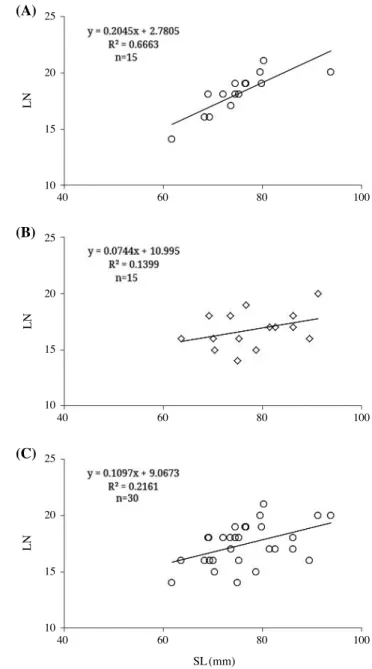
7.2mm vs. 78.0±8.1mm) 차이를 보이지 않았다(독립표본 t-검정, t = -1.051, df =28, P =0.302; Fig. 3A). 후판의 개 수(18±1.8 vs. 17±1.6)는 수컷이 암컷보다 더 많은 평균값 을 나타냈으며 통계적으로 유의미한 차이를 보였다(독립표 본 t-검정, t=2.132, df=28, P<0.05; Fig. 3B). 체장대비 후 판의 비율(24.2±1.3% vs. 21.7±2.5%)은 수컷이 암컷보다 더 높았으며 통계적으로 유의미한 차이를 나타냈다(독립표 본 t-검정, t=3.398, df=28, P<0.05; Fig. 3C). 체장과 후판 에 대한 Pearson의 상관분석에서 수컷(Pearson’s correlation coefficient, n=15, r=0.816, P<0.001; Fig. 4A)은 높은 선형 상관관계를 나타냈으나 암컷(n=15, r=0.374, P=0.170; Fig.
4B)은 유의미한 상관관계를 보이지 않았다. 종 전체 개체수 의 상관분석에서는 높은 선형 상관관계를 나타냈다(n =30, r=0.465, P<0.05; Fig. 4B).
고 찰
본 연구에서 좌우 한 쌍인 남방종개 I. hugowolfeldi 후각기 관의 외부 형태는 튜브형의 전비공과 그 뒤쪽에 위치한 눈모 양의 후비공, 총 두 개의 구멍으로 구성된다. 진화적으로 칠성 Fig. 2. The head’s schematic diagram(below) of Iksookimia hugowolfeldi, and the external(A) and internal(B) views of its olfactory organ, and a diagram of the rosette structure. The blue arrows indicate water flowing toward the olfactory organ. AN, anterior nostril; PN, posterior nostril; R, medium raphe; L, olfactory lamellae.
(A) (B) (C)
장어(lamprey)와 먹장어(hagfish)의 무악류(Agnatha)는 두부 위쪽에 오로지 한 개의 비공을 갖지만 유악류(Gnathostomata) 인 연골어류(Chondrichthyes) 판새아강(Elasmobranchii)의 상 어류와 가오리류 이상의 경골어류를 포함하는 분류군에서는 좌우 한 쌍 총 두 개의 비공(nostril)을 두부 주둥이에 보유한 다(Zeiske et al., 1992). 그러나 경골어류가 같은 수의 비공을 보유하는 특징을 나타내더라도 이것의 형태 및 발달 위치는 종마다 매우 다양한 것으로 알려져 있는데(Kasumyan, 2004), 최근 Kim(2018)은 한국산 해수 및 담수, 기수에 서식하는 한 국산 경골어류에 관해서 I) 피부표면과 평행한 반원, II) 아치 형(arch-like shape)의 돌출된 앞부분을 갖는 넓은 반원, III) 피 부표면과 평행한 원형, IV) 튜브형의 총 4개의 type들로 구분
되는 전비공과 I) 피부표면과 평행한 반원, II) 피부표면과 평 행한 타원, III) 개방된 좁고 가느다란 틈(slit), IV) 닫혀진 좁고 가느다란 틈의 총 4개의 type들로 구분되는 후비공의 형태들 을 보고하였다(Kim et al., 2019b). 또한 Kim(2018)은 윗입술 끝에서 I) 앞쪽으로 향하는 전비공과 II) 아래쪽으로 향하는 전 비공, 그리고 III) 주둥이 중간에 위치한 전비공을 묘사하였으 며 입과 눈 사이의 주둥이 위쪽에 위치하는 후비공을 연구된 모든 종에서 확인한 바 있다. 위의 유형들에서 남방종개의 비 공은 주둥이 중간에 위치하는(III type) 튜브형(IV type)에 해 당하는 전비공과 입과 눈 사이의 주둥이 중간에 위치한 개방
SL(mm)LNLN / SL(%)
Total Male Female
(A)
(B)
(C)
80 78 76 74 72 70 25
20
15
10
30 25 20 15 10
n=30
n=15
n=15
Fig. 3. Sexual differences(mean±SD) of Iksookimia hugowolfeldi in standard length(A, mm), olfactory lamellar number(B, mm), olfac- tory lamellar number to standard length ratio(C, %). LN, olfactory lamellar number; SL, standard length.
Fig. 4. Dispersion diagram showing a relationship between standard length(x-axis) and olfactory lamellar number(y-axis) of male(A) and female(B) and total specimens(C) of Iksookimia hugowolfeldi.
(A)
(B)
(C)
LNLNLN
25
20
15
10 25
20
15
10
25
20
15
1040 60 80 100
40 60 80 100 40 60 80 100
SL(mm)
된 좁고 가느다란 틈(III type)의 후비공에 해당하는 특징을 나 타낸다. 특히, 남방종개의 전비공은 망둑어과(Gobiidae), 메기 과(Siluridae), 모로네과(Moronidae)의 어류들과 비슷한 튜브 형(IV type)의 구조를 나타내는데(Kim, 2018) 이러한 구조는 주로 활동성이 약하고 저서성인 대부분의 경골어류에서 발견 되는 특징으로 알려져 있어(Kasumyan, 2004) 남방종개의 생 태적 습성과 일치했다(Kim and Park, 2002). 그러나 남방종개 주둥이의 좌우측면에서 수직방향으로 돌출되는 전비공의 발 달방향은 주둥이 아래로 향하는 말뚝망둥어 Periophthalmus modestus, 주둥이 앞쪽으로 향하는 Silurus microdorsalis와 점 농어 Lateolabrax maculatus의 전비공 발달방향과 차이를 보 였다. 경골어류 전비공의 돌출되는 방향은 서식처에서 개체 가 유영하는 방향, 물의 흐름이 개체에 부딪치는 방향, 서식처 의 물 유량과 관련되는데(Cox, 2008; Kim et al., 2019a), 이러 한 연관성으로 볼 때 남방종개 전비공의 측면 돌출 방향성은 주로 서식처의 모래 또는 자갈에 숨어서 은신하는 과정 중 머 리만 노출시키는 습성에 적응된 구조로 판단된다(Park et al., 2018). 그러나 이러한 비공 특징이 미꾸리과 또는 속에서의 일 반적인 특징인지는 알 수 없기 때문에 추후 생태적 습성과 서 식처 양상이 다른 미꾸리과 어류들의 후속적인 후각기관연구 가 더 필요할 것으로 사료된다.
본 연구에서 남방종개 후판의 개수와 개수의 성적이형을 확 인하기 위해 체장, 후판의 개수, 체장대비 후판의 개수 비율 을 SPSS 통계프로그램의 독립표본 t-test를 이용하여 분석하 였으며, 수컷과 암컷 각각에서 체장과 후판 개수와의 상관관 계를 확인하기 위해 Pearson의 상관분석을 수행하였다. 남 방종개는 14~21개의 후판을 보유하였는데, 이러한 결과는 Sinocyclocheilus jii의 12~14개, S. furcodorsalis의 11~13개 (Waryani et al., 2013b), Epalzeorhynchos bicolor의 45~48 개(Mokhtar and Elhafeez, 2014), Triplophysa dalaica의 20 개(Waryani et al., 2013a), Rhodeus uyekii의 14~15개(Kim et al., 2019b)의 다른 잉어목 어류들의 후판 수와 다소 차이를 나 타낸다. 남방종개의 체장(75.1±7.2mm vs. 78.0±8.1mm, P=0.302)에서 수컷과 암컷은 유의미한 차이를 보이지 않았으 나 후판의 개수(18±1.8 vs. 17±1.6, P<0.05)와 체장대비 후 판의 개수비율(24.2±1.3% vs. 21.7±2.5%, P<0.05)은 수컷이 암컷보다 더 높은 값을 나타냈다. 또한 체장과 후판은 수컷에서 만 유의미한 상관관계를 나타냈다(P<0.001). 일반적으로, 어류 에서 많은 수의 후판은 후각의 민감도와 효율성을 증가시키는 요인으로 알려져 있으나(Zeiske et al., 1976) 후각기관을 조사 한 많은 연구자들은 종의 후각 민감도는 후감각뉴런(olfactory receptor cell)의 증가성과 관련성이 깊지만 후상피층(olfactory epithelium)에서의 뉴런 분포와 수는 후판의 개수가 증가하더 라도 후판의 크기나 구조, 표면에서의 분포패턴(distributional arrangement)에 따라 크게 달라질 수 있으며 이 때문에 민감성
의 증가에 관한 직접적인 증거가 될 수 없다고 보고한다(Hara, 1986; Hara and Zielinski, 1989). 따라서 본 연구에서는 남방종 개의 후판개수(14~21개)에 따른 종의 후각 민감성을 설명할 수는 없다. 그러나 이러한 특징은 종의 생태적 지위에 따른 후 각 의존성을 반영하여 적응된 결과와 다른 종들과 비교되는 분 류학적 특징으로는 간주될 수 있다(Yamamoto, 1982). 남방종 개 수컷의 체장에 따른 후판 증가는 암컷보다 두드러지는 경향 을 나타냈다. 대부분의 경골어류 후각기관 연구에서 후판의 성 적이형은 나타나지 않는다고 알려져 있으나(Kasumyan, 2004), Lophiidae과(Caruso, 1975)와 Stemoptychidae과(Baird et al., 1990)에 속하는 일부 어류에서 확인된 바는 있다. 특히, Baird et al.(1990)은 Argyropelecus hemigymnus와 Valenciennellus tripunctulatus의 후판 개수(암컷 vs. 수컷; 1~14 vs 19~23, 11~12 vs. 17~20), 로제트 면적(0.6~0.7 vs. 1.0~1.7, 0.2~04 vs. 0.5~0.7mm2), 후관(olfactory tract)의 길이(<0.1mm vs.
0.2~0.3mm, <0.1mm vs. 0.1~0.2mm)가 암컷보다 수컷이 더 큰 값을 나타내는 성적이형을 확인하였으며 이러한 결과에 관 하여 생식기간에 짝의 발견과 화학적 상호작용을 위한 전략이 라고 언급하였다. 따라서 남방종개의 암컷보다 더 많은 후판수 를 보유하는 수컷의 특징은 생식을 위한 높은 후각의존도와 암 컷으로 표출되는 화학적 상호작용을 위한 후각기관의 성적이형 으로 판단된다(Baird et al., 1990; Kasumyan, 2004).
요 약
한국 고유종 남방종개 Iksookimia hugowolfeldi 후각기관 의 형태 및 형태계측학적 특징을 확인하기 위해 실체 현미경 을 이용하여 관찰하고 통계프로그램 SPSS로 분석하였다. 후각 기관의 외부 형태는 주둥이 좌우로 돌출된 튜브형의 전비공(직 경 0.35~0.53mm)과 눈모양의 후비공(장축 0.32~0.68mm) 으로 구성된다. 후각기관 내부에서는 14~21개의 후판으로 구 성된 로제트 구조가 확인된다. 형태계측학적 분석에서 후판개 수(수컷 vs. 암컷, 18±1.8 vs. 17±1.6)와 체장대비 후판개수 비율(24.2±1.3% vs. 21.7±2.5%)은 수컷이 암컷보다 더 높 은 값을 나타냈다. 체장과 후판은 수컷에서 유의미한 상관관계 (P<0.001)를 나타냈다. 이와 같은 남방종개의 후각기관 특징은 서식처 바닥의 모래를 파고 숨는 저서성 생활의 적응과 암수 간 생식에서의 후각의존성 차이를 반영하는 결과로 사료된다.
REFERENCES
Baird, R.C., G.Y. Jumper and E.E. Gallaher. 1990. Sexual dimor- phism and demography in two species of oceanic midwater fishes(Stomiiformes: Sternoptychidae) from the eastern
Gulf of Mexico. Bull. Mar. Sci., 47: 561-566.
Caruso, J.H. 1975. Sexual dimorphism of the olfactory organs of lophiids. Copeia, 1975: 380-381.
Cox, J.P. 2008. Hydrodynamic aspects of fish olfaction. J. R. Soc.
Interface, 5: 575-593. https://doi.org/10.1098/rsif.2007.
1281.
Hara, T.J. 1986. Role of olfaction in fish behaviour. In: Hara, T.J.
(ed.), The Behaviour of Teleost Fishes. Johns Hopkins Uni- versity Press, Baltimore, MD.
Hara, T.J. and B. Zielinski. 1989. Structural and functional devel- opment of the olfactory organ in teleosts. Trans. Am. Fish.
Soc., 118: 183-194.
Kasumyan, A.O. 2004. The olfactory system in fish: structure, func- tion, and role in behavior. J. Ichthyol., 44: S180.
Kim, H.T. 2018. A comparative anatomy and histology of the olfac- tory organ of 17 fishes in South Korea. Ph.D. Dissertation Chonbuk Nat’l Univ., Korea, 175pp.
Kim, H.T. and J.Y. Park. 2018. Functional anatomy of the olfactory organ in the torrent catfish, Liobagrus somjinensis(Siluri- formes, Amblycipitidae). Korean J. Ichthyol., 30: 65-68.
Kim, H.T., S.W. Yun and J.Y. Park. 2019a. Anatomy, histology, and histochemistry of the olfactory organ of the Korean shuttles mudskipper Periophthalmus modestus. J. Morphol., 280:
1485-1491. https://doi.org/10.1002/jmor.21044.
Kim, H.T., S.W. Yun, Y.J. Lee and J.Y. Park. 2019b. Morphology, histology, and histochemistry of the olfactory organ in Korean endemic fish, Rhodeus uyekii(Pices, Cyprinidae).
Korean J. Ichthyol., 31: 123-130.
Kim, H.T., Y.J. Lee and J.Y. Park. 2016. An anatomical and histo- chemical study of the olfactory organ in rice-fish Oryzias sinensis(Pisces: Adrianichthyidae) in South Korea. Korean J. Ichthyol., 28: 223-228.
Kim, I.S. and J.Y Park. 2002. Freshwater fishes of Korea. Kyo-Hak Publishing Co. Ltd., Seoul, Korea, pp. 66-67.
Kim, I.S., E.K. Choi, H. Yang and M.H. Koh. 2003. Karyotype Analysis of Southern Spined Loach, Iksookimia hugowol- feldi(Pisces, Cobitidae). Korean J. Ichthyol., 15: 127-129.
Kim, I.S., Y. Choi, C.L. Lee, Y.J. Lee, B.J. Kim and J.H. Kim.
2005. Illustrated Book of Korean Fishes. Kyohak Publ. Co., Seoul, 615pp.
Kim, P., J.H. Han and S.L. An. 2020. Complete mitochondrial ge- nome of Iksookimia hugowolfeldi and its phylogenetic posi- tion within genus Iksookimia. Mitochondrial DNA Part B, 5:
860-861. https://doi.org/10.1080/23802359.2020.1715292.
Ko, M.H. and I.C. Bang. 2016. Egg Development and Early Life History of the Korean Southern Spine Loach, Iksookimia hugowolfeldi(Pisces: Cobitidae). Korean J. Ichthyol., 28:
156-163.
Mokhtar, D.M. and H.H. Abd-Elhafeez. 2014. Light-and elec- tron-microscopic studies of olfactory organ of Red-tail shark, Epalzeorhynchos bicolor(Teleostei: Cyprinidae). J.
Micro. Ultrast., 2: 182-195. https://doi.org/10.1016/j.jmau.
2014.05.003.
NIBR(National Institute of Biological Resources). 2013. Inventory and management of endemic species of Korea. National Institute of Biological Resources, 147pp.
Park, C.W., H.S. Kim, J.G. Kim, S.W. Yun, H.T. Kim, J.S. Park. W.S.
Choi, Y.J. Cho and J.Y. Park. 2016. Microhabitat character- istics of the Korean endemic cobitid species Iksookimia hu- gowolfeldi inhabited at Geogeum island and Jangheung-gun in Korea. Korean J. Ichthyol., 28: 35-40.
Park, C.W., J.G. Kim, S.W. Yun, H.T. Kim, J.S. Park, W.S. Choi, Y.J.
Cho, Y.J. Lee and J.Y. Park. 2018. Habitat, diet, feeding and resting behaviour of the Korean endemic cobitid Iksookimia hugowolfeldi(Cobitidae, Pisces) in the wild. Folia Zoologi- ca, 67: 1-8. https://doi.org/10.25225/fozo.v67.i1.a2.2018.
Park, J.Y. 1996. A morphological study on the gonad of the species in the family Cobitidae(Pisces: Cypriniformes) from Korea.
Ph.D. Dissertation, Chonbuk National University, Korea, 158pp.
Park, J.Y. and I.S. Kim. 2001. Fine structures of oocyte envelopes of three related cobitid species in the genus Iksookimia(Co- bitidae). Ichthyol. Res., 48: 71-75. https://doi.org/10.1007/
s10228-001-8118-5.
Waryani, B., R. Dai, Y. Zhao, C. Zhang and A.R. Abbasi. 2013a.
Surface ultrastructure of the olfactory epithelium of loach fish, Triplophysa dalaica(Kessler, 1876)(Cypriniformes:
Balitoridae: Nemacheilinae). Italian J. Zool., 80: 195-203.
https://doi.org/10.1080/11250003.2013.771711.
Waryani, B., Y. Zhao, C. Zhang, R. Dai and A.R. Abbasi. 2013b.
Anatomical studies of the olfactory epithelium of two cave fishes Sinocyclocheilus jii and S. furcodorsalis(Cyprin- iformes: Cyprindae) from China. Pakistan J. Zool., 45:
1091-1101.
Yamamoto, M. 1982. Comparative morphology of the peripheral olfactory organs in teleosts. In: Hara, T.J.(ed.), Chemore- ception in fishes. Elsevier, Amsterdam, pp. 39-59.
Zeiske, E., J. Kux and R. Melinkat. 1976. Development of the ol- factory organ of oviparous and viviparous cyprinodonts (Teleostei) 1. J. Zool. Syst. Evol. Res., 14: 34-40.
Zeiske, E,, B. Theisen and H. Breucher. 1992 Structure, develop- ment, and evolutionary aspects of the peripheral olfactory system. In: Hara, T.J.(ed.). Fish chemoreception. Springer, Netherlands, pp. 13-39.