서 론
잉어목(Cypriniformes), 미꾸리아목(Cobitoidei)에 속하는 종개과(Balitoridae) 어류는 유럽과 아시아에 다양하게 분화하 여 42속 618종이 분포하고 있으며(Kottelat, 2012; Nelson et al., 2016), 우리나라에는 2속 3종인 종개 Orthrias toni, 대륙 종개 O. nudus, 쌀미꾸리 Lefua costata가 서식하고 있다(Kim, 1997; Kim and Park, 2007). Kottelat(2012)은 미꾸리아목 어류 를 정리하면서 종개, 대륙종개, 쌀미꾸리 3종을 Nemachilidae 에 포함시키고 종개 속명을 Barbatula로 사용한 바 있기 때문 에 분류학적으로 문제가 제기되고 있다. 종개는 대륙종개와 형태적으로 유사하나 추성의 배열 및 전비공과 후비공의 형태 에 차이가 나는 것으로 보고되었다(Kim and Park, 2007; Cao et al., 2012). 분포지에 있어서 종개는 태백산맥을 기준으로 동 해로 흐르는 하천에, 대륙종개는 서해안으로 흐르는 한강수계 에 서식하는 것으로 알려져 있으며, 국외에서 종개는 일본의
북해도, 러시아의 사할린 및 시베리아 동부 등에, 대륙종개는 몽고 및 중국대륙에 서식하는 것으로 알려져 있어 분포지 차 이를 보인다(Kim and Park, 2007).
우리나라 종개속 어류는 모두 자생종으로 하천 중·상류의 돌과 자갈 등이 깔린 곳에 서식하는 대표적 저서성 어류이며 (Kim, 1997; Kim and Park, 2007), 대륙종개의 경우 수서곤충 을 주로 섭식하는 식충성 어류로 보고되어(Byeon, 2010) 수생 태계 먹이사슬에서 중요한 2차 소비자 역할을 하고 있다. 최근 하천생태계에 대한 관심이 높아지면서 생태적적으로 교란된 하천의 경우 하천복원사업이 진행되고 있고(Park et al., 2009;
Choi, et al., 2011; Lee and Choi, 2015), 하천의 건강성을 평가 하여 관리하려는 사업 등(ME, 2007; NIER, 2015)이 진행되고 있는데, 자생종의 생태학적 특징은 멸종위기종 및 고유종과 함께 중요한 자료로 활용되고 있다.
우리나라 종개에 관한 연구는 형태와 핵형분석, DNA 염기 서열 등을 이용한 계통분류학적 연구(Kim et al., 1988; Lee et al., 1990; Park and Lee, 1991; Yang et al., 1991)가 있지만 생태학적 연구는 거의 연구되지 않았으며, 종개과로 확대해 도 대륙종개의 피부구조(Park and Kim, 2003)와 생태(Byeon,
—197 — http://www.fishkorea.or.kr
* Corresponding author: Myeong-Hun Ko Tel: 82-2-3277-4630, Fax: 82-2-3277-2385, E-mail: [email protected]
ISSN: 1225-8598(Print), 2288-3371(Online)
Accepted: September 22, 2017
한국자생종 종개 Orthrias toni (Pisces: Balitoridae)의 생활사
고명훈
*
이화여자대학교 에코과학부
Life History of the Siberian Stone Loach Orthrias toni(Pisces: Balitoridae) in the Buk Stream, Goseong, Korea by Myeong-Hun Ko* (Division of EcoScience, Ewha Womans University, Seoul 03760, Republic of Korea)
ABSTRACT Life history of the Siberian stone loach, Orthrias toni, were investigated using samples collected from Buk Stream, Goseong-gun, Gangwon-do, Korea. Growth was rapid between April and October when water temperature exceeded 10°C, but growth almost stopped from November-March when water temperature was below 10°C. Age groups for O. toni estimated by frequency distribution of total length in spawning season(May) indicated the 60~81mm is 1-year old, the 82~99mm group is 2-years old, the 100~119mm is 3-years old, and the 120~140mm is more than 4-years old. Total length range by sex was similar, and sex ratio(♂/♀) was 0.73. Spawning season according to the gonadosomatic index(GSI) was May with water temperature 14~17°C, and almost all fish were mature after one year old. Fecundity increased rapidly with age with an average of 4,460±3,302(mean±SD).
Size of mature eggs was 0.87±0.03mm in diameter irrespective of age.
Key words: Stone loach, age composition, spawning period, fecundity, mature egg size
2010) 등이 있을 뿐이다. 국외의 경우도 Barbatula barbatula, Metaschistura cristata, Lefua echigonia 등 일부 종들에 대해서 만 생활사와 연령 및 성장, 산란 및 섭식 생태 등의 연구가 진 행되었다(Smyly, 1955; Sauvonsaari, 1971; Mills et al., 1983;
Erös, 2001; Hofmann and Fischer, 2001; Saat et al., 2003; Vin- yoles et al., 2010; Aoyama and Doi, 2011; Patimar et al., 2011).
따라서 본 연구에서는 한국자생종 종개의 생활사 특징인 성 장 및 연령, 성비, 산란특성 등의 생물학적 특징을 밝히고 근 연종들과 비교·논의하였다.
재료 및 방법
1. 조사 지점 및 시기
조사는 종개 Orthrias toni가 집단으로 서식하는 것으로 보 고된(Lee et al., 2010) 강원도 고성군 간성읍 간천리의 북천 (Fig. 1)에서 2013년 1월부터 12월까지 실시하였다.
2. 채집방법
채집은 족대(망목 1×1, 4×4mm)를 사용하였으며, 채집된 개체는 마취제 MS-222(Sindel, Canada)로 마취하여 전장과 체중, 성별 등을 조사한 후 생식소 분석이 필요한 일부 개체 만 10% 포르말린에 고정하고 그 외 모든 개체는 바로 방류하 였다. 또한 채집지역의 수심, 유속, 하상 등을 조사하여 서식지
특성을 파악하였다.
3. 생활사 조사방법
성장 및 연령 추정은 채집된 개체를 근거로 전장빈도분포 도(Ricker, 1971)를 매달 작성하여 추정하였다. 성비는 생식소 가 성숙하여 암수가 구별되는 1월부터 5월, 11월부터 12월까 지 계산하였으며 χ2 검정을 통하여 성비 1:1 유의성을 확인하 였다. 산란기는 매달 3년생 이상인 전장 100~140mm 개체를 암컷과 수컷으로 나누어 각각 10~15개체를 10% 포르말린 수 용액에 고정하였으며, 이후 실험실로 옮겨 전장과 체중, 생식 소 무게 등을 측정한 후 생식소성숙도(gonadosomatic index, GSI=gonad weight/body weight×100)를 계산하여 추정하였 다. 수온 변화는 매달 전자수온계를 이용하여 측정하였으며, 기온변화는 국가수자원관리종합시스템(WAMIS) 강원도 고성 군(속초관측소)의 기상 자료를 인용하여 일평균 기온으로 그 래프를 작성하였다(WAMIS, 2013). 또한 포란수는 3월과 4월 에 채집된 개체의 난수를 계수하였으며, 성숙란의 크기는 4월 에 채집된 성숙개체의 난을 개체별로 30개를 측정하여 계산 하였다.
결 과
1. 성장 및 연령 추정
종개 암·수의 전장 성적이형을 알아보기 위해 산란기인 5 월에 암컷과 수컷으로 나누어 전장빈도분포도를 작성하였다. Fig. 2와 같이 전장 분포는 암·수가 유사한 4개의 최빈값을 보여 전장에 대한 성적이형은 없는 것으로 판단되었다. 따라 서 매월 전장빈도분포도 작성은 암·수 구분 없이 하나의 도 Fig. 1. Study station of Buk Stream, Eocheonri, Ganseong-eup,
Goseong-gun, Gangwon-do, Korea.
128° 37ʹ 128° 48ʹ
38° 32ʹ
Korea
East Sea
Goseong-gun
Gangwon-do
0 2 4 km Buk Stream
Study station
Ganseong-eup
Fig. 2. Frequency distribution of the total length of female and male of Orthrias toni collected from the Buk Stream, Goseong-gun, Gang- won-do, Korea, May, 2013.
Number of individuals
0 20 40 60 80 100 120 140
Total length(mm) Female(n=123)
Male(n=86)
1+
1+
2+
2+
3+
3+
4+≤ 4+≤ 15
10 5 0 5 10 15
표로 작성하였다.
당년생(2013년 부화) 치어는 전장 26~49(mean±SD, 38.6±
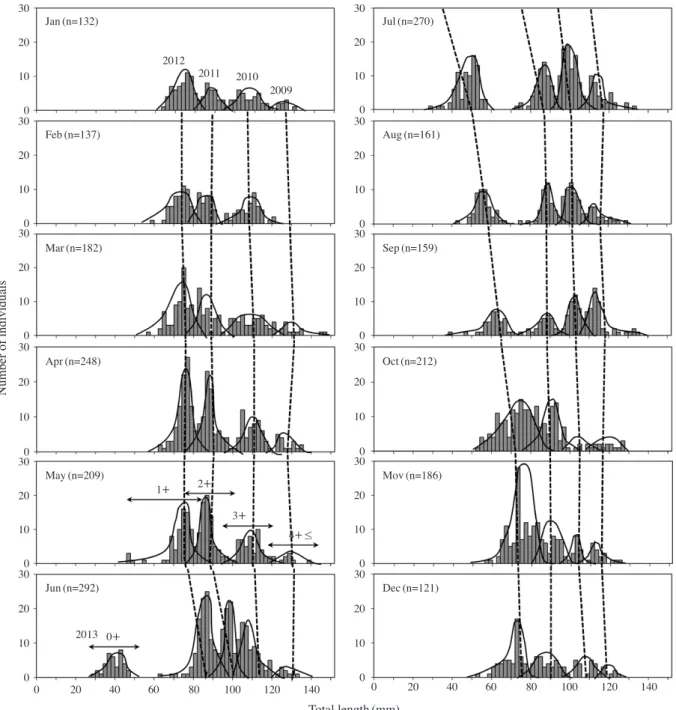
4.93)mm로 6월에 처음 관찰되었으며, 7월 28~59(47.2±5.44) mm, 8월 40~75(57.9±6.95)mm, 9월 38~69(62.0±6.76)mm 로 급격한 성장을 보였으며, 이후 수온이 내려가면서 성장은 둔화되어 10월 50~71(65.2±5.83)mm였고 수온이 10℃ 이 하로 내려가는 11월부터 12월까지는 52~79mm로 성장을 멈 추었다. 당년생 11~12월의 전장 범위는 1월의 첫 번째 최빈 값 범위 62~84mm와 유사하여 같은 당년생으로 판단되었다.
1월부터 4월까지 나타난 당년생(첫 번째 최빈값, 2012년에 부 화)은 1월부터 4월까지는 수온이 낮아 거의 성장을 하지 않 았으나 5월부터 성장을 시작하여 6월 68~90mm, 7월 73~92 mm, 8월 77~94mm, 9월 80~96mm로 빠른 성장을 보였으나 11월 이후에는 80~102mm로 온도가 급격히 내려가면서 성 장을 멈추었다. 이들의 11~12월 전장 범위는 1월의 두 번째 최빈값의 범위와 유사하여 동일한 1년생으로 판단되었다. 2년 생 이상의 연령군도 공통적으로 수온 10℃ 이상 되는 4월에서 10월까지는 성장이 이루어졌으나 수온이 10℃ 이하인 1월부
Fig. 3. Monthly variation of age and year class in frequency distribution of total length of Orthrias toni collected from the Buk Stream, Goseong- gun, Gangwon-do, Korea from January to December, 2013.
Number of individuals
0 20 40 60 80 100 120 140 0 20 40 60 80 100 120 140
Total length(mm) Jan(n=132)
Feb(n=137)
Mar(n=182)
Apr(n=248)
May(n=209)
Jun(n=292)
Jul(n=270)
Aug(n=161)
Sep(n=159)
Oct(n=212)
Mov(n=186)
Dec(n=121) 30
20 10 0
30 20 10 30 0
20 10 0
30 20 10 30 0
20 10 0
30 20 10 30 0
20 10 0
30 20 10 30 0
20 10 0
30 20 10 30 0
20 10 0
30 20 10 0 2012
2013
2011 2010 2009
4+≤ 3+
1+ 2+
0+
터 3월, 11월부터 12월은 거의 성장하지 않았고 1월의 최빈값 단계가 12월에 한 단계씩 이동한 것으로 나타났다. 따라서 이 러한 최빈값의 이동으로 볼 때 각각의 최빈값이 각각의 연령 으로 판단되었다. 산란기(5월)를 기준으로 연령은 암·수 구 분 없이 1년생은 전장 60~81mm, 만 2년생은 82~99mm, 만 3년생은 100~119mm, 만 4년생 이상은 120~140mm로 추정 되었다(Fig. 3).
서식지는 당년생 치어가 빠른 여울부(유속 20~60cm/sec) 의 자갈(입자크기 5~15cm) 바닥에 서식하였으나 1년생 이상 은 공통적으로 느린 여울부(유속 0~20cm/sce)의 돌 또는 큰 돌 바닥(입자크기 10~40cm)에 주로 서식하여 차이를 보였다.
2. 성비
1월부터 12월 중 생식소가 성숙하여 암·수가 구별되는 달 은 1월부터 5월, 11월부터 12월까지 7개월이었다(Table 1). 이 기간 중에 채집된 암컷은 701개체, 수컷은 514개체로 성비(♂/
♀)는 0.73으로 나타나 암·수 간의 성비는 유의한 차이를 보 여 1:1이 아니었다(χ2=28.78, P<0.05). 월별로는 2월과 11 월 12월이 유의한 차이를 보이지 않아 1:1이었으나(χ2<3.84, P>0.05), 1월과 3월, 4월, 5월은 유의한 차이를 보여 1:1이 아니었다(χ2>3.84, P<0.05).
3. 산란기 특징 1) 산란기 추정
산란기를 추정하기 위하여 매월 생식소성숙도(GSI)와 온도 변화를 조사하였다(Fig. 4). 암컷은 1월부터 4월까지 생식소 성숙도가 20% 이상이었으며 약간씩 증가하는 경향을 보이다 가 4월에 23.2±5.02%로 정점을 보였다. 하지만 5월에 8.4±
3.41% 급격히 감소하고 이후 8월까지 조금씩 감소하여 8월에 2.7±0.34%로 최소치를 보였다. 이후 다시 생식소성숙도는 급 격히 증가하여 10월에 13.4±0.90%, 12월에 18.4±1.91%로
증가하였다. 수컷은 1월부터 4월까지 1.2% 이상으로 높았으 나 5월 0.9±0.27%, 6월 0.6±0.24%로 급격히 감소하여 최소 치를 보였다. 이후 7월부터 다시 증가하기 시작하여 8월 0.9±
0.47%를 보였고 9월부터 12월까지는 1.3% 이상으로 높았다.
따라서 생식소 성숙도가 급격히 감소하는 점과 6월에 당년생 치어(전장 27~48mm)가 채집된 점으로 볼 때 산란기는 5월 로 추정되었다. 또한 이때 채집된 수컷의 두부에 추성이 관찰 되었으며, 수온은 14~17℃, 기온은 10~20℃ 범위였다.
2) 포란수와 성숙난의 크기
암컷의 연령별 생식소성숙도와 포란수, 성숙란의 크기는 Table 2와 같았다. 생식소는 만 1년생 소수의 개체를 제외하 고 만 1년생부터 만 4년생 이상까지 모두 성숙하였으며, 생식 소성숙도는 연령이 증가함에 따라 각각 약 2배 가까이 증가하 는 경향을 보였다. 난의 크기는 균일하였으며, 포란수는 1년생 Table 1. The sex ratio of Orthrias toni in the Buk Stream, Goseong-
gun, Gangwon-do, Korea, from January to December, 2013.
Month Female Male Total Sex ratio
(♂/♀) χ2
Jan.Feb.
Mar.Apr.
MayNov.
Dec.
7774 151112 123103 61
5563 7097 8683 60
132137 182248 209186 121
0.710.85 0.630.64 0.700.81 0.98
3.670.88 11.769.69 6.552.15 0.01
Total 701 514 1215 0.73 28.78
The critical value for χ2 goodness-of-fit test of equal numbers of females and males(df=1) at 95% significance is 3.84.
Fig. 4. Change in temperature and gonadosomatic index(GSI) of Orthrias toni in the Buk Stream, Goseong-gun, Gangwon-do, Korea, from January to December, 2013. Air temperature data were obtained from WAMIS(2013).
Temperature(℃)Gonadosomatic index(%)Gonadosomatic index(%)
Jan Feb Mar Apr May Jun Jul Aug Sep Oct Nov Dec Month
Air T.
Water T.
Female(n=113)
Male(n=93) 30
20 10 0 -1030
25 20 15 10 5 2.00
1.5 1.0 0.5 0.0
955±451개, 2년생 2,863±1,294개, 3년생 5,342±1,983개, 4 년생 이상 11,211±2,546개로 연령이 높아지면서 포란수는 급 격히 증가하였고 전체 평균은 4,460±3,302개였다(Fig. 5). 4 월의 성숙난은 거의 완숙되어 있었으며 크기는 연령과 관계 없이 균일한 크기로 평균 0.87±0.03mm였다. 5월에 배란된 성숙란은 회색으로 불투명하였으며 기질에 달라붙는 점착란 이었다.
고 찰
미꾸리아목(Cobitoidei) 어류는 종 또는 속에 따라 독특한 성 적이형을 보이는 것으로 알려져 있는데, 미꾸리과(Cobitidae) 어류 대부분이 수컷 가슴지느러미에 골질반(lamina circularis) 이 나타나고 공통적으로 전장 크기에 있어 암컷이 수컷보다 큰 경향을 보이며(Kim and Park, 2007; Kim, 2009; Kottelat, 2012), 기름종개속 Cobitis 어류 대부분은 산란기 전후로 수컷 의 반문에 성적이형이 나타난다(Kim and Jeong, 1988; Kim et al., 2006; Ko, 2009). 또한 종개과(Balitoridae)의 쌀미꾸리 Lefua costata 수컷도 두 개의 짙은 검은줄이 나타나 암컷과 구별된다(Kim and Park, 2007). 그러나 종개 Orthrias toni의 성적이형을 조사한 결과 산란기에 수컷 두부에 추성이 관찰된 것 이외는 특별한 성적이형이 관찰되지 않았다. 또한 암·수 의 연령별 전장에 대한 성적이형은 없었다(Fig. 2). 근연종인 Barbatula barbatula도 암컷과 수컷의 전장에 큰 차이가 없는 것으로 보고된 바 있다(Vinyoles et al., 2010).
종개의 성비(♂/♀)는 0.73으로 암컷이 수컷에 비해 유의 하게 많았는데(Table 1), 같은 속의 대륙종개 O. nudus는 0.98 (Byeon, 2010), 유럽에 서식하는 B. barbatula도 1.09(Erös, 2001)로 암·수 차이가 없었다. 같은 미꾸리상과에 속하는 우 리나라 미꾸리과 어류의 성비는 참종개 Iksookimia koreensis 0.74(Kim, 1978), 왕종개 I. longicorpa 0.65(Kim and Ko, 2005), 북방종개 I. pacifica 0.63(Ko and Won, 2016), 동방종개
I. yongdokensis 0.69(Ko et al., 2016), 점줄종개 C. nalbanti 0.65(Ko and Park, 2011), 새코미꾸리 Koreocobitis rotundicau- data 0.78(Byeon, 2007), 수수미꾸리 Kichulchoia multifasciata 0.73(Chong, 1986) 등 다수가 0.6~0.8 사이로 나타나 본 종과 유사하였다.
종개의 성장은 수온이 10℃ 이상 되는 4월부터 10월까지 성장을 하였으나 수온이 10℃ 이하인 11월부터 이듬해 3월까 지는 거의 성장을 하지 않았다. 이러한 월별 성장 주기는 이미 보고된 우리나라 미꾸리과 어류들인 왕종개, 북방종개, 동방종 개, 줄종개 C. tetralineata, 점줄종개, 기름종개 C. hankugensis 등과 비교적 유사하였다(Kim and Ko, 2005; Kim et al., 2006;
Ko, 2009; Ko and Park, 2011; Ko and Won, 2016; Ko et al., 2016).
연령은 월별로 전장빈도분포도를 조사하여 추정한 결과, 산 란기를 기준으로 1년생은 전장 60~81mm, 만 2년생은 82~99 mm, 만 3년생은 100~119mm, 만 4년생 이상은 120~140mm 로 추정되었으며, 연령군은 월에 따라 4~5개의 연령군이 관 Table 2. Gonadosomatic index, fecundity and matured egg diameter of Orthrias toni by age in the Buk Stream, Goseong-gun, Gangwon-do, Korea, from fish collected in March and April, 2013.
Age
1+ 2+ 3+ 4+≤ Total
Total length(mm) Number of individuals*
Body weight(g)
Gonadosomatic index of female(%) Fecundity
60~81 3.2±0.639 9.7±2.68 955±451
82~99 5.6±1.2813 18.6±5.88 2,863±1,294
100~119 9.1±1.3021 20.3±6.45 5,342±1,983
120~140 18.8±4.435 27.4±4.74 11,211±2,546
48- 8.0±4.71 18.6±7.31 4,460±3,302 Matured egg diameter(mm)** 0.85±0.03
(n=6) 0.88±0.01
(n=5) 0.86±0.02
(n=6) 0.88±0.03
(n=3) 0.87±0.03
(n=20)
*Data from sample collected in March and April; **Data from sample collected only in April. ‘n’ is the number of individuals examined.
Fig. 5. Fecundity of Orthrias toni by total length and age in the Buk Stream, Goseong-gun, Gangwon-do, Korea from fish collected in March and April, 2013.
Fecundity
50 60 70 80 90 100 110 120 130 140 150 Total length(mm)
16000 14000 12000 10000 8000 6000 4000 2000 0
4+≤ 3+
2+
1+
찰되었다. 이러한 결과는 이석과 아가미 뚜껑(operculae)의 연륜으로 분석된 근연종 Metaschistura cristata의 3~5개 연 령군(Smyly, 1955; Sauvonsaari, 1971; Mills et al., 1983), B.
barbatula의 4개 연령군(Erös, 2001)과 비교적 유사하였다. 하 지만 우리나라에 서식하는 대륙종개는 산란기에 2개의 연령 군만 나타나는 것으로 보고되어 차이를 보였다(Byeon, 2010) (Table 3).
종개의 생식소성숙도는 산란 이후 9월부터 급격히 발달하 여 월동기에 20% 안팎까지 성숙한 후 3~4월에 정점을 보인 후 5월에 감소하여(Fig. 4), 근연종 대륙종개 및 B. barbatula 와 유사한 생식주기를 보였으나 산란기는 6월로 차이를 보였 다(Byeon, 2010; Vinyoles et al., 2010). 우리나라 미꾸리과 어 류 중에서 수수미꾸리는 월동기까지 생식소성숙도가 20% 이 상 성숙하고 5~6월에 산란한다고 보고되어 생식주기 및 산란 기가 본종과 매우 유사하였지만(Chong, 1986; Kim and Yang, 2016), 참종개속 및 기름종개속 어류는 월동기까지 생식소 성 숙도가 5% 미만으로 낮다가 봄에 급격히 성숙한 후 6월부터 7월에 산란하여(Kim, 1978; Kim and Lee, 1984; Kim and Ko, 2005; Kim et al., 2006; Ko, 2009; Ko and Park, 2011; Ko and Won, 2016; Ko et al., 2016) 본 종과 생식주기가 거의 반대 경
향이었고 산란기도 큰 차이를 보였다.
포란수는 평균 4,460±3,302개, 성숙란 크기는 0.87±0.03 mm로 대륙종개의 포란수(4,119±2,416개)와는 유사하였으나 성숙란의 크기(0.75±0.04mm)는 대륙종개보다 큰 편이었다.
이러한 포란수와 난경을 우리나라 미꾸리과 어류와 비교하면 (Table 4), 포란수는 얼룩새코미꾸리(Hong et al., 2011)와 미 꾸리 Misgurnus anguillicaudatus(Uchida, 1939), 미꾸라지 M.
mizolepis(Kim et al., 1992)보다는 적은 편이었으나 그 외의 종들보다는 많은 편이었고, 난경은 미꾸리과 모두보다 작았다.
또한 성숙란은 회색으로 불투명하고 강한 점착성을 가지고 있 어 비교적 투명하고 약한 점착성을 가지는 미꾸리과 어류와 차이를 보였다.
요 약
강원도 고성군 북천에서 종개 Orthrias toni의 생활사를 조 사하여 생물학적 특징을 밝혔다. 성장은 수온이 10℃ 이상 되 는 4월부터 10월까지 빨랐으나 수온이 10℃ 이하인 11월부터 이듬해 3월까지는 거의 멈추었다. 연령은 전장빈도분포도로 Table 3. Comparison of total length by age in spawning season of the stone loach
Species Total length(mm) by age
Reference
1+ 2+ 3+ 4+ 5+
Orthrias toni 60~81 82~99 100~119 120~140 Present study
O. nudus 58~99 100~120 Byeon, 2010
Barbatula barbatula 51~53 75~77 91 104 Erös, 2001
Metaschistura cristata 49 83 102 109 Smyly, 1955
46 72 89 101 112 Sauvonsaari, 1971
65 93 103 Mills et al., 1983
Table 4. Comparison of egg size and fecundity of Balitoridae and Cobitidae in Korea
Species Egg size Fecundity Reference
Balitoridae Orthrias toni
O. nudus 0.87±0.03
0.75±0.04 4,460±330
4,119±2,416 Present study Byeon, 2010
Cobitidae
Iksookimia yongdokensis I. koreensis
I. pumila I. longicorpa I. hugowolfeldi I. pacifica
Cobitis hankugensis C. lutheri
C. tetralineata
Koreocobitis rotundicaudata K. naktongensis
Kichulchoia brevifasciata K. multifasciata
Misgurnus anguillicaudatus M. mizolepis
1.45±0.03 1.10±0.08 1.35±0.08 1.32±0.12 1.30±0.07 1.11±0.04 0.98±0.05 1.09±0.02 0.98±0.10 1.18±0.09 0.87±0.05 1.46±0.07 1.78±0.06
1.121.1
2,292±618 1,138±431 328±203 2,402±944 1,933±530 2,503±1,337 2,783±1,543 1,127±453 1,288±583 1,365±720 22,643±4,629 69±35 820±207 16,430~40,000
8,500~13,500
Ko et al., 2016 Kim, 1978 Kim and Lee, 1984 Kim and Ko, 2005 Choi, 2003; Park, 2016 Ko and Won, 2016 Ko, 2009 Ko and Park, 2011 Kim et al., 2006 Byeon, 2007 Hong et al., 2011 Ko and Bang, 2014 Chong, 1986 Uchida, 1939 Kim et al., 1987; 1992
볼 때 산란기인 5월을 기준으로 전장 60~81mm는 만 1년생, 82~99mm는 만 2년생, 100~119mm는 만 3년생, 120~140 mm는 만 4년생 이상으로 추정되었다. 암컷과 수컷의 연령별 전장 범위는 거의 동일하였고, 성비(♂/♀)는 0.73으로 암컷이 많았다. 산란기는 생식소성숙도(GSI)로 추정한 결과 5월이었 으며, 이때의 수온은 14~17℃였다. 생식소는 모든 연령이 성 숙하였고, 연령이 높아지면서 포란수는 급격히 증가하였으며, 평균 4,460±3,302개였다. 성숙란의 크기는 연령과 상관없이 직경 0.87±0.03mm로 비슷하였다.
REFERENCES
Aoyama, S. and T. Doi. 2011. Morphological comparison of early stages of two Japanese species of eight-barbel loaches: Le- fua echigonia and Lefua sp.(Nemacheilidae). Folia Zool., 60: 355-361.
Byeon, H.K. 2007. Ecology of Koreocobitis rotundicaudata(Cobit- idae) in the Naerin Stream, Korea. Korean J. Ichthyol., 19:
299-305.(in Korean)
Byeon, H.K. 2010. Ecological study of Orthrias nudus(Balitoridae) in the Eoron Stream of Korea. Korean J. Ichthyol., 22: 162- 167.(in Korean)
Cao, L., R. Causse and E. Zhang. 2012. Revision of the loach spe- cies Barbatula nuda(Bleeker 1865)(Pisces: Balitoridae) from North China, with a description of a new species from Inner Mongolia. Zootaxa, 3586: 236-248.
Choi, E.K. 2003. Biology of the southern spined loach, Iksookimia hugowolfeldi(Pisces, Cobitidae). Master Thesis, Chonbuk National University, Jeonju, 42pp.(in Korean)
Choi, J.K., C.R. Jang and H.K. Byeon. 2011. The characteristic of fish fauna by habitat type and population of Zacco platypus in the Tan Stream. Korean J. Environ. Ecol., 25: 71-80.(in Korean)
Chong, D.S. 1986. Morphological and bionomical studies of Ni- waella multifasciata(Wakiya et Mori). Master Thesis, Chonbuk National University, Jeonju, 37pp.(in Korean) Erös, T. 2001. Life history of the stone loach, Barbatula barbatula
in the Bükkös Stream(Hungary). Folia Zool., 50: 209-215.
Hofmann, N. and P. Fischer. 2001. Seasonal changes in abundance and age structure of burbot Lota lota(L.) and stone loach Barbatula barbatula(L.) in the littoral zone of a large pre- alpine lake. Ecol. Freshw. Fish, 10: 21-25.
Hong, Y.K., H. Yang and I.C. Bang. 2011. Habitat, reproduction and feeding habit of endangered fish Koreocobitis naktongensis (Cobitidae) in the Jaho Stream, Korea. Korean J. Ichthyol., 23: 234-241.(in Korean)
Kim, D.S., J.H. Kim and I.S. Park. 1992. Induced and multiple spawnings by human chorionic gonadotropin injection of the loach, Misgurnus mizolepis(Teleostomi; Cobitidae). J.
Aquacult., 5: 109-115.(in Korean)
Kim, H.S. and H. Yang. 2016. Spawning period and spawning char- acteristics of Kichulchoia multifasciata(Pisces: Cobitidae) in the Yugokcheon(stream) of Nakdonggang(river). Korean J. Ichthyol., 28: 93-99.(in Korean)
Kim, I.S. 1978. Ecological studies of cobitid fish, Cobitis koreensis in Jeonju-cheon Creek, Jeonrabug-do province, Korea. Ko- rean J. Ecol., 2: 9-14.(in Korean)
Kim, I.S. 1997. Illustrated Encyclopedia of Fauna & Flora of Korea, Vol. 37, Freshwater Fishes. Ministry of Education, Yeongi, 518pp.(in Korean)
Kim, I.S. 2009. A review of the spined loaches, family Cobitidae (Cypriniformes) in Korea. Korean J. Ichthyol., 21(supple- ment): 7-28.
Kim, I.S. and J.Y. Park. 2007. Freshwater Fishes of Korea. Kyohak Publishing Co., Ltd., Seoul, 467pp.(in Korean)
Kim, I.S. and M.H. Ko. 2005. Ecology of Iksookimia longicorpa (Cobitidae) in the Seomjin River, Korea. Korean J. Ichthy- ol., 17: 112-122.(in Korean)
Kim, I.S., M.H. Ko and J.Y. Park. 2006. Population ecology of Ko- rean sand loach Cobitis tetralineata(Pisces; Cobitidae) in the Seomjin River, Korea. J. Ecol. Field Biol., 29: 277-286.
(in Korean)
Kim, I.S. and M.T. Jeong. 1988. Seasonal variation of the color pat- tern in the Cobitid fish Cobitis taenia lutheri form Korea.
Korean J. Ecol., 11: 77-82.(in Korean)
Kim, I.S. and W.O. Lee. 1984. Morphological and ecological as- pects on the population of Cobitis koreensis Kim(Pisces:
Cobitidae) in the Begchon Stream, Puan-gun, Cholla-bugdo, Korea. Korean J. Ecol., 7: 10-20.(in Korean)
Kim, Y.U., D.S. Kim and Y.S. Park. 1987. Development of eggs, larvae and juveniles of loach, Misgurnus mizolepis Günther.
Bull. Korean Fish. Soc., 20: 16-23.(in Korean)
Ko, M.H. 2009. Reproductive mechanisms of the unisexual diploid- triploid hybrid complex between the spined loach Cobitis hankugensis and Iksookimia longicorpa(Teleostei, Cobiti- dae) in Korea. Doctoral Thesis, Chonbuk National Univer- sity, Jeonju, 160pp.(in Korean)
Ko, M.H. and I.C. Bang. 2014. Spawning character and early life history of the endangered Korean dwarf loach, Kichulchoia brevifasciata(Teleostei: Cobitidae). Korean J. Ichthyol., 26:
89-98.(in Korean)
Ko, M.H. and J.Y. Park. 2011. Growth and spawning ecology of Cobitis lutheri(Teleostei: Cobitidae) in the Mangyeong River, Korea. Korean J. Ichthyol., 23: 158-162.(in Korean) Ko, M.H. and Y.J. Won. 2016. The age and spawning characteristics
of the Korean endemic spine loach, Iksookimia pacifica(Pi- sces: Cobitidae) in the Bukcheon(stream), Korea. Korean J.
Ichthyol., 28: 72-78.(in Korean)
Ko, M.H., Y.S. Jeon and Y.J. Won. 2016. The habitat, age and spawning characteristics of the Korean eastern spined loach, Iksookimia yongdokensis(Pisces: Cobitidae) in the Chuksancheon(stream), Korea. Korean J. Ichthyol., 28: 72- 78.(in Korean)
Kottelat, M. 2012. Conspectus Cobitidum: An iventory of the loaches of the world(Teleostei: Cypriniformes: Cobitoidei).
Raffles B. Zool., Suppl. 26: 1-199.
Lee, H.G. and J.K. Choi. 2015. The characteristic of fish commu- nity following the restoration of Yangjae Stream. Korean J.
Environ. Ecol., 29: 873-883.(in Korean)
Lee, H.Y., K.J. Jee and E.K. Jung. 1990. Characteristics and varia- tions of the chromosomal constituents of Korean Nemache- lius toni(Pisces, Cobitidae). Korena J. Genetics, 12: 256- 262.(in Korean)
Lee, W.O., M.H. Ko, J.M. Bak, D.H. Kim, H.J. Jeon and K.H. Kim.
2010. Characteristics of fish fauna and community structure in Buk Stream of Goseong, Korea. Korean J. Ichthyol., 22:
238-248.(in Korean)
ME(Ministry of Environment). 2007. Research and planning guide- lines of aquatic ecosystems health assessments. Ministry of Environment. Incheon, 334pp.(in Korean)
Mills, C.A., J.S. Welton and E.L. Rendle. 1983. The age, growth and reproduction of the stone loach Noemacheilus barbatulus (L.) in a Dorset chalk stream. Freshwater Biol., 13: 283-292.
Nelson, J.S., T.C. Grande and M.V.H. Wilson. 2016. Fishs of the Word(Fifth edition). John Wiley & Sons, Hoboken, New Jersey, p. 192.
NIER(National Institute of Environmental Research). 2015. Survey and Evaluation Method for River and Stream Ecosystem Health Assessment. National Institute of Biological Re- sources. Incheon, 116pp.(in Korean)
Park, C.S. and H.Y. Lee. 1991. Systematic study on the fishes of family Cobitidae(Psces: Cypriniformes): Extensive varia- tion in mitochondrial DNA among geographic populations of Nemacheilus toni. Korean J. Ichthyol., 3: 140-147.
Park, C.W. 2016. Ecology of the endemic Korean southern king spine loach, Iksookimia hugowolfeldi. Master Thesis, Chon- buk National University, Jeonju, 56pp.(in Korean)
Park, J.Y. and I.S. Kim. 2003. Skin and its gland cells of a neamche- iline loach, Orthrias nudus(Pisces: Balitoridae) in Korea.
Korean J. Ichthyol., 15: 19-25.
Park, J.Y., S.H. Kim, M.H. Ko, M.K. Oh and J.C. Shin. 2009. Change of ichthyolfauna and fish community on natural stream restoration in Jeonju-cheon stream, Jeellabuk-do, Korea.
Korean J. Environ. Ecol., 23: 281-291.(in Korean)
Patimar, R., K.M. Rishkhori and A. Sabiani. 2011. Age, growth and reproductive characteristics of the Turkmenian crested loach Metaschistura cristata(Nemacheilidae). Folia Zool., 60: 302-307.
Ricker, W.E. 1971. Methods for assessment of fish production in freshwater. IBP Hand Book, 3: 112-113.
Saat, T., G. Lauringson and J. Lees. 2003. Reproduction of the stone loach, Barbatula barbatula(L.) in Estonia. Folia Biol., 51:
193-197.
Sauvonsaari, J. 1971. Biology of the stone loach(Nemacheilus bar- batulus L.) in the lakes Päijänne and Pälkänevesi, Southern Finland. Ann. Zool. Fenn., 8: 187-193.
Smyly, W.J.P. 1955. On the biology of the stone-loach Nemacheilus barbatula(L.). J. Anim. Ecol., 24: 167-186.
Uchida, K. 1939. The Fishes of Tyosen. Part I. Nematognathi, Eventognathi. Bull. Fish Exp. Sat. Gov. Gener. Tyôsen, pp.
400-458.(in Japanese)
Vinyoles, D., A.D. Sostoa, C. Franch, A. Maceda-Veiga, F. Casals and N. Caiola. 2010. Life-history traits of the stone loach Barbatula barbatula. J. Fish Biol., 77: 20-32.
WAMIS. 2013. Hydro/meteorology, Sokcho Station. Retrieved from http://www.wamis.go.kr. version(12/2013).
Yang, S.Y., H.Y. Lee, H.J. Yang and J.H. Kim. 1991. Systematic study on the fishes of the family Cobitidae(Pisces: Cyprini- formes): I. Geographic variation of Nemacheilus toni, Lefua costata, and Niwaella multifastiata. Korean J. Zool., 34:
110-122.