서 론
미꾸리상과(Cobitoidea)는 잉어목(Cypriniformes)의 거대 분류군에 속하며 유라시아(Eurasia)의 강과 하천에 서식하는 저서성 소형어류로 10과 185속 1,499종이 보고되었고, 이 중 미꾸리과(Cobitidae)는 21속 171종이 보고되었다(Kottelat, 2012). 우리나라의 미꾸리과는 5속 16종이 서식하고 있으며, 이 중 참종개 Iksookimia속은 한국 고유속으로 6종이 지리적 으로 나뉘어 서식하고 있다(Kim, 1997, 2009). 본 연구종인 동 방종개 Iksookimia yondokensis는 1997년 Kim and Park에 의
해 신종 보고되었는데, 근연종 왕종개 I. longicorpa와 체측반 문과 골질반(lamina circularis), 비늘 등에 차이가 있으며 지리 적으로 우리나라의 동남부 지역인 형상강과 영덕오십천, 축산 천, 송천 일대에서만 서식하는 것으로 알려져 있다(Kim and Park, 1997). 특히 동방종개는 우리나라 미꾸리과 어류 중 유 일하게 염색체 수가 4n =100개로 보고되어 주목받고 있다 (Kim et al., 1999).
우리나라 미꾸리과 어류의 생태학적 연구는 Uchida(1939) 에 의해 여러종의 생태적 특징이 간략히 보고된 이후 1978 년 참종개 개체군 생태를 시작으로 현재까지 많은 종들에서 생태적 연구가 진행되었다(Kim, 1978, 1997, 2008; Kim and Lee, 1984; Chong, 1986; Kim and Ko, 2005; Kim et al., 2006;
Byeon, 2007; Choi and Byeon, 2009; Ko et al., 2009; Hong et
—239 — http://www.fishkorea.or.kr
* Corresponding author: Yong-Jin Won Tel: 82-2-3277-4630, Fax: 82-2-3277-2385, E-mail: [email protected]
ISSn: 1225-8598(Print), 2288-3371(online)
accepted: December 20, 2016
한국고유종 동방종개 Iksookimia yongdokensis (Pisces: Cobitidae)의 서식지와 연령 , 산란기 특징
고명훈·전연선·원용진
*
이화여자대학교 에코과학부
The Habitat, Age and Spawning Characteristics of the Korean Eastern Spined Loach, Iksookimia yongdokensis (Pisces: Cobitidae) in the Chuksancheon (stream), Korea
by Myeong-Hun Ko, Yeon Seon Jeon and Yong-Jin Won* (Division of ecoScience, ewha Womans university, Seoul 03760, republic of Korea)ABSTRACT The habitat, age and spawning characteristics of the Korean eastern spined loach, Iksookimia yongdokensis, were investigated to obtain baseline data for its ecological characteristics in the Chuksancheon (stream), Yeongdeok-gun, Gyeongsangbuk-do, Korea. The difference between the habitats of juveniles (0+) and 1~4 year old loaches was that juveniles mainly inhabited sandy bottoms (substratum particle size 0.6±1.44 cm) with very slow velocities of water current (2.4±2.09 cm/sec) and low depths (29.2±7.57 cm), whereas 1~4 year old loaches inhabited pebble and cobble bottoms (substratum particle size 5.5~6.1 cm) with relatively fast velocities of water current (3.8~4.6 cm/sec) and deep depths (50~70 cm). The age groups for I. yongdokensis (female) estimated by the frequency distribution of total length in the spawning season (July) indicated that the 35~64 mm is 1-year old, the 65~94 mm group is 2-year old, the 95~119 mm is 3-year old, and the 120~145 mm is more than 4-year old. The sex ratio (♂/♀) was 0.69, and females were 10~30 mm larger than males. The lamina circularis at the base of the pectoral fins in males, a secondary sexual characteristic, formed at the 13th month after hatching. The spawning season according to the gonadosomatic index (GSI) was June to July with water temperatures of 20~25°C. The average number of eggs was 2,292±618, with a diameter of 1.46±0.02 mm for mature eggs.
Key words: Spined loach, Iksookimia yondokensis, habitat, age groups, spawning characteristics
al., 2011; Ko, 2015; Park, 2016; Ko and Won, 2016). 특히 서 석지에 있어서 미꾸리속 Misgurnus 어류는 유속이 거의 없 이 정체되고 하상은 펄로 된 곳에 주로 서식하고, 기름종개속 Cobitis 어류는 유속이 느리고 하상이 모래로 된 곳에 주로 서 식하며, 새코미꾸리속 Koreocobitis과 참종개속 Iksookimia, 좀 수수치속 Kichulchoia은 유속이 비교적 빠르며 하상이 자갈 과 돌 등으로 된 곳에 주로 서식하는 등 속에 따라 생태적 특 이성을 보이는 것으로 보고되었다(Kim, 1997, 2009; Kim and Park, 2007). 현재까지 보고된 동방종개에 관한 연구는 핵형분 석(Kim et al., 1999)과 난막구조(Park and Kim, 2001), 분자계 통학적 연구(Šlechtová et al., 2008; Kwan, 2015; Perdices et al., 2016) 등이 있으나 생태학적 연구는 일부 단편적인 보고만 있을 뿐 자세한 연구는 이루어지지 않았다.
따라서 본 연구에서는 한국고유종 동방종개의 서식지 특성 과 서식지 선호도, 성장 및 연령, 성비, 산란기 특징 등을 조사 하여 생태적 특성을 밝히고 유연종과 비교·논의하고자 한다.
재료 및 방법
1. 연구 하천 선정 및 조사지역
동방종개의 생태 연구는 동방종개 출현지역인 송천과 축산 천, 영덕오십천, 곡강천, 형산강 중에서 2014년 예비조사를 실 시하여 서식개체수가 많고 서식지가 안정된 축산천을 선정하 여 실시하였다. 축산천에서 동방종개의 서식경향 및 동소출현 종을 알아보기 위하여 상류부터 하류까지 3~5km 간격으로 5 개 지점을 Fig. 1과 같이 선정하였으며 행정구역은 아래와 같 다. 생태조사는 동방종개가 집단으로 서식하는 경북 영덕군 축산면 상원리(St. 3)에서 이루어졌다.
St. 1: 경북 영덕군 축산면 화천리(36°27′49.37″N, 129°23′
04.12″E)
St. 2: 경북 영덕군 축산면 기암리(36°29′24.07″N, 129°23′
23.25″E)
St. 3: 경북 영덕군 축산면 상원리(생태조사 지역)(36°30′
34.67″N, 129°24′04.13″E)
St. 4: 경북 영덕군 축산면 축산리(36°30′17.53″N, 129°25′
29.56″E)
St. 5: 경북 영덕군 축산면 축산리(36°29′53.80″N, 129°26′
31.92″E)
2. 조사시기
조사는 2015년 3월부터 2016년 2월까지 이루어졌는데, 동 방종개의 서식경향 및 동소출현종 조사는 봄(5월), 여름(8월),
가을(10월) 3회 조사를 실시하였고, 생태조사는 매월 13~17 일 사이에 이루어졌으며, 서식지 분석은 수위가 안정화되는 9 월부터 10월까지 실시하였다.
3. 조사방법
동방종개의 서식환경은 수문학적 환경과 이화학적 환경으로 나누어서 조사하였다. 수문학적 환경은 하폭과 유폭, 수심, 하 천형, 하상구조, 고도 등을 측정하였는데, 하천형은 Kani(1944) 의 방법에 따라, 하상구조는 Cummine(1962)의 방법을 응용 하여 현장에서 육안으로 구분하였다. 이화학적 환경은 2013년 매달 14~16일 사이에 12시를 기준으로 측정하였는데, 서식지 의 기온과 수온은 디지털온도계(T-250A, ASAHI, Japan)를, 전 기전도도(Conductivity)와 용존산소량(DO), pH, 염도 등은 수 질측정기(HI-9828, Romania)를 사용하여 측정하였다.
채집방법은 지점조사의 경우 정량조사가 될 수 있도록 족대 (망목 4×4mm, 60분)와 투망(6×6mm, 10회), 일각망(4×4 mm, 12시간 설치)을 동일하게 사용하였고, 어류의 동정은 Kim and Park(2007)과 Kim et al.(2005)에 따랐으며, 채집된 동소 어류는 종을 확인하고 모두 바로 방류하였다. 동방종개 채집 은 족대(1×1, 4×4mm)와 투망(6×6mm), 일각망(4×4mm) 을 사용하였고, 채집된 동방종개는 마취제 MS-222(Sindel, Canada)로 마취하여 전장과 체중, 성비 등을 조사한 후 대부 분 방류하였으며, 일부 생식소 분석이 필요한 개체만 10% 포 르말린 용액에 고정하여 실험실로 옮겨 분석하였다. 암·수는 수컷의 골질반의 유무로 판단하였으며, 전장은 0.01mm까지, 체중은 0.01g까지 측정하였다.
Fig. 1. Study stations of Chuksancheon(stream), Chuksan-myeon, Gyeongsangbuk-do, Korea, 2015. Thick line: distribution area of Ik- sookimia yongdokensis.
Yeongdeok-gun East Sea
129°20′E
36°30′N
Korea St. 1
St. 2 St. 3
St. 4 St. 5 Chuksan-myeon
Chuksancheon
0 1.5 3km N
동방종개의 연령별 서식지 선호도는 개체별로 수심과 유속, 하상입자 크기 등을 조사한 후 연령별로 비교하였으며, 통계적 유의성은 SPSS 21.0을 사용하여 일원배치분산분석(One-way ANOVA, α=0.05)을 실시한 후 사후분석 LSD test를 수행하 였다. 매달 채집된 개체로 전장빈도분포도를 작성하여 성장도 와 연령은 추정하였으며(Ricker, 1971), 성비를 계산하고 χ2 검 정을 통하여 성비 1:1 유의성을 확인하였다. 산란기는 매달 생 식소가 발달한 암컷(전장 100~140mm)과 수컷(전장 80~125 mm)을 각각 5~10개씩 채집하여 생식소성숙도(gonadosomatic index, GSI=gonad weight/body weight×100)를 계산하여 추 정하였다. 포란수는 5월과 6월에 채집된 개체의 난수를 계수 하였으며, 성숙란의 크기는 6월에 채집된 성숙개체의 난을 개 체별 30개를 측정하여 계산하였다.
결 과
1. 서식지 특성
1) 서식분포 및 환경
축산천에서 동방종개 Iksookimia yongdokensis는 중류부인 경북 영덕군 축산면 상원리(St. 3) 일대 약 3km 구간에만 서식 하고 있었을 뿐 상류지역(St. 1~2)과 하류지역(St. 4~5)에는 서식하지 않았다. 이 지역은 하폭 50~70m, 유폭 10~30m, 수 심 30~80cm이고 하천형은 여울과 소가 반복되는 Bb형이었 으며 하상은 돌(cobble)과 자갈(pebble), 잔자갈(gravel), 모래 (sand), 큰돌(boulder) 등이 비교적 균등하게 분포하는 곳이었 다. 같은 미꾸리과에 속하는 미꾸리 Misgurnus anguillicaudatus 는 축산천 전역에 서식하고 있어 동방종개보다 서식지역이 넓 었다(Table 1).
동방종개 집단서식지인 경북 영덕군 축산면 상원리(St. 3)는 비교적 물이 맑았고 연중 전기전도도(conductivity)는 179~
265μS/cm, 용존산소량(DO)은 8.7~11.6mg/L, pH는 7.25~
8.26로 나타나 수질은 양호하였으며, 염도는 0.09~0.12‰로 순담수였다. 동소출현종은 10과 17종이 출현하였으며, 우점종 은 점몰개 Squalidus multimaculatus(29.4%), 아우점종은 버들 치 Rhynchocypris oxycephalus(21.8%)였으며, 그 밖에 참갈겨 니 Zacco koreanus(18.2%), 피라미 Z. platypus(13.9%), 동방 종개(5.2%), 미꾸리(2.7%), 밀어 Rhinogobius brunneus(2.4%), 참붕어 Pseudorasbora parva(1.9%) 등의 순으로 우세하였다 (Table 1).
2) 연령별 서식지 특징
동방종개가 서식하는 지역은 여울과 소가 반복적으로 나타 는 지역의 소(pool)였으며 빠른 여울에는 서식하지 않았다. 개
체별로 유속과 수심, 하상 기질 크기를 측정한 결과(Fig. 2), 당 년생 치어(전장 25~50mm, n=66)는 소 가장자리의 유속이 느리고(2.4±2.09cm/sec) 수심은 얕으며(29.2±7.57cm) 하 상은 대부분 모래로 이루어진 곳(기질 크기 0.6±1.44cm)에 서식하였지만 1년생(전장 55~79mm, n=46)과 2년생(전장 Fig. 2. Comparison of water velocity, depth and substratum particle size by age of Iksookimia yongdokensis in the Chuksancheon(stream), Chuksan-myeon, Yeongdeok-gun, Gyeongsangbuk-do, Korea from September to October, 2015. The diagrams indicate the median(hori- zontal line) and 50% range(gray rectangle).
Water velocity(cm/sec)
Age(Years)
0+ 1+ 2+ 3+≤
(n=66) (n=46) (n=35) (n=20) 20
15 10 5 0
Water depth(cm)Substratum particle size(cm)
80 60 40 20
0 12 10 8 6 4 2 0
(A)
(B)
(C)
80~105mm, n=35), 3년생 이상(전장 106~155mm, n=20) 은 대체로 유사하게 유속은 평균 5.5~6.1cm/sec로 당년생보 다 빨라졌고(One-way ANOVA, P<0.001), 수심은 평균 50~
62cm 깊어졌으며(P<0.001), 기질 크기는 평균 3.8~4.6cm 로 커져(P<0.001) 차이를 보였다. 1년생 이상의 연령군들 간 에는, 유속과 하상은 모두 연령별 유의한 차이가 없었고(One- way ANOVA, P>0.05), 수심은 1년생과 2년생-3년생 이상에 서 유의한 차이를 보였으나(P<0.001), 2년생과 3년생 이상은
유의한 차이가 없었다(P=0.47).
2. 성장 및 연령 추정
매월 채집된 전장빈도 분포는 Fig. 3과 같이 나타났다. 2015 년에 태어난 당년생 치어는 8월에 처음 채집되었으며 전 장 15~35mm였고, 이후 성장을 하여 9월 27~43mm, 10월 34~48mm였으며, 이후 월동기로 접어들면서 2월까지 35~50 Table 1. Physical characteristics and the number of fish collected in the Chuksancheon(stream), Chuksan-myeon, Yeongdeok-gun, Gyeongsang- buk-do, Korea during May to October, 2015
Items/Scientific name Station
Total RA Remarks*
1 2 3 4 5
River width(m) 25~30 30~40 50~70 50~60 70~90
Water width(m) 3~7 2~6 10~30 10~25 10~30
Water depth(cm) 50~120 50~150 30~80 30~130 40~70
River type** Aa~Bb Aa~Bb Bb Bb Bb~Bc
Altitude(m) 64 36 21 16 6
Bottom structure***
(%)
Mud(~0.1mm) 5
Sand(0.1~2mm) 10 20 20 10
Gravel(2~16mm) 10 10 20 30 20
Pebble(16~64mm) 20 30 25 40 30
Cobble(64~256mm) 50 40 30 30
Boulder(256< mm) 10 10 10 10 10
Family Anguillidae
Anguilla japonica 1 1 0.02 An
Family Cyprinidae
Carassius auratus 24 1 25 0.55
Pseudorasbora parva 15 5 46 3 69 1.53
Squalidus multimaculatus 62 722 39 139 962 21.27 En
Tribolodon hakonensis 16 16 0.35
Rhynchocypris oxycephalus 53 65 537 655 14.48
Zacco koreanus 215 337 447 85 60 1,144 25.29 En
Zacco platypus 27 121 342 217 323 1,030 22.77
Family Cobitidae
Misgurnus anguillicaudatus 12 4 66 10 2 94 2.08
Iksookimia yongdokensis 128 128 2.83 En
Family Bagridae
Pseudobagrus koreanus 1 1 0.02 En
Family Siluridae
Silurus asotus 15 15 0.33
Family Osmeridae
Plecoglossus altivelis 15 12 59 86 1.90 Di
Family Adrianichthyidae
Oryzias latipes 23 23 0.51
Family Centropomidae
Coreoperca herzi 22 36 46 104 2.30 En
Siniperca scherzeri 1 1 0.02
Family Odontobutidae
Odontobutis platycephala 17 8 11 36 0.80 En
Family Gobiidae
Chaenogobius urotaenius 4 21 25 0.55
Rhinogobius brunneus 12 58 32 6 108 2.39 L
Number of species 5 8 17 11 11 19
Number of individuals 322 623 2,459 444 675 4,523
*En: Korean endemic species; L: land-locked species; An: andromous species; Di: diadromous species, **Kani(1944), ***Mud(~0.1mm); Sand(0.1~2mm);
Gravel(2~16mm); Pebble(16~64mm); Cobble(64~256mm); Bolder(256mm<)(Cummins, 1962).
mm로 거의 성장을 하지 않았다. 2012년에 태어난 치어는 3월 에 전장 30~49mm였으나 4월 이후 급격한 성장을 하여 5월 40~59mm, 7월 50~74mm, 9월 55~80mm였으며 이후 월동 기로 들어가면서 거의 성장이 멈추었고, 7월부터는 수컷 가슴 지느러미 기조에 골질반이 생성되면서 암컷과 구별되었다. 2 년생 이상의 연령군도 공통적으로 4월부터 9월까지는 비교 적 빠른 성장을 보였으나 그 외의 계절은 느린 성장을 보이거 나 성장하지 않았다. 산란이 시작되는 6월을 기준으로 연령을 추정하면, 암·수가 구별되지 않은 전장 40~64mm는 만 1년 생 치어였고, 만 2년생 이상은 암·수가 구별되었는데, 암컷 은 65~94mm가 만 2년생, 95~119mm가 만 3년생, 120~145 mm가 만 4년생 이상으로, 수컷은 70~94mm가 만 2년생, 95~125mm가 만 3년생 이상으로 추정되었다. 암컷과 수컷은 만 1년생과 만 2년생에서 유사한 전장범위를 보였으나 만 3년 생 이후부터는 암컷이 수컷보다 10~30mm가 더 컸다.
3. 성비
만 1년 동안 채집된 개체 중 치어는 191개체, 암컷은 617 개체, 수컷 427개체로 성비(♂/♀)는 0.69로 나타났으며(Table 2), 암·수 간의 성비는 유의한 차이를 보였다(χ2=34.58, P<
0.05). 월별로는 3월과 4월, 5월, 8월, 11월이 유의한 차이를 보 였으나(χ2>3.84, P<0.05) 그 외의 달은 모두 유의한 차이를 보이지 않았다(χ2<3.84, P>0.05).
4. 산란기 특징
1) 산란기
산란기를 추정하기 위하여 매월 생식소성숙도(GSI)를 분석 하였다. 암컷은 3월에 4.8±1.64%로 낮았으나 이후 수온이 상 승하면서 4월 7.8±2.56%, 5월 18.9±2.24%로 급격히 높아졌 으며 6월은 21.2±1.51%로 정점을 보였다. 이후 7월에는 8.0±
Fig. 3. Frequency distribution of the total length of Iksookimia yongdokensis in the Chuksancheon(stream), Chuksan-myeon, Yeongdeok-gun, Gyeongsangbuk-do, Korea from March, 2015 to February, 2016. Gray: juvenile, Black: female, Dark gray: male.
Number of individuals
March (n=117)
April (n=112)
(n=114)May
(n=109)June
(n=160)July
August (n=162)
September (n=159)
October (n=109)
November (n=67)
December (n=73)
January (n=29)
February (n=24)
Total length(mm) Total length(mm)
10 5 0 5 10
15 10 5 0 5 10 10 15
5 0 5 10
1510 5 05
1015 10
5 0 5 10
10 5 0 5 10 10
5 0 5 10
10 5 0 5 10 10
5 0 5 10
10 5 0 5 15 10
10 5 0 5 10 15
10 5 0 5 10
1+ 2+
3+
2+ 3+≤
4+≤
0 10 20 30 40 50 60 70 80 90 100 110 120 130 140 150 160 0 10 20 30 40 50 60 70 80 90 100 110 120 130 140 150 160
3.22%로 급격히 낮아졌으며 8월은 6.0±1.86%였고 이후 이듬 해 2월까지 3.4~4.0%로 낮게 유지되었다(Fig. 4B). 수컷은 3 월에 2.0±0.12%로 낮았으나 이후 4월 2.3±0.23%, 5월 3.4±
0.66%로 급격히 높아졌으며 6월은 5.2±0.51%로 정점을 보 였다. 이후 7월은 2.0±0.70%로 급격히 낮아졌으며 8월부터 이듬해 2월까지 2.0% 이하로 높게 유지되었다(Fig. 4C). 산란 기는 6월에 채집된 암·수의 생식소성숙도가 모두 높고 암컷 들은 모두 산란을 하지 않은 점과 7월에 채집된 암·수는 모 두 생식소성숙도가 급격히 낮아지고 8월에 전장 15~35mm의 당년생 치어가 채집된 점으로 볼 때 6월부터 7월로 추정되었 고, 산란성기는 6월말부터 7월 초로 추정되었다(Fig. 3A). 이 때의 수온은 20~25℃였으며(Fig. 4A), 산란에 참여하는 개체 는 만 3년생 이상의 개체로 암컷은 전장 100mm 이상, 수컷은 90mm 이상의 개체들이었다(Fig. 5, Table 3).
2) 포란수와 성숙난의 크기
포란수는 만 3년생(n =5) 1,672±655개, 만 4년생 이상 (n=11) 2,574±349개로 나타났으며, 전체(n=16)는 2,292±
618개였다(Fig. 5). 6월에 채집된 성숙란의 크기는 전장과 생 식소성숙도, 포란수와 상관없이 1.46±0.02(1.43~1.49) mm로 대부분 균일하였다(Table 3).
고 찰
축산천에서 동방종개 Iksookimia yongokensis는 여울과 소 가 반복적으로 나타나고 하상이 돌과 자갈, 잔자갈, 모래 등이 비교적 균등하게 이루어진 중류부(St. 3) 약 3km 구간에서만
서식하여 서식범위가 비교적 좁았다. 또한 예비조사를 실시한 영덕오십천과 곡강천, 형산강, 대종천 등에서도 동방종개는 비 교적 좁은 범위에서만 서식하고 있고 공통적으로 물이 비교 적 맑으며 하상이 돌과 자갈, 모래 등이 많이 쌓인 소지역이었 다. 이러한 특징은 하천(또는 강)의 중·상류에 넓게 분포하 는 같은 속의 참종개 I. koreensis(Ko et al., 2009)와 왕종개 I.
longicorpa(Kim and Ko, 2005)와 서식지는 유사하였지만 서 식범위에서는 차이를 보였다. 한국의 어류 적색자료집에서 동 방종개는 동해 남동부의 제한된 곳에 서식하고 서식지가 점점 감소하고 있어 관심대상종(Least Concern, LC)으로 평가되었 다(NIBR, 2011). 본 조사 결과 서식하천에서도 서식구간이 매 Table 2. The sex ratio of Iksookimia yongdokensis in the Chuk-
sancheon(stream), Chuksan-myeon, Yeongdeok-gun, Gyeongsang- buk-do, Korea from March, 2015 to February, 2015
Month Juvenile Female Male Total Sex ratio (♂/♀) χ2
Mar. 19 64 34 117 0.53 9.18
Apr. 16 61 35 112 0.57 7.04
May 18 63 33 114 0.52 9.38
Jun. 24 48 37 109 0.77 1.42
Jul. - 87 73 160 0.84 1.23
Aug. 26 80 56 162 0.70 4.24
Sep. 25 75 59 159 0.79 1.91
Oct. 29 44 36 109 0.82 0.80
Nov. 12 36 19 67 0.53 5.25 Dec. 11 36 26 73 0.72 1.61 Jan. 5 13 11 29 0.85 0.17 Feb. 6 10 8 24 0.80 0.22
Total 191 617 427 1,044 0.69 34.58
The critical value for χ2 goodness-of-fit test of equal numbers of females and males(1df) at 95% significance is 3.84.
Fig. 4. Temperature and gonadosomatic index(GSI) of Iksookimia yongdokensis in the Chuksancheon(stream), Chuksan-myeon, Yeong- deok-gun, Gyeongsangbuk-do, Korea from March, 2015 to February, 2016.
Mar. Apr. May Jun. Jul. Aug. Sep. Oct. Nov. Dec. Jan. Feb.
Mar. Apr. May Jun. Jul. Aug. Sep. Oct. Nov. Dec. Jan. Feb.
Mar. Apr. May Jun. Jul. Aug. Sep. Oct. Nov. Dec. Jan. Feb.
Temperature(℃)
Air T.
Water T.
Famale (n=60)
(n=52)Male Gonadosomatic index(%)Gonadosomatic index(%)
35 30 25 20 15 10 5 0 -5 25 20 15 10 5
0
7 6 5 4 3 2 1 0
(A)
(B)
(C)
우 좁은 것으로 나타났으며 일부하천에서는 각종 하천공사가 이루어지고 수질이 악화되는 것이 관찰되었다. 따라서 정확한 서식분포 및 감소경향을 파악하여 멸종위협 등급을 평가할 필 요성이 있으며, 이후 평가 결과에 따라 보전대책을 세워야 할 것으로 판단된다.
동방종개의 1년생부터 3년생 이상은 유속이 있고(5.5~6.1 cm/sec) 수심은 깊으며(50~62cm) 하상이 돌과 자갈인 곳을 선호하였지만 당년생 치어는 유속이 거의 없고(2.4±2.09cm/
sec) 수심이 얕고(29.2±7.57cm) 하상이 모래인 곳에 주로 서 식하여 수심이 얕고 유속이 느린 모래지형도 동방종개의 서 식에 있어 중요한 요소로 판단되었다. 이러한 서식지 특징은 비교적 같은 속의 왕종개(Kim and Ko, 2005)와 참종개(Ko et al., 2009), 부안종개 I. pumila(Kim and Lee, 1984), 남방종개 I.
hugowolfedi(Choi, 2003; Park, 2016) 등과 유사하였으나 모래 지형에서만 거의 서식하는 북방종개 I. pacifica(Ko, 2015)와 는 차이를 보였다.
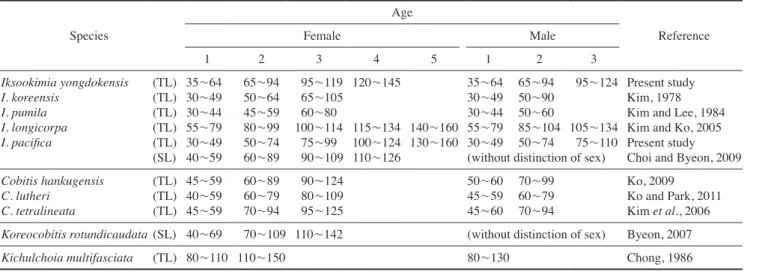
동방종개의 성장은 모든 연령대에서 활동기인 4월부터 9 월까지 급속한 성장을 보였으나 월동기인 11월부터 3월까지 는 거의 성장을 하지 않았다. 또한 수컷은 부화 후 13개월 후 부터 가슴지느러미에 골질반이 형성되어 암수가 구별되었으 며, 암수의 성장 차이를 보여 만 3년생 이상의 개체에서는 암 컷이 수컷보다 10~30mm가 더 크게 나타나 비교적 왕종개 (Kim and Ko, 2005)와 참종개 I. koreensis(Ko et al., 2009), 부안종개(Kim and Lee, 1984), 북방종개 I. pacifica(Ko and Won, 2016), 기름종개 Cobitis hankugensis(Ko, 2009), 점줄종 개 C. lutheri(Ko et al., 2011), 줄종개 C. tetralineata(Kim et al., 2006) 등과 유사하였다. 전장빈도분포도를 이용한 동방종 개의 연령은 암컷이 4년생 이상, 수컷이 3년생 이상까지 추정 되어 연령군의 수는 참종개와 부안종개, 기름종개, 점줄종개, 줄종개, 새코미꾸리 Koreocobitis rotundicaudata, 수수미꾸리 Kichulchoia multifasciata보다 많았으나 왕종개와 북방종개 보다는 적었고, 연령별 전장범위는 비교적 왕종개와 유사한 경향을 보였다(Table 4). 한편 일부 미꾸리과 어류에서는 연륜 형질을 이용하여 연령을 추정한 바 있는데, 이석을 이용한 경 우 유럽의 C. paludica는 암컷 5세, 수컷은 3세(Przybylski and Valladolid, 2000; Oliva-Paterna et al., 2002), C. taenia는 암컷 4세, 수컷 3세까지(Robotham, 1981), 비늘을 이용한 참종개는 암·수 모두 3세까지 추정되어(Kim et al., 2008) 본 결과와 비 교적 연령수가 비슷하였다. 그러나 안하극을 이용한 일본의 Niwaella delicata는 암컷 12.5세, 수컷은 11.5세까지 보고된 바 있어(Kano, 2000), 추후 연륜형질을 이용한 연령 결과와의 비교 검토가 필요하다고 판단된다.
성비(♂/♀)는 0.69로 나타나 부안종개 1.01보다는 낮았으 나 다른 미꾸리과 어류와는 비교적 유사하였다(Table 5). 미꾸 리과 어류의 이차 성징은 골질반 외에 기름종개속 어류에서 는 산란기에 반문 변화가 일어나는 것으로 보고되었는데(Kim and Jeong, 1988; Kim et al., 2006; Ko and Park, 2011; Ko, 2009), 동방종개에서는 이러한 반문변화는 관찰되지 않았다.
산란기는 6월에서 7월(수온 20~25℃)로 추정되어 춘하 산 란형에 속하였으며(Shimzu and Hanyu, 1982; Kaneko et al., 1986), 비교적 참종개와 부안종개, 왕종개, 남방종개, 줄종개, 좀수수치 K. brevifasciata와 유사하였으나 북방종개와 기름종 개, 점줄종개 보다는 빠르고 새코미꾸리, 얼룩새코미꾸리 K.
naktongensis, 수수미꾸리, 미꾸리 Misgurnus anguillicaudatus, 미꾸라지 M. mizolepis보다는 느린 편이었다(Table 5). 성숙난 의 크기는 1.45±0.03mm로 미꾸리과 어류 중에서 비교적 좀 수수치와 유사하고 수수미꾸리 다음으로 큰 편에 속하였으며, 포란수는 2,292±618개로 미꾸리과 어류 중에서 중상위권에 속하였으며 비교적 왕종개와 북방종개, 남방종개, 기름종개, 수수미꾸리와 유사하였다.
동방종개를 비롯한 대부분의 참종개속 어류는 공통적으로 Table 3. Mature egg size of Iksookimia yongdokensis in the Chuk-
sancheon(stream), Chuksan-myeon, Yeongdeok-gun, Gyeongsang- buk-do, Korea, June, 2015
Total length
(mm) Body weight
(g) GSI
(%) Fecundity Mature egg size (mm)
117 9.8 19.2 1,484 1.43±0.10
118 12.4 20.0 2,220 1.45±0.09
122 14.31 23.5 2,221 1.46±0.07
124 14.8 23.2 2,185 1.49±0.07
125 12.3 22.3 2,422 1.44±0.09
126 14.62 20.0 2,540 1.47±0.08
127 14.95 20.5 2,002 1.46±0.06
128 13.83 16.5 2,850 1.45±0.09
129 15.1 20.7 2,397 1.43±0.07
142 21.8 21.6 2,804 1.49±0.11
Mean±SD 1.46±0.02 Fig. 5. Fecundity of Iksookimia yongdokensis(n=16) in the Chuk- sancheon(stream), Chuksan-myeon, Yeongdeok-gun, Gyeongsang- buk-do, Korea from May to June, 2015.
90 100 110 120 130 140 150 160 Total length(mm)
Fecundity
4000 3500 3000 2500 2000 1500 1000 500 0
y=57.794x-4955.3 R2=0.7906
하천 중·상류의 자갈과 돌, 모래 바닥에 서식하고 있으며, 비 교적 연령구조와 성비, 산란기, 난경, 포란수 등의 생태형질이 유사하였다. 그러나 모래에 서식하는 참종개속의 북방종개 및 기름종개속과 펄지역에 주로 서식하는 미꾸리속 등의 어류와 는 서식지 특성과 산란기, 난경, 포란수 등에 차이를 보이고 있었다. Shimizu et al.(1998)은 서식유형에 따라서 초기생활 사에도 큰 차이가 있는 것으로 보고한 바 있으며, 최근 Kwan (2015)의 한국산 미꾸리과 어류의 분자계통학적 연구에서도 계통수는 서식지 유형에 따라 묶이는 경향을 보였다. 따라서 미꾸리과 어류의 서식지 특징은 다양한 생태학적 형질을 결정 하는 중요한 요인으로 판단되며 진화에도 큰 영향을 미친 것 으로 사료되었다.
요 약
한국고유종 동방종개 Iksookimia yongdokensis의 생태적 특 성을 밝히기 위해 2015년 3월부터 2016년 2월까지 경상북도 영덕군 축산군의 축산천에서 서식지와 연령, 산란기 특성 등 을 조사하였다. 연령별로 서식지를 분석한 결과 당년생(0+) 과 1~4년생은 구별되었는데, 당년생은 유속이 느리고(2.4±
2.09cm/sec) 수심이 낮으며(29.2±7.57cm) 모래 바닥(하상 크기 0.6±1.44cm)에 주로 서식하였지만, 1~4년생은 유속 이 비교적 빠르고(3.8~4.6cm/sec) 수심은 깊은(50~70cm) 자갈과 돌 바닥(하상크기 5.5~6.1cm)에 주로 서식하여 차이 를 보였다. 전장빈도분포도로 연령(암컷)을 추정한 결과, 산란 Table 4. Comparisons of age by the total length distribution of Cobitidae during spawning period in Korea
Species
Age
Reference
Female Male
1 2 3 4 5 1 2 3
Iksookimia yongdokensis (TL) 35~64 65~94 95~119 120~145 35~64 65~94 95~124 Present study
I. koreensis (TL) 30~49 50~64 65~105 30~49 50~90 Kim, 1978
I. pumila (TL) 30~44 45~59 60~80 30~44 50~60 Kim and Lee, 1984
I. longicorpa (TL) 55~79 80~99 100~114 115~134 140~160 55~79 85~104 105~134 Kim and Ko, 2005 I. pacifica (TL) 30~49 50~74 75~99 100~124 130~160 30~49 50~74 75~110 Present study
(SL) 40~59 60~89 90~109 110~126 (without distinction of sex) Choi and Byeon, 2009
Cobitis hankugensis (TL) 45~59 60~89 90~124 50~60 70~99 Ko, 2009
C. lutheri (TL) 40~59 60~79 80~109 45~59 60~79 Ko and Park, 2011
C. tetralineata (TL) 45~59 70~94 95~125 45~60 70~94 Kim et al., 2006
Koreocobitis rotundicaudata (SL) 40~69 70~109 110~142 (without distinction of sex) Byeon, 2007
Kichulchoia multifasciata (TL) 80~110 110~150 80~130 Chong, 1986
Table 5. Comparisons of spawning characters of Cobitidae in Korea Species Sex ratio
(♂/♀) Spawning period
(water temperature, ℃) Mature egg size
(mm) Fecundity Reference
Iksookimia yongdokensis 0.69 June~July(20~25) 1.45±0.03 2,292±618 Ko et al., 2016
I. koreensis 0.74 June~July(20~26) 1.10±0.08 1,138±431 Kim, 1978; Ko et al., 2012
I. pumila 1.01 May~July(20) 1.35±0.08 328±203 Kim and Lee, 1984; Ko et al., 2013
I. longicorpa 0.65 June(20~24) 1.32±0.12 2,402±944 Kim and Ko, 2005
I. hugowolfeldi 0.59 June~July(21~23) 1.30±0.07 1,933±530 Choi, 2003; Park, 2016
I. pacifica 0.63 July(20~25) 1.11±0.04 2,503±1,337 Ko and Won, 2016
0.93 July(25~27) 0.76±0.01 809±295 Choi and Byeon, 2009
Cobitis hankugensis 1.55 July(22~27) 0.98±0.05 2,783±1,543 Ko, 2009
C. lutheri 0.65 July(24~26) 1.09±0.02 1,127±453 Ko and Park, 2011
C. tetralineata 0.58 June~July(22~26) 0.98±0.10 1,288±583 Kim et al., 2006
Koreocobitis rotundicaudata 0.78 May~June(20~23) 1.18±0.09 1,365±720 Byeon, 2007 K. naktongensis 0.92 May~June(17~20) 0.87±0.05 2,2643±4,629 Hong et al., 2011
Kichulchoia brevifasciata 0.49 June~July(19~29) 1.45±0.16 69±35.3 Kim, 2008; Ko and Bang., 2014
K. multifasciata 0.73 April~May(13~21) 1.78±0.06 820±207 Chong, 1986
Misgurnus anguillicaudatus - May~June 1.1 16,430~40,000 Uchida, 1939
M. mizolepis - April~June 1.12 8,500~1,3500 Kim et al., 1987, 1992
기인 6월에 35~64mm는 만 1년생, 65~94mm는 만 2년생, 95~119mm는 만 3년생, 120~145mm은 만 4년생 이상으로 추정되었다. 생후 13개월 후에 수컷 가슴지느러미 기조에 골 질반(lamina circularis)이 형성되어 암·수가 구별되었고, 성 비(♂/♀)는 0.69였으며, 암컷이 수컷보다 10~30mm가 더 컸 다. 산란기는 생식소성숙도(GSI)로 추정한 결과 6~7월(수 온 20~25℃)이었고, 포란수는 2,292±618개, 성숙난 크기는 1.46±0.02mm였다.
사 사
이 논문은 2015년도 정부(미래창조과학부)의 재원으로 한 국연구재단의 지원을 받아 수행된 기초연구사업임(과제번호:
2015R1A2A2A01007117).
REFERENCES
Byeon, H.K. 2007. Ecology of Koreocobitis rotundicaudata(Cobit- idae) in the Naerin Stream, Korea. Korean J. Ichthyol., 19:
299-305.(in Korean)
Choi, E.K. 2003. Biology of the southern spined loach, Iksookimia hugowolfeldi(Pisces, Cobitidae). Master Thesis, Chonbuk National University, Jeonju, 42pp.(in Korean)
Choi, J.K. and H.K. Byeon. 2009. Ecological characteristics of Co- bitis pacifica(Cobitidae) in the Yeongok Stream. Korean J.
Limnol., 42: 26-31.(in Korean)
Chong, D.S. 1986. Morphological and bionomical studies of Niwaella multifasciata(Wakiya et Mori). Master Thesis, Chonbuk National University, 37pp.(in Korean)
Cummins, K.W. 1962. An evolution of some techniques for the col- lection and analysis of benthic samples with special empha- sis on lotic waters. Amer. Midl. Nat’l., 67: 477-504.
Hong, Y.K., H. Yang and I.C. Bang. 2011. Habitat, reproduction and feeding habit of endangered fish Koreocobitis naktongensis (Cobitidae) in the Jaho Stream, Korea. Korean J. Ichthyol., 23: 234-241.(in Korean)
Kaneko, T., K. Aida and I. Hanyu. 1986. Changes in ovarian ac- tivity and fine structure of pituitary gonadotoropin during spawning cycle of thachichibugoby, Tridentiger obscurus.
Nippon Suisan Gakkaishi, 52: 1923-1928.
Kano, Y. 2000. Age and growth of the ajime-loach, Niwaella delicata, in the Yura river, Kyoto, Japan. Ichthyol. Res., 47: 183-186.
Kani, T. 1944. Ecology of Torrent-inhabiting Insects, pp. 171-317.
In: Insect 1(Furukawa H., ed.). Kenkyu-sha, Tokyo.(in Jap- anese)
Kim, D.H., H.Y. Jo and H.J. Lee. 2008. Study on the reproduction and growth of Iksookimia koreensis Kim(Pisces: Cobitida)
in the Namdae Stream, Cheorwon-gun, Gangwon-do, Ko- rea. Korean J. Ichthyol., 20: 21-27.(in Korean)
Kim, D.S., J.H. Kim and I.S. Park. 1992. Induced and multiple spawnings by human chorionic gonadotropin injection of the loach, Misgurnus mizolepis(Teleostomi; Cobitidae). J.
Aquacult., 5: 109-115.(in Korean)
Kim, E.J. 2008. Conservation biology of dwarf loach, Kichulchoia brevifasciata. Master Thesis, Chonbuk National University, Jeonju, 58 pp.(in Korean)
Kim, I.S. 1978. Ecological studies of cobitid fish, Cobitis koreensis in Jeonju-cheon Creek, Jeonrabug-do province, Korea. Ko- rean J. Ecol., 2: 9-14.(in Korean)
Kim, I.S. 1997. Illustrated Encyclopedia of Fauna & Flora of Korea, Vol. 37, Freshwater Fishes. Ministry of Education, Yeongi, 518pp.(in Korean)
Kim, I.S. 2009. A review of the spined loaches, family Cobitidae (Cypriniformes) in Korea. Korean J. Ichthyol., 21(supple- ment): 7-28.
Kim, I.S. and J.Y. Park. 1997. Iksookimia yongdokensis, a new co- bitid fish(Pisces: Cobitidae) from Korea with a key to the species of Iksookimia. Ichthyol. Res., 44: 249-256.
Kim, I.S. and J.Y. Park. 2007. Freshwater Fishes of Korea. Kyohak Publishing Co., Ltd., Seoul, 467pp.(in Korean)
Kim, I.S. and M.H. Ko. 2005. Ecology of Iksookimia longicorpa (Cobitidae) in the Seomjin River, Korea. Korean J. Icthyol., 17: 112-122.(in Korean)
Kim, I.S. and M.T. Jeong. 1988. Seasonal variation of the color pat- tern in the Cobitid fish Cobitis taenia lutheri form Korea.
Korean J. Ecol., 11: 77-82.(in Korean)
Kim, I.S. and W.O. Lee. 1984. Morphological and ecological as- pects on the population of Cobitis koreensis Kim(Pisces:
Cobitidae) in the Begchon Stream, Puan-gun, Cholla-bug- do, Korea. Korean J. Ecology, 7: 10-20.(in Korean) Kim, I.S., M.H. Ko. and J.Y. Park. 2006. Population ecology of ko-
rean sand loach Cobitis tetralineata(Pisces; Cobitidae) in the Seomjin River, Korea. J. Ecol. Field Biol., 29: 277-286.
(in Korean)
Kim, I.S., Y. Choi, C.L. Lee, Y.J. Lee, B.J. Kim and J.H. Kim. 2005.
Illustrated Book of Korean Fishes. Kyohak Publishing, Seoul, 615p.(in Korean)
Kim, S.Y., J.Y. Park and I.S. Kim. 1999. Chromosome of spined loach, Iksookimia yongdokensis(Pisces: Cobitidae) form Korea. Korean J. Ichthyol., 11: 172-176.
Kim, Y.U., D.S. Kim and Y.S. Park. 1987. Development of eggs, larvae and juveniles of loach, Misgurnus mizolepis Gȕnther.
Bull. Korean Fish. Soc., 20: 16-23.(in Korean)
Ko, M.H. 2009. Reproductive mechanisms of the unisexual dip- loid-triploid hybrid complex between the spined loach Cobitis hankugensis and Iksookimia longicorpa(Teleostei, Cobitidae) in Korea. Doctoral Thesis, Chonbuk National University, Jeonju, 160pp.(in Korean)
Ko, M.H. 2015. Habitat characteristics and feeding ecology of the korean endemic species, Iksookimia pacifica(Pisces: Cobit-
idae) in the Bukcheon(stream), Korea. Korean J. Ichthyol., 27: 275-283.(in Korean)
Ko, M.H. and I.C. Bang. 2014. Spawning character and early life history of the endangered Korean dwarf loach, Kichulchoia brevifasciata(Teleostei: Cobitidae). Korean J. Ichthyol., 26:
89-98.(in Korean)
Ko, M.H. and J.Y. Park. 2011. Growth and spawning ecology of Cobitis lutheri(Teleostei: Cobitidae) in the Mangyeong riv- er, Korea. Korean J. Ichthyol., 23: 158-162.(in Korean) Ko, M.H., J.Y. Park and S.H. Kim. 2009. Habitat enviornment and
feeding habitat of Iksookimia koreensis and Cobitis lutheri (Pisces: Cobitidae) in the Mangyeong River, Korea. Korean J. Ichthyol., 21: 253-261.(in Korean)
Ko, M.H., S.Y. Park and I.C. Bang. 2012. Egg development and early life history of Korean spined loach, Iksookimia ko- reensis(Pisces: Cobitidae). Korean J. Limnol., 45: 93-101.
(in Korean)
Ko, M.H., S.Y. Park and I.C. Bang. 2013. Egg development and early life history of the endangered Korean spine loach, Iksookimia pumila(Pisces: Cobitidae). Korean J. Ichthyol., 25: 65-73.(in Korean)
Ko, M.H. and Y.J. Won. 2016. The age and spawning characteristics of the Korean endemic spine loach, Iksookimia pacifica(Pi- sces: Cobitidae) in the Bukcheon(stream), Korea. Korean J.
Ichthyol., 28: 72-78.(in Korean)
Kottelat, M. 2012. Conspectus Cobitidum: An Inventory of the Loaches of the World(Teleostei: Cypriniformes: Cobitoi- dei). The Raffles Bull. Zool., 26(Suppl.): 1-199.
Kwan, Y.S. 2015. Molecular Phylogenetic and Population Genetic Studies of the Freshwater Fish Family Cobitidae(Teleostei:
Cypriniformes) in Korea. Doctoral Thesis, Ewha Womans University, Seoul, 143pp.
NIBR(National Institute of Biological Resources). 2011. Red Data Book of Endangered Fishes in Korea. Ministry of Environ- ment, Incheon, 202pp.(in Korean)
Oliva-Paterna, F.j., M.M. Torralva and C. Fernández-Delgado.
2002. Age, growth and reproduction of Cobitis paludica in a seasonal stream. J. Fish Biol., 60: 389-404.
Park. C.W. 2016. Ecology of the endemic Korean Southern king spine loach, Iksookimia hugowolfeldi. Master Thesis, Chon- buk National University, Jeonju, 56pp.(in Korean)
Park, J.Y. and I.S. Kim. 2001. Fine structures of oocyte envelopes of three related cobitid species in the genus Iksookimia(Co- bitidae). Ichthyol. Res., 48: 71-75.
Perdices, A.J., Bohlen, V. Šlechtová and I. Doadrio. 2016. Molec- ular evidence for multiple origins of the European spined loaches(Teleostei, Cobitidae). Plos One, 11: e0144628.
doi:10.1371.
Przybylski, M. and M. Valladolid. 2000. Age and growth of Cobitis paludica in the Lozoya River(Central Spain). Folia Zoo., 49(Suppl.): 129-134.
Ricker, W.E. 1971. Methods for assessment of fish production in freshwater. IBP hand book, 3: 112-113.
Robotham, P.W.J. 1981. Age, growth and reproduction of a popu- lation of spined loach, Cobitis taenia(L.). Hydrobiologia, 129-136.
Shimizu, A. and I. Hanyu. 1982. Environmental regulation of annu- al reproductive cycle in a spring-spawning bitterling Achei- lognathus tabira. Nippon Suisan Gakkaishi, 48: 1563-1568.
Shimizu, T., H. Sakai and N. Mizuno. 1998. Embryonic and larval development of a Japanese spinous loach, Cobitis takat- suensis. Ichthyol. Res., 45: 377-384.
Šlechtová, V., J. Bohlen and A. Perdices. 2008. Molecular phyloge- ny of the freshwater fish family Cobitidae(Cypriniformes:
Teleostei): Delimitation of genera, mitochondrial introgres- sion and evolution of sexual dimorphism. Mol. Phylogenet.
Evol., 47: 812-831.
Uchida, K. 1939. The Fishes of Tyosen. Part I. Numatognathi, Eventognathi. Bull. Fish Exp. Sta. Gov. Gener. Tyôsen, pp.
400-458.(in Japanese)