Pd/TiO 2 촉매를 이용한 HCO 2 K 광 분해 반응
전미나1⋅최수빈1,2⋅도현미1⋅박현서1⋅윤창원1,2⋅남석우1,†
1한국과학기술연구원 연료전지연구센터, 2경희대학교 KHU‐KIST 융합과학기술학과
Photocatalytic Dehydrogenation of Potassium Formate Over Pd/TiO 2 MINA JEON
1, SU BIN CHOI
1,2, HYUNMI DOH
1, HYUN S. PARK
1, CHANG WON YOON
1,2, SUK WOO NAM
1,†1Fuel Cell Research Center, Korea Institute of Science and Technology, 5 Hwarang-ro 14-gil, Seongbuk-gu, Seoul 02792, Korea
2KHU-KIST Department of Converging Science and Technology, Kyung Hee University, 26 Kyungheedae-ro, Dongdaemun-gu, Seoul 02447, Korea
†Corresponding author : [email protected]
Received 28 September, 2017 Revised 24 October, 2017 Accepted 30 October, 2017
Abstract >> A Pd/TiO
2catalyst was prepared by a conventional impregnation method, and further characterized using transmission electron microscopy (TEM), X-ray diffraction (XRD), X-ray photoelectron spectroscopy (XPS), and UV-Vis spectroscopy. The as-prepared material was employed to accelerate de- hydrogenation of potassium formate in the presence of light at different temperatures. The Pd/TiO
2catalyst showed distinct dehydrogenation activities, and particularly, the material exhibited a higher turnover frequency (TOF) of 2,097 h
-1at 80
oC after 10 minutes in the presence of light compared to that (TOF of 1,477 h
-1) obtained in the absence of light. Numerous analytical techniques suggest that the increased dehydrogenation activity likely originates from light-excited electron and hole at the photocatalyst, i.e., TiO
2, in conjunction with metal-support interaction.
Key words : Palladium(팔라듐), TiO
2(이산화타이타늄), Photolysis(광반응), Potassium formate(포름산칼륨), Dehydrogenation(탈수소화)
447
1. Introduction
Hydrogen has been considered as an alternative energy carrier to fossil fuels because of its high gravimetric energy density
1,2). To realize hydrogen economy, it is necessary to develop innovative and economically feasible technologies for hydrogen pro- duction, storage, and utilization. However, these key
technologies have still several technical obstacles for commercialization, and particularly, an efficient and safe hydrogen storage method with high storage den- sities is needed.
To address the issues, numerous chemical hydrogen
storage materials including NaBH
43,4), NH
3BH
35-7), and
HCO
2H
8,9)have been proposed. Owing to its relatively
high volumetric hydrogen storage capacity (53 g/L) as
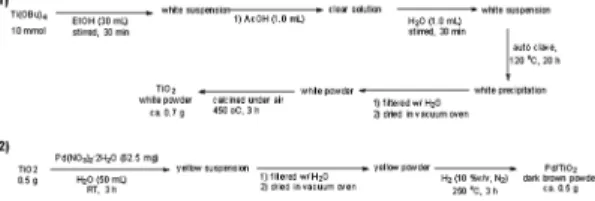
Scheme 1. The procedure for TiO2 support (1) and Pd/TiO2
catalyst (2)
Fig. 1. TEM (a- c) and STEM (d) images of Pd/TiO2. Pd particle size distribution was presented in Fig. 1(d) (inset)
mand in the presence of palladium based heteroge- neous catalysts even at room temperature, producing hydrogen (H
2) and carbon dioxide (CO
2) gases
10). Likewise, structurally similar compounds, metal for- mate (MCO
2H; M = Na, K, or an alkali metal) based materials have also proved to be potential hydrogen carriers, although their hydrogen storage densities are relatively low.
For a chemical hydrogen storage material to be valuable for practical applications, it is necessary to accelerate the rate of dehydrogenation by providing energy required to overcome a kinetic barrier. In general, thermal energy is employed to activate rele- vant chemical bonds from the hydrogen storage ma- terials (e.g., FA) with a heterogeneous catalyst. For instance, FA dehydrogenation was proceeded in the presence of Pd catalysts at temperatures ranging from room temperature to 60
oC. In contrast to the thermal induced dehydrogenation, light can be em- ployed as a energy source. For example, photolysis of formic acid was recently reported using pure, N-doped and Au-promoted TiO
211); the N-doped Au/TiO
2catalyst with visible light showed enhanced photocatalytic activity by lowering the band gap of TiO
2.
We report here on the preparation and character- ization of Pd catalysts supported on the photo-active TiO
2material. In addition, their photo-induced de- hydrogenation activities of potassium formate are further assessed using simulated sun light, demon- strating that photocatalytic H
2-release activity was significantly improved by charge transfer to Pd ac- tive sites.
TiO
2support and Pd/TiO
2catalyst were synthe-
sized according to scheme 1. TEM and STEM im-
ages revealed that Pd nanoparticles (NPs) were well
dispersed over the prepared TiO
2support with an
average size of ca. 2.2 nm (Fig. 1). XRD patterns of
TiO
2showed the clear peaks attributed to anatase
phase were presented while no peaks were observed
for rutile or other phases (Fig. 2). After immobiliza-
tion of Pd NPs on TiO
2, no phase transition was ob-
served on the XRD pattern. In addition, no peaks at-
tributed to metallic Pd species were observed presum-
ably due to the small-sized Pd NPs.
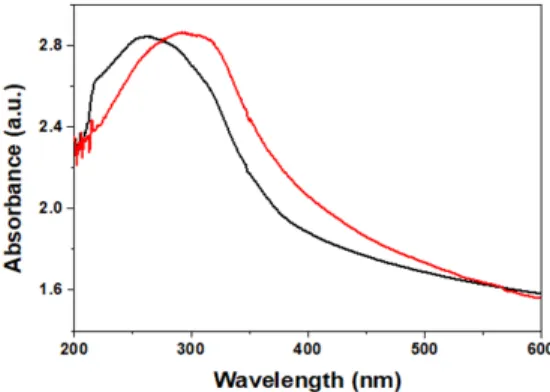
Fig. 4. UV-Vis absorption spectra of TiO2 (black) and Pd/TiO2 (red)
Fig. 2. XRD spectra of Pd/TiO2 (red) and TiO2 (black)
Fig. 3. XPS spectra of Pd/TiO2: (a) survey peaks, (b) Pd3d, (c) O1s, and (d) Ti2p
To elucidate chemical states of Pd, Ti, and O spe- cies, XPS analyses were conducted (Fig. 3). The Pd, Ti and O species was clearly appeared in the XPS survey spectrum (Fig. 3(a)). In addition, as depicted in Fig. 3(b) and 3(c), the Pd3(d) and O1s peaks at- tributed to Pd-O bond were observed, indicating in- teractions between Pd (metal) and O (from TiO
2, sup- port). The interaction could occur in away that acti- vated electrons of TiO
2by irradiation of light were transferred into Pd active sites, which enhanced the catalytic activity of formate dehydrogenation (see be- low). UV-vis absorption spectroscopy was addition- ally employed to determine electronic structures of the TiO
2and Pd/TiO
2materials (Fig. 4). Compared to that of TiO
2, the absorption peak of Pd/TiO
2was red
shifted by the interaction of Pd with the TiO
2support. Pd NPs is known to show the surface plas- monic resonance absorption dependent on the NP size
12). The enhanced light absorption clearly displays a synergistic interaction of Pd NPs and TiO
2where the Pd NPs improves both reactions kinetics of FA dehydrogenation (vide infra) and light absorption of TiO
2photocatalyst, the two most important factors determining the efficiency of photocatalysis.
2.2. Photolysis of potassium formate over Pd/TiO2
The photocatalytic dehydrogenation activity of Pd/TiO
2towards potassium formate was assessed at different temperature with and without light. In a typ- ical reaction, 150 W Xenon lamp was used as a light source to provide a simulated sun light with light in- tensities ranged from 100 to 300 mW/cm
2. Compared to that obtained under dark conditions, the Pd/TiO
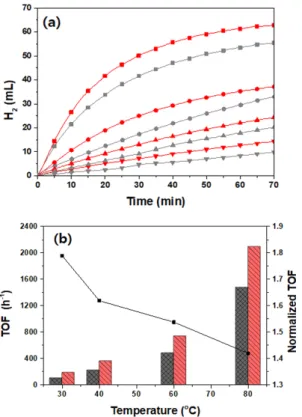
2catalyst showed a higher activity at each temperature
in the presence of light (Fig. 5(a)); e.g., Pd/TiO
2dis-
played a turnover frequency (TOF) of 2,097 h
-1at
80
oC after 10 min in the presence of light but ex-
hibited a TOF of 1,477 h
-1without light source. In
order to determine the extent of light effect as a func-
tion of temperature on catalytic activity, the TOF val-
Fig. 6. TOF values of formate dehydrogenation using Pd/TiO2 under different light intensity. The reaction was conducted at 60oC
Fig. 5. Catalytic dehydrogenation of potassium formate over Pd/TiO2 at different temperature: (a) 80oC (light, ■; dark, ■), 60oC (light, ●; dark, ●), 40oC (light, ▲; dark, ▲), and 30oC (light, ▼; dark ▼) and (b) TOFs (light,▧; dark, ▩) and normal- ized TOFs at each temperature. The light intensity was 300 mW/cm2
creasing temperature although the apparent TOFs in- creased with temperature, indicating that the light ef- fect decreased as temperature increased. In other words, thermal effect is dominant at high temper- atures for the catalytic dehydrogenation of potassium formate over Pd/TiO
2while light effect seems to be favored at relatively low temperatures. Next, we fur- ther examined the influence of light intensity on the photocatalytic activity (Fig. 6). The catalytic activity increased as light intensity increased, whereas the TOF under 300 mW/cm
2of light was not sig-
3.1. Catalyst preparation
Photo-active TiO
2support was prepared by a con- ventional hydrolysis method
13). First, a titanium con- taining precursor (Ti(OBu)
4), 1.0 g) was added into ethanol (30 mL) upon vigorous stirring, followed by addition of acetic acid (CH
3COOH, 1.0 mL) after 30 min. Deionized water (1.0 mL) was then added into the solution sequentially and further stirred for 30 minutes. The resultant white suspension was trans- ferred into an autoclave reactor, followed by hydrol- ysis at 120℃ for 20 hours. The formed white precip- itation was filtered, washed several times with de- ionized water, and dried in a vacuum oven for 12 hours. Finally, the resulting material was calcined at 450℃ for 3 hours, yielding white powder (0.7 g).
The prepared TiO
2powder (0.5 g) was then used
as a support for a desired catalyst. The TiO
2material
was added into the aqueous solution (50 mL) of
Pd(NO
3)
2 2H
2O (62.5 mg), which was stirred at
room temperature for 3 hours. The heterogeneous re-
action mixture was filtered, washed several times with deionized water, and dried in a vacuum oven for 12 hours. The obtained yellowish powders were re- duced under a H
2flow (10 v/v%, N
2) at 250℃ for 3 hours, yielding dark brown powders (0.5 g, 4.75 wt% Pd).
3.2. Catalyst characterization
The morphology of the as-prepared Pd/TiO
2cata- lyst was analyzed by high-resolution transmission electron microscopy (HR-TEM) and scanning trans- mission electron microscopy (STEM) using a field emission, FEI Tecnai microscope G2 F20 operating at 200 kV. X-ray diffraction (XRD) studies of the catalyst was carried out using a Rigaku Mini Flex II instrument operating with Cu Kα X-ray source at 40 kV and 20 mA. XPS spectra were acquired with an XPS instrument equipped with a PHI50000 Versa Probe operating with an Al Kα X-ray beam at a background pressure of 6.7×10
−8Pa. The spectra were calibrated by using peak of C1s at 284.6 eV.
UV-Vis absorption of the catalyst was measured by Cary 100 UV-Vis instrument (Agilent Technologies).
3.3. Photocatalytic dehydrogenation of potassium formate