• 검색 결과가 없습니다.

The Spatial Mismatch between Population Ageing and the Level of Public Welfare Service

N/A
N/A
Protected

Academic year: 2021

Share "The Spatial Mismatch between Population Ageing and the Level of Public Welfare Service"

Copied!
14
0
0

로드 중.... (전체 텍스트 보기)

전체 글

(1)

This work was supported by the Ministry of Education of the Republic of Korea and the National Research Foundation of Korea (NRF- 2015S1A3A2046745)

* Research Professor, Department of Public Administration, College of Public Administration, Daegu University, [email protected]

** Professor, Department of Public Administration, College of Public Administration, Daegu University, [email protected]

The Spatial Mismatch between Population Ageing and the Level of Public Welfare Service

Changhwan Yeo* · Deokho Cho**

인구 고령화와 공공서비스 수준 간의 공간적 불일치에 관한 연구

여창환*·조덕호**

Abstract : The increase of elderly population is inevitable a universal trend in developed countries. The Ko- rea also followed this tendency. Especially the elderly population in Korea has been rapidly increasing since the 1990s. The rural population is aging more rapidly than the urban one because younger generations move into the urban area, due to better jobs and children education’s opportunities. However, the majority of studies on population ageing are focused on the urban area rather than the rural ones. Rural areas also have been excluded as a priority of the national welfare policy for the elderly people. This paper tries to analyze the population ageing among regions and to identify the regional disparity between the elderly people and the level of public services in the rural area. Based upon these results, this study notes some policy alterna- tives for the improvement of quality of life of the rural elderly. It also suggests on the suitable location of public service facilities in the rural areas.

Key Words : Moran’s index, Population ageing, Public welfare service, Regional disparity, Spatial autocor- relation.

요약 : 인구고령화 현상은 유럽, 일본 등 선진국에서 이미 경험하고 있는 일반적인 현상으로서 근본적으로 인구고령화

현상 자체를 문제시 하기보다 이 현상으로 파생되는 문제를 최소화하기 위한 정책적 노력이 필요하다. 다른 선진국과 비교해 볼 때, 우리나라의 인구고령화 속도는 급속도로 이루어지고 있고, 지역적으로도 상당히 다른 양상으로 전개되 고 있는 특징이 있다. 즉, 인구고령화 속도는 세계적으로도 유례없는 경제성장과 더불어 가장 빠르게 고령화되고 있고, 도시화 과정에서 이촌향도의 인구이동 현상과 맞물리면서 도시지역보다 농촌지역의 인구고령화 현상이 더 빠르게 진 행되고 있는 바 이 현상으로 파생되는 문제 또한 농촌지역이 훨씬 심각할 것으로 예상된다.

이러한 점에서 본 연구는 농촌지역 고령인구의 삶의 질과 직결되는 공공서비스 수준을 분석하되 공공서비스 수준의 지역적 차이를 분석하기 위하여 국지적 공간자기상관 분석기법을 적용하였다. 분석결과, 고령인구가 집중되어 있지만, 정작 고령자들에게 요구되는 공공서비스가 부족한 지역들이 지역적으로 차이 나게 분석되었다. 향후 인구고령화는 모 든 공간정책 분야에서 중요한 인자로서 작용할 수 있다. 특히, 공공서비스 설치와 관련하여 효율성 측면에서 늘 소외되 어온 농촌지역과 사회적 약자인 고령인구 등에 대한 정책적 배려가 확대되어야 하며, 농촌지역 고령자들의 삶의 질 제 고를 위한 지역적으로 상이한 여건을 고려한 지역 맞춤형 공공서비스 설치 계획 등이 요구된다.

주요어 : 모란지수, 고령화, 공공서비스, 공간자기상관관계, 공공서비스시설

(2)

1. Introduction

Population ageing represents a universal trend in the developed countries and this tendency will be continued in the near future due to the longer life expectancy and good welfare system. In this way, the ageing problem becomes gradually a worldwide issue. According to the definition offered by the United Nation, a society is called “an ageing soci- ety” if the ratio of elderly population belongs to the 7-14%, if the ratio of elderly population represents 14-20% such society is named as “the aged society”, and finally, if the ratio of elderly population is more than 20% a society is defined as “post aged society”.

In 2010, the ratio of elderly population among the Organization for Economic Cooperation and Devel- opment (OECD) countries was 11.3%, which is con- sidered as not high level (Yeo et al., 2014; http: //sgis.

nso.go.kr/pyramid/view_country.asp, 09.30.2015).

However, the speed of Korean population ageing is the highest from the all countries in the world.

Furthermore, the regional difference of level of age- ing and poverty level of elderly people is one of the most serious worldwide. Especially the weak welfare system in the rural areas generates serious social con- flicts. Finally the income replacement rate of pension in Korea belongs to 42.1%, though the average rate for OECD countries is 63.6% (Cho, 2015). In other words, among OECD countries Korea has the lowest income replacement rate of pension, and in the same time, the highest poverty rate of elderly people.

The phenomenon of population ageing differs from region to region. It is affected by several differ- ent factors such as regional disparity, income differ- ence, and other socio-economic factors (Lowe and Speakman, 2006; Keating, 2008; Son et al., 2010;

Glasgow and Brown, 2012; Choi, 2013; Yeo et al., 2014). In Korea the total number of elderly popula- tion in the urban areas is higher than that in the rural areas, since a lot of people moved into urban area during the industrialization process. Especially younger generations move into the urban area due to better jobs offers and greater children educations opportunities. In addition the low birth rate lead to the aggravation of the population ageing phenom- enon in the rural area, due to fact that young people who may have children no longer live in such areas.

Therefore the problems of population ageing and elderly poverty in the rural area are more serious than those existing in the urban ones. These difficul- ties in the rural area create other social issues, such as income reduction and elderly poverty, because of the shortage of labor ability and the deterioration of community activities. Sooner or later they will grow into social conflicts. In order to solve these problems, many developed countries make efforts to improve the living environment for the rural areas through the integration of housing and welfare policies. These efforts can be presented, for example, as the silver village, silver town, and silver city or retirement city (Son et al., 2010). However, until now these welfare facilities are mainly located in the urban area due to the high demand. Therefore, the rural elderly was excluded as a subject of the housing and welfare poli- cies.

In order to solve these problems in this paper we are analyzing the regional disparity of welfare fa- cilities and its appropriateness among the regions.

Especially the article is focused on the rural welfare

facilities and their environments because the social

problems of the rural areas are more serious than

those of urban ones. The goals of this paper are to

analyze the regional disparity of welfare facilities and

(3)

to evaluate its appropriateness in the rural areas. It suggests some policy alternatives to solve the social conflicts among regions and welfare policy demand- ers. In order to do those, firstly, in this paper we find out the difference of level of population ageing among Eup and Myeon areas (local communities).

Secondly we are analyzing the regional disparity of the local welfare accommodations in order to evalu- ate the level of local public service facilities. Based upon these analyses, thirdly, in this paper we suggest some policy alternatives to solve the social conflicts and regional disparity of the public services among the regions.

2. Review of Literatures

The population ageing differs from regions to regions depending upon regional socio-economic characteristics. The previous studies noted that the speed of population ageing in the rural areas is much faster than that in the urban areas. Subsequently the socio-economic problems in the rural areas are more serious than those in the urban ones. We can fore- cast that in the near future these social issues will be developed into social conflicts among regions (Lowe and Speakman, 2006; Keating, 2008; Glasgow and Brown, 2012; Lee et al., 2012; Yeo et al., 2014).

The problem of the population ageing in the rural areas becomes a big social matter among developed countries since 2000. Glasgow and Brown (2012) note that the financial burden on the elderly welfare policy will be increased along with the retirement of “baby boomers”. They also insist that the welfare policies between the urban areas and the rural areas should be distinguished, because comparing with

urban areas, the population ageing will increase dra- matically in rural domains. In the European coun- tries the public concerns on the rural elderly welfare policy are gradually increased since 2000. Nummela et al., (2007) analyze the problem of population age- ing in the rural areas in Finland, comparing with that of urban areas. Philip and Gilbert (2007) note the population ageing in England. Marcellini et al., (2007) identify the rural ageing population in Italy. Burholt and Dobbs (2012) suggest four differ- ent strategic research areas such as social-economic, technology, the change of weather, and agriculture parts. More specifically, they note the levels of edu- cation, transportation, health care and dwelling environment for the provision of public service in the rural areas.

However in Korea there are few researches that targeted the population ageing nation in the rural areas. Lee et al., (2012) by analyzing the relationship between the socio-economic characteristics and the speed of population ageing developed the indicators for the evaluation of the crisis correspondence ability of local government. Yeo et al., (2014) analyzed the concentration and spread of population ageing in the Eup and Myeon units. Most of the researches on the rural areas mainly were focused on the public health facility and social welfare one, without considering the correlation between the population ageing and public services (Son et al., 2010; Cho et al., 2010;

Kim et al., 2011; Lee at al., 2013; Kim et al., 2015).

Moreover there are almost no studies on the public

services which directly effect on the quality of life

for the elderly people in the rural areas. The equal-

ity and appropriateness of the public services for the

elderly people can be evaluated through the distance

between the location of demanders and that of public

service facilities (Cho et al., 2010). In short there are

(4)

almost no study about the correlation between the level of the age of the population and the location of public service facilities in the Eup and Myeon areas.

Therefore in this paper we tried to find out the level of population ageing among regions and to measure the distance between the demander group and the location of public service facilities. We also estimated the coefficients of spatial autocorrelation between two variables, in order to suggest the appropriate policy alternatives for the rural elderly.

In terms of methodology, Talen and Anselin (1998) and Cho et al., (2010) use the container ap- proach which evaluates the level of public service through the ratio between the supply of public ser- vice and its demand. Son et al., (2010) analyses the equality of public services among regions through the analysis of the number of elderly population and its change trend. In evaluating the level of regional public service for the elderly there are several meth- odologies such as minimum distance, gravity model, and coverage method which can be used depending upon the data availability (Cho et al., 2010; Kim et al., 2011; Lee et al., 2013). However these studies do not take into consideration the spatial autocorrela- tion between the level of population ageing and that of public service in the rural areas (Eup and Myeon).

They also do not reflect the spatial distribution of public service facilities for the basic administrative units.

Kim (2013) analyzes the research trends and char- acteristics about the public services from 1991 to 2013. He notes that it is difficult to distinguish clear- ly the public service and its related policies, making conclusion that 28.5% of total researches belongs to the social welfare. Lee et al., (2013) identifies that the first priorities of public services in the rural areas are the improvements of health service environment and

hospital facilities. Most of studies eventually focus on the public medical service and private hospital facilities for the improvement of rural elderly welfare (Cho et al., 2010; Kim et al., 2011; Lee et al., 2013).

3. Data and Analysis Methods

1) Data and Analysis Areas

In this study we focused on the analyses of the regional disparity of public services for the elderly, especially in the rural areas where relatively a few public service facilities are located. We used the census data on the Population and Housing Census Report (2010) and Regional Population Census on Agriculture, Forestry and Fishery (2010) provided by the Korean government. These data sets represent the population survey on the public service facilities and living convenient ones at the level of Ri (village: the lowest level as administrative unit). These census sets of data bring some benefits into the analysis because it provides quantitative data on the several welfare facilities. However these data sets do not make avail- able the information about the capacity of each facil- ity which causes some difficulties in measuring the appropriate scale of public service facilities. In spite of these problems, those sets of data can provide a good solution for the public services of rural elderly because it contains the number and accessibility of facilities.

Taleai et al., (2011) and Chang and Liao (2014)

analyzed the level of public service by the level of in-

dividual plot. Such research provides more accurate

analysis results because the plot of land represents

the smallest analysis unit. Unfortunately the Korean

(5)

government does not offer geospatial code to distin- guish the Ri unit, even if government surveys the census data at the level of the minimum administra- tive unit. Therefore the analysis is implemented at the level of Eup or Myeon through the integration of Ri data that belongs to the county. Analysis areas are composed of 216 Eups and 1,196 Myeons. The total analysis areas are composed of 1,409 administrative units. The total number of Ri is composed of 36,498 minimum administrative units.

2) Analysis Methods

In this study we tried to analyze the regional dif- ference of population ageing and public services in order to provide the rural elderly with appropriate public services. At first, we noted the regional differ- ence of the population ageing. The level of regional population ageing considers simultaneously the ratio of elderly population and the index of ageing popula- tion at the local level. More specifically, total elderly population who live in the rural area and their spatial distribution is presented in the each local unit using Geographic Information System (GIS) mapping method. Following the UN ageing standard and us- ing the Census Survey of Population and Housing (2010), the indexes of population aging are 39.7%

in Eup and respectively 89.0% in Myeon rural areas (Yeo et al., 2014). This means that the rural areas in Korea already belong to the post aged society. And then the UN index on the population ageing can no longer be used to explain clearly the regional differ- ence of population ageing in the Korean rural areas.

Therefore in this study we tried to implement addi- tional analyses using the quartiles statistics of popu- lation ageing and the number of elderly population, in order to present clearly the regional differences on

the level of population ageing. Using three different indexes (UN index, quartile statistics and the num- ber of elderly populations) we analyzed the regional differences of population ageing.

In this article we also choose 6 different variables on the public services by taking into consideration the previous studies and data availability (see Table 1). These variables are highly related with the qual- ity of life of elderly people. As well we analyzed their regional differences in order to provide the equal opportunity for elderly people to use public services.

The results note the regional difference of public services comparing with other regions. In order to figure out the alienated areas in terms of the provi- sion of the public services it was used the correlation analysis, cluster analysis and spatial autocorrelation methods. The level of public services might depend upon the spatial heterogeneity and dependence nevertheless, the previous studies did not consider the location factors. Spatial autocorrelation statis- tics measure and analyze the degree of dependency among observations in a geographic space. Classic spatial autocorrelation statistics include Moran’s I, Geary’s C, Getis’ G and the standard deviational ellipse. These statistics require measuring a spatial weights matrix that reflects the intensity of the geographic relationship between observations in a neighborhood, for example, the distances between neighbors, the lengths of shared border, or whether they fall into a specified directional class such as

“west”. Classic spatial autocorrelation statistics com-

pare the spatial weights to the covariance relation-

ship at pairs of locations. Spatial autocorrelation that

is more positive than expected from random indicate

the clustering of similar values across geographic

space, while significant negative spatial autocor-

relation indicates that neighboring values are more

(6)

dissimilar than expected by chance, suggesting a spatial pattern similar to a chess board (https: //

en.wikipedia.org/wiki/Spatial_analysis#Spatial_

autocorrelation: 09.30.2015).

Moreover, the distribution of budget of public service is implemented according to the administra- tive unit. Therefore the spatial connectivity is a very important factor in the implementation of policy on the public services. And then regional difference of level of public services can be measured by the spatial autocorrelation of specific local areas by using Moran’s index (local Moran’s index) or Getis –Ord Gi statistic values. They can be different according to the spatial weight matrix and the type of feature however, the spatial distribution patterns are similar to each other. Therefore in this paper we used Mo- ran’s index for estimating the coefficients of spatial autocorrelation.

Rook’s case and Queen’s case spatial weight ma- trix can be utilized in the lattice spatial data like a raster data. Eventually Eq.1 represents the Moran’s index formula for estimating the regional difference between the population ageing and level of public services. Wij notes spatial weight matrix (Getis and Ord, 1992). This weight matrix can be changed depending upon the assumption on the contiguity among features. However the spatial weight matrix can be adapted according to the distance and conti- guity among the features in case that the spatial fea- ture is the irregular vector data such as census tracts and administrative areas (Getis, 2010).

n j=1,j≠i

n j=1,j≠i

I

i

=

S

i2

= - X-

2

w

i,j

(x

j

- X-), (x

j

- X-)

2

x

i

- X-

S

i2

n-1

Eq. 1

Ii gives the statistics point(i)’s spatial correlation

statistics value for the association between i and all j points in spatial threshold defined by wi,j (spatial weight matrix).

Inverse distance w

ij

=d

ij

Eq.2

Inverse distance weight (wij) is assumed to be no diminishing effect in distance up to threshold d.

Where weights are negative power function of distance of the form, and α is any positive exponent, typically α=1 or α=2.

The map features of Eup and Myeon areas are the irregular vector map, therefore the spatial weight in the map should be applied by the inverse distance and K-nearest neighbor. Yeo et al., (2014) actually note that the method of inverse distance in measur- ing the coefficient of spatial autocorrelation in the local Moran’s index is the most appropriate method.

For that reason in this paper we also adopted the inverse distance method in estimating the coefficient of the spatial autocorrelation like is shown in Eq. 2 and Eq. 3.

4. The Analysis of Population Ageing and Level of Public Services

1) The Ageing Levels in Rural Areas We are usually using the UN ageing index to ex- plain the circumstances of regional ageing problems.

However, we cannot use this method in order to

identify the level of population ageing in the Korean

rural areas, because most of the rural areas already

belong to the post aged society. Therefore we focused

our paper on three different methods as previously

(7)

mentioned. Firstly we measured the level of popu- lation ageing in each Eup and Myeon areas. Their indicators are presented in GIS map considering the administrative areas (see Figure 1). In the first figure it is presented the analysis result using the ageing in- dex of UN by noting that most rural areas (Eup and Myeon) are already changed into the aged society, with exception of the Eups and Myeons areas of the metropolitan city neighboring areas such as Seoul, Busan, and Daegu. Consequently, the UN index is not useful and cannot explain the regional differ- ences of ageing levels in the Korean rural areas. In order to figure out the regional differences in the sec- ond and third figures was used the quartile indexes on the ageing level and the number of elderly popula- tion. Analyzing those two figures we can bring some new ideas. In the second figure, the ageing levels are relatively low in the neighboring areas of Seoul metropolitan area, such as Chungcheongnam-do and Chungcheongbuk-do . They are also low in the neighboring areas of big cities such as Busan, Daegu, and Ulsan. In other words, the levels of ageing in the

neighboring areas of metropolitan cities are relatively low comparing with those of rural areas (Eups and Myeons). On the other hand, the levels of ageing in the Jeollanam-do and Jeollabuk-do , except the neighboring areas of the metropolitan cities are rela- tively high comparing with those of other areas.

In terms of the number of elderly population, the third figure shows the opposite results with the second one. The number of elderly population in the rural areas changed already into the post aged society is relatively lower than that of urban or urban neighboring areas. It means that the total popula- tion of rural areas (Eup and Myeon) is lower than that of urban neighboring areas irrespective of the level of population ageing. Additionally we noted the regional disparity between the rural and urban areas in terms of total population. This phenomenon also might interrupt the efficient utilization of national space, due to the fact that most of the people moved into urban or urban neighboring, especially to the Seoul metropolitan areas. Consequently, it will results in the breakdown in the near future of rural

Figure 1. The Population Ageing Circumstances among Regions (the Ageing Index of UN, Quartile Indexes of

Ageing and Elderly Population)

(8)

communities (Eup and Myeon) if the government will not establish the rural restoration policy as soon as possible.

2) The Level of Public Services among Regions

The first and second figures in the Figure 2 note the analysis results of the levels of public services, which are based upon the average distances between the living areas and the location of public facilities.

The public services provided to the rural elderly are referring to the Office of Public Administration, Public Medicare, Public Transportation, Private Medical, Agriculture Cooperation, and Market Ac- cessibility as it is shown in Table 1. It presents the re- gional differences by the standardization of distance with the public facilities and living areas. Therefore, it can be interpreted that the longer is the distance the poorer is the service level. The distance between housing and facility location is indicated in Table 1.

Figure 2 focuses on the service level of public sec- tor among regions. The average distance of the public office can differ from region to region however the service levels might be similar, because each admin- istrative unit has its own office. The level of medical service in the public sector is relatively higher than that in the private sector, since each administrative

unit has its own public medical center. Nevertheless, the average distance of public transportation system is significantly long one and its deviation is also rela- tively large. This means that the accessibility to the public transportation services in the rural areas is not good enough and the rural elderly have some diffi- culties in using the public transportation system.

Figure 3 focuses on the level of public service by the private sector among regions. The 1st figure notes that the average distance to the private hospitals is significantly long and its standard deviation also dif- fers from region to region. This means that the qual- ity of health care service is significantly poor in the rural areas, even if there is a public health center in the administrative unit. Therefore, the rural elderly need to take a long ride in order to use the public or private hospital. The 2nd figure identifies that there is no big difference among regions referring to the financial service by the agriculture cooperation. The 3rd figure shows that the rural elderly have some dif- ficulties in terms of market accessibility; due to the low demand many traditional markets have been closed. In summary, we can conclude that the qual- ity of public services in the rural areas is relatively low in terms of private medical services, public trans- portation, and market accessibility. As a result the government should consider these three factors in establishing the welfare policy in the rural areas.

Table 1. The Level of Public Service by Distance between Housing and Facility Location (units: km) Pub.

Administration Pub.

Medicare Pub.

Transportation Private

Medical Agri-Cooperation Market Accessibility

Mean 8.86 9.95 17.27 17.03 8.77 18.01

Stedv 4.01 6.62 15.97 15.21 6.25 14.20

Max 81.67 77.78 266.32 245.26 169.84 245.26

Min 0.00 0.00 0.00 0.00 0.00 0.00

Sources: regional survey(2010) involved agricultural census by national statistical office

(9)

3) The Analysis of Level of Public Services by the Public and Private Sectors

Figure 4 and 5 represent the results of spatial autocorrelation analysis between the public service

costs and the level of ageing through 999 times of permutation process at the 95% significant level.

Global spatial autocorrelation has negative correla- tion and its coefficient is almost 0 except the private medical services. Therefore we cannot figure out the regional difference of public service by the coef- Figure 2.The Level of Public Service among Regions in the Public Sector (Public Administration, Public

Health and Public Transportation)

Figure 3.The Level of Public Service among Regions in the Private Sector (Hospital, Bank, and Market

Accessibilities)

(10)

ficients of global spatial autocorrelation. However, the local spatial autocorrelation, which is measured by local Moran’s Index, notes the regional differ- ence of public service through the Figure 3 and 4.

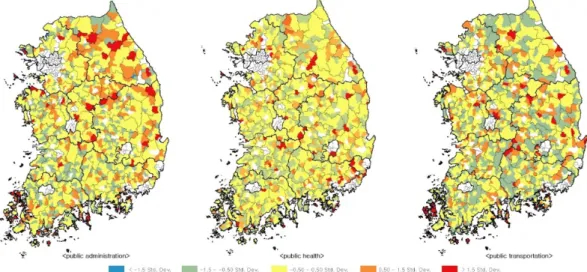
More specifically, in this paper we distinguish four different categories such as HH, LL, LH, and HL regions. The areas which do not belong to these four categories are not statistically significant at 95% con- fidence level. More precisely, HH regions (hot spot regions) have the meaning that, both the high cost of public service and the high level of population ageing are spatially concentrated. Therefore, in these areas simultaneously are required two different regional policies, such as the provision of public services and the policy alternatives on the population ageing.

They are typical rural areas where the public service policies are required. LH regions have the sense that, both the low cost of public service and the high level of population ageing are spatially concentrated to each other. HL regions are the areas where the cost of public service is relatively high comparing with the neighboring areas, but the age level is low. Moreover these areas are related with the HH regions and they are spatially distributed in the near hot spot areas. As a conclusion, the government must take into close consideration these two areas in building the public policies.

On the other hand, LL regions (cold spot regions) have the meaning that, both the low cost of public service areas and the low level of population ageing areas are spatially concentrated to each other. These areas are relatively not serious than any other area in term of the cost of the public service and population ageing. They are usually located in the outskirts of urban areas. HL regions have the sense that the level of population ageing is high, but the cost of public services is relatively low comparing with the neigh-

boring areas. The public services in these two areas (LL and LH regions) are better than those in other two areas (HH and LH regions).

The previous studies note the lack of the public health services in the rural areas. By using in this study the coefficient of local autocorrelation we reached a similar result. Especially in the rural areas the health care service provided by the public sector is very poor, as an example can serve the Gangwon- do. More precisely, the poor health care service offered by the private sector in the south regions in Gangwon-do and in the north regions of Gyeong- buk. In those areas the HH regions is the poorest one among regions. The islands in the south-west area of the Korean peninsula also show the same result.

Therefore, in order to improve the level of health care services in the rural areas, hospital facility should be located in these regions (see the 2nd Figure in Figure 4 and the 1st Figure in Figure 5). However the public transportation and traditional market show the similar spatial patterns. The islands in the Sinan-gun and Jindo one, where are HH regions, show the poorest public transportation system. Con- sequently, the public transportation system should receive some support as well. In terms of level of the service of public administration there is no big dif- ference among regions. Nevertheless, there are some differences in the rural areas, due to the difference of service of the public transportation. The maps (the 2nd and 3rd maps in Figure 4) represent that the ser- vices of banking and traditional market are relatively good.

In summary, the services of public administration,

public health care, and banking by Agri-Coorpera-

tion do not show big differences among the regions

in the rural areas, because each administrative unit

has its own office, even if the accessibility by the

(11)

Public Administration Public Health Care Public Transportation Figure 4. The Levels of Public Administration, Public Health, and Public Transportation among Regions

Private Health Care Agri-Cooperation Service Tradition Market

Figure 5. The Levels of Private Health Care, Banking Service, and Traditional Market among Regions

(12)

public transportation is slightly different between regions. However the hospital service by the private sector shows a big difference among regions in the rural areas, especially in the south regions in Gang- won-do, in the north regions of Gyeongbuk and in island areas. Moreover, the levels of public services are highly related with the public transportation sys- tem, because the rural elderly generally are using the public transportation.

5. Conclusion

Many advanced countries have experienced the circumstance of population ageing. Ageing issue in Korea differs from that of the other developed coun- tries in terms of three aspects. At first, the speed of population ageing is too fast comparing with other advanced countries due to the longer life expectancy and serious low birth rate. At second, it is the exis- tence of an alarming regional disparity between the urban and the rural areas. Especially, the critical population ageing in the rural areas resulted in giv- ing up on the farming, which will lead to the fact that the rural community will be closed because of the lack of population. As a result, the rural com- munities will collapse at the local level which will deteriorate the equal utilization of national space and competitiveness. At third, the elderly population meets difficulties in the daily life, because social wel- fare system including the pension one is very weak.

Therefore more than 50% of the elderly household will fall to the bottom of poverty line.

In order to solve these problems in this paper we analyzed the distribution of facilities of public service for the rural elderly. We also noted the connectiv-

ity between the level of population ageing and that of public services. Analysis results can be summa- rized as follows. The level of population ageing and distribution of public facilities differ from regions to regions. However there are serious mismatches between the population ageing and the provision of public services. The public services, such as the pub- lic health care, public administration, and financial services offered by the public sector are relatively equally provided. However, the public services such as private medical service, public transportation, and local market offered by the private sector are rela- tively unequally provided.

Based upon the analysis results of this article we can conclude as follows: at first, the government should establish the restoration policy in the rural areas as possible as it can, due to the fact that the population ageing represent a serious issue in the ru- ral areas. In order to overcome the regional disparity in terms of population ageing between the urban and the rural areas, government can choose the rural pol- icies to the farm and rural community for the young generations. Second, the government should con- sider the regional disparity in the provision of public services, especially by the private sector in order to secure the equal quality of life among the regions and to overcome the regional conflicts. Third, the Korean government also should consider the improvement of quality of life in the rural areas in terms of pension system and income disparity in order to solve the so- cial conflicts among regions.

Reference

Amanda, D. 2011. On Constructing Ageing Rural Popula-

tions: ‘Capturing’ the Grey Nomad. Journal of

(13)

Rural Studies 27: 191-199.

Anselin, Luc. 1988. Spatial Econometrics: Methods and Models. Kluwer Academic Publishers.

Anselin, Luc. 1995. Local Indicators of Spatial Association- LISA. Geographical Analysis 27(2): 93-115.

Batta, Rajan, Miguel L. and Srinivas P. 2014. Public Facil- ity Location Using Dispersion, Population, and Equity Criteria. European Journal of Operational Research 234: 819-829.

Berliant, Marcus, Shin-Kun Peng and Ping Wang. 2006.

Welfare Analysis of the Number and Locations of Local Public Facilities. Regional Science and Urban Economics 36: 207-226.

Chang, H. and Liao, C. 2011. Exploring an Integrated Method for Measuring the Relative Spatial Equity in Public Facilities in the Context of Urban Parks.

Cities. 28: 361-371.

Cho, D. H., Shin, J.Y., Kim, K.Y. and Lee, G.H. 2010. An Analysis of Spatial Accessibility to Public Health- care Services in Rural Areas. 16(2): 137-153.

Choi, J.H. 2013. The Analysis of Regional Characteristics of the Aging Population in Korea. Economic Geo- graphical Society of Korea 16(2): 233-246.

Choi, M.G. 2012. An Analysis for the Changing Trends of Residential Environment Based on the Change of Residents in Rural Areas. Korean Institute of Rural Architecture 14(3): 9-16.

Engels, B. and Gang-Jun L. 2011. Social exclusion, Location and Transport Disadvantage Amongst Non-driv- ing Seniors in a Melbourne Municipality, Australia.

Transport Geography 19: 984-996.

Getis, A. 2010. Constructing the Spatial Weights Matrix Using a Local Statistic. Geographical Analysis 36(2): 90-104.

Getis, A. and K. Ord. 1992. The Analysis of Spatial Associa- tion by Use of Distance Statistics. Geographical Analysis 24: 189-206.

Glasgow, N. and Brown, D.L. 2012. Rural Ageing in the United States: Trends and Contexts. Rural Studies 28: 422-431.

Guagliardo, M.F. 2004. Spatial Accessibility of Primary Care: Concepts, Methods and Challenges. Interna- tional Journal of Health Geographics3 (3). http: //

www.ij-healthgeographics.com/content/3/1/3.

Keating, N. 2008. Rural Ageing: A Good Place to Grow Old? The Policy Press. Bristol.

Kim, H.J., Lee, S.H. and Cho, D.H. 2011. The Spatial Equality and Appropriateness of Location of Public Health Facilities in the Rural Area. Journal of Rural Development. Rural Economics 34(4): 1-24.

Lee, J., Lee, Y., Bae, Y., Lee, J., and Suh, K. 2012. Develop- ment of Indicators to Evaluate the Regional Pre- paredness Level for Rural Aging. Korean Society of Rural Planning 18(4): 69-78.

Lee, J.M., Cho, S.C. and Hwang, J.I. 2013. Potential Ac- cessibility of Public Healthcare Facilities in Rural Areas. Journal of Agricultural Extension & Com- munity Development 20(2): 431-450.

Lowe, P. and Speakman, L. 2006. The Ageing Countryside:

The Growing Older Population of Rural England, Age Concern England, London.

Nina, G. and David, L. B. 2012. Rural ageing in the United State: Trends and contexts. Rural Studies 28: 422- 431.

Ord, J.K. and A. Getis. 1995. Local Spatial Autocorrelation Statistics: Distributional Issues and an Application.

Geographical Analysis 27(3): 286-306.

Sekhar, S. and Matthew, S. 2013. Examining the Distribu- tion of the Elderly and Accessibility to Essential Service. Procedia-Social and Behavioral Sciences 104: 942-951.

Serra, D. and Marianov, V. 2004. New Trends in Public Fa- cility Location Modeling. Economics and Business.

Working paper.

Son, S.H. and Han, M.H., 2010. The Regional Characteris- tics of Aging and the Location of Senior Housing.

Korean Urban Geographical Society 13(1): 17-29.

Statistical Research Institute. 2008. Development of Indices by Types of Rural Areas.

Taleai, M., Sliuzas, R. and J. Flacke. 2014. An Integrated

(14)

Framework to Evaluate the Equity of Urban Public Facilities using Spatial Multi-criteria Analysis. Cit- ies 40: 56-69.

Talen, E. and Anselin, L., 1998. Assessing Spatial Equity:

an Evaluation of Measures of Accessibility to Public Playgrounds. Environment and Planning A. 30:

595-613.

Yafei, L., Martin, D. and Stan, G. 2014. Residential Segre- gation and Well-being Inequality between Local and Migrant Elderly in Shanghai. Habitat Interna- tional 42: 175-185.

Yeo, C.H. and Seo, Y.H. 2014. Analysis on the Spatial Spill- over Patterns of Aging Population in Rural Areas.

Korean Association of Geographic Information Studies 17(3): 39-53.

Nummela, O.P., Sulander, T.T., Heinonen, H.S., Uutela, A.K. 2007. Self-rated Health and Indicators of SES among the Ageing in Three Types of Communities.

Scandinavian Journal of Public Health 35(1): 39- 47.

Burholt, V. and Dobbs, C. 2012. Research on Rural Ageing:

Where have we got to and where are we Going in Europe? Rural Studies 28: 432-446.

Marcellini, F., Giuli, C., Gagliardi, C., Papa, R. 2007. Ag- ing in Italy: Urban-rural Differences. Archives of Gerontology and Geriatrics 44(3): 243-260.

Philip, L.J., Gilbert, A. 2007. Low Income Amongst the Older Population in Great Britain: a Rural/non- rural Perspective on Income Levels and Dynamics.

Regional Studies 41(6): 735-747.

교신: 조덕호, 경상북도 경산시 진량읍 대구대로 201, 전

화: 82-53-850-6167, 팩스: 82-53-850-6169, 이메 일: [email protected]

Correspondence: Deokho Cho, 201, Daegudae-ro, Gyeong- san-si, Gyeongsanbuk-do, Tel: 82-53-850-6167, Fax: 82-53-850-6169, E-mail: [email protected]

최초투고일 2016년 4월 21일

수 정 일 2016년 5월 10일

최종접수일 2016년 5월 13일

수치

Figure 1. The Population Ageing Circumstances among Regions (the Ageing Index of UN, Quartile Indexes of  Ageing and Elderly Population)
Figure 2 focuses on the service level of public sec- sec-tor among regions. The average distance of the public  office can differ from region to region however the  service levels might be similar, because each  admin-istrative unit has its own office
Figure 4 and 5 represent the results of spatial  autocorrelation analysis between the public service
Figure 5. The Levels of Private Health Care, Banking Service, and Traditional Market among Regions

참조

관련 문서

Modern Physics for Scientists and Engineers International Edition,

First, a welfare model like the Danish needs a very high level of employment to be able to offer and finance public benefits to the extent and quality that match the demand

These developments call into question the domestic nature of competition rules and the absence of binding rules at the international level and increase

This call for tenders aims at the establishment of framework service contracts with IT consultancy service providers in the area of Microsoft infrastructure first

감각손실(Sensory deficits) 관절염(Arthritis) 고혈압(High blood pressure) 심장병(Heart disease) 당뇨(Diabetes) 폐질환(Lung diseases) 뇌졸증(Stroke)

웹 표준을 지원하는 플랫폼에서 큰 수정없이 실행 가능함 패키징을 통해 다양한 기기를 위한 앱을 작성할 수 있음 네이티브 앱과

_____ culture appears to be attractive (도시의) to the

The key issue is whether HTS can be defined as the 6th generation of violent extremism. That is, whether it will first safely settle as a locally embedded group