한국컴퓨터정보학회 하계학술대회 논문집 제29권 제2호 (2021. 7)
691
●
요 약●
The malalignment of the trunk causes abnormal stress in a specific area and lead to trunk instability. The purpose of this study was to investigate the correlation between the angle between the infrasternal angle and the trunk side shift distance. The participants in this study 22 subjects were participated. The infrasternal angle and trunk side shift distance were measured using a camera and analyzed using the Image J program. The correlation between the asymmetry of the infrasternal angle and trunk side shift distance was moderate (r=−0.413; p=0.028). According to the asymmetry of the infrasternal angle, it was confirmed that trunk lateral shift appeared in a specific direction.
Based on result, it suggests that infrasternal angle and trunk side shift should be considered in the intervention plan of patients with asymmetry of the infrasternal angle.
키워드: Malalignment, Trunk lateral shift, Infrasternal angle, Correlation, Image J program
명치각의 비대칭 성과 몸통 측 이동 거리 사이의 상관 관계
정성훈
*, 최슬아
**, 하성민
O*
연세대학교 물리치료학과,
**
안산대학교 물리치료학과,
O
상지대학교 물리치료학과
e-mail: [email protected], [email protected], [email protected]
Correlation between the asymmetry of the infrasternal angle and trunk side shift distance
Sung-hoon Jung
*, Sil-ah Choi
**, Sung-min Ha
O*
Dept. of Physical Therapy, Yonsei University,
**
Dept. of Physical Therapy, Ansan University,
O
Dept. of Physical Thrapy, Sangji University
I. Introduction
The malalignment of the trunk causes abnormal stress in a specific area and lead to trunk instability [1,2]. Also, asymmetrical or abnormal shape of the infrasternal angle along with the abnormal alignment of the spine causes a great influence not only on the external appearance but also on the cardiopulmonary function[3].
Especially, the rotated trunk causes the asymmetry of the rib cage, causing length changes of the internal oblique and external oblique muscles, and causing asymmetry of movement as well as the shape of the trunk [4-6]. The evaluation of such a problem can confirm the asymmetry through the measurement of the infrasternal angle [7].
Previous studies have mainly focused on how the asymmetry of the infrasternal angle asymmetry affects the trunk rotation
[8]. However, the asymmetry of the infrasternal angle causes not only rotational asymmetry but also the abnormal trunk side shift in coronal plane [9]. As a representative example, scoliosis patients show changes in postural malalignment in the form of S shape or C shape due to the change in the position of the spine in the coronal plane [10]. Trunk side shift occurring in the coronal plane accompanied by trunk rotation is typical of the form of scoliosis [9, 10].
Therefore, it is considered critical to assess people with trunk malalignment to accurately confirm the relationship or influence between the asymmetry of the infrasternal angle and trunk side shift. Most of the studies on the effects of the asymmetry of the infrasternal angle focus only on the rotation of the trunk, so this study examines the correlation between the asymmetry
한국컴퓨터정보학회 하계학술대회 논문집 제29권 제2호 (2021. 7)
692
of the infrasternal angle and the trunk side shift.II. Preliminaries
The malalignment of the trunk causes abnormal stress in a specific area and lead to trunk instability. Although the relationship between the asymmetry of the infrasternal angle and trunk side shift is important, most studies focus on the effect of the asymmetry of the infrasternal angle on the rotation of the trunk. The current study examines the correlation between the asymmetry of the infrasternal angle and the trunk side shift.
III. Research design
1. Research Subjects and Data collection
22 male subjects aged 20–30 years were voluntarily recruited from among university students. Inclusion criteria included (1) healthy; (2) no disorder of metabolic, neuromuscular, or musculoskeletal; (3) no history of vertebrae; and (4) no pain in any part of the body at the time of testing. Exclusion criteria included (1) pain in the spine region; (2) a previous history of vertebrae surgery. Before the experiment, the examiner explained all procedures to the subjects. Each provided written informed consent on a form.
2. Research Tool
2.1 Infrasternal angle
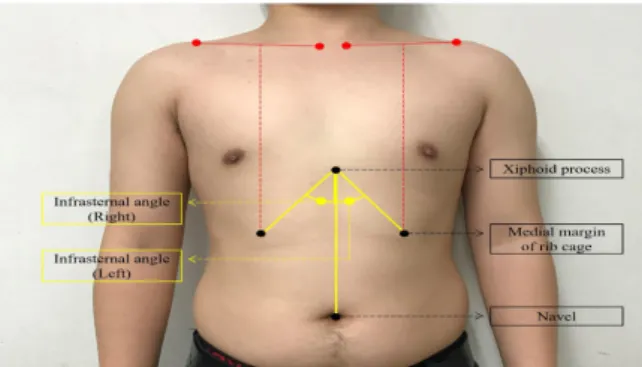
The infrasternal angle was measured according to Kim and Weon [8] method. Subjects were instructed to relaxed standing and breathe comfortably during measurement. Markers were attached to the xiphoid process, and the medial margin of the rib cage, defined on perpendicular line was drawn from the mid clavicle to the medial margin of the rib cage (Fig 1). The camera was adjusted to the level of the xiphoid process using the height-adjustable tripod. The camera was placed 1 m in front of the subject’s foot as measured using a tape measure.
The infrasternal angle was analyzed with Image J software (National Institutes of Health, Bethesda, MD, USA). An angle formed between the two lines (from the xiphoid process to the medial margin of the rib cage; from the xiphoid process to the navel) were measured (Fig 1). Kim and Weon14demonstrated excellent intra- and inter-rater reliability for measurement of infrasternal angle. The formula for calculating the asymmetry of infrasternal angle is as follows: left side of infrasternal angle - right side of infrasternal angle.
Fig. 1. Measuremnt of infrasternal angle
2.2 Trunk side shift distance
The subject lies on a table so that the xiphoid process and the navel are in a straight line. To measure the side shifted distance, a tape measure is placed in the left and right direction over the xiphoid process (Fig 2A). The examiner fixes the pelvis of the subject in the direction to be examined with one hand, and translates the lateral rib cage in the opposite direction to be examined into examined direction at the level of the xiphoid process. At this time, the length at which the marker of the xiphoid process is side-translated is measured (Fig 2B). The formula for calculating the trunk side shift distance is as follows:
left side of the trunk side shift distance - right side of trunk side shift distance [11, 12].
Fig. 2. Measurement of trunk side shift distance
2.3 Data analysis method
Statistical analyses were performed using the statistical software package Statistical Package for the Social Sciences (SPSS) version 20.0 (SPSS Inc., Chicago, IL), and the level of statistical significance was set at p < 0.05. Pearson’s correlation coefficients were calculated to quantify the linear relationship between the asymmetry of trunk side shift distance and infrasternal angle. Pearson’s correlation coefficients defined r>0.75 as
“excellent”, 0.5–0.75 as “good”, 0.25–0.5 as “moderate”, and
<0.25 as “poor”[13.] G ∗ power ver. 3.1.2 (Franz Faul, University of Kiel, Kiel, Germany) was used for the power analysis.
한국컴퓨터정보학회 하계학술대회 논문집 제29권 제2호 (2021. 7)
693
IV. Results
Twenty-two subjects (age: 24.09±1.72; height: 174.68±4.77;
weight: 76.23±7.96) participated in this study. The average of the right and left infrasternal angle was 40.64±6.30, and the average of the right and left trunk side shift distance was 4.58±0.97.
The asymmetry of the infrasternal angle was 1.66±4.20, and the asymmetry of the trunk side shift distance was -0.11±0.97.
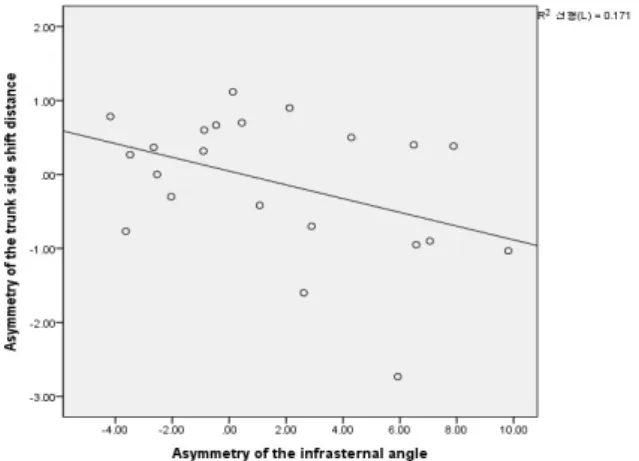
The Pearson’s correlation between the asymmetry of the infrasternal angle and trunk side shift distance was moderate (r=–0.413; p=0.028). A scatter plot between the asymmetry of the infrasternal angle and trunk side shift distance is shown in fig 3. A power defined 95% by G*power analysis was assumed 0.64 of effect size calculated using correlation coefficients between the asymmetry of trunk side shift distance and infrasternal angle.
Fig. 3. Correlation of the asymmetry of the infrasternal angle
IV. Conclusions
This study aimed to investigate the correlation between the asymmetry of the infrasternal angle and the trunk side shift.
Our results, it showed a moderate correlation between the asymmetry of the infrasternal angle and trunk side shift distance.
Although not a high correlation, it was found that there was a moderate negative correlation between the asymmetry of the infrasternal angle and the trunk side shift. This result indicates whether the individual with an asymmetric trunk (asymmetry of the infrasternal angle) was damaged in a specific direction.
To our knowledge, this result is the first reported study to investigate the correlation between the asymmetry of the infrasternal angle and trunk side shift distance. In previous studies, there are many tests on the lumbo-pelvic part of the spine, but studies of tests related to the thorax (thoracic spine and ribs) related tests may be insufficient [14]. The ability to effectively transfer the load through the thorax is dynamic and
depends on the optimal function of the bones, joints and ligaments (form closure), the optimal function of the muscles and fascia (force closure), and appropriate neural function (motor control, emotional state) [11]. Thorax malalignment causes damage to the components of spinal stabilization, especially form closures and force closures, and it is critical to pinpoint these problems [8, 11] The trunk side shift test used in this study is a test method designed to evaluate the damage of the form closure, which means structural deformation of the thoracic spine, rib cage, etc. Based on result in this study, whether a specific area is damaged, it is believed to be helpful in establishing in patient with thorax malalignment in treatment planning. The limitations of this study are as follows. First, there are limitations in generalizing the results of the study. The subjects of this study were healthy subjects in aged 20–30. In future studies, it is considered that there is a need to conduct research on patients of various ages with thorax malalignment (asymmetry of the infrasternal angle). This result indicates whether the individual with asymmetry of the infrasternal angle was damaged in a specific direction. Based on result, it suggests that infrasternal angle and trunk side shift should be considered in the intervention plan of patients with asymmetry of the infrasternal angle.
ACKNOWLEDGEMENT
This work was supported by the Ministry of Education of the Republic of Korea and the National Research Foundation of Korea (NRF-2019R1F1A1059871)
REFERENCES
[1] Schamberger W. Malalignment syndrome in runners.
Physical Medicine and Rehabilitation Clinics. Vol. 27, No. 1, pp 237-317. 2016.
[2] Kisner C, Colby LA, Borstad J. Therapeutic exercise:
Foundations and techniques. Fa Davis, 2017.
[3] Hrysomallis C, Goodman C. A review of resistance exercise and posture realignment. The Journal of Strength & Conditioning Research. Vol. 15, No. 3, pp 385-390, 2001
[4] Lim J-H. Correlations of symmetry of the trunk muscle thickness by gender with the spinal alignment in healthy adults. Journal of Korean Physical Therapy. Vol. 25, No.
6, pp 405-410, 2013
한국컴퓨터정보학회 하계학술대회 논문집 제29권 제2호 (2021. 7)
694
[5] Kang H, Chang S. The effect of robo-horseback ridingexercise on trunk muscle activity ratios in patients with low back pain. Journal of Korean Physical Therapy. Vol.
24, No. 6, pp 393-397, 2012.
[6] Vera-Garcia FJ, Brown SH, Gray JR et al. Effects of different levels of torso coactivation on trunk muscular and kinematic responses to posteriorly applied sudden loads. Clinical Biomechanics. Vol. 21, No. 5, pp 443-455, 2006.
[7] Peterson-Kendall F, Kendall-McCreary E, Geise-Provance P et al. Muscles testing and function with posture and pain.
US: Lippincott Williams & Wilkins Ltd. pp 49-118, 2005.
[8] Kim M-H, Weon J-H. Intra-and inter-rater reliabilities of infrasternal angle measurement. Journal of Korean Physical Therapy. Vol. 27, No. 3, pp 154-158, 2015.
[9] Lehnert-Schroth C. Dreidimensionale skoliosebehandlung:
Atmungs-orthopädie system schroth. Elsevier Health Sciences, 2014
[10] HR W. Schroth therapy: Advancements in conservative scoliosis treatment. Saarbruecken: LAP Lambert Academic Publishing. 2015.
[11] Lee D. The thorax: An integrated approach. OPTP, 2003 [12] P. Mohankumar LWY. Evaluation on thoracic trunk shift
and coronal balance in post-operative scoliosis patients.
ASM Science Journal. Vol. 11, No. 1, pp 1-8, 2018.
[13] Alanay A, Cil A, Berk H et al. Reliability and validity of adapted turkish version of scoliosis research society-22 (srs-22) questionnaire. Spine. Vol. 30, No. 21, pp 2464-2468, 2005.
[14] Vleeming A, Mooney V, Stoeckart R. Movement stability and lumbopelvic pain. 2007.