Received: June 8, 2012 ; Accepted: June 17, 2012 Corresponding author: Yun Kyung Shin
Tel: +82 (51) 740-2421 e-mail: [email protected] 1225-3480/24435
북방전복 Haliotis discus hannai 의 계절별 생리적 변화
신윤경, 이원찬1, 김동욱1, 손맹현, 김응오, 전제천, 김성희2
국립수산과학원 전략양식연구소 양식관리과, 1국립수산과학원 기반연구부 어장환경과
2국립수산과학원 연구기획부 연구기획과
Seasonal Changes in Physiology of the abalone Haliotis discus hannai reared from Nohwa Island on the South Coast of Korea
Yun Kyung Shin, Won Chan Lee1, Dong Wook Kim1, Myung Hyun Son, Je Cheon Jun, Eung Oh Kim and Seong Hee Kim2
Aquaculture Management Division, NFRDI, 619-705, Republic of Korea
1Fundamental Research Department, NFRDI, 619-705, Republic of Korea
2Research and Development Planning Department, NFRDI, 619-705, Republic of Korea
ABSTRACT
Growth, oxygen consumption, ammonia excretion, feeding and assimilation rate were examined from May 2010 to February 2011 in order to assess the physiological changes of Haliotis discus hannai in accordance with changes in season. The water temperature was in the range of 8-23.2℃ and the salinity in the range of 31.9-34.1psu during the examination period. The length of shell of Haliotis discus hannai grew from 36.3 mm to 66.1 mm in the 1 year old entities and from 60.6 mm to 66.1 mm for the 2 year old entities, while the weight of the meat increased from 3.16 g to 12.04 g and from 15.8 g to 21.5 g, respectively. The oxygen consumption and ammonia excretion rate displayed trend of increase in accordance with the increase in water temperature, while the feeding rate was high during the period from July to October. The assimilation rate was in the range of 68%-71% without significant difference between the age of the entities and seasons. SFG displayed +value throughout the year for the 1 year old entities of Haliotis discus hannai as well as for the 2 year old entities with the exception of the period of July, thereby showing that they are growing throughout the year. Therefore, there was no environmental effect including water temperature and salinity during the examination period.
Key words: Haliotis discus hannai, Growth, Metabolism, Feeding, Assimilation
서 론
전복은 한대지역에서 열대지역, 수심 40 m에서 조간대 지 역에 이르기까지 널리 분포하고 있으며, 해산 종으로는 약 70 여종이 분포하는 것으로 분류하고 있으며 (Lindberg, 1992), 북방전복 Haliotis discus hannai은 아한대 서식 종으로 주 로 알려져 있다.
전복에 관한 연구는 양식 (Jeong et al., 1994; Yoon et al., 2004), 사료 (Cho et al., 2006), 유전 (Park et al.,
2003) 및 환경변화에 따른 스트레스 (Chen and Chen 1999, 2000), Yang et al., 2008; Cheng et al., 2002) 등 다수 보고되고 있으며, 패류의 에너지수지 및 생태생리에 관한 연구는 수온 (Ezgeta-Balic et al., 2011), 염분 (Chen and Chen, 2000), 먹이 (Farías et al., 2003) 및 환경변화 (Ren and Ross, 2005) 등 다양하게 보고되고 있으며, 종간의 에너 지흐름 비교와 다양한 환경변화에 따른 패류의 환경적응력을 비교 검토하여 양식 종으로서의 가능성을 찾고자 노력하고 있 다 .에너지수지에 관한 연구는 해양생물의 서식지적응에 대한 이해를 돕는데 중요하며, 생물체내 저장된 에너지는 대사유지, 성장 및 생식 등으로 이용되어 생물체의 내적, 외적 요인에 따 라 영향을 받으므로 양식장 환경을 고려하여 양식생물의 어장 환경적정수용력을 파악하는데 중요한 역할을 한다.
북방전복은 수산분야 10대 수출전략 품목 중 양식성장 잠재 력과 고부가가치를 가진 양식생물로서 평가되고 있다. 전복양
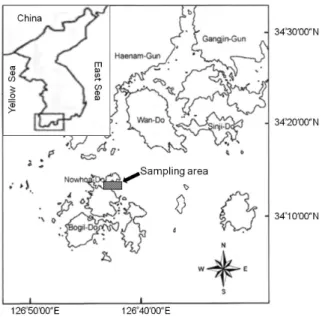
Fig. 1. Sampling area of abalone Haliotis discus hannai.
식생산량은 2009년 6,207톤, 2011년 6,779톤으로 우리나라 양식패류 생산량 중 1.7% (농수산식품부, 2011) 에 불과하지 만 생산금액은 42.9% (농수산식품부, 2011) 의 비중을 차지 하고 있어 우리나라 패류양식산업에 있어서 전복은 매우 중요 한 품종으로 자리 잡고 있다. 해상가두리식 전복양식장은 전남 지역에서 주로 분포하고 있으며, 여름철 고 수온 및 저염분, 겨울철 한파에 의한 폐사 및 밀식에 따른 피해영향이 발생하 고 있어 안정적인 전복의 생산량 유지를 위하여 해상가두리 전복양식장의 지속적인 관리가 시급한 실정이다. 본 연구는 전라남도 완도군 노화도에서 양식되고 있는 전복을 대상으로 매월 성장, 산소소비율, 암모니아질소배설률, 먹이섭취율 및 동화효율 등을 조사하여 전복양식장의 적정 수용력 산정을 위하여 환경변화에 따른 전복의 건강도를 추정하고, 생리생태 를 분석하여 계절변동에 따른 전복의 대사변화 및 에너지흐 름을 분석하였다.
재료 및 방법
1. 실험재료
본 실험에 사용된 전복은 전남 완도군 노화읍 해상가두리 전복양식장 (Fig. 1) 에서 2010년 5월부터 2011년 2월 동안 매월 1회 인공종묘 생산하여 사육하고 있는 개체를 이용하여 1년산과 2년산 양식 그룹으로 나누어 채취하여 실험실내에서 일주일간 실온에서 순치시킨 후 실험에 사용하였다. 순치시키 는 동안 먹이는 매일 다시마를 제공하였으며, 섭이 후 찌꺼기 는 매일 수거하고 청소하였다.
2. 측정방법
북방전복의 성장도를 측정하기위하여 2010년 5월-2011년 2월 동안 매월 1년산과 2년산 그룹별로 각각 30마리씩 무작 위로 채취하여 각장 및 육중을 측정하였다. 전장은 버니아캘리 프스를 이용하여 0.01 mm까지 측정하였으며, 육중은 전자저 울을 이용하여 0.01 g까지 측정하였다. 비만도 (CI) 는 각장 (mm)3/육중(g) × 1000 으로 산출하였다. 월별 산소소비율 은 0.6 L volume의 호흡측정기 (respirometer) 를 사용하였 으며, 호흡측정기내 용존산소의 농도는 용존산소측정기 (Orbis, 3600 made by Switzerland) 를 이용하여 실험전후 의 용존산소의 차이로 구하였다. 암모니아질소배설률은 산소 소비율의 측정과 동시에 호흡측정기에서 실험용액 2 ml을 채 수하여 phenolhypochlorite (Solorzano, 1969) 법을 이용 하여 분석하였다. O/N원자비는 산소소비율과 암모니아질소배 설률로부터 구하였으며, 방정식 O/N = (mg O2/h/16)/(mg NH4-N/h/14) (Widdows and Johnson, 1988) 에 의해 산 출하였다. 동화효율은 실험동물을 0.45 μm로 여과한 해수에 24시간을 두어 장내용물을 배출시킨 다음, 여과해수 10 L에 다시마를 충분히 먹인 후 실험생물을 수거하여 여과해수가 들 어 있는 다른 수조로 옮겨 6시간 동안 장내용물을 배출 시켰 다. 배출된 분은 스포이드로 비이커에 옮긴 후 증류수로 헹구 고 70℃의 항온 건조기에 넣어 24시간 건조시켰다. 건조된 배 설물은 micro-Kjedahl장치를 사용하여 질소함량을 측정하여 Durbin and Durbin (1981) 의 방법으로 동화효율을 산출하 였다.
% assimilation = (Food N-Faeces N)/ Food N × 100
에너지수지에 이용된 에너지량은 에너지전환 계수 (Bayne et al., 1985) 를 이용하여 매월 산출하였으며 Warren and Davis (1967) 의 방정식을 이용하여 분석하였다.
1 mg of organic matter = 23.50 J 1 ml O2 respired = 20.33J 1 μg NH4-N excreted = 0.0249J
SFG = A-[R+U]
SFG: Scope for growth (J h-1g-1) A: Energy absorbed
R: Respiration rate U: Excretion rate
본 연구의 각장-육중간의 상관관계 및 각 실험자료는 SPSS 통계패키지에 의해 분산분석과 Duncan의 다중검정을 실시하 여 유의차 유무를 검정하였다.
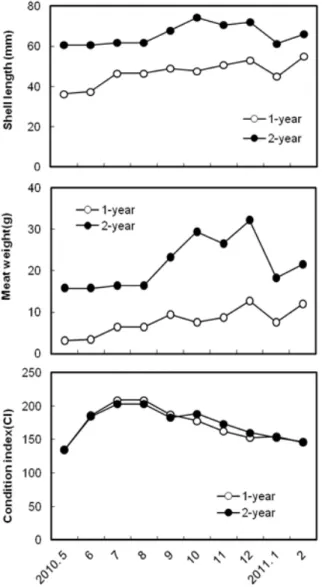
Fig. 3. Haliotis discus hannai: changes of growth in shell length and meat weight and condition index related to seasonal variation.
Fig. 2. Monthly variation of temperature and salinity in sample area of Nowha, Wan-do.
Fig. 4. Haliotis discus hannai: oxygen consumption related to seasonal variation. Values are means ± SD.
결 과
전남 완도군 노화읍에 소재하고 있는 전복양식장에서 수심 5 m 저층의 수온 및 염분의 월별변화를 Fig. 2에 나타내었다.
수온은 연중 8.0-23.2 ℃의 변동을 나타내었으며, 1월에 8 ℃ 로 가장 낮았으며, 8월에 23.2℃으로 가장 높게 나타났으며, 연평균 수온은 14.4 ℃였다. 염분은 31.9-34.1 psu를 나타내 었으며, 조사기간 동안 8월에 31.9 psu으로 가장 낮았다.
노화도 전복양식장에서 채취한 전복의 월별 각장 및 육중의 성장도를 Fig. 3에 나타내었다. 각장은 2년산의 경우에는 각 장 60.6 mm에서 66.1 mm으로 성장하였으며, 1년산은 36.3 mm에서 66.1 mm, 육중은 1년산과 2년산에서 각각 3.16 g에 서 12.04 g, 15.8 g에서 21.5 g으로 성장하여 2년산에 비해 성장률은 높았다. 각장성장은 연중 꾸준히 성장하는 양상을 나 타내었으나 육중성장은 주로 9-12월중에 높았으며, 비만도는 6-8월 중에 다소 상승을 보인 후 감소하였다.
Fig. 4-7은 북방전복의 월별 산소소비율, 암모니아질소배설 률, 먹이섭취율 및 동화효율의 변화를 나타낸 것이다. 산소소 비율은 1년산과 2년산 북방전복에서 유사한 양상을 나타내었 으며, 7월에 각각 2.92 mg O2/g DW/h과 2.30 mg O2/g DW/h으로 가장 높게 나타났으며, 이후 수온이 감소함에 따라 산소소비율은 감소하는 경향을 나타내었으며 겨울동안 낮은 값을 나타내었다 (Fig. 4). 암모니아질소배설률은 북방전복의 크기에 따라 유의한 차이를 보이지 않았으며 (p 〉0.05), 산소 소비율의 변화와 유사하게 수온의 감소에 따라 감소하는 경향 을 보였다 (Fig. 5).
북방전복의 먹이섭취율은 Fig. 6에서와 같이 1년산의 경우 3.9-7.1%, 2년산의 경우 3.4-6.1%의 범위를 나타내어 연령에 따른 유의한 차이는 보이지 않았으며, 9월에 1년산과 2년산 북방전복에서 모두 감소하였으며, 10-12월 동안 증가하였다.
Fig. 6. Haliotis discus hannai: feeding rate related to seasonal variation. Values are means ± SD.
Fig. 5. Haliotis discus hannai: ammonia excretion rate related to seasonal variation. Values are means ± SD.
Fig. 7. Haliotis discus hannai: assimilation rate related to seasonal variation.
Fig. 8. Haliotis discus hannai: O:N ratio related to seasonal variation.
Fig. 7은 북방전복의 월별 섭취한 먹이에 대한 체내 동화효율 을 나타낸 것이다. 1년산의 경우 69-71%, 2년산의 경우에는 68-70.5%였으며, 전복의 연령 및 계절 간 유의한 차이는 보이 지 않았다 (p 〉0.05, Fig. 7). 산소소비율과 암모니아 질소배 설률로부터 산출한 O:N 원자비는 1년산과 2년산 개체간 유의 한 차이는 보이지 않았으며 (p 〉0.05), 대체로 9-10월 동안 10이하로 현저히 낮은 값을 나타내어 계절에 따라 변화하는 양상을 보였다 (Fig. 8).
고 찰
생리적 반응은 환경 또는 생물자체의 스트레스에 의한 영향 으로 인해 세포적 또는 생화학적 반응의 총체로서 나타나며, 개체군이나 집단으로 피해영향이 확산되기 전에 생물은 체내 변화하는 양상을 나타내므로 총대사반응, O:N원자비 및 에너 지수지의 분석은 생물의 건강도를 추정하고 스트레스 정도를
파악하는데 도움이 된다 (Bayne et al., 1985). 수서동물의 생리적 반응은 연령, 크기 및 생활사를 포함한 여러 가지 요인 에 의해 영향을 받으며, 특히 먹이섭취, 성장 및 대사율은 수 온, 염분 등 해양 환경의 변화에 따라 다양한 반응을 보인다 (Bayne et al., 1985). 조사기간 동안 전남 완도군 노화읍 전 복양식장의 수온은 8.0℃-23.2℃, 염분은 31.9-34.1 psu였다.
북방전복 Haliotis discus hannai의 성장은 20℃ 전후 (Sakai, 1962) 에서 빠르며, 최적성장수온은 15-20℃
(NFRDI, 2011) 으로, 본 연구기간의 9-11월 동안 최적성장 수온기였으며 이 기간동안 전복의 각장 및 육중성장이 양호하 였다. 북방전복의 염분내성농도는 24.9 psu으로 (Shin et al., 2011), 조사기간 동안 염분에 의한 영향은 없었던 것으로 추 정되어 환경변동에 따른 북방전복의 영향은 없었다. 북방전복 의 산소소비율과 암모니아질소배설률의 대사양상은 연령에 관 계없이 유사한 양상을 보였으며, 호흡률은 5-7월 동안 다소 상 승한 것을 제외하고 유의한 차이는 없었다. 그러나 대부분의 패류에서 산소소비율은 생식주기와 관련하여 계절적인 뚜렷한
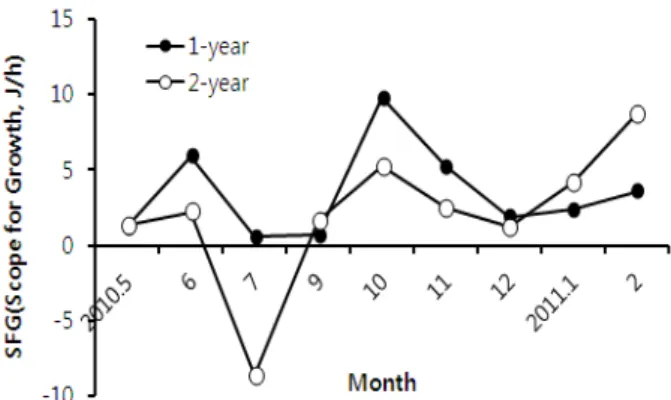
Fig. 9. Haliotis discus hannai: scope for growth(SFG) related to seasonal variation.
변화 (De Vooys, 1976; Mao et al., 2006) 를 나타내지만 본 연구에 이용된 북방전복의 경우에는 미성숙 또는 최소연령 개체로 생식소발달에 의한 대사율변화 보다는 수온에 의한 영 향이 다소 컸던 것으로 여겨진다. 북방전복의 암모니아질소배 설률은 1.3-4.9%를 차지하여 green abalone Haliotis fulgens의 0.9-3.5%와 유사하였으며, 이 값은 일반적인 무척 추동물의 배설형태에 해당된다 (Farías et al., 2003). 먹이섭 취율은 북방전복의 크기에 따라 유의한 차이는 보이지 않았으 며, 체중의 3.4-7.1%를 나타내었으며, 5월에 가장 높았으며, 10월-12월 동안 높게 나타났다. Barkai and Griffiths (1987) 에 따르면, 전중 200-700 g의 전복의 경우 먹이섭취율 은 하루에 체중의 11%를 섭취하는 것으로 보고하였으나, 사 료 공급의 경우 green abalone, Haliotis fulgens의 경우 사 료 섭취율은 체중에 따라 유의한 차이를 보였으며, 체중의 0.2-1 %를 보고하였다 (Farías et al., 2003). 동화효율은 본 연구에서 다시마를 공급시킨 전복에서 68-71%으로, 이 값은 Yamasaki (1998) 가 보고한 Haliotis discus hannai의 동 화효율 78 %와 유사한 반면, Haliotis discus의 81 %보다는 다소 낮았다. 반면, Haliotis midae의 경우에는 다시마를 공 급한 경우에도 동화효율이 37.25 % (Barkai and Griffiths, 1988) 으로 매우 낮은 반면 사료를 공급한 green abalone, Haliotis fulgens의 경우 84.9-89.3 %으로 높았으며, 유의한 차이가 없는 것으로 보고하였다. 따라서 전복의 먹이섭취율은 종에 따라 먹이의 질에 따라 차이가 있으며 (Bayne and Newell, 1983), 다시마를 공급한 경우 다시마의 열량이 낮기 때문에 전복의 에너지요구를 충족시키기 위한 더 많은 양의 먹 이를 요구할 것으로 추정된다.
에너지수지 분석은 양식생물의 건강도를 분석하고 생활사에 미치는 스트레스 인자 또는 환경적인 영향을 추정하기 위한 지 표로 활용하고 있다 (Newell and Branch, 1980). 이는 SFG (Scope for Growth) 의 형태로 표현 할 수 있으며, 일 시적인 환경의 영향과 생물체의 성장을 분석할 수 있으며 (Bayne and Newell, 1983), 이는 먹이공급의 형태, 사육조 건 등과 관련된다.
본 연구에서 전복의 성장은 연령에 따라 다소 차이를 보이 고 있는데 1년산의 경우에는 5월부터 12월까지 꾸준한 성장 패턴을 보이고 있으나 2년산의 경우에는 5월에서 8월 동안에 는 성장은 정지되었으나 비만도는 7-8월 동안 최고를 나타내 었다.
또한 SFG는 (Fig. 9) 북방전복 2년생의 경우 7월을 제외하 고 모든 기간동안 +의 값을 보였으며, 1년생의 경우는 +의 값을 나타내어 연중 성장하는 양상을 나타내었다. 본 연구에 사용된 북방전복은 미성숙 또는 최소성숙 연령의 개체로서 생 식소발생에 일부 산란에 가입한 개체에 의해 에너지가 소모되
었거나 7월 고수온기 높은 산소소비율로 인한 대사에너지의 소비로 인해 성장에너지가 감소된 것으로 추정된다. 전복과 같 은 복족류는 이동력이 많아 점액의 분비가 많다할지라도, 점액 생성 분석이 어렵고, 대부분의 경우 이에 대한 측정오차가 많 이 발생하므로 점액으로 인한 에너지손실 부분은 에너지수지 평가에서 제외한다 (Culley and Sherman, 1985). 그러나 Haliotis tuberculaba는 섭취한 먹이의 23.3-29.1%를 점액 분비 (Peck et al., 1987) 로 사용하는 예를 북방전복에 적용 시킨다면, 북방전복의 성장효율은 본 연구의 결과보다 다소 감 소할 것으로 추정된다.
요 약
북방전복의 계절변동에 따른 대사변화 및 에너지흐름을 파 악하기 위하여 2010년 5월부터 2011년 2월 동안 성장, 산소 소비율, 암모니아질소배설률, 먹이섭취율 및 동화효율 등을 조 사하였다. 조사기간 동안 수온은 8-23.2 ℃, 염분은 31.9-34.1 psu이었다. 북방전복의 각장은 1년산에서 36.3 mm에서 66.1 mm으로, 2년산에서는 60.6 mm에서 66.1 mm으로 성 장하였으며, 육중은 각각 3.16 g에서 12.04 g과 15.8 g에서 21.5 g으로 증가하였다. 산소소비율과 암모니아질소배설률은 수온 상승에 따라 증가하는 경향을 보였으며, 먹이섭취율은 7 월-10월 동안 높았다. 동화효율은 68-71 %으로 연령 및 계절 간 유의한 차이는 없었다. SFG는 북방전복 1년산은 연중 + 값을 보였으며, 2년산의 경우에는 7월을 제외하고 +값을 보 여 연중 성장하는 것으로 나타나 조사기간 동안 수온, 염분 등 에 의한 환경적인 영향은 없었다.
사 사
본 연구는 국립수산과학원 전략양식연구소 (RP-2012-AQ 035) 의 지원에 의해 수행되었습니다.
참고문헌
Bayne, B.L., Brown, D.A., Burns, K, Dixon, D.R., Ivanovici, A., Livingstone, D.R., Lowe, D.M., Moore, M.N., Stebbing, A.R.D. and Widdows. J. (1985) The effects of stress and pollution on marine animals (Praeger special studies). Praeger Scientific, Westport, C.T. p. 9.
Barkai, R., Griffiths, C.L., 1988. An energy budget for the South African abalone Haliotis midae Linn.
Journal of Molluscan Studies, 54: 43-51.
Barkai, R., Griffiths, C.L., 1987. Consumption, absorption efficiency, respiration and excretion in the South African abalone Haliotis midae. South African Journal of Marine Science, 5: 523-529.
Bayne, B.L. and Newell, R.C. (1983) Physiological energetics of marine mollusca. In: Saleuddim, ASM.
and Wilbur, KM (Eds). The Mollusca 4, Academic press, New York, pp. 407-515.
Chen, J.C. and Chen, W.C. (1999) Temperature tolerance of Haliotis diversicolor supertexta at different salinity and temperature levels. Comparative Biochemistry and Physiology. Part A, 124: 73-80.
Chen, J.C. and Chen, W.C. (2000) Salinity tolerance of Haliotis diversicolor supertexta at different salinity and temperature levels. Aquaculture. 181: 191-203.
Cheng, W., Yeh, S.P., Wang, C.S. and Chen, J.C. (2002) Osmotic and ionic changes in Taiwan abalone Haliotis diversicolor supertexta at different salinity levels. Aquaculture. 203: 349-357.
Cho, S.H., Park, J.E., Kim, C.L., Yoo, J.H., Lee, S.M.
and Choi, C.Y. (2006) Effect of the various sources of dietary additives on growth, body composition and shell color of abalone Haliotis discus hannai.
Journal of Aquaculture, 19(4): 275-280.
Durbin, E.G. and Durbin, A.G. (1981) Assimilation efficiency and nitrogen excretion of a filter feeding planktivore, the atlantic menhaden, Brevoortia tyrannus (Pisces: Clupeidae). Fisheries Bulletin, 601-616.
De Vooys, C.G.N., 1976. The influence of temperature and time of the year on the oxygen uptake of the sea mussel Mytilus edulis. Marine Biology, 36:
25-30.
Ezgeta-Balic, D., Rinaldi, A., Peharda, M., Prusina, I., Montalto, V., Niceta, N. and Sarà, G. (2011) An energy budget for the subtidal bivalve Modiolus barbatus (Mollusca) at different temperatures.
Marine Environmental Research, 71: 79-85.
Farías A. Zaul G.E. and Maria T.V. (2003) Physiological energetics of the green abalone, Haliotis fulgens, fed on a balanced diet. Journal of experimental marine biology and ecology. 289: 263-276
Jeong, S.C., Jee, Y.T. and Son P.W. (1994) Indoor tank culture of the abalone Haliotis discus hannai Ⅱ.
Effect of diets on growth of young abalone. Journal of Aquaculture. 7: 77-87.
Lindberg, D.R. (1992) Evolution, distribution and systematics of Haliotidae. In: Abalone of the World:
Biology, Fisheries and Culture. (ed. by Shepherd, S.
A., Tenger, M. J. and Gunzmándel Próo, S.A.). pp.
3-18. Fishing News Books, Blackwood Scientific, Oxford.
Mao, Y., Zhou, Y., Yang, H. and Wang, R. (2006) Seasonal variation in metabolism of cultured pacific oyster, Crassostrea gigas, in Sanggou Bay, China.
Aquaculture, 253: 322-333.
National Fisheries Research and Development Institute(NFRDI). (2011) Standard manual of abalone culture, 3rd ed. 11-17.
Newell, R.C. and Branch, G.M. (1980) The influence of temperature on the maintenance of metabolic energy balance in marine invertebrates. Advances in Marine Biology, 17: 329-396.
Park, I.S., Im, J.H., Lee, Y.D., Kim, B.L. and Han, S.J.
(2003) A temperature -dependent index of mitotic interval in Haliotis gigantea and Haliotis discus.
Korea Journal of Genetics, 25(1): 15-19.
Peck, L. S., Culley, M.B., Helm, M.M. (1987) A laboratory energy budget for the ormer Haliotis tuberculata L. Journal of Experimental Marine biology and Ecology, 106: 102-123.
Ren, J.S. and Ross, A.H. (2005) Environmental influence on mussel growth: A dynamic energy budget model and its application to the green shell mussel Perna canaliculus. Ecological Modelling, 189:
347-362.
Sakai, S., (1962) Ecological studies on the abalone Haliotis discus hannai Ino (4). Bulletin of Japanese Society of Scientific Fisheries, 28: 899-904.
Shin Y.K., Jun J.C., Im J.H., Kim D.W., Son M.H. and Kim EO. 2011. Physiological responses in abalone Haliotis discus hannai with different salinity.
Korean Journal of Malacology. 27(4): 283-289.
Solorzano, L. (1969) Determination of ammonia natural waters by the phenolhypochlorite method. Limnology Oceanogrphy, 14: 799-801.
Warren, G.E. and Davis, G.E. (1967) Laboratory studies on the feeding, bioenergetics and growth of fish. In:
The Biological Basis of Freshwater Fish Production.
(ed. by Gerking, S.D.). pp. 175-214. Blackwell Scientific Publications, Oxford.
Yang, H.S., Park, K.I., Hong, C.H. and Choi, K.S.
(2008) Effect of salinity stress on the composition of free amino acids of the Pacific abalone Haliotis discus discus. Journal of Aquaculture, 21(4):
218-225.
Yamasaki, M. (1998) Energy budget of laboratory reared juvenile abalone Haliotis discus and Haliotis discus hannai. Bulletin of Tohoku National Fisheries Research Institute, 60: 63-68.
Yoon H.S., Rha S.J., Cha Y.B., Cho J.H., Kim K.Y. and Choi S.D. 2004. Growth and survival rate on density of Haliotis discus hannai in cage culture.
Journal of Korean fisheries society, 37(4): 287-294.