| Abstract |
Purpose: This study identified the effects of dual-task gait training on balance, gait function, and activity of daily living in patients with Parkinson’s disease.
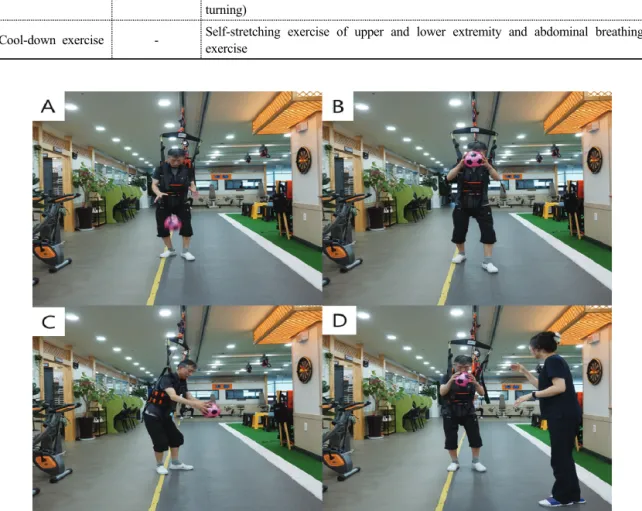
Methods: This study used a single-subject design. Two patients with Parkinson’s disease participated in this study. Dual-task gait training was performed 1 hour per day 8 times during intervention phase. The subjects were measured 8 times in the baseline phase, 8 times in the intervention phase, and 8 times in the follow-up phase. The outcome measurements included a timed up and go test (TUG), a Berg balance scale (BBS), a 10 meter walk test (10MWT), a 6 minute walk test (6MWT), a dynamic gait index (DGI) and a Korean modified Barthel index (K-MBI).
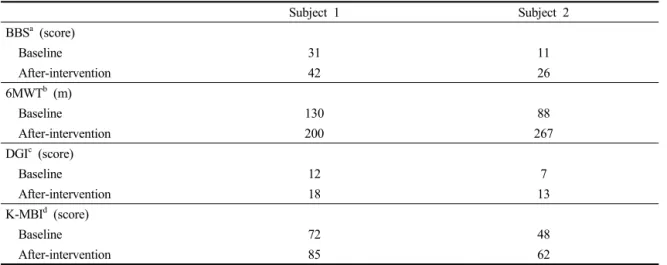
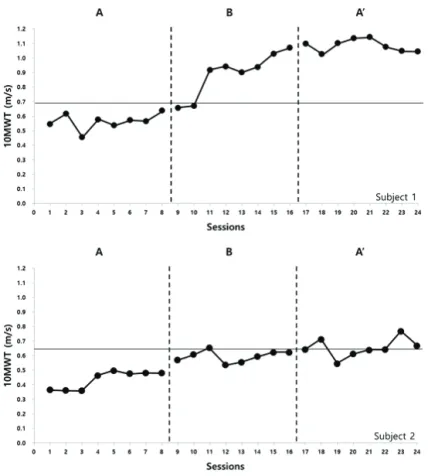
Results: When compared to the average of the baseline process, the data collected during the intervention period showed that the TUG and 10MWT results improved and the tendency line was above the baseline. In addition, BBS, 6MWT, DGI, and K-MBI values for both patients increased remarkably after the training.
Conclusion: The results of this study revealed that dual-task gait training may be helpful to improve balance, walking function,
†Corresponding Author : Eon-Ju Lee ([email protected])
Case Study Open Access
이중과제 보행훈련이 파킨슨병 환자의 균형, 보행능력 및 일상생활동작에 미치는 효과
-단일사례연구-
박현주⋅이언주 1† ⋅나규민 1 ⋅강태우 21)
굿데이케어센터 물리치료실,
1 대전대학교 보건의료과학대학 물리치료학과, 2 우석대학교 보건복지대학 물리치료학과
The Effect of Dual-task Gait Training on Balance, Gait, and Activities of Daily Living for Patients with Parkinson’s Disease