ABSTRACT
Objectives: The purpose of the study was to investigate dental care effects of periodontal diseases patients with systemic diseases.
Methods: The study subjects were ten patients. The study consisted of direct examination and interview survey. Direct examination comprised pocket depth, bleeding on the brush, O'Leary plaque record, salivary flow rate, and oral bacterial culture for three months.
Results: The number of diabetic patients was eight. Four patients xerostomia and one of them had 0.7 mL per minute of salivary flow rate, decreased O'Leary plaque record, and bleeding in the brush. Those who received education were able to take control of plaque management. They recognized the need for oral care and had good self-management of oral care skills.
Conclusions: The professional dental care and oral health education improved periodontal health and self-management skills of plaque in periodontal disease patients with systemic diseases.
Key Words: dental care, dental hygienists, periodontal diseases
색인: 구강 관리, 치과위생사, 치주질환서론
9)2014년 국민건강영양조사에 의하면 만 30세 이상 성인 의 28.9%는 고혈압, 11.1%는 당뇨병 이고 65세 이상은 고 혈압 60.5%, 당뇨병 23.0% 이환되었으며, 그 외에도 연령 이 증가할수록 악성신생물, 뇌혈관질환 등 8대 질환 유병자 가 증가되고 있다[1]. 전신질환은 복합적 양상으로 나타나 기도 하는데 8대 질환뿐만 아니라 구강질환과의 연계성이 높다. 당뇨병에서 치주질환이 주요 합병증으로 나타나 치주
Copyrightⓒ2016 by Journal of Korean Society of Dental Hygiene
This is an open-access article distributed under the terms of the Creative Commons Attribution Non-Commercial License (http://creativecommons.org/
licenses/by-nc/3.0/), which permits unrestricted non-commercial use, distribution, and reproduction in medium, provided the original work is properly cited.
질환 유병률이 높고 증상이 심한 경우 치아발거의 주원인이 된다[2]. 뿐만 아니라 전신질환자가 복용하는 고혈압제와 이뇨제, 항우울제, 항히스타민제 등의 수많은 약물들이 타액 분비를 감소시켜 구강건조증을 유발하고 , 구강건조증은 치 아우식증, 치주질환의 발생을 높여 연하 및 의치 장착 불편 감, 미각 변화 등을 초래해 삶의 만족도를 저하시키는 원인 이 된다 [3,4]. 결과적으로 전신질환자는 일반인에 비해 치주 질환 등 구강질환 발생위험이 높다.
전신질환 입원환자의 구강질환 조사에 의하면 , 내분비, 대사 질환의 경우 치은염 및 치주질환 44.9%, 타액선 질환 22.4%, 치아우식증 12.2%여서 치주질환 발생빈도가 높았 다. 구강질환 중 치주질환자를 중심으로 전신질환 분포를 분석한 결과 당뇨 39.2%, 뇌경색 29.4%, 신경근 및 신경총 장애 5.6%, 뇌내출혈 3.9%였고 치주질환자의 전신질환 발
http://dx.doi.org/10.13065/jksdh.2016.16.04.567 ISSN 2288-2294(Online)
J
전신질환자 중 치주질환자 구강관리 효과
김설희
건양대학교 의과학대학 치위생학과
Oral health care effects of periodontal disease patients with systemic diseases: case report
Seol-Hee Kim
Department of Dental Hygiene, College of Medical Science, Konyang University
*Corresponding Author: Seol-Hee Kim, Department of Dental Hygiene, College of Medical Science, Konyang University, Daejeon 35365,
Korea, Tel: +82-42-600-6382, Fax: +82-42-600-6565, E-mail: [email protected]
Received: 12 May 2016; Revised: 21 August 2016; Accepted: 22 August 2016
한국치위생학회
생이 높았다[5,6]. 특히 전신질환 입원환자, 외래환자의 경 우 전신질환으로 인한 구강건강 악화뿐만 아니라 전신질환 치료에 집중하면서 구강관리가 상대적으로 소홀해져 구강질 환이 발생될 수 있으므로, 이를 예방하기 위한 정기적인 전 문가 구강관리가 중요하다.
전문가 구강관리는 구강질환 주요 원인인 치면세균막을 조절하여 구강질환 예방 및 관리가 가능하고 주기적인 치석 과 치면 부착물 제거[7]를 통해 구강건강을 유지 증진시킨 다. 주기적 구강관리시 구강보건교육을 시행하면 구강관리 능력이 향상되므로 반복적 구강보건교육은 구강건강관리에 중요한 역할을 한다. 특히 칫솔질은 치면세균막을 제거하는 기능뿐만 아니라 치은조직을 적절히 마사지하여 치은염증에 대한 저항성, 면역성을 높이고, 치실과 치간칫솔 등 구강관 리용품은 치면세균막 관리 효과를 높여 구강건강관리 교육 과정에서는 환자에게 적절한 용품 선정과 교육과정이 필요 하다[8].
기존 연구에서 전신질환 입원환자의 구강질환 진료 의뢰 실태에 관한 연구[5], 입원한 전신질환자의 구강질환 진료 실태에 관한 연구[9]가 시행되었고, 최근 당뇨환자를 대상 으로 전문가 구강관리 효과 연구[2]가 있었다. 입원환자 및 외래환자 대상 전문가 구강관리에 관한 연구가 많지 않아 본 연구에서는 입원환자 및 외래환자의 구강관리실태조사와 주기적 치면세균막관리, 구강관리습관 개선을 위한 구강보 건교육을 시행하여 치주질환 개선 효과를 분석하고자 한다.
이를 통해 구강건강 증진효과와 경험에 대한 현상학적 연구 결과를 제시하여 전신질환자의 구강관리 필요성에 관한 기 초자료를 제공하고자 한다.
연구방법
1. 연구설계
본 연구는 입원환자, 외래환자를 대상으로 전문가 구강 관리 프로그램을 적용하여 구강건강증진 효과를 제시하는 증례연구이다.
2. 연구대상
2015년 9월부터 11월까지 대전 A병원에 입원 혹은 입 원하지 않고 치료를 받는 외래환자 중 잇몸염증, 출혈, 통증 및 치아흔들림으로 치주관리를 위해 치과에 의뢰된 35세 이 상 성인 환자를 대상으로 하였다. 대상자에게 치위생 검사, 치석제거, 치면세균막 관리, 불소를 이용한 지각과민처치, 구강보건교육에 관한 프로그램을 설명하고 연구목적 이외 취득한 자료를 사용하지 않을 것을 설명한 후 참여 동의서 에 서명한 자를 선정하였으며, 구강관리경험에 대한 표현과 의사소통이 가능한 자를 대상으로 하였다 . 대상자 중 3회 이상 전문가 구강관리프로그램에 참여하고 면담까지 완료한 10명의 자료를 최종 분석하였고 연령분포는 35-71세, 평균 연령 47.5세였다.
3. 연구방법 3.1. 치위생 검사
타과에서 의뢰된 환자의 1차 검사는 치과의사가 수행하 였고, 치위생 검사는 치과위생사인 연구자가 시행하였다. 검 사항목은 치주질환부위 치주낭 깊이(pocket depth, PD) 측 정, 잇몸출혈(bleeding on brushing, BOB) 부위 측정, 구강 관리능력 개선 평가를 위한 O’Leary 검사를 하였다. 또한
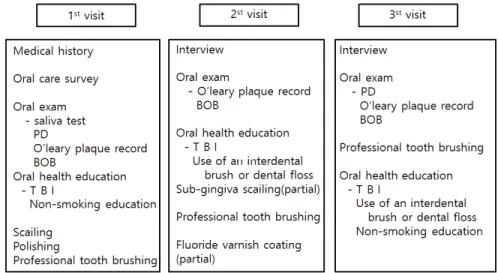
Fig. 1. Study design
타액 영향요인 분석을 위해 타액분비율 검사, 구강내 세균 검사를 시행하였고 치주관리에 영향을 미치는 구강환경요인 을 확인하기 위해 일반적 구강검사를 하였다. 치조골 흡수 정도를 파악하기 위한 파노라마 영상을 참고하였으며, 일반 적 병력조사는 환자의 문진과 진료기록부로 확인하였다.
3.2. 전문가 구강관리(professional maintenance care)
전문가 구강건강관리는 치주관리와 구강보건교육으로 분류할 수 있으며 2주 간격으로 시행, 횟수에 따라 환자에 게 적합한 과정으로 진행되었다. 일반적인 시행과정은 다음 과 같다.
1회차: 병력조사, 구강관리실태조사, 치위생 검사(구강검사, 타액분비율검사, 구강내 세균검사, PD, BOB) → 치면세균막 검사(O’Leary) → 구강보건교육(환자에게 적합한 칫솔질 방법 교육 , 금연교육) → 초음파 치석제거, 부분 치면연마 → 전문가 칫솔질(회전, 바스, 와타나베법)을 시행하였다.
2회차: 면담 → 치면세균막 검사(O’Leary) → 구강보건 교육(칫솔질 방법 개선 확인, 환자에게 적합한 구강관리용 품 교육, 타액 세균검사 결과를 통한 구강관리 동기유발) → 연하치석 탐지 후 수기구 이용 부분 연하치석제거, 전문가 칫솔질 → 필요시 불소바니쉬 도포를 하였다.
3회차: 치위생 검사(PD), 치면세균막 검사(O’Leary) → 구강보건교육(구강관리용품 재교육, 금연교육) → 부분 치 면연마, 전문가 칫솔질 → 자가관리 실천, 참여효과에 관한 면담을 시행하였다.
3.3. 조사연구
대상자의 의견을 수집하기 위해 개방적 질문을 1차적으 로 하여 경험을 이야기하도록 비구조화된 질문을 하였고, 2 차적으로 주제를 명확히 구성하여 구조화된 질문을 하였다.
면담은 대화가 방해되지 않는 곳에서 시행하였으며 면담 횟 수는 2회 하였고, 1회 소요시간은 15-20분으로 직접 면담을 실시하였다.
면담시 주요 질문은 “전문가 구강관리를 받은 결과 어떤 변화가 있었습니까?”이었고, 하위 질문은 “전문가 구강관리 경험 후 구강관리 실천 변화는 무엇입니까?”, “전문가 구강 관리를 받은 후 어떤 효과가 있습니까? 등이었다. 대상자 진술시 연구자는 의견을 제시하지 않았고, 대상자가 자유롭 게 이야기 할 수 있도록 관심있는 표정 등 비언어적 반응과 짧은 응답을 하면서 면담을 지속하였다. 대상자의 반응은 대상자의 표현 언어로 주요 내용을 기록하였고, 재확인이 필요한 경우 2차 면담을 통해 확인하였다.
3.4. 자료분석
SPSS/WIN 18.0 프로그램을 이용하여 O’Leary, PD, BOB 전후 비교를 위해 Wilcoxon matched pairs signed-ranks test 를 하였다. 조사연구내용 분석은 대상자의 전문가 구강관리 경험 자료를 얻기 위한 면담내용을 토대로 주제모음을 조직하 였다. 그리고 주제모음을 중심으로 경험 내용 일치를 재확인 후 기술하였다.
연구결과
1. 일반적 특성
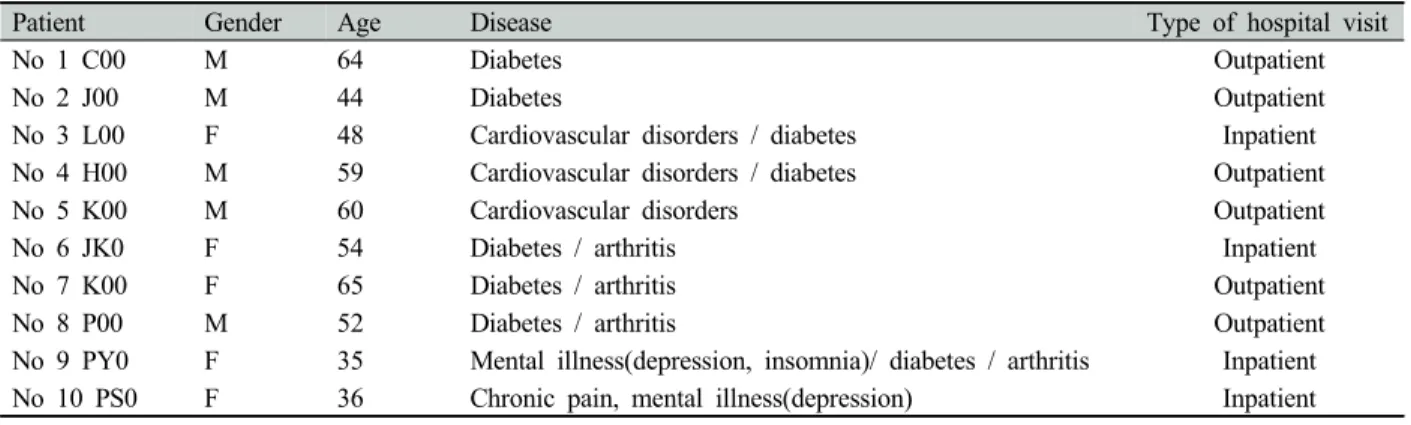
전문가 구강관리프로그램에 참여한 10명의 연령분포는 35-71세, 평균연령 47.5세 이었다. 당뇨질환이 8명으로 가 장 많았고, 그 중 심혈관계 질환자도 있는 대상이 6명이었 으며 정신질환자는 2명 이었다. 입원환자는 4명, 외래환자 는 6명 이었다<Table 1>.
2. 구강환경변화
연구대상자의 타액분비량 검사결과 자극성 타액 5분 분 비량 검사기준 8.0 ml 이하는 5명이었고, 분당 0.7 ml 이하 분비 대상자는 정신과 입원자 1명(공황장애, 고지혈증, 당
Patient Gender Age Disease Type of hospital visit
No 1 C00 M 64 Diabetes Outpatient
No 2 J00 M 44 Diabetes Outpatient
No 3 L00 F 48 Cardiovascular disorders / diabetes Inpatient
No 4 H00 M 59 Cardiovascular disorders / diabetes Outpatient
No 5 K00 M 60 Cardiovascular disorders Outpatient
No 6 JK0 F 54 Diabetes / arthritis Inpatient
No 7 K00 F 65 Diabetes / arthritis Outpatient
No 8 P00 M 52 Diabetes / arthritis Outpatient
No 9 PY0 F 35 Mental illness(depression, insomnia)/ diabetes / arthritis Inpatient
No 10 PS0 F 36 Chronic pain, mental illness(depression) Inpatient
Table 1. Demographic characteristics of study subjects
뇨, 고혈압 약 복용/ 구치부 모두 충전 처치 경험 있음, 현 전치부 인접면 치아우식증 존재)이었다.
구강환경관리지수인 O’Leary plaque rate 와 BOB 전후 비교분석결과 통계적으로 유의한 차이가 있었다(p<0.05)
<Table 2>.
3. 전문가 구강관리(구강검사, 구강보건교육, 구강위생관리 행동변화)
구강건강상태는 구강관리, 구강보건교육, 구강위생관리 행동 변화로 진행결과를 기록하였다.
구강관리 시 환자의 주증상은 치주질환과 지각과민이었 으며, 칫솔질 빈도는 1-2회 칫솔질 시간은 1분 이하가 7명 이었다. 구강보건교육 무경험자는 6명, 치석제거경험은 모 두 있었으나 비정기적 치석제거자가 8명, 최근 1년이내 치 과치료경험자는 치주질환처치와 치주질환으로 인한 발치경
험자가 9명이었다. 치과불안도는 0점부터 10점까지 있었다.
구강보건교육은 환자의 구강환경특성을 고려한 칫솔질 및 구강관리용품 사용법 교육, 치면세균막관리의 필요성, 당 뇨 외 질환과 구강질환과의 관련성, 정기적 구강관리의 필 요성, 치주질환부위 집중 관리법, 치경부 마모부위 외 치료 필요성을 교육하였고 , 치료가 필요한 부분은 치과의사에게 처치 받도록 하였다.
구강위생관리 행동변화 인식조사결과 구강보건교육을 통한 구강관리 동기유발 , 칫솔질 방향 개선, 구강관리용품 사용을 통한 치면세균막 관리능력 향상 및 습관 개선이었 고, BOB 감소, 금연, 주관적 구강건강관리능력 향상, 초기 치료의 필요성 인식변화, 정기적 구강관리 필요성 인식 향 상 등이 있었다<Table 3>.
Patient Saliva/5 minutes PD O’Leary p-value
*BOB p-value
*No 1 C00 6.7 ml First : Min 3/ Max 7
Third : Min 3/ Max 5
First : 60 Second: 32 Third : 16
0.005
*First : 7 Second: 3 Third : 2
<0.001
No 2 J00 8.5 ml First : Min 2/ Max 9
Third : Min 2/ Max 9
First : 50 Second: 36.6
Third : 25
First : 9 Second: 5 Third : 1
No 3. L00 10.5 ml First : Min 2/ Max 5
Third : Min 2/ Max 3
First : 44.6 Second: 35.7 Third : 28.5
First : 1 Second: 0 Third : 0
No 4 H00 6.5 ml First : Min 2/ Max 6
Third : Min 2/ Max 4
First : 48 Second: 18.2
Third : 8.6 (Best patient)
First : 3 Second: 0 Third : 0
No 5 K00 8.5 ml First : Min 2/ Max 4
Third : Min 2/ Max 3
First : 50.9 Second: 31.7 Third : 33.6
First : 3 Second: 0 Third : 0
No 6 JK0 8.3 ml First : Min 2/ Max 5
Third : Min 2/ Max 3
First : 62.5 Second: 28.5 Third : 16.0
First : 4 Second: 0 Third : 0
No 7 K00 8.5 ml First : Min 2/ Max 4
Third : Min 2/ Max 3
First : 55.2 Second: 34.3 Third : 31.2
First : 3 Second: 0 Third : 0
No 8 P00 7.5 ml First : Min 2/ Max 4
Third : Min 2/ Max 3
First : 49.1 Second: 30.3 Third : 16.9
First : 3 Second: 0 Third : 0 No 9 PY0 1st 2.5 ml
2st 3.8 ml Mean = 3.15 ml
First : Min 2/ Max 5 Third : Min 2/ Max 3
First : 76.9 Second: 23 Third : 38.4
First : 7 Second: 5 Third : 2
No 10 PS0 6.5 ml First : Min 2/ Max 5
Third : Min 2/ Max 3
First : 48.2 Second: 22.3 Third : 25
First : 4 Second: 1 Third : 0
*
by Wilcoxon matched pairs signed-ranks test(first – third analysis) PD: pocket depth, BOB: Bleeding on the brush
Table 2. Dental hygiene examination and change of oral health status
4. 전문가 구강관리경험 면담결과
전문가 구강관리경험 면담결과 구조화된 설문은 과거 구 강관리경험 4문항, 전문가 구강관리 경험이 10문항(5점척 도)이었다. 비구조화된 면담은 진술은 총 42개이었고, 2개 의 주제로 구체화되었다. 주제 모음은 구강관리인식변화, 전 문가 구강관리 효과로 나타났으며, 내용은 다음과 같다.
<구조화된 설문>
- 착색제 도포후 세균막 확인 경험은 2명 이었고, 미디어를 통한 구강보건교육외 구강내 구강보건교육 경험자는 1명, 타액검사 경험, 예방적 관리경험은 전무하였다.
- 구강건강 중요성인식 변화: 10명.
- 타액검사를 통한 구강내 문제 확인이 구강관리에 도움 이 됨: 8명(2명 타액검사 시행하지 않음).
- 세균막 확인후 칫솔질 관리가 효과가 있음: 10명.
- 구강관리 교육 후 실천: 6명(4명은 자가관리실천 평가 를 보통으로 응답함 ).
- 자가관리 실천에 따른 구강건강 개선: 8명(2명은 보통 으로 응답함 ).
- 관리후 예방적 관리의 필요성 인식: 8명(2명은 보통으 로 응답함 ).
- 지속적 관리 참여의사: 8명(1명 거주지 문제, 1명 자가 관리 향상하여 직접관리 ).
- 타인에게 권장: 8명.
- 조기치료를 함께 할 수 있어 도움이 됨: 10명.
- 치과공포, 불안 감소: 8명(2명 보통 응답).
<비구조화된 설문 - 구강관리인식변화>
- 당뇨 때문에 이가 더 상한다고 생각했는데 반대로도 된다니 관리를 더 해야겠다 .
- 이 닦을 때 더 신경쓰게 되었다. 관리 잘하면 치과에 덜 오게 될 것 같다.
- 관리를 잘하면 이를 덜 빼게 될 것 같다.
- 솔이 안 맞는지도 모르고 사용했는데 나한테 맞는 방 법을 알려주어서 도움이 되었다.
- 금연을 오늘부터는 꼭 해야겠다.
- 시린이도 치료를 빨리 해야겠다.
- 더 일찍 관리를 받았으면 건강했을 텐데 아쉽다.
- 이를 잘못 닦고 있었다는 것을 알았고 가족들에게도 알려주고 싶다.
<비구조화된 설문 - 전문가 구강관리 효과>
- 이가 건강해지는 것을 느낀다. 계속 치료를 받고 싶다.
- 입안이 개운하여 음식을 안 먹고 싶어졌다. 날마다 받 으면 좋겠다 .
- 잇몸이 건강해지는 것을 느낀다. 잇몸에 피나는 것도
없어지고 냄새도 안 나는 것 같다.
- 이가 많이 흔들리지만 조금 단단해지는 느낌이 들어서 안 빼도 되지 않을까 기대된다 .
- 그동안 잇몸치료를 많이 받았는데 안 아프게 치료받아 서 좋고 효과가 더 많은 것 같다 .
- 닦을 때 피가 안 나서 좋아지는 것이 느껴진다.
총괄 및 고안
건강보험심사평가원의 최근 5년간(2008-2012년) 치은염 및 치주질환 분석결과 진료인원은 2008년 673만 명에서 2012년 843만 명으로 약 170만 명이 증가(25.3%) 하였고 연평균 증가율은 4.6%였다[10]. 최근 전신질환으로 인한 치 주질환 발생, 치주질환으로 인한 전신질환 발생 위험에 관 한 연구가 시행되면서 [2, 5] 치주질환 관리의 중요성이 부 각되고 있다.
본 연구는 전신질환자 중 치주질환자의 전문가 구강관리 효과분석을 위한 증례연구이다 . 타과에서 치주질환 문제로 의뢰된 연구대상자 중 80%는 당뇨환자였다. 치주질환은 당 뇨병 합병증 6위로 조사되었으며, 치주농양의 형성, 치은 증 식, 치아동요 등의 증상이 나타난다[11]. 또한 치주질환이 있는 경우 인슐린 저항성을 증가시켜 고혈당을 초래하고 당 조절을 어렵게 만들어 당뇨병 발생률을 6배 증가시킨다. 인 슐린 저항성이 증가되면 고지혈증, 동맥경화를 초래하여 관 상동맥질환 발생 2.7배, 뇌졸중 발생 2.8배, 폐렴 발생을 4.2 배 증가시키고 알츠하이머 환자는 뇌에 정상인보다 치주질 환 원인균이 더 많이 발견되는 등 구강세균이 혈류를 통해 전신질환을 유발하는 위험인자로 판단되고 있다[12]. 그러 므로 치주질환자의 치주질환 개선을 위한 전문가 구강관리 가 요구되며, 정기적 관리를 통해 당뇨를 비롯한 전신질환 위험성을 감소시킬 필요가 있다.
연구대상자의 구강검사 중 타액분비량 검사결과 자극성 타액 분비량이 분당 0.7 ml 이하인 대상자는 구강건조증이 심한 9번 환자 1명이었는데 우울증 공항장애로 인한 약뿐만 아니라 혈압, 고지혈증, 당뇨약을 복용하고 있었으며 구치부 모두 충전처치 경험이 있었고, 현재 전치부 인접면 치아우 식증이 존재하였다. 약물은 구강건조증의 가장 흔한 원인으 로 500개 이상의 약물이 타액 분비를 감소시키거나 타액 조 성을 변화시킨다. 구강건조증 환자는 타액의 항균작용, 자정 작용 역할 저해로 인해 구강질환 발생이 높아질 수 있으므 로 예방을 위해 치아 및 구강점막 관리, 가글액 사용 등이 요구되며[13] 정기적 전문가 구강관리가 필요하다.
전문가 구강관리시 시행되는 전문가칫솔질은 단순히 이
닦기 목적뿐만 아니라 체계적 치면세균막 제거를 통해 치주
572•J Korean Soc Dent Hyg 2016; 16(4): 567-75 PatientOral hygiene by interviewOral health educationChange of oral hygiene behavior No 1 COSC.C: Bleeding during brushing, The ache of tooth Tooth brush: 3 minutes, 4 times Dental education experience: Yes Use interdental brushes: Yes Non-regular calculus removal Dentistry(within a year) - gum inflammation Drinking: once a month Smoking: No Dental Anxiety: 0 points Toothbrush method: Use a toothbrush about low strength & Excessive brushing habits reformation Use a oral hygiene instrument: Interdental brush need for dental biofilm management Diabetes Disease-Oral Health Impact Regular management of gums (Posterior alveolar bone absorption Low anterior: Gingival swelling&rupture,#46, 47 Implant) Education cervical abrasion treatment needs(13 point)
Improve brushing habits → Reduce bad breath Reduce bleeding during brushing Patient – High motivation Recognize that brushing is very helpful Patients No 2 JJSC.C: alveolar bone absorption, inflammation& mobility Tooth brush: 1 minutes, 1-2 times Dental education experience: No Use interdental brushes: Yes Non-regular calculus removal Dentistry(within a year): gum inflammation& mobility Drinking: 2/ month Smoking: No Dental Anxiety: 7 points
Toothbrush method : rolling method Use a oral hygiene instrument: Interdental brush -> Size exchange need for dental biofilm management Diabetes Disease-Oral Health Impact Regular management of gums Anti-smoking education Patients denied treatment → Process of alveolar bone absorption Extraction needs of mobility tooth
Mobility improvement(Patient awareness) : #15, 16, 25-26, 36-37, 44-47 Improve brushing habits Reduce bleeding during brushing Smoking reduction Regular management for oral health improve No 3. LSYC.C: Hypersensitivity, Bleeding during brushing(# 25-27) Tooth brush: 1-2 minutes, 2 times Dental education experience: Dental clinic Use interdental brushes: No Regular calculus removal Dentistry(within a year): Periodontal treatment Drinking: No Smoking: No Dental Anxiety: 2 points
Toothbrush method : Dental biofilm remaining areas Use a oral hygiene instrument: Interdental brush → Size exchange Need for dental biofilm management Diabetes Disease-Oral Health Impact Regular management of gums
Improve habits: Use of Interdental brush → Improve gum inflammation & hypersensitivity Regular management for oral health improve Not good habits improved: limited brushing habits No 4 HMKC.C: Hypersensitivity, gum inflammation Tooth brush: 40 second, 2 times Dental education experience: No Use interdental brushes: No, use of mouth rinse Non-Regular calculus removal Dentistry(within a year): Periodontal treatment Drinking: 4/week Smoking: No Dental Anxiety: 7 points
Toothbrush method : Dental biofilm remaining areas Use a oral hygiene instrument: Interdental brush Regular management of gums : improving mobility & bleeding (#14-11,25, 32-42) Diabetes Disease-Oral Health Impact Education cervical abrasion treatment needs(9 point)
Improve habits: Use of Interdental brush Increases brushing time, brushing before bedtime Oral administration recognizes the importance of diabetes Patient High motivation: Dental biofilm reduction Regular management for oral health improve No 5 KYSC.C: Hypersensitivity, Wisdom teeth pain Tooth brush: 1 minutes, 1-2 times Dental education experience: media Use interdental brushes: No, use of mouth rinse Non-Regular calculus removal Dentistry(within a year): Periodontitis Extraction(#16,17,25) Drinking: 3-54/week Smoking: 15/day Dental Anxiety: 7 points & treatment costs
Toothbrush method: rolling method Excessive brushing habits reformation Use a oral hygiene instrument: Interdental brush Cervical abrasion causes education Fluoride varnish coating effect & cervical abrasion treatment need(#14,15) Wisdom Teeth extraction need Attrition(Past boxers)- Excessive occlusal habits Improve habits, Patient High motivation, but Limited bru habits(Scrub method) use of weak intensity toothbrush Improve gum inflammation & hypersensitivity Recognize changes on the wisdom teeth extraction Regular management for oral health improve
Table 3. Oral examination, oral health education, change of oral hygiene behavior
김설희 / 전신질환자 중 치주질환자 구강관리 효과• PatientOral hygiene by interviewOral health educationChange of oral hygiene behavior No 6 JKMC.C: Bleeding during brushing, Root rest extraction-> denture Tooth brush: 2 minutes, 2 times Dental education experience: No Use interdental brushes: No Non-regular calculus removal Dentistry(within a year) - No Prosthetic treatment before 4-5 years Drinking: No Smoking: No Dental Anxiety: 10 points
Toothbrush method : Use a toothbrush about low strength Use a oral hygiene instrument: Interdental brush Need for dental biofilm management Heavy calculus -> needs of management Diabetes Disease-Oral Health Impact (Cerebrovascular diseases & arthritis drug) Regular management of gums Low anterior: Gingival swelling -> brushing
Improve brushing habits, Increasesbrushing time Use o Interdental brush → Reduce Gingival swelling Patient High motivation Diabetes Disease->important of Oral Health Impact Reduce dental anxiety No 7 KYSC.C: Hypersensitivity, Implant surgery(#27) Tooth brush: 1 minutes, 1 times Dental education experience: No Use interdental brushes: No Non-regular calculus removal Dentistry(within a year): Extraction Drinking: No Smoking: No Dental Anxiety: 10 points
Toothbrush method : Scrub method, Overpressure → rolling method Use a oral hygiene instrument: Interdental brush Need for dental biofilm management Diabetes Disease-Oral Health Impact(Cholesterol medication) Regular management of gums Education cervical abrasion treatment needs(3 point)
Improve brushing habits: rolling method Use of Interdental brush Regular management for oral health improve No 8 PCHC.C: Hypersensitivity, Bleeding during brushing(# 25-27) Tooth brush: 1 minutes, 1 times Dental education experience: dental clinic Use interdental brushes: No Regular calculus removal Dentistry(within a year): Periodontal treatment Drinking: No Smoking: No Dental Anxiety: 2 points
Toothbrush method : Dental biofilm remaining areas Use a oral hygiene instrument: Interdental brush → Size exchange Need for dental biofilm management Diabetes Disease-Oral Health Impact Regular management of gums
Improve habits: Use of Interdental brush → Improve gum inflammation & hypersensitivity Regular management for oral health improve Not good habits improve: Limited brushing habits No 9 PYHC.C: Hypersensitivity, gum inflammation Tooth brush: 40 second, 2 times Dental education experience: No Use interdental brushes: No, use of mouth rinse Non-Regular calculus removal Dentistry(within a year): Periodontal treatment Drinking: 4/week Smoking: No Dental Anxiety: 7 points
Toothbrush method : Dental biofilm remaining areas Use a oral hygiene instrument: Interdental brush Regular management of gums : improving mobility & bleeding (#14-11,25, 32-42) Diabetes Disease-Oral Health Impact
Improve habits: Use of Interdental brush Increases brushing time, brushing before bedtime Oral administration recognizes the importance of diabet Patient High motivation: Dental biofilm reduction Regular management for oral health improve No 10 PSHC.C: Hypersensitivity, Wisdom teeth pain Tooth brush: 1 minutes, 1-2 times Dental education experience: media Use interdental brushes: No, use of mouth rinse Non-Regular calculus removal Dentistry(within a year): Periodontis Extraction(#16, 17, 25) Drinking: 3-54/week Smoking: 15/day Dental anxiety: 7 points & treatment costs
Toothbrush method: rolling method Excessive brushing habits reformation Use a oral hygiene instrument: Interdental brush Cervical abrasion causes education Fluoride varnish coating effect & cervical abrasion treatment need(#14,15) Wisdom Teeth extraction need Attrition(Past boxer)- Excessive occlusal habits Improve habits, Patient high motivation, but limited brushin habits(scrub method) use of weak intensity toothbrus Improve gum inflammation & hypersensitivity Recognize changes on the wisdom teeth extraction Regular management for oral health improve
(Table 3 continued)