This is an Open Access article distributed under the terms of the Creative Commons Attribution Non-Commercial License (http: //creativecommons.org/licenses/by- nc/4.0/) which permits unrestricted non-commercial use, distribution, and reproduction in any medium, provided the original work is properly cited.
Copyright: © 2018 Korean Journal of Agrcultural Science
ANIMAL
Effects of non-genetically modified organism wheat-based diets on growth performance, nutrient digestibility, blood profile, and meat quality in grower-finisher pigs
Huan Wang
1, Dae Won Kim
1, Jong Sang Yoo
2, In Ho Kim
1,*1
Department of Animal Resource & Science, Dankook University, Cheonan 31116, Korea
2
Daehan Feed Co., Ltd, Incheon 22300, Korea
*
Corresponding author: [email protected]
Abstract
This study was conducted to determine the effects of dietary non-genetically modified organism (non-GMO) wheat-based diets on the growth performance, nutrient digestibility, blood profile and meat quality of grower-finisher pigs. A total of 70 [(Landrace × Yorkshire)
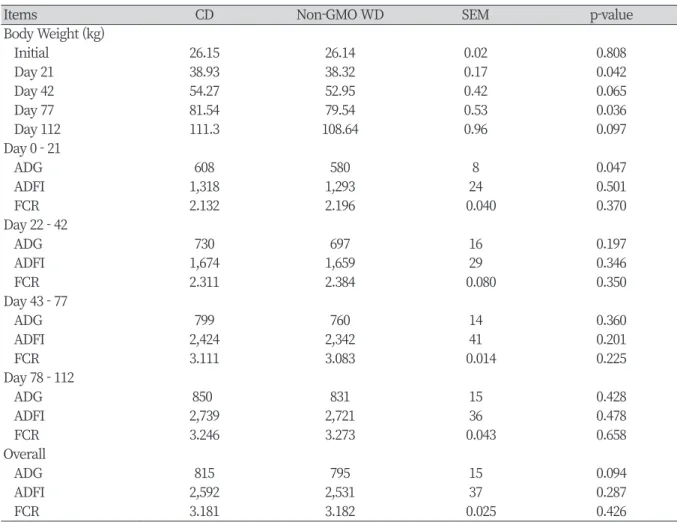
× Duroc] growing pigs with an initial body weight of 26.15 ± 1.57 kg were used in a 112 day trial. The dietary treatments were as follows: (I) CD, corn-based diet and (II) non-GMO WD, a non-genetically modified organism wheat-based diet. Each treatment consisted of 7 replicate pens with 5 pigs per pen. In the current study, the pigs fed the corn-based diet had a higher body weight than the pigs fed the non-GMO wheat-based diet at day 21 and day 77 (p < 0.05).
There was a significant difference in the average daily gain (ADG) during the first 21 days (p
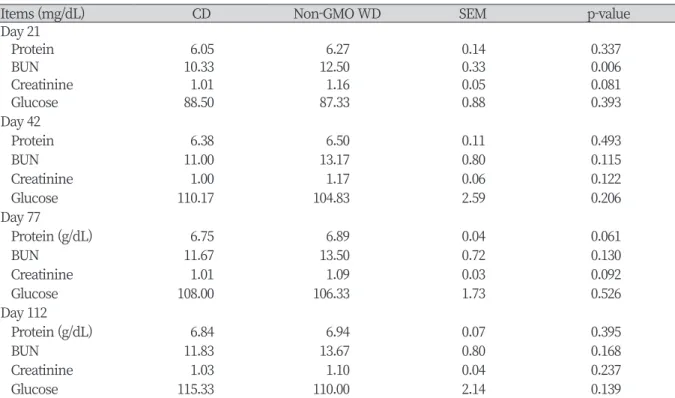
< 0.05). The non-GMO wheat-based diet had no effect on nutrient digestibility. In addition, the non-GMO wheat-based diet had no effect on the blood profile except for blood urea nitrogen (BUN) at d 21. In conclusion, the non-GMO wheat-based diet only had a slight effect on the growth performance of growing pigs but had no significant impact on the nutrient digestibility, fecal score, blood profile and meat quality of the pigs during the grower-finisher period.
Keywords: growing-finishing pigs, growth performance, non-genetically modified organism wheat
Introduction
With the continuous development of animal husbandry, the world pig production in the past few decades have risen to about 1.2 billion heads. Due to increased demand for corn, and changes in the price of corn on the international market, alternative low cost feed ingredient such as wheat is being researched as a source of energy as well as other nutrients to replace certain amount of corn in the diet.
Wheat is one of the most important agricultural products in the world and produced in OPEN ACCESS
Accepted: July 08, 2019 Revised: July 03, 2019 Received: July 18, 2018 Citation: Wang H, Kim DW, Yoo JS, Kim IH. 2019. Effects of non-genetically modified organism wheat-based diets on growth performance, nutrient digestibility, blood profile, and meat quality in grower-finisher pigs. Korean Journal of Agricultural Science 46:705-713. https://
doi.org/10.7744/kjoas.20190037
many parts of the world (Carré et al., 2007). Due to wheat, generally lower cost per megajoule of digestible energy and its relatively high protein content in comparison to other grains, more attentions have been paid to the wheat. It has a feeding value of approximately 92% of corn for pigs (Hancock et al., 1993). Like most other vegetable feed ingredients, it is not a good source of P because most of its P is bound to phytic acid (PA), which is poorly digested by pigs (Bedford, 2000). Moreover, the higher content of non-starch polysaccharides (NSP) in wheat affects the digestion and absorption of wheat nutrients (Woyengo and Nyachoti, 2011). There have been some studies investigating enzyme supplementation and particle size of wheat in diets of pigs (Mavromichalis et al., 2000). As genetically modified (GM) crops pose a potential environmental, ecological, and human risk, many countries that use wheat as their main staple have opposed to the promotion of GM wheat (Quist and Chapela, 2001; Hanson et al., 2005).
The objective of the experiments reported herein was to investigate the effect of non-GMO wheat-based diet on growth performance, nutrient digestibility, blood profile, and meat quality in grower-finisher pigs.
Materials and Methods
The experimental protocols describing the management and care of animals was reviewed and approved by the Animal Care and Use Committee of Dankook University, South Korea.
Experimental design, animals, and diets
A total of 70 growing pigs [(Landrace × Yorkshire) × Duroc; 26.15 ± 1.57 kg] were used in a 112 days trial to evaluate the growth performance, nutrient digestibility, fecal score, blood profile and meat quality. Dietary treatments included: CD, corn-based diet; non-GMO WD, non-genetically modified organism wheat-based diet.
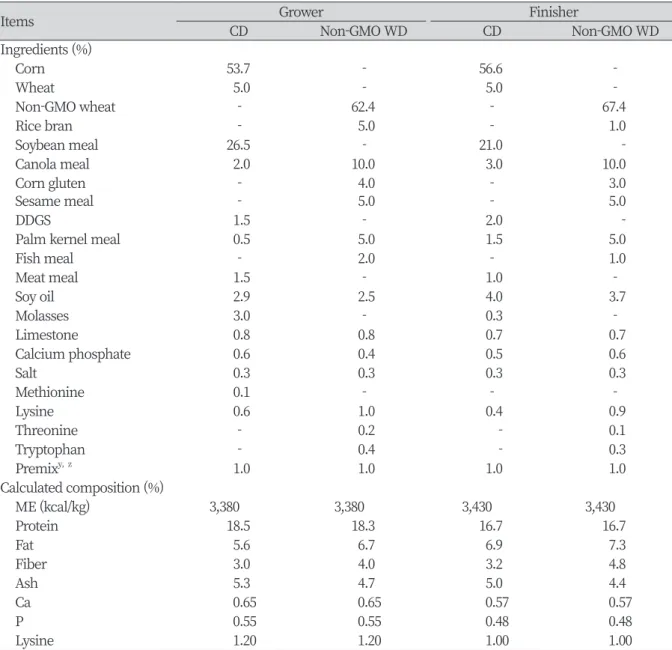
Each treatment consisted of 7 replicate pens with 5 pigs per pen. The diets were formulated to meet or exceed NRC (2012) recommendations for all nutrients (Table 1). Pigs were housed in an environmentally controlled facility with slatted plastic flooring and a mechanical ventilation system. Each pen was equipped with a single face self-feeder and a nipple drinker to allow the pigs ad libitum access to feed and water throughout the experimental period.
Sampling and measurements
The live body weight (BW) of each individual pig was measured at the beginning and end (112 days) of the experimental period. Feed consumption was also recorded and gain/feed ratio was calculated on a pen basis.
Individual pig �s BW was checked at the d 21, 42, 77, and 112, and the feed consumption was recorded per pen during the experiment to calculate the average daily gain (ADG), average daily feed intake (ADFI), and gain/
feed (F/G) ratio.
During d 21 to 27, d 42 to 48 and d 112 to 118, chromium oxide (Cr
2O
3) was added to the diets as an
indigestible marker at 0.20% of the diet to measure digestibility. Fresh fecal grab samples were obtained from at
least two pigs in each pen at d 27, 48, and 118 to determine the apparent total tract digestibility (ATTD) of dry
matter (DM), nitrogen (N) and gross energy (GE). All fecal and feed samples were stored at - 20 ℃ until analysis.
Prior to chemical analysis, the fecal samples were thawed and dried for 72 h at 60 ℃, after which they were ground to pass through a 1 mm screen. The feed and fecal samples were analyzed for DM, N, and GE according to AOAC (2000). Chromium was analyzed by UV absorption spectrophotometry (Shimadzu, UV-1201, Kyoto, Japan) following the method described by Yin and Kim (2019).
Table 1. Composition of the experimental growing-finishing pig diets (as-fed basis).
Items Grower Finisher
CD Non-GMO WD CD Non-GMO WD
Ingredients (%)
Corn 53.7 - 56.6 -
Wheat 5.0 - 5.0 -
Non-GMO wheat - 62.4 - 67.4
Rice bran - 5.0 - 1.0
Soybean meal 26.5 - 21.0 -
Canola meal 2.0 10.0 3.0 10.0
Corn gluten - 4.0 - 3.0
Sesame meal - 5.0 - 5.0
DDGS 1.5 - 2.0 -
Palm kernel meal 0.5 5.0 1.5 5.0
Fish meal - 2.0 - 1.0
Meat meal 1.5 - 1.0 -
Soy oil 2.9 2.5 4.0 3.7
Molasses 3.0 - 0.3 -
Limestone 0.8 0.8 0.7 0.7
Calcium phosphate 0.6 0.4 0.5 0.6
Salt 0.3 0.3 0.3 0.3
Methionine 0.1 - - -
Lysine 0.6 1.0 0.4 0.9
Threonine - 0.2 - 0.1
Tryptophan - 0.4 - 0.3
Premix
y, z1.0 1.0 1.0 1.0
Calculated composition (%)
ME (kcal/kg) 3,380 3,380 3,430 3,430
Protein 18.5 18.3 16.7 16.7
Fat 5.6 6.7 6.9 7.3
Fiber 3.0 4.0 3.2 4.8
Ash 5.3 4.7 5.0 4.4
Ca 0.65 0.65 0.57 0.57
P 0.55 0.55 0.48 0.48
Lysine 1.20 1.20 1.00 1.00
CD, corn-based diet; Non-GMO WD, non-genetic ally modified organism wheat-based diet; DDGS, dried distillers grains with solubles; ME, metabolic energy.
y
Provided per kilogram of complete diet: vitamin A, 10,000 IU; vitamin D3, 2,000 IU; vitamin E, 48 IU; vitamin K3, 1.5 mg; riboflavin, 6 mg; niacin, 40 mg; d-pantothen ic, 17 mg; biotin, 0.2 mg; folic acid, 2 mg; choline, 166 mg;
vitamin B6, 2 mg; and vitamin B12, 28 µg.
z