This is an Open Access article distributed under the terms of the Creative Commons Attribution Non-Commercial License (http: //creativecommons.org/licenses/by- nc/4.0/) which permits unrestricted non-commercial Copyright: © 2020 Korean Journal of Agrcultural Science
ANIMAL
Growth performance and nutrient
digestibility of grower and finisher pigs fed diets containing non-genetically modified soybean meal
Hyunjin Kyoung
1,†, Sangwoo Park
1,†, Jeong Jae Lee
1,†, Joowon Kang
1, Seong-Ki Kim
1, Jeehwan Choe
2,*, Minho Song
1,*1
Division of Animal and Dairy Science, Chungnam National University, Daejeon 34134, Korea
2
Department of Beef Science, Korea National College of Agriculture and Fisheries, Jeonju 54874, Korea
†
These authors equally contributed to this work.
*
Corresponding authors: [email protected], [email protected]
Abstract
This study assessed the effects of a dietary non-genetically modified organism (non-GMO) source on growth performance and nutrient digestibility of grower-finisher pigs. The dietary treatments were 1) rice-soybean meal-based control diet and 2) rice and non-GMO soybean meal-based diet. In the experiment 1, 60 growing pigs (initial body weight [BW] = 23.76 ± 3.42 kg) were randomly assigned to 1 of 2 dietary treatments with 6 pigs·pen
-1(5 replications) for 6 weeks. In experiment 2, 48 finishing pigs (initial BW = 64.31 ± 6.17 kg) were randomly assigned to 1 of 2 treatment groups with 4 pigs·pen
-1(6 replications) for 6 weeks. Measurements were the average daily gain (ADG), average daily feed intake (ADFI), gain-to-feed ratio (G : F), and nutrient digestibility. The growth performance was measured at the beginning and end of each period. The apparent total tract digestibility (ATTD) was determined by chromium oxide as an indigestible marker during the last 7 days of each experiment. During the grower period, pigs fed the diet containing the non-GMO soybean meal had a higher (p < 0.05) ADFI than those fed the control diet; however, there were no differences between the dietary treatments in the ADG, G : F, and ATTD. Moreover, the dietary treatments did not affect the ATTD and growth performance of the finishing pigs. In conclusion, the inclusion of non-GMO soybean meal in the diet had no negative effects on the growth rate and nutrient digestibility, indicating that non-GMO soybean meal can be used in diet formulations with other feed ingredients and be a substitute for conventional soybean meal.
Keywords: feed efficiency, grower-finisher pigs, non-genetically modified organism, nutrient digestibility
OPEN ACCESS
Accepted: March 10, 2020 Revised: March 03, 2020 Received: February 13, 2020 Citation: Kyoung H, Park S, Lee JJ, Kang J, Kim SK, Choe J, Song M. 2020. Growth performance and nutrient digestibility of grower and finisher pigs fed diets containing non-genetically modified soybean meal. Korean Journal of Agricultural Science 47:229-237. https://
doi.org/10.7744/kjoas.20200013
Introduction
Over the past few decades, numerous studies have been conducted by nutritionists and other professionals to identify strategies for feeding or management to increase production efficiency and profitability, which is consistent with the ultimate goal of the livestock industry (Hollis and Curtis, 2001; Kil and Stein, 2010; Kil et al., 2013). This has facilitated stable performance and efficient pig production (Hollis and Curtis, 2001; Park et al., 2016). However, since the prices of conventional feed ingredients are affected by various factors, feed costs, which account for a large proportion of pig production, still remain an inevitable problem (Noblet et al., 1994; Suh and Moss, 2017; Li et al., 2018). For this reason, many studies have been conducted to reduce feed costs such as feed processing or pretreatment, evaluation of alternative feed ingredients, and using feed additives (Adeola and Cowieson, 2011; Woyengo et al., 2014; Kim et al., 2015; Stein et al., 2016). Using cost-effective alternative feed, without extra cost, is one way to reduce the production costs, depending on the circumstances (Che et al., 2012;
Woyengo et al., 2014; Stein et al., 2016). Rice, the staple crop in South and Southeast Asia or the Far East, is a good substitute for traditional energy sources in swine diets such as corn because it contains more starch and less fiber, compared to other grains (Khalique et al., 2005; Kim et al., 2007). Also, rice has been reported to be more digestible than corn because of its relatively low resistant starch content compared to other cereal grains (Vicente et al., 2008; Cervantes-Pahm et al., 2014).
Soybean meal is a commonly used protein source in swine diets and is a good source of amino acids; therefore, it accounts for most of the feed costs along with corn (Friedman and Brandon, 2001; Valencia et al., 2008; Zheng et al., 2014). Soybean is used not only for livestock feed but also for human food; therefore, it is one of the most common genetically modified crops (He et al., 2016; de Santis et al., 2018; de Vos and Swanenburg, 2018).
Genetically modified organisms (GMOs) have been used to overcome limits of plants or resources, and maximize their strengths to increase profit and efficiency (i.e., productivity) of agriculture (Flachowsky et al., 2005; EFSA, 2008; Domingo, 2016; Zhang et al., 2016). However, there are ongoing debates about the potential risks of GMOs for humans, animals, and the environment (Domingo, 2016; Zhang et al., 2016; Tsatsakis et al., 2017; de Santis et al., 2018).
The objectives of this study were to evaluate the effects of a non-GMO source on the growth performance and nutrient digestibility of grower and finisher pigs and to compare the performance and digestibility between pigs fed a control diet based on rice and soybean meal and pigs fed a rice and non-GMO soybean meal-based diet.
Materials and Methods
The Institutional Animal Care and Use Committee of Chungnam National University approved all experimental
protocols used in this study. Two experiments were conducted at the Animal Research Center of Chungnam
National University.
Experimental animals, diets, and design
Two experiments were conducted to evaluate the effects of non-GMO source on growth performance and nutrient digestibility of grower-finisher pigs. In experiment 1, 60 growing pigs (Duroc × [Landrace × Yorkshire]) with average initial body weight (BW) of 23.76 ± 3.42 kg were used for 6 weeks. Pigs were randomly assigned to 1 of 2 treatment groups with 6 pigs per pen (5 replicated pens·treatment
-1) in a completely randomized design. The dietary treatments were 1) control diet based on rice and soybean meal (GMO) and 2) experimental diet based on rice and non-genetically modified soybean meal (NGMO). In experiment 2, 48 finishing pigs (Duroc × [Landrace
× Yorkshire]; 64.31 ± 6.17 kg of average BW) were used in this experiment. Pigs were randomly assigned to 1 of 2 treatment groups (4 pigs·pen
-1; 6 replication) in a completely randomized design. The dietary treatments were the same as those described in experiment 1: 1) control diet based on rice and soybean meal (GMO) and 2) experimental diet based on rice and non-genetically modified soybean meal (NGMO). The experiment lasted for 6 weeks.
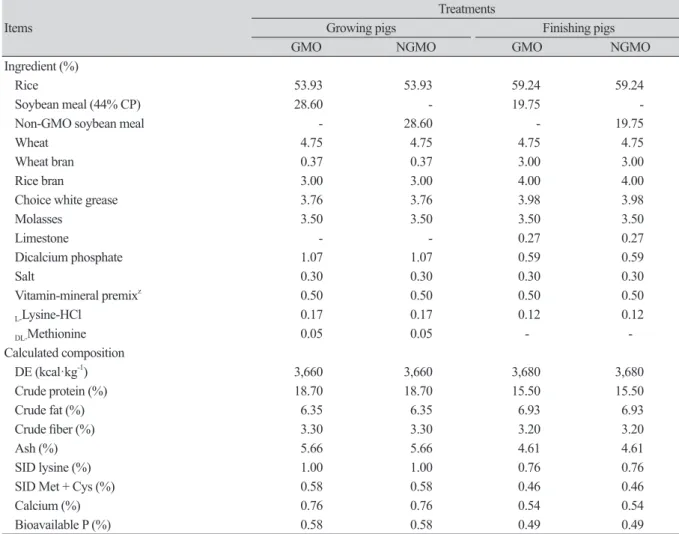
In the present study, diets for grower and finisher pigs were formulated to meet or exceed the NRC (2012) estimates of nutrient requirements, and the diets were formulated to have the same nutritional value for each experimental period (Table 1); all diets were provided in a meal form. Pigs were housed in an environmentally controlled room and each pen was equipped with a feeder and waterer, respectively.
Measurements, sample collection, and analysis
The growing and finishing pigs were weighed at the start and end of each experimental stage, and their weights were recorded at each time. Provided feed amount was weighed and recorded throughout the growing and finishing period and those remains were weighed at the end of each study. At the conclusion of each trial, average daily gain (ADG), average daily feed intake (ADFI), and the ratio between ADG and ADFI (gain-to-feed ratio; G : F) for each pen were summarized and calculated within treatment. The apparent total tract digestibility (ATTD) of nutrient was determined by chromium oxide (Cr
2O
3) as an index compound; all pigs were fed respective dietary treatments containing 0.25% Cr
2O
3for last week of each experimental period. After the adjustment period for 4 days, one pig from each pen was selected at random to collect the fecal sample, and the fecal sample was collected by rectal palpation for the last 3 days of each period. Diet and fecal samples from each experiment were pooled and stored at - 20℃ for later analysis of ATTD.
All of the samples were dried in a forced-air drying oven at 60 ℃ and ground through a cyclone mill (Foss
Tecator Sycltec 1093, HillerØd, Denmark) before analysis. All samples were analyzed for dry matter and crude
protein according to the procedures described by the Association of Official Analytical Chemists (AOAC, 2007),
and for gross energy using a bomb calorimeter (Parr 1281 Bomb Calorimeter, Parr Instrument Co., Moline,
USA), using benzoic acid as a calibration standard. The chromium content in the samples was measured using an
absorption spectrophotometer (Hitachi Z-5000 Absorption Spectrophotometer, Hitachi High-Technologies Co.,
Tokyo, Japan) based on the report by Williams et al. (1962) and ATTD was determined based on the index method
(Adeola, 2001).
Statistical analysis
In this study, data were analyzed using the General Linear Models procedure of SAS (SAS Institute Inc., Cary, USA) in a completely randomized design. Pig was the experimental unit. The statistical model for growth performance and nutrient digestibility included effects of dietary treatments as the fixed effect. Results are given as mean values ± standard error of the mean. Statistical significance and tendency were considered at p < 0.05 and 0.05 ≤ p < 0.10, respectively.
Table 1. Ingredient and calculated compositions of diets for growing and finishing pigs (as-fed basis).
Items
Treatments
Growing pigs Finishing pigs
GMO NGMO GMO NGMO
Ingredient (%)
Rice 53.93 53.93 59.24 59.24
Soybean meal (44% CP) 28.60 - 19.75 -
Non-GMO soybean meal - 28.60 - 19.75
Wheat 4.75 4.75 4.75 4.75
Wheat bran 0.37 0.37 3.00 3.00
Rice bran 3.00 3.00 4.00 4.00
Choice white grease 3.76 3.76 3.98 3.98
Molasses 3.50 3.50 3.50 3.50
Limestone - - 0.27 0.27
Dicalcium phosphate 1.07 1.07 0.59 0.59
Salt 0.30 0.30 0.30 0.30
Vitamin-mineral premix
z0.50 0.50 0.50 0.50
L-
Lysine-HCl 0.17 0.17 0.12 0.12
DL-
Methionine 0.05 0.05 - -
Calculated composition
DE (kcal·kg
-1) 3,660 3,660 3,680 3,680
Crude protein (%) 18.70 18.70 15.50 15.50
Crude fat (%) 6.35 6.35 6.93 6.93
Crude fiber (%) 3.30 3.30 3.20 3.20
Ash (%) 5.66 5.66 4.61 4.61
SID lysine (%) 1.00 1.00 0.76 0.76
SID Met + Cys (%) 0.58 0.58 0.46 0.46
Calcium (%) 0.76 0.76 0.54 0.54
Bioavailable P (%) 0.58 0.58 0.49 0.49
GMO, control diet based on rice and soybean meal; NGMO, rice and non-genetically modified soybean meal-based diet;
DE, digestible energy; SID, standardized ileal digestibility; Met + Cys, methionine + cysteine; Bioavailable P, Bioavailable phosphorus.
z