This is an Open Access article distributed under the terms of the Creative Commons Attribution Non-Commercial License (http: //creativecommons.org/licenses/by- nc/4.0/) which permits unrestricted non-commercial use, distribution, and reproduction in any medium, provided the original work is properly cited.
Copyright: © 2018 Korean Journal of Agrcultural Science
https://doi.org/10.7744/kjoas.20180064
ANIMAL
Effects of restricted feeding with fermented whole-crop barley and wheat on the growth performance, nutrient digestibility, blood characteristic, and fecal microbiota in finishing pigs
Chang Hee Lee
1, Hyeun Bum Kim
2,†, Jung Hyun Ahn
3,†, Hyun Jung Jung
4,†, Won Yun
1, Ji Hwan Lee
1, Woo Gi Kwak
1, Han Jin Oh
1, Shu Dong Liu
1, Ji Seon An
1, Tae Hwa Song
5, Tae Il Park
5, Doo Wan Kim
4, Dong Jo Yu
6, Min Ho Song
7*, Jin Ho Cho
1,*
1
Division of Food and Animal Sciences, Chungbuk National University, Cheongju 28644, Korea
2
Department of Animal Resources and Science, Dankook University, Cheonan 31116, Korea
3
National Institute of Horticultural & Herbal Science, RDA, Wanju 55365, Korea
4
Swine Division, National Institute of Animal Science, RDA, Cheonan 31000, Korea
5
National Institute of Crop Science, Wanju 55365, Korea
6
Planning & Coordination Division, National Institute of Animal Science, RDA, Wanju 55365, Korea
7
Department of Animal Science and Biotechnology, Chungnam National University, Daejeon 34134, Korea
*
Corresponding author: [email protected], [email protected]
†
These authors contributed equally to this work.
Abstract
A total of 80 pigs [(Landrace × Yorkshire) × Duroc] with an average body weight of 72.9
± 2.6 kg were used in the present study to investigate the effects of fermented whole crop wheat and barley with or without supplementing inoculums throughout the restricted feeding in finishing pigs. There were 4 replicate pens per treatment. Pigs were fed ad libitum throughout the experiment as the control (CON), and the other four groups were restricted to 10% in the CON diet and fed ad libitum fermented whole crop cereals: fermented whole crop barley with inoculums; fermented whole crop barley without inoculums; fermented whole crop wheat with inoculums; and fermented whole crop wheat without inoculums. During the entire experiment, the average daily feed intake (ADFI) decreased in the fermented barley and fermented wheat groups compared to the CON, while no difference was observed in the average daily gain (ADG), feed efficiency (gain : feed ratio, G : F) between the control and fermented whole crop barley, wheat diet group. Dry matter and nitrogen digestibility did not show a significant difference among the treatments. In the blood constituents, concentrations of blood urea nitrogen were significantly lower in pigs fed fermented whole crop barley without inoculum diets compared with the other treatments. In conclusion, restricted feeding with fermented whole crop barley and wheat regardless of the supplementing inoculums showed no significant difference in growth performance compared to the CON. This suggests that there is a possibility that fermented whole crop barley and wheat could replace part of the conventional diets.
OPEN ACCESS
Accepted: September 5, 2018 Revised: August 10, 2018 Received: June 20, 2018 DOI:
Citation: CH Lee, HB Kim, JH Ahn, HJ Jung, W Yun, JH Lee, WG Kwak, HJ Oh, SD Liu, JS An, TH Song, TI Park, DW Kim, DJ Yu, MH Song, JiH Cho.
2018. Effects of restricted feeding with fermented whole-crop barley and wheat on the growth performance, nutrient digestibility, blood characteristic, and fecal microbiota in finishing pigs. Korean Journal of Agricultural Science. https://
doi.org/10.7744/kjoas.20180064
Keywords: alternative feed, dietary fiber, feed intake, swine, whole crop silage
Introduction
Barley and wheat are commonly produced in winter idle in Korea , higher in yield than other forage crops ( Lee et al ., 2016 ).
They are also the most common crops grown in the world after corn and rice . As the price of corn varies with global climate , the Korean market is interested in using relatively low - priced barley and wheat as alternative energy sources for conventional feeds that use corn as a raw material : The market price of imported corn in 2012 was 316 won · kg
-1, while the price of domestic silage forage was 145 won · kg
-1.
Interest in the study of fermentation feeds as an alternative to the use of antibiotic growth promoters has been increased by the ban of antibiotics as feed additives to promote animal growth for pigs ( Missotten et al ., 2015 ). Fermentation of feeds can reduce antinutritional factors such as b - glucan , a dietary essential nutrient , and has a probiotics effect that can have beneficial effects on microorganisms in the gastrointestinal tract ( Urlings et al ., 1993 ; van Winsen et al ., 2001 ; Skrede et al ., 2003 ). In addition , Inoculum in feeds ( probiotics ; Bacillus subtilis , Lactobacillus fermentum and Enterococcus faecium ) could reduce the number of intestinal enterobacteria and prevent diarrhea caused by E . coli ( Huang et al ., 2004 ; Guo et al ., 2006 ).
There is not enough information on the effect of substituting conventional feed for fermented whole crop cereals . Therefore , the objective of the current study is to determine the effects of restricted feeding and fermented whole barley and wheat on growth performance , nutrient digestibility , blood constituents , and fecal microbiota in finishing pigs .
Material and Methods
The Animal Care and Use Committee of Chungbuk National University approved all the experimental protocols used in the current study .
Producing fermented whole crop wheat and barley with inoculum
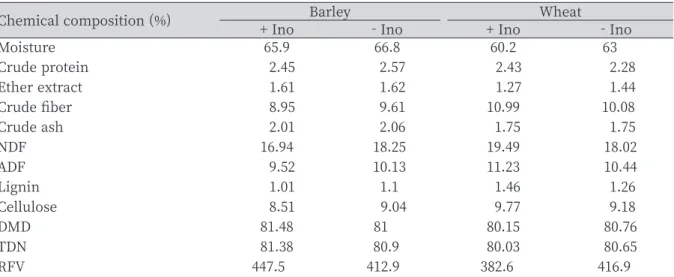
Barley ‘ Seassal ’ and wheat ‘ Gumgang ’ developed by the National Institute of Crop Science were used . Barley and wheat were harvested respectively at 35 and 40 days after heading when Total digestible nutrition ( TDN ) and dry matter ( DM ) contents were high ( Song et al ., 2017 ). They were ground in a hammer mill to pass under 5 - mm screen . After grounding , the inoculum was diluted 100 times in the groundwater and sprayed evenly to the material using an atomizer . The barley and wheat were sealed with 5 kg of the vacuum plastic pack having a capacity of 10 L . The chemical composition of the silage used in the test was measured by Lee et al . ( 2016 ). The inoculated microorganisms used as fermentation additives were lactobacillus sp 3 - 1 , 5 - 1 , 14 - 1 , similar to L . plantarum , and the isolates were rice straw silage ( Lee et al ., 2017a ).
Experimental design, animals, housing and diets
A total of 80 finishing pigs [( Landrace × Yorkshire ) × Duroc ] with an average body weight of 72 . 9 ± 2 . 6 kg ) were used in a
4 - weeks experiment designed to evaluate the effects of fermented whole crop barley and wheat . Pigs were allocated to one of
five dietary treatments groups on the basis of initial body weight in accordance with a randomized complete block design . There
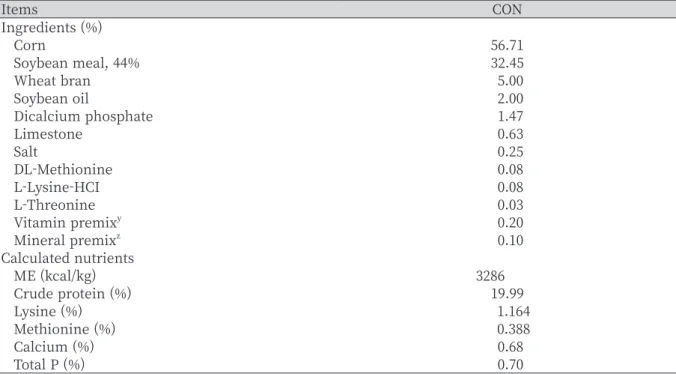
were four replications per treatment , with 4 pigs per pen ; Pigs were fed ad libitum throughout the experiment as the control ( CON ), and other four groups were restricted to 10 % in CON diet and fed ad libitum fermented whole crop cereals : fermented whole crop barley with inoculums ; fermented whole crop barley without inoculums ; fermented whole crop wheat with inoculums ; fermented whole crop wheat without inoculums . All pigs were housed in an environmentally controlled facility with a straw floor and basal diets in mash form were formulated to meet or exceed the requirements suggested by the NRC ( 2012 ) nutrient requirements .
Sampling and measurements
Individual pigs weights were measured at the 0 , 14 , and 28 of the experiment period , feed intake was also recorded on a pen basis during the experiment to calculate average daily gain ( ADG ), average daily feed intake ( ADFI ), and gain : feed ratio ( G : F ).
To estimate the apparent total tract digestibility ( ATTD ), chromium oxide ( Cr
2O
3) was added to the diet at 0 . 20 % as an indigestible marker for 7 d prior to fecal collection at the 4th week . During the final 2 days of the study , fecal samples were then collected from pigs per pen via rectal massage . The fecal samples were pooled within pen and dried in a forced air - drying oven at 70 ℃ for 72 h , after which they were ground to finely pass through a 1 . 0 - mm screen .
The procedure utilized for the determination of DM measured by methods method 930 . 15 ( AOAC , 2006 ) and nitrogen ( N ) measured by methods 930 . 06 ( AOAC , 2006 ). Neutral detergent fiber ( NDF ) and acid detergent fiber ( ADF ) were determined using fiber bags and fiber analyzer equipment ( Fiber Analyzer , Ankom Technology , Macedon , NY , USA ) following an adaptation procedure of van Soest et al . ( 1991 ). Chromium concentrations were determined via automated spectrophotometry ( Shimadzu , UV - 1201 , Kyoto , Japan ) following the method described by Williams et al . ( 1962 ). The ATTD was calculated using the following formula : ATTD (%) = [ 1 – {( N
f× C
d)/( N
d× C
f)}] × 100 , where N
fis the nutrient concentration in feces (% DM ), N
dis the nutrient concentration in diet (% DM ), C
dis the chromium concentration in diet (% DM ), and C
fis the chromium concentration in feces (% DM ).
For the blood characteristics , a 5 - mL blood sample was collected by jugular vein puncture from pigs in each pen on last day
Table 1. Chemical composition and feed value of crushed whole crop silage of barley and wheat (Lee et al., 2016).
Chemical composition (%) Barley Wheat
+ Ino - Ino + Ino - Ino
Moisture 65.9 66.8 60.2 63
Crude protein 2.45 2.57 2.43 2.28
Ether extract 1.61 1.62 1.27 1.44
Crude fiber 8.95 9.61 10.99 10.08
Crude ash 2.01 2.06 1.75 1.75
NDF 16.94 18.25 19.49 18.02
ADF 9.52 10.13 11.23 10.44
Lignin 1.01 1.1 1.46 1.26
Cellulose 8.51 9.04 9.77 9.18
DMD 81.48 81 80.15 80.76
TDN 81.38 80.9 80.03 80.65
RFV 447.5 412.9 382.6 416.9
Ino, inoculums; NDF, Neutral detergent fiber; ADF, Acid detergent fiber; DMD, dry matter digestibility;
TDN, Total digestible nutrition; RFV, Relative feed value.
of experiment . Blood samples were collected into vacuum tubes containing no additives to obtain serum . After centrifugation ( 3000 × g for 15 min at 4 ℃ ), blood urea nitrogen ( BUN ), high - density lipoprotein ( HDL ), low - density lipoprotein ( LDL )- cholesterol , and glucose in the serum samples were determined by the automatic biochemistry analyzer ( HITACHI 747 , Tokyo , Japan ).
At the end of experiment , fecal samples were collected directly via massaging the rectum of pigs in each pen . Samples from each pen were pooled and placed on ice for transportation to the laboratory . 1 g of fresh sample from each pen was diluted with 9 mL of 10 g / L peptone broth ( Becton , Dickinson and Co ., Franklin Lakes , USA ) and homogenized . Viable counts of bacteria in the fecal samples were then conducted by plating serial 10 - fold dilutions ( in 1 % peptone solution ) onto MacConkey agar plates ( Difco Laboratories , Detroit , MI , USA ) and lactobacilli medium III agar plates ( Medium 638 , DSMZ , Braunschweig , Germany ) to isolate the E . coli and Lactobacillus , respectively . The lactobacilli medium III agar plates were then incubated for 48 h at 36 ℃ , the MacConkey agar plates were incubated for 24 h at 36 ℃ . The E . coli and Lactobacillus colonies were counted immediately after removal from the incubator . Colonies on each agar plate were counted using a colony counter and the results were expressed as a log of colony forming units per gram ( log10CFU / g ) according to the method of White et al . ( 2002 ).
Statistical analysis
In this study , all data were analyzed by ANOVA using the general linear model ( GLM ) procedure of SAS ( SAS , 2008 ), with the pen being defined as the experimental unit . Differences among treatments were determined with Duncan ’ s multiple range tests . The results were expressed as the least square means ± SE and the differences between treatments were considered statistically significant if p < 0 . 05 .
Table 2. Basal diet composition for experiment (as-fed basis).
Items CON
Ingredients (%)
Corn 56.71
Soybean meal, 44% 32.45
Wheat bran 5.00
Soybean oil 2.00
Dicalcium phosphate 1.47
Limestone 0.63
Salt 0.25
DL-Methionine 0.08
L-Lysine-HCI 0.08
L-Threonine 0.03
Vitamin premix
y0.20
Mineral premix
z0.10
Calculated nutrients
ME (kcal/kg) 3286
Crude protein (%) 19.99
Lysine (%) 1.164
Methionine (%) 0.388
Calcium (%) 0.68
Total P (%) 0.70
CON, control; ME, metabolizable energy.
y
Provided per kilogram of diet: 4,500 mg of vitamin A, 93.75 mg of vitamin D3, 37.5 mg of vitamin E, 2.55 mg of vitamin K3, 3 mg of thiamin, 7.5 mg of riboflavin, 4.5 mg of vitamin B6 24 μg of vitamin B12, 51 mg of niacin, 1.5 mg of folic acid, 0.2 mg of biotin, and 13.5 mg of pantothenic acid.
z
Provided per kilogram of diet: 37.5 mg of Zn, 37.5 mg of Mn, 37.5 mg of Fe, 3.75 mg of Cu, 0.83 mg of I,
62.5 mg of S, and 0.23 mg of Se.
Results
Growth performance
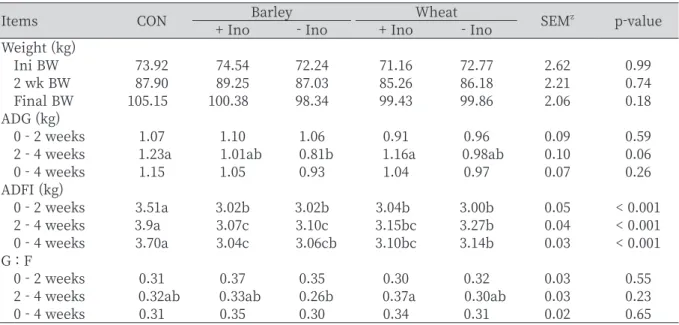
Growth performance of pigs fed experimental diets is presented in Table 3 . During the entire experiment , there were no significant differences in ADG and G : F between treatments . ADFI decreased in fermented whole crop barley and wheat diets compared to CON ( p < 0 . 05 ), regardless of inoculation . Pigs fed CON diets were significantly higher ADFI than other treatments .
Nutrient digestibility
In nutrient digestibility , there were no significant differences in DM and N digestibility . Similarly , there was no significant difference in NDF and ADF digestibility ( Table 4 ).
Blood constituents
Table 3. Effect of fermented whole crop barley and wheat diets on growth performance in finishing pigs.
Items CON + Ino Barley - Ino + Ino Wheat - Ino SEM
zp-value
Weight (kg)
Ini BW 73.92 74.54 72.24 71.16 72.77 2.62 0.99
2 wk BW 87.90 89.25 87.03 85.26 86.18 2.21 0.74
Final BW 105.15 100.38 98.34 99.43 99.86 2.06 0.18
ADG (kg)
0 - 2 weeks 1.07 1.10 1.06 0.91 0.96 0.09 0.59
2 - 4 weeks 1.23a 1.01ab 0.81b 1.16a 0.98ab 0.10 0.06
0 - 4 weeks 1.15 1.05 0.93 1.04 0.97 0.07 0.26
ADFI (kg)
0 - 2 weeks 3.51a 3.02b 3.02b 3.04b 3.00b 0.05 < 0.001
2 - 4 weeks 3.9a 3.07c 3.10c 3.15bc 3.27b 0.04 < 0.001
0 - 4 weeks 3.70a 3.04c 3.06cb 3.10bc 3.14b 0.03 < 0.001
G : F
0 - 2 weeks 0.31 0.37 0.35 0.30 0.32 0.03 0.55
2 - 4 weeks 0.32ab 0.33ab 0.26b 0.37a 0.30ab 0.03 0.23
0 - 4 weeks 0.31 0.35 0.30 0.34 0.31 0.02 0.65
CON, control; Ino, inoculums; Ini, initial; BW, body weight; ADG, average daily gain; ADFI, average daily feed intake; G : F, gain : feed ratio.
z
Standard error means (means are 4 replicates per treatment).
a - c: means in the same row with different superscripts differ (p < 0.05).
Table 4. Effect of fermented whole crop wheat and barley diets on nutrient digestibility in finishing pigs.
Items (%) CON + Ino Barley - Ino + Ino Wheat - Ino SEM
zp-value
DM 82.63 83.27 79.94 83.62 80.83 1.00 0.68
N 71.75 75.55 69.00 71.83 69.64 1.75 0.10
NDF 63.08 59.93 63.80 61.77 62.79 1.59 0.49
ADF 63.61 64.47 65.15 59.50 63.89 1.44 0.10
CON, control; Ino, inoculums; DM, dry matter; N, nitrogen; NDF, neutral detergent fiber; ADF, acid detergent fiber.
z
Standard error means (means are 4 replicates per treatment).
BUN in blood was significantly lower in pigs fed fermented whole crop barley without inoculums diets . Total cholesterol , HDL cholesterol , LDL cholesterol , and glucose were not significantly different ( Table 5 ).
Fecal microbiota
Fecal microbiota of pigs fed experimental diets is presented in Table 6 . The number of E . coli was lowest in fermented whole crop wheat without inoculums and the number of lactobacillus was significantly higher ( p < 0 . 05 ) in pigs fed fermented whole crop wheat with inoculums .
Discussion
In this study , the primary aim was to determine if feeding fermented whole crop cereals could replace conventional feed in the performance in pigs . In this study , fermented whole crop barley and wheat diets did not affect the growth performance throughout the experiment compared to CON . Whole crop silage contains not only grains but also leaves and stems and has the function of both forage and concentrated feed . Zanfi et al . ( 2014 ) reported that 30 % replacement of whole wheat bran and corn husks in whole feed corn silage did not affect growth in pigs , Jeong et al . ( 2017 ) reported that pigs fed fermented wheat bran did not have a negative effect on growth performance , and which is in line with our study . However , supplementing the diet with a fiber component can reduce the amount of nutrients available , which in turn reduces the growth rate of the animal ( Skiba et al ., 2005 ). Galassi et al . ( 2017 ) reported that when diets supplemented with whole plant maize silage were replaced by 20 %, the daily gain in body weight decreased . However , 2 % fermented apple diet significantly increased the growth of pigs compared to the control diet ( Lee et al ., 2009 ). In our study , ADFI was decreased in fermented whole crop silage treatments , Cho et al . ( 2007 ) reported a decrease in ADFI compared to the basal diet when corn was replaced with 1 . 16 % whole crop rye silage in the basal Table 5. Effect of fermented whole crop barley and wheat diets on blood constituents in finishing pigs.
Items (mL/dL) CON + Ino Barley - Ino + Ino Wheat - Ino SEM
zp-value
BUN 19a 16ab 10c 14bc 19a 1.42 0.01
Cholesterol 110 115 97 106 91 8.24 0.15
HDL/C 60 62 63 61 60 2.30 0.21
LDL/C 51 57 54 51 56 4.19 0.12
Glucose 58 64 62 66 64 6.93 0.90
Ino, inoculums; CON, control; BUN, blood urea nitrogen; HDL, high-density lipoprotein; LDF, low- density lipoprotein; C, Cholesterol.
z
Standard error means (means are 4 replicates per treatment).
a - c: Means in the same row with different superscripts differ (p < 0.05).
Table 6. Effect of fermented whole crop barely and whaet diets on fecal microbiota in finishing pigs.
Items (log10CFU/g) CON + Ino Barley - Ino + Ino Wheat - Ino SEM
zp-value
E. coli 5.44b 5.39b 6.3a 5.43b 4c 0.17 0.01
Lactobacillus 7.12b 7.27b 7.1b 7.89a 6.7c 0.17 0.01
CFU, colony forming units; CON, control; Ino, inoculums.
z