This is an Open Access article distributed under the terms of the Creative Commons Attribution Non-Commercial License (http: //creativecommons.org/licenses/by- nc/4.0/) which permits unrestricted non-commercial use, distribution, and reproduction in any medium, provided the original work is properly cited.
Copyright: © 2019 Korean Journal of Agricultural Science
https://doi.org/10.7744/kjoas.20190032
ANIMAL
Effects of γ-aminobutyric acid and
hydrochloric acid on growth performance, nutrient digestibility and fecal score of growing pigs
Zhenyu Ding, Inho Kim
*Department of Animal Resource and Science, Dankook University, Cheonan 31116, Korea
*Corresponding author: [email protected]
Abstract
A study was conducted to determine the effects of feeding γ-aminobutyric acid (GABA) and hydrochloric acid (HCl) on the growth performance, nutrient digestibility and fecal score in growing pigs. Ninety Duroc × (Landrace × Large Yorkshire) growing pigs with an average initial body weight (BW) of 25.51 ± 1.63 kg were randomly allotted to three treatment groups with 6 replications of 5 pigs per replicate pen for each treatment in a 6-week trial period. The treatments were as follows: 1) basal diet (CON); 2) basal diet with 0.05% GABA and 3) basal diet with 1% of a 10% HCl solution. The results showed that GABA supplementation significantly increased the average daily gain (ADG) (p < 0.05) compared with the control during week 4 and the overall experiment period (0 to 6 weeks). However, HCl supplementation had a numerical increase in the ADG compared with the control. The total tract digestibility of dry matter (DM) was greater in GABA group than the CON (p < 0.05).
The supplementation of GABA and HCl in the diet of growing pigs had no significant effect on the fecal scores compared with the CON. Experimental results show that supplementation of 0.05% GABA in the diet of growing pigs had a positive effect on the ADG and DM digestibility in growing pigs.
Keywords: growing pigs, growth performance, hydrochloric acid, γ-aminobutyric acid
Introduction
In animal production, reducing the stress of animals is one of the points that cannot be ignored in improving production performance. Stress represents the reaction of the body to stimuli that disturb its normal physiological equilibrium or homeostasis, often with detrimental effects (Khansari et al., 1990). Stress is caused due to temperature variation (cold and overheating), weaning, transfer, castration, docking, vaccination, drugs; the stress of feed nutrition; the stress of stocking density (Kelley, 1980). Stress response causes OPEN ACCESS
Accepted: June 24, 2019 Revised: May 21, 2019 Received: March 06, 2019 DOI:
Citation: Ding Z, Kim I. 2019. Effects of γ-aminobutyric acid and hydrochloric acid on growth performance, nutrient digestibility and fecal score of growing pigs. Korean Journal of Agricultural Science. https://doi.org/10.7744/
kjoas.20190032
obstruction of animal growth and loss of appetite which have serious impact on animal production. According to Erdö (1985) and Bongianni et al. (2006) studies, γ-aminobutyric acid (GABA) has the physiological functions of sedation, hypnosis, anti-convulsion, lowering blood pressure, regulating respiration and anti-stress and one of the major inhibitory neurotransmitters in the central nervous system. Abdou et al. (2006) reported for humans, GABA not only relaxes but also reduces anxiety. Moreover, GABA administration is able to enhance immunity under stress conditions. Data from animal studies suggested that decreased GABA levels in the brain are associated with anxiety-like behavior (Dalvi and Rodgers, 2001; Shekhar et al., 2006). Dai et al. (2011) reported the diet supplemented with GABA increased weight gain and feed consumption by 11.7 and 9.0% in broilers.
Wang et al. (2013) suggested that GABA exhibits its functions by lowering heat production, relieving fever, sedation and better for growth in dairy cows.
The growth of animals needs to be carried out by feeding fodder, and the digestion and metabolism of fodder are carried out by the digestive system. The functions of the stomach include feed mixing, digestion of some feed and form a barrier with the outside environment (Barrow et al., 1977; Zhang and Xu, 2003). For digestion, the stomach is endowed with hydrochloric acid (HCl) secreting cells that help to keep its pH low and forming an acid environment can kill pathogenic microorganisms (Lewis and Southern, 2000). Ravindran and Kornegay (1993) and Kil et al. (2005) reported that supplementation of hydrochloric acid to the feed can increase the nitrogen retention and improve the apparent digestibility of nitrogen, and can activate pepsin, promoting digestions. It is reported that an acid condition of less than pH 4.5 prevents the growth of many bacteria, prevent diarrhea in weaning pigs in an in-vitro study (Sissons, 1989). The hypothesis of this study is that GABA and HCl supplementation may reduce stress and improve performance of animals.
From the study of γ-aminobutyric acid and hydrochloric acid, there are many advantages, this test will further verify the growth, digestibility and fecal index of growing pigs, providing more valuable research.
Materials and methods
Animals and experimental diets
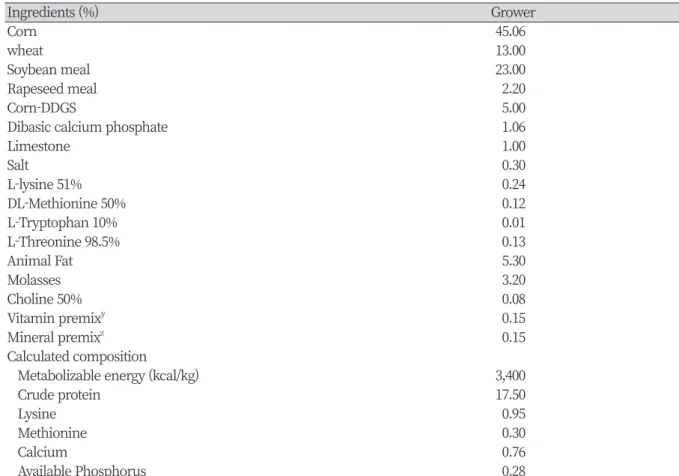
In total 90 pigs of Duroc × (Landrace × Yorkshire) were approved by the Animal Care and Use Committee of Dankook University, with an average 25.51 ± 1.63 kg were selected and randomly allotted to three treatment groups with 6 replications of 5 pig per replicate pen for each treatment. The experiment treatments were as follows: 1) control, basal diet (CON); 2) 0.05% γ-aminobutyric acid, basal diet with 0.05% GABA; 3) 1% HCl (10%), basal diet with 1% HCl (10%). The diets were based on the nutrient requirements recommended by NRC (2012) (Table 1). The γ-aminobutyric acid used in the current experiment was provided by a commercial company (Milae Resources ML Co., Ltd., Korea), and hydrochloric acid was obtained from (Duksan pure chemicals Co., Ltd., Korea)
Animal feeling and management
Pigs were raised in a pen equipped with a self-feeder and a nipple drinker in Dankook University (Cheonan, Korea) farm. The additives were directly added to the basal diet according to the experimental design. Pigs were housed in environmentally controlled rooms at 23 ± 1℃, each pen provided a self-feeder and nipple drinker.
Pigs were provided to consume feed and water ad libitum. The experiment was conducted for six weeks, with daily cleaning and immunization procedures.
Sampling and chemical analysis
The individual body weight (BW) of pigs and feed consumption from each pen were determined at the start, week 4 and week 6 of the experiment to calculate the average daily gain (ADG), average daily feed intake (ADFI), and gain : feed ratio (G/F). Chromium oxide (Cr
2O
3) was added to the diet at 0.2% of the diet as an indigestible marker for 7 days prior to fecal collection on weeks 6 to calculate dry matter (DM), nitrogen (N) and energy.
The fecal score was determined as the average value of five pigs of each pen using a 5-grade score system (Hu et al., 2012), with grade of 1 standing for hard, dry pellets in a small, hard mass, grade of 2 for hard formed stool
Table 1. Composition of the experimental diets (as-fed-basis).
Ingredients (%) Grower
Corn 45.06
wheat 13.00
Soybean meal 23.00
Rapeseed meal 2.20
Corn-DDGS 5.00
Dibasic calcium phosphate 1.06
Limestone 1.00
Salt 0.30
L-lysine 51% 0.24
DL-Methionine 50% 0.12
L-Tryptophan 10% 0.01
L-Threonine 98.5% 0.13
Animal Fat 5.30
Molasses 3.20
Choline 50% 0.08
Vitamin premix
y0.15
Mineral premix
z0.15
Calculated composition
Metabolizable energy (kcal/kg) 3,400
Crude protein 17.50
Lysine 0.95
Methionine 0.30
Calcium 0.76
Available Phosphorus 0.28
y
The vitamin and mineral premix supplied per 1 kg of the diet: 20,000 IU of vitamin A, 3,000 IU of vitamin D
3, 80 IU of vitamin E, 12 mg of vitamin K, 150 mg of vitamin C, 20 mg of riboflavin, 60 μg vitamin B
12, 50 mg of D-pantothenic acid, 60 mg of biotin, 80 mg of niacin, 2 mg of vitamin B
6.z
25 mg of Cu from CuSO
4·5H
2O, 250 mg Fe from FeSO
4·7H
2O, 70 mg of Mn from MnO
2, 58 mg of Zn from ZnSO
4, 0.2
mg of Se from Na
2SeO
3·5H
2O, 0.3 mg of Co from CoSO
4·7H
2O.
that remains firm and soft, grade of 3 for soft formed and moist stool that retains its shape, grade of 4 for soft unformed stool that assumes the shape of the container, and grade of 5 for watery liquid stool that can be poured.
Scores were recorded on a pen basis following the observations of individual pig and signs of stool consistency in each pen every week.
Data analysis
All data obtained in the current study were analyzed in accordance with a completely randomized block design using the GLM procedure of SAS (SAS Institute, 1996). Duncan's multiple range test was used to compare the means of the treatments. Variability in the data is expressed as the standard error (SE) and a probability level of p
< 0.05 was considered statistically significant.
Results
Growth performance
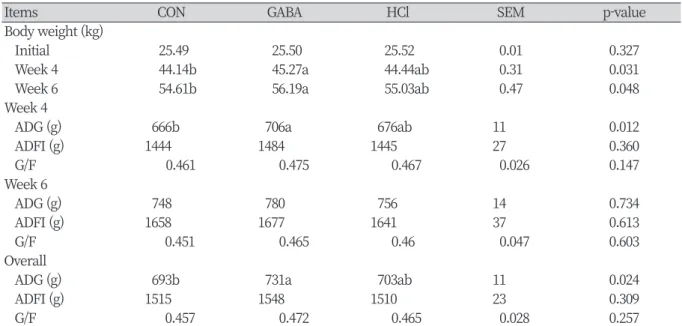
No piglets were found dead because of diseases or other reasons throughout the experiment. The effect of GABA or HCl supplementation on growth performance is presented in Table 2. The average daily gain of GABA was significantly higher than group CON (p < 0.05) during week 4 as well as during overall experimental period.
The ADG was numerically higher for pigs receiving HCl supplemented diet compared with control.
Nutrient digestibility
Table 2. The test for the role of pH on growth performance in growing pigs.
Items CON GABA HCl SEM p-value
Body weight (kg)
Initial 25.49 25.50 25.52 0.01 0.327
Week 4 44.14b 45.27a 44.44ab 0.31 0.031
Week 6 54.61b 56.19a 55.03ab 0.47 0.048
Week 4
ADG (g) 666b 706a 676ab 11 0.012
ADFI (g) 1444 1484 1445 27 0.360
G/F 0.461 0.475 0.467 0.026 0.147
Week 6
ADG (g) 748 780 756 14 0.734
ADFI (g) 1658 1677 1641 37 0.613
G/F 0.451 0.465 0.46 0.047 0.603
Overall
ADG (g) 693b 731a 703ab 11 0.024
ADFI (g) 1515 1548 1510 23 0.309
G/F 0.457 0.472 0.465 0.028 0.257
CON, The control; GABA, 0.05% γ-aminobutyric acid; HCl, 1% of a 10% hydrochloric acid; SEM, standard error of means; ADG, average daily gain; ADFI, average daily feed intake; G/F, gain/feed ratio.
a, b: Means in the same row with different superscript differ significantly (p < 0.05).
The effects of GABA and HCl on total tract nutrient digestibility is shown in Table 3. The apparent total digestive tract digestibility (ATTD) of DM was greater in GABA than CON (p < 0.05). However, the ATTD of nitrogen (N) and energy were unaffected with GABA supplementation as compared with control. The digestibility of DM with HCl supplementation was slightly higher than that of control group (p > 0.05).
Fecal score
The effect of GABA and HCl on fecal score is shown in Table 4. The supplementation of GABA and HCl in the diet of growing pig had no significant effect on fecal scores compared with CON.
Discussion
GABA has been widely used in the production of various animals. Adding GABA to the diet of ruminants, reduced rectal temperatures, increased milk production, and enhanced milk protein and lactose concentrations (Cheng et al., 2014). From Chen et al. (2015) study, adding GABA in Wen Chang chicken diet, increased BW, ADG, and FCR (feed conversion ratio). After the brain of rats was injected with GABA excitatory receptors, increased the amount of intake (Stratford and Kelley, 1999). GABA also promotes the secretion Table 3. The test for the role of pH on nutrient digestibility in growing pigs.
Items (%) CON GABA HCl SEM p-value
Week 6
Dry matter 75.39b 77.64a 76.45ab 0.61 0.023
Nitrogen 73.83 75.39 75.05 0.62 0.146
Energy 74.99 75.81 75.15 0.59 0.445
CON, The control; GABA, 0.05% γ-aminobutyric acid; HCl, 1% of a 10% hydrochloric acid; SEM, standard error of means.
a, b: Means in the same row with different superscript differ significantly (p < 0.05).
Table 4. The test for role of pH on fecal score in growing pigs.
Items (%) CON GABA HCl SEM p-value
Fecal score
zInitial 3.39 3.38 3.36 0.04 0.892
Week 2 3.34 3.36 3.30 0.03 0.547
Week 3 3.30 3.36 3.34 0.03 0.559
Week 4 3.23 3.29 3.29 0.04 0.608
Week 5 3.25 3.25 3.29 0.04 0.736
Finish 3.20 3.23 3.23 0.05 0.786
CON, The control; GABA, 0.05% γ-aminobutyric acid; HCl, 1% of a 10% hydrochloric acid; SEM, standard error of means.
z