Bacillus lentimorbus B-6 균주로부터 생산된 a-Glucosidase 억제제의 생물 유화제로서의 특성 115
methylnaphthalene을 비롯한 기타 실험에 사용된 시약돌은 Sigma-Aldrich사에서 구입하였으며, 흡광도측정은 Jasco V550 UV-visible spectrophotometer룰이용하였다.
생울계면 활성제 생산 균주 및 배양 조건
실험균주는전보오여서 a-glucosidase 억제제및 p-glucosidase 억제제롤생산하는것으로보고된Bacillus lentimorbus B-6(B-
6)균^ 시용하였으며 , 배양조건및배지조건도견보에서보고 된것과같은조건을시용하였다. B-6균을 PGI 배지 (polygalac- turonase inhibitor 생산배지: glucose 0.5%, sodium glutamate 0.25%, K2HPO4 • 3H2O 0.1%, MgSOi • 7H2O 0.05%, CUSO4 •
4H2O, M11SO4 • 4H2O, Z11SO4 • 4H2O 혼합액 0.0002%)에서 2~
3일간 30°C에서 배양한 상등 액을 동결 건조 후물에 녹여 Sephadex G-100 column chromatography률 2 번수행하여 a- glucosidase 억제활성이있는분획을모아다시동결건조하여증 류수에 녹여 투석막(celluluose dialysis tubing, Sigma, MW cut off- lOkDa)에넣고 100배부피의증류•수로 4T에서 18시간동안 증류수를2번교환시키면서투석히여유화활성시료로이용하였다.
유화 활성의 측정
유화활성의측정은 E. Rosenberg등■의방법2^>을변형하식 사 용하였다. 즉 0.01M MgSCV7H2 0률함유한 0.05 M Tris HCl buffer(pH 8.0) 7.0 m/에유화기질인 n-hexadecane과 2-methyl- naphthalene의1: l(v/v) 혼합액 0 . 1 m M 섞은후, 1 . 0 m/의시료 률첨가하고 2분간 vortexing하여 유화시킨 다옴 10분후 540 nm에서흡광도률측정하였다. control로는시료대신시료률녹 인용매를첨가하여 반응시킨후시료의 흡광도에서 control의 흡광도를뻔값을유화활성 값으로정하였다.
a-Glucosidase 억제제의 발색 반뭉
a-Glucosidase억제제의 구성성분의특성 분석을위하식여러 가지 발색 반응을 행하였다. phosphomolybdic acid(PMA), antdmonydn) chloride, dragendorffs reagent, bomtrager reagent, Ninhydrin, Ehrlich reagent, Bial's reagent, Rhodamine B reagent, ferric chloride를사용하여 발색 여부를조사하였다.
a-Glucosidase 억제제의 특성 조사
a-Glucosidase 억제제(a-GI)의특성을조사하기 위하식 200- 700nm까지 UV scanning을 실시하였으며 , ethyl acetate:
methanol( 2 :1), chloroform : methanol( 2 :1)을 전개 용매로 silica gel TLC률이용하^=1 Rf치룰조사하였다. 각종유기용매및 물에 대한용해도률조사하기 위하며부분 정제된 a-GI에각종 유기용매 및물을소량씩 첨가하식 300 rpm으로 5분간강하게 교반한후용해된정도를육안^ 확인하식 결정하였다.
a-Glucosidase 억제제의 유화 활성에 대한 엘안정성과 pH 안 정성
분리된 억제제를 100T에서 15분간가온한후 얼음에서 식힌 다음' 유화활성을측정하며 열안정성을조^}하였다. pH 안정성 은 NaOH 용액과 HC1 용액으로 pH를조정한 pH 3-11 까지의 물에 1% 농도로시료률녹여 4 T에서 15시간보관후중화시켜 유화 활성을측정하의조사하였다. 결과는 3번씩 실험하여 평균
±표준편차로나타내었다.
생물 유화제의 기질 특이성
a-Glucosidase 억제제(a-GI)의생물유화제로서의 기질 특이 성을 조사하기 위하여 kerosene, hexane, benzene, crude oil, toluene등을유화시키는정도를비교하였다. 시험관에기질 2 ml 을넣고동량의 a-GI(l% 용액)를 첨가하고 2분간 vortex 후 24 시간 정체시킨다옴유화된층의 높이률전체 액의높이로나누 어%로계산하여유화지수(emulsion index, E24)로비교하였다.
NaCl 농도에 따른 유화 지수의 변화
NaO을 0-32% 농도로첨가한 a-glucosidase 억제제(1% 용액) 2 m/과기질로 toluene 2 m/을 섞은후 2분간 vortex 푸 24시간 정체시킨 다옴유화된층의 높이를전체 액의높이로나누어 % 로유화 지수(E24)를 비교하여 NaCl 농도에 따른 번화를조사 하였다. 결과는 3번씩실험하여 평균±표준편차로나타내었다.
실험결과 및 고찰
a-Glucosidase 억제제의 유화 활성
a-Glucosidase 억제 활성과 p-glucosidase 억제 활성을 모두 가진 B- 6 균주 상등액을 동결 건조 후 견보^^써1서와 같이
Fig. 1 - Emulsifying activity of glucosidase inhibitor purified from Bacillus lentimorbus B-6 (B-6). A: p-glucosidase inhibitor purified from B-6; B: a-glucosidase inhibitor purified from B-6.
Sephadex 0-100 column chromatography•를 ^ 시초M a-gluco- sidase 억 제 활성 분획을 모아 동결 건조 후 cellulose 투석 막 (MW cut off, 10 kDa)으로 투석 후 p-glucosidase 억제 활성이 완전허 제거된 a-glucosidase 억제제를 유화 활성 죽정 시료로 사용하였다.
Fig. 1 에서 보는 바와 같이 B-6 균주 상등 액에서 분리한 a- glucosidase 억제제(oc-GI, B)와 p-glucosidase 억제제(p-GI, A)의 유화 활성을 비교한 결과, 견자(B)는 유화 활성을 가졌으나 후자 (A)는 전혀 없는 것으로 나타났다. a-Glucosidase 는 식이중의 탄수화물을 분해하식 포도당으로 견환시키는 효소이므로 이 효 소의 저해제는 탄수화물의 소화와 흡수률 지연시켜 식후 혈당증 가를 완화시킨다. a-GI는 인슐린 분비를 촉진시키며, 소장에서 글루카곤 분비룰 억제하는 glucagon-like peptide-1 의 분비률 촉 진하는 것으로 알려져 있다. 현재 acrbose, voglibose와 miglitol 등의 a-glucosidase 억제제가 시관되고 었으며, a-GI의 유화 활 성을 활용하면 당뇨병 치료제 개발의 일환으로 연구되고 있는 a-GI의 리포좀 제제 개발에도 도움이 될 것으로 사료된다. 리포 좀 형성으로 약물 방출이 지연되도록 하늬 약물의 효과를 오래 지속시킬 수 있을 것이다.
a-Glucosidase 억제제의 발색 반움
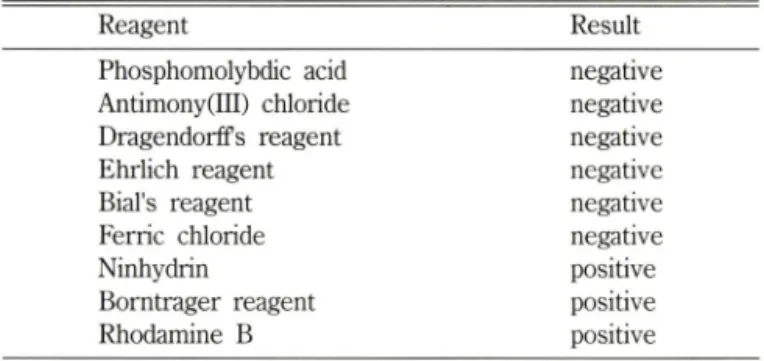
Table I에서 보는 바 와 같이 B-6 균으로부터 분리된 a- glucosidase 억제제(a-GI)의 발색 반응은 a-GI와 각각의 시약이 반응하여 나타나는 색을 육안 관찰로 조사한 결과, terpene류 와 반 응 하 는 phosphomolybdic acid(PMA)반 응 , diterpene, flavonoid와 반응하는 antimony(III) chloride 반응, alkaloid와 반 응하는 dragendorffs reagent 반응, indole과 반응하는 Ehrlich reagent 빈:응 , 당파 빈응하는 Bial's reagent 빈'i", 페놀성 화합물 파 hydroxamic acid와 반응하는 ferric chloride 반옹에 대해서는 옴성 반옹을 나타내었다. 그러나 아미노산, 아민류, 단백질과 반 응하는 ninhydrin 반응, 지방과 반응하는 rhodamine B 반응과 coumarin, anthraquinone^ 보h§*굵 bomtrager reagent^l 서는 양성 반응을 보였다. 유화 활성을 가진 a-GI의 발색 반응 결과
Table I - Visualization results of bioemulsifier purified from Bacillus
지방과 단백질로 이루어진 물질로 추정된다. 이와 유사한 발색 반 응을 하는 것 으 로 는 Bacillus subtilis피가 생산하 는 cyclic lipopeptide와 Bacillus amyloliquefaciens LP03이 생산하는 bamylocin lipopeptide계 생물 유화제로 보고되었다.
a-Glucosidase 억제제의 특성
a-Glucosidase 억제제의 최대 흡광도는 272 피고에서 나타났으며 silica gel TLC에서 ethyl acetate : methanol(2 :1)과 chloroform:
methanol(2 :1)을 견개 용매로 전개한 결과 각 Rf 처가 0.55와 0.89로 나타났다. 여러 가지 용매에 대한 용해도는 물, ethanol과 methanol에서는 용해되었으나 acetone, chloroform, ethyl acetate, hexane 등에서는 용해되지 않는 것으로 나타났다(Table II).
a-Glucosidase 억제제의 유화 활성의 기질 특이성
Table m 에서 보는 바와 같이 a-glucosidase억제제의 유화 활 성에 대한 여러 가지 기질들을 조사한 결과, Toluene이 가장 좋 은 기질로 나타났으며, w-Hexane이 가장 활성이 낮은 기질로 나
^ 났다.
a-Glucosidase 억제제의 생물 유회제로서의 열안정성과 pH 안 정성
a-Glucosidase 억제제(a-GI)의 생물 유화제로서의 열안정성을 Table II - Physico-chemical properties of bioemuisifier purified
from Bacillus lentimorbus B-6
Nature White powder
UV >jnax 272 nm
TLC Rf value* (A) 0.55, (B) 0.89 solubility:
Soluble: water, ethanol
methanol
Insoluble; hexane
acetone chloroform ethyl acetate
* Precoated silica gel plate (Merck) Developing solvent:
(A) ethyl acetate : methanol (2 : 1) (B) chloroform : methanol (2 : 1)
lentimorbus B-6 Table III - Substrate specificity of the bioemuisifier purified from
Reagent Result tsaciiius lentimowus b-t)
Phosphomolybdic acid negative Substrate Emulsion index E24
Antimony(III) chloride negative Crude oil 51
Dragendorffs reagent negative Kerosene 42
Ehrlich reagent negative Hexadecane 40
Bial's reagent negative ;i-Hexane 33
Ferric chloride negative w-Decane 45
Ninhydrin positive Cyclohexane 48
Bomtrager reagent positive Benzene 50
Rhodamine B positive Toluene 56
pH
Fig. 2 - pH stability of a-glucosidase inhibitor purified from Bacillus lentimorbus B-6. Results are means ±SD from 3 separate experiments.
염 농도에서 사용할 수 있는 생물유화제로 산업적 가처가 높을 것^ 사료된다. 이러한 결과는 5% 이상의 NaCl 농도에서는 유 화지수가 감소되는 Aeromoms spp.딱 !" 생산히는 유화제와는 다 른 것으로 추정된다.
결 론
Glucosidase 억제제률 생산하는 Bacillus lentimorbus B-6(B- 6)균주의 a-glucosidase 억제제(a-GI)와 P-glucosidase 억제제((3- GI)의 유화 활성을 조사한 결과, 전자는 유화 활성을 나타내었으 나 후자는 나타내지 않는 것으로 조사되었다. 유화 활성을 가지 는 a-GI는 sodium glutamate와 glucose를 함유한 최소배지에서 배 양 한 B-6균의 상등 액을 동결 건조 푸 Sephadex G-100 column chromatography를 이용하여 a-glucosidase 억제 휠성 분 획을 모아 물로 투석하여 p-glucosidase 억제 활성을 완전히 제 거 후 정제하였다. a-GI의 유화 활성에 대한 기질 특이성을 조 사한 결과, toluene이 가장 유화 지수가 높은 좋은 기질로 나타 났으 며, w-Hexane이 가장 유화 지수가 낮은 것으로 나타났 다 . a-GI의 열안정성을 조사한 결파 100°C에서 15분 가온한 후에도 유화 활성에 번화가 없어 열에 안정한 것으로 관단되었으며, pH 안정성은 pH 4~10까지 넓은 범위에서 안정된 것으로 나타났으 며 고농노(32%)의 NaCl 하에서도 유화 지수가 번화 없었다.
_|_ _|_
0 8 12 16 20 24 28 32
KaC i C o n c (X w / v )
Fig. 3 - Effect of NaCl concentration on the emulsion index of a- glucosidase inhibitor purified from Bacillus lentimorbus B- 6. Results are means ±SD from 3 separate experiments.
감사의 말씀
본 논문은 2008년도 농촌 진흥청의 수확 후 관리연구사업단의 연구비 지원에 의하여 연구되었으며 이에 감사•드럽니다.
참고문헌
조A]■하기 위하며 100T에서 15분간 가온한 후 얼음에서 식힌 다 옴 유화 활성을 측정하여 가온견의 활성파 비교한 결과, 약 95%
정도의 활성을 그대로 지니고 있는 것으로 열에 안정한 것으로 나타났다. pH 안정성을 조사하기 위하여 pH 3-11 까지의 물에 녹여 15시간 후 중화하^^ 유화 활성을 비교한 결과 pH 4~10까 지 넓은 범위의 pH에서 안정된 것으로 나타났다(Fig. 2). a-GI 는 높은 열 안정성과 넓은 범위의 pH에 안정한 물질로 산업적 응용에 유용한 물질로 활용도가 높을 것으로 사료된다.
NaCl 농도에 따른 유화 지수의 변화
NaCl 의 능 도 (0~32%)에 따른 a-glucosidase억 제 제 (a-GI)의 toluene에 대한 유화 지수를 비교한 결과 32% NaCl을 함유한 경우에도 거의 번화가 없었으며 , 그 보다 높은 농도에서는 NaCl 이 녹지 않아 유화 지수를 절 수가 없었다(Fig. 3). a-GI는 높은
1) Lang, S. : Biological amphiphiles (microbial biosurfactants).
Curr. Opin. Colloid. Interface. Sci. 7, 12 (2002).
2) Lang, S. : Surfactants produced by microorganisms. In: K.
Holmberg, Editor, Novel surfactants preparation, applications, and biodegradability, Dekker, New York, 279 (2003).
3) Makkar, R. S. and Cameotra, S. S. : An update on the use of unconventional substrates for biosurfactant production and their new applications. Appl. Microbiol Biotechnol 58, 428 (2002).
4) Rodrigues, L., Teixeira, J., Oliviera, R. and van der Mei, H .C. : Response surface optimization of the medium components for the production of biosurfactants by probiotic bacteria. Process.
Biochem. 41, 1 (2006).
5) Batista, S. B., Mounteer, A. H., Amorim, E R. and Totola, M. R. : Isolation and characterization of biosurfactant/
bioemulsifier-producing bacteria from petroleum contaminated Bacillus lentimorbus B-6 균주로부터 생산된 a-Glucosidase 억제제의 생물 유화제로서의 특성 117
SOT«
에
M2
c o
~
« s w
sites. Bioresour. Technol 97, 868 (2006).
6) Banat, I. M., Makkar, R. S. and Cameotra, S, S. : Potential commercial applications of microbial surfactants. AppL Microbiol. BiotechnoL 53, 495 (2000).
7) Cunha, C. D., do Rosario, M., Rosado, A. S. and Leite, S. G. E : Serratia sp. SVGG16; a promising biosurfactant producer isolated from tropical soil during growth with ethanol-blended gasoline. Process. Biochem. 39, 2277 (2004).
8) Doong, R. A. and Lei, W. G. : Solubilization and mineralization of polycyclic aromatic hydrocarbons by Pseudomonas putida in the presence of surfactant. J. Hazard. Mater, 96, 15 (2003).
9) Kim, S. H., Lim, E. J., Lee, S. 0., Lee, J. D. and Lee, T. H. : Purification and characterization of biosurfactants from Nocardia sp. L-417. BiotechnoL AppL Biochem. 31, 249 (2000).
10) Kitamoto, D., Isoda, H. and Nakahara, T. : Functions and potential applications of glycolipid biosurfactants-from energy- saving materials to gene delivery carriers. J. Biosci. Bioeng.
94, 187 (2002).
11) Nitschke, M., Costa, S. G. and Contiero, J. : Rhamnolipid surfactants: an update on the general aspects of these remarkable biomolecules. BiotechnoL Prog. 21, 1593 (2005).
12) Chen, R, Pickard, M. A. and Gray, M. R .: Surfactant inhibition of bacterial growth on solid anthracene. Biodegradation 11, 341 (2000).
13) Mata-Sandoval, J. C., Karns, J. and Torrents, A, : Influence of rhamnolipids and triton X-100 on the desorption of pesticides from soils. Environ. Sci. Technol. 36, 4669 (2002).
14) Mulligan, C. N., Yong, R. N. and Gibbs, B. E : Surfactant- enhanced remediation of contaminated soil: a review. Eng.
Geol 60, 37 (2001).
15) Benincasa, M., Abalos, A., Oliveira, I. and Manresa, A. : Chemical structure, surface properties and biological activities of the biosurfactant produced by Pseudomonas aeruginosa LBI from soapstock. Antonie van Leeuwenhoek 85, 1 (2004).
16) Bonilla, M., Olivaro, C., Corona, M., Vazquez, A. and Soubes, M. : Production and characterization of a new bioemulsifier from Pseudomonas putida ML2. J. AppL Microbiol. 98, 456 (2005).
17) Nitschke, M., Costa, S. G., Haddad, R., Goncalves, L. A., Eberlin, M. N. and Contiero, J. : Oil wastes as unconventional substrates for rhamnolipid biosurfactant production by Pseudomonas aeruginosa LBI. BiotechnoL Prog. 21, 1562
(2005).
18) Costa, S. G., Nitscke, M., Haddad, R., Eberlin, M. N. and Contiero, J. : Production of Pseudomonas aeruginosa LBI rhamnolipids following growth on Brazilian native oils. Process.
Biochem. 41, 483 (2006).
19) Rau, U., Nguyen, L. A., Schulz, S., Wray, V, Nimtz, M. and Roeper, H. : Formation and analysis of mannosylerythritol lipids secreted by Pseudozyma aphidis. AppL Microbiol BiotechnoL 66, 551 (2005).
20) Morn, A. C., Olivera, N., Commendatore, M., Esteves, J. L. and Sieriz, E : Enhancement of hydrocarbon waste biodegradation by addition of a biosurfactant from Bacillus subtilis 09. Biodegradation 11, 65 (2000).
21) Rosenberg, E., Rubinovitz, C., Legmann, R. and Ron, E. Z. : Purification and chemical properties of Acinetobacter calcoaceticus A2 biodispersan. AppL Environ. Microbiol 54, 323 (1987).
22) Adamczak, M. and Bednarski, W. : Influence of medium composition and aeration on the synthesis of biosurfactants produced by Candida antarctica. BiotechnoL Lett 22, 313 (2000).
23) Cavalero, D. A. and Cooper, D. G. : The effect of medium composition on the structure and physical state of sophorolipids produced by Candida bombicola ATCC 22214./.
BiotechnoL 103, 31 (2003).
24) Kim, H. S., Jeon, J. W, Lee, H. W, Park, Y. L, Seo, W. T. and Oh, H. M. : Extracellular production of a glycolipid bio
surfactant, mannosylerythritol lipid, from Candida antarctica.
BiotechnoL Lett. 24, 225 (2002).
25) Kim, K. J., Yang, Y. J. and Kim, J. K. : Production of a- Glucosidase inhibitor by p-glucosidase inhibitor-producing Bacillus lentimorbus. J. Microbiol BiotechnoL 12, 895 (2002).
26) Lee, S. C., Kim, S. H., Fsrk, I. H., Chung, S. Y. and Choi, Y. L .:
Isolation and structural analysis of bamylocin A, novel lipopeptide from Bacillus amyloliquefaciens LP03 having antagonistic and crude oil-emulsifying activity. Arch. Microbiol 188, 307 (2007).
27) Ilori, M. 0., Amobi, C. J. and Odocha, A. C. : Factors affecting biosurfactant production by oil degrading Aeromonas spp.
isolated from a tropical environment. Chemosphere. 61, 985 (2005).