korean j intern med 2012;27:262-270
http://dx.doi.org/10.3904/kjim.2012.27.3.262 pISSN 1226-3303 eISSN 2005-6648
http://www.kjim.or.kr
Practical Treatments for Constipation in Korea
Kyung-Sik Park
1, Suck-Chei Choi
2, Moo-In Park
3, Jeong-Eun Shin
4, Kee-Wook Jung
5,
Seong-Eun Kim
6, Tae-Hee Lee
7, Hoon-Sup Koo
8, and Constipation Study Group in the Korean Society of Neurogastroenterology and Motility
Department of Internal Medicine,
1Keimyung University School of Medicine, Daegu;
2Wonkwang University School of Medicine, Iksan;
3Kosin University College of Medicine, Busan;
4Dankook University College of Medicine, Cheonan;
5University of Ulsan College of Medicine, Seoul;
6Ewha Womans University School of Medicine, Seoul;
7
Soonchunhyang University College of Medicine, Seoul;
8Konyang University College of Medicine, Daejeon, Korea
Constipation is a digestive symptom that is frequently seen in clinical practice. Its prevalence has been reported to be 2% to 20%, depending on geographical region. Despite the rapid development of medical science, systematic studies on constipation have been rarely conducted in Korea. Recently, guidelines on the diagnosis and treatment of functional gastrointestinal disorders, including constipation, were proposed by The Korean Society of Neurogastroenterology and Motility. These guidelines are expected to reflect the current situation regarding treatment of constipation in Korea. In this paper, practical constipation treatment methods that are in current use will be reviewed with reference to these recent guidelines.
Keywords: Constipation; Therapy; Korea
Received : February 9, 2012 Accepted : June 19, 2012
Correspondence to Suck Chei Choi, M.D.
Department of Internal Medicine, Wonkwang University School of Medicine, 460 Iksan-daero, Iksan 570-974, Korea Tel: 82-63-859-2563, Fax: 82-63-855-2025, E-mail: [email protected]
INTRODUCTION
Constipation is a digestive symptom that is frequently seen in clinical practice. Its prevalence has been re- ported to be 2% to 20%, depending on the geographical region [1-3]. Few studies on the prevalence of consti- pation have been conducted in Korea. A prevalence of 16.5% was reported in one Korean epidemiological study [4]. Constipation may occur because of organic diseases such as endocrine, metabolic or neurological conditions, or colon cancer. However, because most of them appear as functional constipation without an explanatory cause, their management is problematic.
In Korea, despite the rapid development of medical science, systematic studies on constipation have been
conducted only rarely. Meanwhile, guidelines on the
diagnosis [5] and treatment [6] of functional gastroin-
testinal disorders, including constipation, have recently
been proposed by The Korean Society of Neurogastro-
enterology and Motility (KSNM). Despite the limited
data regarding constipation in Korea, these guidelines
have been established under the assumption that the
results of foreign studies can be applied to the domes-
tic situation, because the difference in the response to
drugs among patients of different ethnic backgrounds
is insignificant. Furthermore, to overcome limitations,
the guidelines refer to data from other Asian countries
with a similar epidemiological distribution to that of
Korea. To produce guidelines based on a review of do-
mestic and international studies, a consensus among
experts was reached using the Delphi method. In addi- tion, a survey via e-mail among doctors in primary and secondary medical institutions was conducted in which the guidelines will be used most frequently, followed by development of clinical treatment guidelines. Therefore, these guidelines are expected to reflect the current situ- ation regarding treatment of constipation in Korea. In this paper, practical constipation treatment methods that are in current use in Korea will be reviewed with reference to these guidelines [6].
DEFINITION OF CONSTIPATION
To establish proper management, identification of the symptoms and an accurate diagnosis are important. It seems that there is no marked difference in the defini- tion used in Korea and that in other countries [4]. Con- stipation that is perceived by patients is very compre- hensive. It includes various features such as propulsive force during defecation, sense of insufficient defecation, hard stools, a sense of barriers to defecation, longer stay in the bathroom, and decreased frequency of defeca- tion [2,3]. Like other countries, the Korean definition of constipation has been established according to the ROME III criteria proposed in 2006 [7]. In these crite- ria, functional constipation, excepting that caused by organic factors, is defined as including two or more of the following: 1) straining during at least 25% of defeca- tions; 2) lumpy or hard stools in at least 25% of defeca- tions; 3) sensation of incomplete evacuation for at least 25% of defecations; 4) sensation of anorectal obstruc- tion/blockage for at least 25% of defecations; 5) manual maneuvers to facilitate at least 25% of defecations (e.g., digital evacuation, support of the pelvic floor); and 6) fewer than three defecations per week.
ASSESSMENT BEFORE TREATMENT
Careful procedures are necessary to exclude second- ary constipation. Subjective symptoms can be identified by detailed medical history taking. When patients visit the hospital due to the sudden occurrence of melena, abdominal pain, abdominal distension, and fecal in- continence, an interview appropriate to each situation,
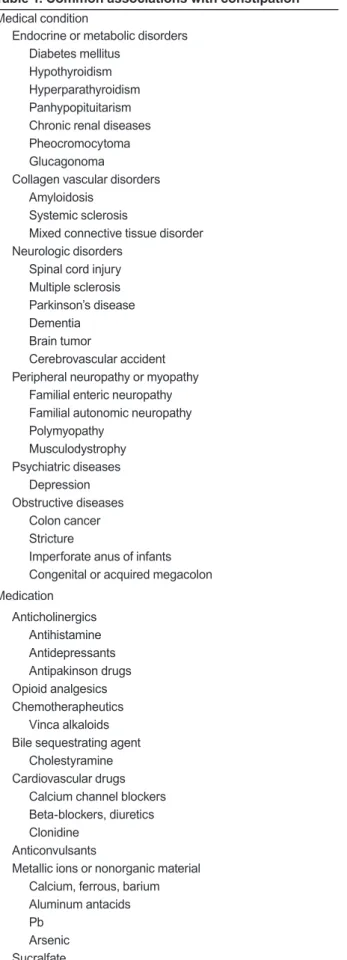
including concurrent diseases and current medication, is required. In general, when constipation is associated with identifiable causative factors or systemic diseases, this is called secondary constipation. In particular, the fact that a variety of drugs can cause constipation should be kept in mind. Diseases and drugs frequently related to constipation in Korea are presented in Table 1 [8].
Secondary constipation caused by organic diseases of the colon, rectum, and anus such as colon cancer, stricture, rectocele, and anal fissure is sometimes called organic constipation. In this case, constipation can be cured by treatment of the causative diseases. Other organic forms of constipation are caused by imperfo- rate anus in infants, congenital or acquired megacolon, mucosal prolapse syndrome, and solitary rectal ulcer syndrome.
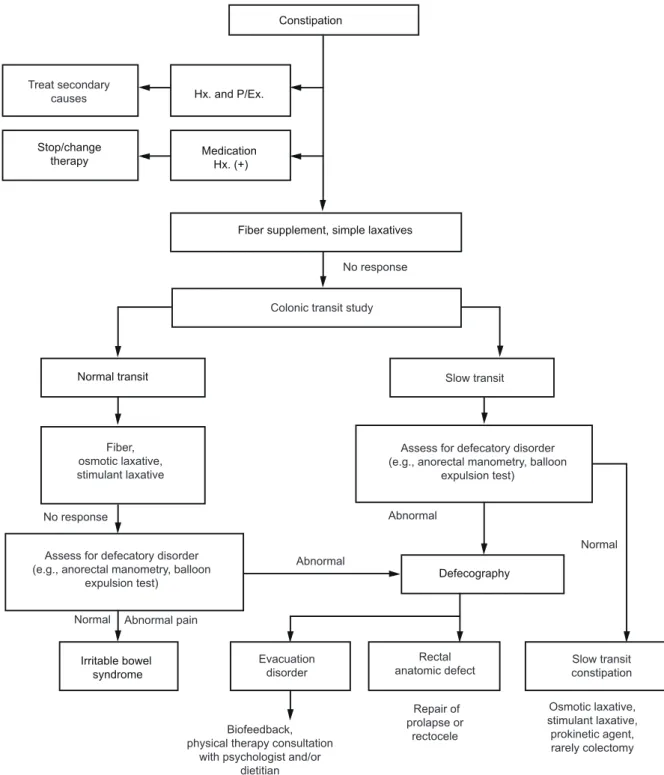
If secondary constipation with known causative fac- tors is excluded, patients are diagnosed with idiopathic or primary constipation. Idiopathic constipation is classified into normal transit, slow transit, and outlet- obstruction-type constipation. Some patients may pres- ent with a combination of these subtypes.
Patients with normal-transit constipation frequently complain of infrequent defecation without delayed colon transit, and tend to be unresponsive to laxatives and fi- ber supplements [9]. These patients may show increased psychosocial distress and misperceive bowel frequency [9,10].
Slow-transit constipation, also called colonic inertia, is usually associated with dysfunction in the enteric plexus or interstitial cells of Cajal, which are the pace- maker cells of gastrointestinal smooth muscle [11]. The typical finding is delayed passage of radiopaque mark- ers through the proximal colon. This is again divided into delayed colonic transit and motility disorder of the colon due to the diffuse whole gastrointestinal tract.
Outlet-obstruction-type constipation is called anis-
mus, defecation disorder, or pelvic floor dyssynergia. In
this type, failure in synergic movements among pelvic
floor muscles such as puborectalis, external sphincter,
and anal internal sphincter muscles causes inadequate
defecation [12]. If outlet-obstructive type constipation
is suspected, anorectal manometry and defecography
may facilitate differentiation of pelvic floor dyssynergia,
rectal intussusception, and rectal prolapse.
Irritable bowel syndrome of constipation type or con- stipation period in mixed type may be another cause of constipation. The classification of constipation accord- ing to pathogenesis is summarized in Table 2.
Together with other physical examinations, digital rectal examination is essential. It is important because it is a basic method of identifying organic factors such as rectal cancer, and because it can identify constipa- tion with obstructive defecation by assessing the func- tions of pelvic floor muscles and internal and external anal sphincter via attempted defecation.
In cases of no response to experiential constipation treatment or patients with warning symptoms such as melena and weight loss, colonoscopy or barium enema should be conducted to exclude colon cancer and other organic diseases.
PRACTICAL TREATMENT
As mentioned above, the removal of causative factors is critical to the treatment of secondary constipation, which is beyond the scope of this review. Instead, we mainly discuss the treatment of primary constipation.
Dietary control
Dietary control is the most fundamental constipation treatment method. First of all, patients with constipa- tion should have an appropriate water and fiber intake [8]. Although dietary fiber itself has a minimal effect on constipation treatment, it is fermented by normal flora in the colon and induces its proliferation, causing in- creased stool volume. Dietary control increases defeca- tion frequency and the amount of stool by softening the stools and increasing their volume by combining with water and ions in the colon, leading to improvement of constipation. Usually, a daily fiber intake of 15 to 25 g Table 1. Common associations with constipation
Medical condition
Endocrine or metabolic disorders Diabetes mellitus
Hypothyroidism Hyperparathyroidism Panhypopituitarism Chronic renal diseases Pheocromocytoma Glucagonoma
Collagen vascular disorders Amyloidosis
Systemic sclerosis
Mixed connective tissue disorder Neurologic disorders
Spinal cord injury Multiple sclerosis Parkinson’s disease Dementia
Brain tumor
Cerebrovascular accident Peripheral neuropathy or myopathy
Familial enteric neuropathy Familial autonomic neuropathy Polymyopathy
Musculodystrophy Psychiatric diseases
Depression Obstructive diseases
Colon cancer Stricture
Imperforate anus of infants Congenital or acquired megacolon Medication
Anticholinergics Antihistamine Antidepressants Antipakinson drugs Opioid analgesics Chemotherapheutics
Vinca alkaloids Bile sequestrating agent
Cholestyramine Cardiovascular drugs
Calcium channel blockers Beta-blockers, diuretics Clonidine
Anticonvulsants
Metallic ions or nonorganic material Calcium, ferrous, barium Aluminum antacids Pb
Arsenic Sucralfate
Table 2. Classification of constipation by pathophysiology Primary constipation
Normal transit constipation Slow transit constipation
Outlet obstruction type (PFD, anismus, defecation disorder) Mixed type
Secondary constipation
Irritable bowel syndrome-constipation type
PFD, pelvic floor dyssynergia.
per day is recommended with sufficient water (1.5 to 2 L) [13]. Dietary fiber is abundant in grains, fruits, and vegetables. If a large amount of fiber is consumed in a short time, complications such as abdominal distension, belching, and diarrhea may occur. In Korea, it has been reported that dietary fiber supplementation reduces symptoms of constipation without side effects and shortens colonic transit time [14-17]. However, Korean studies have been conducted on a small scale and over a short time, therefore, a further large-scale, long-term randomized controlled study is required. Korean clini- cians generally agree that the intake of dietary fiber in- creases the amount of stool and reduces colonic transit time [6]. Therefore, although the effect of dietary fiber on the treatment of constipation is minimal, it could be used as an early treatment because it has the advantag- es of easy implementation, no adverse effects, and a low cost.
Changes in lifestyle
It is important for patients to be in the habit of going immediately to the bathroom for defecation when they want to have a bowel movement. The continuous hold- ing of stools contributes to the vicious cycle of constipa- tion by inhibiting neuromuscular reflex and decreasing sensation [13]. For defecation posture, patients who are unable to sit with their back straight are recommended to adopt the squat position with both legs lifting to the abdomen, or the left decubitus position.
Regular exercise such as walking eases defecation by facilitating colonic motility, but evidence is not insuf- ficient. Physical activities including exercise are known to improve the symptoms of colonic motility in some patients [18-20], but results vary depending among in- dividual patients and according to exercise intensity [21].
In Korea, although there has to-date been no report that exercise improves constipation, short-term, small-scale studies have reported that abdominal massage reduces the symptoms of constipation [22,23]. Domestic clini- cians generally agree that exercise improves the symp- toms of constipation [6]. Therefore, although the cor- relation of exercise with constipation is unclear in adult patients, exercise is likely to improve the symptoms of constipation in elderly individuals.
Drugs
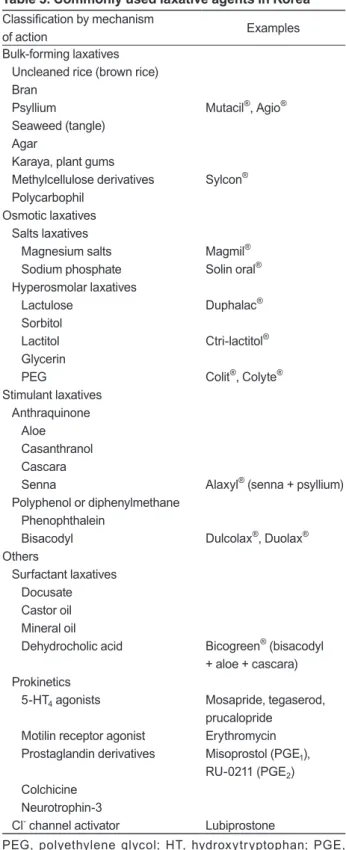
If no response to the aforementioned methods is ob- served, drug treatment should be considered. Drugs used for the treatment of constipation are classified as bulk-forming, osmotic, stimulant, and other laxatives, according to their mechanism of action [8].
Bulk-forming laxatives are generally considered as a first-line drug. They are not absorbed through the small intestine, and are not degraded by bacteria in the colon.
Thus, they can contain water, which in turn increases stool volume in the intestine and the amount of defeca- tion by increasing the level of water in the stool. They are useful for patients who have a sufficient intake of dietary fiber. Brown rice, bran, plant seeds, seaweed, agar, karaya, methylcellulose, and polycarbophil are ex- amples of these agents. Commercially available drugs in Korea include Mutacil
®, Agio
®, and Sylcon
®. However, if these drugs are used in patients with colonic stricture or obstruction, obstructive symptoms may worsen due to increased stool volume. In general, Korean clinicians agree that bulk-forming laxatives are effective in the treatment of constipation [6], although no long-term study is available.
Osmotic laxatives are not absorbed from the colon.
They facilitate defecation by softening stools via an in- crease in water inside the colon. They are classified into salt and hyperosmolar laxatives. Salt laxatives include various Mg salts and phosphate. Mg ions are not ab- sorbed in the intestine; therefore, the gastrointestinal pressure increases due to retention of water. Thus, Mg ions act as a laxative. However, overdose may cause hypermagnesemia; therefore, Mg ions should be admin- istered carefully to patients with renal failure and to children. Although no study of the effect of Mg laxatives on constipation has been conducted in Korean patients with constipation, Mg laxatives have been widely used in such patients elsewhere [24,25], and Korean clini- cians generally agree that these are useful for treatment of constipation [6].
Hyperosmolar laxatives include lactulose, sorbitol,
lactitol, glycerin, and polyethylene glycol (PEG). These
drugs are not absorbed in the intestine and maintain
high osmosis in the colon [26-28]. Thus, defecation oc-
curs in a liquid form due to a lack of absorption of water
into the body. Korean clinicians generally agree that
administration of PEG and various nonabsorbable poly-
saccharides is effective for treatment of constipation [6].
Hyperosmolar laxatives are likely to be effective drugs that can be safely administered to patients over a long period.
Stimulant laxatives are used if no response to the aforementioned drugs is observed. Although their ex- act mechanism of action has not been established, they are known to facilitate colonic motility by inhibiting absorption of water and electrolytes and accumulating water and electrolytes [29-32]. Commonly used stimu- lant laxatives include anthraquinone drugs (e.g., aloe, senna, or cascara) and polyphenol drugs (e.g., bisacodyl or phenolphthalein). Although there is some disagree- ment among researchers, short-term use of these drugs for several months is generally recommended [13]. In the case of long-term use, loss of water and electro- lytes, secondary hyperaldosteronism, steatorrhea, and protein-losing enteropathy may occur. These drugs are abused without prescription in Korea; therefore, they should be prescribed with caution. Although no study of the effect of stimulant laxatives on constipation has been conducted in Korea, they have been used in some patients [6]. In addition, Korean clinicians generally agree that stimulant laxatives are effective in some con- stipation patients.
Other laxatives include surfactant laxatives and pro- kinetics. Surfactant laxatives include docusate, castor oil, mineral oil, and dehydrocholic acid. Although they seem to have a stool-softening effect, their effects on chronic constipation are varied [33-37]. No study of the effect of surfactant laxatives on constipation has been conducted in Korea, but they have been widely used.
Korean clinicians generally agree that surfactant laxa- tives are effective in the treatment of constipation [6].
Representative prokinetic drugs for constipation in- clude 5-HT
4receptor agonists such as cisapride, tegas- erod, and prucalopride [38-41]. They mediate intestinal peristalsis via 5-HT
4receptors, and stimulate secretion into the intestinal tract. One Korean study reported that cisapride was effective in constipation [42]. Although it is controversial, most of these drugs are not commer- cially available due to cardiovascular side effects [43].
Even if they are used, it is difficult to achieve efficacy with prokinetics alone in actual clinical practice. In Korea, 5-HT
4receptor agonists have not been available since tegaserod was withdrawn in 2007. New 5-HT
4Table 3. Commonly used laxative agents in Korea Classification by mechanism
of action Examples
Bulk-forming laxatives Uncleaned rice (brown rice) Bran
Psyllium Seaweed (tangle) Agar
Karaya, plant gums Methylcellulose derivatives Polycarbophil
Osmotic laxatives Salts laxatives Magnesium salts Sodium phosphate Hyperosmolar laxatives Lactulose
Sorbitol Lactitol Glycerin PEG
Stimulant laxatives Anthraquinone Aloe Casanthranol Cascara Senna
Polyphenol or diphenylmethane Phenophthalein
Bisacodyl Others
Surfactant laxatives Docusate Castor oil Mineral oil Dehydrocholic acid Prokinetics
5-HT
4agonists Motilin receptor agonist Prostaglandin derivatives Colchicine
Neurotrophin-3 Cl
-channel activator
Mutacil
®, Agio
®Sylcon
®Magmil
®Solin oral
®Duphalac
®Ctri-lactitol
®Colit
®, Colyte
®Alaxyl
®(senna + psyllium) Dulcolax
®, Duolax
®Bicogreen
®(bisacodyl + aloe + cascara) Mosapride, tegaserod, prucalopride
Erythromycin Misoprostol (PGE
1), RU-0211 (PGE
2)
Lubiprostone
PEG, polyethylene glycol; HT, hydroxytryptophan; PGE,
prostaglandin E.
receptor agonists such as prucalopride, renzapride, and other enterokinetics that are safe and have few side ef- fects have been developed and introduced into clinical practice in Western countries, and are expected to be widely used in Korea in the near future. Korean clini-
cians generally agree that 5-HT
4receptor agonists are effective in the treatment of constipation [6].
In the case of a lack of response to the aforemen- tioned drugs, suppositories or enema therapy using saline, sodium phosphate, glycerin, and sorbitol may be
Hx. and P/Ex.
Stop/change
therapy Medication
Hx. (+)
Normal transit
Defecography
Irritable bowel syndrome
Biofeedback, physical therapy consultation
with psychologist and/or dietitian Treat secondary
causes
Constipation