• 검색 결과가 없습니다.

Study on Wood Species Identification for Daeungjeon Hall of Jeonghyesa Temple, Suncheon

N/A
N/A
Protected

Academic year: 2021

Share "Study on Wood Species Identification for Daeungjeon Hall of Jeonghyesa Temple, Suncheon"

Copied!
6
0
0

로드 중.... (전체 텍스트 보기)

전체 글

(1)

1. INTRODUCTION

Jeonghyesa Temple, Suncheon was built in the 8

th

century in United Silla dynasty period. In Hyesoguksajemunui, a national master Hyeso wanted to build Jeonghyesa Temple for his old age. However, because of the sudden death of national master Hyeso, his disciples completed to build the Jeonghyesa Temple. Old documents such as Donggukyeojisungnam, Sungpyeongji and Beomwugo indicated that Jeonghyesa

Temple was large scale of temple. Through the Japanese Invasion in 1592 and 1597, it lost many wooden buildings and became small scale of temple. It was rebuilt by buddhist monk Sinwuk in 1617. Size of Daeungjeon Hall of Jeonghyesa Temple is 3 room scale in front and 2 room scale in side (Korea Creative Content Agency, 2016). Daeungjeon Hall have Dapo style and Korean gambrel roof style in architectural aspects (Fig. 1 and 2). Because of its historic and aca- demic values, it was designated as Treasure No.

Original Article

Study on Wood Species Identification for Daeungjeon Hall of Jeonghyesa Temple, Suncheon 1

Soo Chul Kim

2,†

⋅Jaewan Choi

3

ABSTRACT

This study was conducted to identify wood species from main pillars of Daeungjeon Hall, the main building of Jeonghyesa Temple located in Suncheon, Jeollanamdo Province in Korea. It was known that this temple had been built in the 8

th

century by Hyeso, a national master in the Unified Silla period, and was designated as Treasure No. 804 in 1984 due to its historic and academic values. The results of wood species identification showed that main pillars from Daeungjeon Hall of the Jeonghyesa Temple were made of hard pine, Korean fir (Abies spp.) and Zelkova tree (Zelkova spp.). In addition to the wood species identification, floor plan doc- umentation was also done to help identify what wood species had been used for main pillars. These results could be applied and utilized for the conservation and restoration of Daeungjeon Hall in future. This study may help with the authenticity of conservation works.

Keywords : wood species identification, traditional wooden building, Jeonghyesa Temple, conservation science

1

Date Received July 8, 2016, Date Accepted November 2, 2016

2

Department of Conservation Science, University of Science and Technology, Korea National University of Cultural Heritage, Buyeo, 33115, Republic of Korea.

3

Department of Heritage Conservation & Restoration, Graduate School of Convergence Cultural Heritage, Korea National University of Cultural Heritage, Buyeo, 33115, Korea.

Corresponding author: Soo Chul Kim (E-mail: [email protected])

(2)

804 in 1984 (Cultural Heritage Administration of Korea, 2016). The Cultural Heritage Charter of Korea states that cultural heritage must be pre- served in its original formation and be restored by original materials. In addition, it mentions the authenticity of cultural heritage and conservation materials (Cultural Heritage Administration of Korea, 1997). Therefore, investigation for wood species identification of important Korean tradi- tional buildings such as National Treasure and Treasure are required. Conservation and restora- tion works must reflect investigated data.

However, only few studies of wood species iden- tification regarding Daeungjeon Hall of Jeonghyesa Temple have been carried out.

In this study, species identification regarding main pillars for Daeungjeon Hall of Jeonghyesa Temple are investigated. With this database, great help could be given to authenticity of conservation and restoration works.

2. MATERIALS and METHODS 2.1. Materials

Firstly, past studies and floor plans of Daeungjeon Hall of Jeonghyesa Temple were

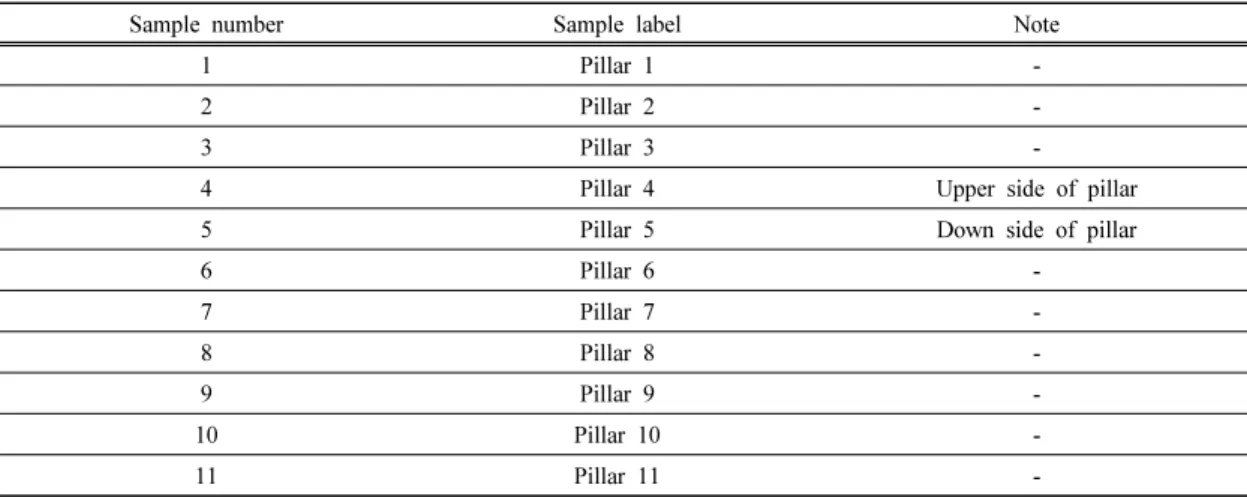
collected. Based on this, sampling locations for main pillars were selected (Table 1). Next, field works were performed. It should be checked whether pre-inspection and field sit- uations are in accordance. To decide the ap- propriate tools and equipment necessary for sampling, the inside of the buildings and the environment should be researched. The scaf- foldings, multi-purpose ladders and ladders could used for sampling. The sampling must carried out from natural cleavages using scalpels. If there are no natural cleavages, sampling should be performed in incon- spicuous area of wooden structural members.

The samples are stored in zipper bags and the name of building and location of wooden structural members are labelled as specifically as possible.

2.2. Methods

Wood species identification was carried out

by preparing thin sections of samples of 20 ∼30

µm width with a razor blade (ST-300, Dorco,

Korea) or microtome blade (YL-MBA35, YLS,

Korea) for the cross, radial and tangential

Fig. 1. Scenery of Jeonghyesa Temple. Fig. 2. Scenery of Daeungjeon Hall.

(3)

sections. The thin sections were stained with aqueous safranin solution (0.5 ∼ 1 wt% con- centration) for 2 minutes, and washed thor- oughly before being placed on the slide glass.

To complete the preparat, glycerine (50%, aq.

soln.) was used to mount the sample with cover glass and slide glass. Optical microscope (Eclipse Lv 100, Nikon, Japan) was used to identify anatomical characteristics of wood spe- cies (Kim et al., 2016). The wood species were identified according to the standards set by IAWA: List of Microscopic Features for Identification (Park and Lee, 2007; Park et al., 2005; Park et al., 2003; Lee and Park, 2012;

Lee, 1997). Final confirmations were made by comparing with the standard samples from Korea National University of Cultural Heritage.

After the wood species identification, floor plan documentation was performed to assist in the recognition of the location of each main pillars.

3. RESULTS 3.1. Wood Species Identification

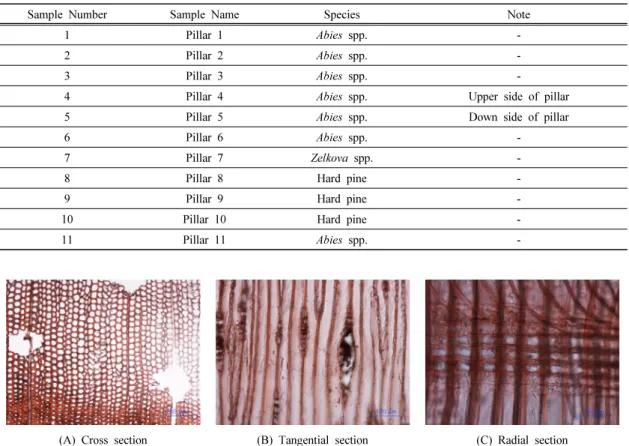
Hard pine, Korean fir ( Abies spp.), Zelkova tree ( Zelkova spp.) was identified in main pil- lars of Daeungjeon Hall of Jeonghyesa Temple (Table 2). Hard pine was identified in pillar 8, 9 and 10. Korean fir ( Abies spp.) was identified in pillar 1, 2, 3, 4, 5, 6 and 11. Zelkova tree ( Zelkova spp.) was identified in pillar 7. These results assumed that hard pine, Korean fir and Zelkova tree were used in main temple during ancient times in Korea.

3.1.1. Anatomical characteristics of hard pine As the micro observation result of species identification through optical microscope for each preparat, the latewood turns rapidly to the early wood and vertical resin canal can be found in cross section. Ray tracheid have den- tate toothed thickening and bordered pit main- ly in one row. Also, crossfield pitting observed

Sample number Sample label Note

1 Pillar 1 -

2 Pillar 2 -

3 Pillar 3 -

4 Pillar 4 Upper side of pillar

5 Pillar 5 Down side of pillar

6 Pillar 6 -

7 Pillar 7 -

8 Pillar 8 -

9 Pillar 9 -

10 Pillar 10 -

11 Pillar 11 -

Table 1. List of collected samples for wood species identification

(4)

as fenestriform. Tangential section is composed of uniseriate rays and radial parenchyma cells (Fig. 3). Dentate toothed thickening, fenestri- form of crossfield pitting and vertical resin ca- nal are the specific anatomical characteristics of hard pine (National Research Institute of Cultural Heritage, 2015; Lee, 1997).

3.1.2. Anatomical characteristics of Korean fir (Abies spp.)

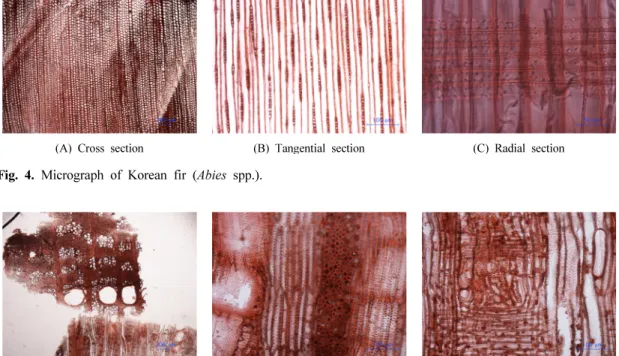
As the micro observation result of species identification through optical microscope for each preparat, the latewood turns gradually to

the early wood. There are narrow width in latewood. Traumatic resin occasionally found in transverse section. In tangential section, bor- dered pits generally located in one raw. Radial section is mainly composed of uniseriate rays.

Horizontal wall of radial parenchyma cell is generally thick and have moniliform (Fig. 4).

Cross field pitting observed as Cryptomeria type (National Research Institute of Cultural Heritage, 2015; Lee, 1997).

Sample Number Sample Name Species Note

1 Pillar 1 Abies spp. -

2 Pillar 2 Abies spp. -

3 Pillar 3 Abies spp. -

4 Pillar 4 Abies spp. Upper side of pillar

5 Pillar 5 Abies spp. Down side of pillar

6 Pillar 6 Abies spp. -

7 Pillar 7 Zelkova spp. -

8 Pillar 8 Hard pine -

9 Pillar 9 Hard pine -

10 Pillar 10 Hard pine -

11 Pillar 11 Abies spp. -

Table 2. Result of species identification

(A) Cross section (B) Tangential section (C) Radial section

Fig. 3. Micrograph of hard pine.

(5)

3.1.3. Anatomical characteristics of Zelkova tree (Zelkova spp.)

As the micro observation result of species identification through optical microscope for each preparat, ring-porous wood can be found in cross section. Large scale of vessels are ob- served as 1 or 2 rows. Pore cluster are sur- rounded by axial parenchyma. Intervascular trcheid observed in alternative type (Fig. 5).

Spiral thickening can be found in small size of vessel (National Research Institute of Cultural Heritage, 2015; Lee, 1997).

3.2. Floor Plan Documentation

Floor plan documentation was performed to present the visual representation of the re-

searched and analysed data (Fig. 6). The floor plan documentation data is expected to aid in the application and utilization of conservation Fig. 6. Floor plan documentation for Daeungjeon Hall of Jeonghyesa Temple, Suncheon.

(A) Cross section (B) Tangential section (C) Radial section

Fig. 5. Micrograph of Zelkova tree (Zelkova spp.).

(A) Cross section (B) Tangential section (C) Radial section

Fig. 4. Micrograph of Korean fir (Abies spp.).

(6)

and restoration of cultural heritage in the future.

4. CONCLUSION

Through species identification of Daeungjeon Hall of Jeonghyesa Temple, Suncheon, there were 3 pillars and identified as hard pine. 7 pil- lars were identified as Korean fir ( Abies spp.).

1 pillar was identified as Zelkova tree ( Zelkova spp.). Interestingly, most of main pillar were made of Korean fir ( Abies spp.) and hard pine.

Also, Zelkova tree ( Zelkova spp.) was used in pillar. The significance of this is that it implies the use of hard pine, Korean fir ( Abies spp.) and Zelkova tree ( Zelkova spp.) in constructing temples in Korea. This also implies the ex- istence of hard pine, Korea fir ( Abies spp.) and Zelkova tree ( Zelkova spp.) in ancient times of Korea. Most importantly, this database let us use same species of wood in the conservation and restoration for Daeungjeon Hall of Jeonghyesa Temple, aiding in the authenticity.

Furthermore, through species identification of other important traditional wooden buildings, more databases can be gathered, ultimately leading to authentic conservation and restoration of wooden cultural heritage in Korea.

ACKNOWLEDGEMENT

We appreciate and give our sincere gratitude to the City Hall of Suncheon, Jeonghyesa Temple and Korea Institute of Structural Safety for their great support to fulfil this experiment successfully.

REFERENCES

Cultural Heritage Administration of Korea, 2016.

Heritage Information.

Cultural Heritage Administration of Korea, 1997.

Charter of Cultural Heritage.

Kim, S.-C., Choi, J.-W., Jang, H.-U. 2016. Study Regarding Species Identification for Royal Palace of Korea, World Conference on Timber Engineering 2016.

Korea Creative Content Agency, 2016. Sumidan of Korean Buddhism and Woodcraft.

Lee, H.-C., Park, W.-K. 2012. Analysis of Species and Tree-Ring Dating of Traditional Furniture in Forest Museum of Korea National Arboretum, Journal of Korea Furniture Society 23(1): 84∼

94.

Lee, P.-W. 1997. Characteristic and Usage of Korean Wood II, Publication of Seoul National University.

Lee, P.-W. 1997. The Structure of Korean Wood, Publication of Seoul National University.

National Research Institute of Cultural Heritage, Species Identification of Korean Tradition Wooden Buildings.

Park, B.-S., Park, J.-H., 2005. Main Species of Wooden Cultural Heritage, Korea Forest Service.

Park, W.-K., Kim, S.-J., Kim, Y.-J., Han, S.-H.

2003. Species Identification and Age Determination for Wooden Structural Elements of Junghwajeon, Study of Architecture History.

Park, W.-K., Lee, K.-H. 2007. Changes in the

Species of Woods Used for Korean Ancient

Historic Architectures, Study of Architecture

History 16(1): 9∼28.

수치

Table 1. List of collected samples for wood species identification
Table 2. Result of species identification
Fig. 4. Micrograph of Korean fir (Abies spp.).

참조

관련 문서

The proposal of the cell theory as the birth of contemporary cell biology Microscopic studies of plant tissues by Schleiden and of animal tissues by Microscopic studies of

Diagrammatic representation of the mechanisms of local deformation of wood cells under a longitudinal compression force; (a) wood before the application of the force, (b)

A cross section of wood from a white-pocket area of decayed wood showing delignified wood cells. These cells have no middle lamella (this is the area between

_____ culture appears to be attractive (도시의) to the

william James Hall, M.D., Medical Missionary to the Slums of New York; Pioneer Mission of Korean Native Costumes, China Medical Journal, 1916.3; Medical Needs of Korean

Made needles out of carved bone to sew clothes Used clay to make pots to make food.. Made musical instruments out of plants, wood

The Dusky Lory ( Pseudeos fuscata ) is a monotypic species of parrot in the Psittaculidae family, and the only species of the genus Pseudeos... platyrhynchos

It considers the energy use of the different components that are involved in the distribution and viewing of video content: data centres and content delivery networks