2020 Keimyung University School of Medicine
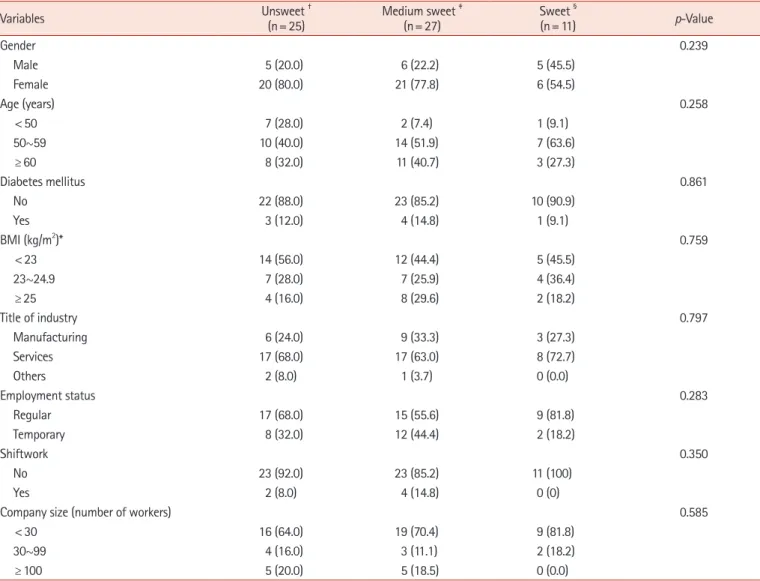
This study aimed to evaluate the relationship of sweet taste perception with over- weight and obesity among workers in some industrial areas. Participants were 63 workers (mean age: 57.8±7.8 years), who were divided into three subgroups based on sweet taste evaluation using a sweet taste assessment tool provided by Ministry of Food and Drug Safety: unsweet group (n=25), medium sweet group (n=27), and sweet group (n=11). There was no significant difference in body mass index (BMI), and any work-related variables among the three groups; however, the difference be- tween subjective perception and objective perception for sweet tastes is statistically different. We also found slight or fair agreement between subjective and objective sweet taste perception of the subjects (weighted kappa value 0.34~0.43). The pres- ent study provided measuring objective sweet taste perception may be useful for assessing the risk of high sugar consumption and for improving undesirable dietary behaviors, and management of non-communicable disease among workers.
Keywords: Obesity, Taste perception
관련성
이상희1, 이주형1, 양선희1,2, 이미영1,2,3
1
대구근로자건강센터
2
계명대학교 동산병원 직업환경의학과
3
계명대학교 의과대학 예방의학교실
The Relationship between Sweet Taste
Perception and Obesity of Workers in Some Industrial Area
Sanghee Lee1, Juhyung Lee1, Seonhee Yang1,2, Mi-Young Lee1,2,3
1
Daegu Workers’ Health Center, Daegu, Korea
2
Department of Occupational and Environmental Medicine, Keimyung University Dongsan Medical Center, Daegu, Korea
3