Perilla frutescens (L.) Britton var. frutescens, an annual plant from the Lamiaceae mint family, is the second-biggest upland crop of South Korea (KOSIS, 2018) which originated in East Asia. Perilla is usually consumed in two ways on Korean dishes, as oil and leafy vegetable. For this reason, the perilla cultivar has been developed for the purpose of either extracting oil or harvesting fresh leaves. Generally, the cultivars used for oil have large amount of crude fat contents in the soft, thick seed and have early-flowering date. On the other hand, the cultivars used for vegetable have heart-like large leaves, relatively late flowering date and contain pigments and volatile compounds like perilla aldehyde, which is expressed as unique color and scent of perilla leaves (Choung, 2005). Perilla seed mainly contains lipid and protein, which is 44.4% and 17.4% of seed grain, respectively. Also, carbohydrate takes about 29.9% of
seed and 8.3% for ash (RDA, 2017). Perilla oil is one of the richest ω-3 fatty acid source among the edible seed oils (Asif, 2011). Linolenic acid takes 63.1% of the total fatty acid in perilla oil. Oleic and linoleic acids are composed of 15.2% and 13.9% of fatty acids, and saturated fatty acids like palmitic acid and stearic acid takes 6.5% and 1.7%, respectively (Ryu et al., 1993). Recently, several functional components contained in perilla had been reported to show anti-inflammatory response, and inhibitory for α-glucosidase and antioxidative activity (Banno et al., 2014; Ha et al., 2012; James et al., 2000;
Žekonis et al., 2008). Moreover, it is demonstrated that the α- linolenic acid, which is rich in perilla seed, has reduced the risk of cardiovascular diseases and affected the change of brain lipid composition and recognition ability in several studies (Guixiang et al., 2004; Hamazaki et al., 1996; Kim et al., 2010;
Estimation of Oil Yield of Perilla by Seed Characteristics and Crude Fat Content
Eunyoung Oh 1,† , Myoung Hee Lee 1 , Jung In Kim 1 , Sungup Kim 1 , Suk-Bok Pae 1 , and Tae Joung Ha 1
ABSTRACT Perilla (Perilla frutescens var.frutescens) is an annual plant of the Lamiaceae family, mainly grown for obtaining oil by press extraction after roasting the seeds. Oil yield is one of its important traits, but evaluating this yield is time-consuming, requires many seeds, and is hard to adjust to pedigrees in a breeding field. The objective of this study was to develop a method for selecting high-oil-yield lines in a breeding population without oil extraction. Twenty-three perilla cultivars were used for evaluating the oil yield and seed traits such as seed hardness, seed coat thickness, seed coat proportion and crude fat. After evaluation of the seed traits of 23 perilla cultivars, the ranges of oil yields, seed hardness, seed coat thickness, seed coat proportion, 100-seed weight, and crude fat were 24.68-38.75%, 157-1166 gf, 24-399 ㎛, 15.4-41.5%, 2.79-6.69 g, and 33.0-47.8%, respectively.
In an analysis of correlation coefficients, the oil yield negatively correlated with seed length, seed width, the proportion of seed coat, seed hardness, and 1000-seed weight, but positively correlated with crude fat content. It was observed that as the seed coat proportion increased, the seed coat thickness, hardness, and 1000-seed weight also increased. Multiple linear regression (MLR) was employed to find major variables affecting the oil yield. Among the variables, traits crude fat content and seed coat proportion were assumed to be indirect parameters for estimating the potential oil yield, with respect to a significant positive correlation with the observed oil yield (R
2= 0.791). Using these two parameters, an equation was derived to predict the oil yield. The results of this study show that various seed traits in 23 perilla cultivars positively or negatively correlated with the oil yield. In particular, crude fat and the seed coat proportion can be used for predicting the oil yield with the newly developed equation, and this approach will improve the efficiency of selecting prominent lines for the oil yield.
Keywords : oil yield, perilla oil, perilla breeding, seed coat
DOI : https://doi.org/10.7740/kjcs.2018.63.2.158Original Research Article
ⓒ 본 학회지의 저작권은 한국작물학회지에 있으며, 이의 무단전재나 복제를 금합니다.
This is an Open-Access article distributed under the terms of the Creative Commons Attribution Non-Commercial License (http://creativecommons.org/licenses/by-nc/3.0) which permits unrestricted non-commercial use, distribution, and reproduction in any medium, provided the original work is properly cited.
1)
Upland Crop Breeding Research Div., National Institute of Crop Science, RDA, Miryang, 50424, Korea
†
Corresponding author: Eunyoung Oh; (Phone) +82-55-350-1232; (E-mail) [email protected]
<Received 30 March, 2018; Revised 31 May, 2018; Accepted 12 June, 2018>
Lee et al., 2017; Schaefer et al., 2006; Yamamoto et al., 1987;
Zhang et al., 2014). Since the nutraceutical potentials of perilla have been reported, consumption of perilla oil has increased consistently. Korea Agro-Fisheries & Food Trade Corporation informed that the perilla oil retail market had increased by 24.2% in 2016 compared to the record from 2012 (FIS, 2017).
Researchers of the National Institute of Crop Science have developed perilla cultivars exclusive for oil extraction based on seed components like crude fat and linolenic acid composition (Lee et al., 2011). Generally, seed oil from oil-bearing grains like soybean, maize or canola are obtained by mechanical extraction, solvent extraction, supercritical CO
2or aqueous enzymatic extraction method (Eggers, 1985; Li et al., 2014;
Rosenthal et al., 1996). In the case of perilla oil, traditional method is used, usually hydraulically expressed after roasting.
In order to have high oil yield, manufacturers roast perilla seed at high temperature over 180 ℃ and then extract the oil using a pressing machine when the grains exude nutty flavors and expanded by heat. By this process, perilla oil can get its unique flavor and fragrance as seasoning oil (Kim et al., 1996). Like other oil processing, the seed properties of the raw materials would determine the cost and productivity. Aremu and Ogunlade (2016) reported that African oil bean had oil yield variation due to the diameter of seeds when using mechanical oil press. Similarly, seed coat ratio and oil body organelles of rapeseed were highly correlated with oil content (Hu et al., 2013). Considering this, it is assumed that perilla oil yield could also be closely related with morphological characteristics and seed constituents. However, selection of elite lines was conducted based on breeder perception even if oil yield improvement is one of the priorities in perilla breeding.
In order to develop a cultivar with high oil yield, it is important to determine seed phenotypic properties connected to oil yield. Therefore, in this study, the parameters which have influence on oil yield were identified by examining the morphologi- cal characteristics of perilla seed from the developed cultivars.
MATERIALS AND METHODS Perilla samples
Twenty three perilla cultivars harvested at the National Institute of Crop Science (NICS) in Miryang in 2016 were examined in this study (Table1). All samples originated from
Breeder’s seed managed by the NICS breeding team and produced by standard cultivation techniques for perilla. The moisture content of the sample was adjusted to 7% on average.
Oil extraction
Oil yield was evaluated by calculating average oil weight extracted from automatic oil press. Prior to extracting, five hundred grams of perilla seed were roasted at 180 ℃ for ten minutes using automatic stir-roasting cauldron (24" Electric roaster, Dongbang Machinery Co.). Roasted perilla seed was divided into two hundred grams per sample for replication, then inserted into the expeller oil pressing machine (Oillove, NationalENZ). After refining using a filter paper (Qualitative filter paper No.10, Hyundai Micro Co.), oil weight was measured at room temperature.
Examination of seed properties
The following seed properties were chosen for this study:
seed size, seed coat thickness, seed coat proportion, and seed hardness. Seed size and seed coat thickness were measured by a digital microscope (IMSD345, Sometech Vision) and images Table 1. Information on the 23 Korean perilla cultivars examined.
Cultivar Released Year
Seed Coat Color
Yield (kg/10a)
1000-Seed Weight (g)
Yeopsil 1988 brown 126 3.78
Okdong 1989 light brown 118 5.31
Daeyeop 1992 white 124 6.39
Baegsang 1993 white 127 5.78
Saeyeupsil 1994 light brown 123 5.49
Areum 1996 brown 135 4.1
Yangsan 1997 brown 143 4.46
Chungsan 1998 light brown 140 4.54
Hwahong 1998 dark brown 136 4.21
Daesil 1999 brown 126 4.21
Hyangim 2000 brown 116 4.19
Kwangim 2001 dark brown 119 4.41
Dayu 2004 dark brown 144 3.66
Anyu 2008 dark brown 99 3.43
Danjo 2009 light brown 122 4.45
Baekjin 2009 greyish brown 131 6.69
Joim 2010 greyish brown 126 4.34
Jungmo5101 2011 greyish brown 118 3.81
Jungmo5102 2012 brown 123 3.6
Dami 2013 brown 142 4.02
Deulsaem 2013 brown 142 3.21
Sodam 2014 silver grey 123 2.79
Jungmo5103 2015 brown 137 2.86
were obtained at 160 magnification scale, processed by 1/100 mm objective micrometer and calculating software (IMT iSolution Lite ver.9.1, IMT). Each seed was longitudinally cut into two to make symmetrical split pieces using a razor blade (ST-300, Dorco). Seedcoat thickness was determined at three section points by visual judgement and measured by the software. The thickest part was observed near the hilar area while the thinnest part was measured at the furthermost point from the hilar area, and the medium thickness at the width axe point was chosen. A proportion of seed coat was examined by measuring the weight after carefully removing the cotyledon using tweezers. The hardness of the perilla seed was determined by a texture analyzer, at the point of breaking strength using a cylindrical probe (TA1_FG/CY10, Lloyd Instrument).
Physicochemical analysis
For the crude fat content, two grams of homogenized perilla seed was put into the cellulose thimble (Z27-103-9, Whatman) and crude fat was extracted by automatic soxhlet analyzer (B-811, Buchi) with n-hexane (Extra pure grade, Daejung Chemical) by the method of Oh et al. (2000).
Data analysis
All statistical analysis was performed by SAS ver. 9.4 (SAS Institute Inc, 2012).
RESULTS AND DISCUSSION
The morphological characteristics, oil yield and crude fat content of perilla seed varied by cultivar. The average, minimum, maximum and standard deviation of examined seed properties is shown in Table 2. The average oil yield was 31.58%, and
‘Yeopsil’ with the highest yield at 38.75% and ‘Baekjin’ with the lowest at 24.68%. The crude fat content was highest on
‘Yeopsil’ and lowest on ‘Baekjin’ cultivar with an average of 41.1% of seed weight. In the case of seed hardness, ‘Daesil’
was the lowest of 157 gf and ‘Baegsang’ was the highest of 1166 gf in seed breaking point.
The result of Pearson correlation coefficients between the examined seed properties is shown in Table 3. Oil yield showed positive correlation with crude fat contents but showed negative correlations with seed length, width, seed coat thickness, seed coat proportion, seed hardness, and 1000-seed weight. Seed Table 2. Seed properties of the examined perilla cultivars.
LEN
a( ㎛) WD
( ㎛) TT
( ㎛) TM
( ㎛) TL
( ㎛) Hardness (gf)
SCP (%)
Crude Fat (%)
1000SW (g)
Oil Yield (%)
Min 2084 1494 63 44 24 157 15.4 33 2.79 24.68
Max 3173 2091 399 176 136 1166 41.5 47.8 6.69 38.75
AVG 2599 1776 163 90 69 538 28.4 41.1 4.34 31.58
SD 233.8
***142.9
***66.4
***30.4
***25.1
***293
***7.0
***4.0
***0.992
***3.26
***a
LEN : seed length, WD : seed width, TT : maximum seed coat thickness, TM : medium seed coat thickness, TL : minimum seed coat thickness, SCP : proportion of seed coat, 1000SW : 1000-seed weight.
***
Least significant difference at 0.001 probability level.
Table 3. Pearson’s correlation coefficients between variables of the tested perilla seed.
Variables LEN
a(㎛) WD
(㎛) TT
(㎛) TM
(㎛) TL
(㎛) Hardness
(gf)
SCP (%)
Crude Fat (%)
1000SW (g) LEN
WD .72
***TT .79
***.63
***TM .82
***.73
***.85
***TL .17
ns-.01
ns.27
ns.06
nsHardness .40
**.29
*.39
**.67
***.00
nsSCP .27
ns.14
ns.16
ns.46
***-.20
ns.77
***Crude Fat -.45
***-.30
**-.27
ns-.56
***-.12
ns-.85
***-.69
***1000SW .85
***.73
***.74
***.89
***.13
ns.56
***.43
***-.58
***Oil Yield -.34
*-.37
**-.22
ns-.46
***-.27
ns-.69
***-.47
***.87
***-.48
***a
LEN : seed length, WD : seed width, TT : maximum seed coat thickness, TM : medium seed coat thickness, TL : minimum seed coat thickness, SCP : proportion of seed coat, 1000SW : 1000-seed weight.
ns
Correlation coefficient is not significant;
*Correlation coefficient is significant at 0.05 level;
**p≤0.01 level;
***p≤0.001 level.
hardness revealed positive correlation with seed length and width, seed coat thickness, seed coat proportion, and 1000-seeds weight, while it showed negative correlation with crude fat contents. The seed coat proportion increased as seed coat thickness, hardness, and 1000-seed weight increased.
The 1000-seed weight showed significant positive correlation with seed length and width, which is an essential trait selection for perilla yield components. However, 1000-seed weight was negatively correlated with oil yield. Like ‘Baekjin’ and ‘Baegsang’, varieties with heavier 1000-seed weight indicated lower oil yield. It was assumed that seed kernel takes a small part of seed weight for cultivars with relatively thicker and heavier portion of seed coat. Also, seed hardness forces of these cultivars were much higher, which was not a favorable trait for oil processing.
Regarding the differences in oil yield of perilla varieties, respective parameters for increasing selection efficiency to identify promising line with less time and cost were determined.
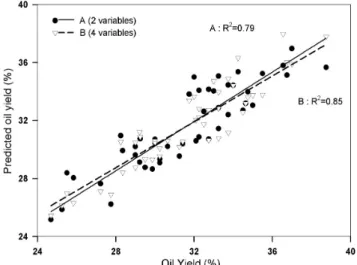
Multiple linear regression was used to estimate parameters which affect oil extraction. To optimized oil yield estimation, multiple linear regression in two-way was conducted (Table 4).
The value of crude fat content and seed coat proportion made significant equation for estimating oil yield at stepwise analysis, while by removing inexplicable variables from the equation backwardly, seed coat thickness, seed length, width, and crude fat contents remained for available parameters. Fig. 1 shows the comparison between expected and actual oil yield, with the coefficient of determination at 0.791 and 0.851, respectively. However, in stepwise regression, coefficient of seed coat proportion is positive, which is opposite to the negative relation with oil yield in Pearson correlation (Table 3).
In the range from 20.69% to 25.76% of seed coat proportion, the observations had positive correlation with oil yield, with
coefficient of determination of 0.725. Likewise, observations of seed coat proportion between 31.94% and 36.64%, their correlation was positive (R
2=0.7312). Therefore, it is assumed that this inconsistency is due to the presence of the partial positive slope in certain rage of observations. In backward regression, four variables were selected from the 0.01 significant level. Among four parameters, crude fat content showed the highest standardized estimate, and took the major portion of the determination of oil yield. Variance inflation factors were 1.262, 1.068, 2.482, and 2.140 in the crude fat content, thinnest seed coat thickness, seed length, and seed width, respectively, despite the fact that there were correlations between these four variables.
This study demonstrated that seed properties related to oil yield were varied among cultivars. Even though oil yield
Table 4. Analysis of two-way Multiple Linear Regression for estimating perilla oil yield.
Oil Yield Equation R-Squared RMSE
aCV Variables Std. Estimates
A. Oil Yield (%); stepwise = -6.807 + 0.853*CF (%)
+ 0.118*SCP (%) 0.791 1.527 4.834 CF
***1.046
SCP
*0.256
B. Oil Yield (%); backward = 6.935-0.029*TL (㎛)
+ 0.005*LEN (㎛)-0.010*WID (㎛) + 0.732*CF (%) 0.851 1.318 4.172
CF
***0.898
TL
**-0.219
LEN
**0.366
WD
**-0.367
a
RMSE: Root Mean Square Error, CV: Coefficient of Variation, CF: crude fat content, SCP: proportion of seed coat, TL:
minimum seed coat thickness, LEN: seed length, WD: seed width.
*