Print ISSN: 2288-4637 / Online ISSN 2288-4645 doi:10.13106/jafeb.2021.vol8.no5.0951
The Sustainable Purchase Intention in a New Normal of COVID-19: An Empirical Study in Malaysia*
Muhammad Safuan Abdul LATIP 1 , Farhana Tahmida NEWAZ 2 , Siti Nur Nadhirah Abdul LATIP 3 , Rachel Yong Yuen MAY 4 , Ahmad Esa Abdul RAHMAN 5
Received: February 10, 2021 Revised: April 05, 2021 Accepted: April 15, 2021
Abstract
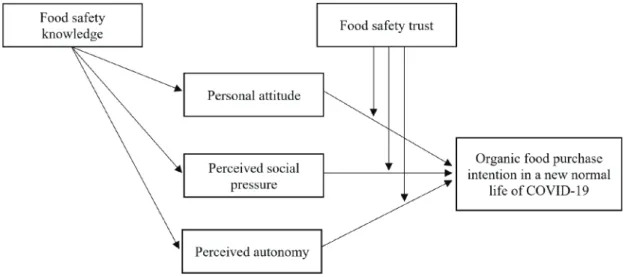
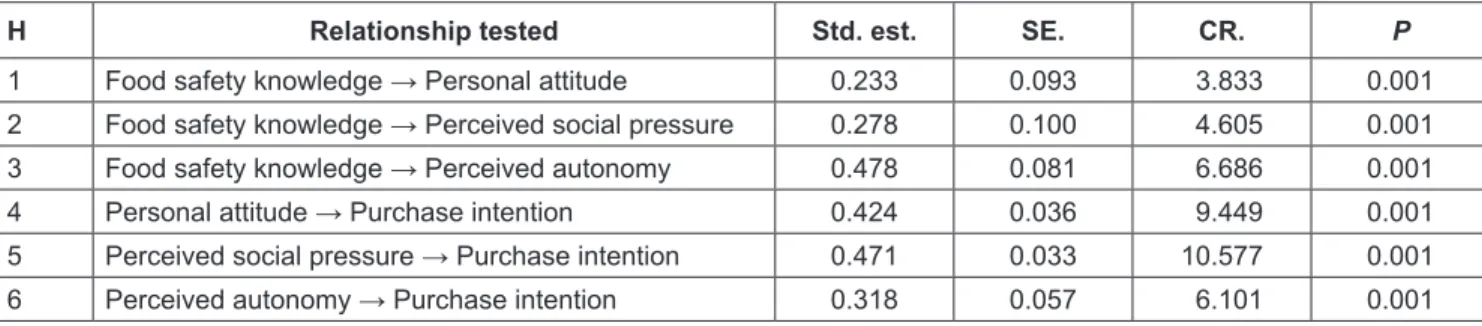
The study investigated the effect of food safety knowledge, food safety trust and the factors influencing organic food purchase intention in the ‘new normal’ of the COVID-19 pandemic. The study employed non-contrived and cross-sectional methods. The data was collected in Malaysia using convenience sampling. A total of 330 valid questionnaires were analyzed using Structural Equation Modelling (SEM) and PROCESS for hypothesis testing. The study revealed a significant relationship involving food safety knowledge on personal attitude, perceived social pressure, and perceived autonomy. Moreover, organic food purchase intention was found to be influenced by personal attitude, perceived social pressure, and perceived autonomy. Interestingly, trust in organic food safety moderated the relationship between perceived autonomy and organic food purchase intention. The study proved valuable for stakeholders and organic food producers to understand the ‘new normal’ COVID-19 market scenario for a sound understanding of the market and the sustainability of the organic food industry. A new research framework is proposed and validated, related to individual purchase decision in global health issues which is limited in current literature. Hence, the study contributed to a better comprehension of green consumerism mainly in the Asian market.
Keywords: New Normal Life, COVID-19, Consumer Perception, Organic Food, Individual Green Consideration JEL Classification Code: Q56, M39, D16, Q01, M59
1. Introduction
The COVID-19 pandemic originated from Wuhan, China towards the end of 2019 and has resulted in high mortality rates worldwide. The contagious and lethal outbreak was declared a pandemic by the World Health Organisation (WHO). Consequently, the movement control order (MCO) and other forms of movement restrictions were enforced by the affected countries. The pandemic also resulted in the emergence of a ‘new normal’ life in society and the business context. Given the necessary changes in lifestyle and business practices to prevent infections (Latip et al., 2020; Sajed & Amgain, 2020), the
‘new normal’ context mainly concerns individuals’ health and wellbeing regarding changes in attitudes and product purchase decisions.
Organic food is perceived as a safe and healthy food choice for consumers (Latip et al., 2020; Somasundram et al., 2016). Previous studies highlighted a safe and healthy
*Acknowledgements:
1
This research is supported by Universiti Teknologi MARA, and Universiti Tun Abdul Razak Postgraduate Development Program. It is also, to some extent, supported by volunteer respondents.
1
First Author and Corresponding Author. Faculty of Hotel and Tourism Management, Universiti Teknologi MARA Cawangan Terengganu Kampus Dungun, Malaysia [Postal Address: Sura Hujung, 23000 Dungun, Terengganu, Malaysia]
Email: [email protected]
2
Graduate School of Business, Universiti Tun Abdul Razak, Malaysia.
Email: [email protected]
3
Graduate School of Business, Universiti Tun Abdul Razak, Malaysia.
Email: [email protected]
4
Faculty of Hospitality and Tourism, CITY University, Malaysia.
Email: [email protected]
5