
Association of Inter-arm Blood Pressure Difference with Atherosclerosis in Patients without Cardiovascular Diseases
10
0
0
전체 글
(2) Inter-arm Blood Pressure Difference and Atherosclerosis. agnosis of hypertension3) and is associated with poor con-. ies showed that the difference of IABP was associated. trol of BP, because failure to measurement to the arm with. with ABI13) and cardiovascular adverse outcomes. However. the higher value can mislead decisions about management.. they had measurement bias because BP was measured se-. Currently guidelines, the American Heart Association and. quentially for each arm. Recently a domestic study14) estimated. the Korean hypertension Association recommended that. the IABP by simultaneously measuring the both arms BP. BP should initially be measured in both arms for identi-. using an automatic electronic sphygmomanometer. However,. fying upper-extremity arterial obstruction and coarctation. they did not assess ABI and baPWV. Accordingly, the ob-. 4,5). If there was a difference in BP, an arm. jective of present study, using simultaneous BP measure-. with higher values should be used for BP measurements.. ment, was to compare the ABI, baPWV between patients. However, this recommendation has not been followed. with and without an IABP difference and to identify the. by many clinicians, because lack of sphygmomanometer. independent factors associated with an IABP difference.. of the aorta.. that can measure bilateral brachial BP at the same time. Most primary clinic has used unilateral automatic sphyg-. Subjects and methods. momanometer for BP monitoring. Then, which arm should patients put in the sphygmomanometer?. This study was conducted in patients aged 18 years or. Meanwhile, ankle-brachial pressure index measurement. older who visited the outpatient clinic of the department. has been routinely used as a screening test for the non-in-. of family medicine of Pusan National University Hospital.. 6). vasive assessment of peripheral vascular disease (PVD),. The both arm BP have been simultaneously examined all. and a lower ankle-brachial index (ABI) has been reported. patients visited the outpatient clinic of the department of. to identify this condition in both clinical practice and epi-. family medicine of Pusan National University Hospital.. 7). demiologic studies. Also brachial-ankle pulse wave ve-. Patients were eligible if they were carried ABI, baPWV,. locity (baPWV) was useful to screen the arterial stiff-. and the both arm BP at the same day. We excluded par-. 8). ness and high baPWV value showed strong powers in. ticipants by criteria as follows: 1) patients with stroke or. predicting the mortality, cardiovascular event.9,10) However. ischemic heart disease; 2) patients with significant vas-. it is not routinely undertaken in primary practice assess-. cular diseases such as aortic aneurysm or subclavian steal. ment because of time consuming, need of specialized. syndrome; 3) patients who had receiving cardiovascular. equipment and degree of training.. stenting or bypass surgery; 4) patients who had an arrhythmia. Previous study of primary care patients proposed that the. or valvular heart disease; 5) patients who had injury, sur-. difference of inter-arm BP (IABP) may be caused by PVD. gery or paralysis of arm; 6) patients who were receiving. and presence of the inter-arm difference (IAD) may have a. hemodialysis on the arm; and 7) patients who were meas-. prognostic value in predicting cardiovascular events.11,12). ured ABI, baPWV, and the both arm BP at the other day.. If there is association between ABI and IABP, meas-. We recorded the participant’s past history (cerebrovascular. urement of IABP could have value in providing a simple. events and cardiovascular events such as myocardial in-. screening test to apply in primary clinic to identify pa-. farction and angina) and characteristics (age, sex, smoking. tients at the highest risk of cardiovascular disease (CVD). status, alcohol habit, exercise, and body mass index [BMI]).. and therefore in need of early assessment. Previous stud-. In addition, information regarding medications such as. 72 The Korean Society of Hypertension.
(3) Yun-Jin Kim et al.. antihypertensive drugs, oral hypoglycemic agent, insulin,. This device can automatically calculate the ABI and record. and 3-hydroxy-methyl glutaryl-coenzyme A reductase in-. baPWV by sensor in the four cuffs. BP monitoring cuffs. hibitors (statins) was obtained from medical records and. were wrapped around the both sides of the upper and lower. interviews with patients. Subjects were defined as having. extremities. After obtaining bilateral ABI and baPWV values,. hypertension, diabetes and hyperlipidemia if treatment. we used a mean right/left ABI and baPWV as representative. medications were prescribed. This study protocol was ap-. for each subject. The ABI and baPWV tests were checked. proved by the institutional review board of the Pusan. once in each patient. The BMI was calculated as the ratio of. National University Hospital (E-2013019).. weight in kilograms divided by square of height in meters. We collected data from 15 November 2012 until 15 April 2013.. 1. Measurements In our study, the both arm BP measurements were done simultaneously using an oscillometric automatic device equipped with two cuffs (EX PLUS 1300; Jawon Medical, Gyeongsan, Korea) in sitting position (Fig. 1). The SBP and DBP were checked twice in both arms and recorded by the average. All patients were refrained from caffeine intake and smoking for more than one hour before the test. If there was a difference of more than 5 mm Hg in BP between both arms, BP was rechecked twice in both arms after five minutes. At the same day, the ABI and baPWV were tested using an ABI/PWV-form device (VP-1000 plus; Colin Co., Komaki, Japan) that can simultaneously measure BP in both arms and ankles by an oscillometric method in the supine position.. 2. Statistical analysis As the both arm BP were examined twice and averaged, the mean values of BP were obtained. Data are expressed as percentages or mean ± standard deviation. To compare clinical characteristics including SBP, DBP, and physical measurements between men and women, we used independent t-test. Moreover, when comparing medical history and health related habits between the two sexes, we conducted a chi-square test. Subjects were divided 2 groups as IAD ≥ 5 and IAD < 5 and the differences between groups were checked by chi-square test for categorical variables or by independent t-test for continuous variables. In addition, to identify correlations between the difference of IABP, ABI, and baPWV, Pearson’s correlation coefficients was used. Statistical analysis was carried out using PASW SPSS ver. 18.0 (SPSS Inc., Chicago, IL, USA). If p-value was less than 0.05, difference was considered statistically significant.. Results 1. Baseline characteristics of subjects The mean age of the 153 patients was 52.8 ± 9.9 years. Sixty percent of total patients had higher SBP in the left arm and Fig. 1. Simultaneous blood pressure measurements using automatic double arm blood pressure monitor.. fifty-one percent of total patients had higher DBP in the left arm. The mean IAD of the patients was 5.6 ± 4.3 mm Hg. J Korean Soc Hypertens 2013;19(3):71-80. 73.
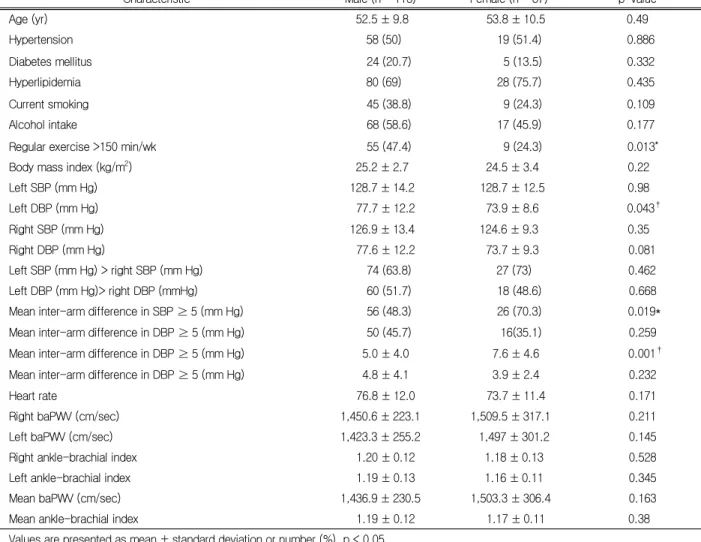
(4) Inter-arm Blood Pressure Difference and Atherosclerosis. in SBP and 4.5 ± 3.7 mm Hg in DBP. There were 46.4% of. 10.5 years in women. The differences between men and. patients with the IAD in SBP of < 5 mm Hg, 32.7% with. women were shown in Table 1.. the 5 ≤ IAD < 10 mm Hg, 17.6% with the 10 ≤ IAD < 15. In women, the prevalence of inter-arm SBP difference. mm, 2.6% with the 15 ≤ IAD 20 mm Hg, 0.7% with the. ≥ 5 mm Hg was higher (48.3% in men and 70.3% in. ≥ 20 mm Hg. There were 58.2% of patients with the IAD. women). Compared with women, men were found to. in DBP of < 5 mm Hg, 34.6% with the 5 ≤ IAD < 10. have more regular exercise habit (47.4% and 24.3%, p =. mm Hg, 5.2% with the 10 ≤ IAD < 15 mm, 1.3% with. 0.013), higher DBP in the left arm (77.7 ± 12.2 mm Hg. the 15 ≤ IAD 20 mm Hg, 0.7% with the ≥ 20 mm Hg.. and 73.9 ± 8.6, p = 0.043), lower IAD in SBP (5.0 ± 4.0 mm Hg and 7.6 ± 4.6 mm Hg, p = 0.001), lower prevalence. 2. Comparison of clinical characteristics between men and female. of IAD in SBP ≥ 5 mm Hg (48.3% and 70.3%, p = 0.019).. The mean age was 52.5 ± 9.8 years in men and 53.8 ±. Table 1. Baseline clinical characteristics of the study subjects (n = 153) Characteristic Age (yr). Male (n = 116). Female (n = 37). p-value. 52.5 ± 9.8. 53.8 ± 10.5. Hypertension. 58 (50). 19 (51.4). 0.886. Diabetes mellitus. 24 (20.7). 5 (13.5). 0.332. Hyperlipidemia. 80 (69). 28 (75.7). 0.435. Current smoking. 45 (38.8). 9 (24.3). 0.109. Alcohol intake. 68 (58.6). 17 (45.9). 0.177. Regular exercise >150 min/wk. 55 (47.4). 9 (24.3). 0.013*. 2. Body mass index (kg/m ). 0.49. 25.2 ± 2.7. 24.5 ± 3.4. 0.22. Left SBP (mm Hg). 128.7 ± 14.2. 128.7 ± 12.5. 0.98. Left DBP (mm Hg). 77.7 ± 12.2. 73.9 ± 8.6. Right SBP (mm Hg). 126.9 ± 13.4. 124.6 ± 9.3. Right DBP (mm Hg). 0.043† 0.35. 77.6 ± 12.2. 73.7 ± 9.3. 0.081. Left SBP (mm Hg) > right SBP (mm Hg). 74 (63.8). 27 (73). 0.462. Left DBP (mm Hg)> right DBP (mmHg). 60 (51.7). 18 (48.6). 0.668. Mean inter-arm difference in SBP ≥ 5 (mm Hg). 56 (48.3). 26 (70.3). 0.019*. Mean inter-arm difference in DBP ≥ 5 (mm Hg). 50 (45.7). 16(35.1). 0.259. Mean inter-arm difference in DBP ≥ 5 (mm Hg). 5.0 ± 4.0. 7.6 ± 4.6. 0.001†. Mean inter-arm difference in DBP ≥ 5 (mm Hg). 4.8 ± 4.1. 3.9 ± 2.4. 0.232. Heart rate. 76.8 ± 12.0. 73.7 ± 11.4. 0.171. Right baPWV (cm/sec). 1,450.6 ± 223.1. 1,509.5 ± 317.1. 0.211. Left baPWV (cm/sec). 1,423.3 ± 255.2. 1,497 ± 301.2. 0.145. 1.18 ± 0.13. 0.528. 1.16 ± 0.11. 0.345. Right ankle-brachial index Left ankle-brachial index Mean baPWV (cm/sec) Mean ankle-brachial index. 1.20 ± 0.12 1.19 ± 0.13 1,436.9 ± 230.5 1.19 ± 0.12. 1,503.3 ± 306.4 1.17 ± 0.11. Values are presented as mean ± standard deviation or number (%). p < 0.05. SBP, systolic blood pressure; DBP, diastolic blood pressure; baPWV, brachial-ankle pulse wave velocity. * By chi-square test. †By independent-test.. 74 The Korean Society of Hypertension. 0.163 0.38.
(5) Yun-Jin Kim et al.. Table 2. Comparison of groups with and without in systolic blood pressure between arms 5 mm Hg or more Variable Age (yr). Mean interarn difference in SBP < 5 Mean interarn difference in SBP ≥ 5 (n = 71) (n = 82). p-value 0.012*. 50.6 ± 9.8. 54.6 ± 9.8. Male. 60 (84.5). 56 (68.3). Hypertension. 30 (42.3). 47 (57.3). 0.063. Diabetes mellitus. 12 (16.9). 17 (20.7). 0.547. Hyperlipidemia. 47 (66.2). 61 (74.4). 0.267. Current smoking. 29 (40.8). 25 (30.5). 0.181. Alcohol intake. 42 (59.2). 43 (52.4). 0.404. Regular exercise > 150 min/wk Body mass index (kg/m2) Left SBP (mm Hg). 0.019†. 26 (36.6). 38 (46.3). 0.224. 25.1 ± 3.1. 25.0 ± 2.7. 0.804. 126.3 ± 12.2. 130.8 ± 14.8. 0.044*. Left DBP (mm Hg). 77.0 ± 11.2. 76.7 ± 11.8. 0.873. Right SBP (mm Hg). 125.5 ± 12.0. 127.2 ± 13.8. 0.416. Right DBP (mm Hg). 77.1 ± 11.2. 76.3 ± 12.1. 0.678. Mean SBP (mm Hg). 125.09 ± 12.0. 129.0 ± 13.6. 0.139. Mean DBP (mm Hg). 77.0 ± 10.8. 76.5 ± 11.6. 0.765. 44 (62). 57 (69.5). 0.004†. Left SBP (mm Hg) > right SBP (mm Hg) Left DBP (mm Hg) > right DBP (mm Hg) Mean inter-arm difference in DBP (mm Hg) Heart rate. 39 (54.9). 39 (47.6). 0.560. 4.2 ± 4.2. 4.8 ± 3.3. 0.337. 76 ± 11.1. 76 ± 12.7. 0.965. Right baPWV (cm/sec). 1,414.4 ± 194.1. 1,508.5 ± 282.6. 0.019*. Left baPWV (cm/sec). 1,394.2 ± 193.7. 1,481.7 ± 314.0. 0.043*. Right ankle-brachial index. 1.2 ± 0.1. 1.2 ± 0.1. 0.954. Left ankle-brachial index. 1.17 ± 0.1. 1.19 ± 0.1. 0.494. 1,404.3 ± 189.5. 1,495.1 ± 289.4. 0.025*. 1.18 ± 0.1. 1.19 ± 0.1. 0.72. Mean baPWV (cm/sec) Mean ankle-brachial index. Values are presented as mean ± standard deviation or number (%). p < 0.05. SBP, systolic blood pressure; DBP, diastolic blood pressure; baPWV, brachial-ankle pulse wave velocity. * By independent t-test. †By chi-square test.. 3. Comparison of groups with and without in diastolic blood pressure between arms 5 mm Hg or more Compared with group with an inter-arm SBP difference less than 5 mm Hg, group with an inter-arm SBP differ-. ter-arm DBP difference more than 5 mm Hg was shown to be higher proportion of patient whose left arm DBP was higher than right (46% and 57.6%, p = 0.002), higher the difference of IABP in SBP (4.6 ± 3.6 mm Hg and 6.9 ± 4.8 mm Hg, p = 0.003) (Table 3).. ence more than 5 mm Hg were more older (50.6 ± 9.8 years and 54.6 ± 9.8 years, p = 0.012), higher proportion of patient whose left arm SBP was higher than right (62% and 69.5%, p = 0.004), higher left arm SBP (126.3. 4. Correlation between the inter-arm blood pressure difference and mean ankle-brachial index, mean brachial-ankle pulse wave velocity. ± 12.2 mm Hg and 130.8 ± 14.8 mm Hg, p = 0.044),. In the correlation analysis, an inter-arm SBP difference. higher mean baPWV (1,404.3 ± 189.5 and 1,495.1 ±. was not found to be significantly associated with age (r. 289.4, p = 0.025) (Table 2). In DBP, group with an in-. = 0.152, p = 0.06), mean SBP (r = 0.113, p = 0.165),. J Korean Soc Hypertens 2013;19(3):71-80. 75.
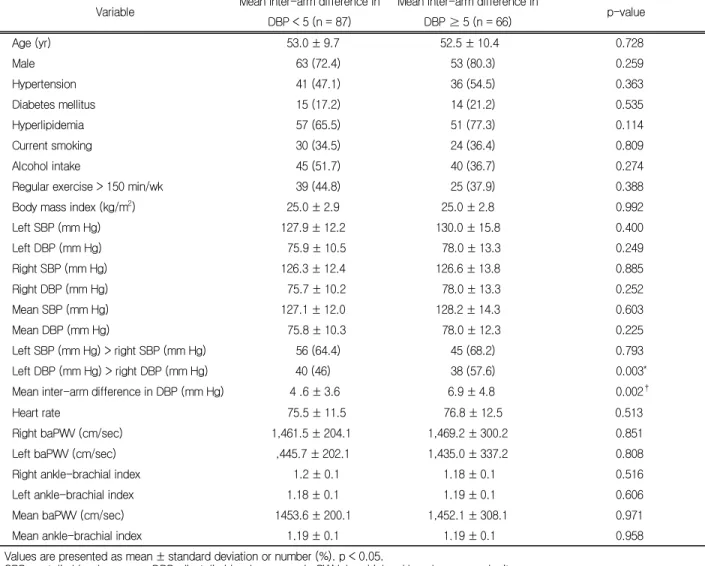
(6) Inter-arm Blood Pressure Difference and Atherosclerosis. Table 3. Comparison of groups with and without in DBP between arms 5 mm Hg or more Variable. Mean inter-arm difference in. Mean inter-arm difference in. DBP < 5 (n = 87). DBP ≥ 5 (n = 66). 53.0 ± 9.7. Age (yr). p-value. 52.5 ± 10.4. 0.728. Male. 63 (72.4). 53 (80.3). 0.259. Hypertension. 41 (47.1). 36 (54.5). 0.363. Diabetes mellitus. 15 (17.2). 14 (21.2). 0.535. Hyperlipidemia. 57 (65.5). 51 (77.3). 0.114. Current smoking. 30 (34.5). 24 (36.4). 0.809. Alcohol intake. 45 (51.7). 40 (36.7). 0.274. Regular exercise > 150 min/wk. 39 (44.8). 25 (37.9). 0.388. 25.0 ± 2.9. 25.0 ± 2.8. 0.992. Left SBP (mm Hg). 127.9 ± 12.2. 130.0 ± 15.8. 0.400. Left DBP (mm Hg). 75.9 ± 10.5. 78.0 ± 13.3. 0.249. Right SBP (mm Hg). 126.3 ± 12.4. 126.6 ± 13.8. 0.885. Right DBP (mm Hg). 75.7 ± 10.2. 78.0 ± 13.3. 0.252. Mean SBP (mm Hg). 127.1 ± 12.0. 128.2 ± 14.3. 0.603. Mean DBP (mm Hg). Body mass index (kg/m2). 75.8 ± 10.3. 78.0 ± 12.3. 0.225. Left SBP (mm Hg) > right SBP (mm Hg). 56 (64.4). 45 (68.2). 0.793. Left DBP (mm Hg) > right DBP (mm Hg). 40 (46). 38 (57.6). 0.003*. 4 .6 ± 3.6. 6.9 ± 4.8. 0.002†. Mean inter-arm difference in DBP (mm Hg) Heart rate. 75.5 ± 11.5. 76.8 ± 12.5. 0.513. Right baPWV (cm/sec). 1,461.5 ± 204.1. 1,469.2 ± 300.2. 0.851. Left baPWV (cm/sec). ,445.7 ± 202.1. 1,435.0 ± 337.2. 0.808. Right ankle-brachial index. 1.2 ± 0.1. 1.18 ± 0.1. 0.516. Left ankle-brachial index. 1.18 ± 0.1. 1.19 ± 0.1. 0.606. 1453.6 ± 200.1. 1,452.1 ± 308.1. 0.971. 1.19 ± 0.1. 1.19 ± 0.1. 0.958. Mean baPWV (cm/sec) Mean ankle-brachial index. Values are presented as mean ± standard deviation or number (%). p < 0.05. SBP, systolic blood pressure; DBP, diastolic blood pressure; baPWV, brachial-ankle pulse wave velocity. * By chi-square test. †By independent-test.. Table 4. Correlation between mean inter-arm difference in BP and ABI, baPWV, and other variables Variable. Mean inter-arm difference in SBP (mm Hg) Correlation coefficient (r). p-value. Mean inter-arm difference in DBP (mm Hg) Correlation coefficient (r). p-value*. Age. 0.152. 0.060. 0.030. 0.715. Mean SBP. 0.113. 0.165. 0.023. 0.780. Mean DBP. 0.019. 0.813. 0.086. 0.291. Mean ABI. 0.021. 0.801. 0.131. 0.105. Mean baPWV. 0.115. 0.158. 0.068. 0.403. ABI, ankle-brachial pressure index; SBP, systolic blood pressure; DBP, diastolic blood pressure; baPWV, brachial-ankle pulse wave velocity. By Pearson’s correlation analysis.. *. mean DBP (r = 0.019, p = 0.813), mean ABI (r = 0.021,. nificantly associated with age (r = 0.03, p = 0.715), mean. p = 0.801), mean baPWV (r = 0.115, p = 0.158). Also. SBP (r = 0.023, p = 0.780), mean DBP (r = 0.086, p =. an inter-arm DBP difference was not shown to be sig-. 0.219), mean ABI (r = 0.131, p = 0.105), mean baPWV. 76 The Korean Society of Hypertension.
(7) Yun-Jin Kim et al.. (r = 0.068, p = 0.403) (Table 4).. SBP difference was associated with female gender, hypertension, high BMI, ABI < 0.9, and high baPWV.. Discussion. Their findings were consistent with our study results that female gender, high baPWV were correlated with in-. We investigated the association between the differences. ter-arm SBP difference. In studies with Kimura19) and. of IABP, simultaneously measured in both arm and ABI,. Lane,16) gender was not a significant factor of inter-arm. PWV or cardiovascular risk factors. In our study, more. SBP difference. However, our study showed that female. than half of the patients, the IAD of SBP were more than. gender was one of factors for an inter-arm SBP differ-. 5 mm Hg and about 20.9% (SBP) and 7.2% (DBP) of. ence of 5 mm Hg or more. More elderly and hyper-. the patients, the IAD of BP were more than 10 mm Hg.. lipidemic female patients were enrolled in our study and. These results were similar to that of the study by Clark. these differences might influence the results. Further. et al.15) (19% in SBP and 7% in DBP). But the differ-. studies are necessary to identify the association and pos-. 16,17,18). ac-. sible mechanisms between inter-arm SBP difference and. cording to the studies. Right arm BP was significantly. female gender. Also, our study found that group with an. higher than left in our study and these results consistent. inter-arm SBP difference 5 mm Hg or more showed. ences were reported widely from 1.4% to 39%. 19,20). but several studies reported op-. higher baPWV than group with an inter-arm SBP differ-. posite results.16,21) However, most studies reported that. ence less than 5 mm Hg. Arterial stiffness plays an im-. right or left handedness was not related to the differences. portant role in the atherosclerotic process and can be esti-. of IABP.17,22,23) These different results between studies. mated non-invasively with PWV24,25) and higher PWV. may be due to the diversity of methodology. They meas-. has been accepted as a predictor of CVD. Therefore, these. ured BP sequentially rather than simultaneously, used. finding suggested that inter-arm SBP difference might be. mercury sphygmomanometers and inter-observer varia-. used as an important potential marker of CVD. But there. bility also may influence the results. Regarding to the. were no reports about the quantitative correlation be-. handedness, theoretically, if the muscles in dominant arm. tween the differences of simultaneously measured IABP. are more developed, it might take more pressure in the. and ABI or baPWV. In contrast with our results, some. right arm cuff to overcome tissue inertia. Hence, in right. studies2,15,19) showed that low ABI, ABI less than 0.9, or. handed people, BP in the right arm might be measured. high baPWV was correlated with inter-arm SBP difference.. slightly higher than the left arm. In contrast, higher BP. These results might be due to the prevalence of patients. in the left arm might be explained that the arteries of the. in our study that the number of patient with ABI less. left arm are closer to the heart, which sometimes causes. than 1.0 was very low (no patients with ABI less than 0.9). a difference. Namely, respective small differences of ana-. and PWV was relatively lower than earlier studies.14,26). tomical structures and hemodynamic profiles might influ-. Our study has some limitations. First, regional varia-. ence the bilateral BP disparity. In addition, we revealed. tions cannot be excluded since we selected subjects who. that advanced age, higher left arm SBP, high baPWV. visited outpatient clinic of local university hospital and. were associated with an inter-arm SBP difference of 5. then, our study results cannot be generalized to all. mm Hg or more. Su et al.13) had shown that inter-arm. Korean population. Second, the number of enrolled pa-. with earlier studies,. J Korean Soc Hypertens 2013;19(3):71-80. 77.
(8) Inter-arm Blood Pressure Difference and Atherosclerosis. tients was too small. Third, as a cross-sectional study, it. 람들은 제외하였다. 양팔 혈압은 자동화혈압계를 이용하. had limitation to reveal relations among variables. Forth,. 여 동시에 측정하였고, 이외 신체계측과 병력을 조사하였. information about right or left handedness was not. 다. 양팔 혈압의 차이 5 mm Hg를 기준으로 두 그룹으로. 25). obtained. However, Kim et al.. reported that IABP was. not related with right or left handedness.. 분류하여 여러 인자들을 비교하였고 혈압 차이와 ABI, baPWV 간의 상관관계를 분석하였다.. Previous studies measured BP sequentially rather than. 결과: 대상자의 평균 연령은 52.8 ± 9.9세이며 양팔 혈. simultaneously and used different methods with various. 압의 차이는 수축기에서 5.6 ± 4.3 mm Hg, 이완기에서 4.5. measuring instruments, they could not reflect real differ-. ± 3.7 mm Hg이었다. 양팔 간 수축기혈압이 5 mm Hg 이상인. ence of IABP. Whereas, in ours study, we measured both. 경우 그렇지 않은 경우에 비하여 나이가 많았고(p = 0.012),. arm BP simultaneously with a use of automatic sphyg-. 왼쪽의 수축기혈압이 오른쪽보다 높은 사람의 비율이 많았. momanometers, which might reflect the real IABP difference.. 으며(p = 0.004), 왼쪽의 수축기혈압이 높았고(p = 0.044),. Lohmann et al.26) reported that simultaneously measured. baPWV가 유의하게 높았다(p = 0.025). 하지만 수축기 또. BP for both arms with automatic device were more accu-. 는 이완기 양팔 혈압 차이와 나이(r = 0.152, p = 0.06 and. rate than sequentially and manually measured BP for. r = 0.03, p = 0.715), ABI (r = 0.021, p = 0.801 and r =. each arm in subjects with cardiovascular risk factors.. 0.131, p = 0.105), baPWV (r = 0.115, p = 0.158 and r =. In conclusion, we can screen the patients at risk of. 0.068, p = 0.403) 간의 상관관계는 보이지 않았다.. atherosclerosis with a use of inter-arm SBP and DBP dif-. 결론: 심혈관질환이 없는 비교적 건강한 성인의 반수. ferences in primary practice. And then, in primary care,. 이상에서 5 mm Hg 이상의 양팔 간의 혈압 차이를 보였. bilateral BP measurements should be applied as a routine. 지만, 양팔 혈압의 차이와 ABI, baPWV 간의 의미 있는. assessment to measure the BP.. 상관관계를 보이지는 않았다.. Summary 연구배경: 양팔 간의 혈압 차이가 동맥경화도 및 심혈 관질환 위험도와 관련이 있다고 알려져 있지만 이제까지. Conflict of interest No potential conflict of interest relevant to this article was reported.. 의 연구들은 양팔의 혈압을 동시에 측정하지 않아 실제 양팔 혈압의 차이를 반영하는 데 한계가 있다. 이에 본 연. Acknowledgements. 구는 양팔의 혈압을 동시에 잴 수 있는 측정기기를 이용 하여 양팔의 혈압 차이와 ankle brachial index (ABI), brachial ankle pulse wave velocity (baPWV)와의 연관성. This work was supported by a 2-year Research Grant of Pusan National University.. 을 알아보고자 하였다.. References. 방법: 부산대학교병원 가정의학과 외래를 방문했던 18세 이상의 남자 116명, 여자 37명의 병원기록을 분석하였다.. 1. O’Brien E, Beevers DG, Marshall HJ. General principles of. 대상자는 양팔의 혈압을 측정한 같은 날 ABI와 baPWV. blood pressure measurement. In: O’Brien E, Beevers DG,. 를 검사하였던 사람들로 이 중 심혈관질환이나 상완의 손. Marshall HJ, editors. ABC of hypertension. London: BMJ. 상, 의미 있는 판막질환, 부정맥, 말초혈관질환을 가진 사. Books, 1995: 3-8.. 78 The Korean Society of Hypertension.
(9) Yun-Jin Kim et al.. 2. Clark CE, Campbell JL, Powell RJ. The interarm blood pressure difference as predictor of cardiovascular events in patients with hypertension in primary care: cohort study. J Hum Hypertens. 2007;21:633-8. 3. Banks MJ, Erb N, George P, Pace A, Kitas GD. Hypertension is not a disease of the left arm: a difficult diagnosis of hypertension in Takayasu’s arteritis. J Hum Hypertens. 2001;15: 573-5. 4. Pickering TG, Hall JE, Appel LJ, Falkner BE, Graves J, Hill MN, et al. Recommendations for blood pressure measurement in humans and experimental animals: Part 1: blood pressure measurement in humans: a statement for professionals from the Subcommittee of Professional and Public Education of the American Heart Association Council on High Blood Pressure Research. Hypertension. 2005;45:142-61. 5. The Korean Society of Hypertension. Blood pressure monitoring guidelines [Internet]. Seoul: The Korean Society of Hypertension; 2007 [cited 2012 Nov 20]. Available from: http://www.koreanhypertension.org/board/list.html?num=2 80&start=0&sort=top%20desc,reg_dt%20desc&code=info02& key=&keyword=. 6. Applegate WB. Ankle/arm blood pressure index: a useful test for clinical practice? JAMA. 1993;270:497-8. 7. Fishbane S, Youn S, Kowalski EJ, Frei GL. Ankle-arm blood pressure index as a marker for atherosclerotic vascular diseases in hemodialysis patients. Am J Kidney Dis. 1995;25: 34-9. 8. Kim NH, Jeong JW, Choi JH, Song M, Park EM, Kim YK et al. Effect of hemodynamic changes on pulse wave velocity. Korean Hypertension J. 2006;12:16-22. 9. Boutouyrie P, Tropeano AI, Asmar R, Gautier I, Benetos A, Lacolley P, et al. Aortic stiffness is an independent predictor of primary coronary events in hypertensive patients: a longitudinal study. Hypertension. 2002;39:10-5. 10. Kitahara T, Ono K, Tsuchida A, Kawai H, Shinohara M, Ishii Y, et al. Impact of brachial-ankle pulse wave velocity and ankle-brachial blood pressure index on mortality in hemodialysis patients. Am J Kidney Dis. 2005;46:688-96. 11. Clark CE, Powell RJ. The differential blood pressure sign in general practice: prevalence and prognostic value. Fam Pract. 2002;19:439-41. 12. Clark CE, Campbell JL, Evans PH, Millward A. Prevalence and clinical implications of the inter-arm blood pressure difference: a systematic review. J Hum Hypertens. 2006;20:. 923-31. 13. Su HM, Lin TH, Hsu PC, Chu CY, Lee WH, Chen SC, et al. Association of interarm systolic blood pressure difference with atherosclerosis and left ventricular hypertrophy. PLoS One. 2012;7:e41173. 14. Kim KB, Oh MK, Kim HG, Ki JH, Lee SH, Kim SM. Inter-arm differences in simultaneous blood pressure measurements in ambulatory patients without cardiovascular Diseases. Korean J Fam Med. 2013;34:98-106. 15. Clark CE, Campbell JL, Powell RJ, Thompson JF. The inter-arm blood pressure difference and peripheral vascular disease: cross-sectional study. Fam Pract. 2007;24:420-6. 16. Lane D, Beevers M, Barnes N, Bourne J, John A, Malins S, et al. Inter-arm differences in blood pressure: when are they clinically significant? J Hypertens. 2002;20:1089-95. 17. Singer AJ, Hollander JE. Blood pressure: assessment of interarm differences. Arch Intern Med. 1996;156:2005-8. 18. Eguchi K, Yacoub M, Jhalani J, Gerin W, Schwartz JE, Pickering TG. Consistency of blood pressure differences between the left and right arms. Arch Intern Med. 2007;167: 388-93. 19. Kimura A, Hashimoto J, Watabe D, Takahashi H, Ohkubo T, Kikuya M, et al. Patient characteristics and factors associated with inter-arm difference of blood pressure measurements in a general population in Ohasama, Japan. J Hypertens. 2004; 22:2277-83. 20. Harrison EG, Roth GM, Hines EA. Bilateral indirect and direct arterial pressures. Circulation. 1960;22:419-36. 21. Arnett DK, Tang W, Province MA, Oberman A, Ellison RC, Morgan D, et al. Interarm differences in seated systolic and diastolic blood pressure: the Hypertension Genetic Epidemiology Network study. J Hypertens. 2005;23:1141-7. 22. Kim SJ, Jung IC, Lee BA, Woo KW, Lee SW, Hong YS. Assessment of disparity in the blood pressure of both arms. J Korean Soc Emerg Med. 2003;14:241-50. 23. Orme S, Ralph SG, Birchall A, Lawson-Matthew P, McLean K, Channer KS. The normal range for inter-arm differences in blood pressure. Age Ageing. 1999;28:537-42. 24. Hansen TW, Li Y, Staessen JA, Jeppesen J, Rasmussen S, Wang JG, et al. Independent prognostic value of the ambulatory arterial stiffness index and aortic pulse wave velocity in a general population. J Hum Hypertens. 2008;22:214-6. 25. Kim DY, Kong SY, Lee SJ, Song HD, Han EJ, Yang JH, et al.. J Korean Soc Hypertens 2013;19(3):71-80. 79.
(10) Inter-arm Blood Pressure Difference and Atherosclerosis. Determinants of follow-up changes of brachial ankle pulse wave velocity in Korean women. J Korean Soc Hypertens. 2012;18:154-65. 26. Lohmann FW, Eckert S, Verberk WJ. Interarm differences in. 80 The Korean Society of Hypertension. blood pressure should be determined by measuring both arms simultaneously with an automatic oscillometric device. Blood Press Monit. 2011;16:37-42..
(11)
수치

관련 문서
The study is focused on how brachial-ankle pulse wave velocity (baPWV) is related to cardiovascular disease risk factors in patients with acute stroke.. The results are as
Objectives: We evaluated the association between common carotid artery intima-media thickness (CCA-IMT), brachial- ankle pulse wave velocity (baPWV), carotid plaque,
Relationship between coronary artery plaque composition and brachial-ankle pulse wave velocity in patients with coronary artery disease. 중앙대학교 병원 순환기내과
And VC is associated with arterial stiffness.The objective of this study was to evaluate the association of iPTH levels with brachial-ankle pulse wave velocity (baPWV) and
ankle brachial pressure index, baPWV: brachial-ankle pulse wave velocity, BMI: body mass index, BP: blood pressure, HDL: high density lipoprotein, LDL: low density lipoprotein, BNP:
Although the age-adjusted Framingham risk score (AFRS), flow-mediated dilation (FMD), brachial-ankle pulse wave velocity (baPWV), high-sensitivity C-reactive protein (hsCRP),
The aim of this study was to determine the normal value of brachial-ankle pulse wave velocity (baPWV) and carotid-femoral pulse wave velocity (cfPWV) according to age group,
BMI, body mass index; Smoking, current smoker; ABI, Ankle-Brachial pressure index; ba-PWV, brachial Ankle pulse wave velocity; BP, blood pressure; HDL, high
