Postgraduate Students’ Use of E-Resources in Nigerian
University Libraries: What is the Influence of User Education?
Open Access
Accepted date: September 7, 2016 Received date: May 16, 2016
*Corresponding Author: Daniel Abubakar University of Jos Library, Jos, Nigeria E-mail: [email protected]
All JISTaP content is Open Access, meaning it is accessible online to everyone, without fee and authors’ permission. All JISTaP content is published and distributed under the terms of the Creative Commons Attribution License (http:/ creativecommons. org/licenses/by/3.0/). Under this license, authors reserve the copyright for their content; however, they permit anyone to unrestrictedly use, distribute, and reproduce the content in any medium as far as the original authors and source are cited. For any reuse, redistribution, or reproduction of a work, users must clarify the license terms under which the work was produced.
ABSTRACT
Introduction. Inadequate methods for acquiring user education could affect the level of library user education
possessed by postgraduate students, and ultimately influence the purposes of their usage of e-resources provided in their university libraries. Despite the global acceptance that e-resources are contributing to postgraduate stu-dent’s research work, however, it has been documented that there is low use of e-resources in university libraries in Nigeria among postgraduate students. This drift could have negative consequences on their overall develop-ment. Therefore, this study determined how influential library user education is on the use of e-resources by post-graduate students in Nigerian university libraries.
Methods. A survey research design and multi-stage sampling technique was adopted to select 2,726 from 54,578
postgraduate students from four faculties in 16 federal conventional universities in Nigeria. The data set was col-lected using a questionnaire and an interview schedule for e-resources librarians/system librarians and was anal-ysed using percentage and Pearson’s product moment correlation.
Results. The majority of the students were at the Master’s level (57.5%). The gender shows a ratio of 59.0% male
and 41.0% female. Most Nigerian students enrol for postgraduate programmes in their thirties ‘30-39’ years. The use of e-resources by the postgraduates was low (weighted average of 2.45). The relationship between level of library user education and postgraduate students’ use of e-resources was positive, slightly strong, and significant (r = 318; df = 2284; p< .05).
Conclusion. User education has positively inclined postgraduate students to the use of e-resources in their
librar-ies. Therefore, libraries should employ all methods for acquiring user education for postgraduate students. Keywords: Postgraduate Students, University Libraries, Use of E-resources, User Education
Daniel Abubakar *
University of Jos Library, Jos, Nigeria E-mail: [email protected]
Airen Adetimirin
Department of Library, Archival and Information Studies University of Ibadan, Ibadan, Nigeria
E-mail: [email protected]
1. INTRODUCTION
E-resources are becoming increasingly available in university libraries in Nigeria, facilitating postgradu-ates’ access and use of current and relevant literature for their studies and research. Since a decade ago, a paradigm shift has been noticed in collection devel-opment policies and practices in university libraries in Nigeria, with the purchase of print resources decreas-ing and those of e-resources increasdecreas-ing (Okiki & Asiru, 2011). Sharma (2009) noted that students are looking for convenient and time saving responses as they move from using physical materials to e-resources in their libraries. The university library is the academic heart of the university system and its basic purpose is to pro-vide its immediate users with resources, services, and facilities that facilitate teaching, learning, and research.
The users of university libraries include students (undergraduates and postgraduates) and staff. Post-graduate students form a vital component of users of library resources due to their research activities. The library’s resources include both print and e-resources. E-resources are information sources that are available and can be accessed electronically through comput-er-networked facilities such as online library cata-logues, the Internet and the World Wide Web (WWW), CD-ROM databases, etcetera. Types and forms of e-re-sources in university libraries include e-journals, e-da-ta archives, e-manuscripts, e-maps, e-books, e-mag-azines, e-theses, WWW, e-newspapers, e-research reports, and e-bibliographic databases (Univ. Chicago Library, 2014).
The benefit of use of e-resources for postgraduate students as identified by Mathew and Sornam (2007) at Kerala Agricultural University, India are as follows: ease of access; availability of accessibility from differ-ent locations; full text can be accessed remotely; they are user-friendly; they meet student needs and expec-tations. However, Sinha et al. (2011) summarised the benefit of e-resource use by postgraduate students as giving easy access and accurate and comprehensive information. Also, Khan et al. (2011) submitted that the purpose of e-resources use among postgraduate students is for studying.
Considering the importance and purpose of e-re-source use by postgraduate students, providing accu-rate and timely information for their research efforts,
this probably explains the underlying principle for the acquisition of e-resources in university libraries. Previous studies have been carried out on the use of e-resources among postgraduate students in university libraries (Swain & Panda 2009; Okiki & Asiru 2011), and in most cases studies show that they ameliorate and fasten student research. Similarly, Bar-llan et al. (2003), in their study on the use of e-journals among postgraduates and academic staff of Israeli universities, submitted that their use increased with time and vari-ables such as age and academic position were inversely related to the use of e-journals. In a related study, Abubakar and Adetimirin (2015) measured the rela-tionship between computer literacy levels of Nigerian postgraduate students and their use of e-resources. The result shows that use was low due to the moderate computer literacy of the students. Indeed, the study was concurrently undertaken with the present study (same methodology, scope, and respondents).
University libraries are however making efforts at determining suitable factors to retrieve information resources for use by users, particularly those postgrad-uate students that are involved in research and other scholarly works. This is with the view to easing their information search, retrieval, and use. However, some postgraduate students may enrol for their studies with little or no education on library services and resources. The education acquired might probably not be ade-quate to enable them to explore and exploit library services and resources for their research, learning, and other scholarly activities. This scenario will pose some degree of impediment during their research work.
The most likely cause of low use of e-resources by postgraduate students in university libraries for their research work is probably lack of user education. Ajala (2007) and Agyen-Gyesi (2008) opined that lack of user education is the major impediment to the use of e-resources by research students. User education is critical for retrieving e-resources for scholarly work. Also, educating library users implies equipping and providing them with training on how to use library tools in order to use e-resources. Cram (2008) defined user education as an attempt to change the behaviour of an individual who will be developing a search strat-egy to retrieve useful information.
and learn searching skills to be able to retrieve and use e-resources for their research. To support this view, Ozoemelem (2009) argued that postgraduate students must acquire and put into practice necessary informa-tion searching skills to be able to retrieve e-resources among postgraduate students of the Department of Library and Information Science of Delta State Uni-versity, Abraka, Nigeria. Mohammadi et al. (2008), citing Clarke (1999), gave credence to these views that student at the postgraduate levels should be giv-en detailed instruction in methods of searching and formulation of clear requests necessary to use library resources. The purchase of e-resources in Nigerian university libraries, particularly in the harsh economic situation the libraries are facing, calls for attention on how these e-resources can be put into judicious use by postgraduate students for their research work.
Some of the postgraduate students might have re-ceived training on user education and probably could search and retrieve e-resources for their research. This might be due to their course of study such as those pursuing degrees in computer and information sciences. For improved academic performance, all postgraduate students are expected to retrieve and use e-resources without hitch and waste of time. This will eliminate aggravation of searching needed information and promote scholarship. Postgraduate students that acquire user education guidance are more likely to lo-cate, retrieve, and use e-resources in maximizing their learning than those without user education instruction (Omelezor, 2010). Nithyanandam et al. (2006) posit that “if study programmes are to be based on the stu-dents’ active search for knowledge, then students must acquire more sound knowledge for searching, evalua-tion and utilisaevalua-tion of scientific and scholarly informa-tion.”
It is generally believed by some researchers such as Ren (2000) and Tella et al. (2007) that one of the caus-es of poor performance of the majority of postgraduate students in universities is inability to effectively use the e-resources in their libraries, which consequently affects their overall scores. E-resources in university libraries should always be available to provide research information needs in addition to complementing study resources. Previous studies have argued that user education is necessary for effectively searching need-ed information in university libraries (Busayo, 2003;
Badu & Markwei, 2005; Mohammadi, Moghaddam, & Yeganeh, 2008; and Omeluzor, 2010) because user education is mainly concerned with communication processes involving the interaction of users with any type of library (Bundy, 1999; Singh & Jindal, 2009).
Bhatti (2010) explored the user education level of postgraduate students in university libraries in Paki-stan and reported that user education was faced with constraints; consequently, students demonstrated low library use and low frequency of use of all types of materials. He recommended that the delivery of user education should be incorporated in the university curriculum, and is not to be treated as a separate sub-ject. This report was similar to those of Singh and Jin-dal (2009), who reported from their study on promot-ing the use of e-resources at Delhi University Library System (DULS) India that graduate students agreed that user education was important for their learning and research. They added that their user education programme has provided a proper platform for direct interaction with library users and posit that a user education programme coupled with robust ICT infra-structure will create high access and usability of e-re-sources. Similarly, McDowell (2002) stated that user education is critical in e-resources usage and needs to be developed taking into account the growing oppor-tunities presented by e-resources within the context of learning.
In order to improve library user education and to produce informational evidence on the importance of this core library service, the Hong Kong Univer-sity of Science and Technology Library, Hong Kong, mandated Wong et al. (2006) to conduct a formal as-sessment on its instruction programme in 2006 for all programmes. A group of 688 users from 25 one-shot sessions were surveyed by a questionnaire from four to eight weeks after the sessions were conducted. Results showed that the majority of attendees remained pos-itive about the usefulness of the library sessions; they retained and used the skills learned; the overall ratings of the library sessions and the instructors were compa-rable to those of the university’s credit course ratings.
library schools in Africa to ascertain whether librari-ans are taking the leading role in the development of user education in universities. His study revealed that only a few library schools have successfully integrat-ed a stand-alone information literacy course into the curriculum. Lwehabura and Stilwell (2008) found that user education is still new in the university curricula in Tanzania. They added that a lack of explicit user ed-ucation policies on how information literacy activities should be conducted has resulted in some existing user education programmes not being allocated official time within university timetables.
In Nigeria, similar studies (Aguolu & Aguolu, 2002; Folorunso et al., 2006) have been carried out on the impact of user education on students’ use of library resources in university libraries. Most of the results revealed that the libraries concentrated on purchasing print materials rather than educating their users for optimal use. Similarly, Ozoemelem (2009) studied the use of e-resources by Library and Information Science (LIS) postgraduate students of Delta State University, Abraka, Nigeria and revealed that the students were not optimally utilizing e-resources because of lack of awareness, and advocated for intensive user education programmes for the postgraduate students. In addi-tion, Popoola and Zaid (2007) reported that many Nigerian university libraries have not been taking user education very seriously, therefore not promoting the use of library products and services. Adeleke and Olorunsola (2010) concluded that the user education training programme offered in Redeemer’s University Library, Nigeria, enabled a good number of students to attain information literacy, but much is needed to be done by both libraries and faculty to attain the desired result of making students information-literate.
The pertinent question is whether university librar-ies derive value for the money invested on e-resources. This question has prompted researchers to place much concern on the paucity of literature on the use of e-re-sources in university libraries. Therefore, to justify the investment on e-resources, it is the library’s respon-sibility to ensure its e-resources are beneficial to its users.
1.1. Research Questions
The following research questions were answered in the study:
(i) What are the methods through which post-graduate students acquired user education in the university libraries?
(ii) What is the level of user education possessed by postgraduate students in federal universi-ties in Nigeria?
(iii) What is the purpose of e-resources usage by postgraduate students in federal university libraries in Nigeria?
(iv) What is the frequency of use of e-resources by postgraduate students in federal university libraries in Nigeria?
1.2. Hypothesis
The following null hypothesis was tested in the study at a 0.05 level of significance:
(i) There is no significant relationship between user education and use of e-resources by post-graduate students in university libraries in Nigeria.
2. METHODOLOGY
3. SIGNIFICANCE OF THE STUDY
The present study is significant in the area of use of e-resources by postgraduate students in Nigerian uni-versity libraries because it has provided the empirical basis for postgraduate students to swing their prefer-ences from print materials to using more of e-resourc-es in their university librarie-resourc-es. This will boost their learning and research activities; in turn, the research output could solve the nation’s social problems and add knowledge for further research efforts. As society’s problems are being solved, there will be development for the nation (Nigeria).
In the area of practice the study is significant because it has revealed the most used types of e-resources in the university libraries, and this will inform university librar-ians on how to invest in the provision of e-resources. In addition, university libraries could benefit by conserving spaces meant to place print materials, thereby utilizing them to create more access points for e-resources use. This will translate into better working conditions for the staff and also cut budgets for printed materials as the university librarians can enter negotiations into e-re-source sharing when more postgraduate students begin
to shift their preferences to e-resource use.
This study will also help library managers/university librarians in the aspect of policy statements on how to improve on e-resource access and utilization by set-ting a conducive e-resource policy use and designing effective products and services in university libraries. It may further provide impetus to designing a better user education method for postgraduate students. The study is further significant because it has added litera-ture on librarianship in the area of user studies.
4. RESULTS AND DISCUSSION
Today, university libraries in Nigeria have incorpo-rated various electronic resources for their collection developments to fulfil the requirements of all cate-gories of library users. The e-resources contain both local and international informational resources and databases such as e-journals, e-books, e-magazines, e-research reports, e-newspapers, and so on. These are essential for the educational process and research. Research activities are performed by postgraduate students and the subscription and use of e-resources Table 1. Samples Selected and Sampling Fraction
S/N University Study Population Sample Size
1 Ahmadu Bello University Zaria 8800 440
2 Bayero University Kano 2481 124
3 University of Abuja 3157 157 4 University of Benin 2002 100 5 University of Calabar 9946 497 6 University of Ibadan 10986 549 7 University of Jos 2641 132 8 University of Lagos 10450 522 9 University of Maiduguri 1692 84
10 Usman Danfodio University Sokoto 2423 121
provided by university libraries in Nigeria will improve such activities.
Among the three levels, the numbers at the master’s level were 1,314 (57.5%), M.Phil./Ph.D. 500 (21.9%), and Ph.D. 471 (20.6%). This reveals that a majority of the postgraduate students in this study were at the master’s level (Table 2). Also, there were 1,348 (59.0%) male postgraduate students and 937 (41.0%) female postgraduate students. Table 2 also indicated that 548 (24.0%) and 420 (18.4%) of the sample were between the ages of ‘30-34’ and ‘35-39’ respectively. Only 6 (0.3%) were above 59 years. This shows that most of the postgraduate students were within ‘30-39’ years.
This implies that most Nigerian students pursue their postgraduate programmes in their thirties.
Research Question 1: What are the methods through
which postgraduate students acquired user education in the university libraries?
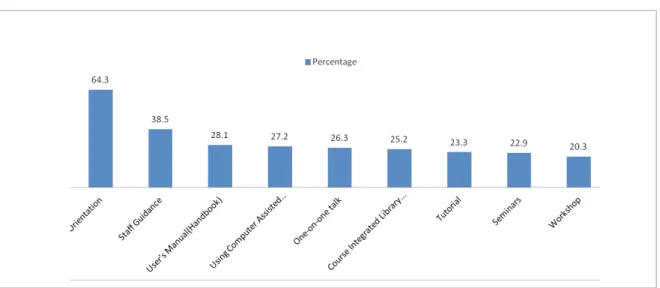
The major methods for acquisition of user education by the postgraduate students were library orientations (N=1,470; 64.3%), user education through library staff guidance (N=880; 38.5%) and users’ manuals or in-formation handbooks (N=643; 28.1%) as presented in Fig. 1. It was found in this study that the major method Table 2. Levels, Gender, and Age Range of Respondents
for acquisition of user education by the postgraduate students was the library orientation, by which the ori-entation is given to fresh students in the universities. It could be argued to be so because fifty percent of the librarians in charge of e-resources/systems librarians interviewed responded that they taught their postgrad-uate students user education via library orientations; few of the e-resources librarians responded that they only create awareness on demand. Yet, some do not teach user education to their postgraduate students at all. Over sixty-four percent of the postgraduate students had acquired user education via a library ori-entation. This percentage is overwhelming as the other methods are of low frequency. This will have negative implications because postgraduate students’ ability to maximise the use of their library’s e-resources will be limited, as methods to learning about the library’s re-sources and facilities were limited.
The other methods for acquiring user education should be inculcated to create a wider sensitisation on the use of the library’s e-resources. In practice today, postgraduate students’ enrolment in universities is growing astronomically and this will pose a challenge to librarians if the library orientation is the major method for user education acquisition. Besides, the purpose of user education programmes is to enable students to patronise libraries for their academic
activ-ities and eventually become sophisticated users of the resources. This finding agrees with Suleiman’s (2012) submission that postgraduate students should attend user education classes apart from other avenues of user education. Ninety percent of his respondents agreed that attending user education classes would enable them find relevant information they need. However, John (2008) argued that library orientation is benefi-cial because it will produce more library users. There-fore, the finding of this study in respect to the major methods of acquiring user education is in consonance with that of John (2008).
Research Question 2: What is the level of user
ed-ucation possessed by postgraduate students in federal universities in Nigeria?
Table 3 (a and b) shows that 16 items out of the 20 items had high mean scores ranging from 2.50 to 2.97. This revealed that most of the items are above the mean of 2.50 of the scale of maximum of 4 points. It thus implied that the postgraduate students’ user education was relatively high. The other four items had low mean scores below the 2.50 mean of the scale. The weighted average of 2.60 summarised the mean scores, implying that the level of user education of the students is slightly above average.
This implies that most of the students had a reason-able level of library user education. This is expected because over fifty-six percent of the postgraduate stu-dents had acquired library user education. In addition, some might have had sound user education at their undergraduate days apart from the library orientation and staff guidance they received at the postgraduate level. Furthermore, 50% of the librarians in charge of e-resources/systems librarians interviewed attested to the fact that their postgraduate students’ user educa-tion was reasonable enough for retrieving e-resources in the library. However, 1% were not categorical but re-sponded that the postgraduate students could retrieve e-resources only if they attend the library orientation. This assertion was validated by Tramullas and Casa-bon (2010), that postgraduate students need to be in-structed on how to exploit and use e-resources because university libraries spent huge sums of money on pro-viding such resources and services. Questions could be asked on why some students use libraries more than others. And why is using some libraries easier than others? Perhaps, the main factor affecting library use is familiarity with how the library, as a whole, can be optimally used. For the postgraduate students to op-timally use the library and its resources, they have to attend the user education programme.
User education programmes are an important aspect of library services because they inform students of the availability, location, and use conditions of e-resources in their libraries. Different, however, is computer lit-eracy that enables the students to retrieve e-resources from computerised systems. Abubakar and Adetimirin (2015) reported among the same set of postgraduate students, using the same methodology and usage of e-resources as the dependent variable, that there is a positive and strong relationship between the students’ use of e-resources and their computer literacy. It can be inferred from this study that the difference between the relationship of “user education and the students’ use of e-resources” and that of “computer literacy lev-els of the students and their use of e-resources” is that user education creates awareness of availability, loca-tion, and conditions of usage, among other instruc-tions, while computer literacy enables students to re-trieve e-resources from computerised systems. In any case, both user education and computer literacy can be considered as twin components for identification and
retrieval of e-resources by the students in their librar-ies. Distinctively, this study measured the influence of user education on postgraduates vis-a-viz their use of e-resources. The level is relatively high, while that of computer literacy was moderate. Another difference is that the researchers were able to rank the purposes of usage of the use of e-resources for this study.
It can be inferred from this finding that in most of the university libraries, user education was given attention and this has come to bear on the postgrad-uate students’ user education level, which was slightly above average. This result is in line with that of Ali-mohammadi and Sajjadi (2008) who submitted that if user education is given attention and organised in university libraries, it will help students locate, retrieve, and use information. Clarcke (1999) reviewed the development of user education within the context of arguments for and against it for postgraduate students and submitted that without user education, university libraries’ investments would be wasted for lack of use. Nevertheless, Agyen-Gyesi (2008) opined that the compartmentalisation of universities into faculties and departments has necessitated the introduction of an enhanced user education because of increases in the amount of literature.
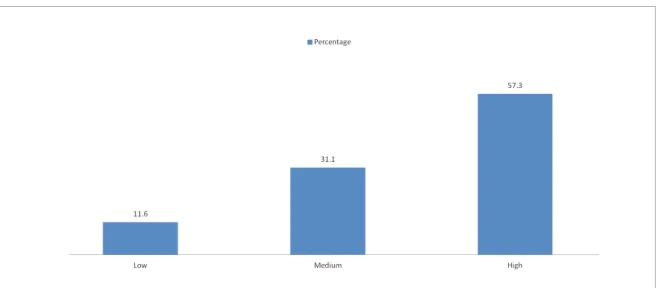
Further analysis revealed the levels of user education of the students using the index mean (x) of 2.50 as cut off points for classification (Fig. 2). Those with mean score lower than the index mean of 2.50 were 265 (11.6%) in number and those with mean score higher than the index mean comprised 1,309 (57.3%) out of the 2,285 postgraduate students. This implies that the students had high library user education.
Research Question 3: What is the purpose of
e-re-sources usage by postgraduate students in federal uni-versity libraries in Nigeria?
Table 3a. Descriptive Statistics of User Education Possessed by Postgraduate Students Item The user education programme enables me to:
SA A D SD x Std
(4) (3) (2) (1) Dev.
N % N % N % N %
1 Use Internet e- resources for my studies 751 32.9 1071 46.9 113 4.9 350 15.3 2.97 1.00 2 Obtain information on topics taught in my class
from the Internet 558 24.4 1065 46.6 228 10.0 434 19.0 2.77 1.02 3 Use Boolean operators (AND, OR, NOT) to
retrieve specific e-resources from the Internet 271 11.9 973 42.6 484 21.2 557 24.4 2.42 0.98 4 Retrieve e-resources by the use of online public
access catalogue (OPAC) 327 14.3 1121 49.1 368 16.1 469 20.5 2.57 0.97 5 Know I can get direct aid from library staff 356 15.6 1125 49.2 231 10.1 573 25.1 2.55 1.03 6 Use reference materials (works) most effectively 419 18.3 1171 51.2 231 10.1 464 20.3 2.68 1.00 7 Choose a topic and formulate a research
question 357 15.6 1153 50.5 205 9.0 570 24.9 2.57 1.03
8 Justify topic choice by placing it in the context of
earlier research 314 13.7 1061 46.4 306 13.4 604 26.4 2.48 1.03 9 Justify topic choice through considering
theoretical framework and methodology 328 14.4 1156 50.6 298 13.0 503 22.0 2.57 0.99 10 Assess project feasibility 309 13.5 1136 49.7 337 14.7 503 22.0 2.55 0.98
Table 3b. Descriptive Statistics of User Education Possessed by Postgraduate Students Item The user education programme enables me to:
SA A D SD x Std
(4) (3) (2) (1) Dev.
N % N % N % N % 11 Understand how information quality is assured
in the publication process 274 12.0 1125 48.2 305 13.3 581 25.4 2.48 1.00 12 Judge the appropriateness of the information
source for the task at hand 363 15.9 992 43.4 287 12.6 643 28.1 2.47 1.06 13 Search in subject-specific sources 341 14.9 1069 46.8 289 12.6 586 25.6 2.51 1.03 14 Master the use of evaluation criteria in a variety
of sources (Websites, academic and popular articles, books)
325 14.2 1012 44.3 417 18.2 531 23.2 2.50 1.00
15 Evaluate e-resources and ascertain the most
useful for my work 587 25.7 955 41.8 331 14.5 412 18.0 2.75 1.03 16 Use and cite bibliographies 438 19.2 1236 54.1 138 6.0 473 20.7 2.72 1.00 17 Be familiar with research ethics and copyright
law 406 17.8 1139 49.8 141 6.2 599 26.2 2.59 1.06
18 Handle and take care of books 445 19.5 1076 47.1 285 12.5 479 21.0 2.65 1.02 19 See the need and obey library regulations 520 22.8 988 43.2 192 8.4 585 25.6 2.63 1.10 20 Know how the library and its facilities are
organized 660 28.9 874 38.2 221 9.7 530 23.2 2.73 1.11
Fig. 2 Level of library user education of postgraduate students
Fig. 3 Purpose of Use of Library E-Resources
postgraduate students whose main courses of study have to do with research and seminar presentations.
Research Question 4: What is the frequency of use
of e-resources by postgraduate students in federal con-ventional university libraries in Nigeria?
postgrad-Table 4. Postgraduate Students’ Use of E-resources S/N In the university library, I use:
Daily Once a week Occasionally Never x Std
(4) (3) (2) (1) Dev. N % N % N % N % 1 E-journals 827 36.2 606 26.5 358 15.7 494 21.6 2.77 1.15 2 E-manuscripts 457 20.0 611 26.7 491 21.5 726 31.8 2.35 1.12 3 E-books 538 23.5 589 25.8 473 20.7 685 30.0 2.43 1.15 4 E- magazines 526 23.0 773 33.8 370 16.2 616 27.0 2.53 1.12 5 E-theses 431 18.9 655 28.7 444 19.4 755 33.0 2.33 1.12 6 E-newspapers 732 3.2 601 26.3 359 15.7 593 26.0 2.64 1.18 7 E- research reports 577 25.3 671 29.4 389 17.0 648 28.4 2.52 1.15 8 E-bibliographic databases 317 13.9 727 31.8 464 20.3 777 34.0 2.26 1.07 9 E-reference sources (dictionaries, etc.) 365 16.0 708 31.0 519 22.7 693 30.3 2.33 1.07
10 E-tutorials 454 19.9 732 32.0 363 15.9 736 32.2 2.40 1.13
11 Other electronic databases 339 14.8 711 31.1 581 25.4 647 28.3 2.32 1.04 Weighted Average =2.45
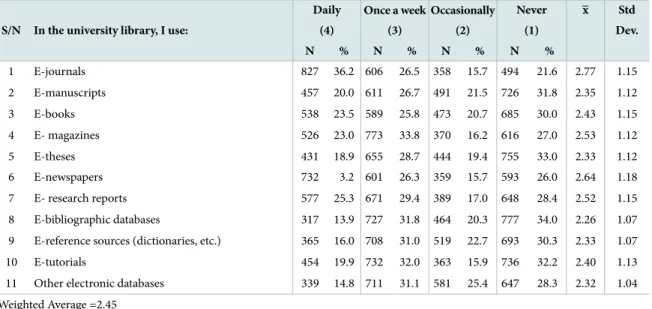
uate students’ frequency of use of e-resources was low. This finding is not cheering to those university li-braries that spent enormous funds to subscribe to e-re-sources for users. The frequency of use of e-ree-re-sources ranges from daily to occasionally. This finding is in harmony with those of Okiki and Asiru (2011) who reported that postgraduate students from the Univer-sities of Lagos, Ibadan, and Ife used e-resources daily, weekly, monthly, and occasionally. But the breakdown generally revealed low frequency of e-resource use by the postgraduate students of the three universities. Among the most used e-resources, the majority of the respondents used them once a week and occasionally, while only a few respondents used e-resources daily.
The low use of e-resources has not reflected student levels of user education. The four e-resources fre-quently used are expected because, worldwide, post-graduate students use them for academic activities. However, the other e-resources are supposedly to be put to use by the students based on their levels of user education. Perhaps, awareness of such e-resources was not given to the students. And even if awareness was given to them, they were not skilled in the use of the 7 e-resources. It was, however, revealed that use of
e-re-sources is not commensurate to investments made in acquiring these resources.
The low use of e-resources by the postgraduate stu-dents has dual implications. First, this will amount to massive failure of funding allocated for the payment of e-resources in the university libraries because the provision of the e-resources was unjustified, for lack of use. Secondly, the postgraduate students’ research output will not be qualitative enough for lack of use of current and standardised information resources. It is clear from the study that the four e-resources were ac-cepted by the postgraduate students, but the frequency of usage of the other 7 e-resources was not found to be at optimum level. Many of the respondents might be unaware and have not used them, perhaps, for their scholarly activities; therefore, the library should take initiatives to organize orientation programmes and user awareness programmes for these 7 e-resources.
Test of hypothesis: There is no significant
Pearson product moment correlation was used to test for this relationship. Table 5 reveals that there is a positive and slightly strong relationship between post-graduate students’ library user education and their use of e-resources (r = .318; df = 2284; p < .05). This rela-tionship, therefore, is significant and means as library user education improves, use of library e-resources also improves. Based on this, the null hypothesis was rejected.
5. CONCLUSION
The use of e-resources by postgraduate students in Federal Conventional University Libraries in Nigeria is essential for promoting scholarships. The postgraduate students’ level of user education was reasonable; how-ever, this did not influence their use of the e-resources in their libraries. It was revealed that due to lack of continuing user education on most e-resources in the libraries, the e-resources were not fully retrieved and used for research and other scholastic works. There-fore, the lack of continuing user education for post-graduate students should be viewed as an obstacle that should be overcome in order to influence the students to fully optimise and benefit from the e-resources pro-vided in their university libraries.
Recommendations
University libraries should employ all methods (library orientations, course integrated library in-struction, staff guidance, user’s manuals, one-on-one talks, tutorial, seminars, workshops, and using com-puter assisted learning) for acquiring user education.
This should be made compulsory for all postgraduate students in order to improve the retrieval and use of e-resources. There should be feedback mechanisms to evaluate user education programmes between the library and the postgraduate students. User education in university libraries should be a continuous pro-gramme which should be tailored not only on the use of available e-resources, but also to make the students information literate.
REFERENCES
Abubakar, D., & Adetimirin, A. (2015). Influence of computer literacy on postgraduates’ use of e-re-sources in Nigerian University libraries. Library
Philosophy and Practice (e-journal), paper 1207,
1-7. Retrieved from http://digitalcommons.unl. edu/libphilprac/1207.
Adeleke, A.A., & Olorunsola, R. (2010). Training in the use of e-resources in academic libraries: One uni-versity’s approach. Library Hi Tech News, 27(6/7), 16-19.
Aguolu, C.C., & Aguolu, I. E. (2002). Libraries and in -formation management in Nigeria: Seminar essays on theses and problems (p. 85). Maiduguri, Nigeria:
Ed-Inform Services.
Agyen-Gyesi, K. (2008). User education at the Kwame Nkrumah University of Science and Technolo-gy (KNUST) Library: Prospects and challenges.
Library Philosophy and Practice. Retrieved from
http://digitalcommons.unl.edu/libphilprac. Ajala, I.O. (2007). Internet awareness, accessibility and
use by undergraduate and postgraduate students
Table 5. Relationship Between Library User Education and Use of e-Resources
Variables Mean Std. Deviation N R Df Sig. (p) Remarks
USER EDUCATION 75.5103 20.7334 2285
.318* 2284 .000 Significant
USE OF E-RESOURCES 41.4871 13.3645 2285
in Nigeria universities: A case study of LAUTECH, Ogbomosho, Nigeria. The Information Technologist
4(2), 147-162.
Alimohammadi, D., & Sajjadi, M. (2006). Library in-struction: Past lessons, future plans. Library
Phi-losophy and Practice 9(1). Retrieved from http://
digitalcommons.unl.edu/libphilprac/99.
Badu, E. E., & Markwei, E. D. (2005). Internet aware-ness and use in the University of Ghana. SAGE
Journal Online, 21(4), 260-268.
Bar-Ilan, J., Bluma C., & Wolman, Y. (2003). A survey of the use of electronic databases and electronic journals accessed through the web by the academic staff of Israeli universities. Journal of Academic Li -brarianship, 29(6), 346-61.
Baro, E. E. (2011). A survey of information literacy ed-ucation in library schools in Africa. Library Review,
60(3), 202-217.
Bhatti, R. (2010). An evaluation of user-education pro-grammes in the university libraries of Pakistan. Library Philosophy and Practice. Retrieved from www.webpages.uidaho.edu/~mbolin/bhatti2.htm. Bundy, A. (1999). Information literacy: the 21st century
educational smart card. Australian Academic and
research Libraries, 30:4, 233-250. DOI:10.10801000
48623.1999.10755099.
Busayo, I. O. (2003). Use of library as a requisite course: A survey of the perception of University of Ado Ekiti freshmen. Gateway Library Journal 6(1), 44-52.
Clarcke, R. (1999). User education at Main Library of the University of West Indies, St. Augustine: A his-torical chronicle. Library Review, 48(5), 242-250. Cram, L. (2008). What is user education? University
of South Australia. Retrieved from www.unisanet.
unisa.edu.au/012561/Seminars/Week_9.htm. Folorunso, O., Ogunseye, O. S., & Sushil, S. K. (2006).
An exploratory study of the critical factors affect-ing the acceptability of e-learnaffect-ing in Nigerian Uni-versities. Information management and Computer
Security, 14(5), 496-505.
John, W. (2008). The effect of library orientation on student usage of the library. Library Hi-tech News,
25(1), 27-29.
Khan, S. A., Khan, A. A., & Bhatti, R. (2011). Internet access, use and gratification among university students: A case Study of the Islamia University of
Bahawalpur, Pakistan. Chinese Librarianship: an
International Electronic Journal, 31. Retrieved from
http://www.iclc.us/cliej/cl32KKB.pdf.
Lwehabura, M. J., & Stilwell, C. (2008). Information literacy in Tanzanian universities: Challeng-es and opportunitiChalleng-es. Journal of
Librarian-ship and Information Science, 40(3): 179-191.
DOI:10:1177/0961000608092553.
Mathew, S., & Sornam, S. A. (2007). Use of e-resources among postgraduate students of Kerala Agricultur-al University. Kelpro Bulletin, 1(2), 13-24.
McDowell, L. (2002). Electronic information resources in undergraduate education: An exploratory study of opportunities for student learning and indepen-dence. British Journal of Educational Technology,
3(3), 255-266.
Mohammadi, M., Moghaddam, A.I., & Yeganeh, M. E. (2008). Students’ perception of the impact of user education on the use of reference resources: An Iranian experience. Library Philosophy and Practice
(e-journal), paper 199. Retrieved from
http://digi-talcommons.unl.edu/libphilprac/199.
Mugyabuso, J. L., & Stilwell, C. (2008). Information literacy in Tanzanian universities: Challenges and potential opportunities. Journal of Librarianship
and Information Science, 40(3), 179-191.
Nithyanamdam, K., Kanniyappan, E., Arul Dhanakar, M., & Rajasekar, V. (2006). User education pro-grammes and academic libraries. 4th International
Convention CALIBER – 2006, Gulbarga, INFLIB-NET Centre, Ahmedabad.
Okiki, O. C., & Asiru, S. M. (2011). Use of electronic information sources by postgraduate students in Nigeria: Influencing factors. Library philosophy and
Practice (e-journal). Retrieved from
http://digital-commons.unl.edu/libphilprac.
Omeluzor, S. U. (2010). User education and use of library at Babcock University, Nigeria. The Free
Online Library. Retrieved from
http://www.the-freelibrary.com .
Ozoemelem, O. A. (2009). Use of electronic resources by postgraduate students of the Department of Library and Information Science of Delta State University, Abraka, Nigeria. Library Philosophy and
Practice (e-journal) . Retrieved from
http://digital-commons.unl.edu/libphilprac.
and use of library information products and ser-vices in Nigerian universities. Library progress
(In-ternational), 2(2), 127-137.
Ren, W. (2000). Library instruction and college student self-sufficiency in electronic information searching.
Journal of Academic Librarianship, 26(5), 323-328.
Singh, R., & Jindal, S. C. (2009). Promoting the use of E-resources and research. 7th International
CALI-BER, held at Uppsala, Sept. 27-29. Retrieved from
www.inflibnet.ac.in/caliber2009/caliberPDF/54. Sinha, M. K., Singha, G., & Sinha, B. 2011. Usage of
electronic resources available under UGC-IN-FONET digital library consortium by Assan Uni-versity library users. International CALIBER. Goa University, Goa. Retrieved from http://ssrn.com/ abstract=2710314.
Suleiman, S. A. (2012). User education programs in academic libraries: The experience of the Interna-tional Islamic University Malaysia students. Library
Philosophy and Practice (e-journal), paper 774.
Retrieved from http://digitalcommons.unl.edu/ libphilprac/774.
Swain, D. K., & Panda, K. C. (2009). Use of electronic resources in business school libraries of an Indian state: A study of librarians’ opinion. Electronic Li -brary, 27(1), 74-85.
Tell, M., Tella, A., Ayeni, C.O., & Omoba, R. O. (2007). Self-efficacy and use of electronic information as predictors of academic performance. Electronic
Journal of Academic and Special Librarianship, 8(2).
Retrieved from http://southernlibrarianship.icaap. org/content/v08n02/tella_a01.html.
Tramullas, J., & Casabon, A. (2010). Scientific informa-tion retrieval behavior: A case study in students of philosophy. Paper presented at the I Congreso Español de Recuperación de Información (CERI 2010), Madrid, Spain, 15-16 June. Retrieved from http://ir.ii.uam.es/ceri2010/papers/ceri2010-tram-ullas.pdf.
University of Chicago Library. (2014). Collections and exhibits. Retrieved from https://www.lib.uchicago. edu/collex/.
Wong, G., Chan, D., & Chu, S. (2006). Assessing the enduring impact of library institution programs.