Endovascular Treatment of Symptomatic Vasospasm after Aneurysmal Subarachnoid Hemorrhage: A Three-year
Experience
Eun-Sung Park, Dae-Won Kim, Sung-Don Kang
Department of Neurosurgery, School of Medicine, Institute of Wonkwang Medical Science, Wonkwang University, Iksan, Korea
Objective : The cause of severe clinical vasospasm after aneurysmal sub- arachnoid hemorrhage remains unknown, despite extensive research over the past 30 years. However, the intra-arterial administration of vaso- dilating agents and balloon angioplasty have been successfully used in severe refractory cerebral vasospasm.
Materials and Methods : We retrospectively analyzed the data of 233 pa- tients admitted to our institute with aneurysmal subarachnoid hemorrhage (SAH) over the past 3 years.
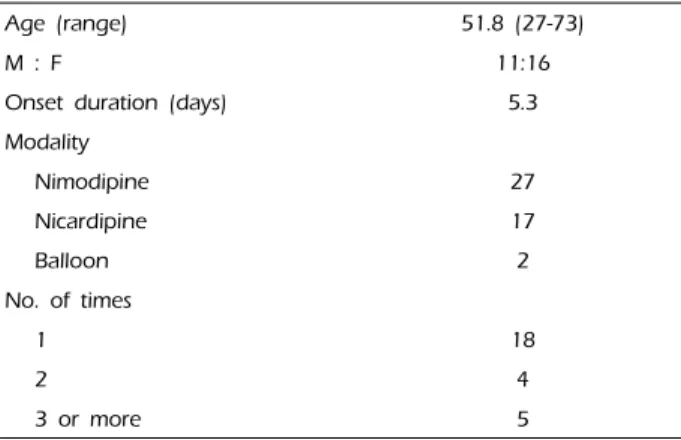
Results : Of these, 27 (10.6%) developed severe symptomatic vasospasm, requiring endovascular therapy. Vasospasm occurred at an average of 5.3 days after SAH. A total of 46 endovascular procedures were performed in 27 patients. Endovascular therapy was performed once in 18 (66.7%) patients, 2 times in 4 (14.8%) patients, 3 or more times in 5 (18.5%) patients.
Intra-arterial vasodilating agents were used in 44 procedures (27 with ni- modipine infusion, 17 with nicardipine infusion). Balloon angioplasty was performed in only 2 (7.4%) patients. The Average nimodipine infusion vol- ume was 2.47 mg, and nicardipine was 3.78 mg. Most patients recovered after the initial emergency room visit. Two patients (7.4%) worsened, but there were no deaths.
Conclusion : With advances in endovascular techniques, administration of vasodilating agents and balloon angioplasty reduces the morbidity and mortality of vasospasm after aneurysmal SAH.
J Cerebrovasc Endovasc Neurosurg.
2017 September;19(3):155-161 Received : 25 July 2017
Revised : 28 August 2017 Accepted : 17 September 2017 Correspondence to Dae-Won Kim
Department of Neurosurgery, Wonkwang University School of Medicine and Hospital, 895 Muwang-ro, Iksan 54538, Korea Tel : 82-63-859-1466
Fax : 82-63-852-2606 E-mail : [email protected]
ORCID : http://orcid.org/0000-0003-2151-2841
This is an Open Access article distributed under the terms of the Creative Commons Attribution Non- Commercial License (http://creativecommons.org/li- censes/by-nc/3.0) which permits unrestricted non- commercial use, distribution, and reproduction in any medium, provided the original work is properly cited.
Keywords Subarachnoid hemorrhage, Vasospasm, Endovascular therapy, Morbidity, Mortality
INTRODUCTION
Cerebral vasospasm remains a leading cause of mor- bidity and mortality following aneurysmal sub- arachnoid hemorrhage (SAH).21) Cerebral vasospasm is a prolonged but reversible narrowing of cerebral arteries beginning days after SAH. Progression to cer-
ebral ischemia is tied mostly to vasospasm severity, and its pathogenesis lies in artery encasement by blood clots, although the complex interactions be- tween hematoma and surrounding structures are not fully understood. Minimizing ischemia by avoiding inadequate blood volume and pressure, administering the calcium antagonist nimodipine, and intervention
Age (range) 51.8 (27-73)
M : F 11:16
Onset duration (days) 5.3
Modality
Nimodipine 27
Nicardipine 17
Balloon 2
No. of times
1 18
2 4
3 or more 5
Table 1. Patients demographics and endovascular methods
with balloon angioplasty, when necessary, constitutes the current best management.13) The objective of endo- vascular treatment of cerebral arterial vasospasm is to restore adequate blood flow and to prevent cerebral ischemia and infarction.41) Two different techniques are applied: mechanical or pharmacological vessel dilatation. Mechanical vasodilatation is achieved by means of transluminal balloon angioplasty and is di- rected towards a circumscribed proximal vessel segment. Pharmacological endovascular dilatation is based on continuous intraarterial infusion of drug via a microcatheter positioned within the proximal intra- cranial vessel territory affected by vasospasm.41) However, vasospasm remains an important determi- nant of outcome after aneurysm rupture. The aim of this study was to analyze the incidence and results of endovascular treatment of vasospasm.
MATERIALS AND METHODS
A total of 233 patients with aneurysmal SAH were enrolled in this study between January 2012 and December 2014. Patient information and endovascular treatment methods are summarized in Table 1. All pa- tients underwent aneurysm clipping or coil emboliza- tion to prevent rebleeding. Vasospasm was confirmed by performing computed tomography (CT) angiog- raphy or digital subtraction angiography in sympto- matic patients.
RESULTS
In our series of 233 SAH patients, 27 (11.6%) developed severe clinical vasospasm requiring endovascular therapy.
Vasospasm occurred at an average of 5.3 days after SAH. A total of 46 endovascular procedures were per- formed in 27 patients. Intra-arterial injections of nimo- dipine (average dose, 2.47 mg) or nicardipine (average dose 3.78 mg) was performed 44 times in 27 patients and balloon angioplasty was performed in 2 patients.
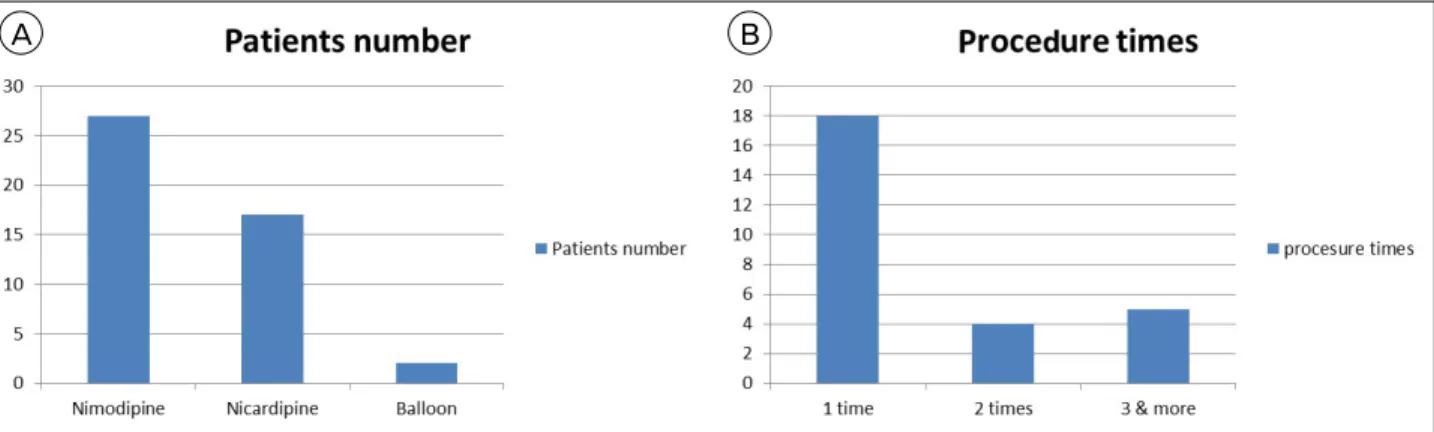
Endovascular therapy was performed once in 18 (66.7%) patients, 2 times in 4 (14.8%) patients, and 3 or more times in 5 (18.5%) patients (Fig. 1).
Location of aneurysms
The most frequent site of aneurysm was the anterior communicating artery, followed by the posterior com- municating artery (26.2%) and middle cerebral artery (18.9%) (Table 2, Fig. 2). The most frequent site of aneurysms in symptomatic vasospasm patients was also anterior communicating artery (37.1%), followed by posterior communicating artery (25.9%) and mid- dle cerebral artery (18.5%) (Table 3, Fig. 3).
Prognosis
The clinical results are shown in Table 4. Improvement was observed in 14 (51.9%) patients. Craniectomy was performed in 4 (14.8%). The mortality rate was 11.1%.
The causes of death were pneumonia in 2 patients (7.4%) and acute renal failure in 1 patient (3.7%).
After the patients were followed-up for 3-6 months, favorable outcomes were observed (average modified Rankin scale score: 3.3). No procedure-related compli- cations were observed.
DISCUSSION
Angiographic vasospasm is common after rupture of an aneurysm, with an overall incidence of 50-90%.9) Vasospasm is rare in the first 2 days after SAH, but increases after the fourth day.27) In 530 cases,28) the highest incidence was between days 10 and 17, peak- ing on day 13 at 60%. In another series,16) vasospasm
Location N (%)
Acom 68 (29.2)
Pcom 61 (26.2)
MCA 44 (18.9)
Distal ACA 14 (6.0)
Distal ICA 19 (8.1)
Posterior circulation 27 (11.6)
Total 233
Acom = anterior communicating artery; Pcom = posterior communi- cating artery; MCA = middle cerebral artery; ACA = anterior cerebral artery; ICA = internal carotid artery
Table 2. Aneurysm location in enrolled patients
Location N (%)
Acom 10 (37.1)
Pcom 7 (25.9)
MCA 5 (18.5)
Distal ICA 4 (14.8)
Posterior circulation 1 (3.7)
Total 27
Acom = anterior communicating artery; Pcom = posterior communi- cating artery; MCA = middle cerebral artery; ICA = internal carotid artery
Table 3. Aneurysm location in symptomatic vasospasm
A B
Fig. 1. Number of patients (A) and endovascular procedures (B).
occurred in a third of patients in the first week and in two-thirds in the second week. Accordingly, it is important to remain vigilant for this complication for at least 2 weeks after SAH. The aim of vasospasm management is to optimize cerebral blood flow in or- der to prevent delayed cerebral ischemia (DCI).
Medical treatment is usually the initial step when vas- ospasm is suspected. However, vasospasm is often re- fractory to these treatments. Moreover, many patients do not tolerate the combination of induced hyper- tension, hypervolemia, and hemodilution, which is re- ferred to as 'triple-H' therapy, usually due to cardiac and pulmonary complications including myocardial ischemia, congestive heart failure and pulmonary edema. For these patients, early endovascular treat- ment appears to be the best alternative.1)12)29)31)39)44)
Papaverine was first described as a treatment option for cerebral vasospasm in 1992.19)20) Its mechanism is
believed to result from inhibition of cyclic adenosine monophosphate (cAMP) and cyclic guanosine mono- phosphate phosphodiesterase in the smooth muscle, as well as from blockage of calcium ion channels in the cell membrane, resulting in vasodilation by in- hibition of smooth muscle contraction. Firlik et al.15) analyzed the use of papaverine in 15 patients with symptomatic vasospasm after SAH. The vessel caliber improved immediately following treatment on 18/23 occasions. Vasospasm associated clinical symptoms improvement was major on 6 cases, and either minor or nonexistent on 17. The authors concluded that al- though the papaverine was reduced in the reversal of arterial narrowing in the majority of cases (78%), this angiographic improvement was associated with CBF augmentation in only 46% of the cases and major clin- ical improvement in only 26%.15) Papaverine treat- ment is effective within the entire vessel territory, of- ten treated and recirculated exerts an effect within
Endovascular intervention 27/233 (11.6%)
Craniectomy 4/27 (14.8%)
Improved patients 14/27 (51.9%)
Mortality 3/27 (11.1%)
Average mRS 3.3
mRS = modified Rankin scale Table 4. Clinical results
Fig. 3. Aneurysm location in symptomatic vasospasm. Acom = anterior communicating artery; Pcom = posterior communicating artery; MCA = middle cerebral artery; ACA = anterior cerebral artery; ICA = internal carotid artery.
Fig. 2. Aneurysm location in enrolled patients. Acom = anterior communicating artery; Pcom = posterior communicating artery;
MCA = middle cerebral artery; ACA = anterior cerebral artery;
ICA = internal carotid artery.
other vascular territories as well. Its action is predom- inantly directed towards the active component of arte- rial vasospasm.
Nimodipine was first tested as a treatment for DCI due to its preferential vasodilation of the cerebral cir- culation and experimental work showing reduced im- pairment of post ischemic reperfusion.23) Nimodipine is an L-type dihydropyridine calcium channel antago- nist and remains the only intervention shown to con- sistently reduce the incidence of DCI and improve outcomes after SAH. Calcium plays a critical role in cellular communication and regulation and is im- portant for the maintenance of normal cerebral vas- cular tone.36) Nimodipine has a neuroprotective effect in SAH by blocking calcium influx after tissue ische- mia at a neuronal level.32)38) However, as nimodipine does not exert a beneficial effect on other diseases that lead to cerebral ischemia such as ischemic stroke18) or traumatic brain injury,28) it seems likely that it acts on a mechanism specific to SAH. Potential complications include hypotension, bradycardia, rash and diarrhea. Rare cases of refractory hypotension leading to death have been reported with the intra- venous use of nimodipine.4) An experimental SAH model suggested that intra-arterial nimodipine might be more effective than intra-arterial papaverine in promoting reversal of vasospasm.2)14) Biondi et al.6) studied the efficacy of intra-arterial nimodipine in
preventing infarcts in 25 consecutive patients with symptomatic vasospasm.
Nicardipine is a dihydropyridine calcium antago- nist, similar to nimodipine, blocks the L-type volt- age-gated calcium channels, preventing the influx of extracellular calcium, which would eventfully lead to muscle contraction. Badjatia et al.3) reported IA ni- cardipine in the treatment of SAH-induced vasospasm.
Forty-four vessels were treated in 18 patients. All ves- sels treated demonstrated angiographic improvement in the degree of vasospasm. TCD demonstrated sig- nificant decreases in peak systolic velocity after treatment. Neurological improvement was seen in about 42% of the patients after treatment. No sig- nificant changes in blood pressure or signs of pulmo- nary edema or renal dysfunction.
Balloon angioplasty is usually limited to the prox- imal vessels (> 2-3 mm), predominantly the supra- clinoid internal carotid artery, the M1 and proximal M2 segments of the middle cerebral artery, the A1
segment of the anterior cerebral artery, the P1 seg- ment of the posterior cerebral artery, and the basilar artery. Distal vessel balloon angioplasty is typically not feasible. Vessel tortuosity, preventing endovas- cular navigation, is another potential limitation.8) In a review by Hoh and Ogilvy,17) balloon angioplasty had an approximately 5% risk of a major complication, in- cluding an approximately 1% risk of vessel perfo- ration/rupture, which is usually fatal.5)10)11)17)31-33)39)47)48)
Even though angioplasty is directed to and effective on a proximal vessel segments only, the rational is to improve blood flow, oxygenation and metabolism within the distal arterial territory as well.15) Balloon angioplasty is superior to chemical angioplasty for the permanent treatment of vasospasm.22) The durable ef- fects of angioplasty after stretching of the vessel wall are well documented,7)25) whereas the vasodilatory ac- tion of papaverine is short lasting.26)34)
Numerous pharmacologic agents have been tested in experimental models of SAH and vasospasm, many of which were intended to explore a particular patho- genic theory for vasospasm by targeting a specific pathologic process. For example, ET-1 overproduction by cerebral endothelial cells damaged by SAH is a leading theory in the pathogenesis of cerebral vasospasm.
The ETA/B receptor antagonist TAK-044 was found to reduce DCI with an acceptable safety profile in a phase II randomized controlled trial, but with no ap- parent effect on outcome.37)42) The ETA receptor antag- onist clazosentan, which showed promising results in a multicenter phase IIa study,46) has now been studied in a randomized, double-blind, placebo-controlled, phase II dose-finding trial (Clazosentan to Overcome Neurological iSChemia and Infarct OccUrring after Subarachnoid hemorrhage [CONSCIOUS-1]).30) Statins increase nitric oxide biosynthesis and bioavailability, and have great potential for vasospasm prophylaxis in the setting of SAH.35) A meta-analysis of 6 random- ized controlled statin trials found no overall sig- nificant reduction in poor neurological outcome, al- though delayed ischemic deficits were less common in the statin-treated patients.45) The international,
randomized, double-blind Simvastatin in Aneurysmal Subarachnoid Hemorrhage (STASH) trial recruited 803 patients until February 2013. This study failed to detect any short- or long-term benefit in the use of simvastatin 40 mg per day, started within 96 hours of stroke, followed by up to 3 weeks of administration.24) Magnesium sulfate (MgSO4) has neuroprotective and vasodilatory properties and has therefore been tested for the prevention of vasospasm and ischemia in pa- tients with SAH. One early study found no benefit from intravenous MgSO4 infusions,47) another showed a variety of beneficial trends toward benefit,43) and a third suggested efficacy equivalent to nimodipine in preventing ischemic damage.40)
CONCLUSION
Endovascular intervention may have an important role in selected cases to reduce vasospasm-related morbidity and mortality after aneurysmal SAH. In our experience, endovascular treatment is safe, with a low complication rate, but further studies are re- quired to determine appropriate patient selection and treatment efficacy.
ACKNOWLEDGEMENTS
This paper was supported by Wonkwang University in 2015.
Disclosure
The authors report no conflict of interest concerning the materials or methods used in this study or the findings specified in this paper.
REFERENCES
1. Awad IA, Carter LP, Spetzler RF, Medina M, Williams FC Jr. Clinical vasospasm after subarachnoid hemor- rhage: response to hypervolemic hemodilution and arte- rial hypertension. Stroke. 1987 Mar-Apr;18(2):365-72.
2. Barth M, Capelle HH, Weidauer S, Weiss C, Münch E, Thomé C, et al. Effect of nicardipine prolonged-release implants on cerebral vasospasm and clinical outcome af-
ter severe aneurysmal subarachnoid hemorrhage: a pro- spective, randomized, double-blind phase IIa study. Stroke.
2007 Feb;38(2):330-6.
3. Badjatia N, Topcuoglu MA, Pryor JC, Rabinov JD, Ogilvy CS, Carter BS, et al. Preliminary experience with intra-arterial nicardipine as a treatment for cerebral vasospasm. AJNR Am J Neuroradiol. 2004 May;25(5):819-26.
4. Bayer HealthCare: Important drug warning, February 2006.
5. Bejjani GK, Bank WO, Olan WJ, Sekhar LN. The efficacy and safety of angioplasty for cerebral vasospasm after subarachnoid hemorrhage. Neurosurgery. 1998 May;42(5):
979-86; discussion 986-7.
6. Biondi A, Ricciardi GK, Puybasset L, Abdennour L, Longo M, Chiras J, et al. Intra-arterial nimodipine for the treat- ment of symptomatic cerebral vasospasm after aneurysmal subarachnoid hemorrhage: preliminary results. AJNR Am J Neuroradiol. 2004 Jun-Jul;25(6):1067-76.
7. Chan PD, Findlay JM, Vollrath B, Cook DA, Grace M, Chen MH, et al. Pharmacological and morphological ef- fects of in vitro transluminal balloon angioplasty on nor- mal and vasospastic canine basilar arteries. J Neurosurg.
1995 Sep;83(3):522-30.
8. Dabus G, Nogueira RG. Current options for the man- agement of aneurysmal subarachnoid hemorrhage-induced cerebral vasospasm: A comprehensive review of the literature.
Interv Neurol. 2013 Oct;2(1):30-51.
9. Dorsch NW, King MT. A review of cerebral vasospasm in aneurysmal subarachnoid haemorrhage: Part I: Incidence and effects. J Clin Neurosci. 1994 Jan;1(1):19-26.
10. Elliott JP, Newell DW, Lam DJ, Eskridge JM, Douville CM, Le Roux PD, et al. Comparison of balloon angio- plasty and papaverine infusion for the treatment of vas- ospasm following aneurysmal subarachnoid hemorrhage.
J Neurosurg. 1998 Feb;88(2): 277-84.
11. Eskridge JM, McAuliffe W, Song JK, Deliganis AV, Newell DW, Lewis DH, et al. Balloon angioplasty for the treatment of vasospasm: results of first 50 cases.
Neurosurgery. 1998 Mar;42(3):510-6; discussion 516-7.
12. Feigin VL, Rinkel GJ, Algra A, Vermeulen M, van Gijn J. Calcium antagonists in patients with aneurysmal sub- arachnoid hemorrhage: a systematic review. Neurology.
1998 Apr;50(4):876-83.
13. Findlay JM, Nisar J, Darsaut T. Cerebral vasospasm: A review. Can J Neurol Sci. 2016 Jan;43(1):15-32.
14. Firat MM, Gelebek V, Orer HS, Belen D, Firat AK, Balkanci F. Selective intraarterial nimodipine treatment in an experimental subarachnoid hemorrhage model.
AJNR Am J Neuroradiol. 2005 Jun-Jul;26(6):1357-62.
15. Firlik KS, Kaufmann AM, Firlik AD, Jungreis CA, Yonas H. Intra-arterial papaverine for the treatment of cerebral vasospasm following aneurysmal subarachnoid hemorrhage.
Surg Neurol. 1999 Jan;51(1):66-74.
16. Griffith HB, Cummains BH, Thomson JL. Cerebral arterial spasm and hydrocephalus in leaking arterial aneurysms.
Neuroradiology. 1972 Dec;4(4):212-4.
17. Hoh BL, Ogilvy CS. Endovascular treatment of cerebral vasospasm: transluminal balloon angioplasty, intraarterial papaverine, and intra-arterial nicardipine. Neurosurg Clin N Am. 2005 Jul;16(3):501-16, vi.
18. Horn J, Limburg M. Calcium antagonists for ischemic stroke: a systematic review. Stroke. 2001 Feb;32(2):570-6.
19. Kaku Y, Yonekawa Y, Tsukahara T, Kazekawa K.
Superselective intra-arterial infusion of papaverine for the treatment of cerebral vasospasm after subarachnoid hemorrhage. J Neurosurg. 1992 Dec;77(6):842-7.
20. Kassell NF, Helm G, Simmons N, Phillips CD, Cail WS.
Treatment of cerebral vasospasm with intra-arterial papaverine. J Neurosurg. 1992 Dec;77(6):848-52.
21. Kassell NF, Torner JC, Haley EC Jr, Jane JA, Adams HP, Kongable GL. The international cooperative study on the timing of aneurysm surgery. Part 1: overall man- agement results. J Neurosurg. 1990 Jul;73(1):18-36.
22. Katoh H, Shima K, Shimizu A, Takiguchi H, Miyazawa T, Umezawa H, et al. Clinical evaluation of the effect of percutaneous transluminal angioplasty and intra-arterial papaverine infusion for the treatment of vasospasm fol- lowing aneurysmal subarchnoid hemorrhage. Neurol Res. 1999 Mar;21(2):195-203.
23. Kazda S, Towart R. Nimodipine: a new calcium antago- nistic drug with a preferential cerebrovascular action.
Acta Neurochir (Wien). 1982;63(1-4):259-65.
24. Kirkpatrick PJ, Turner CL, Smith C, Hutchinson PJ, Murray GD; STASH Collaborators. Simvastatin in aneurysmal sub- arachnoid hemorrhage (STASH): a multicentre random- ized phase 3 trial. Lancet Neurol. 2014 Jul;13(7): 666-75.
25. Kobayashi H, Ide H, Aradachi H, Arai Y, Handa Y, Kubora T. Histological studies of intracranial vessels in primates following transluminal angioplasty for vasospasm.
J Neurosurg. 1993 Mar;78(3):481-6.
26. Kuwayama A, Zervas NT, Shintani A, Pickren KS.
Papaverine hydrochloride and experimental hemorrhagic cerebral arterial spasm. Stroke. 1972 Jan-Feb;3(1):27-33.
27. Kwak R, Niizuma H, Ohi T, Suzuki J. Angiographic study of cerebral vasospasm following rupture of intra- cranial aneurysms: Part 1. Time of the appearance. Surg Neurol. 1979 Apr;11(4):257-62.
28. Langham J, Goldfrad C, Teasdale G, Shaw D, Rowan K.
Calcium channel blockers for acute traumatic brain injury. Cochrane Database Syst Rev. 2003;(4):CD000565.
29. Lennihan L, Mayer SA, Fink ME, Beckford A, Paik MC, Zhang H, et al. Effect of hypervolemic therapy on cere- bral blood flow after subarachnoid hemorrhage: a randomized controlled trial. Stroke. 2000 Feb;31(2):383-91.
30. Macdonald RL, Kassell NF, Mayer S, Ruefenacht D, Schmiedek P, Weidauer S, et al. Clazosentan toovercome neurological ischemia and infarction occurring after sub- arachnoid hemorrhage (CONSCIOUS-1) : randomized, dou- ble-blind, placebo-controlled phase 2 dose-finding trial.
Stroke. 2008 Nov;39(11):3015-21.
31. Mindea SA, Yang BP, Bendok BR, Miller JW, Batjer HH.
Endovascular treatment strategies for cerebral vasospasm.
Neurosurg Focus. 2006 Sep;21(3):E13.
32. Murai Y, Kominami S, Kobayashi S, Mizunari T, Teramoto A. The long-term effects of transluminal balloonangio- plasty for vasospasms after subarachnoid hemorrhage:
analyses of cerebral blood flow and reactivity. Surg Neurol. 2005 Aug;64(2):122-6; discussion 127.
33. Newell DW, Eskridge JM, Mayberg MR, Grady MS,
Winn HR. Angioplasty for the treatment of symptomatic vasospasm following subarachnoid hemorrhage. J Neurosurg.
1989 Nov;71(5 Pt 1):654-60.
34. Ogata M, Marshall BM, Lougheed WM. Observation on the effects of intrathecal papaverine in experimental vasospasm. J Neurosurg. 1973 Jan;38(1):20-5.
35. O'Driscoll G, Green D, Taylor RR. Simvastatin, an HMG- coenzyme A reductase inhibitor, improves endothelial func- tion within 1 month. Circulation. 1997 Mar;95(5):1126-31.
36. Peroutka SJ, Allen GS. Calcium channel antagonist bind- ing sites labeled by 3H-nimodipine in human brain. J Neurosurg. 1983 Dec;59(6):933-7.
37. Pisani A, Calabresi P, Tozzi A, D'Angelo V, Bernardi G.
L-type Ca2+ channel blockers attenuate electrical changes and Ca2+ rise induced by oxygen/glucose deprivation in cortical neurons. Stroke. 1998 Jan;29(1):196-201; discussion 202.
38. Rosenwasser RH, Armonda RA, Thomas JE, Benitez RP, Gannon PM, Harrop J. Therapeutic modalities for the management of cerebral vasospasm: timing of endovas- cular options. Neurosurgery. 1999 May;44(5):975-9; dis- cussion 979-80.
39. Sayama CM, Liu JK, Couldwell WT. Update on endo- vascular therapies for cerebral vasospasm induced by aneurysmal subarachnoid hemorrhage. Neurosurg Focus.
2006 Sep;21(3):E12.
40. Schmid-Elsaesser R, Kunz M, Zausinger S, Prueckner S, Briegel J, Stieger HJ. Intravenous magnesium versus nimo- dipine in the treatment of patients with aneurysmal sub- arachnoid hemorrhage: a randomized study. Neurosurgery.
2006 Jun;58(6):1054-65.
41. Schuknecht B. Endovascular treatment of cerebral vaso- spasm following aneurysmal subarachnoid hemorrhage.
Acta Neurochir Suppl. 2005;94:47-51.
42. Shaw MD, Vermeulen M, Murray GD, Pickard JD, Bell BA,Teasdale GM. Efficacy and safety of the endothelinA/B receptor antagonist TAK-044 in treating subarachnoid hemorrhage: a report by the Steering Committee on be- half of the UK/Netherlands/Eire TAK-044 Subarachnoid Haemorrhage Study Group. J Neurosurg. 2000 Dec;93(6):992-7.
43. Stippler M, Crago E, Levy EI, Kerr ME, Yonas H, Horowitz MB, et al. Magnesium infusion for vasospasm prophylaxis after subarachnoid hemorrhage. J Neurosurg.
2006 Nov;105(5):723-9.
44. Suarez JI, Tarr RW, Selman WR. Aneurysmal subarachnoid hemorrhage. N Engl J Med. 2006 Jan; 354(4):387-96.
45. Su SH, Xu W, Hai J, Wu YF, Yu F. Effects of sta- tins-use for patients with aneurysmal subarachnoid hem- orrhage: a meta-analysis of randomized controlled trials.
Sci Rep. 2014 Apr;4:4573.
46. Vajkoczy P, Meyer B, Weidauer S, Raabe A. Thome C.
Ringel F, et al. Clazosentan (AXV-034343), a selective endothelin A receptor antagonist, in the prevention of cerebral vasospasm following severe aneurysmal sub- arachnoid hemorrhage; results of a randomized, dou- ble-blind, placebo-controlled, multicenter phase IIa study.
J Neurosurg. 2005 Jul;103(1):9-17.
47. Veyna RS, Seyfried D, Burke DG, Zimmerman C, Mlynarek M, Nichols V, et al. Magnesium sulfate therapy after aneurysmal subarachnoid hemorrhage. J Neurosurg. 2002 Mar;96(3):510-4.
48. Zubkov YN, Nikiforov BM, Shustin VA. Balloon catheter technique for dilatation of constricted cerebral arteries after aneurysmal SAH. Acta Neurochir (Wien). 1984;70(1-2):65-79.