Simple Method of Evaluating the Range of Shoulder Motion Using Body Parts
Yeo-Hon Yun, Byeong-Jin Jeong, Myeong-Jae Seo, Sang-Jin Shin
Department of Orthopedic Surgery, Ewha Womans University School of Medicine, Seoul, Korea
Background: The purpose of this study is to assess the range of shoulder motion using an indirect evaluation method without physical examinations of patients based on questionnaires regarding several specific arm postures referenced by patient’s own body parts.
Methods: Nine criteria of specific shoulder motion including 4 forward flexion, 2 external rotation, and 3 internal rotation were de- cided as reference position which can represent a certain shoulder motion. Flexion contains postures such as lifting arm to waist-height, shoulder-height, eye-height, and raising arm above head with arm touching ears. External rotation comprises grasping ears and placing hands on back of the head. Vertebral height in internal rotation is determined by calculating the samples’ motions, which are holding on to trouser belts, opposite-elbow, and scapula. These postures are included in questionnaires for patients to evaluate the validity and ef- fectiveness of this indirect method.
Results: The range of flexion was 77o (60o to 100o), 96o (87o to 115o), 135o (115o to 150o), and 167o (150o to 175o) when arms go up to waist, shoulder, eye, and high vertically. Range of external rotation was 39.6o (30o to 50o) when grasping ears and 69.2o (60o to 80o) with the hands on the back of the head. Range of internal rotation was L4 when placing trouser belts, T12 for holding opposite elbow, and T9 for reaching scapula. The mismatch rates of flexion, external rotation, and internal rotation were 11.6%, 9.6%, and 7.8%.
Conclusions: The range of shoulder motion using this method is expected to be applied to an established shoulder scoring system which included shoulder motion evaluation item.
(Clin Shoulder Elbow 2015;18(1):13-20)
Key Words: Shoulder joint; Range of motion; Self-assessment; Telephone
Copyright © 2015 Korean Shoulder and Elbow Society. All Rights Reserved. pISSN 2383-8337
Clinics in Shoulder and Elbow Vol. 18, No. 1, March, 2015 http://dx.doi.org/10.5397/cise.2015.18.1.13
Received October 20, 2014. Revised January 8, 2015. Accepted January 14, 2015.
Correspondence to: Sang-Jin Shin
Department of Orthopedic Surgery, Ewha Womans University Mokdong Hospital, 1072 Anyangcheon-ro, Yangcheon-gu, Seoul 158-710, Korea Tel: +82-2-2650-5143, Fax: +82-2-2642-0349, E-mail: [email protected]
Financial support: None. Conflict of interests: None.
Introduction
Measuring the range of joint motion is a critical element in evaluation of shoulder function. The amount of shoulder motion limitation makes it possible to assume the severity of shoulder function objectively. Furthermore, the changes of shoulder mo- tion after appropriate treatment become the guide to under- standing the degree of healing process and judging the effective- ness of treatment.
There are several widely used forms for evaluation of func- tion of shoulder joint; American Shoulder and Elbow Surgeons standardized shoulder assessment form, Constant Murley shoul- der score, and the University of California at Los Angeles (UCLA)
shoulder rating score. These evaluation forms included shoulder joint range motion measurement criteria; however, it is inevi- table for doctors to physically diagnose their patients’ condition and measure the range of shoulder joint directly. Moreover, it is inconvenient for patients to visit hospital for routine examina- tion, even though they do not feel any subjective symptoms in the shoulder joint after treatment. It is believed that follow-up loss results in failure to define precise effects of treatment at last follow-up unless doctors meet patients.1) There could be option- al methods of direct examination, such as home-visit, telephone interviews, and mailing checking lists. These indirect examina- tions seem to be effective, to a certain extent, for doctors to perceive patients’ personal physical state, such as the degree of
pain, and their ability to return to normal life. However, precise measurement of range of motion of the shoulder joint is limited using these indirect evaluations.
If the indirect method to assess the range of shoulder motion is developed, the inconvenience of patients and doctors will definitely decrease, and the failure rate will also decline. In ad- dition, the more accurate examination will create more oppor- tunity for patients to receive the proper treatment. In this study a new method for measurement of the range of shoulder motion using patients’ own body as references without help from doc- tor’s observation was contrived and the validity of the devised measurement was assessed.
Methods
The Ewha Womans University Institutional Review Board ap- proved the study proposal, and informed consent was obtained from all patients (ECT 230-01).
A pilot study was conducted with 30 volunteers with normal shoulder motion without any discomfort in order to determine the average range of motion of the shoulder joint in certain positions as referenced by their body posture. Questionnaires were prepared regarding anatomical structures and postures which will represent specifics for each motion of forward flex-
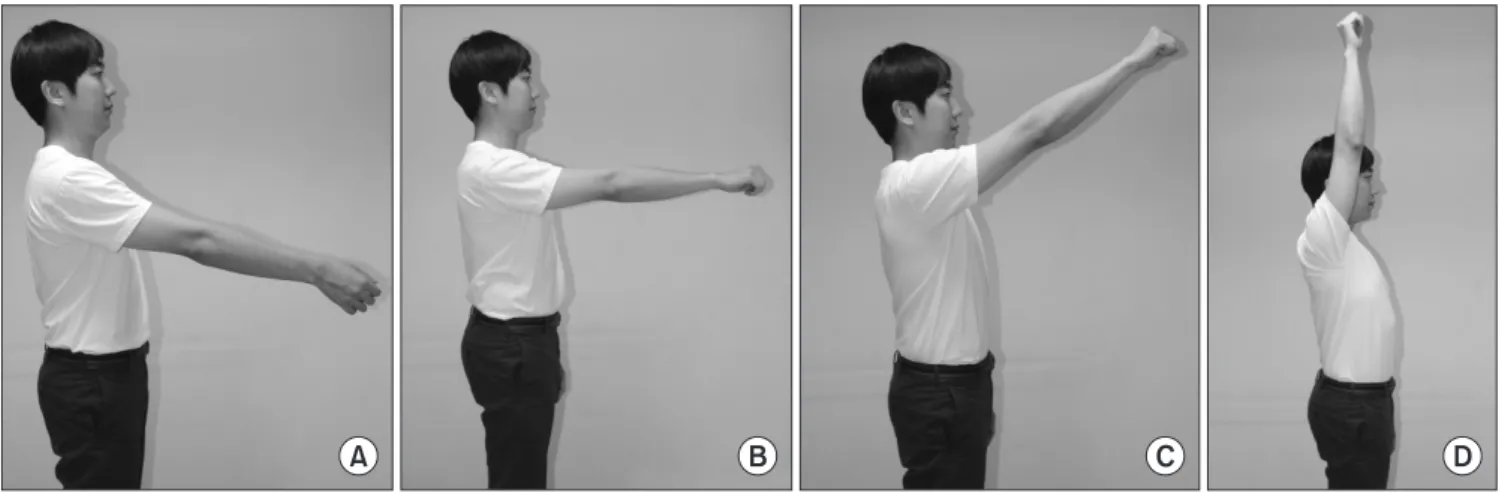
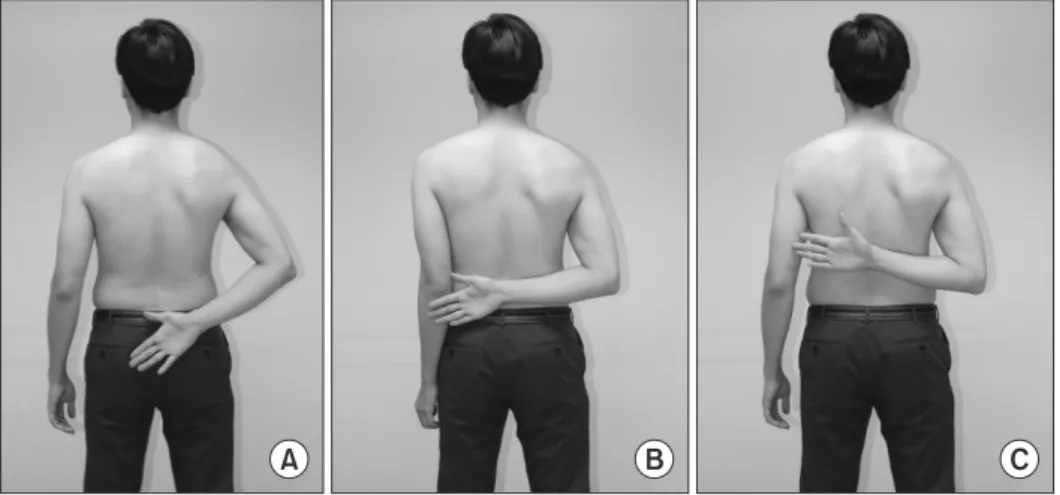
ion, external rotation, and internal rotation. The compliance of examinees for each question was assessed and each motion was also evaluated for its reproducibility for reflecting the patient’s range of shoulder motion. Those materials are tested in the way that examinees are instructed to imitate the postures according to the questionnaires so that the examinees are able to comply with the pilot study. Motions are coordinated with forward flex- ion, external rotation, and internal rotation which will be proper for measuring the range of shoulder joint. This pilot study is de- signed according to three different categories. Forward flexion, shoulder flexion movement from standing still to lifting hands to waist, shoulder, eye height, and raising both hands vertically above the head with arm touching ears (Fig. 1). External rota- tion comprises grasping ears with both hands and placing both hands on the back of their heads (Fig. 2). Internal rotation is determined by the volunteers’ arm can reach their trouser belt, back of the opposite elbow, and lower tip of the scapula (Fig .3).
Then 9 criteria of specific shoulder motion, including 4 forward flexion, 2 external rotation, and 3 internal rotation were decided as reference positions which can represent a certain range of shoulder motion (Appendix).
In order to prove its effectiveness, the evaluation items se- lected through the pilot study were once again practiced by 100 healthy volunteers (47 males, 53 females with average age of 46
A B C D
Fig. 1. Posture of forward flexion referenced by body parts. Waist-height (A), shoulder-height (B), eye-height (C), arm above head with arm touching ears (D).
A B
Fig. 2. Posture of external rotation forward flexion referenced by body parts. Grasping ears with both hands (A), both hands on the back of their heads (B).
years old). Examinees were selected out of those who had not visited an orthopedic clinic due to other joint related diseases.
After obtaining informed consent from subjects, they were asked to pose their arms in the order of given questions. Examinees of forward flexion were instructed to stand against the wall with their hands falling down towards the floor. They were sequen- tially instructed to stretch out both arms vertically to waist-height, shoulder-height and then to the eye-height, and finally raise both arms above the head with their arm touching ears. While volunteers were performing the given motions, a goniometer was placed parallel to their bodies and the angles between the goniometer and the stretched arms were measured. Measure- ments of external and internal rotation were also performed in a standing posture. Sample group for the external rotation also followed the indicated motions, and the examiner kept the go- niometer parallel on the lateral side of acromion over the exam- inees’ heads and measured the angle between the forearm and goniometer while the examinees maintained posture. Special care is required for measuring external rotation, both elbows should be placed as far as possible, opposite from each other.
If both elbows are posed close to the body without shoulder abduction, the examinees tend to flex their shoulders forwardly rather than to rotate externally to touch their ears. During the in- ternal rotation, the volunteers performed the indicated motions and the height was measured by the level of the spinous process of the vertebra touched by their thumbs.
However, when the examinees failed to reach their belt, and just managed to touch only their buttock level, the measurement was recorded as is. A physician assistant averaged two con- secutive measurements for each criterion. The initial attendees underwent an identical test in the outpatient clinic two weeks later, and then intraobserver reliability was analyzed. Intraclass correlation and coefficients (ICCs) were applied for analysis. In addition, standard range of motion for each evaluation item was set after measuring the average amount using a goniometer for each criterion.
The normal range of each criterion derived from the mean value and standard deviation of goniometer measurement is shown in Table 1. According to the forward flexion, average waist-height was 77.1o ± 10.7o, shoulder-height 96.3o ± 5.7o, eye-height ended up as 135.5o ± 8.7o, and 167.0o ± 5.7o for the arm above head with arm touching ears. The rounded-up angles of motion were 60o to 85o, 86o to 115o, 116o to 150o, and 151o to 180o for waist-height, shoulder-height, eye-height, and arm above head with arm touching ears, respectively, based on mean values (86o, 116o, and 151o, respectively) between the two adjacent categories and the minimum and maximum values of each category. In terms of internal rotation, buttock for touching the hand only buttock area, L4 for trouser belt, T12 for the back of the opposite elbow, and T9 for and lower tip of the scapula have become the basic values. The standard values allow the range measurement of internal rotation for trouser belt to be L3 to L5, back of the opposite elbow to be L2 to T11, and lower
A B C
Fig. 3. Posture of internal rotation forward flexion referenced by body parts. (A) Arm can reach trouser belt, (B) back of the oppo- site elbow, (C) lower tip of the scapula.
Table 1. Normal Group and Values Defined as a ‘Match’
Movement Minimum
(°) Maximum
(°) Mean ± standard
deviation (°) Match-range (°) Flexion
Waist-height 60 100 77.1 ± 10.7 60–85
Shoulder-height 87 115 96.3 ± 5.7 86–115
Eye-height 115 150 135.5 ± 8.7 116–150
Raise arms vertically 150 175 167.0 ± 5.7 151–180 External rotation
Grabbing both ears 30 50 39.6 ± 5.6 30–54
Hands-behind-head 60 80 69.2 ± 4.9 55–80
Internal rotation
Waist-belt L5 L3 L1 ± 1.1 L3–L5
Opposite-elbow L1 T10 T12 ± 2.5 L2–T10
Scapula T11 T7 T9 ± 0.9 T11–T7
tip of the scapula to be over T10. The average angles of each motion under external rotation were 39.6o ± 5.6o for grasping ears and 69.2o ± 4.9o for hands on back of the head. The mean value between two categories yielded 54o. In the same manner as calculation in forward flexion, standard rounded-up angles were calculated as grasping ears with 30o to 54o, hands on back of the head with 55o to 80o.
The datum points are patients with shoulder joint problem at our shoulder clinic, who were tested by 1 specially trained physician’s assistant. Patients who underwent shoulder opera- tion within 1 month and had pain in their shoulders that was too severe to take a test were excluded from this study. Once the patient group agreed to follow the motions, the angles of each motion were measured by goniometer, and moved onto another criterion. When a patient felt difficulty in making the following motion, he was asked to perform a motion at his best, and the angle was measured during the actual movement. For example, if an attendee said he was capable of forward flexion to shoulder-height, the angle was measured immediately during posturing.
On the other hand, when an examinee thought shoulder- height flexion was not possible, waist-height replaced flexion angle. Those who could not reach the waist-height were in- structed to raise their arms to the best possible height and the angle was measured as well. Exactly identical process was con- ducted for both the external and internal rotation. The factually calculated value of angle was compared to the previously estab- lished value. If a patient abided by both the verbal and physical practice, he was identified as ‘match’ category. Likewise, when a patient mentioned that it was impossible to reach his eye- height, and fell within the waist-height, he was labeled to match the waist-height criteria and the angle was still calculated under his capability. When the verbal and behavioral motion did not correspond to each other, for example when the verbal motion exceeded the actual angle or when the actual angle exceeded the verbal motion angle, a patient was directly determined as
‘mismatch.’ Such measuring methods are used for both external rotation and internal rotation when it comes to distinguishing either ‘match’ or ‘mismatch’ motion group. Contributing factors, including patient’s age, gender, result of diagnosis, education level, financial status, and the experiences of the evaluation of range of shoulder motion previously, which might affect the match rate were recorded.
Single attendee provided the number of ‘match’ and ‘mis- match’ motions out of 9, and finally ‘match’ and ‘mismatch’
motions from 300 patients counted 2,700 in total. Overall mis- match rate was calculated by dividing 2,700 by the number of mismatch motions. The mismatch rate of each motion was de- termined by dividing the total number of mismatch motions by 300, total number of patients. The mismatch rate of each criteri- on comes from dividing the sum of ‘match’ motions within each
criterion by 1,200 for forward flexion, 600 for external rotation, and 900 motion for internal rotation. Patients with no ‘mismatch’
motions were classified as group A, and patients with more than 1 mismatch were classified as group B. Statistical analysis was performed for both group A and B for age, gender, educational level, and past-experience of measuring the range of motion.
For the analysis of intraobserver reliability, ICCSs (ICC2,1) and 95% confidence interval were applied using the tool of the standard statistical package (PASW Statistics ver. 18.0; IBM Co., Armonk, NY, USA). If ICC exceeded 0.7, the data were assumed to have reliability.2,3) Effect of demographic factors in the differ- ence in the ‘mismatch’ proportion was studied by applying mul- tivariate logistic regression analysis.
Results
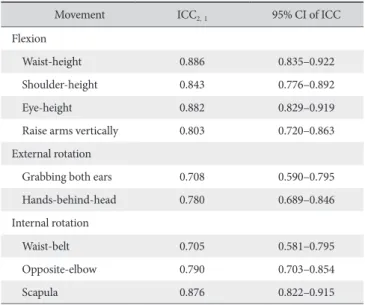
A total of 300 patients comprised 152 males and 148 fe- males. Among them, 28 patients were age 20- to 29-year-old, 24 patients were age 30- to 39-year-old, 74 patients were age 40- to 49-year-old, 90 patients were age 50- to 59-year-old, 61 patients were age 60- to 61-year-old, and 23 patients were over 70-year-old. Patients suffering from rotator cuff tear hit the highest number of 96 and adhesive capsulitis was followed by calcific tendinitis. Regarding the educational level, 227 out of 300 patients (75.7%) had a high school diploma, and 73 patients (24.3%) graduated middle school. The intraobserver reliability of each motion showed the ICC value of 0.705 to 0.886 (Table 2).
Overall mismatch rate was 10.2% (Table 3). In the case of individual motion, the mismatch rate of forward flexion to the waist-height reached 23.3%, as the highest rate within forward flexion, with a rate of eye-height of 19.3%. In external rotation, grabbing hands on back of the head (9%) was the highest mis-
Table 2. Intra-observer Reliability
Movement ICC2‚1 95% CI of ICC
Flexion
Waist-height 0.886 0.835–0.922
Shoulder-height 0.843 0.776–0.892
Eye-height 0.882 0.829–0.919
Raise arms vertically 0.803 0.720–0.863
External rotation
Grabbing both ears 0.708 0.590–0.795
Hands-behind-head 0.780 0.689–0.846
Internal rotation
Waist-belt 0.705 0.581–0.795
Opposite-elbow 0.790 0.703–0.854
Scapula 0.876 0.822–0.915
ICC: intraclass correlation coefficient, CI: confidence interval.
match position and reach hands on the belt had a mismatch rate of 16.0%. The sequence of mismatch rate goes from forward flexion with 11.6% as the highest, and external rotation with 9.6%, and internal rotation with 7.8%.
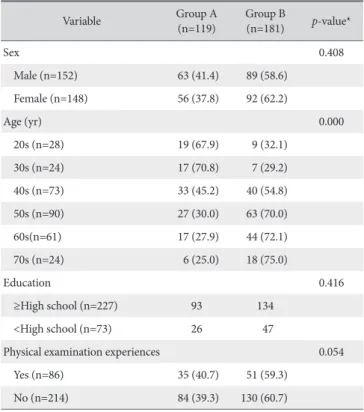
Group A, with patients who succeeded in performing all of the motions consisted of 119 patients, along with group B, which included 181 patients who made more than one mismatch cri- terion. There were 77 patients with 1 criteria mismatch, 62 with 2 criteria mismatches, 29 with 3 criteria mismatches, 11 with 4 criteria mismatches, and one patient made 5 criteria mismatches and 6 mismatches, respectively. The average age of patients in group A was 47 years old, including 63 males and 56 females (53% and 47%), and 54 years old for group B, which included 89 males and 92 females (49% and 51%). Regarding average educational level, in group A 78.2% of patients had academic background over high school graduates (93/119), while in group B 74.0% of patients had a high school diplomamn (134/181) (p=0.416). The numbers of patients who had previous experi- ence in shoulder physical examinations in hospital were higher, with 29.4% in group A (35/119) compared with 28.2% in group B (51/181), while showing no significant difference (p=0.054).
According to the regression analysis, the patient’s age was a statistically significant demographic factor (p<0.01), and the older patient was, the higher mismatch rate revealed. However, patients’ gender, diagnosis, and previous experience of measur- ing range of motion at an orthopedic clinic including their edu- cational level, which was expected to have some significance, all proved to be insignificant (Table 4).
Discussion
Clinicians or researchers have willingness to evaluate the changes in every stage of patients while examining them. One of the quintessential methods for evaluating patients with shoulder joint disease is range of shoulder motion measurement, which examines the degree of dysfunction. More importantly, the initial evaluation plays a critical role as the baseline of treatment and is utilized to ideally judge the result of treatment. According to this regular assessment, doctors can offer the timely visit of patients to the hospitals and modify the previous approach of treatment to enhance the effective outcomes. Hence, the continuous mea- surement of the range of patients’ shoulder motion contributes to one of the most important parts of clinical evaluation. Direct face to face measurement of the range of shoulder joint using a goniometer is the most fundamental method. Unfortunately, in reality continuous follow-up of patient measurement is not easy.1) According to Norquist et al.,4) in patients with rotator cuff tear rate of follow-up lost was 46% during the mean follow-up period of 1.2 ± 1.4 years. What is worse, the long-term follow- up rate continues to decrease. The failure of routine check-up is due to the patients’ advanced age, medical cost and not-facil- itated visit to hospitals, their compliance, and the limitation of time and distance. Failure of follow-up visit was proven to cause Table 4. Contributing Factors Affecting Mismatch Rate
Variable Group A
(n=119) Group B
(n=181) p-value*
Sex 0.408
Male (n=152) 63 (41.4) 89 (58.6)
Female (n=148) 56 (37.8) 92 (62.2)
Age (yr) 0.000
20s (n=28) 19 (67.9) 9 (32.1)
30s (n=24) 17 (70.8) 7 (29.2)
40s (n=73) 33 (45.2) 40 (54.8)
50s (n=90) 27 (30.0) 63 (70.0)
60s(n=61) 17 (27.9) 44 (72.1)
70s (n=24) 6 (25.0) 18 (75.0)
Education 0.416
≥High school (n=227) 93 134
<High school (n=73) 26 47
Physical examination experiences 0.054
Yes (n=86) 35 (40.7) 51 (59.3)
No (n=214) 84 (39.3) 130 (60.7)
Values are presented as number (%) or number only.
Group A: match group, Group B: mismatch group.
*Calculated by Pearson’s chi-square test.
Table 3. Mismatch Rate
Posture Mismatch rate (%)
Flexion
Waist-height 23.3
Shoulder-height 4.6
Eye-height 19.3
Raise arms vertically 10.6
Overall 11.6
External rotation
Grabbing both ears 6.6
Hands-behind-head 9.0
Overall 9.6
Internal rotation
Waist-belt 16.0
Opposite-elbow 17.3
Scapula 5.3
Overall 7.8
negative clinical results. Murray et al.1) reported that patients who underwent total hip replacement turned out to have less pain and limit on their hip motion when they had proper 16- year follow-up compared to those who did not. Another study reported that the simple shoulder test score of nonresponders (102 patients) who were lost to follow-up was 3.3 ± 4.1, signifi- cantly lower than the score of 7.9 ± 3.7 of the response group (122 patients).4)
Various patient evaluation methods have been introduced, including self-assessment questionnaires, in order to reduce the expense, time-waste, and inconvenience. In several studies a diagram was created based on the questionnaire so that patients can measure the range of shoulder motion by themselves and forward the information via post, e-mail, and self-reporting web- site.5-7) However, these methods could not avoid critique since the measurements were not performed by specialists. In addi- tion, the diagram-based questionnaire could be lost, and even if the form is safe-kept, it requires a significant amount of time, and the elderly do not have easy access to internet. Besides this idea, Hoffman et al.6) introduced internet-based goniometer measurement using the tele-rehabilitation system along with Shin et al.8) who output the inclinometer using an application for smartphones. On the other hand, elderly patients, who make up the majority of the disease, confront the technological obstacles, and most patients cannot afford the expense.
This study focused on the customized questionnaire through which patients can easily measure and evaluate the range of motion of the shoulder joint using their own body parts taking advantage of the drawbacks of currently introduced methods or diagrams. The questionnaire method has many advantages.
One, specialists ask questions through phone calls and allow subjects to perform perform certain motions. The examiner is able to directly determine the patient’s physical condition, which enables a dramatic reduction of follow-up failure rate. Second, this method does not involve the expense as well as inconve- nience of visiting hospitals. Third, use of simple and concise questionnaires enables rapid evaluation. Fourth, the scientifically organized questions prevent biased evaluation related to the observer. Fifth, this method enhances the advantage of Constant Murley shoulder score, and UCLA shoulder rating score, which require the physical examination in person; however the above mentioned methods can be completely applied through phone calls.
Overall patients’ mismatch rate was 10.2%, whereas, forward flexion’s mismatch rate was 11.6%, 9.6% for external rotation, and 7.8% for internal rotation according to each separate cri- terion. On each motional basis, waist-height’s mismatch rate reached the highest rate of 23.3% because the motion of raising hands to waist-height is the most unfamiliar activity to patients. It was one of the trickiest questions to explain and for examinees to understand. In addition, since the patients’ eyes are directed
downward, it is not an easy task to help them perceive and place their arms at the waist level. Actually, lots of patients said their arms were located at the waist-height, in most cases, even if their arms were below or above their waist level. It is assumed that the mismatch rate (19.3%) for the eye-height motion is due to the same reason of waist-height situation. On the contrary, raising arms to shoulder-height and vertically is known to be done frequently, so that the mismatch rate is relatively lower.
Out of patient-related factors, patient’s age showed (p<0.001) statistically significant relation to mismatch rate. Studies by Carter et al.7) and Godfrey et al.9) also reported that patient’s age has a clinically crucial connection. Unlike our study, Carter et al.7) also claimed that patient’s educational level was associated with the relational trend. In spite of Carter et al.7)’s study, the question- naire method requires simple conversational level, meaning that educational level does not appear to have a significant effect on the result. Not having to consider the educational factor is the foremost advantage of our questionnaire method. In addition, it was proved that mismatch rate among those who had their shoulder joint range measured had little effect on the statistical significance.
However, our method has several limitations. Internal rotation gives a wide range between the waist belt and elbow, only when buttocks, waist-height, elbow, and scapula are the anatomical landmarks for measuring the rotation. Measuring hand-behind- back generates slight errors in value depending on each intraob- server when the test is performed. Moreover, hand-behind-back method may be influenced by movement of the elbow joint.
Wakabayashi et al.10) suggested that 90o abduction should be used when measuring internal rotation at level over T12, be- cause the level is influenced more by elbow flexion rather than using humerus internal rotation. It is certain that 90o abduction is a more accurate measurement for internal rotation; however it could not be used in patients with severe limitation of shoulder motion who could not abduct their arm to 90o. As far as it is con- cerned, hand-behind-back method is still the easiest tool with high compliance and a preferred method for assessment among clinicians.10,11) Second, it is tremendously difficult to make the most of body parts for external rotation, for ears and heads are the only reference points. Due to the disadvantages, the span of defining either match, or mismatch motions is not specific enough. Also, various ways of patients’ holding ears and heads could lead to the various results as well. There is no reason for performing external rotation if patients do not stretch out their elbows far enough, the calculation of the rotation can be ex- tended and covered through forward flexion; grasping ears and back of the head with hands. Third, patients with shoulder stiff- ness use trunk tilting for compensating for the shoulder problem.
It would act as a bias in this assessment. Therefore, when we ask patients to make every posture, we always asked them not to tilt their trunk. And abduction, which posture may be affected most
by trunk tilting, was excluded in assessment. It is recommended that clinicians should not only take this disadvantage into con- sideration when creating questions, but also notify the patients of them when the test is in process. It is necessary for discovery of additional standard body parts that can be used effectively for external rotation. Fourth, although we tried to measure range of shoulder motion, which is an objective parameter, by phone call, patients measured their motion of the shoulder subjectively by themselves. This may reduce validity and effectiveness which leads to high miss-match rate and wide range of motion. Con- siderably high rate of mismatch motion in forward flexion as well as the perplexity in measurement of both external and internal rotation is left to be disentangled through constant effort.
This study introduces a far more developed method of mea- suring the range of motion of the shoulder joint via phone calls together with updated methods of forward flexion, external, rotation, and internal rotation.
Despite several limitations, our questionnaire method is used to ask patients about their capability to perform given mo- tions, and measure the probable as close range of motion of the shoulder joint as possible from patient’s response. Virtually, this method provides a convenient tool by making it possible to esti- mate the range of shoulder motion through phone calls, without visiting hospitals. Range of motion estimated using this indirect measurement can be applied to an established shoulder scoring system which included shoulder motion evaluation items. This may reduce follow-up loss rate and help in proper assessment of the treatment effects in shoulder problems.
Conclusion
The devised method is a convenient assessment tool for es- timation of the shoulder motion using patients’ own body parts as references without direct physical examination of patients.
The range of shoulder motion using this method is expected to be applied to an established shoulder scoring system which in- cluded shoulder motion evaluation items.
References
1. Murray DW, Britton AR, Bulstrode CJ. Loss to follow-up mat- ters. J Bone Joint Surg Br. 1997;79(2):254-7.
2. Kolber MJ, Vega F, Widmayer K, Cheng MS. The reliability and minimal detectable change of shoulder mobility measure- ments using a digital inclinometer. Physiother Theory Pract.
2011;27(2):176-84.
3. Streiner DL, Norman GR. Health measurement scales: a prac- tical guide to their development and use. 4th ed. New York:
Oxford University Press; 2008.
4. Norquist BM, Goldberg BA, Matsen FA 3rd. Challenges in evaluating patients lost to follow-up in clinical studies of rota- tor cuff tears. J Bone Joint Surg Am. 2000;82(6):838-42.
5. Perkins JJ, Sanson-Fisher RW. An examination of self- and telephone-administered modes of administration for the Aus- tralian SF-36. J Clin Epidemiol. 1998;51(11):969-73.
6. Hoffmann T, Russell T, Cooke H. Remote measurement via the Internet of upper limb range of motion in people who have had a stroke. J Telemed Telecare. 2007;13(8):401-5.
7. Carter CW, Levine WN, Kleweno CP, Bigliani LU, Ahmad CS.
Assessment of shoulder range of motion: introduction of a nov- el patient self-assessment tool. Arthroscopy. 2008;24(6):712-7.
8. Shin SH, Ro du H, Lee OS, Oh JH, Kim SH. Within-day reli- ability of shoulder range of motion measurement with a smart- phone. Man Ther. 2012;17(4):298-304.
9. Godfrey J, Hamman R, Lowenstein S, Briggs K, Kocher M.
Reliability, validity, and responsiveness of the simple shoulder test: psychometric properties by age and injury type. J Shoul- der Elbow Surg. 2007;16(3):260-7.
10. Wakabayashi I, Itoi E, Minagawa H, et al. Does reaching the back reflect the actual internal rotation of the shoulder? J Shoulder Elbow Surg. 2006;15(3):306-10.
11. Ginn KA, Cohen ML, Herbert RD. Does hand-behind-back range of motion accurately reflect shoulder internal rotation? J Shoulder Elbow Surg. 2006;15(3):311-4.
Appendix. Questionnaires about Nine Positions of Shoulder Referenced by Body Parts
• How high can you raise your arm?
1. Stand up straight with your back against the wall
2. Keep your elbow straight and raise your arm as high as you can Raise your arm up to waist-height
Raise your arm up to shoulder-height Raise your arm up to eye-height
Raise your arm above head with arm touching ears
• How much can you rotate your arm?
1. Stand up straight with your back against the wall Touch your ears with elbow at shoulder-height Touch back of your head with elbow at shoulder-height
• How far up your back can you reach with your arm?
1. Stand straight up with your arm at side
2. Reach behind your back and up as high as you can with your thumb Touch your thumb on waist at the level of belt
Touch your thumb on back to the level of opposite elbow
Touch your thumb on back to the level of other bottom of shoulder blade