This study aimed to report the effect of Korean medical treatment including miniscalpel acupuncture on 2 patients who underwen tsurgery for rotator cuff tear. They were treated for almost 4 weeks at the Department of Acupuncture and Moxibustion, Dong-Eui University Korean Medicine Hospital. Visual analog scale (VAS), and range of movement (ROM) were used to evaluate treatment effects. In both patients, shoulder pain and restriction of shoulder joint movement improved after miniscalpel acupuncture treatment. In Case 1, shoulder pain decreased from a VAS score 8 to a VAS score 3, and ROM of the shoulder improved from flexion 100°
to 160°, extension 10° to 30°, abduction 90° to 130°, adduction 10° to 40°, internal rotation 10° to 50°, and external rotation 10° to 50°. In Case 2, shoulder pain, which was rated a VAS score 8 at first-visit, disappeared, and ROM of the shoulder recovered to normal range. These results suggest miniscalpel acupuncture may contribute to the recovery process after rotator cuff tear surgery.
©2019 Korean Acupuncture & Moxibustion Medicine Society. This is an open access article under the CC BY- NC-ND license (http://creativecommons.org/licenses/by-nc-nd/4.0/).
Article history:
Submitted: June 11, 2019 Revised: July 22, 2019 Accepted: August 5, 2019 Keywords:
acupuncture, rotator cuff tear, shoulder pain,
soft tissue injury
https://doi.org/10.13045/jar.2019.00129 pISSN 2586-288X eISSN 2586-2898
Case Report
Korean Medical Treatment Including Miniscalpel Acupuncture for Patients After Rotator Cuff Tear Surgery: A Report of Two Cases
Su Gyeong Kim
1, Eun Jin Park
1, Jae Eun Lim
1, Hyun Jeong Do
1, Jeong Yoon Kim
2, Sung Woo Cho
3, Hyun Min Yoon
1, Cheol Hong Kim
1,*
1 Department of Acupuncture and Moxibustion Meridian and Acupoint, College of Korean Medicine, Dong-Eui University, Busan, Korea 2 Department of Ophthalmology, Otolaryngology and Dermatology, Daejeon Jaseng Hospital of Korean Medicine, Daejeon, Korea 3 Department of Oriental Rehabilitation, College of Korean Medicine, Dong-Eui University, Busan, Korea
ABSTRACT
Journal of Acupuncture Research
Journal homepage: http://www.e-jar.org
Introduction
The rotator cuff consists of four muscles; the supraspinatus, infraspinatus, subscapularis, andteres minor. The humeral head is covered by muscles, which rotate the arm and stabilize the humeral head in the joint [1].
Rotator cuff tear (RCT) is a common injury that is responsible for 50% of shoulder joint pain, and usually occurs in individuals aged 40 years or more. Most patients have a history of traumatic damage or repetitive overuse of the muscles [2]. RCT symptoms are shoulder pain and restriction of movement of the shoulder joint. The pain worsens in the night time, and active movement is restricted, whereas passive movement is normal [1]. There are conservative and surgical treatments for RCT.
Surgical treatment is considered for RCT either when there has been no improvement after 3-6 months using conservative treatment, or depending on the degree of the tear and motion
disorder. After surgical reatment, management with braces and rehabilitation is required for several months to restore normal shoulder function. In addition, shoulder pain and joint stiffness are often reported despite successful surgery [3,4]. The studies of surgical methods which focus on the better clinical outcome and a low re-rupture rate have been reported. However, treatment for patients with complications such as shoulder pain and joint stiffness after RCT surgery is insufficient [5,6].
In Korean medical treatment, various treatments such as herbal medicine, acupuncture, pharmacopuncture, and moxibustion, have been reported in patients after RCT surgery [3,7]. However, reports on miniscalpel acupuncture are scarce.
It has been reported that miniscalpel acupuncture has a better outcome on musculoskeletal pain compared with regular acupuncture treatment [6,7]. It can recover the original kinetic state, and promote blood circulation to the lesionby peeling the chronically damaged soft tissue of the muscles, tendon sheath, and
*
Corresponding author.Department of Acupuncture and Moxibustion Meridian and Acupoint, College of Korean Medicine, Dong-Eui University, Busan, Korea E-mail: [email protected]
ORCID: Su Gyeong Kim https://orcid.org/0000-0001-9615-3690, Cheol Hong Kim https://orcid.org/0000-0003-2058-0762
©2019 Korean Acupuncture & Moxibustion Medicine Society. This is an open access article under the CC BY-NC-ND license (http://creativecommons.org/licenses/by-nc- nd/4.0/).
ligament [10].
Here, we report the clinical effects of miniscalpel acupuncture, acupuncture and herbal medicine in 2 patients who visited the Department of Acupuncture and Moxibustion, Dong-Eui University Korean Medicine Hospital for shoulder pain and range of movement (ROM) restriction after RCT surgery.
Case Report Subjects
There were 2 patients who were admitted to the Department of Acupuncture and Moxibustion, Dong-Eui University Korean Medicine Hospital on October 22, 2018 and were discharged on November 17, 2018 after RCT surgery. The patients received miniscalpel acupuncture 4 times, and they also received herbal medicine, and regular acupuncture throughout their hospital stay. This study is a retrospective chart review and approved for exemption from deliberation by the Institutional Review Board (IRB) of Dong-Eui University Korean Medicine Hospital (IRB No.:
2019-03).
Treatment methods Miniscalpelacupuncture
Prior to treatment, the patients were provided with comprehensive information about the procedure, and patients who agreed to the procedure were treated with miniscalpel acupuncture. Following the first treatment, subsequent treatment sessions were conducted at intervals of 5-8 days. The treatment interval was adjusted according to the patients’ symptoms and conditions.
To prevent infection, the practitioner wore sterilized gloves and a mask, and the treatment area was sterilized with betadine.
The miniscalpel acupuncture points were: LI14, LI15, LI16, TE14, TE15, SI10, SI12, SI13, GB21, LU01, LU02 and tender points of the rotator cuff. The procedurewas performed in the recumbent position.Sterilized, disposable miniscalpels (0.5 mm × 50 mm;
DongBang Acupuncture Inc., Korea) were used. The miniscalpel was inserted parallel to the nearby muscle and ligaments, at a depth of 20-40 mm, and the adhered soft tissue was peeled and the miniscalpe lpulled out. After the procedure, the patient was informed about possible side effects such as temporary discomfort, hemorrhage, dizziness, cold sweat, and palpitation. The miniscalpel acupuncture was performed by a Korean medicine doctor with over 2 years of clinical practice (Table 1).
Acupuncture
Acupuncture was performed once every day during the hospital stay, and the needle retention time was approximately 30 minutes.
Sterilized, disposable needles (0.25 mm × 40 mm; DongBang Acupuncture Inc., Korea) were used. The acupuncture points were:
Shinkwan (Dong’s acupuncture), ST40 of the normal side, and LI11, SI03, TE03 of the affected side.
Herbal medicine treatment
Seokyung decoction was prescribed to both patients from October 22. In Case 1, the medicine was changed to Kaegyeol- seokyung decoction on October 24 and maintained until discharge day on November 17. In Case 2, Seokyung decoction was maintained during the hospital stay. The medicine was taken 3 times a day (Table 2).
Evaluation methods Visual analogscale (VAS)
VAS was used to evaluate the intensity of subjective pain. The patient’s level of pain was assessed on a scale of 0 to 10 using a 10 cm measuring instrument. 0 represented no pain, and 10 represented the worst pain imaginable. VAS was used to evaluate the patient at the first-visit and every day after miniscalpel acupuncture was performed for a total of 5 times.
ROM Active ROM of the right shoulder joint was measured. The angles were measured by moving flexion, extension, abduction, adduction, external rotation, and internal rotation, to the maximum extent. Evaluation was performed at the first-visit and every day after miniscalpel acupuncture, for a total of 5 times.
Case 1 Patient
Song00, F/61 Chief complaint
Right shoulder pain and ROM restriction Onset
February 2018 Past history
Left RCT, calcific tendinitis- 2012 op.
Present illness
Shoulder pain occurred whilst playing tennis in February 2018.
The patient did not receive medical treatment and rested at home for 2 months. As the pain worsened, the patient sought medical treatment at a local hospital and was diagnosed with RCT using magnetic resonance imaging (MRI). The patient received a steroid injection in her right armand she underwent physical therapy for 3 months , but showed no improvement in symptoms. On August 10, the patient underwent arthroscopic surgeryat a local hospital. After the surgery, shoulder pain and ROM restriction persisted despite rehabilitation. On August 24, the patient was admitted to local Korean medicine hospital, and was treated with herbal medicine, acupuncture, and rehabilitation for a month, without significant improvement. She visited the Department of Acupuncture and Moxibustion, Dong-Eui University Korean Medicine Hospital on October 22, 2018.
Symptoms of first-visit
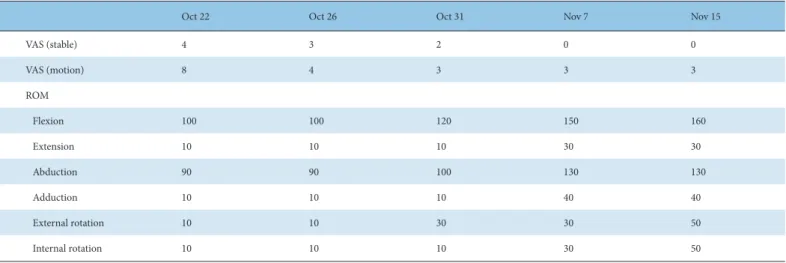
The pain, which was rated as a VAS score 4, occurred around the rotator cuff, in a stable state. The pain increased to a VAS score 8 when the right arm was pressed, flexed, abducted and raised above the head, and when the arm was rotated internally and moved backward (ROM: flexion 100°, extension 10°, abduction 90°, adduction 10°, internal rotation 10°, external rotation 10°).
Radiological findings
The MRI of the patient’s shoulder was taken on August 7, 2018 at a local hospital. The finding was a partial tear of the supraspinatus and infraspinatus (Fig. 1).
Treatment progress
The shoulder pain, which was a VAS score 4 in a stable state,
disappeared after the 3rd miniscalpel acupuncture treatment.
Item Detail
1. Acupuncture rationale
1a) Style of acupuncture - Miniscalpel acupuncture
1b) Reasoning for treatment provided, based on historical context, literature sources, and/or consensus methods, with references where appropriate
- Textbook [10,14]
- Clinical experience
- Consensus by the experts in acupuncture 1c) Extent to which treatment was varied
- Fixed points plus optional points according to symptoms
2. Details of needling
2a) Number of needle insertions per subject per session (mean and range where relevant) - From 11 to 15
2b) Names (or location if no standard name) of points used (uni/bilateral)
- LI14, LI15, LI16, TE14, TE15, SI10, SI12, SI13, GB21, LU01, LU02 and tender points of the rotator cuff (Affected side) 2c) Depth of insertion, based on a specified unit of measurement, or on a particular tissue level
- From 20 to 40 mm
2d) Response sought (e.g., de qi or muscle twitch response) - ‘De qi’ sensation
2e) Needle stimulation (e.g., manual, electrical)
- Manual stimulation: peeling off the adhesion of soft tissue by needling.
2f) Needle retention time - No retention time
2g) Needle type (diameter, length, and manufacturer or material)
- Sterilized, disposable miniscalpels (0.5 mm × 50 mm; DongBang Acupuncture Inc., Korea)
3. Treatment regimen
3a) Number of treatment sessions - Four treatment sessions
3b) Frequency and duration of treatment sessions - Once weekly for 4 weeks, 20 minutes for each session
4. Other components of treatment
4a) Details of other interventions administered to the acupuncture group (e.g., moxibustion, cupping, herbs, exercises, lifestyle advice)
- Acupuncture
- Herbal medicine treatment
4b) Setting and context of treatment, including instructions to practitioners, and information and explanations to patients - How to procedure
- Possible response after the treatment 5. Practitioner background
5a) Description of participating acupuncturists (qualification or professional affiliation, years in acupuncture practice, other relevant experience)
- Korean medicine doctor with over 2 years of clinical practice
6. Control or comparator interventions
6a) Rationale for the control or comparator in the context of the research question, with sources that justify this choice - No control or comparator interventions
6b) Precise description of the control or comparator. If sham acupuncture or any other type of acupuncture-like control is used, provide details as for items 1 to 3 above
- No control or comparator interventions Table 1. Miniscalpel Acupuncture Details Based on the STRICTA 2010 Checklist [11].
Furthermore, pain on movement of the arm decreased from a VAS score 8 to a VAS score 3, and shoulder ROM improved (Table 3), so it became possible for her arm to flex, abduct and raise above the head, and rotate internally and move backward.
Case 2 Patient
Yu 00, F/61 Chief complaint
Right shoulder pain and ROM restriction Onset
December 2017 Past history
Non specific Present illness
Shoulder pain occurred during exercising in December 2017.
The patient did not receive medical treatment and the pain persisted. On April 2018, the patient was diagnosed with RCT using an MRI at a local hospital, and underwent arthroscopic surgery. However, the ROM of the shoulder joint worsened whilst wearing the shoulder brace. The patient received rehabilitation for 5 months, but no significant improvement was seen. She visited the Department of Acupuncture and Moxibustion, Dong-Eui
Prescription Composition
Seokyung decoction Curcumae Longae Rhizoma 8g, Puerariae Radix・Atractylodis Rhizoma Alba・Angelicae Gigantis Radix・Paeoniae Radix Alba・
Kalopanacis Cortex 4g, Zingiberis Rhizoma Crudus 3g, Glycyrrhizae Radix・Osterici Radix 2g
Kaegyeol-Seokyung decotion Pinelliae Rhizoma・Atractylodis Rhizoma Alba・Cnidii Rhizoma・Angelicae Gigantis Radix・Osterici Radix・Cyperi Rhizoma・
Citri Pericarpium・Arisaematis Rhizoma・Linderae Radix・Zingiberis Rhizoma Crudus・Perillafrutescens 4 g, Cinnamomi Ramulus
・Glycyrrhizae Radix 2 g Table 2. Composition of Herbal Medicine.
Oct 22 Oct 26 Oct 31 Nov 7 Nov 15
VAS (stable) 4 3 2 0 0
VAS (motion) 8 4 3 3 3
ROM
Flexion 100 100 120 150 160
Extension 10 10 10 30 30
Abduction 90 90 100 130 130
Adduction 10 10 10 40 40
External rotation 10 10 30 30 50
Internal rotation 10 10 10 30 50
ROM, range of movement; VAS, visual analog scale.
Table 3. Progress in the Treatment of Case 1.
Fig. 1. Shoulder MRI of Case 1. (A) Axial, (B) Coronal. MRI, magnetic resonance imaging.
Fig. 2. Shoulder MRI of Case 2. (A) Axial, (B) coronal. MRI, magnetic resonance imaging.
(A)
(A)
(B)
(B)
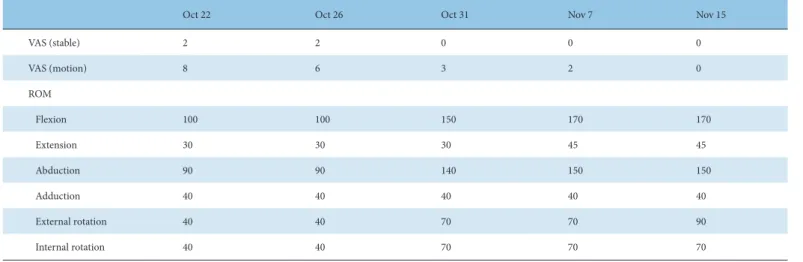
Oct 22 Oct 26 Oct 31 Nov 7 Nov 15
VAS (stable) 2 2 0 0 0
VAS (motion) 8 6 3 2 0
ROM
Flexion 100 100 150 170 170
Extension 30 30 30 45 45
Abduction 90 90 140 150 150
Adduction 40 40 40 40 40
External rotation 40 40 70 70 90
Internal rotation 40 40 70 70 70
ROM, range of movement; VAS, visual analog scale.
Table 4. Progress in the Treatment of Case 2.