Printed in the Republic of Korea DOI 10.5012/jkcs.2011.55.3.495
산성 조건에서 부드러운 강철용 부식억제제로 사용되는 플라보노이드계 화합물의 부식억제성질과 흡착성질
J. Christy Ezhilarasi and Prabavathy Nagarajan*
P.G. & Research Department of Chemistry, Bishop Heber College (Autonomous), Tiruchirappalli, Tamil Nadu, 620 017, India
(접수 2011. 2. 17; 수정 2011. 3. 20; 게재확정 2011. 3. 23)
Corrosion Inhibitive and Adsorption Properties of a Flavonoid compound for Mild Steel in Acidic Medium
J. Christy Ezhilarasi and Prabavathy Nagarajan*
P.G. & Research Department of Chemistry, Bishop Heber College (Autonomous), Tiruchirappalli, Tamil Nadu, 620 017, India. *E-mail: [email protected] (Received February 17, 2011; Revised March 20, 2011; Accepted March 23, 2011)
요 약. 플라보노이드계 화합물인 HMPC (3-hydroxy-7-methoxy-2-phenylchromen-4-one의 부식억제성질, HMPC와 TBAB (n-tetrabutylammonium bromide) 간 상승효과, 염산 조건하 부드러운 강철의 흡착성질을 무게 감량, 변전위 편극, 전기화학 임피던스 분광기를 사용하여 연구하였다. 다양한 온도에서 무게 감량 측정 실험한 결과 부식 억제 효율은 억제제 농도가 증가함에 따라 증가하였고, 계의 온도가 증가함에 따라 감소하였다. 전기화학 실험 결과 부식 억제는 여러 혼합된 형태의 억제 방법에 의해 가능하였다. 금속 표면에 흡착된 억제 화합물 분자는 보호막을 형성하였다.
주제어: 상승 효과, 흡착 등온선, 변전위 편극, 전기화학 임피던스 분광기(EIS)
ABSTRACT. The corrosion inhibitive nature of a flavonoid compound, 3-Hydroxy-7-methoxy-2-phenylchromen-4-one (HMPC), the synergistic effect between HMPC and n-Tetrabutylammonium bromide (TBAB) and their adsorption behavior on mild steel in hydrochloric acid solution were studied by weight loss, potentiodynamic polarization and electrochemical impedance spectroscopy (EIS) measurements. The results of weight loss study at different temperatures revealed that the inhi- bition efficiency increases with inhibitor concentration and decreases with increase in the temperature of the system. The elec- trochemical studies showed that the inhibitor acts through mixed mode of inhibition and the inhibitor molecules adsorb on the metal - solution interface forming a protective layer. The adsorption of the inhibitor molecules over the metal surface was supported by the obeyed Langmuir’s adsorption isotherm, Scanning Electron Microscopic analysis (SEM) and Fourier Trans- form Infrared (FT-IR) spectroscopic studies.
Keywords: 3-Hydroxy-7-methoxy-2-phenylchromen-4-one, n-Tetrabutylammonium bromide, Synergistic effect, Adsorption isotherm, Potentiodynamic polarization, Electrochemical impedance spectroscopy (EIS)
INTRODUCTION
Acids are widely used in many industrial processes. The aggressive solutions used for acid pickling, cleaning and de-scaling are hydrochloric, sulphuric and phosphoric acids, due to their special chemical properties. There is a danger of metal dissolution upon the already cleaned metal surface during these processes after the removal of the oxides, scale, or other coatings. This involves the loss of dissolved metal as well as larger acid consumption. The corrosion inhibitors are added to prevent metal from cor- rosion in aggressive media. The heterocyclic compounds
which contain N, S and O atoms have been proved as effective corrosion inhibitors1-4 for metals in acid media.
The polar groups act as the reaction center for the adsorp- tion process.5 The protection efficiency depends on adsorption ability of inhibitor molecules, where the result- ing adsorption film acts as a barrier that separates the metal from the corroding medium.6,7 During corrosion, the inhibitor molecules will constitute a distinct phase between the metal and the aqueous solution, there by interacts with this inter phase.8 The efficiency of corro- sion inhibitors depends on the mechanical, structural, and chemical properties of the layer formed.9
As many synthetic compounds are highly toxic to both human beings and environment, nowadays, attention has been focused on many alternative eco-friendly and harm- less green corrosion inhibitors.
In the present work, the corrosion inhibition potential of a flavonoid compound, HMPC for mild steel in 1 M hydro- chloric acid medium, was investigated through weight loss, electrochemical, FT-IR and SEM techniques. The study also includes the synergistic effect of TBAB on the per- formance of the inhibitor.
EXPERIMENTAL Reagents
The mild steel specimen with chemical composition (wt.%): Si(0.002%), C(0.060%), Mn(0.308%), P(0.001%), S(0.009%) and Fe(99.62%) was used for the study.
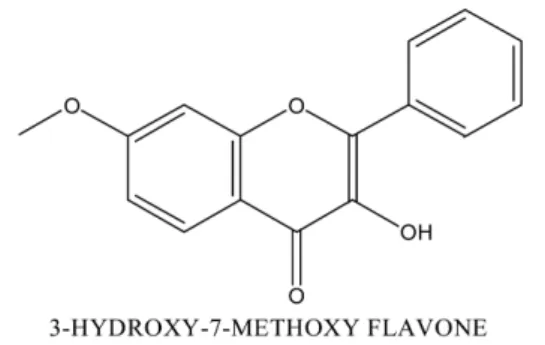
The aggressive medium was made from AnalaR Grade hydrochloric acid and conductivity water. The flavonoid compound HMPC (Fig. 1) was purchased from Research Organics, Chennai, India, and re-crystallized from meth- anol.
Recommended procedure
The mild steel specimens were mechanically polished with different grades of emery papers, degreased with ace- tone, rinsed with double-distilled water, and finally dried before immersion in the acid solution.
Weight loss method
The weight loss measurements were carried out10 with the solution volume of 100 ml. The polished and pre- weighed mild steel specimens of size 3 cm × 1 cm × 0.2 cm were immersed for 2 hours in both blank and inhibited solutions. The specimens were carefully washed at the end of these tests with acetone, dried, and then reweighed and the weight loss was calculated. The percentage inhi- bition efficiency (IE%) was calculated11 using the follow-
ing equation.
IE(%) = (W0 - Wi ) / W0 × 100
where W0 and Wi are the weight losses in uninhibited and inhibited corroding solutions respectively. The degree of surface coverage (θ) can be determined by the expres- sion, θ = IE(%) / 100. The corrosion rate in g/cm2/min was also calculated.
It has been reported that TBAB is adsorbable on steel.10 So, the effect of TBAB along with HMPC was tested. The weight loss study was carried out in triplicate to get repro- ducible results at three different temperatures (303K, 313K and 323K).
Electrochemical studies
The electrochemical experiments, including potentio- dynamic polarization measurements and electrochemical impedance spectroscopy measurements were carried out using PRINCETON versaSTAT Potentiostat-Galvanostat.
A conventional three-electrode cell configuration was used for the electrochemical studies. The working elec- trode was prepared from mild steel specimen mounted in epoxy resin in such a way that the area exposed to solu- tion was 1 cm2. A saturated calomel electrode (SCE) and a platinum electrode were used as the reference and counter electrodes, respectively and all potentials were reported versus SCE. The polarization measurements were recorded after 60 minutes immersion at room temperature at 300 mV±OCP with a scan rate of 10 mVs-1. The per- centage inhibition efficiency (IE%) values were calcu- lated from the Icorr values using the following equation.
IE(%) = (Icorr - I'corr) / Icorr × 100
where Icorr and I'corr are corrosion current densities without and with the inhibitor, respectively.
The electrochemical impedance spectroscopy mea- surements were performed over a frequency range between 1 Hz to 200 Hz at an amplitude of 10 mV and the impedance diagrams were given in Nyquist repre- sentations. In the represented electrical equivalent cir- cuit (Fig. 2), Rs is the solution resistance, Rct is the charge transfer resistance and Cdl is the double layer capacitance. The inhibition efficiency was calculated from the charge transfer resistance (Rct) values12,13 using the following formula
IE(%) = (R'ct - Rct) / R'ct × 100
where Rct and R'ct are charge transfer resistances without and with inhibitor, respectively.
Fig. 1. 3-Hydroxy-7-methoxy-2-phenylchromen-4-one (HMPC).
SEM analysis
The specimens used for surface morphological exam- ination were immersed in the acid containing various concentrations of HMPC and blank for 2 hours. They were then removed, rinsed quickly with acetone, and dried. The analysis was performed on ZEISS model- Supra 40 SEM.
FT-IR analysis
The pure flavonoid compound and the scrapped corro- sion products formed on the mild steel surface were ana- lyzed separately with the help of FT-IR (Perkin-Elmer FT- IR spectrometer) spectra using the potassium bromide pel- let method.
RESULTS AND DISCUSSION Weight loss method
The corrosion rate and percentage inhibition efficiency values determined by weight loss method at three differ- ent temperatures were summarized in Table 1. It was noted from the results that the IE(%) increases with increase in concentration of the inhibitor. This may be due to the increased number of molecules adsorbed over the mild steel surface by blocking the active sites where direct acid attack proceeds. The inhibition efficiency was also found
to decrease with rise in temperature. This gives a clue that the mechanism of adsorption of the inhibitor may be due to physisorption, because physisorption is due to weak Van der Waal’s forces which disappear at elevated tem- peratures. Thus the maximum inhibition efficiency is attained at higher concentration of the inhibitor and at lower temperature.
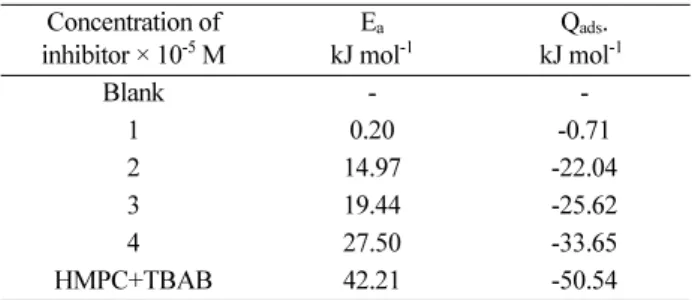
The values of activation energy (Ea)and heat of adsorp- tion (Qads) are listed in Table 2. It is found that the value of Ea increases with increase in concentration of the inhib- itor which indicates the low inhibition efficiency at ele- vated temperatures. From the Qads values it is observed that the inhibitor molecules on the mild steel surface are physically adsorbed.
Adsorption isotherm
The degree of surface coverage (θ) for different con- centrations of the inhibitor was evaluated by assuming the corrosion inhibition due to the adsorption of the inhibitor (Table 3). The surface coverage increases with increase in concentration of the inhibitor thereby increasing the per- centage of inhibition efficiency. The establishment of adsorption isotherms describes the adsorptive behavior of inhibitor molecules which can provide important clues to the nature of the metal inhibitor interaction.
The adsorption of the organic molecule occurs as the Fig. 2. The electrical equivalent circuit for the ac impedance
measurement.
Table 1. Effect of temperature on the inhibition efficiency of HMPC alone and in presence of TBAB on mild steel corrosion in 1 M HCl by weight loss method
Concentration of inhibitor × 10-5 M
IE(%)
303K 313K 323K
Blank - - -
1 35.73 35.52 34.78
2 73.78 68.03 47.54
3 82.18 76.92 58.42
4 88.09 82.84 63.79
HMPC+TBAB 90.49 83.37 66.48
Table 2. Thermodynamic parameters for the inhibition of cor- rosion of mild steel in 1M HCl by HMPC alone and in presence of TBAB
Concentration of inhibitor × 10-5 M
Ea kJ mol-1
Qads. kJ mol-1
Blank - -
1 0.20 -0.71
2 14.97 -22.04
3 19.44 -25.62
4 27.50 -33.65
HMPC+TBAB 42.21 -50.54
Table 3. Effect of HMPC alone and along with TBAB on rate of corrosion and surface coverage for mild steel in 1 M HCl at 303 K
Concentration of inhibitor × 10-5 M
Rate of corrosion
g/cm2/min IE(%) Surface coverage (θ)
Blank 11.67 - -
1 7.50 35.73 0.3573
2 3.06 73.78 0.7378
3 2.08 82.18 0.8218
4 1.39 88.09 0.8809
HMPC+TBAB 1.11 90.49 0.9049
interaction energy between molecule and the metal sur- face is higher than that between the water molecules and the metal surface.14 In order to find out the nature of the adsorption isotherm, attempts were made to fit various isotherms like Frumkin, Langmuir and Temkin. However, the best fit was obtained only with the Langmuir adsorp- tion isotherm (Fig. 3), supporting the monolayer adsorp- tion of the inhibitor on the mild steel surface.
Synergistic effect
When equal volumes of TBAB and HMPC of same concentration were taken together, there has been an enhancement in the inhibition efficiency of HMPC. It may be due to the synergistic effect of TBAB. The hydrocar- bon part of TBAB may form a closed network structure, which prevents the approach of the aggressive ions to the metal surface.
Electrochemical studies
The polarization behaviour of steel in 1 M hydrochlo- ric acid in presence and absence of inhibitor is shown in
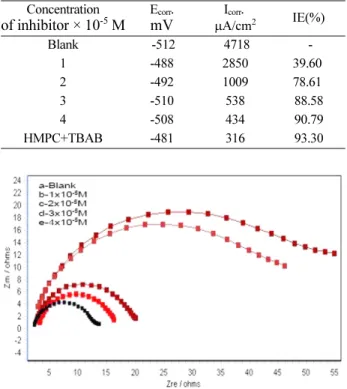
Fig. 4. The values of corrosion current (Icorr.), corrosion potential (Ecorr) and the percentage inhibition efficiency are depicted in Table 4. The decrease in Icorr values is more pronounced with the increase in the inhibitor con- centration. The addition of inhibitor shifts the Ecorr val- ues and thus alters both anodic and cathodic Tafel slope values indicating the mixed mode of action of inhibi- tor.15
The corrosion behavior of steel at 303K in the acidic solution in the absence and presence of green inhibitor is also investigated by the EIS method after 60 minutes of immersion. The Rct values were calculated from the dif- ference in impedance at lower and higher frequencies from Nyquist plot (Fig. 5) and from Rct values, Cdl values were computed by using the following equation.
Cdl = 1 / 2πfmax Rct
where fmax is the frequency at which the imaginary com- ponent of the impedance (-Zmax) is maximal. The imped- ance parameters derived from these investigations are given in Table 5. It is worth noting that the presence of the inhibitor does not alter the profile of impedance diagrams which are almost semi-circular in shape indicating that the Fig. 3. Langmuir adsorption isotherm for HMPC.
Fig. 4. Potentiodynamic polarization curves for the corrosion of mild steel in 1 M HCl in the absence and presence of HMPC at various concentrations at 303 K.
Table 4. Potentiodynamic polarization parameters for the corrosion of mild steel in the absence and presence of HMPC alone and along with TBAB in 1 M HCl
Concentration of inhibitor × 10-5 M
Ecorr. mV
Icorr.
µA/cm2 IE(%)
Blank -512 4718 -
1 -488 2850 39.60
2 -492 1009 78.61
3 -510 538 88.58
4 -508 434 90.79
HMPC+TBAB -481 316 93.30
Fig. 5. Nyquist plots for mild steel in 1 M HCl in the absence and presence of HMPC at various concentrations at 303 K.
corrosion of steel is mainly controlled by the charge trans- fer process.
The deviations from the perfect semicircular shape are often referred to as the frequency dispersion of interfa- cial impedance. This anomalous phenomenon is inter- preted by the inhomogeneity of the electrode surface arising from surface roughness or interfacial phenom- ena.16 In fact, the presence of HMPC enhances the val- ues of Rct in the acidic solution. The values of the double layer capacitance have been decreased to the maximum extent in the presence of inhibitor revealing the adsorp- tion of the inhibitor on the metal surface in the acidic solution.
SEM analysis
The SEM images of the surface of mild steel before and after immersion in 1M hydrochloric acid solution, for 2 hours in the absence and presence of inhibitor are shown in Figs. 6(a) and 6(b), respectively. The Fig. 6(a) reveals that the surface is highly damaged in the absence of inhib- itor. The surface morphological features of the mild steel specimen in the presence of inhibitor under identical con- dition are shown in Fig. 6(b). It can be seen from this micrograph that the inhibitor exhibits substantially higher protective effect on mild steel surface in 1 M hydrochlo- ric acid medium.
FT-IR analysis
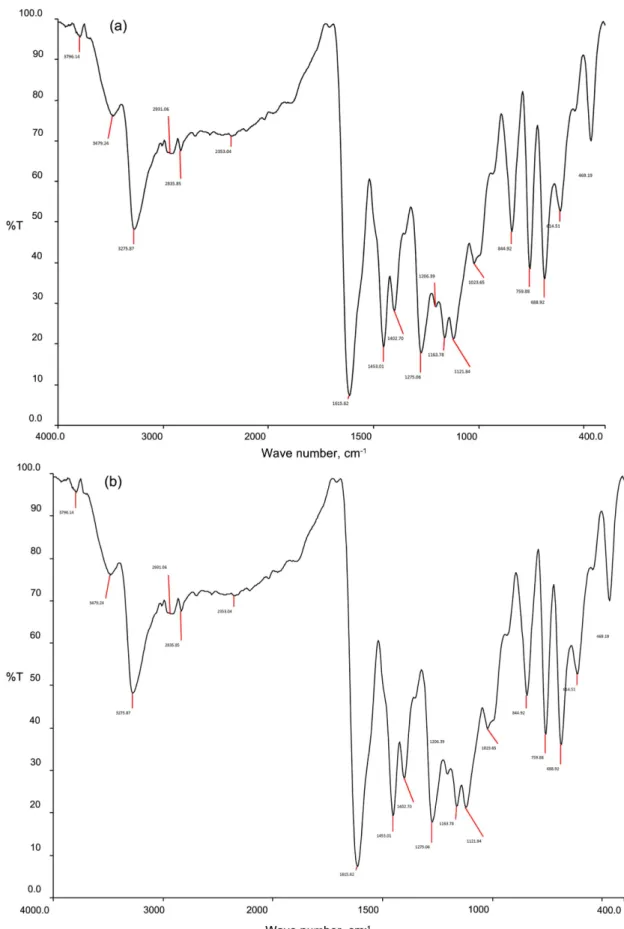
The FT-IR spectra taken for the characterization of both pure HMPC and the corrosion product have been dis- played in Fig. 7(a) and 7(b) respectively. The spectrum 7(a) shows all the characteristic bands corresponding to the functional groups present in the inhibitor and spec- trum 7(b) shows the characteristic bands of scrapped sample deposited over the mild steel surface in 1 M hydrochloric acid. The spectrum 7(b) is almost identical with the spec- trum 7(a) which proves the absence of coordination bond
with the metal surface through the above said heterocy- clic centers of the inhibitor.
CONCLUSION
The flavonoid compound 3-Hydroxy-7-methoxy-2-phe- nylchromen-4-one acts as a good inhibitor for the corrosion of mild steel in 1 M hydrochloric acid at room tempera- ture and found to follow the Langmuir adsorption isotherm.
It is evident from the polarization studies that HMPC acts as a mixed type inhibitor. The electrochemical impedance measurements also clearly revealed the inhibitive action of HMPC. The SEM analysis provided supporting evi- dence for the adsorption of this flavonoid compound over the mild steel surface. The FT-IR analysis of the corrosion product also revealed the same.
Table 5. Electrochemical Impedance measurements for the corro- sion of mild steel in the absence and presence of HMPC alone and along with TBAB in 1 M HCl
Concentration of inhibitor × 10-5 M
Rct
Ωcm2
Cdl × 10-4
F/cm2 IE(%)
Blank 10.62 3.766 -
1 17.14 0.074 38.04
2 37.34 0.021 71.56
3 52.33 0.019 79.71
4 75.42 0.017 85.92
HMPC+TBAB 89.70 0.014 88.16
Fig. 6. (a) SEM image of mild steel sample kept in 1 M HCl for 2 h at 303 K, (b) SEM image of mild steel sample kept in 1 M HCl along with HMPC for 2 h at 303 K.
Fig. 7. (a) FT-IRspectrum of pure HMPC, (b) FT-IRspectrum of scrapped sample.
Acknowledgements. The authors thank the management of Bishop Heber College (Autonomous), Tiruchirappalli- 620017, Tamil Nadu for their encouragement and UGC (New Delhi) for the financial support. The authors also thank Dr. S. Sundar Manoharan, professor of chemistry, IIT, Kanpur, Dr. Victor Williams, professor of physics, St.
Joseph’s College, Tiruchirappalli and Dr. S. Abraham John, professor of chemistry, Gandhigram Rural University, Gandhigram, for providing the instrumentation facilities.
REFERENCES
1. Khaled, K. F. Appl. Surf. Sci. 2004, 230, 307.
2. Popova, A.; Christov, M.; Raicheva, S.; Sokolova, E.
Corros. Sci. 2004, 46, 333.
3. Bentiss, F.; Traisnel, M.; Lagrenee, M. J. Appl. Electro- chem. 2009, 39, 1399.
4. Bothi Raja, P.; Sethuraman, M. G. Mater. Corros. 2008, 59, 9999.
5. Ashassi-Sorkhabi, H.; Masoumi, B.; Ejbari, P.; Asghari,
E. J. Appl. Electrochem. 2009, 39, 1497.
6. Keles, H.; Keles, M.; Dehri, I.; Serindag.O. Mater. chem.
phys. 2008, 112, 173.
7. Vishwanatham, S.; Haldar, N. Corros. Sci. 2008, 50, 2999.
8. Kalman, E.; Palinkas, G. Corros. Sci. 1993, 35, 1471.
9. Oguzie, E. E.; Unaegbu, C.; Ogukwe, C. N.; Okolue, B.
N.; Onuchikwu, A. I. Mater. Chem. Phys. 2004, 84, 363.
10. Prabavathi, N.; Morris Princey, J.; Christy Ezhilarasi, J.;
Kavitha, D. J. Ind. Council Chem. 2009, 26, 153.
11. Sethuraman, M. G.; Bothi Raja, P. Pigm. Res. Technol.
2005, 34, 327.
12. Bentiss, F.; Lagrenee, M.; Traisnel, M.; Hornez, J. C.
Corros. Sci. 1999, 41, 789.
13. Ashassi-Sorkhabi, H.; Shaabani, B.; Seifzadeh, D. Elec- trochim. Acta, 2005, 50, 3446.
14. McCaffferty, E.; Leidheiser Jr, H. Corrosion Control by Coating, Science Press, Princeton, 1979, 279.
15. Huilong, W.; Fiashen, Z.; Fing, L. Anti-corros. Methods.
Mat. 2002, 49, 127.
16. Shih, H.; Mansfeld, H. Corros. Sci. 1989, 29, 1235.