• 검색 결과가 없습니다.

Aortopulmonary Fistula Presenting without an Endoleak after Thoracic Endovascular Aortic Repair

N/A
N/A
Protected

Academic year: 2021

Share "Aortopulmonary Fistula Presenting without an Endoleak after Thoracic Endovascular Aortic Repair"

Copied!
4
0
0

로드 중.... (전체 텍스트 보기)

전체 글

(1)

ISSN: 2233-601X (Print) ISSN: 2093-6516 (Online)

− 287 −

Received: November 10, 2016, Revised: February 22, 2017, Accepted: March 29, 2017, Published online: August 5, 2017

Corresponding author: Giacomo Sica, Division of Radiology, Department of Diagnostic Imaging, Monaldi Hospital, Via L. Bianchi, Naples, Italy

(Tel) 39-08119812582 (Fax) 39-08119812582 (E-mail) [email protected]

© The Korean Society for Thoracic and Cardiovascular Surgery. 2017. All right reserved.

This is an open access article distributed under the terms of the Creative Commons Attribution Non-Commercial License (http://creativecommons.org/

licenses/by-nc/4.0) which permits unrestricted non-commercial use, distribution, and reproduction in any medium, provided the original work is properly cited.

Aortopulmonary Fistula Presenting without an Endoleak after Thoracic Endovascular Aortic Repair

Giacomo Sica, M.D., Ph.D. 1 , Gaetano Rea, M.D. 1 , Giorgio Bocchini, M.D. 1 , Romilda Lombardi, M.D. 2 , Massimo Muto, M.D. 1 , Tullio Valente, M.D. 1

1

Division of Radiology, Department of Diagnostic Imaging, Monaldi Hospital,

2
Division of Radiology, Department of Diagnostic Imaging, AO Rummo

Herein, we report the case of a 60-year-old man, a smoker with a history of arterial hypertension and dia- betes mellitus. After computed tomography (CT) for an episode of hemoptysis, the patient underwent elective thoracic endovascular aortic repair (TEVAR) because of a degenerative aneurysm of the descending thoracic aorta. The area of perianeurysmal pulmonary atelectasis reported on the CT scan was not considered. Three months later, he developed an aortopulmonary fistula without endoleaks. Although TEVAR is a relatively safe procedure, no detail should be overlooked in the preoperative evaluation in order to avoid life-threatening complications. Further, the effectiveness and modality of prolonged antibiotic prophylaxis and/or preoperative respiratory physiotherapy should be assessed in such cases.

Key words: 1. Endovascular procedures 2. Aortic aneurysm

3. Pulmonary atelectasis 4. Complication

5. Physiotherapy

Case report

Herein, we report the case of a 60-year-old man, a smoker with a history of arterial hypertension, dia- betes mellitus, and recent unspecified retinal vein thrombosis treated with heparin and oral anticoagu- lants. In the emergency department (ED), following an episode of hemoptysis, the patient underwent thoracic contrast-enhanced multidetector computed tomography (CE-MDCT) revealing ground-glass opac- ities (GGO) in the left lung parenchyma for hemor- rhagic alveolitis, associated with small consolidation areas in the presence of normal blood inflammatory indices (serum C-reactive protein, erythrocyte sed-

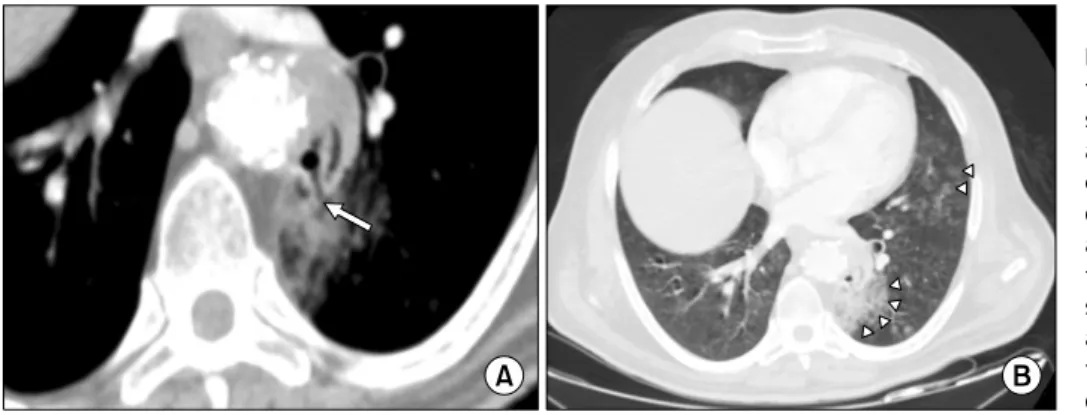
imentation rate, and white blood cell count). Further, the CE-MDCT revealed a saccular aneurysm of the left side wall of the descending thoracic aorta with a maximum transverse diameter of 57 mm and ate- lectasis of the surrounding lung parenchyma com- pressed by the aneurysm (Fig. 1). The saccular aneu- rysm was considered to be of atherosclerotic nature, considering the relatively high incidence of athero- sclerotic saccular aneurysms [1]; the lack of clearly suggestive computed tomography (CT) signs for an infected aneurysm; the absence of fever, intersca- pular or back pain, or coughing; completely normal inflammatory indices; and no history of high-energy trauma or bladder cancer. Moreover, considering the

Korean J Thorac Cardiovasc Surg 2017;50:287-290 □ CASE REPORT □

https://doi.org/10.5090/kjtcs.2017.50.4.287

(2)

Giacomo Sica, et al

− 288 −

Fig. 1. Contrast-enhanced multidetector computed tomography showing (A) a saccular aneurysm (asterisk) and perianeurysmal ate- lectasis (arrowheads), (B) favorable position of the aneurysm in reformatted coronal oblique multiplanar reconstruction (arrow), and (C) the presence of ground-glass opacities (arrows).

Fig. 2. Minimum intensity projec- tion reformation (A) shows the pre- sence of a significant proportion of air in the aneurysmal sac with a lin- ear air image with an interruption of the aortic wall (arrow); (B) an axial contrast-enhanced multide- tector computed tomography scan showing reduction of atelectasis and an increase in ground-glass opac- ities (arrowheads) in the absence of endoleaks.

favorable anatomical location of the aneurysm and the spontaneous cessation of hemoptysis, elective thoracic endovascular aortic repair (TEVAR) was car- ried out. However, after approximately 3 months, the patient returned to the ED with a new episode of he- moptysis, and therefore underwent multiphase CE- MDCT, which excluded a pulmonary embolism, show- ing the correct positioning of the endoprosthesis, the total absence of an endoleak, size reduction of the aortic aneurysm sac for thrombus retraction, size re- duction of the parenchymal lung atelectasis, the on- set of air bubbles in the excluded aneurysmal sac with a linear arrangement of air and an interruption of the aortic wall in the minimum intensity projec- tion reformation, and persistent GGO that explained the new episode of hemoptysis (Fig. 2). Therefore, the patient was hospitalized again. Since the in- flammatory markers were normal and the patient had neither fever nor chest pain in the absence of the CE-MDCT signs of a stent-graft infection, we de- cided upon nonoperative management, reserving the possibility of open aortic repair if the hemoptysis

worsened and pending the performance of positron emission tomography–CT if a stent-graft infection was suspected. Fortunately, after 5 days, CE-MDCT imag- ing showed a significant reduction of air in the aneurysmal sac and a reduction of the GGO along with lung consolidation. Therefore, the patient was discharged with home care (Fig. 3). One week after being discharged from the hospital, the patient re- turned to our clinic completely asymptomatic and his blood tests confirmed the normality of the in- flammatory markers. After 1 month, a follow-up CT scan confirmed a gradual improvement of the thora- cic findings.

Discussion

Aortopulmonary and aortobronchial fistulas (ABPFs)

are a rare but feared condition that, favored by the

long course of the aorta and due to its elevated in-

traluminal pressure, may arise as a life-threatening

postoperative complication. Although the incidence of

ABPFs is reported to be relatively high after open

(3)

Aortopulmonary Fistula Complicating a TEVAR

− 289 −

Fig. 3. Axial contrast-enhanced mul- tidetector computed tomography scan showing (A) an absence of en- doleaks and a reduction of the air in the aneurysmal sac (arrowhead) with restoration of the wall in- tegrity and (B) a significant reduc- tion of atelectasis and ground glass opacities (arrowheads).

surgery, this complication has also been reported af- ter TEVAR in the literature [2,3]. TEVAR is known to be a valid alternative to open surg ery and is often the first therapeutic solution for the treatment of thoracic aortic disease, particularly in patients in whom the presence of a comorbidity contraindicates traditional surgery [4-6]. However, even though TEVAR is relatively safe, several complications re- lated to this procedure have been reported in the literature. In particular, ABPFs have a relatively low incidence, ranging from 0.56% to 0.8% [2,3], but an infection of the stent graft is feared, often requiring repair with open surgery [4,5]. In ABPFs, hemoptysis is often the only symptom and depends on the fistu- la entity. CE-MDCT can be used to identify chang es in the adjacent lung as consolidation or rarely, the flooding of the intravenous contrast medium into the lung tissue or airways. Sometimes, intragraft or peri- g raft air is an indirect sig n that may be the only sig n of a fistula. Leukocytosis, fever, and chest pain are nonspecific clinical findings in the case of a serious graft infection. In such cases, CE-MDCT can show aortic wall thickening, perigraft soft tissue or fluid collection, pseudo-aneurysm, perigraft air or an in- creasing amount of air on serial imag ing examina- tions, adjacent soft-tissue stranding, abscess for- mation, and graft thrombosis or expansion [3]. This case shows that even in the overall evaluation before a relatively safe procedure such as TEVAR, no MDCT detail can be overlooked, even a minor detail such as the limited area of atelectasis. In fact, longstanding atelectasis may indicate adherence to the aneurysmal aortic wall that is already lacking elasticity. Further- more, chronic pulsatile compression of a progressively degenerative aneurysm that expands into the lung parenchyma and the airways could cause a local in-

flammatory response with a further formation of adhesions. Despite the excellent positioning of the endoprosthesis and the total absence of endoleaks, in the considered case, the reduction of the aneurysmal sac size that comes from thrombus retraction might be associated with better expansion of the periaortic lung parenchyma (no longer compressed), and cause traction on the wall of the aneurysmal sac, thereby causing an aortopulmonary fistula. Furthermore, vigo- rous coughing due to hemoptysis can increase the amount of air, further emphasizing the interruption of the aortic wall and air embolism into the excluded aneurysmal sac [7]. Fortunately, the patient never presented with leukocytosis, fever, or chest pain; he- moptysis, although important, was limited, consider- ing the absence of an endoleak, and required only prudent admission to a highly specialized department.

Some authors have argued that many endopros- theses are placed off-label and that some indications of TEVAR are often bold and not adequately proven [2,5]. However, this case shows that even when all the indications stated in the international guidelines are observed [8], TEVAR, which is relatively easy a favorable position and extent, with a regular diame- ter and optimal length of the healthy proximal and distal landing zones, may be complicated by danger- ous events, such as an ABPF, if small MDCT details are underestimated in the preoperative assessment.

Furthermore, the present case supports the view-

point of other authors who have recommended a

multidisciplinary approach for determining the type

of treatment for thoracic aortic disease depending on

the functional anatomy, pathology, and comorbidity

of the case being treated [8]. Further multicenter

studies are needed to encourage the development of

additional preoperative risk stratification tools that

(4)

Giacomo Sica, et al

− 290 − must take into account the smaller MDCT details that are often not considered in a pre-TEVAR evaluation, but mig ht still be responsible for undesirable post- operative complications requiring conversion to open repair. Finally, although encouraging studies on respi- ratory physiotherapy before cardiothoracic and ab- dominal surgery have been reported in the literature [9-11], currently, the role of this procedure, which is generally associated with prolonged antibiotic pro- phylaxis, has never been considered when it is per- formed before endovascular procedures. Therefore, respiratory physiotherapy, a safe and relatively inex- pensive practice, could be introduced before elective TEVAR procedures with associated perianeurysmal pulmonary atelectasis to avoid potentially catastro- phic postoperative complications, such as an ABPF or a peri-stent-graft infection, even in the absence of endoleaks.

Conflict of interest

No potential conflict of interest relevant to this ar- ticle was reported.

References

1. Shang EK, Nathan DP, Boonn WW, et al. A modern experi- ence with saccular aortic aneurysms. J Vasc Surg 2013;

57:84-8.

2. Czerny M, Reser D, Eggebrecht H, et al. Aorto-bronchial and aorto-pulmonary fistulation after thoracic endovas- cular aortic repair: an analysis from the European Registry of Endovascular Aortic Repair Complications. Eur J Cardio- thorac Surg 2015;48:252-7.

3. Valente T, Rossi G, Rea G, et al. Multidetector CT findings of complications of surgical and endovascular treatment of aortic aneurysms. Radiol Clin North Am 2014;52:961-89.

4. Coselli JS, Spiliotopoulos K, Preventza O, de la Cruz KI, Amarasekara H, Green SY. Open aortic surgery after thoracic endovascular aortic repair. Gen Thorac Cardio- vasc Surg 2016;64:441-9.

5. Roselli EE, Abdel-Halim M, Johnston DR, et al. Open aortic repair after prior thoracic endovascular aortic repair. Ann Thorac Surg 2014;97:750-6.

6. Kim JT, Yoon YH, Lim HK, Yang KH, Baek WK, Kim KH.

Thoracic endovascular stent graft repair for aortic aneu- rysm. Korean J Thorac Cardiovasc Surg 2011;44:148-53.

7. Irwin RS. Complications of cough: ACCP evidence-based clinical practice guidelines. Chest 2006;129(1 Suppl):54S- 58S.

8. Erbel R, Aboyans V, Boileau C, et al. 2014 ESC guidelines on the diagnosis and treatment of aortic diseases: docu- ment covering acute and chronic aortic diseases of the thoracic and abdominal aorta of the adult. The Task Force for the Diagnosis and Treatment of Aortic Diseases of the European Society of Cardiology (ESC). Eur Heart J 2014;

35:2873-926.

9. Varela G, Ballesteros E, Jimenez MF, Novoa N, Aranda JL.

Cost-effectiveness analysis of prophylactic respiratory physiotherapy in pulmonary lobectomy. Eur J Cardiothorac Surg 2006;29:216-20.

10. Katsura M, Kuriyama A, Takeshima T, Fukuhara S, Furukawa TA. Preoperative inspiratory muscle training for postoperative pulmonary complications in adults under- going cardiac and major abdominal surgery. Cochrane Database Syst Rev 2015;(10):CD010356.

11. Mans CM, Reeve JC, Elkins MR. Postoperative outcomes

following preoperative inspiratory muscle training in pa-

tients undergoing cardiothoracic or upper abdominal sur-

gery: a systematic review and meta analysis. Clin Rehabil

2015;29:426-38.

수치

Fig. 2. Minimum intensity projec- projec-tion reformaprojec-tion (A) shows the  pre-sence of a significant proportion of  air in the aneurysmal sac with a  lin-ear air image with an interruption  of the aortic wall (arrow); (B) an  axial contrast-enhanced
Fig. 3. Axial contrast-enhanced mul- mul-tidetector computed tomography  scan showing (A) an absence of  en-doleaks and a reduction of the air  in the aneurysmal sac (arrowhead)  with restoration of the wall  in-tegrity and (B) a significant  reduc-tion of

참조

관련 문서

P.( Kidney

management of community-acquired pneumonia: an evidence- based update by the Canadian Infectious Diseases Society and the Canadian Thoracic Society. The

1 John Owen, Justification by Faith Alone, in The Works of John Owen, ed. John Bolt, trans. Scott Clark, "Do This and Live: Christ's Active Obedience as the

The foreign policy triumphs with China and the Soviet Union and the administration’s announcement that peace “is at hand” in Vietnam helped reelect Nixon as

Autho: Effectiveness of surgery for lumbar stenosis and degenerative spondylolisthesis in the octogenarian population: analysis of the Spine Patient Outcomes Research

In this study we will survey the changes in DNA repair factors during aging in rat, including mismatch repair (MMR), base excision repair (BER), and double-strand break

 In the present study, as a preliminary study, a LACC-based Compton CT was developed to estimate the activity of the spot inside the radioactive waste drum. To

(A) Before repair of RCT shows fatty degeneration of supraspinatus (stage 2) and infraspinatus (stage 3) muscle and atrophy (Grade 2) (B) After 18months later