Acute motor axonal neuropathy (AMAN) is a subtype of Guillain-Barre syndrome (GBS), which is relatively common in East Asia including Japan, China, and Korea.1,2 According to some reports, AMAN is more prevalent than typical GBS known as acute inflammatory demyelinating polyradiculoneuropathy (AIDP).3-5 On the other hand, acute motor sensory axonal neuropathy (AMSAN) is a rare disease compared with AMAN, but the pathophys- iology and clinical course of AMSAN are reported to be similar to those of AMAN except sensory nerve involvement.2
Reversible conduction block (RCB) which was known to be associated with a sodi- um-channel dysfunction in node of Ranvier has been reported in some AMAN patients.
AMAN with RCB is known to show relative rapid recovery and good prognosis.1,2 However, RCB was rarely reported in patients with AMSAN and the clinical course and outcome in patients with AMSAN with RCB were not well-known. Recently, we experienced a case of AMSAN with RCB in serial electrophysiologic studies.
Received: August 22, 2017 Revised: December 22, 2017 Accepted: December 28, 2017 ANNALS OF CLINICAL
NEUROPHYSIOLOGY
CASE REPORT
Ann Clin Neurophysiol 2018;20(1):49-52 https://doi.org/10.14253/acn.2018.20.1.49
Correspondence to Kyong Jin Shin
Department of Neurology, Inje University Haeundae Paik Hospital, 875 Haeun-dae- ro, Haeundae-gu, Busan 48108, Korea Tel: +82-51-797-2080
Fax: +82-51-797-1196 E-mail: [email protected]
http://www.e-acn.org pISSN 2508-691X eISSN 2508-6960
Copyright © 2018 The Korean Society of Clinical Neurophysiology
This is an Open Access article distributed under the terms of the Creative Commons Attribution Non-Commercial License (http://
creativecommons.org/licenses/by-nc/4.0) which permits unrestricted non-commercial use, distribution, and reproduction in any medium, provided the original work is properly cited.
A case of acute motor sensory axonal neuropathy presenting reversible conduction block
Dongah Lee1, Hyung Chan Kim1, Kang Min Park1, Jinse Park1, Sam Yeol Ha1, Sung Eun Kim1, Byung In Lee1, Jong Kuk Kim2, Byeola Yoon2, and Kyong Jin Shin1
1Department of Neurology, Haeundae Paik Hospital, Inje University College of Medicine, Busan, Korea
2Department of Neurology, Dong-A University Hospital, Dong-A University College of Medicine, Busan, Korea
Reversible conduction block (RCB) was rare in patients with acute motor sensory axonal neu- ropathy (AMSAN). A-46-year-old man presented with paresthesia, weakness, diplopia, and dysarthria. Nerve conduction study (NCS) exhibited axonal changes with conduction block in motor and sensory nerves. His symptoms were rapidly progressed and recovered. Conduc- tion block was disappeared in the follow-up NCS performed after 2 weeks. The AMSAN case with RCB showed rapid progress and rapid recovery of clinical symptoms as acute motor axo- nal neuropathy patients with RCB.
Key words: Guillain-Barre Syndrome; Nerve conduction; Muscle weakness
50 https://doi.org/10.14253/acn.2018.20.1.49 http://www.e-acn.org
Annals of Clinical Neurophysiology Volume 20, Number 1, January 2018
CASE
A 46-year-old man presented with tingling sensations of 4 limbs, double vision, and speech disturbance developed the day before of admission. He was healthy and had no history of any particular disease and medication. He was diagnosed and treated for acute enterocolitis by diarrhea a week ago.
Bilateral horizontal diplopia, dysarthria, dysphagia, bifacial palsies, quadriparesis (MRC grade 4), and gait ataxia were observed on neurologic examinations. Deep tendon reflex- es on 4 limbs were absent. Nerve conduction study (NCS) which was performed on the second day of the admission exhibited the decreased sensory nerve action potential
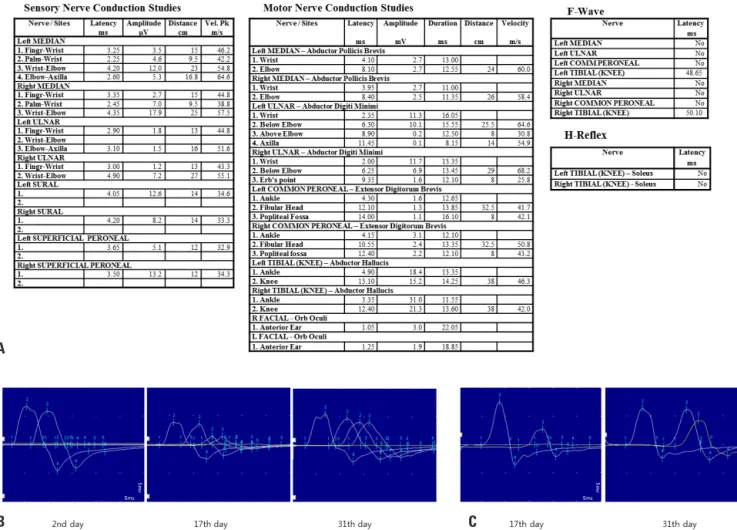
(SNAP) amplitude and compound motor action potential (CMAP) potential of both upper extremities with sparing the both lower limbs. Conduction block was observed in both ulnar nerves. F-waves of both median, ulnar, and common peroneal nerves and H-reflexes in both calf muscles were not formed (Fig. 1A). Cerebrospinal fluid test was normal.
Enzyme-linked immunosorbent assay for IgG and IgM anti- bodies against GM1, GM2, GD1a, GD1b, GT1a, GT1b, GQ1b, and GD3 were all negative. No specific abnormal finding was observed in CBC, blood chemistry, urine analysis, and serology and virology tests. Stool culture for Campylobacter jejuni was negative.
He was treated with IV immunoglobulin (0.4g/kg) for 5
Fig. 1. Nerve conduction studies in the present case. (A) Initial nerve conduction study which was performed on the second day of admission exhibit- ed the decreased sensory nerve action potential amplitude and compound motor action potential amplitude of both upper extremities. Conduction block was observed in both ulnar nerves. F-waves of both median, ulnar, and common peroneal nerves and H-reflexes in both calf muscles were not formed. (B) Conduction block in the left ulnar motor nerve was firstly appeared on the second day of admission, began to reverse on the seventeenth day of admission, and disappeared on the thirty-first day of admission. (C) Conduction block in the left common peroneal nerve was firstly appeared on the seventeenth day of admission and disappeared at the thirty-first day of admission.
A
B C
51
http://www.e-acn.org https://doi.org/10.14253/acn.2018.20.1.49
Dongah Lee, et al. An AMSAN case with reversible conduction block
days, however, quadriparesis (MRC 1 in upper limbs or 2 in lower limbs), dysphagia, dysarthria and facial diplegia were worsen and bilateral extraocular muscles (EOM) limitation and dyspnea were newly developed. He had to undergo ar- tificial ventilator therapy in intensive care unit for 9 days from the third day of admission. Respiratory hold and dyspnea was rapidly recovered, and he could remove the ventilator at the eleventh day of admission.
NCS which was performed at seventeenth day of admis- sion exhibited the decreased SNAP and CMAP amplitudes in 4 limbs with newly developed conduction block in both common peroneal nerves. Conduction blocks in both ulnar nerves were partially recovered. F-waves in both median and ulnar nerves were recovered but F-waves in both common peroneal and H-reflexes in both calf muscles were still not formed (Fig. 1B). At the same day, quadriparesis (MRC 2 in upper limbs and 3 in lower limbs), dysarthria, dysphagia, and facial diplegia were improved. He can walk with assistance and swallow and speech without obstacle. However, EOM limitation and sensory symptoms still remained.
At the thirty-first day of admission, SNAP amplitude in 4 limbs was still decreased, however, CMAP amplitude of 4 limbs returned to normal range and conduction block of both ulnar and common peroneal nerves disappeared (Fig.
1C). Quadriparesis (MRC 4 in upper limbs and MRC 4-5 in lower limbs) was much improved. He can walk without as- sistance. Slight EOM limitation in both horizontal directions and sensory symptoms still remained.
DISCUSSION
AMAN and AIDP are major subtypes of GBS. In general, patients with AMAN present with more rapid progression and poor recovery of neurological deficits compared with patients with AIDP. The natural course of AMAN depends on the immunopathophysiology, which are classified as axonal degeneration and RCB. AMAN patients with axonal degen- eration tended to show rapid progression, late recovery and poor outcome, whereas AMAN patients with RCB tended to show fast recovery and good outcome.1,4 RCB was reported in about 45% among patients with AMAN in two recent ret- rospective studies.6,7 RCB was observed in 12 patients (70.6%) among 17 patients with AMAN in a study of Korea.8
RCB is known to be caused by a transient sodium-channel disruption and the detachment of paranodal myelin which was initiated by the ganglioside antibody deposition and subsequent complement activation at node of Ranvier and paranodal area.1,2,6 The pathophysiology and clinical course in AMSAN patients with RCB are likely to be similar to AMAN patients with RCB because both diseases shared many clin- ical and laboratory similarities. RCB has also been reported in AMSAN, Miller-fissure syndrome, and pharyngeal-cervi- cal-brachial GBS as well as AMAN.2,9 The present case exhib- ited a rapid progression and rapid recovery with minor re- sidual symptoms. Serial NCS exhibited RCBs in motor nerves.
Conduction block was reversed after two weeks. These find- ings are consistent with the previous reports in AMAN pa- tients with RCB. This report supports that AMAN and AMSAN are one clinical spectrum. However, any anti-ganglioside antibodies were not detected. The serum sample for the an- ti-ganglioside antibody assay was obtained on the second day of admission and third day of onset. The possibility of false-negative due to the fast sample acquisition time and method of measurement should be considered. Follow-up antibody test using more sensitive assay can increase the sensitivity of the anti-ganglioside antibody assay. Further in- vestigation to evaluate the clinical course and immunologic characteristic in patients with AMSAN patients with RCB is needed.
Conflicts of Interest
The authors have no conflicts to disclose.
REFERENCES
1. Bae JS, Yuki N, Kuwabara S, Kim JK, Vucic S, Lin CS, et al. Guil- lain-Barré syndrome in Asia. J Neurol Neurosurg Psychiatry 2014;85:907-913.
2. Kuwabara S, Yuki N. Axonal Guillain-Barré syndrome: concepts and controversies. Lancet Neurol 2013;12:1180-1188.
3. Islam Z, Jacobs BC, van Belkum A, Mohammad QD, Islam MB, Herbrink P, et al. Axonal variant of Guillain-Barre syndrome asso- ciated with Campylobacter infection in Bangladesh. Neurology 2010;74:581-587.
4. Kim JK, Bae JS, Kim DS, Kusunoki S, Kim JE, Kim JS, et al. Preva- lence of anti-ganglioside antibodies and their clinical correlates
52 https://doi.org/10.14253/acn.2018.20.1.49 http://www.e-acn.org
Annals of Clinical Neurophysiology Volume 20, Number 1, January 2018
with guillain-barré syndrome in Korea: a nationwide multicenter study. J Clin Neurol 2014;10:94-100.
5. Sekiguchi Y, Uncini A, Yuki N, Misawa S, Notturno F, Nasu S, et al. Antiganglioside antibodies are associated with axonal Guil- lain-Barré syndrome: a Japanese-Italian collaborative study. J Neurol Neurosurg Psychiatry 2012;83:23-28.
6. Chan YC, Punzalan-Sotelo AM, Kannan TA, Shahrizaila N, Umap- athi T, Goh EJH, et al. Electrodiagnosis of reversible conduction failure in Guillain-Barré syndrome. Muscle Nerve 2017;56:919- 924.
7. Uncini A, Ippoliti L, Shahrizaila N, Sekiguchi Y, Kuwabara S.
Optimizing the electrodiagnostic accuracy in Guillain-Barré syndrome subtypes: Criteria sets and sparse linear discriminant analysis. Clin Neurophysiol 2017;128:1176-1183.
8. Hong YH, Sung JJ, Oh MY, Moon HJ, Park KS, Lee KW. Axonal con- duction block at intermediate nerve segments in pure motor Guillain-Barré syndrome. J Peripher Nerv Syst 2011;16:37-46.
9. Chan YC, Ahmad A, Paliwal P, Yuki N. Non-demyelinating, re- versible conduction failure in a case of pharyngeal-cervical-bra- chial weakness overlapped by Fisher syndrome. J Neurol Sci 2012;321:103-106.