임상노인의학회지 제 1권 제4호
2000
Korean J Clin Geri Vol. 1, No. 4 December
口 원 저 口A Study on some polymorphisms of human leptin receptor gene in Koreans
Bong-Keun Choe,
T띠」YoungYoon, Joon-Myung Choi,
Soon」YoungPark, IJong-Joon Lew
Department of Preventive
Me,벼~cine,&.뼈olof Medicine, Kyung Hee University
lnsto ‘ iJC:tion : L€ptin is an adipocyte-derived blood borne satiety factor that acts on its cognate leptin receptor(Ob-R) in the l\ypothalamus, thereby
regrula미igfood intake and energy
얹:penditure.To exlore whether mutations in the Ob- R gene cause
φesityin humans, we have searched for mutations in the gene for Ob-Rb, a biologically active receptor isofonn, in
o뾰sekorean subjects.
Methe얘 :
Genomic DNA was extracted from whole
blo여stored at the time of colletion, and used for subsequent analyses. PCR-RFLP
없ialysiswas performed for
genot째,ingat codons 2Z3 and 1019.
ResUt : In obese subjects, allele frequencies of the polymorphic site at the codons 2Z3 and 1019
(GlnZ정.Arg
and Prol019pro) were 91 and Erl%. In non-obese subjests, they wre 92 and 86%. The odds ratio
(않%confidence interval) for obesity of
ArgZ경and prol019
외lelewere 0.9 (0.3-2.6) and
1.1(0.5-2.5) , respectively. No significant
이fferencewas
obseπedin the clinical characteristics among the genotype groui:s. Diastolic blood pressure of subjects with he Gln/Gln and Gln/
Argin the non -obese.
There are no significant
띠fferencein TC, TG, HDL-C
때dLDL-C among the Ob-R genotype groui:s.
Conch.회on
: Diastolic
blo여pressure of subjects with the Gln/Gln and Gln/ Arg in the obese was signifi- cantly higher than that of those with Gln/Gln
ar띠Gln/
Argin the non -obese.
Hypertension is associated with obesity. Further
stu띠$are
req버redto
cl따itythe association
양tweenpolymorphism of Ob-R gene and hypertension.
Keywords : Obesity,
Re때nreceptor, PCR - RFLP,
p얘morp비sm,Diastolic
pr'얹sure,Hypertension
and non - insulin dependent diabetes mellitus (NI- Introduction DDM)
.1iNowadays obesity
뼈sreached epidemic
proportions and is threatening to become a global Obesity arises from complex interactions be- epidemic.
ziWhat is causing the dramatic rise in
때een
genetic and environmental factors, confer- overweight among the population? Although rese-
미ig
a higher
디skof cardiovascular and
met.ab이icarch advances have
뼈매ightedthe importance of
disorders such as hypertension, hyperlipidernia, molecular genetic factors in determining
indi까d-ual susceptibility to
O뾰sity,the landmark discov- eries of leptin, uncoupling proteins and neurope- ptides involved in
bodyweight
reg띠ation,cannot explain the obesity epidemic. Our genes have not changed substantially during the
맹sttwo dee- ades.
πleculprit is an environment which pro- motes
beha띠orsthat cause obesity.3l Obesity can
a디se
only when energy intake exceeds energy expenditure. Our current environment is charac- terized by an essentially unlimited supply of con- venient, relatively
ine자iensive, highlypalatable, energy-dense foods, coupled with a lifestyle re- quiring only low levels of physical
acti띠tyfor subsistence. Such an environment promotes
비ghenergy intake and low energy
e짜ienditure.Genetic make up
외soplays a role in that it determines the strength of an
m띠찌du외’sphysio- logical defense against gaining and maintaining
often obese individuals have very
비ghcirculating levels of leptin, the OB gene product.9·10l It has
뾰en
recognized that leptin is an adipocyte - de- rived blood - borne satiety factor that acts on OB - R in the hypothalamus, thereby regulating food intake and energy
e짜ienditure.OB- R gene mutation or polymorphism may contribute to human obesity. Therefore,
manystudies of the OB- R gene in humans were per- formed , and some
reve외edseveral sequence polymorphism in African - American, Caucasians and Pima Indians.11 · 1 2J
In
t비Sstudy, we investigated relationship be- tween OB - R gene polymorphism and clinical characteristics in Korean
ad버ts.Methods
an obese
m아rfat level. Genetic factors are crit- Subjects ically importance for determining how different
in
di찌dualsrespond
wit비na given environment.
T때S
is
뾰st 피ustratedby the differences in
mφr
weight
와nong U떠i띠d따ls U띠ngin a com- mon environment. The
molec버arpathogenesis of obesity is, however, largely unknown. The
띠scovery of leptin, the obese (ob) gene product,
뼈Sprovided a
usef버molecular tool to elucidate the pathophysiology of obesity and obesity-associated diabetes. ‘
-6)The recent identification and
developn웅ntof
p이yrrorphic
markers within candidate genes, and
associa디ons
of alleles at candidate loci
뼈sproved an informative and practical method for
analy강ng
polygenic quantitative traits in animal models and human population.
1‘ 8)Studies conducted in rodent models of
o뾰sityhave demonstrated that mutations in either the OB gene (ob/ob mice) or OB-R, the leptin rece- ptor gene (dh/dh mice, Zucker fa/fa rats, Kole- sky rat) . A defect in the OB gene in
m비kelyto represent a major cause of obesity in humans as
만le
subjects examined in this study were Ko- rean
ad버tsin Seoul.
Blo여 S없npleswere collect- ed as part of a population - based survey. In- formed consent was obtained from subjects be- fore the
blo여was collected.
Obesity index ( (
(re외weight - standard weight) I
standard weight) × 100) was
calc띠atedusing the standard weight for Korean
ad버잉and deter- mined according to
쟁egender and
stat따e.Non -obesity was defined as obesity index between
a>% and + a>%. Obesity was defined as
o뾰sityindex of more than +a>%.
Bodymass index (BMI) was
c외C띠ated accor띠ngto the formula ,
(re외
weight
(kg)/height2 (M2) ) . Blood pressure was measured by an auto- hemodynamonleter in the sitting position
따ter5 min rest.
Laboratory tests
Blood samples were obtained in the morning
after an overnight fast. Total cholesterol (TC),
Bong-Keun
α10eet
외 :A Study on sorre JX>lyroorphisms of human
lep마1recept;or gene in Koreans
A:Gln223Arg
AJA AJG GIG
42lbp 294bp 127bp
B:Pro1019pro
G/G GIA A/A
99bp 7lbp 28bp
Fig.I IA - B Genotyping of the polymorphic alleles in th Ob - Rb gene by PCR- RFLP at codons 223(nucletide668) (A) and 10I9(3057) (B), where A to G and G to A transversions occurred, respectively. PCR- RFLP analyses were performed using upstream and down- stream sequence - specific primer(for Gln223Arg) or upstream and downstream mutated sequence -specific primer(for Pro1019pro) as described in Subjects and methods. The re- striction site created (Msp I (A) and Hind II (B)) in polymorphic alleles were depicted.
Polymorphic nucleotides are shown bold. Gel electrophoresis of the PCR products after di- gestion with restriction enzymes.
180 160 140 120
100
80 60 40 20
0
SBP(때n뼈) DBP(빼벼) 口 N。n-o'oose
NA. NG 'rJpe •
α〕eseA/A. NG 'rjpe
Figure 2. Comparison of blood pressure in Gln223Arg genotype in female.
SBP: systolic blood pressure; DBP:diastolic blood pressure.
(* p-value <0.05 tested by ANCOVA)
triglyce디de
(TG), fasting glucose level and
비힐l- significant was
establis뼈dat the p<0.05 level.
density Jipoprotein cholesterol (HDL) were measu-
red by an
autoan외yzer.Results
Polymerase chain reaction (PCR) - restriction
fragment length polymorphism
(RFLP) Characte「isticsGenomic DNA was extracted from whole blood stored at the
따neof collection
(Wi않rdGenomic DNA Purification
때t, Prom앵aCorporation, Madi- son, WI, USA) , and used for subsequent
와mlyses.Obtained genomic DNA was used as templates in PCR with upstream and downstream
primer잉se- lected to
amρJifysequences corresponding to exons 2 to 20 of the human Ob-Rb gene ac-
cor띠ng
to the
G없IBANK data없nk(US않깡7-U59263).
The reaction profiles were as follows ;
denat따ation at 94 for
4않, ann없파igat 55 for 45s, and extension at 72 for 90s, for 54 cycles. All PCR products were
없mlysedby agarose gel electro- phoresis.
PCR- RFLP analysis was performed using pub-
lis뼈d
oligonucleotied sequences and PCR conditi- ons to amplify the region of interest within the appropriate genes.
'3lPCR- RFLP analysis was performed for geno- typing at codons
2경 ar띠1019.
πlePCR
p띠nerswere sequence - specific and/ or mutated for con- venience. The PCR products were
이gestedwith
빠n
Ill and Hind II at
c여ons 짧and 1019, respectively, and were
a떠Jysedas described
(뀐g.1) 14)
Statistical analysis
All data are expressed as mean
士standardde-
끼ation
(s.d.) . One-way analysis of variance (ANOV A) , unpaired t- test, analysis of
cova디ance (ANCOV A) test were used to
es따natethe effects of each
gen따rpeon quantitative and
qualita디ve
variables.
Statisti않lanalyses were performed using SAS 6.12 software. Statistical
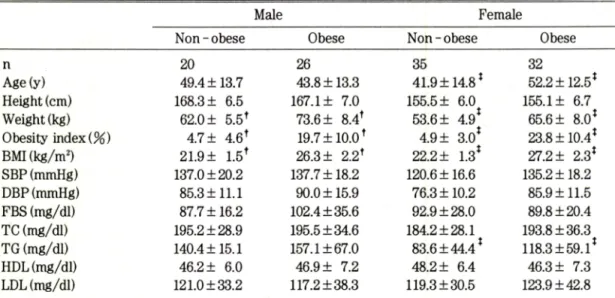
Table 1 present physical and clinical characte- ristics of the subjects. Number(%) of subjects with obesity, non-obesity were 58 (51.3%) , 55 (48.
7%), respectively.
Genotype and allele frequencies of
t따Ob-R gene and effect of the Ob-R genotype on obesi-
@
πle 띠st다bution
of the Ob - R genotype, allele frequencies and odds ratio for obesity are shown in Table 2-1, 2-2, 3-1, 3-2 .. In male obese subjects, allele frequencies of the polymorphic site at the codons 223 and 1019 (Gln223Arg and Prol019pro) were 92 and 89%. In non-obese
subκcts,
they were 90 and 90%. The odds ratio (95% confidence interval) for obesity of
ArgZ정and prol019
외lelein
m외ewere 0.8(0.1-5.5) and 1.1 (0.2-4.9) , respectively. There were no interac- tion between Gln223Arg and Prol019pro
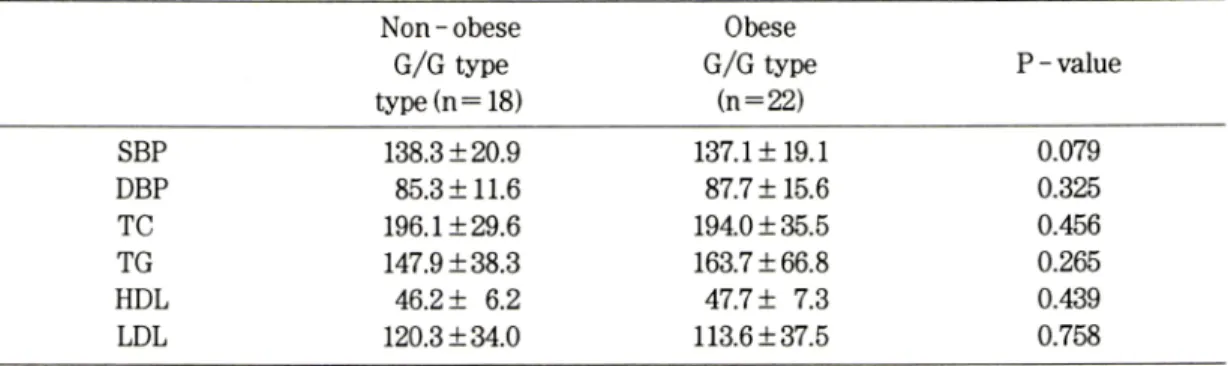
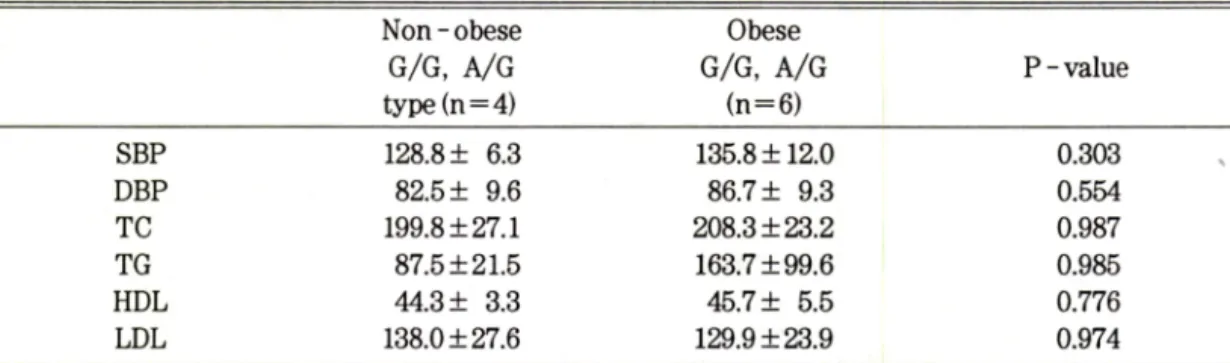
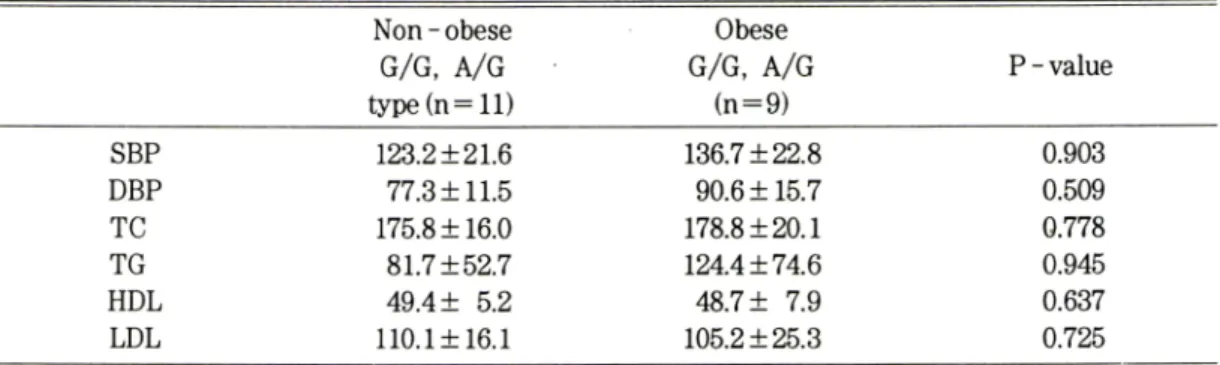
geno앙Rfor obesity prevalence (Table 4) . Clinical charac- teristics of subjects according to Gln223Arg and Prol019pro genotype of the Ob-R gene and obesity are shown in Table
4-1 ∼4-4.No signif- icant difference was
obseπ'edin the clinical characteristics among the genotype groups.
Systolic blood pressure (SBP) of subjects with the Gln/Gln and Gln/ Arg in the female obese was significantly higher than that of those with Gln/
Gln and Gln/ Arg in the non -obese (p=0.024).
Serum lipid value, according to the Gln223 and
Prol019pro genotype of the Ob-R gene are show
in Table 4 and 5. There are no significant diffe-
rence in TC, TG, HDL-C
뻐dLDL-C among the
Ob - R genotype groups.
Bong-Keun
α10eet al : A
Stuφron
so~ I빼rmrphisrrsof human leptin receptor gene in Koreans
Table 1. Physical and clinical characteristics of study populations by gender and obese sta tus .
Male Female
Non-obese Obese Non -obese Obese
n 20 26 35 32
Age (y) 49.4± 13.7
43.8 土 13.3 41.9 土14.8 i 52.2± 12.5i
Height(cm) 168.3± 6.5 167.1± 7.0 155.5± 6.0 155.1± 6.7 Weight (kg) 62.0± 5.5t 73.6± 8.4 ’ 53.6± 4.9
、65.6± 8.0i Obesity index(%)
4.7 土4.6t 19.7 ±10.0
•4.9± 3.0 i 23.8± l0.4i BMI(kg/m2 ) 21.9± 1.5
•26.3± 2.2 ’ 22.2± l.3 i 27.2± 2.3i SBP(mmHg) 137.0±20.2 137
‘7± 18.2
120.6 土16.6135.2± 18.2
DBP(mmHg) 85.3± 11.1 90.0± 15.9
76.3 士 10.285.9± 11.5
FBS(mg/띠) 87.7 土 16.2
102.4±35.6 92.9±28.0 89.8±20.4
TC(mg/dl) 195.2±28.9 195.5±34.6 184.2±28.1 193.8±36.3
TG (mg/dl) 140.4± 15.l
157.1 土 67.083.6 土 44.4 i 118.3 土 59.1 i
HDL(mg /dl) 46.2± 6.0 46.9± 7.2 48.2± 6.4 46.3± 7.3
LDL (mg/dl) 121.0±33.2 117.2±38.3 119.3±30.5 123.9±42.8
data are
mean 土 s.d.MBI, body mass indes; SBP, systolic blood pressure; DB P, diastolic blood pressure ; FBS, fasting blood sugar; TC, total cholesterol; TG, triglyceride ; HDL, high - swnairy lipoprotein; LDL, low - density lipoprotein.
t
ip value< 0.05 tested by unpaired t - test in same gender.
Table 2 - 1. Human leptin receptor gene Gln223Arg polymorphism in male.
Genotype Allele
Odds
rati이95%CI)Group frequency
A/A A/G G/G Gln223 Arg223 Gln223 Arg223
All (n =46) 0(0.0%) 6(13.0%) 40(87.0%) 0.065 0.935 Non - obese (n =
2이0(0.0%) 2(10.0%) 18 (90.0%) 0.100 0.900
Obese (n = 26) 0(0.0%) 4(15.3%) 22(84.7%) 0.076 0.924 1.0 0.8 (0.1- 5.5)
Table 2- 2. Human leptin r eceptor gene Gln223Arg polymorphism in female.
Genotype Allele
Odds ratio (95%CI)
Group freq uency
A/A A/G G/G Gln223 Arg223 Gln223 Arg223
All(n=67) 2(3.0%) 9(13.4%) 56(83.6%) 0.097 0.903 Non-obese(n=35) 1 (2.8%) 5(14.3%) 29(82.9%) 0.100 0.900
Obese (n = 32) 1 (3.1%) 4(12.5%) 27(84.4%) 0.093 0.907 1.0 0.7 (0.2- 3.2)
The
띠scoveryof leptin, the obese (ob) gene Di scussion product, has
pro띠deda useful molecular tool to elucidate the pathophysiology of obesity and
만1e
molecular pathogenesis is largely
m뻐1own.obesity-related
이seases.15iIt has been recognized that leptin is an adipo-
cyt.e-de디ved
blood - borne satiety factor that is involved in the regulation of food intake and en- ergy
e짜ienditure.16JThe leptin receptor (OB-R) is a single transmembrane protein that belongs to the gp 130
fam바of cytokine receptor super-
fam바.11J
Recently other researchers have demon- strated that Ob- R is also mutated in genetically
O뾰seZuker fatty <fa/fa)
m잉and obese sponta- neously
이rpertensiveKolestky (fak !fa ’‘) rats.1BJ For
a따]ysis
of the Ob-R gene in humans, previous
Stu이es reve외ed sever외sequence
polymorp비smsin the Ob-Rb gene with no obesity-causing mu- tation in black African - American, Caucasians and Pima lndians.11· 12l No sequence variants were located in functionally defined
dom외ns.Genetic
e찌dence sh애ed
that ob, db,fa, and fak,
외lof which code for leptin or Ob-R, are autosomal recessive mutation in rodents.11 ·1 2J In the present study, 4 amino acid substitutions (Lys109Arg, Gln223Arg, Lys656Asn, and
Al뼈76Asp)were founded to be homozygous but were
이sσibutedin both obese and non - obese subjects.
πleamino acid change at codon 492(Ser492Thr) was found to
뾰only heterozygous.
I띠ividually,
the OB gene and
Gln2잃.Argpoly- morphism were not associated with the obese.
There was an association between the Pro1019Pro polymorphism and
띠astolicblood pressure. In addition,
indi띠du외Swith homozygous for the common alleles of
외lthree polymorphism exhibited significantly higher fasting insulin con- centration than individuals without the polymor- phisms. The allele frequencies for the three pol- ymorphisms investigated were compared to fre- quencies for observed in several populations.
A frequency of 89% was observed for Arg allele of the Gln223Arg
p이ymorphismin the Na-
따uan
subjects.
T매Sis not sinlilar from previous studies conducted in Japanese and Pima Indian populations where the frequency of this
외lelewas found to be
appro잉mately85% and 75%
respectively.1 9J It is, however, somewhat higher than the frequency reported for British males, 44
%. Previous reports have suggested that allele frequency of the Arg2Z3 of the Ob-R gene was higher in
Ja탱nese(O없8-0.872)than in Caucasi-
킹lS (0.421-0.44이
and in Pima
In띠ans(0.75이_12.
20)These studies showed that allele frequency varies
없nong
ethnic groups and that the polymorphism is not associated with obesity. Further studies are needed to determine associations between the
p얘morp비sm
of the Ob- R gene and obesity.
The frequency of the pro allele for the Pro1019Pro
polymorp비sm, appro잉mately80%,
외so
appears to be sinlilar in the Nauran
pop띠ation to that seen in other populations. Frequen- cies of 88% and 85% were observed for this allele in Japanese and Pima Indians populations, respectively, the frequency in the Korean popu- lation was 86%.
안le
OB and Ob-R
gen얹have
뾰enmapped to human chromosomes 7q31 and lp32, respectively.
These genes lie in regions identified through ge- nomewide scans as containing loci important in the development of obesity and type 2
띠abetes.Strong evidence of
파뼈gehas recently
뾰endemonstrated for insulin precursors and the OB region. 2 1 J The relationship
descri뾰dmay be abse- nt in other populations either
양causeof
띠ffer- ent haplotype combinations at the Ob- R gene or
뾰cause
the markers tested may not themselves be functional polymorphisms. While the function-
외ity
of these polymorphisms needs to be investi- gated, the lack of physiological functions at these polymorphic sites would not necessarily rule out the possibility of the presence of
피lkagedisequilibrium between these marker and closely linked functional polymorphisms.
In the
C따rentstudy, the DBP subjects of with
the obese A/ A type was significantly
미양'lerthan
t뼈tof those with the non -obese A/ A type before
Bong-Keun
α10eet
외 :A Study on soire
I얘rrorp비srrsof human leptin receptor gene in Koreans
Table 3-1. Human leptin receptor gene Pro1019pro polymorphism in male.
Genotype Allele
Odds ratio (95%CI)
Group freq1:1ency
G/G G/A A/A Pro1019 Pro1019 Prol019 Pro1019 All(n=46) 0(0.0%) 10(21.7%) 36(78.3%) 0.109 0.891
Non-obese(n=20) 0(0.0%) 4(20.0%) 16(80.0%) 0.100 0.900
Obese(n=26) 0(0.0%) 6(23.1%) 20(76.9%) 0.115 0.895 1.0 1.1 (0.2-4.9)
Table 3 - 2. Human leptin receptor gene Pro1019pro polymorphism in female.
Allele
G/G G/A A/A
frequency
Prol019 Pro1019 Prol019 Pro1019 Odds ratio (95%CI) Genotype
Group
때 m 씨 때
nU nU nU
m %%%
%n
깎
”
amω
%%…·
m강 이ω%ω mωn
9
%%%
nU nU nU nU nU nU
멧
m
잉
--nd
끼 꽁
=
얘 빼 빼 m
m
뾰A N O
0.851 0.843
0.860 1.0 0.9(0.3-3.1)
Table 4. Odds ratio of interaction between Gln223Arg and Pro1019pro genotype for obesity prevalence.
Pro1019pro
G/G, G/ A type A/ A type Gln223Arg A/G, A/A type
G/G type
1.0
2.9(0.5 ∼
15.9)
6.5
(0.7 ∼ 59.6) 1.7(0.3 ∼8.2)
Table 5 - 1. Association between the Gln223Arg polymorphism and clinical characteristics in male.
Non-obese Obese
A/A,A/G A/A,A/G P-value
type(n=2) (n=4)
SBP
125.0 土7.1 138.8±14. 4 0.624
DBP
85.0 土7.1
102.5 土 11.90.805
TC
187.0 土 28.3 203.3 土 32.40.806
TG 72.0± 5.7 120.8±63.8 0.905
HDL 45.5± 4.9 42.3± 5.1 0.732
LDL 127.1±34.4 136.9±42.3 0.736
Data are
mean 土 s.d.‘ 'ANCOV A, adjusted for age and BMI, was used for comparisons of the two groups.
SBP, systolic blood pressure; DBP, diastolic blood pressure; TC, total
ch이esterol;TG, triglyceride;
HDL,
미gh- density lipoprotein; LDL, low - density lipoprotein
Table 5- 2. Association between the Gln223Arg polymorphism and clinical characteristics in male
Non-obese Obese
G/G type G/G type P-value
type (n= 18) (n=22)
SBP 138.3±20.9 137.1±19.1 0.079
DBP 85.3±11.6 87.7± 15.6 0.325
TC 196.l ±29.6 194.0±35.5 0.456
TG 147.9 ±38.3 163.7±66.8 0.265
HDL 46.2± 6.2
47.7 土7.3 0.439
LDL 120.3±34.0 113.6±37.5 0.758
Data are mean± s.d. 'ANCOV A, adjusted for age and BMI, was used for comparisons of the two groups.
SBP, systolic blood pressure; DBP, diastolic blood pressure; TC, total cholesterol ; TG, triglyceride;
HDL, high - density lipoprotein; LDL, low - density lipoprotein
Table 5-3. Association between the Gln223Arg
p이ymorphismand clinical characteristics in female.
Non-obese Obese
A/A, A/G A/A, A/ G P-value
type(n=6) (n=5)
SBP 110.8±12.8 143.0±25.9 0.024
DBP 70.8± 6.6 89.0± 18.5 0.141
TC 191.8±20.1 182.0±21.6 0.680
TG 95.5±62.1
97.8 土 44.30.418
HDL 46.5± 4.5 47.8± 4.4 0.662
LDL
126.2 土 23.4114.6±27.1 0.833
Data are mean
土 s.d.aANCOVA, adjusted for age and BMI, was used for comparisons of the two groups.
SBP , systolic blood pressure; DBP, diastolic blood pressure; TC , total cholesterol; TG, triglyceride ; HDL, high -density lipoprotein; LDL, low-density lipoprotein
adjm tments for age, gender and obesity index (Table 7) . It is of interest that Widen et al.
22>Hypertension is associated with obesity, further studies are required to clarify the association between polymorphism of Ob-R gene and hype- rtension.
c。nclusi。n
In the present study, investigation into the re- lationship between polymo[phisms in the Ob-Rb gene, a leptin receptor gene, and clinical findings
in a sample population of Koreans classified into the control and obese group;
뼈sedon the crite- ria set by the Japanese Society of Obesity has led to the following conclusions. First of
떠I,no difference in the prevalence of obesity has
뾰enassociated with the different polymorphisms in the leptin receptors. Secondly, no relavance was observed between variations in the levels of cho-
l않terol,
low- and
비gh- density lipoproteins, and neutral fat, associated
깨thobesity, and the le- ptin receptor polymorphisms studied.
Addition외ly,members of the group; with the phenotypically
Bong-KetID
α10eet
외 :AStuφron sorre polyrmrphisms of human Jeptin receptor gene in Koreans
Table 5 - 4. Association between the Gln223Arg
p애morphismand
c피ricalcharacteristics in female
Non-obese Obese
G/G type G/G type P-value
type(n=29) (n=27)
SBP 122.6± 16.7 133.7± 16. 7 0.412
DBP 77.4± 10.5 85.4± 10.1 0.322
TC 182.6±29.5 196.0±38.3 0.566
TG 81.1±40.8 122.0±61.4 0.896
HDL 48.6± 6.8
46.0 土7.8 0.860
LDL
117.8 土 31.9 125.6 土 45.30.575
Data are mean
土 s.d.‘ 'ANCOV A, adjusted for age and BMI, was used for comparisons of the two groups.
SBP, systolic blood pressure; DBP, diastolic blood pressure ; TC, total cholesterol; TG, triglyceride;
HDL,
피gh- density !ipoprotein ; LDL, low - density !ipoprotein
Table 6-1. Association between the Pro1019pro polymorphism and clinical characteristics in male
Non -obese Obese
G/G, A/G G/G, A/G P-value
type (n=4) (n=6)
SBP 128.8± 6.3 135.8±12.0 0.303
DBP 82.5± 9.6 86. 7± 9.3 0.554
TC
199.8 土 27.1 208.3 土 23.20.987
TG 87.5±21.5
163.7 土 99.60.985
HDL 44.3± 3.3 45.7± 5. 5 0.776
LDL 138.0±27.6 129.9±23.9 0.974
Data are mean
土 s.d.‘ ' 'ANCOV A, adjusted for age and BMI, was used for comparisons of the two groups.
SBP, systolic blood pressure ; DBP, diastolic blood pressure ; TC, total
ch이esterol;TG, triglyceride;
HDL, high - density !ipoprotein; LDL, low - density !ipoprotein
Table 6-2. Association between the Pro1019pro polymorphism and clinical characteristics in male
Non-obese Obese
A/A type A/A type P-value
type (n= 16) (n=20)
SBP 139.1 ± 22.1 138.3±20.0 0.108
DBP 85.9± 11.6 91.0± 17.4 0.892
TC 197.1± 30.0 191.6±36.9 0.562
TG 153.6 ± 113.9 155.2±57.2 0.127
HDL 46.6± 6.5 47.3± 7.7 0.821
LDL 116.7± 33.8 113.3±41.4 0.893
Data are mean
土 s.d.'ANCOV A, adjusted for age and BMI, was used for comparisons of the
’two groups.
SBP, systolic blood pressure; DBP, diastolic blood pressure; TC, total cholesterol ; TG, triglyceride;
HDL,
비gh- density lipoprotein; LDL, low - density !ipoprotein
Table 6-3. Association between the Pro1019pro polymorphism and clinical characteristics in female
Non-obese Obese
G/G, A/G G/G, A/G P-value
type (n= 11) (n=9)
SBP 123.2±21.6 136.7 ±22.8 0.903
DBP 77.3±11.5 90.6± 15.7 0.509
TC 175.8±16.0 178.8±20.l 0.778
TG 81.7±52.7 124.4±74.6 0.945
HDL 49.4± 5.2 48.7± 7.9 0.637
LDL 110.1±16.1 105.2±25.3 0.725
Data are mean± s.d. 'ANCOV A, adjusted for age and BMI, was used for comparisons of the two groups
’SBP, systolic blood pressure ; DBP, diastolic blood pressure; TC, total
ch이esterol;TG , triglyceride;
HDL, high density lipaprotein; LDL, low - density lipaprotein
Table 6- 4. Association between the Prol019pro polymorphism and clinical characteristics in female
Non-obese Obese
A/A type A/A type P-value
type (n=24) (n=23)
SBP 119.4± 14.1 134.6± 16.7 0.581
DBP 75.8± 9.7 84.1± 9.1 0.345
TC 188.0±31.7 199.7±39.7 0.679
TG 84.5±41.2 115.8±53.6 0.703
HDL 47.7± 7.0 45.3± 7.1 0.933
LDL 123.4±34.7 131.2±46.4 0.629
Data are mean
土s.d. 'ANCOVA, adjusted for age and BMI, was used for comparisons of the two
grou뼈.
SBP, systolic blood pressure ; DBP, diastolic blood pressure; TC, total
ch이esterol;TG, triglyceride;
HDL , high - density lipoprotein; LDL, low - density lipaprotein
wild - type polymorphisms for the Gln2Z3Arg
gηnotype (A/ A or A / G) demonstrated higher systolic
요
blood pressures than those of the obesity group did (p=0.024).
약
연구배경
:
비만은 산업사회에 있어 주요한 건강운제이고 그 이환률도 급증하고 있다. 비만은 꽉히 고혈압, 지 방간, 고지혈증, 퇴행성 관절엽, 당뇨병 (NIDDM), 심혈관 질환 및 대사질환 퉁과 밀접한 관계가 있어 비만을 하나의 질환으호 인식하고 치료할 필요가 었다. Le며n은 지방세포에서 유래된satiety
factor로 음식섭취와 에 너지소비 조절에 관여한다 -Leαm은 cyto때e 수용체 supezfa띠]y의 하나언leptin
수용체(Ob-R)
에 작용하는 데 크게 5가지의 isoform을 가지고 있다. 그 isoform총l] 뇌의 시상하부에서는 Ob-Rb의 isoform이 존재한다.최근 leptin과 Ob-R은 에너지 향상성
(energy
homeostasis) 을 조절하는 시챔}부와 지방세포에서의 feed뼈ckBong-Keun
α¥>eet al : A Study on
so~po!yroorphisrrn of
hur때n lep미1receptor gene in Koreans
system에 중요한 작용을 하고있다고 보고되고 있다.
방 법
:
1999년 11월 1일부터 am년 8월 31 일까지 한국인을 대상으로 일본비만학회에서 제시한 기준으로 비만군과 정상군으로 분류하여 한국인에서의 lepψ1 수용체 유전자 중Ob-Rb
유전자의 다형성과 임상자료와 의 관련성에 대하여 조사하였다.결 과:
1.
비얀유전자 수용체의 다형성에 따른 비만 유병률은 차이를 보이지 않았다.2.
비얀유전자 수용체의 다형성에 따른 비만과 관련 있는 콜레스테롤, 저농도 지질단백질, 중성지방, 고밀도 지질단백질은 유의한 차이를 보이지 않았다.3.
유전자 다형성중Allele
빈도는 Gln2잃:Arg,Prol019pro
모두 빈도의 차이는 보이지 없t으나Piim
인디언 과 일본인보다는 발현율이 높았다.4. Gln2Z3Arg
과 ProlOl않0 사이의 비만 유병률에 대한 유전자 상현1용은 통계척i로 연관성을 찾을 수 없었다.5.
남녀로 구분하여 비만유전자 (Ob-R) 의 다형성에 따른 임상자료를 비교한 결과 수축기 혈압에서 차이를 보였는데, 여성비만군의Gln223Arg
유전자중A/A, A/G
형태다형성을 보인 군의 혈압이 높았다 φ=0.0'24) 중심단어 :비얀유전자수용체, 비얀유전자다형성, 유병률, 수축기 혈압Reference
1. Bj rnrorp P, Brodoff BN. Obesity. JB
다ppincott Company,
P비ladelp비a.1992.2. World Health Organization.
O뾰sity.Preventing and Managing the
Glo뼈lEpidemic, Geneva.
1998.
3. James 0,
H피and John C, Peters. Environ- mental Contributions to the
O뾰sityEpidemic.
Science 1998; 280: 1371 -4.
4. Zhng Y, Proenca R, Marffei M , Barone M, Le- opold L,
F디어manJB. Positional cloning of _ the mouse obese gene and its human homo-
logue. Nature 1999;
372;싫5-32.5. Spiegelman BM, Flier JS . Adipogenesis and Obesity:rounding out the big picture. Cell 1996;87:377-89.
6. Cari JF, Sinha
빠〈,Kolaczynski JW, Jhan PL, Considine RV.
Leαin:The tale of an obesity gene, Diabetes
1앉l6;45:1455-62.
7. Warden CH,
뀐slerJS, Shoemarker SM, Wen P-Z, Svenson
m」,Pace MJ, Lusis AJ. Identi- fication of four chrormsomal loci determining obesity in a mutifactorial mouse model. J
Clin Invest 1995; 95:
1없5-52.8. Norman R,
Thom~onD, Foroud T, Garvey W, Bennett P, Bogardus C Ravussin E. Geno- mwide search for genes influencing percent
bodyfat in Pima
I띠ians: suggestive
파lkageat chromosome llq21-q22. Pima Diabetes Gene Group. Am J Hum Genet. 1997; 60: 166- 73.
9. Considine RV, Sinha MK, Heman ML, Kriauci- unas A, Stephens TW, Nyce MR, Phannesian JP, Macro CC, Mekee LJ, Bauer T, Caro JF.
Serum immunoreactive - leptin concentrations in normal-weighted and obese humans. The New
암lgJ Med.
1얹X>;334:292-5.10. Maffei M,
Ha뻐asJER, Pratley RE, Lee GH, Zhan Y, Fei H, Kim S, Lallone R, Rangana- than S, Kem PA, Frieman JM. Leptin levels in human and rodent : Measurement of plas- ma leptin
없dob RNA in obese and weight - reduced subjects. Nat Med 1995; 1: 1155- 61.
11. Considine RV, Considende
표, W버퍼msCJ,
바rde
TM, Caro JF.
πle hypot따lamicleptin
receptor in humans: identification of inci-
dental sequence polymorphism and absence
of the db/db mouse and fa/fa rat mutations.
Diabetes 1996;45:992-4.
12. Thomp;on DB, Ravussin E, Bennett PH,
Bo-rgadus C. Structure and sequence variantion at
t뼈human
lep따1receptor gene in lean and obese Pima Indian. Hum Mol Genet 1997 ;6 :675-9.
13. Shintani M, Ikegami H, Yamato
E,Kawaguchi Y,
F띠isawaT, Nakagawa Y, Hamada Y, Ueda H, Miki T, Ogihara T. A
rr뼈elmicrosatellite palyrrorphism in the human ob gene
‘미g비ypalyrrorphic marker for linkage analysis.
Diabetologial땐;
39:
1~8-401.14. Takaya K, Ogawa Y, Isse N et al. Molecular cloning of rat leptin receptor isoform com- plementary DANs indentification of a missense mutation in
Z따cerfatty (fa/ fa) rats. Biochem Biophys Res Commun 1996;225:75-83.
15. Caro R ’,
S비바mMK, Kolaczyzinski JW, Zhang PL, Considine RV. The tale of obesity gene.
Diabetes 1996;45: 1455-62.
16. Campfield LA, Smith FJ, Guisez Y, Devos R, Burn P. Recombination mouse OB protein:ev- idence for a peripheral signal
피뼈ngadiposi- ty and central
neur외networks. Science 1995;
269: 없6-9.
17. LeeGH, Proenca R, Montez JM et al. Pheno- types of mouse diabetes and rat fatty due to mutations in the OB (leptin) receptor. Science 1996:271 :994-6.
18.
P때피psMS, Liu Q, Hammound HA et al. Le-
p디n
receptor missense mutation in the fatty
Z따cer
rat. Nature Genet
1앉%;13: 18-9.
19. Matsuoka N, Ogawa Y, Hosoda K, Matsda J , Masuzaki H, Miyawaki T, Azuma N, Natsui H,
Nis비mura
H, Yoshimasa Y, Nishi S, Thomson DB and Nakao. Human leptin receptor gene in obese Japanese subjects : evidence against either obesity-causing mutations or
잃sociation of sequence variants
뻐thobesity. Dia - betologia 1997; 40: 1204- 10.
al.Ech뼈ld
SM, Sorense TD, Sorense
πA,Han- sen AT, Andersen T, Chun WK, Leibel RL, Pedersen 0 . Amino acid variant in the human leptin receptor: lack of association to juvenile onset obesity. Biochem Biophys Res Commun. 1997 ;
2Z3;경8-52.21.
Duggir외aR, Stem MP, Mitchell BD, Reinhart
LJ,Shipman PA, Uresandi OC, Chung WK, Leibel
뻐」,Hales CN, 0 ’ Connel P, Blangero J.
Quantitative variation in obesity- related traits and insulin precusors
피tl<:edto the OB gene region on human chromosome 7. Am J Hum Genet.1996;
59; 없4-703.22. Widen E, Lehto M, Kanninen T, Walston J,
Sh버띠ner