• 검색 결과가 없습니다.

A Study on Anthropomorphic Animal Characters Search System Visualization for UX Design

N/A
N/A
Protected

Academic year: 2021

Share "A Study on Anthropomorphic Animal Characters Search System Visualization for UX Design"

Copied!
7
0
0

로드 중.... (전체 텍스트 보기)

전체 글

(1)

A Study on Anthropomorphic Animal Characters Search System Visualization for UX Design

Young-Suk Lee

ABSTRACT

This paper presents to design User eXperience(UX) of anthropomorphic animal characters search system (hereinafter, AACSS) for efficient user search. To this end, meta data were utilized herein to elevate the search efficiency of multimedia information and text information. Anthropomorphic animal characters require the human elements and the animal elements, thus this paper extracted the key elements of meta data as below; phenotypic element in animal system classification (Morphologic property elements, Ecological property elements, Behavioral property elements), emotion classification, which is the trait of personification and the Step of Anthropomorphic Animal Characters.

Key words: AACSS, Anthropomorphic Animal Characters UX, Phenotypic Element in Animal

※ Corresponding Author : Young-suk Lee, Address:

(100-272) Center for Digital Image & Contents 2, Toegye- ro 36-gil, Jung-gu, Seoul, Korea, TEL : +82-10-8313-9825, FAX : +82-2-2264-0159, E-mail : [email protected] Receipt date : Sep. 16, 2014, Revision date : Nov. 12, 2014 Approval date : Nov. 21, 2014

Institute of Image and Cultural Contents, Dongguk University, Korea

※ This research was supported by Basic Science Research Program through the National Research Foun- dation of Korea(NRF) funded by the Ministry of Education, Science and Technology(2013R1A1A3012358)

1. INTRODUCTION

It is necessary to have various kinds of charac- ters to produce animations and games and in par- ticular, a lot of the anthropomorphic animal charac- ters appear in the commercialized or the best sell- ing digital contents under the influence of the de- velopment in recent contents industry[1]. In the digital contents market, animal characters have accounted for more significant parts. In the area of smart phone contents, particularly, animal char- acters are playing almost unrivaled roles. Currently, along with the South Korean government’s policy of nurturing one-person creative startups, small digital contents production companies are increas- ing. In this situation, AACSS becomes more nec- essary for them to refer to, in order to produce con- tents with lower cost. Also for easier search of de- sired data, a more intuitive UX is urgently needed.

This paper, recognizing these and the perspective

of users, seeks to develop an information search system in a more efficient manner information ac- cess to converged sets of data. This research real- izes as follows: first, it presents AACSS meta data elements. Second, by adopting the data visual- ization technique, it designs UX which enables an intuitive search of anthropomorphic characters.

This paper utilizes meta data to elevate search effi- ciency of multimedia information and text in- formation and by developing an intuitive UX sys- tem, it helps users search data easier under its newly proposed AACSS UX design plan[7,9,12,14].

2. RELATED WORK

2.1 Anthropomorphic Animal Characters

In most of the digital contents fiddle, human, an-

imal and monster characters enter. In the animation

area, in particular, animal characters rather than

human characters, have been reported to have been

(2)

Fig. 1. DIKW hierarchy.

more popular. In the animation history, animal characters’ significance and play have been con- tinuously expanded and diversified in their looks, behavioral characteristics, habits and other fea- tures[2]. Currently however, only few researches have been conducted on anthropomorphic animal characters by separating their emotions and ac- companied expressions and building into a data- base. For this reason, necessary meta data ele- ments have not been fixed. Most meta data were actually developed for system information man- agement. There are fewer meta data developed for efficient search of information by users. Lee(2010) reported in a paper about anthropomorphic charac- ters appearing in animation films from an en- gineering approach for the first time. Lee also com- pared animal features with human emotional ex- pressions and suggested guidelines for animal an- thropomorphic phase classification. This paper aims to further develop Lee(2010)’s classification in order to extract more appropriate meta data for users’ search of anthropomorphic characters.

2.2 UX designing through effective visualization elements

UX refers to a whole set of experiences a user comes to feel and think while the person uses a certain system or product service directly or indirectly. UX design means to create or unify general related elements so that a user can reach a positive effect in his or her recognition and be- havior while using a product service or system.

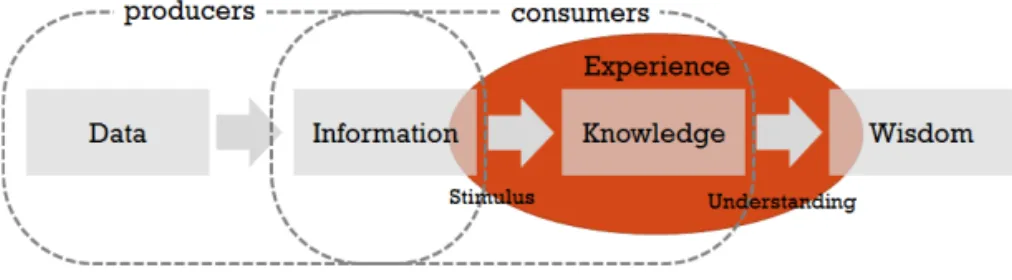
Ackoff(1989)[3] defined UX as the process of turning data to wisdom. Nathan Shedroff(1994)

presented a function of understanding in the proc- ess of converting data into wisdom[Fig. 1]. That is to say, data are symbols to convey a certain fact or numerical value, and are the product of research, creation, and gathering. Information is data to which a meaning is added, and it is the processed product so as to be helpful to user's purpose.

Knowledge is a method of how data and in- formation is applied after information is interpreted and a meaning is added. And it was said that wis- dom was an idea for utilizing knowledge.

Peter Moville(Ambient Findability, 2005)[4] ex-

panded information architecture to make it in a

bee-hive-shaped diagram to propose 7 different

areas of the significance of user experiences. Jesse

James Garrett(2000)[5] said that users contact a

system via interface, the outside of the interface

is a space supporting users’ perception with visual

elements, and its inside should be made of visual

elements, perception elements, behavioral elements

and elements necessary for users’ task, referring

to these elements as The Elements of User

Experience. Steve Psomas(2007)[6] proposed the

Five Competencies of User Experience Design

which were information architecture, interaction

design, usability engineering, and prototype

engineering. The previously discussed UX is real-

ized via information visualization. Information vis-

ualization requires novel, informative, efficient and

aesthetic aspects. In this sense, this research seeks

to establish a user-oriented meta data system and

propose a data-visualizing UX for improved in-

formation usefulness and search efficiency.

(3)

Fig. 2. AACSS meta data extraction.

3. UX DESIGN STRATEGY THROUGH USER- ORIENTED META DATA

3.1 AACSS meta data extraction

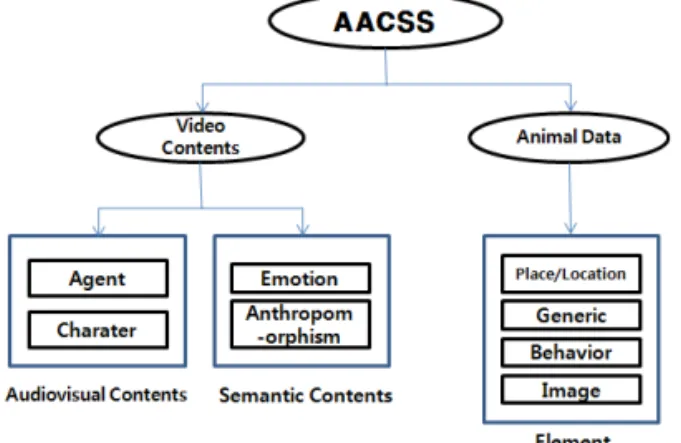
This paper tries to re-establish AACSS data- base meta data for a more well-organized search by users. The anthropomorphic system model has to types of information elements[Fig. 2]. First is systematic zoological features of animals them- selves originally and second is animation-ex- tracted video clips. The video clip elements, ac- cording to Hampapur and Jain (1998)[7]’s classi- fication, are grouped into semantic contents and audiovisual contents. The audiovisual contents then, further divided into their own bibliographic information and actually expressed visual infor- mation. Semantic contents are classified according to two types of technical criteria which is emo- tional classification and anthropomorphic phases–

keywords of AACSS database. This means that it functions as meta data for’ extraction information based on necessary user elements’ beyond just a simple ‘information for information’. ‘Animal Data’

elements that classify animal species are further divided into each animal-specific basic data and systematic trait elements[8]. These systematic trait elements, in turn, comprise morphological, ecological and behavioral factors and function as a measure to calculate the distance between each animal. These can be specified under the logical

phased model of information search from the user’s perspective as follows: The two types of in- formation that can be searched are video contents and each animal’s unique information and these, in turn, are further divided into different elements.

3.2 AACSS establishment

As discussed above, we, in this research, have inferred a search logical model through a system model and based on this, produced a scenario by extracting search elements and using overlapping or necessary elements. Based on this hierarchical relations of information search, we referred to and re-organized existing standard meta data in pre- vious studies and established a meta data structure appropriate for the system proposed herein[Table 1].

Agent corresponds to the bibliography of an ani- mation and belongs to the video clip identification.

Video clip identification is a unique element that does not appear repeatedly. Agent title, and char- acter name are dependent on the video clip identi- fication and include sub-elements of each agent and character. Each sub-element repeatedly ap- pears in its higher-level data. By extracting such meta data, this research has laid the foundation for a more efficient information search by users and UX design. Even though it is a same character, its emotion and the degree of emotion were made for users to choose, thus enabling them to more effi- ciently search the complicated information they desire. And user manual was simplified through each element’s repetition.

3.3 Visualization of anthropomorphic animal charac- ters system UX

The previously discussed UX(User eXperience) of many scholars, is recognized by human sight.

It particularly requires the visualization of in-

formation-containing meta data. In this chapter,

we try to propose the UX strategy of extracting

metal data for information visualization.

(4)

Table 1. Meta data structure establishment

Element Definition Repeat Required

VideoClip Identification video resource identification ○

Agent.Title Animation Title ○

Agent.Creator Animation studio ○ ○

Agent.Dates Year of opening ○

Character.Name Name

Character.Sex Sex ○

Character.Age Age ○

Character.Role The role of the character in animation ○ ○

Emotion Emotional kind ○ ○

Emotion.Level Level of Emotion ○ ○

MediaTimePoint The temporal position of the video clip

Technique Anthropomorphism levels ○ ○

Animal Animal Species ○ ○

Animal.Generic Morphologic property elements ○ ○

Animal.Place/Location Ecological property elements ○ ○

Animal.Behavior Behavioral property elements ○ ○

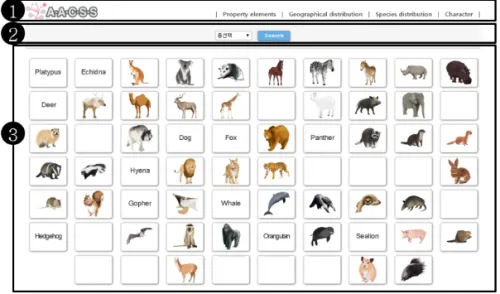
Fig. 3. AACSS MAIN UI The No. 1 area of the figure below is a menu

bar visualized in text button, to improve in- formation delivery. The No. 2 area is the actual search area. This integrated and reduced search el- ements for enhanced info search. The No. 3 field is data visualization helping users recognize in- formation values intuitively. Based on the in- formation search hierarchical relations and pre- vious standard meta data in preceding studies, we

established a meta data structure suitable for the proposed system herein[Fig. 3].

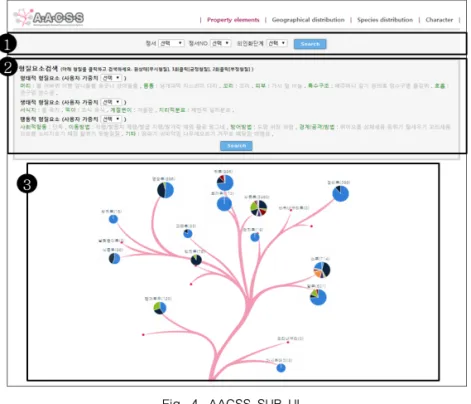
The No. 1 area of the figure presents the emo- tions of personified animal characters, intensity of emotion and personification step in buttons[Fig 4].

The No. 2 area of the figure are set easily select

the trait elements of personified animals by a user

[Fig. 4]. The elements are morphological, ecological

and behavioral characters. The No. 3 area of the

(5)

Fig. 4. AACSS SUB UI.

Fig. 5. AACSS SUB UI.

figure is the results of what user has selected[Fig.

4]. It presents the amount of extracted data which indicates the amount of searched data by a user.

Fig. 5 presents a geographical distribution of personified animal characters. The No. 1 area of

the figure shows habitats of each animal on a world

map[Fig. 5]. In other words, it is designed for user

to intrinsically realize the habitat of the personified

animal characters. The No. 2 area of the figure

presents the searched data by the user[Fig 5].

(6)

Fig. 6. AACSS SUB UI

Fig. 7. AACSS SUB_Character UI.

Fig. 6 classifies personified animal characters accordingly to animal classification system. Through the mammalian classification, it is designed for a user to easily realize the position of each animal on the animal classification system. The No. 1 area of the figure can be searched by name of any mam-

mal[Fig. 6]. The No. 2 area of the figure presents the data distribution of the search results visu- ally[Fig. 6]. The No. 2 area of the figure presents the data of the result output in sequence[Fig. 6].

Fig. 7 shows properties of the animal movie clip

of personified animal characters. It is designed

(7)

with considerations to the name, age, gender, pub- lisher and published year of each characters. The No. 1 area of the figure presents the species, name, age, gender, publisher and published year of per- sonified animals with texts[Fig. 7]. The No. 2 area of the figure presents the data of the result output in sequence[Fig. 7].

4. CONCLUSION

This paper developed the Anthropomorphic Animal Characters Search System (AACSS) for user convenience of efficient data search. First, to maximize information usability and search effi- ciency, we extracted anthropomorphic meta data as an appropriate element and applied them to UX design. Thereby, we tried to establish an efficient organization of anthropomorphic animal character meta data and propose UX with more useful and efficient information. For future studies, expert group verification will be necessary for the system usability. In the paper, the menu bar and search window were split into and expressed, utilizing the horizontal composition by the distinctive principle of UX. The users can intuitively experience the emotion classification and the Step of Anthropo- morphic Animal Characters the letter button in menu bar. Search window visualizes the form ele- ment, which is phenotypic element in animal sys- tem classification, biological element, thus it in- tends to enhance the work efficiency of users to cut down the search time and expense. This paper can be utilized as reference in the design process for personification of animal characters in digital contents production field and expects to cut down the production budget and enhance time efficiency.

REFERENCE

[ 1 ] Y. Lee, “A Study on The Step of Anthropo- morphic Animal Charaters in Animation,”

Journal of Korea Multimedia Society, Vol. 12, No. 11, 2009. 1661-1662.

[ 2 ] Y. Lee, Classification and Searching for Anthropomorphic Animal Charaters in Animation, Doctor`s Thesis of Pusan National University, 2010.

[ 3 ] R.L Ackoff, "From Data to Wisdom," Journal of Applied Systems Analysis, Vol. 16, 1989.

[ 4 ] Semantic Studios, P. Moville, 'User Experience Design', 2014, 01, 20.

[ 5 ] J.J. Garrett, The Elements of User Exper- ience, New Riders, 2010. San Francisco, US.

[ 6 ] Uxmatters, S. Psomas, The Five Competen- cies of User Experience Design, Uxmatters, 2007.

[ 7 ] A. Hampapur and R. Jain, Video Data Man agement Systems: Metad Data an d Archetecture, McGraw-Hill, New York, 1998.

[ 8 ] E. Mayr and P.D. Ashlock, Principles of Animal Species and Ecolution, Cambride, MA, Harvard Univ. Press, 1991.

[ 9 ] IMDB, http://www.imdb.com, 2014, 01, 20.

[10] A. Cairo, Functional Art, The: An Introduc- tion to Information Graphics and Visualization, New Riders, 2012. San Francisco, US.

[11] J. Steele and N. Iliinsky, Beautiful Visualiza- tion, Reilly Media, 2010. 1301 Sansome Street, San Francisco, US.

[12] S.M. Weinschenk, Neuro Web Design: What Makes Them Click?, New Riders Publish- ing, 2009. San Francisco, US.

[13] UX matters, http://www.uxmatters.com, 2014, 05, 01.

[14] Anthropomorphic Animal Characters Search System, http://aacss.kr, 2014, 01,30.

Young-Suk Lee

is an Assistant Professor at Research Institute for Image &

Cultural Content, Dongguk Uni- versity. She received B.Des. de- gree from Tongmyong Univer- sity in 2002 and Her M.E. &

Ph.D degrees from Busan

National University in 2004 and 2010. Her research

interests include the game of graphic design, animation

and character.

수치

Fig. 1. DIKW hierarchy.
Fig. 2. AACSS meta data extraction.
Fig. 3. AACSS MAIN UIThe No. 1 area of the figure below is a menu
Fig. 4. AACSS SUB UI.
+2

참조

관련 문서

Bain, Functions of the Alloying Elements in Steel, American Society for Metals, 1939, p. Bain, Functions of the Alloying Elements in Steel, American Society for

(A) Interestingly, this has often been the case with English animal expressions.. As you may have observed, they make irregular twists and turns in their

The foreign genes "must be transmitted through the germ line, so that every cell, including germ cells, of the animal contain the same modified genetic material." (

The cleanest animals in the facility should be easily serviced from the clean side of the cage- wash or clean cage storage areas, while rooms holding the dirtiest animals

A combination of parallel translational and non-translational symmetry elements produces an interesting effect on the way in which the pattern

Due to the changes of observational elements from Gangneung Weather Station (no.105), eye observational elements such as the number of days for weather conditions and mean

• Controlled decomposition of organic materials such as plant materials, animal waste, food.. waste, and wastewater sludge

This study derived the financial risk elements of the sports circle and suggested the methods to decrease subsidy support and increase financial independence