1)
†
To whom correspondence should be addressed.
Department of Life Science, Kongju National University, Korea E-mail: [email protected]
∙ Soo-In Lee Baekdudaegan National Arboretum / Researcher ([email protected])
∙ Eung-Pill Lee Department of Life Science, Kongju National University / Ph.D ([email protected])
∙ Young-Sik Hong Korea Environmental Preservation Association / Researcher ([email protected])
∙ Eui-Joo Kim Department of Life Science, Kongju National University / Ph.D. candidate ([email protected])
∙ Seung-Yeon Lee Department of Life Science, Kongju National University / Ph.D ([email protected])
∙ Jae-Hoon Park Department of Life Science, Kongju National University / Ph.D. candidate ([email protected])
∙ Rae-Ha Jang National Institute of Ecology / Researcher ([email protected])
∙ Young-Han You Department of Life Science, Kongju National University / Professor ([email protected])
한국의 묵논에서 멸종위기식물의 복원생태학적 연구 및 서식지 관리방안
이수인・이응필
*
・홍용식**
・김의주*
・이승연*
・박재훈*
・장래하***
・유영한†
국립백두대간수목원
*공주대학교 생명과학과
**한국환경보전협회
***국립생태원
Study on Ecological Restoration of Endangered Species in Abandoned Paddy of Korea and Management Plan for its Habitat
Soo-In Lee・Eung-Pill Lee
*・Young-Sik Hong
**・Eui-Joo Kim
*・Seung-Yeon Lee
*・Jae-Hoon Park
*・ Rae-Ha Jang
***・Young-Han You
†Baekdudaegan National Arboretum, Bonghwa, Republic of Korea
*
Department of Life Science, Kongju National University, Republic of Korea
**
Korea Environmental Preservation Association, Daejeon, Republic of Korea
***
National Institute of Ecology, Seocheon-gun, Republic of Korea
(Received : 15 April 2020, Revised : 29 April 2020, Accepted : 29 April 2020)요 약
묵논을 생태적으로 활용하기 위한 방법의 일환으로 논의 특성을 고려하여 생활형이 다른 멸종위기식물 9종의 현지외보전 대상지로서의 잠재력을 확인하였다. 한국의 전통적인 논의 구성요소인 둠벙을 조성하기 위해 묵논의 일부를 변형하여 수 분 환경을 다르게 하였다. 묵논에 각 식물들의 유성생식체(seed, sapling)와 무성생식체를 이식하여 1년간 생존률과 식물계 절학 반응을 관찰하였고 그 후 2년간 모니터링을 실시하였다. 그 결과 묵논에 도입이 가능한 수생식물은 4 분류군 (가시연 꽃, 삼백초, 전주물꼬리풀, 조름나물), 지중식물은 1 분류군 (큰바늘꽃), 반지중식물은 1 분류군 (독미나리) 이었다. 도입 시 가시연꽃, 전주물꼬리풀, 조름나물은 둠벙에 도입해야하고, 삼백초, 큰바늘꽃, 독미나리는 논습지에 도입해야한다. 또 한, 가시연꽃과 순채의 생육은 초본류에 의해 저해되었고 큰바늘꽃의 생식생장은 섭식자에 의해 저해되었다. 따라서 묵논 에 도입한 멸종위기식물의 효율적인 정착을 돕기 위해서는 생육을 저해하는 초본류들의 제거와 섭식자의 관리가 필요하 고, 논둑에 목본 또는 식생 매트를 형성하는 초본류를 식재하여 둑의 붕괴를 방지할 필요가 있다. 특히 묵논을 생태적으로 활용할 때 생물다양성을 높이기 위해서는 둠벙을 조성하여 수분환경을 다양화시키는 것이 효과적이다.
핵심용어 : 묵논, 생태적활용, 둠벙, 현지외보전, 생물다양성
Abstract
As part of method for ecologically utilizing abandoned paddy, potential of the abandoned paddy as a target site for ex-situ conservation of 9 endangered species of different life form was confirmed by considering the nature of rice paddy.
In order to create Dum-bung, a component of traditional Korean rice paddy, a part of the abandoned paddy was modified to change the water environment. The seeds, asexual reproductive and sexually reproductive individuals
1. 서 론
최근 1인 가구의 증가와 여성의 경제활동 증가 등의 사회경 제적 변화에 따른 식생활 문화가 변화하여 쌀이 주식인 한국 의 쌀 소비량은 감소하고 있다(Kim et al., 2019; Korean Statistical Information Service, 2018). 이러한 쌀 소비량의 감 소와 함께 농촌 내 고령인구의 증가로 벼를 재배하지 않고 방 치한 휴경논이 증가하였다(Byun et al., 2008; Yoo et al., 2018; Korean Statistical Information Service, 2018).
논은 인간에게 식량을 제공할 뿐만 아니라, 오염정화, 홍수 조절, 수자원 함양, 기후조절, 생물다양성 유지 등의 생태계서 비스를 제공한다(Altieri, 1999; Kong, 2017). 특히 한국과 일 본은 다양한 생물들의 서식처로서의 논의 가치를 중요하게 보 았고, 2008년에 람사르 총회에서 ‘습지로서의 논의 생물다양 성 강화’ 결의문을 공동으로 채택하였다(Kim et al., 2011). 결 의문 채택 후 국내에서는 벼를 재배하는 목적으로만 활용된 논에 멸종위기식물 Ⅱ급인 매화마름(
Ranunculus kazusensis
Makino)이 집단서식하는 것을 확인하였고, 이 논을 보호하고 자 국내에서 유일하게 논습지로써 람사르 습지로 등록하는 등 의 노력이 진행되었다(Ministry of Environment, 2011).하지만 국내에서 휴경한 논을 생태적으로 활용하는 사례는 적고(Rhee et al., 2009), 논습지 보전을 위한 직접적인 정책의 부재와 도로의 개설, 산업시설의 설치, 문화시설의 확충 등 타 용도 전환이 빈번하게 이루어지는 실정이다(Ministry of Environment, 2011; Shim et al., 2013; Kong, 2017).
작물을 재배하지 않고 방치된 묵논은 지속적으로 물의 유입과 배수에 따라 자연스럽게 습지화가 되며, 이를 기반으로 다양한 식물군락의 발달과정을 거치게 된다(Shim et al., 2013). 그리고 묵논은 습지의 기능을 수행하기 때문에, 무분별한 개발의 장소보 다는 서식지다양성의 증진과 생태계 서비스 제공 등과 같이 생태 적가치가 있는 장소로 고려되어야 한다(Cramer et al., 2008).
한편 관리가 되지 않고 그대로 방치된 묵논은 많은 문제를 발생시키고 있고, 자연스러운 천이 과정을 거치는 단계에서 병 해충 발생과 논둑 붕괴로 인하여 주변 농가에 피해를 주고 있 다(Paik et al., 2009). 특히, 일반적인 토양에 비해 양분이 높 은 논 토양은 외래종의 침입가능성을 증가시켜(Burke and Grime, 1996; Kercher and Zedler, 2004; Huston, 2004) 외
래종이 확산되는 근원의 역할을 할 수 있으므로 묵논의 적절 한 관리가 필요하다(López and Martínez, 2011).
현지외 보전의 목적은 서식지가 아닌 외부의 인위적인 조건 에서 야생종의 종자와 개체를 유지하여 현지내 보전에 사용하 기 위함이며(Husband and Campbell, 2004), 이는 해당 종들 의 멸종을 방지할 수 있는 방법이다(Primack, 2012).
대표적인 논 농경 국가인 중국은 묵논을 습지로 복원함으로 써 식물종다양성을 증가시켰고(Lu et al., 2007), 일본은 묵논 이 위협에 처해있는 식물의 잠재적 서식지가 될 수 있다고 보 고하였다(Uematsu et al., 2010; Ikegami et al., 2011;
Osawa et al., 2013).
습지의 특성을 가지는 논은 작물을 재배하는 공간 외에 논 둑, 둠벙, 논두렁, 수로 등을 포함하고 있으며, 다양한 식생 형 성에 중요한 역할을 한다(Oh et al., 2008). 특히 일시적인 빗 물의 저장고로 사용되었던 둠벙은 논에 물이 없을 때 정수지 역에 서식하는 생물들의 서식처로서 매우 중요한 역할을 하고 둠벙의 유형에 따라 식물상이 차이가 난다(Korea Rural Community Corporation, 2010; Kim et al., 2011). 이러한 점으로 보아 둠벙은 정수식물 외에 부유식물, 부엽식물, 침수 식물의 서식처로도 활용이 가능할 것으로 생각된다.
따라서 본 연구는 논 습지의 구조적 특성을 활용하여 묵논의 생물다양성 유지 기능을 증진시키고 멸종위기식물의 현지외보 전의 방법으로 묵논에 생활형이 다른 멸종위기식물을 도입하 여 서식처로의 재현가능성을 확인하고자 하였다.
2. 연구방법
2.1 실험 대상 식물 선별 및 보관
멸종위기식물의 서식처로서 재현이 가능성을 확인하기 위해 환경부 지정 멸종위기야생식물 77분류군 (2016년 기준, 환경 부) 중 총 9분류군을 선별하였다. 1년 동안 생활사(life cycle)를 관찰하기 어려운 목본류, 난균근과 공생이 필요한 난초과에 속 하는 종, 매우 특수한 환경에서 서식하는 종 등은 제외하였다.
많은 연구들에서 논습지, 묵논, 저수지에서 출현하는 식물은 라운키에르의 생활형(Raunkiaer, 1934)에 따라 분류하였는데 일년생식물(Therophyte, Th)이 가장 많았고 반지중식물 of each endangerd species were transplanted into the abandoned paddy to observe the survival rate and phenological response for 1 year, and then monitored for 2 years. As a result, Hydrophyte 4 taxa (Euryale ferox, Saururus chinensis, Dysophylla yatabeana, Menyanthes trifoliata), Geophyte taxa 1 (Epilobium hirsutum), and Hemicryptophyte taxa 1 (Cicuta virosa) could be introduced into the abandoned paddy. In particular, Euryale ferox, Dysophylla yatabeana, and Menyanthes trifoliata should be introduced into Dum-bung, and Saururus chinensis, Epilobium hirsutum, and Cicuta virosa should be introduced into paddy wetland. Growth of Euryale ferox and Brasenia schreberi was inhibited by herbaceous species, and the growth of Epilobium hirsutum was inhibited by herbivores. Therefore, in order to help efficient settlement of endangered plants introduced in abandoned paddy, it is necessary to remove herbs that inhibit growth and to manage herbivores. In addition, it is necessary to prevent the collapse of paddy bank by planting on the paddy field trees or herbaceous forming vegetation mat. When using abandoned paddy ecologically, it is effective to diversify the moisture environment by creating a Dum-bung to increase biodiversity.
Key words : abandoned rice paddy, ecological land use, Dum-bung, ex-situ, restoration, rehabilitation
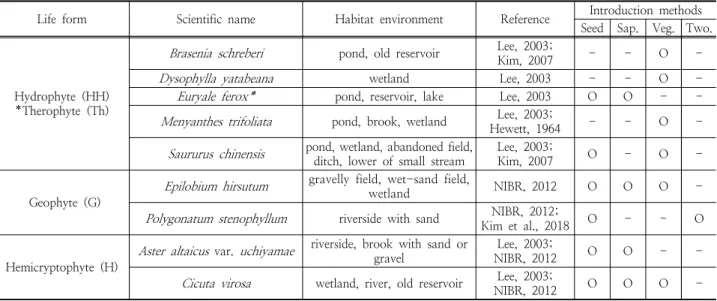
(Hemicryptophtye, H), 수생식물(Hydrophyte, HH), 지중식 물(Geophyte, G)순이었다(Kim et al., 2011; Shim et al., 2013; Kong et al., 2018). 따라서 선행연구를 고려하여 멸종 위기식물 중 수생식물(HH) 5 분류군, 지중식물(G) 2 분류군, 반지중식물(H) 2 분류군을 선별하였다(Table 1). 이때 수생식 물 중 1종은 일년생식물(Th)이었다(Table 1).
실험에 사용한 종자는 환경부의 허가를 받아 공주대학교 온 실에서 인공 증식한 개체로부터 2016년 6월부터 10월까지 수 확한 것을 사용하였다. 이때 9분류군 중 3분류군은 결실이 되 지 않아 6 분류군(가시연꽃, 삼백초, 큰바늘꽃, 층층둥굴레, 단 양쑥부쟁이, 독미나리)의 종자만 사용하였다. 가시연꽃의 종자 는 수확 후에는 실험 전까지 물을 채운 수조에 보관하였고, 나 머지 5종의 종자는 상온에 건조시킨 후 4℃ 냉장고에 보관하 였다. 이 중 200개 이상 종자 확보가 가능한 종은 온실에서 발 아시켰고 발아한 유식물은 정착에 용이하도록 일정기간 온실 에서 양묘한 후 묵논에 도입하였다. 이때 종마다 발아시작일과 종료일이 다르기 때문에 종별 이식 시기는 달랐으며, 6월 말 까지 발아가 종료되지 않은 종은 이식하지 않았다. 무성번식개 체와 2년생 개체는 온실 내 화분에 심겨진 상태로 보관하였고,
크기가 유사한 개체를 선별하여 이식하였다.
2.2 야외 실험 2.2.1 연구대상지 개황
연구대상지는 충남 공주시에 위치한 천이 초기 단계인 묵논 이었다. 물의 유입은 농업용수와 강수에 의해 유입되는 체계이 고, 묵논의 주변 식생은 침엽수림과 경작지(밭과 논)가 분포하 고 있었다(Fig. 1). 토양 특성은 Table 2와 같다.
2.2.2. 수분구배설정 및 환경모니터링
수분 환경을 다양화시키기 위하여 묵논을 변형하여 두 가지 유형의 수분 구배를 조성하였다. A구역은 둠벙을 조성하기 위 하여 포크레인으로 땅을 파고 수심이 10-40cm 되게 만들었 고, B구역은 벼를 재배하였던 일반적인 습지이었다.
연구기간 동안 강수에 따른 수심의 변화는 영구적으로 설치해 둔 눈금자를 통하여 매주 3회 이상 모니터링 하였다. 수분함량의 변화는 토양수분함량측정기(3685WD1, WatchDog 1400 Micro Station, Spectrum Technologies, Inc., UK)를 이용하여 30분
Table 1. Habitat environment and introduction methods of nine endangered species that were used in this study
Life form Scientific name Habitat environment Reference Introduction methods Seed Sap. Veg. Two.
Hydrophyte (HH)
*Therophyte (Th)
Brasenia schreberi pond, old reservoir Lee, 2003;
Kim, 2007 - - O -
Dysophylla yatabeana wetland Lee, 2003 - - O -
Euryale ferox* pond, reservoir, lake Lee, 2003 O O - -
Menyanthes trifoliata pond, brook, wetland Lee, 2003;
Hewett, 1964 - - O -
Saururus chinensis pond, wetland, abandoned field,
ditch, lower of small stream Lee, 2003;
Kim, 2007 O - O -
Geophyte (G)
Epilobium hirsutum gravelly field, wet-sand field,
wetland NIBR, 2012 O O O -
Polygonatum stenophyllum riverside with sand NIBR, 2012;
Kim et al., 2018 O - - O
Hemicryptophyte (H)
Aster altaicus var. uchiyamae riverside, brook with sand or
gravel Lee, 2003;
NIBR, 2012 O O - -
Cicuta virosa wetland, river, old reservoir Lee, 2003;
NIBR, 2012 O O O -
Fig. 1. Key map of study area.
간격으로 모니터링 하였다. 각 구배마다 수심과 수분함량은 Table 3과 같다. 대기 온도는 20.41±6.61℃ 이었고, 강수량은 총 799mm 이었다(Table 3).
2.2.3 이식 및 재배
분류군별로 확보가 가능한 모든 유형 유성생식체(종자, 유식 물, 2년생 개체), 무성생식체(기는줄기 또는 땅속줄기)로 도입 하였다(Table 4). 유성생식체(종자, 2년생 개체)와 무성생식체 는 2017년 3월부터 6월까지 이식을 하였다. 묵논에서 정착률 을 높이기 위해 유식물은 발아가 종료된 후 바로 이식하지 않
고 큰바늘꽃과 단양쑥부쟁이는 4주간, 가시연꽃과 독미나리는 8주간 양묘한 후 이식하였다. 그 후 자생지의 수분 환경과 유 사한 곳에 종자를 파종하고 개체를 이식하였다(Table 4).
연구기간 동안 피압과 경쟁으로 인해 이식한 분류군의 생육 이 불량한 지점은 풀베기를 하였고, 토양유기물함량과 개체의 생육 상태를 모니터링하고 토양의 비옥도가 감소하는 것을 확 인한 후 유기질 비료(참조아유박, ㈜동부팜한농)를 추가로 처 리하였다. 유기질 비료는 질소전량 4.6%, 인산전량 1.4%, 칼 리전량 1%, 유기물함량이 70% 이었고, 20kg의 유기질 비료 를 6월과 8월에 총 2회 처리하였다.
Table 4. Location and dates of seeding and transplanting of nine species in abandoned rice paddy field Structure type Life
form Zone Introduction type Species Transplanted date
Germinated date in greenhouse
Small irrigation pond(Dum-bung)
HH A-1 Rhizome Dysophylla yatabeana 1st, April
-
HH A-2 Rhizome Brasenia schreberi 1st, April
HH A-2 Rhizome Menyanthes trifoliata 5, May
H A-2 Seed Cicuta virosa 3rd, April
H A-2 Rhizome Cicuta virosa 1st, April
HH A-3 Seed Euryale ferox 30, March
HH A-3 Sapling Euryale ferox 1st, August 2nd, June
Wetland(rice paddy) including ditch and ridge between rice
paddies
HH B-1 Rhizome Dysophylla yatabeana 23, June
H B-1 Seed Aster altaicus var. uchiyamae 10, April -
H B-1 Sapling Cicuta virosa 12, June 19, April
HH B-2 Sapling Euryale ferox 1st, August
HH B-3 Rhizome Menyanthes trifoliata 30, March -
HH B Rhizome Saururus chinensis 13, April
G B Seed Epilobium hirsutum 10, April
G B Sapling Epilobium hirsutum 10, June 19, May
G B Runner Epilobium hirsutum 30, March -
G B Individual
(two years old) Polygonatum stenophyllum 13, May Table 2. Chemical character of soil in study area
Site Rainy
season S.O.M
(%)
T-N (%)
T-P (mg/kg)
Exchange cations(cmol+/kg)
K Ca Mg Na
A Before 5.96±0.14 0.2 262.64±1.07 2.27±0.08 7.35±0.04 35.79±0.17 1.05±0.01
After 6.69±0.17 0.14 218.33±0.63 1.61±0.01 4.07±0.02 29.87±0.03 0.99±0.00
B Before 6.68±0.16 0.27 281.48±1.11 2.37±0.01 6.68±0.05 33.61±0.08 1.25±0.00
After 6.51±0.08 0.29 214.55±2.00 2.12±0.01 4.45±0.01 31.68±0.08 0.93±0.00
Table 3. Monthly average water depth, average water content, precipitation (mm) and average temperature (℃) during study period in Gongju-si (study area)
Zone Apr. May Jun. Jul. Aug. Sep. Oct. Average
Water depth(cm)
A-3 20.5±0.7 24±8.5 31.3±0.6 35.5±0.7 36.5±0.7 40.0±0.0 33.3±4.6 31.6±7.0 A-2 11.0±1.4 15.5±6.4 21.3±0.6 25.5±0.7 22.5±0.7 30.0±0.0 23.3±4.6 21.3±6.2 A-1 5.0±0.0 5±7.1 11.3±0.6 15.5±0.7 12.5±0.7 20.0±0.0 13.3±4.6 11.8±5.5 B-3 0.0 19±1.4 17.8±0.8 17.5±0.7 17.5±0.7 17.5±3.5 8.0±4.2 14.2±6.9 B-2 0.0 9.5±0.7 6.3±4.2 11.5±0.7 10.5±0.7 5.5±3.5 3.0±4.2 6.6±4.5 B-1 0.0 9.5±0.7 6.3±4.2 9.0±2.8 5.0±0.0 3.5±0.7 1.5±2.1 5.1±3.8 Water content(%) B 35.3±5.2 31.5±13.9 43.8±4.1 39.3±6.3 38.1±5.5 35.2±5.3 37.2±9.5 37.5±10.5
Precipitation(mm) 69.5 23.5 22.0 305.0 275.5 77.0 26.5 -
Temperature(˚C) 13.6±5.5 18.7±5.5 22.5±5.1 26.8±2.8 25.4±4.2 20±4.5 14.9±5 20.4±6.6
2.3 측정 항목
분류군별로 생존가능성을 확인하기 위해 생존률과 식물계절 학적 반응을 확인하였다. 생존률 (%)은 2017년 9월에 측정하 였고, 개체로 도입한 경우 초기에 도입한 개체의 수 대비 생육 기말에 생존한 개체의 수를 카운팅하여 계산하였다. 종자를 직 접 도입한 경우 생존률은 발아한 개체의 수 대비 생육기말에 생존한 개체의 수를 카운팅하여 계산하였다. 이때, 무성번식체 (기는줄기 또는 땅속줄기)의 개체수는 라메트(ramet)수 이고, 종자에서 발아한 개체수는 제네트(genet)수 이다. 각 분류군의 식물계절적 변화는 개엽, 개화, 결실을 육안으로 확인하여 기 록하였다. 개엽은 잎이 처음 형성되기 시작했을 때로 하였고, 개화는 꽃이 2~3개가 피었을 때로 하였다. 결실은 열매의 색 이 갈변되거나 열매주머니가 벌어져 종자가 분산되었을 때로 하였다.
2.4 사후 모니터링
정착 이후에 재생 및 추가적인 위협요인을 확인하기 위해 2 년간(2018~2019) 모니터링을 하였다. 도입 초기에 정착한 식 물들의 재생 유무 및 방법, 영양생장 유무, 생식생장 유무(개 화, 결실), 위협요인, 개체군의 크기를 모니터링 하였다. 이를 통하여 최종적으로 도입이 가능한 종을 선별하였고, 효과적인 도입 및 관리방안을 제시하였다.
3. 결과 및 고찰
3.1 생존률과 식물계절학 반응 3.1.1 근생수생식물
3.1.1.1 순채
A구역에 땅속줄기의 형태로 도입하였을 때 순채는 영양생장 과 생식생장을 모두 하였지만 생식생장 중 물달개비와의 경쟁으 로 인해 모두 고사하였다(Fig. 2, Fig. 3). 순채는 유기물과 영양 염류의 함량이 높고 폐쇄된 생태계 내에서 자생하고 있다(Ahn et al., 1977). 이러한 이유로 순채는 유기물과 영양염류 함량이
높은 묵논에서 생육이 가능하지만 물달개비의 피압으로 고사한 것으로 보아 모니터링을 통해 초본류의 피압을 관리해야 한다.
3.1.1.2. 전주물꼬리풀
A구역과 B구역에 땅속줄기의 형태로 도입하였을 때 전주물 꼬리풀의 생존률은 A구역이 B구역보다 높았다(Fig. 2). 식물계 절학적 반응을 관찰한 결과 모두 영양생장과 생식생장을 하였 다(Fig. 3). 전주물꼬리풀은 수생식물이고(Kang et al., 2015), 침수 식물의 복원 시에는 수심에 큰 영향을 받지는 않지만 가 급적 50~150cm 이내의 수심을 조성해야 한다(Cho et al., 2011). 하지만, 본 연구에서 전주물꼬리풀을 도입한 A와 B구 역의 평균 수심은 각각 11.8±5.5cm, 5.1±3.8cm로 위의 연구 에서 언급한 수심보다 낮았다(Table 3). 따라서 선행연구보다 낮은 수심을 조성해주었을 때 번식반응까지 진행되었기 때문 에(Fig. 3) 묵논에서 전주물꼬리풀은 생육이 가능할 것으로 판 단된다.
사후모니터링 결과, 전주물꼬리풀은 유성번식과 무성번식으 로 재생을 하였고, 재생 후 생식생장까지 진행되었다(Fig. 3).
특히 A구역의 전주물꼬리풀은 초기 도입 시보다 개체군의 크 기 30배 이상 증가하였고(Fig. 3), 이러한 결과를 보아 전주물 꼬리풀은 묵논 내 둠벙을 조성하여 도입해야 한다.
3.1.1.3. 가시연꽃
A구역에 종자와 유식물로 도입하였을 때 가시연꽃의 생존률 은 유식물로 도입한 것이 종자로 도입한 것보다 더 높았다 (Fig. 2). 식물계절학적 반응을 관찰한 결과, A구역에 종자로 도입한 것은 열매를 맺지 못하였다(Fig. 3). 유식물로 도입한 가시연꽃의 생존률은 B구역이 A구역보다 더 높았고(Fig. 2), A구역에 유식물로 도입한 가시연꽃은 영양생장과 생식생장을 모두 하였지만 B구역의 가시연꽃은 영양생장만 하고 고사하였 다(Fig. 3).
연구기간 동안 식물체 피압의 영향을 최소화하기 위해 A구 역과 B구역에 도입한 가시연꽃 주변의 물달개비와 사마귀풀을 제거하였고 A구역의 평균 수심은 31.6±7cm 이었고, B구역은 6.6±4.5cm 이었다(Table 3). Alfasane et al., (2008)은 가시 연꽃을 발아시킬 때는 수심을 얕게 유지시켜야 하고, 잎의 모
Fig. 2. Survival and death rate (%) of Hydrophyte (
B. schreberi, D. yatabeana, E. ferox, M. trifoliata and S. chinensis).
양이 원형이 되었을 때는 수심을 90-120cm 유지해야 한다고 하였다. You and Kim (2010)은 발아 시 수심을 50cm 내외로 유지해야 하고, 수심이 100cm 이상부터는 정착률이 감소하므 로 그 이하로 수심을 유지해야 한다고 보고하였다. 즉, 위협요 인을 제거하였음에도 불구하고 생육의 차이를 보였던 것은 생 육 중기의 얕은 수심이 영향을 준 것으로 판단된다.
사후모니터링 결과, 가시연꽃은 2018년 유성번식을 하여 재 생에 성공하였고 생식생장까지 진행되었다(Fig. 3). 그 후 2019년에 재생은 성공하였지만 유식물 시기인 5월부터 6월에 참개구리 올챙이가 섭식을 하여 생식생장까지 진행되지 못하 였다(Fig. 3). 따라서 가시연꽃은 수심이 20cm 이상 유지되는 둠벙에 도입이 가능하지만, 유식물 시기에 섭식자인 참개구리 올챙이의 관리가 필요하다.
3.1.1.4. 조름나물
땅속줄기의 형태로 도입하였을 때 조름나물의 생존률은 A구 역이 B구역보다 높았다(Fig. 2). 식물계절학적 반응을 관찰한 결과 A구역과 B구역에 도입한 조름나물은 모두 영양생장만 하였다(Fig. 3). Lee and Kim, (2011)의 연구에 따르면 조름나 물이 서식하는 곳은 양분이 적은 산지습지이지만 양분이 많은 논흙 조건에서 더 잘 성장하였다. 특히 논흙 내 20cm 내외의 침수 조건에서는 잎 수가 계속해서 증가하였고(Lee and Kim, 2011), 이러한 수심은 잎의 성장에 중요한 요인으로 작용하였 는데(Han and Kim, 2006) 본 연구에서는 A구역의 수심 (21.3±6.2 cm)과 유사하였다(Table 3).
사후모니터링 결과, 조름나물은 A구역과 B구역 모두 무성 번식으로 재생에 성공하였고 생식생장까지 진행되었다(Fig.
3). 특히 A구역의 개체군 크기는 초기보다 5배 증가하였고 B 구역의 개체군 크기는 초기보다 4배 증가하였는데(Fig. 3), 이
를 보아 조름나물은 묵논에 도입 시 수심이 20cm 내외로 유지 되는 둠벙에 도입해야한다.
3.1.1.5. 삼백초
B구역에 땅속줄기로 도입한 삼백초의 생존률은 41.7% 이었 고(Fig. 2), 영양생장과 생식생장을 모두 하였다(Fig. 3). 삼백 초는 폐경지와 배수로에 자생하기 때문에 본 연구대상지인 묵 논에 도입하기에 매우 적합한 종이다(Kim, 2007). 사후 모니 터링 결과에서도 B구역에 도입한 삼백초는 무성번식으로 재생 과 생식생장까지 성공하였다(Fig. 3).
삼백초의 생육은 침수되지 않은 곳보다 반침수처리한 처리 구에서 13~36% 증가하였고(Ryu, 2019), 삼백초의 발아율은 토양의 수분함량이 높아질수록 증가하였다(Morimoto et al., 2005). B구역은 연구기간동안(4월~10월) 평균 토양수분함량 이 37.5±10.5% 이었고, Ryu (2019)의 연구와 동일한 기간인 7-8월에는 평균 토양수분함량이 41.86±5.47%인 반침수조건 이었다(Table 3). 따라서 삼백초는 묵논에 도입이 가능하고, 생존률 및 활력도를 높이기 위해서는 이식 장소의 수분함량을 더 높게 유지해야한다.
3.1.2. 지중식물 3.1.2.1. 큰바늘꽃
B구역에 유식물을 도입하였을 때 큰바늘꽃의 생존률은 54.2% 이었고(Fig. 4), 영양생장만 하였다(Fig. 5). 이는 큰바 늘꽃의 섭식자인 주홍박각시 유충의 섭식활동 때문이다. 주홍 박각시가 큰바늘꽃의 대부분의 잎을 섭식하였기 때문에 큰바 늘꽃은 생장과 유지를 위해 생식에 자원을 분배하지 않은 것 이고, 실제로 섭식 후 새로운 잎이 나오는 것을 관찰할 수 있 었다(Fig. 6).
Fig. 3. Schema of annual growth schedules and monitoring results of Hydrophyte.
Fig. 4. Survival and death rate (%) of Geophyte (
E. hirsutum).
B구역에 기는줄기로 도입한 큰바늘꽃은 섭식자에 의한 피해는 없었고 개화를 하였지만 결실 전에 둑이 무너져 생육확인이 불가능하였다(Fig. 5). Lee et al., (2017)의 연구에 따르면 큰 바늘꽃은 토양수분함량과 토양유기물함량이 증가할수록 생육 반응이 증가하였다. 묵논은 토양의 특성상 수분함량과 유기물 함량이 높기 때문에 큰바늘꽃은 묵논에 도입하기에 적합한 분 류군으로 판단된다.
사후 모니터링 결과, 큰바늘꽃은 무성번식으로 재생에 성공 하였으며 생식생장까지 진행되었고, 개체군의 크기는 초기보 다 2~3배 증가하였다(Fig. 5). 따라서 큰바늘꽃은 묵논에 도입 이 가능하며 종자보다는 개체로 도입해야한다.
3.1.3. 반지중식물 3.1.3.1. 독미나리
A구역에 땅속줄기와 B구역에 유식물로 도입하였을 때 독미 나리의 생존률은 각각 9.2%, 35.6% 이었는데(Fig. 7) 이러한 결과는 도입 단계의 차이가 아닌 수심 때문이다. 평창의 묵논 에 자생하고 있는 독미나리 자생지 수심은 10cm 이하이고 (Shin et al., 2013), 백두산의 모래에서 사는 독미나리의 수심 은 0~20cm이다(Kim and Lee, 2003). 본 연구에서 독미나리 를 도입한 A구역과 B구역의 수심은 각각 21.3±6.2cm, 5.1±3.8cm 이었고(Table 3), A구역은 강수에 의해 수심이 최 대 30cm까지 높아졌던 것이 생육에 영향을 준 것이다. 수심은 빛, 토양 유기물, 입자크기, 가스 교환 등을 변화시킬 수 있기 때문에 습지 식물들의 분포는 수심과 같은 단일 환경요인에 의해 결정될 수 있다(Spence, 1982; Coops et al., 2004; Lee et al., 2005).
사후 모니터링 결과, 독미나리는 유성번식과 무성번식으로 재 생에 성공하였고 이후 생식생장까지 진행되었고(Fig. 8), B구역의 독미나리의 개체군 크기는 초기보다 6~7배 증가하였다(Fig. 8).
Fig. 5. Schema of annual growth schedules and monitoring results of Geophyte.
(a) (b) (c)
Fig. 6. Larva of
Deilephila elpenorthat nibble away the leaves of
Epilobium hirsutum(a),
Epilobium hirsutumdamaged by Larva of
Deilephila elpenor(b), leaves of them were out again (c).
Fig. 7. Survival and death rate (%) of Hemicryptophyte (
C. virosa).
따라서 독미나리는 종자보다는 유식물로 수심이 20cm 이하로 유지되는 곳에 도입해야 한다.
3.2. 위협요인 및 관리방안
본 연구에서는 수분, 토양환경 등을 서식지와 유사하게 조성
하여 가시연꽃과 순채를 이식하였지만, 초본류와의 경쟁에 밀 려 생육이 저해되는 것을 확인하였다. 이러한 결과를 보았을 때 생육을 저해하는 초본류들의 제거가 필요하고 초본류와의 경쟁이 생육을 저해하는 핵심요인인지 확인하기 위해서는 통 제된 곳에서 경쟁실험을 진행할 필요가 있다.
가시연꽃의 유식물을 섭식하는 참개구리(
Rana
nigromaculata
)의 올챙이, 전주물꼬리풀의 잎을 섭식하는 세 줄짤름나방(Colobochyla salicalis
)의 유충, 전주물꼬리풀의 잎 과 꽃을 섭식하는 벼메뚜기(Oxya chinensissinuosa
), 조름나물 의 잎을 섭식하는 담배거세미나방(Spodoptera litura
)의 유충, 큰바늘꽃을 섭식하는 주홍박각시(Deilephila elpenor
)의 유충 을 확인하였다(Fig. 9). 특히 큰바늘꽃을 섭식하는 주홍박각시 는 잎의 대부분을 섭식하여 큰바늘꽃의 생식생장에 영향을 주 었다(Fig. 6). 이는 묵논에 도입 시 멸종위기식물들의 생육을 방해하는 섭식자의 관리가 필요하다는 것을 의미한다.연구기간 동안 둑의 주변에 이식하였던 식물들은 목본이 거 의 없고 매트를 형성하지 않는 초본이 우점하는 둑이 총 3차 례 무너져 생육과 생식을 완료하지 못하고 고사하였다. 이를 방지하기 위해서는 목본 또는 식생 매트를 형성하는 초본류의 식재를 통하여 둑 붕괴를 방지할 필요가 있다.
Fig. 8. Schema of annual growth schedules and monitoring results of Hemicryptophyte.
(a) (b) (c) (d)
Fig. 9. Herbivore of
Dysophylla yatabeana(a: larva of
Colobochyla salicalis, b:
Oxya chinensis sinuosa),
Euryale ferox(c: tadpole
of
Rana nigromaculata) and
Menyanthes trifoliata(d: larva of
Spodoptera litura)
4. 결 론
본 연구에서는 증가하고 있는 묵논을 생태적으로 활용하기 위한 방법의 일환으로 묵논의 특성을 고려하여 생활형이 다른 멸종위기식물의 현지외보전의 대상지로서의 잠재력을 확인하 였다. 이를 위해 묵논에 도입 시 단기간 내(1년) 식물의 생존 률과 식물계절학 반응을 확인하였고, 2년간 재생성과 피압, 섭 식자, 둑붕괴 등의 위협요인과 관련한 모니터링을 수행하였다.
그 결과 묵논에 도입이 가능한 수생식물은 4 분류군 (가시연 꽃, 삼백초, 전주물꼬리풀, 조름나물), 지중식물은 1 분류군 (큰바늘꽃), 반지중식물은 1 분류군 (독미나리) 이었다. 본 연 구의 결과를 보았을 때 묵논은 생활형이 다른 멸종위기식물의 도입이 가능하지만 각 분류군별로 도입 위치, 도입 단계, 관리 방안에 차이가 있음을 확인할 수 있었다. 또한 수분 환경을 다 양화하여 효과적으로 생물다양성을 증진시킬 수 있음을 확인 하였지만, 묵논의 유형은 수분 유입 체계에 따라 달라지기 때 문에 이 체계에 따라 종 선별을 신중하게 해야 하고 도입 초기 에 경쟁, 피압, 섭식자, 둑 붕괴 등의 위협요인을 고려해야 하 므로 적절한 관리가 필요하다.
따라서 묵논을 이용한 효과적인 보전 전략 마련 및 보완을 위해서는 개체군의 생존과 직결되는 수심 또는 수분, 광, 토양 환경요인에 대한 지속적인 모니터링도 수행되어야 한다.
사 사
이 논문은 2018년도 정부(교육부)의 재원으로 한국연구 재단의 지원을 받아 수행된 기초연구사업임(No. NRF- 2018R1D1A1B07050269)
References
Ahn YK, Joo, HK and Sheo, HJ (1977). Limnological study on the Brasenia purpurea wildgrowing reservoirs, Keum Ho and Cheok Po Jae,
Korean J Limnol
, 10, pp. 3-4. [Korean Lirerature] [DOI : https://doi.org/10.15230/SCSK.2017.43.3.223]
Alfasane, M, A, Khondker, M, Begum, Z, T, Banu, L, A, Rahman, M, M, and Shahjadee, U, F (2008). Fruit production and biochemical aspects of seeds of
Euryale ferox
Salisb. under ex-situ conditions,Bangladesh Journal of Botany
, 37(2), pp.179-181. [DOI : https://doi.org/10.3329/bjb.v37i2.1727]
Altieri, M, A (1999). The ecological role of biodiversity in agroecosystems, In Invertebrate biodiversity as bioindicators of sustainable landscapes, pp. 19-31, Elsevier.
Burke, M, J, and Grime, J, P (1996). An experimental study of plant community invasibility,
Ecology
, 77(3), pp. 776-790.[DOI : https://www.jstor.org/stable/2265501]
Byun, CH, Kwon, GJ, Lee, DW, Wojdak, JM, and Kim, JG (2008).
Ecological assessment of plant succession and water quality
in abandoned rice fields,
Journal of Ecology and Environment
, 31(3), pp. 213-223. [Korean Lirerature][DOI : 10.5141/JEFB.2008.31.3.213]
Cho, DG, Jin, HY, and Song, JH (2011). Proposal of ecological design of aquatic garden in Korea national arboretum considering natural wetland vegetation structure,
J. Korean Soc. People Plants Environ
, 14(6), 379-391. [Korean Lirerature]Coops, H, Vulink, J, T, and Van Nes, E, H (2004). Managed water levels and the expansion of emergent vegetation along a lakeshore,
Limnologica
, 34(1-2), PP. 57-64. [DOI : https://doi.org/10.1016/S0075-9511(04)80022-7]Cramer, V, A, Hobbs, R, J, and Standish, R, J (2008). What's new about old fields? Land abandonment and ecosystem assembly,
Trends in ecology & evolution
, 23(2), pp.104-112. [DOI : https://doi.org/10.1016/j.tree.2007.10.005]
Han, M, and Kim, JG (2006). Water-holding capacity of a floating peat mat determines the survival and growth of
Menyanthes trifoliata
L (bog bean) in an oligotrophic lake,Journal of Plant Biology
, 49(1), 102-105. [Korean Lirerature] [DOI : 10.1007/BF03030794]Hewett, D, G (1964).
Menyanthes trifoliata
L,Journal of Ecology
, 52(3), 723-735. [DOI : https://www.jstor.org/stable/2257858]
Husband, B, C, and Campbell, L, G (2004). Population responses to novel environments: implications for ex situ plant conservation. Ex situ plant conservation: supporting species survival in the wild, Island Press, Washington, pp. 231-266.
Huston, M, A (2004). Management strategies for plant invasions:
manipulating productivity, disturbance, and competition,
Diversity and distributions
, 10(3), pp. 167-178. [DOI : https://doi.org/10.1111/j.1366-9516.2004.00083.x]Ikegami, Y, Nishihiro, J, and Washitani, I (2011). Vegetation of abandoned rice fields in the head areas of small valley bottoms ('yatsu') in the Lake Kitaura watershed, Ibaraki, Japan,
Japanese Journal of Conservation Ecology
, 16(1), pp.1-15. [DOI : https://doi.org/10.18960/hozen.16.1_1]
Ministry of Environment. (2011). Research for establishing the policy direction of wetland management, Ministry of Environment. [Korean Lirerature]
Morimoto, J, Inamoto, A, Katsuno, T (2005). Ecological Studies for Conservation of
Saururus chinensis
(Lour.) Bail Bottoms in Abandand Paddy Fields in Valley,Journal of The Japanese Institute of Landscape Architecture
, 68(5), pp. 697-700.[DOI : https://doi.org/10.5632/jila.68.697]
Kang, DH, Yim, EY, and Moon, MO (2015). Flora of aquatic and wetland habitats on Jeju Island,
Korean Journal of Plant Taxonomy
, 45(1), pp. 96-107. [Korean Lirerature] [DOI : 10.11110/kjpt.2015.45.1.96]Kercher, S, M, and Zedler, J, B (2004). Multiple disturbances accelerate invasion of reed canary grass (
Phalaris
arundinacea
L.) in a mesocosm study,Oecologia
, 138(3), 455-464. [DOI : 10.1007/s00442-003-1453-7]Kim, CH, Kang, EO, Choi, YE, Park, BM, and Baek, JS (2011).
Flora and life form of 4 man-made wetlands in Gunsan City,
Journal of Environmental Science International
, 20(9), pp.1125-1140. [Korean Lirerature] [DOI : https://doi.org/
10.5322/JES.2011.20.9.1125]
Kim, CS (2007). Studies on the distribution and vegetation of the endangered wild plants in Jeju Island, Ph.D. Dissertation, Jeju National University, Jeju, Korea. [Korean Lirerature]
Kim, EJ, Kim, MH, Lee, SI, Hong, YS, Lee, EP, Park, JH, Lee, SY, Cho, KT, and You, YH (2018). Impact of
Ambrosia trifida
L.(invasive plant) on the Plant Diversity and Performance ofPolygonatum stenophyllum
Maxim.(near threatened) and Management Suggestion for the Habitat Conservation,Journal of Wetlands Research
, 20(3), pp.249-255. [Korean Lirerature] [DOI : https://doi.org/
10.17663/JWR.2018.20.3.249]
Kim, JO, Lee, SH, and Jang, KS (2011). Efforts to improve biodiversity in paddy field ecosystem of South Korea,
Reintroduction
, 1(1), pp. 25-30. [Korean Lirerature]Kim, JS, Hong, GN, Park, NH, and Chun, TY (2019) The Effects of Home Meal Replacement(HMR) Selection Attributes on Consumer Satisfaction and Trust in the Context of Eating Lifestyle,
Journal of Distribution and Management Research
, 22(2), pp. 71-80. [Korean Lirerature]Kim, SH, Kim, JH, and Kim, JG (2011). Water characteristics and similarity analysis of wetland plant communities in 4 types of small irrigation ponds in western Civilian Control Zone in Korea,
Journal of Wetlands Research
, 13(3), pp.581-591. [Korean Lirerature] [DOI : https://doi.org/10.
17663/JWR.2011.13.3.581]
Kim, SN, and Lee, JS (2003). Ecological characteristics and growth environment of Korean native water plants,
J. Kor.
Flower. Res. Soc
, 11(1), pp. 21-35. [Korean Lirerature]Kong, MJ, Kim, CH, Lee, SM, Park, KL, An, NH, Cho, JL, Lim, JA, Lee, CW, Kim, HS, Nam, HS, and Son, JK (2018). The Effect Analysis of Vegetation Diversity on Rice-Fish Mixed Farming System in Paddy Wetland,
Journal of Wetlands Research
, 20(4), pp. 398-409. [Korean Lirerature] [DOI : https://doi.org/10.17663/JWR.2018.20.4.398]Kong, RK (2017). A Study on Improving the Regulations for Conservation and Wise use in Rice Fields,
Journal of Fisheries and Marine Sciences Education
, 29(1), pp. 51-63. [Korean Lirerature] [DOI : https://doi.org/10.13000/JFMSE.2017.29.1.51]
Korea Rural Community Corporation. (2010). A study on the development of ecological infrastructure to improve bio-diversity in paddy wetlands, 11-1541000-000362-10, Korea Rural Community Corporation. [Korean Lirerature]
Korean Statistical Information Service (KOSIS) (2018).
http://kosis.kr/index/index.do.
Lee, BA, Kwon, GJ, and Kim, JG (2005). The relationship of vegetation and environmental factors in Wangsuk stream and Gwarim reservoir: I. Water environments,
Korean J Ecol
, 28(6), pp. 365-373. [Korean Lirerature] [DOI : 10.5141/JEFB.2005.28.6.365]Lee, EP, Han, YS, Lee, SI, Cho, KT, Park, JH, and You, YH (2017).
Effect of nutrient and moisture on the growth and reproduction of
Epilobium hirsutum
L., an endangered plant,Journal of Ecology and Environment
, 41, 35. [Korean Lirerature] [DOI : https://doi.org/10.1186/s41610-017- 0054-z]Lee, GM, and Kim, JG (2011). Effects of habitat substrates on growth of
Menyanthes trifoliata
,Journal of Wetlands Research
, 13(2), pp. 355-362. [Korean Lirerature] [DOI : https://doi.org/10.17663/JWR.2011.13.2.355]Lee, TB (2003). Coloured Flora of Korea, Hyangmunsa. [Korean Lirerature]
López-Toledo, L, and Martínez-Ramos, M (2011). The soil seed bank in abandoned tropical pastures: source of regeneration or invasion?,
Revista Mexicana de Biodiversidad
, 82(2), pp.663-678. [DOI : 10.22201/ib.20078706e.2011.2.462]
Lu, J, Wang, H, Wang, W, and Yin, C (2007). Vegetation and soil properties in restored wetlands near Lake Taihu, China,
Hydrobiologia
, 581, pp. 151-159. [DOI : DOI 10.1007/s10750-006-0495-3]
National Institute of Biological Resources of Korean Ministry of Environment. (2012). Red data book of endangered vascular plants in Korea. [Korean Lirerature]
Oh, YJ, Sohn, SI, Kim, CS, Kim, BW, and Kang, BH (2008).
Phytosociological classification of vegetation in paddy levee,
Korean Journal of Environmental Agriculture
, 27(4), pp.413-420. [Korean Lirerature] [DOI : https://doi.org/10.
5338/KJEA.2008.27.4.413]
Osawa, T, Kohyama, K, and Mitsuhashi, H (2013). Areas of increasing agricultural abandonment overlap the distribution of previously common, currently threatened plant species,
PloS one
, 8(11). [DOI : https://doi.org/10.1371/journal.pone.0079978]
Paik, CH, Lee, GH, Kang, JG, Jeon, YK, Choi, MY, and Seo, HY (2009). Plant flora and insect fauna in the fallow paddy fields of Jeonnam and Jeonbuk Province,
Korean journal of applied entomology
, 48(3), pp. 285-294. [Korean Lirerature] [DOI : 10.5656/KSAE.2009.48.3.285]Primack, RB (2012). A primer of conservation biology, Boston university, Boston.
Raunkiaer, C (1934). The life forms of plants and statistical plant geography; being the collected papers of C. Raunkiaer, Oxford University Press, Oxford, England, UK.
Rhee, SY, Kang, HK, and Lee, SJ (2009). The abandoned farmlands status and management in rural area,
Journal of
Korean Society of Rural Planning
, 15(1), pp. 15-29. [Korean Lirerature]Ryu, SH (2019). Comparison of Competitive Ability between
Saururus chinensis
andS. cernuus
in the Waterfront condition of Urban Botanic Gardens, Master’s Thesis, Seoul National University, Seoul, Korea.Shim, IS, Kim, HB, and Cho, KJ (2013). Syntaxonomical characteristics of abandoned paddy fields by seral stages in South Korea,
Korean Journal of Environmental Agriculture
, 32(3), pp. 185-192. [Korean Lirerature] [DOI : 10.5338/KJEA.2013.32.3.185]Shin, CJ, Nam, JM, and Kim, JG (2013). Comparison of environmental characteristics at
Cicuta virosa
habitats, an endangered species in South Korea, Journal of Ecology and Environment, 36(1), pp. 19-29. [Korean Lirerature] [DOI : 10.5141/ecoenv.2013.003]Spence, DHN (1982). The zonation of plants in freshwater lakes,
Advances in ecological research
, 12, pp. 37-125. [DOI :https://doi.org/10.1016/S0065-2504(08)60077-X]
Uematsu, Y, Koga, T, Mitsuhashi, H, and Ushimaru, A (2010).
Abandonment and intensified use of agricultural land decrease habitats of rare herbs in semi-natural grasslands,
Agriculture, ecosystems & environment
, 135(4), pp.304-309. [DOI : https://doi.org/10.1016/j.agee.2009.10.010]
Yoo, SY, Hur, MJ, Han, BH, and Choi, JW (2018). Habitat Characteristics and Management of Abandoned Rice Paddy Field Wetlands in Mountain-In Case of the Uldae Wetland in Bukhansan National Park,
Journal of the Korea Society of Environmental Restoration Technology
, 21(4), pp.11-23. [Korean Lirerature] [DOI : https://doi.org/10.
13087/kosert.2018.21.4.11]
You, YH, and Kim, HR (2010). Key factors causing the