Characterization of Surface Properties of Hygiene Paper by Fractal Dimension Analysis Technique
Sang-Hyup Lee, Hyoung-Jin Kim1, Young-Chan Ko1, Jin-Hee Lee1, Jung-Yoon Park1, Byoung-Geun Moon2 and Jong-Moon Park†
Received December 8, 2017; Received in revised form December 19, 2017; Accepted December 20, 2017
ABSTRACT
Surface properties of paper include the surface roughness component and the surface friction component. The former component is topographical in nature while the latter is mechanical. Using a surface tester (Model: KES-SESRU, Kato Tech, Japan) with a single U-tube wire stylus, both the surface roughness and the surface friction data can be ob- tained simultaneously. This instrument is a contact type where the stylus touches the surface to collect 200 data points per 20 mm (or 10 points/mm) scan, corresponding to a space distance of 100 μm between two adjacent points. The data of 10 points/mm was found to be insufficient to use the variogram method for fractal dimension (FD) analysis.
By connecting a logger to the instrument, 100 data points/mm, corresponding to the space distance of 10 μm, were obtained. This number was sufficient for the FD analysis of SMD (the mean deviation from the roughness average, Ra) and the MMD (the mean devi- ation from the mean coefficient of surface friction, MIU). Surface characteristics of six commercial toilet paper samples were examined in the present study. The results showed that the SMD had a very high correlation with the MMD, indicating that these two are closely related to each other. Meanwhile, correlation between the FD values of the SMD and the MMD was very poor. A systematic examination should be performed to explain the poor correlation. Nevertheless, it looks promising that the FD analysis technique can be applied for characterizing the surface properties of hygiene paper using a contact type surface tester such as Kawabata surface tester.
Keywords: Surface roughness, surface friction, contact type, fractal, fractal dimension, variogram, autocorrelation, Kawabata KES surface tester, SMD, MMD, rough- ness average
• Department of Forest Product & Engineering, Chungbuk National University, Cheongju, Republic of Korea 1 Department of Forest Products & Biotechnology, Kookmin University, Seoul, Republic of Korea
2 Korea Conformity Laboratories, Seoul, Republic of Korea
† Corresponding Author: E-mail: [email protected]
Printed in Korea http://dx.doi.org/10.7584/JKTAPPI.2017.12.49.6.90
1. Introduction
Surface properties play an important role in the wet-end chemistry and in the converting processes such as coating, printing, and laminating in the papermaking process. Characterization of surface properties is also important in determining the quality of a paper.
Characterization of surface properties is essential to understanding the surface and interfacial phe- nomena such as adhesion between a binder and substrate, wetting of a liquid, printability, coating and laminating to make a multiple ply product.
Surface properties play a critical role in determin- ing softness of tissue and towel as well.
Surface properties include a surface roughness component and a surface friction component. The former is topographical in nature while the latter is mechanical.
1.1 Surface roughness determination methods
Geometrical descriptions of the surface roughness profiles are defined in ISO 42871) and ISO 25178.2) Two types of instruments are available to collect surface profile data: (1) Non-contact profilometer and (2) Contact profilometer.3)
1.1.1 Non-contact method
A non-contact measuring instrument uses light in place of the stylus used in a contact-type mea- suring instrument. Light emitted from the instru- ment is reflected and read, to measure without touching the sample. Many non-contact instru- ments are commercially available. L&W OptiTopo is one that has been widely used in the paper in- dustry.4)
1.1.2 Contact method
In a contact-type method, the tip of the stylus directly touches the surface of the sample. As the
stylus traces across the sample, it rises and falls together with the roughness of the sample surface.
This movement in the stylus is picked up and used to measure surface roughness.
The contact method has been used to determine roughness of printing & writing paper. Emveco Smoothness Tester from Lorentzen & Wettre, US5,6) and Talysurf Surface Profiler from Talyor Hobson, Pennsylvania, USA are commercially available.7) These instruments, however, tend to damage the weak samples of hygiene paper such as tissues and paper towels. The resolution is judged too high for characterizing the surfaces of hygiene products.
Accordingly, these instruments have been judged unsuitable for characterizing the surfaces of hy- giene papers.
Since Kawabata developed a mechanical testing system, known as the Kawabata KES system in 1970’s, it has been widely used to determine the handfeel of fabrics and non-woven substrates.8,9) The Kawabata KES system consists of 4 units: 1) Tensile/shear tester (FB1), 2) Bending tester (FB2), 3) Compression tester (FB3), and 4) Surface tester (FB4). The Kawabata KES system has been estab- lished as the Japanese standard method in deter- mining the handfeel of textiles and nonwovens.8)
The surface tester, FB4 unit, has been used for evaluating surface softness of a hygiene paper.10,11) It uses a single wire probe for surface roughness measurements and for a finger-type probe con- sisting of 10 single wires as shown in Fig. 1.8,12) The instrument was found unsuitable for testing hy- giene papers whose sample sizes were too small for the unit.10,11)
Kato Tech introduced a surface roughness/fric- tion tester, KES-SE surface tester, which was specifically designed for handling tissue and towel samples while using the same stylus as those for the FB4 unit, i.e., a single U-tube piano wire sty- lus for surface roughness measurements and a finger type probe for surface friction measure-
ments. Using this tester, Dwiggins et al. found that only the mean deviation from the mean aver- age friction coefficient (MMD) matters with regards to surface softness.13,14)
Yokura et al., determined objective hand mea- surement of toilet paper, based on their mechanical and surface properties using the Kawabata KES System which generated the 16 mechanical and surface parameters. Among them, the surface friction component, MMD, was found to generate the highest correlation (r=-0.827) with the sub- jective handfeel evaluation. Meanwhile, the surface softness component, SMD, generated a marginal correlation of r=-0.514. They concluded that MMD is the most important property affecting the sub- jective hand evaluation.15)
Yokura et al. also experimented using a single U-tube piano wire stylus to compare with the fin- ger type stylus for the surface friction measure- ments (MMD).15) The single U-tube type was found more discriminating than the finger-type by
showing a higher correlation with handfeel from subjective testing. This suggests that the single U-tube wire stylus can be used for both surface roughness and surface friction at the same time, thus eliminating the need of using the finger-type probe for surface friction. Yokura’s work has been subsequently validated by others.16,17)
In summary, the Kawabata KES-SE surface roughness/friction tester using a single U-tube piano wire stylus seems to be a promising contact instrument for characterizing the surface proper- ties of hygiene paper. A remarkable feature of this instrument is its capability of measuring the sur- face roughness component and the surface friction component simultaneously. No other instrument is commercially available nowadays.18)
1.2 Fractal geometry and fractal dimension analysis
Fractal geometry was first coined by Mandelbrot to describe the geometry of Nature that cannot be Fig. 1. Measurement of roughness depending on wire probe type.8)
described in terms of traditional Euclidean geome- try.19) Since his pioneering work on fractals in the 1970s, fractal geometry has been found in abun- dance in nature, such as mountains, coastlines, clouds, lightning, earthquakes, plants, and even human organs. It seems that fractal geometry in nature is the rule rather than the exception.20-24)
Fractal geometry is characterized by self-simi- larity over many scales of length (or time), indi- cating a hierarchical structure consisting of the same shape, but in different scales. Since fractal geometry is commonly found in nature, it is be- lieved that fractal geometry should be the most ef- fective and efficient system for designing and characterizing the structure.
As more insight is gained on the characteristics of fractal geometry, it is increasingly used to char- acterize surface roughness, porous structures, sig- nal/noise processing, sensor and monitoring de- vices in the health and medical industries, com- puter-aided graphics for the entertainment and film industries, package designs, chemical reactor designs and chemical and polymer synthesis.25-32)
Table 1 lists the potential sources that may con- tribute to the surface roughness of tissue and towel products. It shows that surface roughness may consist of micro-scale, medium-scale, and mac- ro-scale; from individual fibers to post-processing such as embossing.33)
• Micro-scale (i.e., high frequency, high resolu- tion)
Source: free-end fibers, fiber morphology,
Scale: 10-100 μm.
• Medium-scale (i.e., medium frequency, inter- mediate)
Source: creping, printing on a small scale, Scale: 100-1,000 μm.
• Macro-scale (i.e., low frequency, low resolu- tion)
Source: embossing, printing on a macro-scale, fabrics.
Several methods are available for fractal dimen- sion analysis: Box Counting Method - Richardson Plot,34) Fast Fourier Transformation (FFT) method22) and Variogram method.24) Selecting a fractal dimension analysis depends on the spacing distance between two adjacent points. For exam- ple, if 1,000 points per 1 mm are collected, then the spacing distance is 1 μm. The FFT requires the smallest spacing distance, in the order of 0.01-0.1 μm, corresponding to 10,000-100,000 points/
mm.32,33) The Box counting method, also known as Richardson plots is generally used in microscopy or image analysis of the surface images obtained at different magnifications.
The Variogram method is a quantitative statisti- cal method that characterizes the spatial continuity or roughness of a data set using autocorrelation between distances in the surface profile. In statis- tics, autocorrelation means that the observations are dependent on each other. A higher autocor- relation means a higher dependency. A distance between any two points is called lag, so lag K
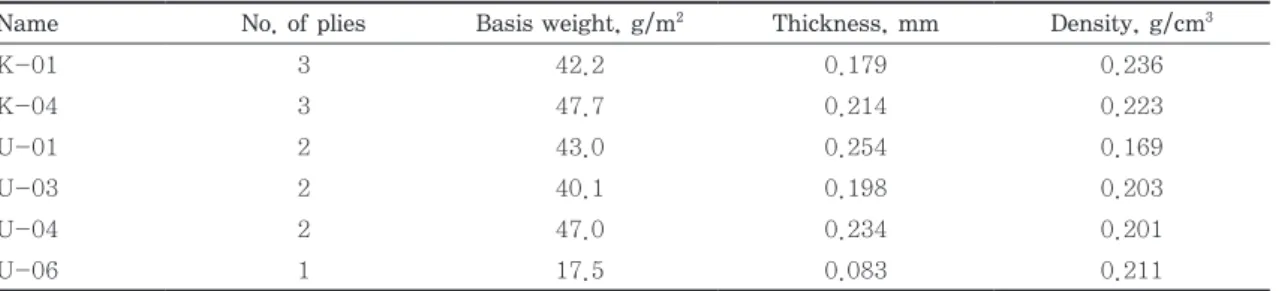
Table 1. Properties of the samples
Name No. of plies Basis weight, g/m2 Thickness, mm Density, g/cm3
K-01 3 42.2 0.179 0.236
K-04 3 47.7 0.214 0.223
U-01 2 43.0 0.254 0.169
U-03 2 40.1 0.198 0.203
U-04 2 47.0 0.234 0.201
U-06 1 17.5 0.083 0.211
means any two points whose distance is equal to K.
Therefore, a larger K means a larger spacing scale.24)
Militky et al. attempted to perform fractal di- mension analysis of the surface roughness data of toilet papers using the variogram method, in order to do this, data were collected using a KES-SE surface tester.33) They realized, however, that a number of data points are only 10 points/mm, cor- responding to the spacing distance of 100 μ while approximately 100 points/mm is needed to perform fractal analysis using the variogram method. As a result, they were unsuccessful with fractal dimen- sion analysis on the surface roughness data ob- tained from the KES-SE Surface Tester.
In the present study, this issue with the KES-SE surface tester has been solved by connecting a data logger to the tester. By doing so, it is possible to collect data points up to 100 points/mm, corre- sponding to a spacing distance of 10 μm.
2. Materials and Methods
2.1 Materials
Six commercial toilet tissue samples were used for this study. Their properties are summarized in Table 1.
2.2 Surface roughness and surface friction measurements
A Kawabata surface/friction tester (KES-SESRU, Kato Tech, Japan) was used in this study. The Kawabata KES-SE surface tester uses a contact type stylus to perform line scans of all the sam- ples.18)
The standard KES tester has a single U-tube type piano wire stylus that is 500 microns in diam- eter and provides 150-200 data points per 20 mm scan. This stylus was used to determine the surface roughness and the surface friction measurements
simultaneously.
For fractal dimension analysis using the vario- gram method, about 100 data points/mm are nec- essary.33) This problem with the surface tester has been solved by connecting a data logger to the tes- ter which allows collecting data up to 2,000-3,000 data points per 20 mm scan. The testing conditions were as follows:
Instrument: KES-SESRU, Kato Tech, Japan Stylus: Singe U-tube wire (diameter = 0.5 mm), Contact force: 5 gf,
Scanning speed: 1 mm/sec, Scan distance: 20 mm,
A number of data points collected: 100 points/mm.
2.3 Surface roughness determination (SMD)
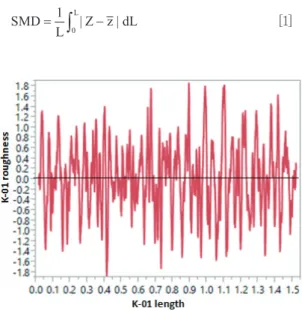
Fig. 2 is a surface roughness profile of sample K-01 in the machine direction as an example. It is a plot of the roughness against the scan length. In the figure, the roughness average, Ra, was points were collected for a scan length of 20 mm.
From the surface roughness data, the mean de- viation from the average (SMD) was calculated us- ing the following Eq. 1:8,9)
SMD=L1∫0L|Z z− | dL [1]
Fig. 2. Surface roughness profile of sample K-01 in the machine direction (MD).
where, SMD = the mean deviation from the roughness average, μm, L = the scan length, mm,
Z = roughness at scan length L, μm, z-
= average thickness, μm.
According to the definition of the ISO standard methods, the average roughness, Ra, is defined as:1-3)
Ra=L1∫0Lzdx [2]
That is, z- corresponds to Ra. Accordingly, SMD can be interpreted as the mean deviation from the roughness average, Ra. It is important to note the difference between the two, which has frequently been overlooked.
Note that the KES-SE surface tester does not provide the thickness. A thickness tester is neces- sary for measuring thickness.
The SMD values were obtained for the samples in the machine direction (MD) and the cross direction (CD). Then, the geometric mean (GM) values were determined from the following Eq. 3.
SMDGM = SQRT (SMDMD × SMDCD) [3]
2.4 Surface friction determination, mean deviation (MMD) from the mean coefficient of friction (MIU)
Fig. 3 is surface frictions profile obtained the same U-tube type stylus as used in Fig. 3 for the sample K-01 in the MD direction. It is a plot of the coefficient of friction against the scan length. As for Fig. 3, 2,000 data were collected for the scan length of 20 mm. Fig. 3 is a surface friction profile of sample K-01 in the MD.
From Fig. 3, the mean friction coefficient (MIU) and the mean deviation of the coefficient of friction (MMD) are calculated as follows:
MMD L
= 1∫0L|µ µ− | dL [4]
where, L = the length of measurement, μ = friction coefficient,
μ-
= mean value of μ.
Eq. 4 shows that the surface roughness compo- nent, SMD, Z, and z- have been replaced by the friction component, MMD, μ, and μ-.
The MMD values were obtained for the samples in the machine direction (MD) and the cross direc- tion(CD). Then, the geometric mean (GM) values were determined from the following Eq. 5.
MMDGM = SQRT (MMDMD × MMDCD) [5]
2.5 Fractal dimension analysis using Variogram method
The variogram method was used for fractal di- mension analysis.24) The variogram at lag K was determined from the autocorrelation function as follows:24,33)
Σ Vk = (1 − r(k+1)) / (1 − rk) [6]
where, Vk = Variogram at lag k = 15 (default), rk = the autocorrelation at lag k, n = number of point in the data set.
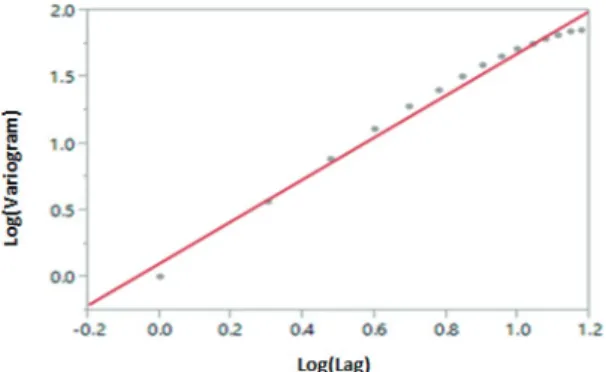
The calculation of sample autocorrelation from the surface roughness and surface friction data from the KES-SE surface tester was performed using the time series analysis in JMP.35) Then, the variogram is plotted against lag K on a log-log scale and a linear regression line is fitted to get the slope, as shown in Fig. 4 for the SMD of the sam- ple, K-01, in MD.
The figure shows an excellent correlation between the two, validating the use of the variogram method for fractal dimension analysis. In the graph, lag K=15 corresponds to 1.18 on a log scale.
From the figure, by linear regression analysis between the two, the following equation was ob- tained for the SMD of Sample K-01 in the MD:
Log(Variogram) = 0.01 + 1.62 × Log(Lag)
R2 = 0.99 [7]
Then, the fractal dimension (FD) was determined from the following equation.24,33)
FD = 2 − | slope | / 2
= 2 − 1.62 / 2 = 1.19 [8]
In a similar way, the fractal dimension of the surface friction (MMD) of sample K-01 in the MD
was determined.
Fig. 5 shows a plot of Variogram vs. Lag on a log-scale of the MMD data of sample K-01 in the MD. It also shows a high degree of linear correla- tion between the two.
The following regression equation was obtained for the MMD of the sample in the MD.
Log(Variogram) = 0.11 + 1.58 × Log(Lag)
R2 = 0.99 [9]
Then,
FD = 2 − | slope | / 2 = 2 − 1.58 / 2 = 1.21 [10]
In this way, the fractal dimension analyses were completed on the SMD and the MMD of the sam- ples for both the MD and the CD directions.
3. Results and Discussion
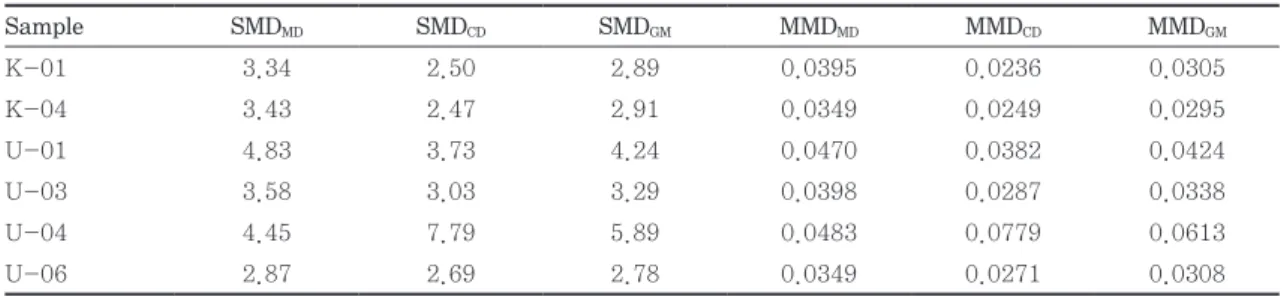
The results of the surface roughness component (SMD) and the surface friction component (MMD) of the six tissue samples, calculated from Eq. 1 through Eq. 4 are shown in Table 2.
3.1 Relationship between SMD and MMD
To find the relationship between the SMD and the MMD, a regression analysis was done for the six samples for the MD, CD, and GM (geometric
Fig. 4. Variogram plot of the surface rough- ness of sample K-01 in the MD.
Fig. 5. The Variogram plot of the surface fric- tion of sample K-01 in the MD.
Fig. 3. Surface friction profile of sample K-01 in the machine direction (MD).
mean), respectively.
3.1.1 The SMD vs. the MMD in the machine direction (MD)
Fig. 6 is a plot of the SMD vs. the MMD in the MD. It shows relatively high correlation between the two. The following regression equation was obtained:
MMDMD = 0.0136 + 0.0072 × SMDMD
R2 = 0.85 [11-1]
3.1.2 The SMD vs. the MMD in the cross direction (CD)
Fig. 7 is a plot of the SMD vs. the MMD in the CD. It shows high correlation between the two. The following regression equation was obtained:
MMDCD = −0.0005 + 0.0101 × SMDCD
R2 = 0.99 [11-2]
3.1.3 The SMD vs. the MMD in the geometric mean (GM)
The GM values of the SMD and the MMD were calculated from Eq. 3 and Eq. 4, respectively. Fig.
8 is a plot of the SMDGM vs. the MMDGM.
As expected from Figs. 6 and 7, it also shows a high correlation between the two. The following regression equation was obtained:
MMDGM = 0.001 + 0.0101 × SMDGM
R2 = 0.991 [11-3]
All above figures show that the MMD and the SMD are highly correlated for the samples of Figs.
6-8 examined in the present study.
3.2 Fractal dimension values
Fractal dimension values of the six samples were determined using the Variogram method with lag, K=15 (default). Time series in JMP SAS was used Table 2. The results of the SMD and the MMD of the six commercial toilet tissue samples
Sample SMDMD SMDCD SMDGM MMDMD MMDCD MMDGM
K-01 3.34 2.50 2.89 0.0395 0.0236 0.0305
K-04 3.43 2.47 2.91 0.0349 0.0249 0.0295
U-01 4.83 3.73 4.24 0.0470 0.0382 0.0424
U-03 3.58 3.03 3.29 0.0398 0.0287 0.0338
U-04 4.45 7.79 5.89 0.0483 0.0779 0.0613
U-06 2.87 2.69 2.78 0.0349 0.0271 0.0308
Fig. 7. Comparison of MMDCD and SMDCD. Fig. 6. Comparison of MMDMD and SMDMD.
to obtain variogram against lag.35) The results are shown in Table 3.
From Table 3, to find the correlation between the fractal dimension of SMD (FD_SMD) and the frac- tal dimension of MMD (FD_MMD), a regression analysis was performed for the MD, CD, and GM, respectively.
3.2.1 Fractal dimension values
Fig. 9 shows a plot of the FD_MMD against the FD_SMD in the MD.
It shows the correlation is poor. The following regression equation was obtained.
FDMDMMD = 0.439 + 0.641 × FDMDSMD
R2 = 0.48 [12-1]
This indicates that unlike in the case of the SMD
and the MMD, their fractal dimension values are not correlated. The reason is not clearly understood at present.
3.2.2 Fractal dimension values of the SMD and the MMD in the CD
Fig. 10 shows a plot of the FD_MMD against the FD_SMD in the CD direction. It shows that the correlation between the two is much lower than that in the MD.
FDCDMMD = 3.117 − 1.610 × FDCDSMD
R2 = 0.2 [12-2]
Fig. 9. Comparison of FDMDMMD and FDMDSMD. Fig. 10. Comparison of FDCDMMD and FDCDSMD.
Fig. 8. Comparison of MMDGM and SMDGM.
Table 3. Summary of the fractal dimension analysis
Sample Direction FD_MMD FD_SMD
K-01 MD 1.202 1.168
K-01 CD 1.162 1.150
K-04 MD 1.208 1.162
K-04 CD 1.185 1.159
U-01 MD 1.117 1.234
U-01 CD 1.172 1.189
U-03 MD 1.197 1.302
U-03 CD 1.204 1.190
U-04 MD 1.154 1.436
U-04 CD 1.077 1.111
U-06 MD 1.278 1.201
U-06 CD 1.257 1.155
3.2.3 Fractal dimension values of the SMDGM and the MMDGM
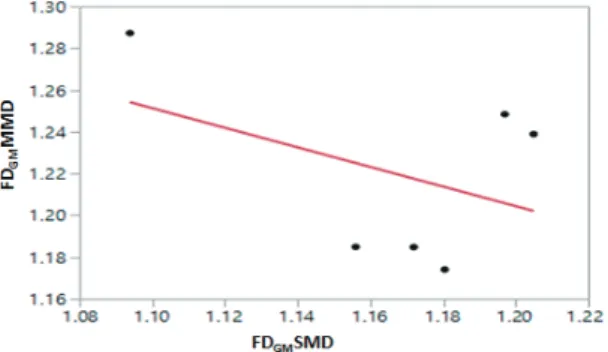
Fig. 11 shows a plot of the fractal dimension of GM_MMD (FDGMMMD) against the fractal dimen- sion of GM_SMD (FDGMSMD). As expected from Fig. 2 and Fig. 3, the correlation between the two was very low.
The following regression equation was obtained.
FDGMMMD = 1.964 − 0.648 × FDGMSMD
R2 = 0.3 [12-3]
4. Conclusions
The surface roughness and the surface friction components of toilet paper samples were deter- mined using a Kawabata KES surface tester (Model: KES-SESRU) from Kato Tech, Kyoto, Ja- pan. The single U-tube wire stylus was used to determine the surface roughness component (SMD) and the surface friction component (MMD) at the same time.
It was found that the variogram method can be used to determine fractal dimension of the sam- ples. By collecting the surface data obtained of points up to 2,000 points per 20 mm scan length using the tester with a connected logger, the method was successful in performing FD analysis of the SMD and the MMD of the samples.
The results showed that the SMD and the MMD had high correlations indicating that they were dependent on each other for the six samples ex- amined in the present study. The correlations be- tween the FD values of the SMD and the MMD were very low. With very limited commercial sam- ples of the unknown processing information, it was impossible to explain the reason why the correla- tion was so poor.
Nevertheless, it was encouraging to find that the variogram method could be applied for determining fractal dimension analysis for characterizing the surface properties of hygiene paper such as toilet papers, facial tissues, and paper towels. Until the present study, no work on this area had been available.
Acknowledgement
We acknowledge the financial support from the Korea Evaluation Institute of Industrial Technol- ogy, Ministry of Trade, Industry and Energy, Re- public of Korea (Project No. 10065715).
Literature Cited
1. ISO 4287, Geometrical product specifications (GPS) - Surface texture profile method - Terms, definitions and surface texture param- eters (1987).
2. ISO 4288:1996(en) Geometrical product speci- fications (GPS) - Surface texture profile method - Rules and procedures for the as- sessment for surface texture.
3. ISO 25178, Geometrical product specifications (GPS) - Surface texture profile method - Terms, definitions and surface texture param- eters (2012).
4. L&W OpitiTopo, ABB AB/Lorentzen & Wettre, Fig. 11. Comparison of FDGMMMD and FDGMSMD.
Kisti, Sweden: https://library.e.abb.com/pub- lic/8e87f903e43142ec8ea7e47b909673d7/269_
LW_OptiTopo_v1.0.pdf.
5. Embeco Roughness Profiler System 210-R, https://tsdrapi.uspto.gov/ts/cd/casedocs/
bundle.pdf?sn=85661618&type=SPE&from- date=2012-06-26&todate=06-26 (2012).
6. TAPPI T575 om-07, Roughness of paper and paperboard, stylus (Emveco-type Method (Re- vision of TAPPI T575 om-07)) (2012).
7. Hobson, T., AmeTech, Pennsylvania, TalySurf Profilometer, USA, http://www.f-di.hu/cli_
systems.pdf.
8. Kawabata, S., The Standardization and Anal- ysis of Hand Evaluation, 2nd ed., The Textile Machinery Society of Japan (1980).
9. Kawabata, S., Niwa, M., and Wang, F., Ob- jective hand measurement of nonwoven fab- rics, Part I: Development of the equations, Textile Res. J. 64(10):597-610 (1994).
10. Ampulski, R. S., Sawdai, A. H., Spendel, W., and Weinstein, B., Methods for the measure- ment of the mechanical properties of the tissue paper, 1991 Proceedings of International Paper Physics Conference, pp. 19-30.
11. Spendel, Soft tissue paper containing nonca- tionic surfactant, US 4,959,125, Assignee:
Procter & Gamble (1990).
12. Ramasubramanian, M. K., 12. Physical and mechanical properties of towel and tissue, In Handbook of Physical Testing of Paper, Mark, R. E., Habeger, Jr., C. C., Borch, J., and Lyne, M. B. (ed.), Marcel Dekker, Inc (2002).
13. Dwiggins, J. H., Harper, F. D., Schulz, G. A., Schuh, B. J., Heath, M. S., and Oriaran, T. P., Soft bulky multi-ply product and method of making the same, IS 6,558,511, Assignee: Fort James Corp. (2003).
14. Harper, F. D., Oriaran, T. P., and Litvay, J.
D., Soft, bulky single-ply absorbent paper having a serpentine configuration, US
6,372,087, Assignee: Fort James Corp. (2002).
15. Yokura, H., Kohono, S., and Iwasaki, M., Ob- jective hand measurement of toilet paper, J.
Textile Engineering 50(1):1-5 (2004).
16. Beuther, P. D., Mullally, C. A., and Holz, J. D., Molded wet-pressed tissue, US 8,257,551, Assignee: Kimberly-Clark, Sep. 4 (2012).
17. Park, J. Y., Lee, J. H., Kim, H. J., Park, J. M., Moon, B. K., and Ko, Y. C., Softness evalua- tion of hygiene paper: Linking between sub- jective evaluation and physical measurement, Poster Session, In 17th Fundamental Research Symposium, Oxford, England (2017).
18. Kato Tech, KES-SE-SR-U Friction Test with Roughness, User’s Manual (2nd version).
19. Mandelbrot, B., The Fractal Geometry of Na- ture, San Francisco, Freeman (1982).
20. Ko, Y. C., Park, J.-M., and Shin, S. J., The principles of fractal geometry and its applica- tions for pulp & paper industry, Journal of Korea TAPPI 47(4):177-186 (2015).
21. Barnsley, M. F., Fractals Everywhere, 2nd ed., Morgan Kaufmann (1993).
22. Falconer, K., Fractal Geometry: Mathematical Foundations and Applications. 2nd ed. John Wiley & Sons (2003).
23. Carney, L. R. and Mecholsky, J. J., Fractal Surfaces, Plenum Press, New York and Lon- don (1993).
24. Constantine, A. G. and Hall, P., Characteriz- ing surface smoothness via estimation of ef- fective fractal dimension, J. Royal Statistical Society Ser. B. 56(1):97-113 (1994).
25. Kaye, B. H., A Random Walk Through Fractal Dimensions, VCH (1989).
26. Thompson, A. H., Katz, A. J., and Krohn, C.
E., Method and means for determining physi- cal properties from measurements of micropo- rous structures, US 4,628,468 (1986).
27. Kearney, M. M., Fractal cascade as an alter- native to inter-fluid turbulence, US 5,938,333
(1999).
28. Kearney, M. M., Fractal device for mixing and reactor applications, US 6,742,924 (2004).
29. Lefbvre, M., Polymers with fractal structure, US 6,001,889 (1999).
30. Shinnar, M., Wavelet analysis of fractal sys- tems, US 5,471,991 (1995).
31. Gipple, K. L., Karr, D. G., and Salvino, L. W., Fractal interfacial enhancement of composite delamination resistance, US 6,333,092 (2001).
32. Dalton, J. L. and Herbert, E. A., Golf ball with
surface texture defined by fractal geometry, US 5,842,937 (1998).
33. Militky, J. and Bajzik, V., Surface roughness and fractal dimension, http://www.tandfon- line.com/doi/abs/10.1080/00405000108659617.
34. Richardson, L. F., The problem of contiguity:
An appendix of statistics of deadly quarrels, General systems Yearbook 6:139-187 (1961).
35. JMP User’s Guide, Version 5.1, 2003, SAS Campus Drive, Cary NC 27513.