© The Korean Society of Plant Pathology http://dx.doi.org/10.5423/RPD.2013.19.4.326
국내 양앵두나무에서 발생한 Cherry green ring mottle virus 동정
조인숙*·최국선·최승국
농촌진흥청 국립원예특작과학원 원예특작환경과
Identification of Cherry green ring mottle virus on Sweet Cherry Trees in Korea
In-Sook Cho*, Gug-Seoun Choi and Seung-Kook Choi
Horticultural and Herbal Environment Division, National Institute of Horticultural and Herbal Science, Rural Development Administration, Suwon 441-440, Korea
(Received on October 11, 2013; Revised on November 5, 2013; Accepted on November 5, 2013)
During the 2012 growing season, 154 leaf samples were collected from sweet cherry trees in Hwaseong, Pyeongtaek, Gyeongju, Kimcheon, Daegu, Yeongju and Eumseong and tested for the presence of Cherry green ring mottle virus (CGRMV). PCR products of the expected size (807 bp) were obtained from 6 samples.
The PCR products were cloned and sequenced. The nucleotide sequences of the clones showed over 88%
identities to published coat protein sequences of CGRMV isolates in the GenBank database. The sequences of CGRMV isolates, CGR-KO 1−6 shared 98.8 to 99.8% nucleotide and 99.6 to 100% amino acid similarities.
Phylogenetic analysis indicated that the Korean CGRMV isolates belong to the group II of CGRMV coat protein genes. The CGRMV infected sweet cherry trees were also tested for Apple chlorotic leaf spot virus (ACLSV), Apple mosaic virus (ApMV), Cherry necrotic rusty mottle virus (CNRMV), Cherry mottle leaf virus (CMLV), Cherry rasp leaf virus (CRLV), Cherry leafroll virus (CLRV), Cherry virus A (CVA), Little cherry virus 1 (LChV1), Prune dwarf virus (PDV) and Prunus necrotic ringspot virus (PNRSV) by RT-PCR. All of the tested trees were also infected with ACLSV.
Keywords : CGRMV, RT-PCR, Sequence analysis, Sweet cherry
양앵두는 크게 단양앵두(Sweet cherry, Prunus avium L.) 와 신양앵두(Sour cherry, Prunus cerasus L.)로 구분되는 데 국내에서 재배되는 거의 대부분이 단양앵두로써 재배 면적은 약 130 ha이고, 국내 소비가 급증함에 따라 재배 면적 또한 꾸준하게 증가하고 있는 추세이다(Yoon 등, 2012). 전 세계적으로 양앵두나무에 발생하는 바이러스병 은 약 30여종 이상이 알려져 있으며(Mandic 등, 2007), 국내에서는 최근 Apple chlorotic leaf spot virus(ACLSV), Apple mosaic virus(ApMV), Cherry necrotic rusty mottle virus(CNRMV), Cherry virus A(CVA) 4종이 보고되었다 (Cho, 2011; Cho 등, 2013). Cherry green ring mottle virus(CGRMV)는 Betaflexiviridae에 속하지만 아직 완전
히 분류되지 않은 바이러스로 1937년 미국 미시간에서 처음 보고된 이후, 아프리카, 일본, 중국, 유럽, 북아메리 카, 오세아니아 등지에서 발생하고 있다(Wang 등, 2013).
CGRMV는 양앵두, 벗나무, 복숭아, 살구나무 등 벗나무 속에서 발생 되는데, 특히 신양앵두나무에서 황반엽과 기 형과 등을 일으켜 경제적으로 문제가 되고 있으며 단양 앵두, 복숭아, 살구나무에서는 병징이 나타나지 않고 잠 복되어 있는 경우가 일반적이다(Zhang 등, 1998). 접목과 삽목에 의해 전염되고 매개곤충에 의한 전염은 아직까지 보고되지 않았다. 과거에는 목본식물검정으로 CGRMV 감염여부를 판단하였지만 최근 분자 생물학 기술의 발달 로 다양한 기주의 새로운 분리주들에 대한 동정이 활발 히 진행되고 있다(Li와 Mock, 2005; Wang 등, 2009; Wang 등, 2013).
본 연구에서는 국내 양앵두나무에서 발생하는 CGRMV
*Corresponding author
Phone)+82-31-290-6237, Fax) +82-31-290-6259 Email) [email protected]
Note Open Access
를 신규 양앵두 재배과원을 중심으로 조사하고, 외피단 백질 유전자 분석을 통하여 국내 CGRMV 분리주들을 동정한 결과를 보고하고자 한다.
CGRMV 유전자 검정. 2012년 화성, 평택, 경주, 김천, 대구, 영주, 음성 7지역, 특히 경기 지역의 신규 양앵두 재배과원을 위주로 양앵두나무 154주를 무작위로 선발하 고 잎을 채집하여 CGRMV 유전자 검정에 사용하였다.
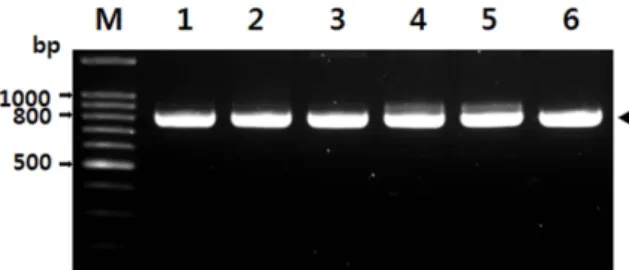
검정할 시료의 핵산(RNA)은 NucliSens Extractor(Biomerieux) 를 이용하여 추출하였으며, 프라이머는 CGRMV 외피단 백질 유전자에 특이적으로 반응하는 CGRMV1/2와 nested 프라이머 CGRM-CPF/CGRM-CPR를 사용하였다(Fiore 등, 2013; Li 등, 2005). RT-PCR 검정은 CGRMV1/2 프라이 머로 1차 PCR을 한 다음, 이 PCR 산물들을 10배 희석 한 것을 주형으로 해서 nested PCR을 수행하였다. 그 결 과 전체 시료 154점 중 6점의 시료에서 PCR 증폭산물 이 검출되었다(Fig. 1). PCR 산물을 정제하고 클로닝하 여 염기서열을 분석한 결과 807 bp 크기의 CGRMV 외 피단백질 유전자가 확인되었다.
CGRMV 발생. 조사된 양앵두나무 154주 중 6주에서 CGRMV가 검출되어 3.9%의 감염률을 보였으며, CGRMV 에 감염된 6주 중 5주는 화성 지역에서 발생되었고, 1주 는 영주 지역에서 발생되었다(Table 1). CGRMV에 감염 된 양앵두나무는 육안상 특이한 바이러스 증상이 관찰되 지 않았으며 이것은 CGRMV가 단양앵두 기주에서 병징 을 나타내지 않는다는 기존 보고와도 같았다(Zhang 등, 1998). 중국에서는 양앵두나무 뿐만 아니라 복숭아나무에
서도 CGRMV 발생이 보고된 바 있어(Zhou 등, 2011), 국내 복숭아나무에서의 CGRMV 발생 유무를 추가적으 로 검정해 보았다. 그 결과 국내 복숭아나무에서는 중국 과는 달리 CGRMV가 전혀 검출되지 않았다(자료 생략).
복숭아나무 시료는 음성, 춘천, 충주 3지역에서 무작위로 채집한 298주의 잎을 사용하였다.
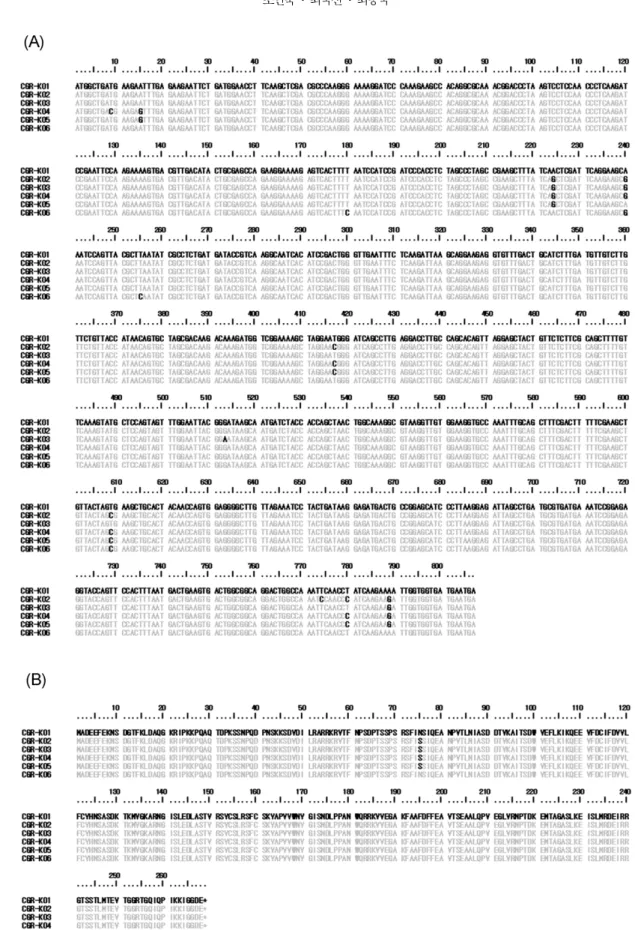
CGRMV 외피단백질 유전자 분석. 양앵두나무에서 검 출된 CGRMV는 외피단백질 유전자 염기서열 분석을 통 해 분리주 6개(CGR-KO 1−6)를 확인하였으며 GeneBank 에 등록된 외국의 CGRMV 분리주들과 염기서열을 비교 한 결과 88% 이상의 염기서열 상동성을 나타내었다(자 료생략). 이들 국내 CGRMV 분리주들 간에는 98.8−99.8%
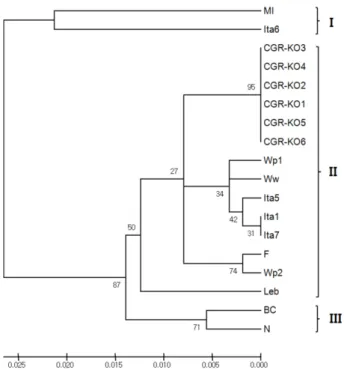
의 염기서열 및 99.6−100%의 아미노산 서열 상동성을 나타내었다(Fig. 2). 기존에 보고된 외국의 CGRMV 분리 주 12개와 국내 분리주들의 외피단백질 유전자 계통도 분석으로 국내 분리주들은 기존에 분류된 CGRMV I, II, III 그룹(Zhang, 2000) 중 II 그룹에 모두 속하는 것으로 나타났다(Fig. 3).
CGRMV 감염주의 단독감염 여부를 확인하기 위해 양 앵두에서 발생하는 10종의 바이러스, ACLSV, ApMV, Cherry mottle leaf virus(CMLV), CNRMV, Cherry rasp leaf virus(CRLV), Cherry leafroll virus(CLRV), CVA, Little cherry virus1(LChV1), Prune dwarf virus(PDV), Prunus necrotic ringspot virus(PNRSV)에 대해서 RT-PCR 을 검정을 수행하였다. 각 바이러스 진단에 사용한 프라 이머와 RT-PCR은 기존에 보고된 방법에 준하여 실시하 였다(Cho, 2011; Isogai 등, 2004; Li 등, 2008). RT-PCR 검정 결과 모든 시료에서 ACLSV가 검출되어 CGRMV 와 ACLSV가 복합 감염된 것을 확인하였다(Table 2).
국내 양앵두나무의 CGRMV는 6주가 검출되었고, 특히 단양앵두나무에서는 병징이 나타나지 않아 현재로서는 국내에서 CGRMV는 크게 문제가 되지 않는 다고 볼 수 있다. 그러나 앞으로 새로운 바이러스병의 출현과 신양 앵두나무의 수요 및 재배가 늘어난다면 CGRMV 피해가 발생할 가능성도 배제할 수 없는 부분이다.
본 연구는 최근 양앵두 신규 재배과원을 중심으로 발 생한 CGRMV를 유전자 검정에 의해 동정하였으며, 실 험에 사용한 바이러스 검정 기술과 이들 바이러스 분리 주들의 유전자 분석 자료는 금후 양앵두나무에 발생하는 Fig. 1. Agarose gel electrophoresis of nested RT-PCR products
for Cherry green ring mottle virus (CGRMV). Lane designations indicate sweet cherry trees examined in this study: 1−5 and 6 were collected from the Hwaseong and Yeongju, respectively. A black arrow head indicates the position of the expected products specific to CGRMV (807 bp).
Table 1. Detection of Cherry green ring mottle virus (CGRMV) by RT-PCR from sweet cherry trees in different areas No. of samples Infection
rate (%) No. of infected samples/tested samples
Infected Tested Hwaseong Pyeongtaek Gyeongju Kimcheon Daegu Yeongju Eumseong
6 154 3.9 5/64 0/41 0/19 0/9 0/7 1/5 0/9
Fig. 2. Nucleotide sequence (A) and amino acid sequence (B) alignments of coat protein genes of Cherry green ring mottle virus (CGRMV) isolates, CGR-KO 1−6 obtained from CGRMV infected sweet cherry trees. The asterisk (*) indicates the stop codon.
CGRMV을 지속적으로 모니터링 하고 연구하는데 기초 자료로 활용될 수 있을 것으로 본다.
요 약
2012년 국내 양앵두나무에서 발생하는 CGRMV를 조 사하기 위해 화성, 평택, 경주, 김천, 대구, 영주 음성의 양앵두 재배과원 7개 지역에서 잎 시료 154점을 채집하 였다. 채집한 시료에 대해 CGRMV 유전자 검정을 수행 한 결과 6점의 시료에서 807 bp 크기의 PCR 증폭산물이 검출되었다. 이들 PCR 증폭산물은 클로닝과 유전자 염 기서열 분석 결과 GeneBank에 등록된 외국의 CGRMV 분리주들과 88% 이상의 외피단백질 유전자 염기서열 상 동성을 보였다. 국내 양앵두나무에서 분리된 분리주들, CGR-KO 1−6 간에는 98.8−99.8%의 염기서열 및 99.6−
100%의 아미노산 서열 상동성을 나타내었다. 국내 CGRMV 분리주들은 외피단백질 유전자 계통도 분석에서 기존에 분류된 I, II, III 그룹 중 II 그룹에 속하였다. 또한 CGRMV 가 감염된 국내 양앵두나무 이병주들은 ACLSV 등 10종 바이러스에 대해서도 RT-PCR을 수행한 결과 모든 시료 에서 ACLSV가 검출되어 CGRMV와 ACLSV가 복합 감 염된 것을 확인하였다.
Acknowledgement
This research was carried out with the support of research fund (Project No. PJ006358) from Rural Development Administration, Korea.
References
Cho, I. S. 2011. Development of diagnostic and control techniques for horticultural diseases and insect pests. In: Res.
Rept. RDA (NIHHS), pp. 33−34. (In Korean)
Cho, I. S., Choi, G. S., Choi, S. K., Seo, E. Y. and Lim, H. S. 2013.
First report of Cherry necrotic rusty mottle virus infecting sweet cherry trees in Korea. Plant Dis. http://dx.doi.org/
10.1094/PDIS-07-13-0723-PDN.
Fiore, N. and Zamorano, A. 2013. First report of Cherry green ring mottle virus and Cherry necrotic rusty mottle virus in sweet cherry (Prunus avium) in Chile and South America.
Plant Dis. 97: 1122.
Isogai, M., Aoyagi, J., Nakagawa, M., Kubodera, Y., Satoh, K., Katoh, T., Inamori, M., Yamashita, K. and Yoshikawa, N.
2004. Molecular detection of five cherry viruses from sweet cherry trees in Japan. J. Gen. Plant Pathol. 70: 288−291.
Li, R. and Mock, R. 2005. An improved reverse transcription- polymerase chain reaction (RT-PCR) assay for the detection of two cherry flexiviruses in Prunus spp. J. Virol. Meth. 129:
162−169.
Fig. 3. Phylogenetic analysis based on nucleotide sequences of coat protein genes from isolates of CGR-KO 1−6 and other 12 Cherry green ring mottle virus (CGRMV) isolates available in nucleotide database (California isolates: F and N; Washington isolates: Wp1, Wp2 and Ww; Michigan isolate: MI; British Columbia, Canada isolate: BC; Italy isolates: Ita1, Ita5, Ita6 and Ita7; Lebanon isolate: Leb). The tree was generated by the neighbor-joining method with 1000 bootstrap replicates using MEGA 5.0.
Table 2. RT-PCR analysis for the presence of 10 viruses from Cherry green ring mottle virus (CGRMV) infected sweet cherry trees
Tested viruses
Host of CGRMV isolate CGR-KO 1 CGR-
KO 2 CGR- KO 3 CGR-
KO 4 CGR-
KO 5 CGR- KO 6
ACLSV + + + + + +
ApMV − − − − − −
CMLV − − − − − −
CNRMV − − − − − −
CRLV − − − − − −
CLRV − − − − − −
CVA − − − − − −
LChV1 − − − − − −
PDV − − − − − −
PNRSV − − − − − −
Li, R., Mock, R., Huang, Q., Abad, J., Hartung, J. and Kinarda, G.
2008. A reliable and inexpensive method of nucleic acid extraction for the PCR-based detection of diverse plant pathogens. J. Virol. Meth. 154: 48−55.
Mandic, B., Matic, S., Al Rwahnih, M., Jelkmann, W. and Myrta, A. 2007. Viruses of sweet and sour cherry in Serbia. J. Plant Pathol. 89: 103−108.
Wang, L. P., Hong, N., Wang, G. P., Michelutti, R. and Zhang, B.
L. 2009. First report of Cherry green ring mottle virus in plum (Prunus domestica) in North America. Plant Dis. 93: 1073.
Wang, L., Jiang, D., Niu, F., Lu, M., Wang, H. and Li, S. 2013.
Complete nucleotide sequences of two isolates of Cherry green ring mottle virus from peach (Prunus persica) in China.
Arch. Virol. 158: 707−710.
Yoon, I. K., Nam, E. Y., Chung, K. H. and Yun, S. K. 2012.
Cherry cultivation manual. RDA, pp. 9−10. (In Korean) Zhang, Y. P., Kirkpatrick, B. C., Smart, C. D. and Uyemoto, J. K.
1998. cDNA cloning and molecular characterization of Cherry green ring mottle virus. J. Gen. Virol. 79: 2275−2281.
Zhang, Y. P., Kirkpatrick, B. C., Terlizzi, B. D. and Uyemoto, J.
K. 2000. Comparison of Cherry green ring mottle virus strains using RT-PCR and coat protein sequence phylogeny. J. Plant Pathol. 82: 49−53.
Zhou, J. F., Wang, G. P., Kuang, R. F., Wang, L. P. and Hong, N.
2011. First report of Cherry green ring mottle virus on cherry and peach grown in China. Plant Dis. 95: 1319.